Review: Bates Motel 2.3 “Caleb”


Caleb

Well, that’s certainly icky.

Regardless of whatever else may have happened on this week’s episode of Bates Motel, it will always be remembered as the episode where things got even ickier than before.

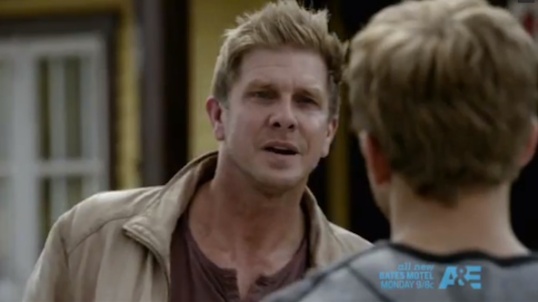
I’m talking, of course, about the revelation that Dylan’s (Max Thieriot) father also happens to be his uncle, Caleb (Kenny Johnson).  I have to admit that I wasn’t necessarily surprised by this.  In fact, when one thinks about the world that Bates Motel takes place in, there was really no way that Caleb wasn’t going to turn out to be Dylan’s father.  It explains why Norma wants nothing to do with her oldest son and Max Thieriot, Vera Farmiga, and Kenny Johnson all deserve a lot of credit for their performances tonight.

That said, I’m hoping that Caleb — much like Deputy Shelby and so many of the other sleazy men who have stopped off at the Motel — will not be around that much longer because, seriously, he is just so icky!  Bates Motel has a good track record for violently executing sexual predators and I expect that same fate is waiting for Caleb.

If nothing else, Bates Motel seems to be making a good case against men in general.  Is there a single man in Norma Bates’s life who isn’t a deviant of some sort?  Earlier in the episode — before we discovered that Caleb was Dylan’s father — Norma met a guy named George (Michael Vartan).  George seems like a really nice guy but, seeing as this is Bates Motel, I’m still expecting him to have somebody chained up in his basement.

Along with the arrival of Uncle Caleb and Norma meeting George, this week’s other major subplot was Emma (Olivia Cooke) attempting to throw a beachside memorial service for Bradley.  As I’ve stated in the past, Emma is my favorite character so I was happy to finally see her getting to do something.  The memorial service was neatly contrasted with the garden party that Norma attended.  And just as Norma met George, Norman got to know Cody (Paloma Kwiatkowski), who, now that Bradley is gone, is apparently going to be the latest obstacle keeping Emma and Norman from getting together.

Then again, that might be for the best.

Norman and Emma are an adorable couple but, ultimately, he is Norman Bates, isn’t he?

Random Thoughts and Observations

  • This week’s “Vera Farmiga is a great actress who deserves an Emmy moment”: The Grand Canyon joke.
  • The great White Pine Bay drug war is apparently still raging.  Fortunately, I love Max Thieriot or else the whole drug war would be kind of boring.
  • That said, Dylan was kinda lingering a bit while Norma was getting dressed.  Again — icky!
  • The name of the town newspaper is the White Pine Bay Current.  For some reason, that amused me.
  • I felt so bad for Norma when she saw she hadn’t been cast in the town musical.
  • Tonight’s episode was directed by Lodge Kerrigan, who has a great name.
  • One thing that was not mentioned in this week’s episode: The murder of Ms. Watson.  I really hope that the show isn’t going to abandon that mystery just because Sheriff Romero arrested the wrong guy last week.  I have to admit that I’m still holding out hope that Norman did not kill Ms. Watson.
  • It’s interesting to note that Bates Motel and The Following both air on Monday nights.  They’re both unapologetically sordid shows about psychotic murderers and sexual deviants.  However, I love Bates Motel and I absolutely hate what I’ve seen of The Following.  The difference is that The Following is a sincerely misogynistic show whereas Bates Motel seems to actually like its cast of misfits.
  • “You’re in the chorus?  Do you want to be in the chorus?”  Trust me, nobody wants to be in the chorus!
  • That said, I would rather be in the chorus than be on the tech crew.  Poor Norman.

Trailer: The Giver


The Giver is a film that has been frequently mentioned as being a possible Oscar contender, largely because it’s being released by the Weinstein Company and the cast includes not only Meryl Streep or Jeff Bridges as well.  I have to admit that I have my doubts.  The trailer looks good but if neither The Hunger Games nor Looper could get any love from the Academy, what hope does The Giver have?

The Giver will be released on August 15th.

Film Review: Veronica Mars (dir by Rob Thomas)


From 2004 until 2007, there were two types of people in the world.  There were people who knew that Veronica Mars was the best show on TV and then there was everyone else.

I’m proud to say that I was a member of the former group.

Airing first on UPN and then on the CW, Veronica Mars was about a tough and tenacious private investigator who also happened to be a high school student.  Veronica (played by Kristen Bell) had once been a popular student at Neptune High until her best friend was murdered.  When Veronica’s father, who also happened to be Neptune’s sheriff, accused Lily’s wealthy and powerful father of having committed the crime, he was forced out of office and Veronica suddenly found herself transformed into a social pariah.  Veronica not only solved Lilly’s murder but several other mysteries as well while also dealing with all the other melodrama that goes along with being a teenage girl.

Veronica Mars never got the ratings that it deserved and it ultimately suffered the humiliating fate of being canceled after three seasons and replaced by a reality series called Pussycat Dolls Presents.  But those of us who watched and loved the show knew that it was something special.  The show’s creator, Rob Thomas, took two genres that one would normally not think to combine — pulpy mystery and teenage soap opera — and used them to create something totally unique and always watchable.  At the center of it all was Kristen Bell’s wonderfully intelligent and snarky performance as Veronica Mars.  Veronica was the type of strong and intelligent character that we all wanted to be.  By watching her, her strength became our strength.

Those of us who loved the show knew that it was special but we also knew that it was something that only we would truly appreciate.  Even as we watched the show, we knew that it was too smart and too quirky to ever be truly appreciated by the type of audiences that embraced shows like JAG or According to Jim.  Perhaps that’s why I was always thankful for every episode of Veronica Mars, even the ones that made up the show’s much maligned third season.  I would watch Veronica and I would appreciate her strength and her humor and I would be jealous of the wonderful relationship she had with her Dad and, in the back of my mind, I always knew that the show would eventually be gone so I had to enjoy while I could.

From the moment that Veronica Mars was canceled, there were rumors that Veronica would eventually return in a feature film that would tie up all of the loose ends left over from the show’s cancellation.  On March 13th, 2013, Rob Thomas and Kristen Bell launched a kickstarter campaign to raise two million dollars to help get that film made.  Reaction was, to put it lightly, enthusiastic as fans of the show donated what they could to bring Veronica to the big screen.  I even talked two friends of mine into donating a hundred dollars each.  Neither one of them had ever seen the show but they both said that my heartfelt pleading won them over.  It took 10 hours for the Kickstarter campaign to reach its goal.  By the time it ended, over 5 million dollars had been raised.

And now, a little over a year since that historic kickstarter campaign was launched, the Veronica Mars movie has been released.  Much as the way the movie was funded made history, the movie itself is making history by being the first major studio film to be concurrently released in theaters and made available via video on demand.

Now, I know what some of you are saying: That’s all great, Lisa, but can you just tell us whether the movie’s any good?

Well, I’m getting there.  There’s a reason why I began this review with nearly 600 words about Veronica Mars the television series.  How you will react the movie will probably greatly depend on how you felt about the original series.  For those who were not fans or who never got around to watching the television series, Veronica Mars the movie will probably feel like a rather standard mystery that’s distinguished by a strong lead performance from Kristen Bell.  However, for those of us who loved the television show, Veronica Mars the movie is the perfect late Valentine’s Day gift.

Opening nine years after the end of the series, the movie wastes no time in getting us caught up with what Veronica’s life.  Veronica has left Neptune and all of her old friends.  She’s moved to New York City, she has a stable relationship with Piz (Chris Lowell), and she’s just been offered a job with a prestigious law firm.  While talking to her potential boss (played by Jamie Lee Curtis), Veronica casually dismisses both her former life as a private investigator and the third season’s infamous sex tape.

However, when her ex-boyfriend Logan (Jason Dohring) is accused of murdering his girlfriend, Veronica returns to Neptune.  Though she originally says that she’s only interested in helping Logan find a good lawyer and maybe attending her high school reunion, Veronica soon finds herself falling into her old habits.

Admittedly, the film’s central mystery isn’t that compelling, especially when compared to the first season mystery of who killed Lilly Kane.  As opposed to the show — where a mystery would be investigated over several episodes — the Veronica Mars movie only has 107 minutes to reveal why Logan’s girlfriend was killed and by who.

But that’s okay because, quite frankly, the movie’s target audience isn’t watching for the mystery.  We’re watching because we want to see how familiar characters like Veronica and Logan are doing.  We want to see how the past nine years have changed them.  This is where director Rob Thomas triumphs.  All of the show’s characters have returned.  Realistically, some of them have matured while some of them have definitely not.  Some of them only show up for cameos while others are central to solving the mystery but what’s important is that all of them are there.  That includes Keith Mars who, as played by Enrico Colantoni, remains one of the greatest father figures ever.

(Also back: Ryan Hansen’s wonderfully obnoxious Dick Casablancas.  I’m always happy for any chance to look at and appreciate Ryan Hansen.)

I enjoyed Veronica Mars and I was especially happy to see that its final scene contained the perfect set up for another film.  If you’re not familiar with the television series, I would suggest watching binge-watching all 64 episodes before watching the movie.  Seriously, you won’t be sorry.  You’ll get to watch one of the best (and most underappreciated) shows of all time and then you’ll be perfectly set up to enjoy one of the most entertaining films released in 2014 so far.

Finally, on a personal note, there’s no way I can’t mention the fact that my celebrity boyfriend, James Franco, appears, in an extended cameo, as himself.  Whether he’s flopping about while trying to fit into a pair of skinny jeans or trying to think of a word that rhymes with orange, James Franco is never less than adorable.  Every film should have a James Franco cameo.

Hopefully, he’ll return for Veronica Mars 2.

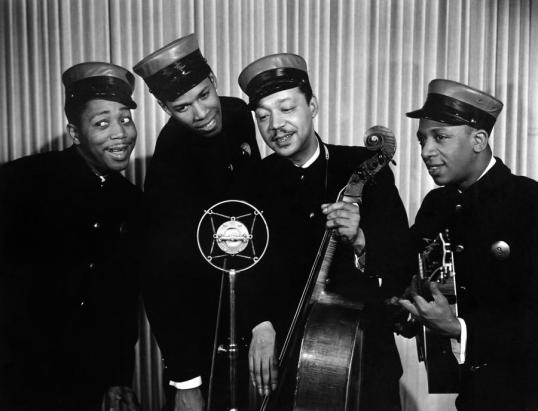
Song of the Day: Maybe (by the Ink Spots)


The Ink Spots

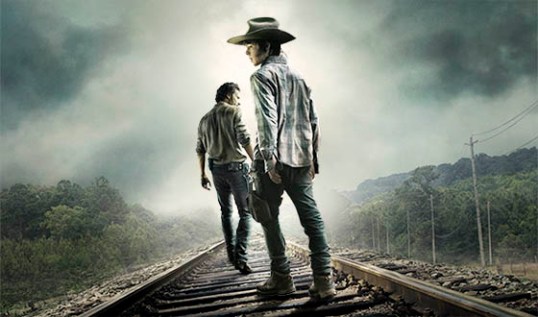
Tonight’s episode of The Walking Dead began with a tune recognizable to many gamers who played through Bethesda’s Fallout 3.

“Maybe” by The Ink Spots have been used many times to highlight simpler, idyllic times when compared to post-apocalyptic wastelands. It worked well for Fallout 3 and definitely lent an eerie, disturbing quality to the flash forward opening to the latest episode of The Walking Dead.

Maybe

Maybe you’ll think of me
When you are all alone

Maybe the one who is waiting for you
Will prove untrue, then what will you do?

Maybe you’ll sit and sigh, wishing that I were near
Then maybe you’ll ask me to come back again
And maybe I’ll say maybe.

Maybe you’ll think of me
When you are all alone

Maybe the one who is waiting for you
Will prove untrue, then what will I do?

Maybe, you’ll sit and sigh, wishing that I were near
Then maybe you’ll ask me to come back again

And maybe I’ll say maybe.

Review: The Walking Dead S4E14 “The Grove”


TheWalkingDeadS4M

“Just look at the flowers, Lizzie. Just look at the flowers.” — Carol Peletier

The Walking Dead tv series has always diverged from the comic book source to keep fans of the books guessing. Some fans of the comic books have complained about this since it would mean discarding certain subplots and characters that they love but were really non-essential to the overall story being told for the tv series version. Yet, the writers of the show, through the comic book’s creator Robert Kirkman, have mined the comic book source for material that remains important to the show’s narrative.

The latest episode, “The Grove”, takes a disturbing but very important subplot from the comics and manages to adapt it for the tv series in a way that made it one of the series’ best.

A cold opening that manages to be both quaint, idyllic and disturbing which sets the tone for the rest of the episode sees the return of the group led by Carol. It’s a group that could almost be seen as a makeshift family unit. There’s Carol the loving, yet stern mother who wants to make sure her daughters learn how to survive in this dangerous, new world while Tyreese remains te compassionate and protective father. Lizzie, Mika and Rick’s baby daughter Judith make up the children who must now adapt to this new world or perish.

First off, Judith remains the blank slate in the show. She’s the first baby born after the world went to hell and thus will have to grow up in it’s new environs and new set of morals and principles. The old civilization is gone and while people try to hold onto what made that civilization tick only those willing to adapt to this new world seem to survive. Now, Lizzie and Mika were already forming their own personalities and sets of morals when the zombie apocalypse hit. We see the two Samuels girl go in differing paths in how they cope with this new world.

While seeing these two girls’ inability to adapt to the world post-zombie apocalypse was a nice theme to explore the episode really focused on the group’s maternal unit. This latest episode was a culmination of the new Carol Peletier that season 4 unleashed on an unsuspecting audience.

This was a character that we saw as being the meek victim of spousal abuse even before the zombies arrived. Her emotional trauma would continue with the loss of her young daughter Sophia in season 2 and almost dying during break in prison security in season 3. Yet, by the time season 4 rolled around we see her become a hardened survivor who has turned the corner and decided she will not remain a victim anymore and make sure those people see as being helpless (the young children in the group) learn how to defend themselves from zombies and humans alike.

The titular grove the group stumbles upon early in the episode has an almost mystical quality to it. An idyllic locale in the middle of literal hell on earth. There’s untainted well water to be had, a pecan grove for food and even a solitary deer that seems to come by at the most opportune time for meat. Hell, the cabin even has a working gas stove (probably a propane tank fed one) and a secure enough fence of barbed wire to fend off the random zombies that may wander by. It’s almost paradise in comparison to the different place Carol, Tyreese and the girls have had to call shelter.

It is no wonder that both Tyreese and Carol entertain the idea of maybe staying at the grove and making a life for themselves with the girls instead of continuing onto the unknown potential haven that is Terminus. But one thing this show has been consistent about when it comes to it’s characters seeming to find peace and tranquility is that it will pull the rug from under them to reveal that things are not ideal and that it’s just a veneer over the ugliness and brutality this new world has turned into.

The rug gets pulled out gradually from beneath Carol’s feet as both Mika and Lizzie continue to fail in heeding her teachings about survival. Mike remains adamant about not ever wanting to hurt anyone alive (she makes some headway in killing off some zombies during the episode) which Carol sees as dangerously naive of the young girl. Lizzie on the other hand begins to reveal an even more dangerous quality which would turn tragic by episode’s end.

By this time many will have written and discussed the events involving Lizzie and Mika that would add another emotional stone on Carol’s back. It’s a sequence that’s as disturbing as anything this show has put on the air in the last four years. It’s not often that children get killed in tv shows (well except for Law and Order: SVU) and yet The Walking Dead manages to do it twice in one night and both times it’s not gratuitous or meant to be entertaining. both Mika and Lizzie’s death become a sort of crucible Carol must go through to find a sort of equilibrium between the nurturing mother she was before season 4 and the cold, pragmatic survivor she has become this season. She still remains conscious to the fact that hard decisions need to be made for the greater good and she makes it ones again when Lizzie murders her younger sister Mika. It’s a murder not done in spite or malice. Lizzie truly believes that Mika will return and remember not to attack her friends and family.

In the end, the grove ceases to be the ideal haven Carol and Tyreese saw it as in the beginning and realize it’s just another place to leave behind with bad memories. It’s become another haunted place for the next people to find and wonder what happened to the previous inhabitants and what caused them to leave behind three small graves in the flower and pecan grove.

Notes

  • Tonight’s episode was written by showrunner Scott M. Gimple and directed by Michael Satrazemis.
  • The cold opening sequence was a nice touch using The Ink Spot’s “Maybe” song that was also used in the Bethesda post-apocalyptic game, Fallout 3.
  • Mika definitely came off as being the more intelligent of the two sisters. Though as many would probably point out, just as Carol did, her inability to hurt other people who will want to hurt her will get her killed sooner or later.
  • Lizzie’s personality matches very closely that of the comic book Carol who began to see the zombies as more her friends than a danger. I’m sure Kirkman had a hand in helping Gimple round out the character of the elder Samuels girl.
  • I noticed that the pistol that Mika carried with her was a Smith & Wesson M&P 9 (full-size one even) just for the fact that I also own one so it was very recognizable.
  • The different subplots involving the scattered groups of prison survivors seem to be following an uneven timeline within this midseason narrative. The fire and smoke seen by Carol, Tyreese and the girls would mean that they’re at least a day behind Daryl and Beth.
  • Gimple must’ve been a fan of Steinbeck because tonight’s episode had a very Of Mice and Men feel to it right up to the sequence with Carol and Lizzie in the end.
  • Talking Dead Guests: Melissa McBride of The Walking Dead, Yvette Nicole Brown from Community and WWE’s CM Punk.

Season 4


Here’s Your Chance To Tell Lisa Marie What To Watch!


So, guess what I did this morning?  That’s right — I put on a blindfold, a stumbled over to my ever-growing Blu-ray, DVD, and even VHS collection and I randomly selected 12 films!

Why did I do this?

I did it so you, the beloved readers of Through the Shattered Lens, could once again have a chance to tell me what to do.  At the end of this post, you’ll find a poll.  Hopefully, between now and next Monday (that’s March 24th), a few of you will take the time to vote for which of these 12 films I should watch and review.  I will then watch the winner on Tuesday and post my review on Wednesday night.  In short, I’m putting the power to dominate in your hands.  Just remember: with great power comes great … well, you know how it goes.

Here are the 12 films that I randomly selected this morning:

The Baader Meinhof Complex (2008) — This German film was nominated for Best Foreign Language Film.  It tells the true life story of the left-wing German terrorist group, The RAF.

The Cat’s Meow (2001) — From director Peter Bogdonavich, this film speculates about the events that led to the shooting of silent film director Thomas H. Ince.  Starring Kirsten Dunst as Marion Davies, Edward Herrmann as William Randolph Hearst, and Eddie Izzard as Charlie Chaplin.

Heavenly Creatures (1994) — The close relationship between two teenage girls (Melanie Lynesky and Kate Winslet) leads to both a vibrant fantasy world and real-life murder.  Directed by Peter Jackson.

In A Lonely Place (1950) — In this film noir from director Nicholas Ray, Humphrey Bogart plays a screenwriter who may (or may not) be a murderer.

Liquid Sky (1983) — In this low-budget, independent science fiction film, an alien lands in New York and soon several members of the city’s underground art scene are vaporized.  Not surprisingly, it all has to do with heroin.

Made in Britain (1983) — A very young Tim Roth makes his debut in this British film.  Roth plays Trevor, a Neo-Nazi who — despite being intelligent and charismatic — also seems to be intent on destroying himself and everything that he sees.

Much Ado About Nothing (2013) — In between The Avengers and Agents of SHIELD, Joss Whedon found the time to direct this adaptation of Shakespeare’s play.

Peyton Place (1957) — In this Oscar-nominated film, the sordid secrets of an outwardly idyllic New England town are exposed.

Pretty Poison (1968) — Having just been released from a mental institution, Dennis (Anthony Perkins) finds himself involved with teenager Sue Anne (Tuesday Weld), who — despite her wholesome appearance — is actually psychotic.

Troll 2 (1990) — A family moves to Nilbog, a small town that is populated by vegetarian goblins.  This movie is widely considered to be one of the worst ever made.

Walkabout (1971) — In this visually stunning Nicolas Roeg film, a teenage girl and her younger brother find themselves stranded and left for dead in the Australian outback.  They try to survive with the help of an Aborigine.

Zabriskie Point (1970) — In this 1970 film, the great Italian director Michelangelo Antonioni takes a look at the 60s counter-culture.  Airplanes are stolen, buildings explode, and orgies magically materialize in the middle of the desert.

The poll will be open until Monday, March 24th.

Happy voting!

When Destro ended up in the Marvel U. and created a Super Sentai


Idea:
It is an attempt to combine the Super Sentai concept with the gun-totting Punisher idea technologically. The creation of the devices will be facilitated by dystopian variations of Bentley-23 and Onome (from Future Foundation) using the remnant of Midas Corporation stolen alien technology and Heroic Age technology.

Paraphernalia:
An Auric Amulet is an unstable molecules derivative of the Sh’iar Darkhawk Amulet. It enables the user to transfer his consciousness into the Auric Android while while at the same time, switching the robotic body’s place with that of his own body.

An Auric Android is a derivative of the Darkhawk Android that functions as portable storage inventory. It resembles a golden version of  DavidFernandezArt Red Zeo Ranger suit

zeo_ranger_5__red_by_davidfernandezart-d5udgw9
Special Attributes:

  • A Doop Drive is a variant of the Omega drive that creates and accesses a fabricated Doop Land (pocket dimension used by Doop to store things).
  • A Kirby Cell is a specialized battery that concerts emotions and belief into energy. It is derived from the Marvel’s Kirby Engine.
  • Advanced optics in conjunction a bleeding edge targeting program provides perfect marksmanship.

Stored Devices:
The Brawler Gauntlets are Pusher Man’s Fistigons with an embedded Schultz vibro-shock unit. They are outfitted with custom insulation that neutralizes the feedback. The gauntlets project concentrated blasts of air that have been vibrated at an intense frequency: the blasts are released on impact.

Pusher_Man
The Idunn Elixir is a gaseous fleet of nano-Sentinels that simulate the function of James Howlett’s healing factor and repairs the android’s wounds.
The Oberon Grenade is a cannister-type grenade that releases a concentrated form of “pixie dust” (a hallucinogenic agent generated by Megan Gwynn).
A Nihil Cube is a Kree Pocket Battlefield based on S.P.I.N. technology. It neutralizes the posthuman abilities of targets within it.

Stored Directed Energy Weapons:
An Absolute Nullifier is an Ultimate Nullifier created from a WWII Mauser C96. It completely eliminates any target the wielder chooses.

Mauser

A Deceptor is a AA-12 automatic 12 Gauge shotgun created from Skrull technology and designed to projects an energy blast that mimics a Majesdanian’s photonic discharge.

AA-12 automatic 12 Gauge shotgun

An Inferno Revolver is an improvised flamethrower created from a Colt Army Model 1860 integrated with modified Pyronanos (a hive race of giant burning nanomachine-based robots derived from the android Human Torch’s cells). The flames are hotter than the fire generated by Jim Hammond.

colt

A Psyche Pistol is a Smith & Wesson Model 36 based on a Shi’ar energy weapon. It projects blasts of psionic energy, causing great damage to both organic and inorganic objects.

Smith & Wesson Model 36

A Repulsor Reaper is a hand-held M134 Minigun developed from an application of Stark’s Repulsor Ray technology. It discharges concussive energy bolts in rapid succession.

M134 Minigun

A Summer Silencer is a biomechanical variant of Barrett M82 developed from Nathaniel Essex’s genetic research. It discharges a high-velocity concussive force similar to the beam fired by Scott Summers.

Barrett M82

Stored Firearms:
A Pym Pistol is a custom Walther P99 reality-hacked for unlimited ammo. It manufactures and fires smart bullets derived from Unstable Molecules saturated with Pym Particles. The bullets possess the following traits:

  • A target lock feature with Z-axis manipulation to phase through any obstacle (civilian or barrier) to reach the target or increase its density to diamond hardness to penetrate armor.
  • Y-axis manipulation will propel the projectile towards the target.
  • X-axis manipulation will cause the bullet to expand to the size of a rocket and gains an ionic payload similar to Simon William’s energy discharge.

Walther P99

A Reverbium Blaster is a M79 grenade launcher reality-hacked for unlimited ammo. It fires an oscillation-based explosive device derived from Horizon Lab’s artificial Vibranium experiments. Reverbium doesn’t absorb vibrations; it does the opposite and blows everything away.

grenade launcher

Scenes I Love: Saturday Night Live (feat. Eddie Murphy)


Celebrity Hot Tub

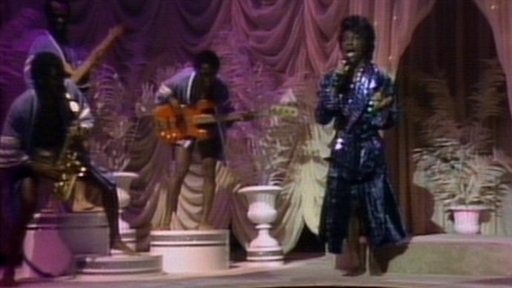
With the trailer for the James Brown biopic now out for people to watch I just thought it would be appropriate I share one of my favorite scenes from the many years of watching Saturday Night Live.

Before he became a mega superstar during the 80’s, Eddie Murphy was just part of the ever-changing cast of comedians for Saturday Night Live. One of the funniest skits had Eddie as James Brown doing the intro to his very own talk show, Celebrity Hot Tub.

See How An “Evil Empire” Is Built


Evil_Empire_001_coverA

You won’t find a much more loaded term in the entire lexicon of political rhetoric than “evil empire.” The phrase was made (in)famous when Reagan used it to describe the Soviet Union back when he had a hard-on for the apocalypse, and while some folks thought he was just being melodramatic, the “joke” he made a couple years later when he thought his mic was off about how he’d “just signed legislation outlawing Russia forever — we begin bombing in five minutes,” went some way towards throwing into stark relief why hard-line anti-communists were every bit as much a threat, if not moreso, than the dreaded “pinkos” themselves.

Fast forward a few years from that and America is thumping its collective chest and patting itself undeservedly on the back for having supposedly “won” the Cold War — uhhhhhmm, sorry, but last I checked the Soviet empire collapsed from within under its own weight — and we find out that our purported “enemy” was a starving nation that couldn’t even put bread on its own collective table, much less invade the US and destroy our much-vaunted “way of life.” In short, folks, we got hustled — the US government spent hundreds of billions on weapons (particularly nuclear weapons) we didn’t need in order to “fight” a “foe” that couldn’t even keep its own house in order. much less come and forcibly annex our own.

The lesson to be learned here? All wars — even “cold” ones — are a racket, in the immortal words of Smedley Butler, and the only “winners” are the defense contractors who profit from them.
JAN140984-02

Still, Cold War anxiety gave rise to some remarkably salient takes on the whole “dystopian future” scenario, the most famous of them in the comics world being Alan Moore and David Lloyd’s seminal V For Vendetta, which eventually became a big-budget Hollywood blockbuster once it had been stripped of all its smartest elements (and anarchist politics),  and  the Guy Fawkes “V” mask has ended up being appropriated not only by groups that probably do, if you’ll pardon the term,”deserve” to wear it given that they understand the story’s socio-political implications — such as the Anonymous hacker collective and various factions of the loosely-defined “Occupy” movement — but also, sadly and ironically, by far-right extremist supporters of arch-conservative/homophobe/racist American politician Ron Paul, and his even less principled, and decidedly more eel-like, son, Rand, who’s not even much of a Libertarian given his opposition to same-sex marriage and civil unions, his oft-stated desire to outlaw all abortion, even in cases of rape and incest, and his flat-out insane idea to “modify” the 1964 Civil Rights Act so that businesses can go back to discriminating against black customers if they want.

This guy’s a “champion of freedom”? Don’t make me laugh. Still, given his propensity for taking credit for work done by others, it’ll probably only be a few years before the junior senator from Kentucky claims authorship of V For Vendetta himself.

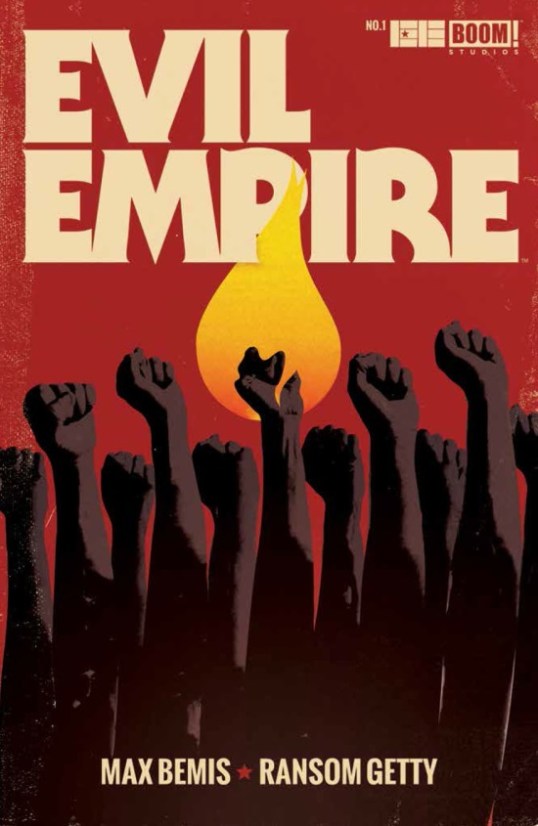
All of which brings us, in an admittedly roundabout way, to the fact that it’s about time for a “dystopian future” comic for a new generation now that the last really good one has been hijacked, at least at the margins, by the very right-wing authoritarian forces it was (bravely, for its time, I might add) braying against. And while I don’t know if writer Max Bemis and artist Ransom Getty’s Evil Empire, the first issue of which has just seen the light of day via Boom! Studios, will prove to be that book, it’s certainly off to an intriguing, if wildly uneven, start.
Evil_Empire_001_PRESS-6

I freely admit to not being at all familiar with either of this title’s principal creators — the only name associated with the series so far that I recognize  being FBP (a book you absolutely need to be reading) artist Robbi Rodriguez, who provides one of the variant covers to this debut installment (the main one, reproduced at the top of this review, being the handiwork of Jay Shaw) — but that’s actually a good thing in my book, since there’s a shitload of up-and-coming talent in comics that deserves much wider exposure than it’s gotten so far. Hell, truth be told I’m not all that schooled on Boom! as a publisher, apart from the fact that they have the RoboCop comics license and  they put out Mike Carey and Elena Casagrande’s Suicide Risk, which is easily one of the three or four best series being published by anyone right now. A quick glance at Evil Empire‘s copyright indicia shows that it’s a company-owned, rather than creator-owned, work, and that’s not cool in my book, but oh well. Marvel and DC certainly have been been getting away with the work-for-hire hustle for decades now — it’s just depressing to see smaller publishing houses following suit, I guess.

In any case, this is at the very least a creator-driven project —it would just be nice it if were a creator-owned one, as well.

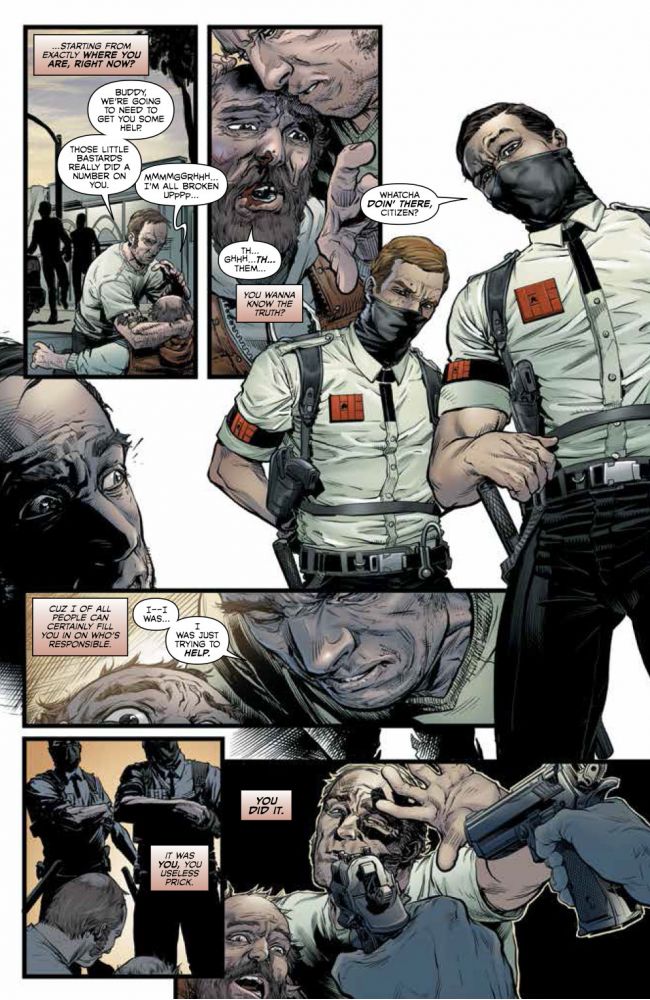
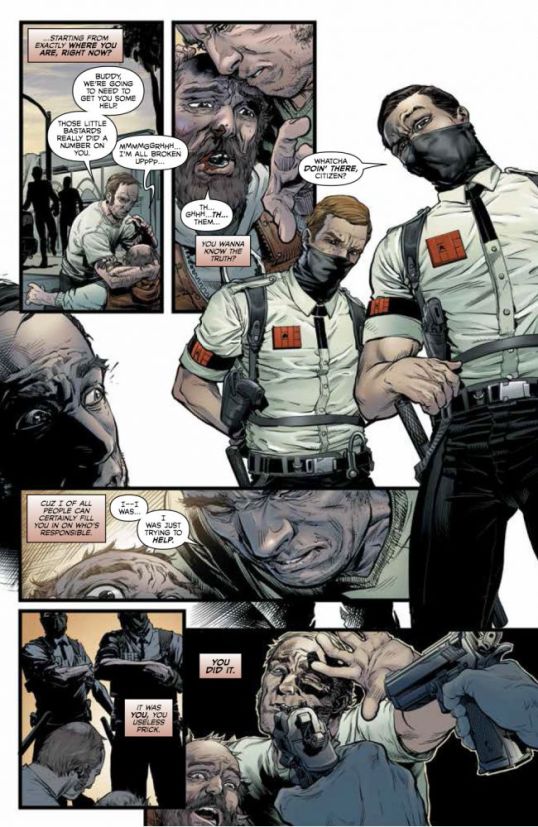
Anyway, to the story — the action starts off 25 years in the future, where things have gone to hell in the proverbial bucket. “Security” cameras monitor every citizen’s every move, armed George Zimmerman-types are given badges and prowl the streets looking for (oh, who are we kidding, creating) trouble, some unnamed corrupt dictatorial overlord runs the whole show, and various technological “bread and circuses” serve to disrupt the cowed and tired populace from the troublesome nature of reality itself.

All in all, then, not too big a reach.

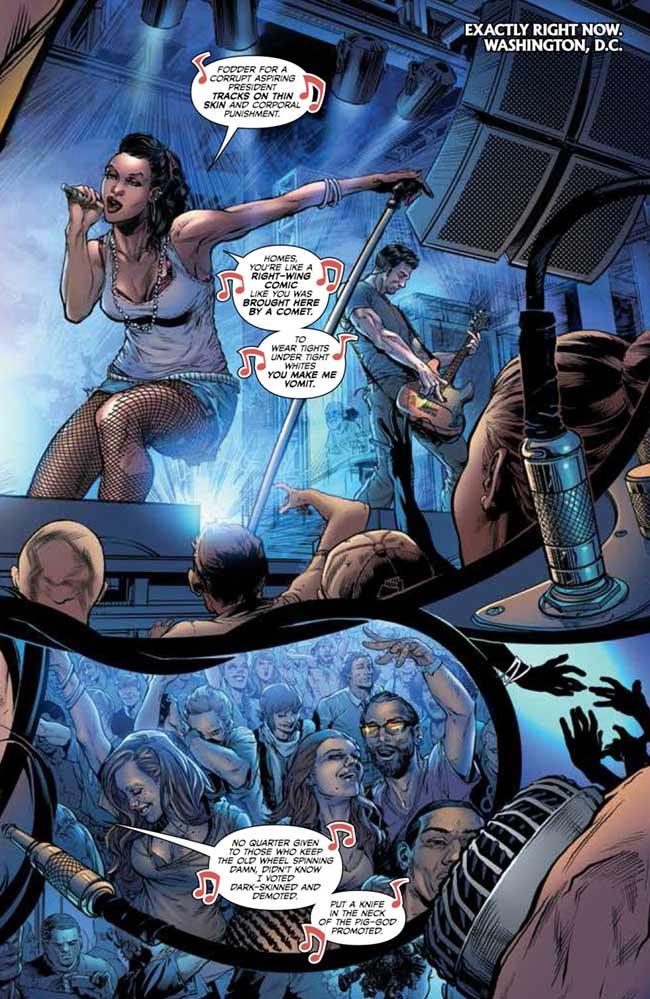
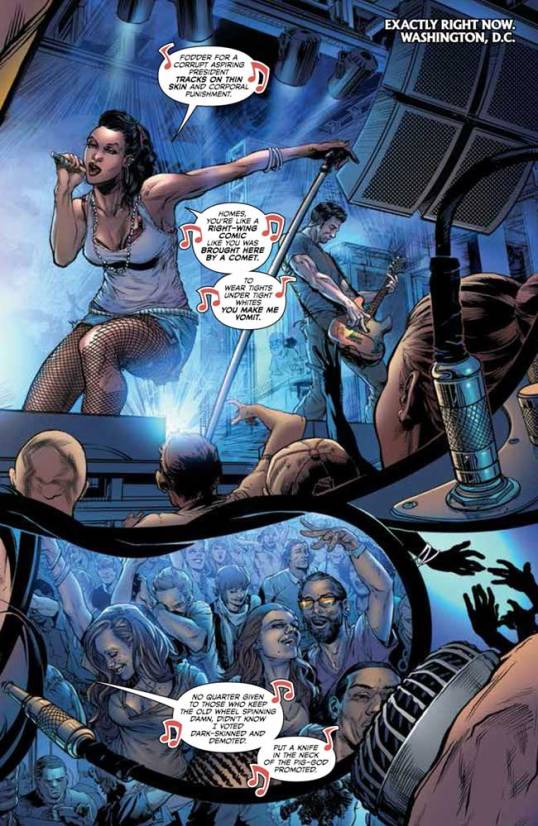
A few pages in, though, is when things start to get interesting, as Bemis and Getty begin the task of charting how we get from here to there. First up we meet politically-aware hip-hop artist Reese Greenwood, and while Bemis saddles her with some truly mind-bogglingly stupid lyrics, to his credit he also manages to establish her as a thoughtful, deeply aware character in fairly short order. She’s got no time for “the system,” as you’d expect, but she ‘s hardly the type of cardboard caricature so many “urban” African-American women in comics are these days. She seems like the sort of person you’d actually enjoy sitting down and having a conversation with, rather than a confrontational, “Invader From Mars” type.

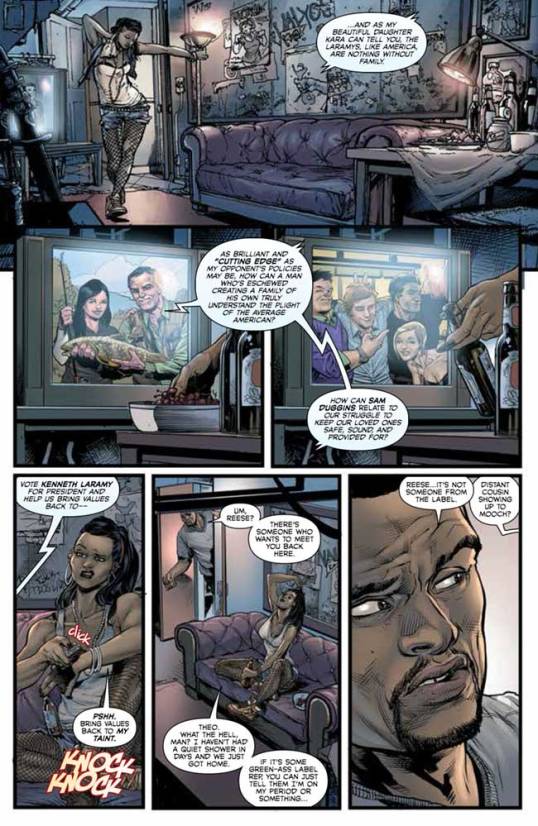
Democratic presidential nominee Sam Duggins certainly seems to have taken a shine to her, as well. He pulls a few strings to meet her backstage after one of her shows, crashes an interview she does with MTV, surreptitiously passes his phone number to her — anything to get the young lady’s attention. Sam seems a decent-enough sort — more progressive than anybody the party would have the guts to nominate for national office in real life, to be sure (not to mention the fact that a single guy without kids wouldn’t stand a chance in a presidential election), but Reese isn’t buying his line entirely. She certainly seems to hope  he’s the real deal (hey, a lot of us hoped for the same from Obama once upon a time, before his “Bush-lite” tendencies fully came to the surface), but she’s  apparently seen one too many phony “leftists” turn out to be  nothing but “kinder, gentler” versions of the same old corporate stooges over the course of her life to fully get on board with either of the “Big Two” political parties, even the less overtly noxious one. I can certainly relate to that.
Evil_Empire_001_PRESS-7

Still, as  patently dishonest as Duggins may (or may not, who knows?) be, he’s a saint compared to pious, grandstanding, loathsome Republican nominee Kenneth Laramy, your typical “family values” right-wing blowhard. Unlike Reese and Sam, Laramy is, in fact, presented as nothing but a two-dimensional collection of tired stereotypes, which is kind of a shame, but with only 22 pages of story and art to work with something’s gotta give, and hey, it’s only the first issue — and there’s plenty of reason to suspect that there’s a  lot more going on with him than meets the eye.

Case in point — midway through through out opening installment, Laramy’s daughter finds her mother bleeding to death in their home with a knife in her back. This scene is handled incredibly clumsily, with hints at first being given that something’s happened to the daughter rather than the mother, and mom croaking (sorry) some incredibly wooden dialogue about something bad she did years ago as she expires (Getty also employs an admittedly unique, but frankly kinda stupid, artistic contrivance when he segues into this scenario via an attached panel-sized asterisk), but the point to take away here, plot-wise,  is that there is no assailant present, so the identity of Mrs. Laramy’s murderer remains a mystery.

At her wake, though, the shit really hits the fan. Duggins shows up with Reese as his date, and while you’d expect a media circus to ensue, that’s avoided when Laramy himself finally takes to the stage — or page, as the case may be — and leaves us with one of the better cliffhanger splash-pages that I can recall in quite some time. Sure, it’s not exactly realistic for a grieving widower to be interrupted in the middle of his eulogy by a reporter asking him a fucking question — even if said widower is running for president (actually, he announces that he’s withdrawing from the race during the speech, but that’s neither here nor there) — but while the set-up may be awkward, to put it kindly (as are little touches of dialogue throughout the book, like Reese referring to Laramy’s running mate as his “runner-up” and Duggins saying that Laramy is opposing him on the “ticket” rather than the ballot, “tickets” being, colloquially speaking, something that a presidential and vice-presidential candidate are, ya know, sharing  — but again, whatever) the payoff is big. Or might be. In any case, our “bad guy” candidate ends the first issue by dropping one heck of a bomb, and Bemis succeeds in leaving his readers damn hungry for answers.

Yeah, alright. Evil Empire has a long way to go before it can even be mentioned in the same breath as V For Vendetta. And Bemis’ story is more concerned with how a fascist government comes to be rather than how it’s toppled. But his set-up shows a lot of promise, and with a little bit of dialogue tightening and some deft editorial tinkering along the edges, this could really turn out to be a fun and thought-provoking ride. Sure, the story definitely has a left-leaning point of view, but at least it’s realistic in its portrayal of Democrats as “less-bad” guys rather than actual good guys, and its forward-thinking presentation of urban youth culture in general, and hip-hop culture specifically, is to be commended. Too often in comics these days people of color under the age of 30 are still portrayed as villains, and that’s certainly not the case here.

On the art side, Getty does a nice job making his characters look reasonably believable physically, and he’s pretty skilled at using facial expressions and other non-verbal cues to communicate thought and feeling. There’s no typical super-hero action — and very little action in general — for him to sink his teeth into and really show off his chops, but his panels mostly flow together pretty nicely and he keeps the reader engaged with his images throughout, which isn’t always easy in a “talky” book such as this one.

So, hey, what the heck — $3.99 is admittedly a lot to shell out for a 24-page package, especially when 2 of those 24 pages are taken up by “house ads” at the back of the book — but Evil Empire managed to hook me, warts and all, and given that its takes place in a self-contained world of its own making rather than a corporate “universe” with decades of backstory to catch up on, readers new to comics in general might find this a decent-enough introduction to the medium, particularly if they’re fans of  sci-fi, thriller, or other genre entertainment with a political twist. I can’t recommend it unreservedly, given that it still has much to prove, but I’m happy enough right now to keep shoveling four bucks a month over to Boom! to see where this ride Bemis and Getty are taking us on ends up going.