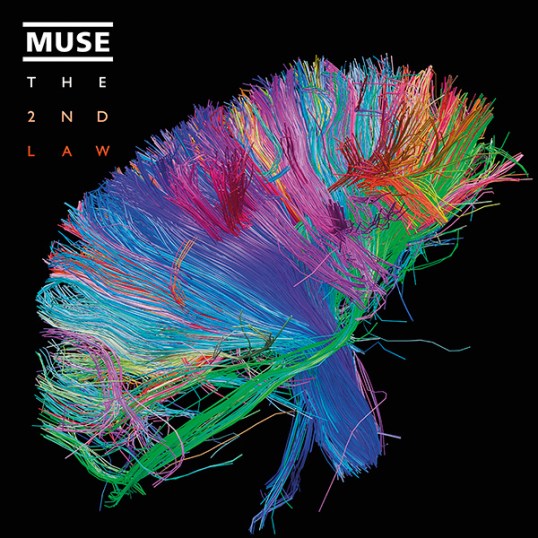
This song is one of my favorite of 2013 and it helped make this summer’s World War Z more entertaining than what many was predicting. This was a film that was considered dead on arrival before it was even out, but it persevered and the decision to use “Isolated System” by Muse as the film’s opening theme was genius.
This video is an excellent piano cover by YouTube user xSymbiose. As someone who has had some piano training I can assure doubters that this cover was and is authentic and not a well-done fake. It’s easy enough to overlay the original song over a video and try to sync-up as perfectly as possible the song with the piano playing. This time around this wasn’t the case.
The playing by xSymbiose is not just precise but almost matches the original song’s tempo. There’s really only a few seconds difference between this cover and the original song’s running time.
Everytime I see piano covers executed nigh-perfectly as this one makes me wish I had continued with my piano lessons. For now I will just live vicariously through those whose skills far surpasses my own. I have our very own Leonard Wilson to thank for finding this little gem.
Here’s the trailer for the remake of Robocop, which appears to be full of all sorts of PG-13-rated mayhem. Personally, just from the look of him, I would have called him Rubber Cop. But that’s just me.
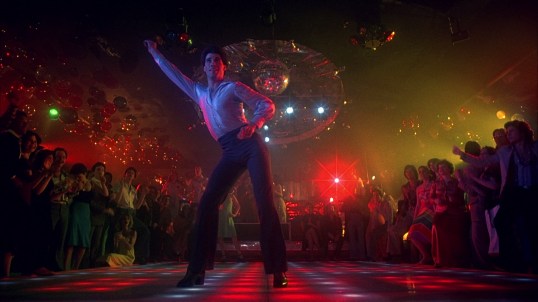
There’s no way that you can post a series of classic dance sequences without including at least one scene from Saturday Night Fever. Even though this scene is nearly 40 years old, it still perfectly captures the excitement and the promise and the pure exhilaration of spending a night out dancing.
That said, I still don’t understand how anyone could mistake John Travolta for Al Pacino.
When we talk about the pioneers of silent film, we usually end up talking about men like D.W. Griffith, Rex Ingram, Fritz Lang, Cecil B. DeMille, Charles Chaplin, and William Desmond Taylor. And it is true that these men were essential to creating the language through which future filmmakers would tell stories of their own.
However, for every important silent filmmaker who continues to be celebrated, there are hundreds of just as important directors who are no longer remembered. When you combine the tendency of the public to automatically dismiss any film made before the advent of sound with the fact that many of the best silent films are now lost films, it’s both understandable and unfortunate that several pioneering directors have been forgotten.
Alice Guy-Blaché may be a forgotten director but, in her way, she is just as important to the development of film as Griffith and DeMille. The French-born Alice Guy directed her first film in 1896, when she was only 23 years old. She is considered, by most film historians, to be the first female director and she was also one of the first directors to experiment with ways to use film to tell a narrative story. (Narrative is something that we now take for granted but, when the movies were still in their infancy as an art form, the idea of using the techniques of filmmaking to tell a story was truly revolutionary.)
Alice Guy married Herbert Blaché in 1907 and moved with him to the United States. It was here that she made the majority of her films. She eventually founded the New York-based Solax Company, which was the largest film studio in pre-Hollywood America. As of this writing, she remains the first and only woman to have owned her own film studio.
Below, you’ll find Alice Guy Blaché’s 1912 film, Fallen Leaves. With a running time of 11 minutes, Fallen Leaves tells the story of a young woman stricken with tuberculosis and her younger sister’s desperate attempts to save her life. This is one of my favorite silent films because it is just such an incredibly emotional and sweet-natured story. Tears come to my eyes whenever I see the little sister starting to gather up her leaves. So, put on some properly dramatic music and enjoy Fallen Leaves.
Happy birthday, Werner Herzog! That’s right — one of the greatest and most visionary directors of all time is 71 years old today.
Now, if you’ve followed this blog for a while, then you know that I love trailers. In honor of Herzog’s birthday, here are 6 trailers from Werner Herzog:
Here is Herzog’s latest (and some would say, most powerful) documentary — an anti-texting PSA:
As a bonus, here’s Les Blank’s 1980 documentary, Werner Herzog Eats His Shoe.
Anime comes in many varying degrees of flavor, so to speak. On one extreme are some of the more dramatic and serious offerings such as Grave of the Fireflies and original films from Miyazaki and others from Studio Ghibli. On the other side of the equation would be what some would call disposable entertainment which could range from fantasy, horror, mecha to the ever-popular mahou shoujo (aka Magical Girl) anime.
Somewhere in-between these two extremes is where some surprising anime series and films tend to pop out of nowhere to become fan-favorites in the industry. One such series is the underrated “slice-of-life” anime simply called Nichijō. The title has a literal translation of “Regular Life” and the show takes that concept of the regular lives of high school girls and adds a dose of the irreverent and the ridiculous to help highlight some of the life lessons that actually resonate beneath the show’s more over-the-top trappings.
That reason alone should be why this is one anime that people should really be watching.
Yet, the show brings more to the table than just funny and entertaining little stories. The main characters of the show are also well-written and go beyond the usual one-dimensional stereotypes of most anime. We have Aioi Yuko who one would consider as the lead girl of the show. One would think that she would be the so-called “straight man” in a show full of eccentric characters, but she herself brings her own quirks to the proceedings. These character quirks comes out more clearly when she deals with her friend Mio who, at first, comes off as the otaku of the show, but actually seems more like your typical high school girl with a talent for art. Though her obsession at drawing yaoi and trying to keep it secret makes for some of the more hilarious scenes on the show.
Even the more over-the-top characters on the show come off as more fully developed than some of the live-action “high school” shows in the west. There’s Hakase, the 8-year old genius girl who happens to have Nano, a life-life android she herself created, taking care of her and acting more like her mother than as an automaton. This pairing makes for my favorite on the show which also includes their back cat Mr. Sakamoto who also happens to talk due to the red scarf that acts like a translator that Hakase invented.
The series ended after 26-episodes and no more were ordered afterwards due to some very low sales of the subsequent video. It’s a shame since the series has since gained quite the following. Nichijō is a series that’s been able to combine the more serious and well-meaning life-lesson storytelling of your typical high school shows with the manic and ridiculous nature that some anime tend to have to help visualize particular reactions and emotions (in reality this show makes over-the-top seem like a tame description). The show has so many classic scenes that watching it becomes almost an exercise in abstract comedy.
So, if you ever come across an anime called Nichijō I recommend you check it out. You won’t be disappointed. Below is just one such scene where a normal, everyday event turns into the surreal.
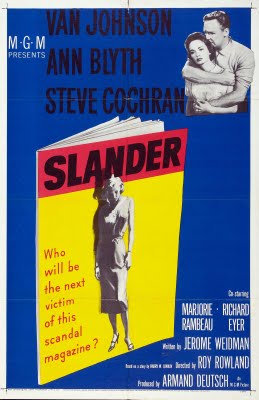
Slander, much like A Cry In The Night, is a B-movie from the 1950s that I recently discovered via Turner Classic Movies. It’s appropriate that both of these relatively obscure films recently aired on TCM because both Slander and A Cry In The Night serve as interesting time capsules of the decade in which they were made.
To truly appreciate Slander, you have to know that, during the 1950s, Hollywood was terrified of magazines with names like Confidential, Exposed, and Private Affairs. These were the magazines that claimed to tell the “sordid” truth about Hollywood. In the 1950s, image was everything and one well-placed story that suggested that an actor or actress was a drug user, a former criminal, a communist, or — gasp! — gay, could end a career. In the 50s, Hollywood filmmakers viewed the tabloids with the same loathing that they currently feel towards the paparazzi. Slander was Hollywood’s attempt to expose the tabloids. Perhaps that’s why it’s appropriate that Slander, in many ways, feels like a 50s version of Paparazzi.
Slander opens with tabloid magazine editor H.R. Manley (Steve Cochran) looking over him empire of scandal and searching for someone to destroy. From the minute that we see Steve Cochran with his slicked back hair and hear him delivering his lines through permanently clenched teeth, we know that H.R. Manley is a bad guy. Indeed, Cochran was best known for playing gangsters and that’s how he plays H.R. Manley. It’s not subtle but it’s definitely entertaining.
Manley wants to destroy Mary Sawyer, an actress who is never seen but who we are assured is America’s sweetheart (or, as Manley puts it, “Everyone thinks she’s practically a nun, right?”) . Manley becomes convinced that children’s entertainer Scott Martin (Van Johnson) has some damaging information on Mary. When Scott refuses to betray his friend, Manley sets out to destroy Scott by revealing that, before he become America’s most beloved puppeteer, Scott served time in prison on an armed robbery conviction.
(To understand just how ludicrous this revelation is, you have to understand that Scott is played by Van Johnson who was pretty much the epitome of the fresh-faced, likeable, All-American optimist in the 50s.)
Despite the pleas of his wife (played by Ann Blyth), Scott refuses to give into blackmail. Soon, Scott Martin is on the cover of the Manley’s magazine. In the great tradition of the 50s social problem film, this leads to the most melodramatic conclusion possible.
Watch, in amazement, as Scott’s son reacts to the scandal of his father being a former criminal by running out in the middle of the street and getting hit by a car.
Try to look away as Manley’s drunken mother (played by Marjorie Rambeau) considers killing her own son in order to end the evil of the tabloid press.
Listen, in shock and regret, as Scott goes on television and gives an overwrought speech in which he tells us that if we’ve ever read a tabloid magazine then we are responsible for his son’s death.
Or, as one extra says when he spots Scott and his wife walking down the street, “Maybe people will stop reading those tabloids…”
It’s a bit too overwrought for its own good but I have to say, as someone who looks forward to going to the doctor specifically so she can read the copies of US Weekly that he keeps in the waiting room, I enjoyed Slander. The film is melodramatic and totally over-the-top and, as a result, it’s also a lot of fun. If for no other reason, the film is worth watching just for the chance to enjoy Steve Cochran’s incredibly sleazy portrayal of the apparently soulless tabloid editor.
Slander shows up on TCM occasionally but it’s also available for viewing on YouTube. Or, if you’ve got 81 minutes to kill, you can watch it below.
Supposedly, the great comedic character actor Edmund Gwenn once said, “Dying is easy. Comedy is hard.”
I have to agree because I’ve seen a lot of comedies in 2013. A few of them — like This Is The End and The World’s End — have worked. However, the majority of them have not only been bad but they’ve been so bad that they’ve invited audiences to wonder if comedy is a dying art form. For every genuinely clever comedy, it seems like we’ve had to sit through a dozen Movie 43s. These are movies where genuinely funny people get together and proceed to prove that they can be just as unfunny as the obnoxious cousin that everyone avoids at the family reunion.
Case in point: Freeloaders.
Even Movie 43 made me laugh once. That’s one laugh more than I got out of Freeloaders. Freeloaders is quite possibly the least funny comedy that I’ve ever seen. Freeloaders almost feels like a social experiment, a test to see what would happen if an audience, expecting to see a silly and crude comedy, instead found themselves trapped in a laugh-repellent environment for 80 minutes.
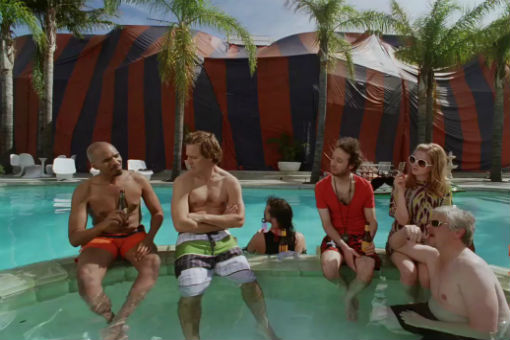
Freeloaders tells the story of a group of stereotypes who have spent the last six years living in a mansion owned by “rock star” Adam Duritz. It turns out that one of them is a childhood friend of Duritz’s and, since Duritz has been out touring for the past decade, he’s allowed his friends to occupy his home rent-free. However, Duritz is getting married and planning on moving to New York City and, as a result, he’s selling his mansion. The freeloaders are told that they have a week to get out of the mansion. Well, since everyone in this film is basically a total and complete dumbass, nobody can figure out how to rent an apartment. So, instead, they come up with some painfully wacky schemes to raise the money to buy the mansion themselves. Standing in their way is Adam’s real estate agent who …. well, it’s never really all that clear why she’s standing in their way. Presumably, it’s because there wouldn’t be a film unless she was standing in their way and then we would have all missed out on the chance to watch Freeloaders.
Why doesn’t Freeloaders work?
Well, let’s start by considering the fact that Adam Duritz plays himself. I actually had to go on Wikipedia to remind myself who Adam Duritz is and I discovered that he’ was apparently a big deal back in the 90s and that he’s responsible for that painfully annoying cover of Big Yellow Taxi that was playing everywhere back in the summer of 2003. Unfortunately, as both an actor and as a “fictional” character, Adam Duritz is so bland that his character serves mostly as a distraction. The use of a real celebrity (if Adam Duritz can legitimately be called a celebrity) should have provided the filmmakers with a lot of comedic opportunity but that opportunity is pretty much wasted because Freeloaders seems to be obsessed with letting us know that Adam Duritz is a really great guy.
(That might be because Adam Duritz was one of the film’s producers.)
While I doubt that Adam Duritz has ever been a funny guy, Freeloaders is filled with other actors who have proven themselves to be funny in the past. I, for one, was excited to see the name Nat Faxon in the opening credits because, while he might not be a household name, anyone who has ever seen Nat Faxon in a movie knows just how funny he can be. However, both Mr. Faxon and the rest of cast struggle with the fact that they’re playing a collection of one-dimensional stereotypes. Everyone has one overly defining, predictable trait to help us keep them straight. There’s the nice guy, the stoner, the womanizer, the nice girl, the hoodlum, and the girl who will inspire some in the audience to say, “Is that Olivia Munn?,” largely because she is Olivia Munn. Since they’re never allowed to become individual characters, all of their attempts at humor fall painfully flat. It doesn’t help that director Dan Rosen directs without any hint of timing or originality.
Freeloaders was produced by Broken Lizard, the comedy troupe that’s developed a large cult following as the result of films like Super Troopers and Club Dread. However, the members of Broken Lizard did not write or direct the film and they only appear in a rather brief cameo where they parody Boogie Nights.
The Boogie Nights parody is actually fairly clever but it also highlights this film’s biggest problem. Freeloaders was originally filmed in 2009 and then sat on the shelf until it finally got a very limited theatrical release earlier this year. (Perhaps that’s why one of the film’s characters worries about getting sent to Iraq if he joins the army.) However, the script feels like it was written back in the 90s. Everything from the premise of slacker stoners being forced to raise money to Adam Duritz being described as a world-famous star to Broken Lizard parodying a film that came out in 1997 serves to make this film feel as if it was made about 14 years too late.
I love a good comedy but, by that same regard, there’s nothing a i hate more than a really bad comedy. However, as a film lover, I will always be willing to take chance on comedy. Comedy may be hard but the rewards are great.
Sometimes, you end up with something really special.
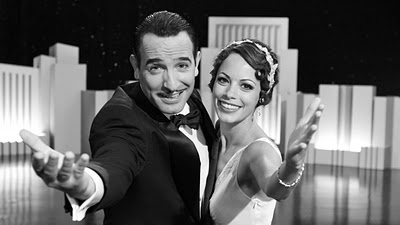
I love this scene from the 2011 Best Picture winner The Artist because, to me, it perfectly captures both the wonder of film and the beauty of dance. If watching Jean Dujardin and Berenice Bejo dance doesn’t make you happy, then there is no hope for you.




 Through the Shattered Lens