Film Review: You’re Next (dir by Adam Wingard)


If Luis Buñuel had ever made a slasher film, it would probably have been a lot like You’re Next.

You’re Next tells the story of the ill-fated Davison clan.  Paul (Rob Moran) has recently retired from his job as a defense contractor and now, he and his wife, Aubrey (Barbara Crampton) are looking forward to celebrating their anniversary at their isolated vacation home.  Soon after they arrive at the house, Aubrey is convinced that she can hear someone else in the house.  However, since the frail Aubrey is obviously emotionally unstable, Paul dismisses her concerns.

Over the course of the day, Paul and Aubrey’s children arrive at the house.  Though, in the best tradition of all troubled families, the Davisons attempt to maintain a facade of peace and harmony, it quickly becomes clear that each member of the family is dealing with his or her own issues and petty jealousies.

For instance, oldest son Drake (Joe Swanberg) obviously feels that he’s superior to his siblings.  His wife, Kelly (Margaret Laney), is just as obviously unhappy with their marriage.

Crispian (A.J. Bowen) is a neurotic academic who is struggling financially and is viewed as being a weakling by the rest of his family.  His girlfriend, Erin (Sharni Vinson) has a secret in her past that will become unexpectedly important as the day progresses.

Daughter Aimee (played by Amy Seimetz, who was so good earlier this year in Upstream Color) tries so hard to be cheerful that you know that she has to be secretly be on the verge of having a nervous breakdown.  Her boyfriend, Tariq (Ti West), is a struggling filmmaker who is scandalized to discover that Drake prefers to watch commercials as opposed to documentaries.

Finally, there’s the youngest son, Felix (Nicholas Tucci).  Felix appears to be the most well-adjusted of all of the Davison children but his quiet girlfriend Zee (Wendy Glenn) is a different story.

Once the family has gathered together for the anniversary dinner, the bickering begins.  What the family don’t realize is that a group of men (all of whom wear animal masks) have previously slaughtered the neighbors and have now surrounded the Davison house.  The bickering is interrupted by a brutal attack that leaves one dead, one seriously injured, and the rest of the family fighting for their lives.

You’re Next starts out as an effective but rather standard home invasion film (think of The Strangers or even Michael Haneke’s Funny Games) but the film features two twists which set it apart.

The first twist is that Erin turns out to be as effective and determined a killer as the men laying siege to the house.  I’ve sat through a lot of horror movies and I love movies where women get to kick ass and I can tell you, without fear of contradiction, that there’s probably no other horror heroine who kicks as much ass as Erin.  As played by Sharni Vinson, Erin is destined to become an iconic character in the history of horror.

youre-next-sharni-vinson

The other twist is one that I can’t tell you about because it’s this twist that literally turns the entire film upside down.  What I can tell you is that this twist forces you to reconsider everything that you’ve seen up until that point.  Most impressively, director Adam Wingard reveals this twist to us long before he reveals it to the film’s characters.  As such, just when the viewer is getting used to the idea of You’re Next being just another home invasion film, a whole new element of suspense is added to the story.

Some reviewers have referred to You’re Next as being a comedy.  I disagree, if just because the film’s violence is too brutal and the gore is too graphic for this film to be considered anything other than primarily a horror film.  That said, there is a strain of dark humor that runs through the film and occasionally provides a much needed relief from the nonstop tension onscreen.  A good deal of the film’s humor comes from just how incredibly screwed-up the Davison family is, even before they find themselves under attack.  This is a family of people who, even while they’re trying to plot their escape from the house, can not resist getting into argument about who can run the fastest.

Ultimately, You’re Next works as both a brutally effective horror film and as a satirical portrait of an All-American family that’s secretly so dysfunctional that — even if they weren’t being attacked by masked men with crossbows — they probably would have eventually ended up killing each other anyway.  It’s a genre film that manages to transcend the rules of genre even while embracing them.  In a year that, so far, has been dominated by surprisingly intelligent and effective horror films, You’re Next is one of the best.

youre-next-movie-image-05

An Appreciation of It


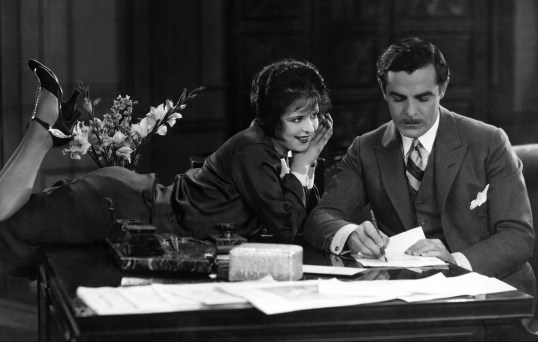
Annex - Bow, Clara (IT)_01

(Spoilers below)

If I could be any character from a silent film, I would want to be Betty Lou Spence, the heroine of the classic 1927 film, It.

As played by the beautiful Clara Bow, Betty has It.  What is It, you may ask?  That’s the question that this film sets out to answer.  The movie starts out with a title card that read, “That quality possessed by some which draws all others with its magnetic force. With ‘It’ you win all men if you are a woman and all women if you are a man. ‘It’ can be a quality of the mind as well as a physical attraction.”  Throughout the film, every man who sets his eyes on Betty automatically says that she has “it.”   Though the film never explicitly says so, it’s pretty obvious that “It” is a combination of sensuality, intelligence, and inner strength.

It is sex.

And yes, since she’s played by Clara Bow, Betty Lou Spencer definitely has ‘it’ and she knows what to do with it as well.

However, one thing that Betty doesn’t have is a lot of money.  Instead, she’s a proud and poor shopgirl who sets her sights on her wealthy and handsome employer, Cyrus Waltham (played by Antonio Moreno).  Realizing that the uptight Cyrus will never notice her while at work, Betty accepts a date with Cyrus’s irresponsible best friend Monty (William Austin).  Knowing that Cyrus and his girlfriend will also be there, Betty asks Monty to take her to a fancy restaurant.  While Monty orders their food, Betty stares shocked at the high prices on the menu.  Why just the appetizers cost $2.00!

Ah, 1927.

Eventually, Betty does manage to get Cyrus’s attention.  After spending a day slumming with her down on Coney Island, Cyrus attempts to kiss Betty.  Betty responds by slapping him and telling him, “So, you’re one of those minute men — the minute you meet a girl, you think you can kiss her!”

The next day, things get a bit more complicated when Betty discovers that two social workers have shown up at the apartment of her best friend, Molly (Priscilla Bonner).  Molly is a single mother and the social workers have shown up to take away her baby.  Betty boldly steps forward, claiming that she is the baby’s true mother and that, since she has a job, the social works have no reason to take away her baby.

One of the snooty social workers (who, needless to say, does not have it) stares down here nose at Betty and asks, “And where is your husband?”

Betty stares straight back at her and replies, “That’s none of your business.”

Seriously, nobody tells Betty Lou Spence what to do.

Since this movie was made in 1927, everyone is scandalized.  Cyrus, obviously miffed that he couldn’t even get a kiss from an unwed mother, dumps her.  Betty responds by quitting her job.  A title card informs us that Betty may have needed the money but her pride was far more important to her.  What makes this movie unique, especially when compared to even some contemporary films, is that Betty is not punished for putting her pride before money or romance.  Instead, the film celebrates her independence.

The rest of the film deals with her getting her own brand of vengeance on Cyrus.  In the end, Betty gets her man but she gets him on her own terms.  Again, take a minute to consider that this film, made nearly 90 years ago, not only features a liberated woman but celebrates her as well.

After this film, Clara Bow became known as the “It Girl,” and it’s easy to see why.  In the role of Betty Lou Spence, Bow epitomizes the perfect combination of outward sensuality and inward strength.  Whether she’s sarcastically telling off a rude customer, defending her best friend, or saving the life of her romantic rival, Clara Bow epitomizes both sex and independence.  In the end, she pursues her man not out of obligation but out of desire.  When she does find her happy ending, she finds it on her own terms.

Those of us in 2013 have a lot to learn from the It Girl of 1927.

Dance Scenes That I Love: Anna Karenina


Hi everyone!

Starting today, I am officially on vacation!

However, though I’ll be away for two weeks, I’m not going to let that stop me from sharing my thoughts here on the Shattered Lens.  What can I say?  I love film, I love this site, and, most importantly, I love our readers.

Now, if you know me, you know that I also love to dance.

So, I figured, why not combine my greatest loves?  For then next two weeks, I will be sharing a special set of scenes that I love.  These are some of my favorite dance scenes.

I’d like to start things off by sharing a scene from my favorite film of 2012.  This deliriously romantic dance scene comes from Joe Wright’s brilliant adaptation of Anna Karenina and features Keira Knightley and Aaron Taylor-Johnson.

Enjoy!