The Greatest Freaking Commercial Of All Time, Part 3


A little over a month ago, I made the argument that the Kia Sockmonkey commercial was the “greatest freaking commercial of all time.”  Than R-Lee had to go and be all contrary-like by saying that no, “the greatest freaking commercial of all time” was actually some series of bodywash advertisements featuring some scary guy named Terry Crews, who I guess is an athlete or something.

What I failed to realize at the time is that we were both wrong.

Below is the greatest freaking commercial of all time…

Shamanism: A Recurring Theme in Warren Ellis Fiction


A shaman is defined as a person who acts as intermediary between the natural and supernatural worlds, using magic to cure illness, foretell the future, control spiritual forces, etc.Mr. Ellis created/redesigned characters that functioned as shaman in his books (like Nate Grey in the Counter X series, the Doctor from Stormwatch/Authority, and Century Babies in Planetary).
Nate Grey functioned as intermediary between the 616 reality and parallel as lower and upper realities, and maintained a multiversal balance. Upper realities were virtual utopias like the Deva Realm from the 6 desire realms in Buddhism. The lower realities were hellish planes like the Preta and Naraku realms.
The Doctor (all iterations) and the Century Babies functioned as mediums for humanity and Gaia (the Earth itself) and maintained harmonic balance.

He also introduced ideas like:

“Down there are people called ayahuasqueros. Tribal doctors, mystics, medicine men. They take this stuff called ayahuasca, this awful mush they brew up out of vines and stuff. It’s a psychedelic. They hallucinate all over the place — but it’s their belief that the visions are actually another dimension. When you ask them why they take it, they say it’s for working with the ancestors. They’re necronauts. They travel in the place of the dead. And what they bring back are messages from the afterlife.”
– Sam Wilson (in Ultimate Nightmare)


“You are aware through esoteric scientific research conducted by many people over the Twentieth Century. that souls do not die. Souls are some form of electromagnetic field that continue to inhabit the body after death. Bones, crackling with strange and imperceptible energetic activity. And we buried them. Are they still aware? Can the dead still perceive we don’t yet know. Is that happens? We lay in the dirt, still somehow aware of being in there? And gravity draws us into the earth. And plants grow. Ayahuasca. Peyote. Psylocibin. Stropharia Cubensis. The drugs. Yes, historically, we consider them shamanic drugs, and they were overlaid with ritual and religion and the other crap of archaic societies. But all societies had their speakers to the dead and their oracles who looked into other places. In legend, the Oracle at Delphi stood at a pool and inhaled its vapor, the pneuma, to oraculate. It was recently found that a vent beneath the pool expressed ethylene, a hydrocarbon gas that creates an euphoric derangement, into the water. Ethylene, the pneuma, is a plant hormone. The dead lay in the ground, their souls oiling out from their bones, into the earth, into roots… that effervesced into the clouds that the oracle inhaled to see new worlds. Into the plants that our speakers to the dead ingested to do their business.
– Melanctha (in Planetary)

“You’re a machine. I’m a machine. Our parts are made out of water and meat and minerals, but we’re walking pieces of engineering. Everything’s a machine. Plants, everything. When we eat a plant, we disassemble it, junk what we don’t want and plug the parts we need into our machine. What if these jungle drugs are machines we can ride?”
– Sam Wilson (in Ultimate Nightmare)

His ideas lead me to look at shamanism, the soul, death and planes of existence, from a different angle. I would love to read an Ellis book where he jumps head first into this theme and runs wild with it in a similar manner to his Crooked Little Vein novel.

Images courtesy of Ben Templesmith and Freak Angels.Warren Ellis’ images courtesy of Warren Ellis’ Official Livejournal.

Black Swan: Aronofsky, Portman and Kunis this December


On July 22, 2010 USA Today score the first exclusive pictures from the set of Darren Aronofsky’s follow-up to his critically-acclaimed 208 film, The Wrestler. This time around Aronofsky takes on Tchaikovsky’s Swan Lake and weaves a psychological thriller around the classic ballet.

Black Swan will have in the titular lead one Ms. Natalie Portman. She’s taking on a role which continues her attempts to expand her repoertoire of character beyond the helpless child-like young women she’s been portraying since she first burst onto the scene. Playing opposite Ms. Portman is Mila Kunis. There’s already been talk going as far back as late 2009 that the two co-sta’ characters will be getting real close.

Synopsis:  The dark tale with psychological twists stars Natalie Portman as Nina, a technically brilliant ballerina whose life takes some strange turns after being picked as the lead in a New York City production of Swan Lake. Pressures mount as her overbearing mother (Barbara Hershey) pushes her to succeed and her manipulative dance master (Vincent Cassel) commands her to be more seductive and loose in her performance.

Complicating matters is the arrival of Lily (Mila Kunis), a sultry dancer who exhibits all the innate ease and sexuality that Nina lacks. Nina begins to fixate on the newcomer as the two forge an unusual relationship.

The film will premiere at the Venice Film Festival this September and also appear in the 35th Toronto Internation Film Festival. Black Swan will be shown in limited release this coming December 1, 2010 to qualify it for the awards season and from the buzz surrounding this film don’t be surprised if it does well with awards and critics prizes. Pictures from the set can be seen in the USA Today link below.

Source: USA Today

Song of the Day: Nocturne, Op. 27 (Composer: Frédéric Chopin, Pianist: Arthur Rubinstein)


Yes, for my latest pick for song of the day I shall dial things back from all the J-pop, metal, hard rock and film scores. My pick for song of the day is Frédéric Chopin’s Nocturne, Op. 27 (No. 1 in C-sharp minor and No. 2in D-flat major).

A nocturne is a musical composition which takes it’s inspiration from the night itself or, at the very least, evocative of the night and darkness. It’s an easy enough description for a type of music which were typically arranged for piano solos. The nocturne was first originated by 18th-century classical composer, John Field but it would find it’s popularity at the hands of Polish composer Frédéric Chopin. Chopin wrote 21 nocturnes and it is Op. 27 (two solos) that I’ve chosen. This particular piece is widely considered by many as one of the greatest pieces of music Chopin ever wrote and I, for one, agree wholeheartedly.

This particular version is played by one of the greatest pianist of the 20th-century and one whose playing style goes hand-in-hand with Chopin’s free-flowing style. When one hears the name Arthur Rubinstein (he himself a fellow Polish musician just like Chopin) one automatically thinks of Chopin and, specifically, his 21 Nocturnes.

I am not one to adequately break down, deconstruct and examine just what makes Nocturne, Op. 27 such a great piece of music, but personally I’ve found it to be evocative of not just night, but one which brings with the night breeze a sense of mystery, the magical feel of the night and the accompanying darkness. For one such as myself whose personality and character make-up has been steeped in the darker nature of things this piece of music (calling it a song is so inadequate a term) definitely speaks to my inner self.

Grindhouse Fans to Haute Campe, Stat!


HAUTE CAMPE

While I and Lisa Marie do review and focus on mainstream films and other forms of entertainment, we do enjoy writing about and discussing all things grindhouse and exploitation in this humble little blog. We could talk for hours about the subject if left to our own devices. Hell, I think I may have started up conversations about the subject with myself (yeah, a tad kooky but hey when bored).

One thing that fascinates me about the grindhouse and exploitation era of cinema wasn’t just the films being made in the hundreds, but the cinema posters created to help sell the films to the public. These posters were works of art themselves. Most were painted in garish primary colors with an abundance of skin exposed and/or violence being performed to better attract the passer-by to the many “grindhouse” cinemas, theaters and drive-ins which dotted the American landscape from seedy downtown corridors of the major cities to the rural town thoroughfares and fairgrounds. It was difficult to avoid seeing these pieces of artwork.

The interesting thing about these grindhouse and exploitation film posters was how successful they were in bringing in butts into the cigarette-smoke saturated theaters and the even more sticky floors (don’t even ask what made them sticky for it could drive one mad). The posters were so in your face that even the most puritan teenager and young adult had to succumb at least once (only took one time to get people hooked to wanting more) and purchase a ticket or two (if a date was present) and a bucket of three-day old popcorn and watered-down sodas.

For those looking to re-live those glory days of enjoying these posters would be paying quite a pretty penny to find original one-sheets. They’ve become collector items and would be priced according to their rarity. If one doesn’t have thousands to spend searching for their favorite vintage grindhouse posters then look no further than an on-line site which caters to the aficionados of such artwork.

Haute Campe has a nice collection of these rare and vintage grindhouse and exploitation poster one-sheets. One thing about these posters is that they are original and authentic. No reprints, fakes or reproductions of original pieces. The lovely Sioux Sinner is the curator of Haute Campe and she’s just not a purveyor of these pieces of film history artwork, but a fan of grindhouse and exploitation cinema herself. So, when one inquires about one of the pieces on the site they will get truthful answers born out of extreme knowledge of the subject matter and also a love of it.

The site also will take the show on the road as evidence of Haute Campe’s presence in the many comic book conventions throughout the country from Wonder-Con in San Francisco to Comic-Con International in San Diego.

So, for those who consider themselves connoisseurs of the grindhouse and exploitation cinema experience I highly recommend they check out Haute Campe.

Official Site: Haute Campe

Too Sordid To Ever Be Corrupted


“How could you have possibly enjoyed that movie?”

I hate that question.  I hate the self-righteous tone of it.  I hate the demand that I justify anything that I choose to do with my life.  I hate the implication of the question, the suggestion that somehow there is some sort of moral force at the center of the universe that determines whether or not a movie can be enjoyed.

Unfortunately, no matter how obviously justified I am in loathing that question, it’s still one that I am frequently asked.  How can I not only enjoy watching old school exploitation and grindhouse films (the majority of which were made before I was even born) but also devote a good deal of my time to not only watching these movies but tracking them down and then telling the rest of the world how much I love them?

(Of course, what they’re really asking is what are you doing watching exploitive trash like House On The Edge of the Park or Fight For Your Life when you should be out finding a husband, driving an SUV, and living a life of quiet desperation?)
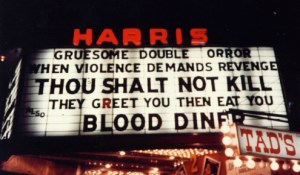
First off, I should confess.  I have commitment issues, I know it.  I realize that, as a result of some personal experiences in the past, that I tend to beg for affection and attention even while I’m putting up my own invisible wall to keep anyone from getting too close.  It’s not easy for me to trust but, after writing for this site since May, I feel like maybe it’s time to share a little bit more about me.  Hi.  My name is Lisa Marie.  I’m 24.  I have three older sisters that I love.  I’m a proud to be an Irish-German-Spanish-Italian-American.  I lived in five different states before I was 13 and I’m rarely amused when people point out the country twang in my voice.  Up until I was 17, ballet was my life but then I fell down a flight of stairs, broke my ankle in two places, and that was the end of that.  I worked very hard to earn a degree in Art History.  Not surprisingly, my current job has nothing to do with art or history.  I have asthma and heterochromia (my right eye is a darker shade of green than the left).  I’m blind without my contacts.  I like cats, driving fast, and being single.  I dislike dogs, needy men, and those tiny little smart cars.  The only thing that can equal my love for the Grindhouse is my hatred for the Mainstream.

Here’s a few reasons why.

1) Before Independent Film, there was the Grindhouse.

Today, if a young director wants to show what he’s capable of doing, he makes his own little film and enters it into various film festivals and, if he’s made something interesting, he might sign a distribution deal and his film might pop up down here in Dallas at the Angelika theater.  In the 70s, that young director would make an exploitation film, hope that it had enough sleaze appeal to make back its budget by playing in a New York Grindhouse (or a Southern drive-in) and, if he had made something interesting, his cheap, exploitation film might eventually end up being released on DVD by Anchor Bay or Blue Underground.  The best Grindhouse films were made by director who were eager to show what they were capable of doing.  These movies were not made by multimillionaires with houses on both coasts of the country.  Grindhouse movies were made by director who had to work to create something memorable, filmmakers who knew that they might never get another chance to put their vision on-screen.

2) The Mainstream Lies.  The Grindhouse is honest.

Mainstream films are just that.  They are films designed to appeal to the widest possible audience.  A mainstream movie is not made for you.  A Mainstream movie is made to appeal to the brain-dead suburbanites who can be easily recruited at the local mall to be a part of a test screening.  A Mainstream movie is made to be inoffensive.  A Mainstream movie is edited and re-edited to remove anything that could possibly negatively reflect on the bottom line.

Grindhouse movies, however, didn’t have time for that.  Grindhouse movies were made to exploit the moment.  As a result, there was no time to worry about appealing to everyone.  There was no time to constantly edit until not a single rough edge remained.  Grindhouse films are messy.  Grindhouse films are not always pleasant.  They don’t always have the perfect ending.  In short, Grindhouse movies are like life itself.

In the end, safe and inoffensive mainstream movies are made to appeal to the who we wish we were.  Grindhouse movies — sordid, sometimes uncomfortable, and always appealing to the audience’s most primal thoughts, fears , and desires — are made to appeal to who we actually are.
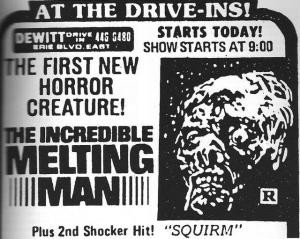
3) The Mainstream is bland.  The Grindhouse is dangerous and unpredictable.

Where else but in a Grindhouse film could you hear a killer who speaks like a duck like in Lucio Fulci’s The New York Ripper?  Because the Grindhouse was free of the need to try to fit in with what the mainstream decreed to be normal, the Grindhouse had the freedom to come up with some of the most brilliantly demented plots in the history of film.  When was the last time that the plot of a Mainstream film really caught you off guard?  I’m not talking about safe, inoffensive surprises like Avatar‘s 3-D effects.  I’m talking about a plot where, halfway through, you look at your fellow viewer and you both say, “What the fuck was that!?”  Anything can happen in the Grindhouse.  As soon as things start to feel safe and a little boring, the Grindhouse has the ability to make things exciting again.  The Mainstream, meanwhile, just asks you to get married.
4) The Mainstream always condescends.  The Grindhouse occasionally empowers.

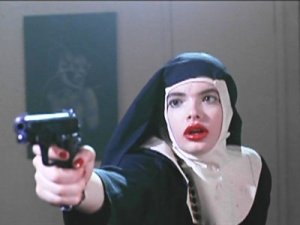
Here’s a story of two movies.  In the mainstream Brave One, Jodie Foster gets a gun after she’s raped and her dog is stolen.  (In typical mainstream fashion, the movie doesn’t seem to be sure which crime is supposed to be worse.)  In the grindhouse Ms. 45, Zoe Tamerlis gets a gun after she’s raped twice in one day.  In the Brave One, Foster passively sits on the New York subway and waits until she threatened with rape a second time before she kills the potential rapist.  In Ms. 45, Tamerlis shoots every man she sees because she knows that every man she sees is a potential rapist.  In The Brave One, Foster gets her revenge by remaining the victim.  In Ms. 45, Tamerlis becomes the aggressor.  Both Foster and Tamerlis act in self-defense but Foster is wracked with guilt because the mainstream cannot risk losing its audience.  Tamerlis becomes stronger and more confident with each murder as, for the first time, she has found a way to control her own destiny.  At the end of The Brave One, Foster is not only rescued by a man but she gets her dog back too.  At the end of Ms. 45, Tamerlis goes on a shooting rampage at a Halloween party and is finally killed by another woman.  The Brave One‘s tag line was “How many wrongs to make it right?”  Ms. 45’s tagline: “She was used and abused and it will never happen again!”

I know this is probably going to be my most controversial argument.  Don’t get me wrong, I’m not advocating that we should just go out and start randomly shooting men.  But, I will say this — in Ms. 45, Zoe Tamerlis refuses to be a victim and she — and the film — refuses to let society off the hook.  When I think about Ms. 45, it doesn’t inspire me to hate men (because, trust me, I don’t) and it certainly doesn’t inspire me to grab a gun and start shooting.  It does, however, inspire me to not allow myself to fall into that never-ending cycle of victimhood.

I’m not attempting to argue that Grindhouse films are secretly feminist films.  Grindhouse films are infamous for exploiting women.  However, so does the mainstream.  (Of the two films, The Brave One features nudity.  Ms. 45 does not.)  Both the Grindhouse and the mainstream obviously get off on victimizing women.  However, in the Grindhouse, women were occasionally (though certainly not often) allowed to fight back with the same aggression and determination that the mainstream, for the most part, usually reserves just for men.

(If The Girl With The Dragon Tattoo had been released in the 70s, it would have played at the Grindhouse.)

5) Lastly, and most importantly, the Grindhouse is still our little secret.

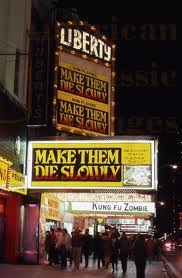
Let’s just admit it — independent films are trendy.  Contemporary independent films have, to a large extent, become the new mainstream.  The earnest film students who had a Sundance hit are now going to Hollywood to make the next Benjamin Button.  Sundance is just ShoWest with more facial hair.  However, the old school grindhouse will never sell out because it no longer exists.  It was destroyed by the morality police before it could sacrifice its soul.  While an independent filmmaker is just a director who will eventually grow up and break your heart, the great Grindhouse films are frozen in time, too sordid to ever be corrupted.  The Mainstream will never embrace the Grindhouse and for that reason, the Grindhouse will always be the ultimate statement of freedom.
Highschool of the Dead: Episode 4 – First Impressions


We’re now an third into the first season of Madhouse’s anime adaptation of the Highschool of the Dead manga. The first three episodes have been used mostly as a set-up to lay out the basic premise of the anime series in addition to introducing the main players. The third episode also sets-up conflict between two groups of survivors as our students (plus one ditzy school nurse) must contend with another teacher (Shido-san) who seems to have some ulterior motives in trying to proclaim himself the appointed leader of the surviving students and faculty in the school bus which just escaped from zombie-infested school.

So far, the series has followed closely the storyline from the manga. There’s been some minute changes to character backstory and certain scenes have been extended or given more time to develop unlike their original manga. Still the writers for the anime look comfortable enough in following the manga with some fidelity instead of venturing on a different path or switching the order of story-arcs around like how some anime adaptation of manga series in the past.

If there’s one thing to take away from this fourth episode it is that the Anime Network’s simulcast of the series definitely has censored the more ecchi scenes to make them more acceptable to North American audiences. I like to point out specifically the sequence at the gas station between Takashi, Rei and the crazed human who holds Rei hostage. In the manga this scene definitely remains uncensored (though it remains to be seen whether Yen Press will keep it that way when they bring the manga over to the North American market), but in the simulcast the scene has some of the details blurred out, but not enough that the audience cannot figure out what is going on.

I definitely think that the more blatant use of fan-service deeper into the series will get the same treatment. This definitely will mean the dvd set when its released better have these scenes uncensored or there will be much declarations of shenanigans sent Sentai’s way. But now that censoring of these scenes have been established further use of it in upcoming episodes shouldn’t come as surprise so I shall keep my complaints to this recap and leave it at that. Other than that the episode was good just like the previous three and I don’t see the series doing nothing but continue to be very good as it moves forward.