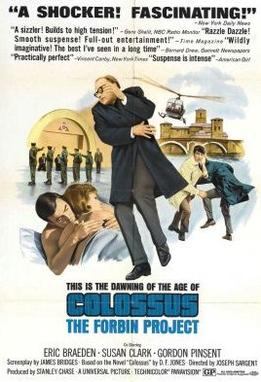
Colossus: The Forbin Project (1970, directed by Joseph Sargent)


Deep in a complex that is hidden away in the Rocky Mountains, Dr. Charles Forbin (Eric Braeden) has put together and programmed a computer called Colossus.  A super computer, Colossus has been designed to control the nuclear arsenal of the United States and its allies.  Colossus will not only keep America safe but it was also remove the chance of human error or human hesitation.  No longer will two men sitting in a silo with a key have to make the decision whether to obey the orders coming from the commander in chief.  No longer will people have to make the split-second decision that could plunge the world into war.

To Forbin’s surprise, the Soviet Union has developed their own super computer, called Guardian.  Colossus asks to be “linked” to Guardian and the Russians agree to allow it as a gesture of good will.  What no one realizes is that both computer systems have become sentient and that they soon decide that humans cannot be trusted to not destroy themselves and the planet.  To Forbin’s horror, Colossus starts to take over the world.

Based on a novel by Dennis Feltham Jones, Colossus was originally filmed in 1968 but it wasn’t released until 1970.  The film looks dated with its gigantic computer but it feels prophetic with its storyline about an AI taking over the world and deciding that it knows better than its makers.  Director Joseph Sargent adroitly mixes science fiction with Bond-style intrigue as Charles Forbin tries to reason with his creation and both the CIA and the KGB try to take down the computers.  The film even tosses a bit of 70s-style paranoia, with both the American and the Soviet governments trying to keep the public from discovering that the supercomputers are trying to take over the world.

Colossus: The Forbin Project is an intelligently written and thought-provoking science fiction film.  Eric Braeden does a great job as Charles Forbin, the engineer who goes from being arrogant and cocky to desperate to finally defiant as his creation slips out of his control.  William Schallert, so often cast as a nice father figure, turns in a good performance as the head of the CIA as does Susan Clark, cast as a colleague who has to pretend to be Forbin’s mistress just so she and Forbin can talk and plot without being monitored by Colossus.

Colossus is a smart sci-fi film that is more relevant than ever.
Late Night Retro Television Review: Highway to Heaven 4.2 “Man’s Best Friend, Part 2”


Welcome to Late Night Retro Television Reviews, a feature where we review some of our favorite and least favorite shows of the past!  On Thursdays, I will be reviewing Highway to Heaven, which aired on NBC from 1984 to 1989.  The entire show is currently streaming on Tubi and several other services!

This week, the fourth season premiere concludes.

Episode 4.2 “Man’s Best Friend Part 2”

(Dir by Michael Landon, originally aired on September 23rd, 1987)

Picking up where last week’s episode, this episode opens with Alex (Danny Pintauro) visiting Jake the Siberian Husky at the big home that Jake shares with Jenny (Elisabeth Harnois), her grandfather (William Schallert), and her parents, Paul (Stan Ivar) and Michelle Raines (Laurie Walters).

Yay!

Alex’s attitude improves so much that it’s decided to move him into a foster home.

Uhmm….what about the Raines family?

The surrogate hired to carry Paul and Michelle’s baby loses the baby.  Paul and Michelle are heartbroken.

Uhmm….hey, I think Alex needs a family….

Jenny gives Jake to Alex.

Awwww!

Alex’s foster family lives in a building that doesn’t allow pets.

Oh no!

Alex and Jake run away and, after nearly dying in the desert, they end up with the Raines family’s home.

I see where this is going….

If you guessed that Paul and Michelle announce that they’re going to adopt Alex and that Jake is going to continue to live with them on the ranch, congratulations!  You could have been a Highway to Heaven writer!

This episode didn’t make me cry as much as last week’s, mostly because it was pretty easy to see where things were heading from the beginning.  Even when Alex and Jake were lost in the desert, I knew they would be okay because this is Highway to Heaven.  Children and their adorable dogs don’t die on this show. (Except, of course, for those two times that they did.  Actually, three times, now that I think about it.)    That said, I was still relieved when Jake was rescued because seriously, that dog was adorable!

This was a good conclusion to last week’s episode.  Everything worked out for the best.  At the end of the episode, Mark said that he understood why “they call them man’s best friend.”  Michael nodded and then said, a little sadly, “Shouldn’t man’s best friend be …. man?”

You tell ’em, Hippie Angel!

You tell them.

Late Night Retro Television Review: Highway to Heaven 4.1 “Man’s Best Friend Part One”


Welcome to Late Night Retro Television Reviews, a feature where we review some of our favorite and least favorite shows of the past!  On Thursdays, I will be reviewing Highway to Heaven, which aired on NBC from 1984 to 1989.  The entire show is currently streaming on Tubi and several other services!

This week, we start the fourth season of Highway to Heaven.  This episode features orphans and dogs!  I feel the tears coming….

Episode 4.1 “Man’s Best Friend Part One”

(Dir by Michael Landon, originally aired on September 16th, 1987)

Oh, this episode made me cry and cry.

Why?  Well, for a couple of reasons….

First off, Jonathan and Mark got new jobs working at a kennel.  Many of the dogs at the kennel had been abandoned by their owners and Ms. Lil (Fran Ryan) took care of them all, rather than taking them to the pound.  And listen, I’m not a dog person.  I’m a cat person.  We all know this.  But seriously, those dogs were adorable!

A Siberian husky named Jake gets lost.  After running across the interstate (gasp!), he finds himself alone at night.  Coyotes approach.  (OH NO!)  Suddenly, Jonathan appears and turns into a lion, scaring the coyotes off.  (*sniff*  *sniff* I’m okay.)

Every few days, Lil takes the dogs down to the local orphanage — (OH MY GOD!) — and lets them play with the orphans.  Jake, now a part of the kennel crew, begs young Alex (Danny Pintauro, who had a much worse experience with a dog in Cujo) to play with him.  Alex is shy and introverted but Jake quickly becomes his best friend.  Alex starts to come out of his shell and says that he knows he’ll never be separated from Jake.  For the first time in his young life, Alex is happy.

(Oh dear.)

The local media does a story on Lil and her dogs.  They take a picture of Alex and Jake.  The next morning, a young girl named Jenny (Elisabeth Harnois) sees the picture and recognizes Jake.  For the past month, she’s been desperately looking for Jake!

(This isn’t good….)

Jenny and her grandfather (William Schallert) pick Jake up from the kennel.  Jonathan has to go to the orphanage and tell Alex that his best friend is no longer going to be visiting him.

(Sorry, give me a minute.)

Alex is depressed.  Jake is depressed.  Jonathan shows at Jenny’s home and asks if Alex can come and visit Jake.  Jenny and grandpa say yes.  (YAY!)

Suddenly, three dreaded words appear on the screen: “TO BE CONTINUED”

What!?  No, there’s no need to continue.  Alex and Jake have been reunited, let’s end the story here….

This episode was Highway to Heaven at its most earnest, manipulative, and effective.  Not only did it feature orphans but also an adorable dog and William Schallert as a genial authority figure.  There was also a subplot about Jenny’s parents trying to have another child with a surrogate and I’m sure that has something to do with that promise of “TO BE CONTINUED.”

Nothing better happen to the dog!

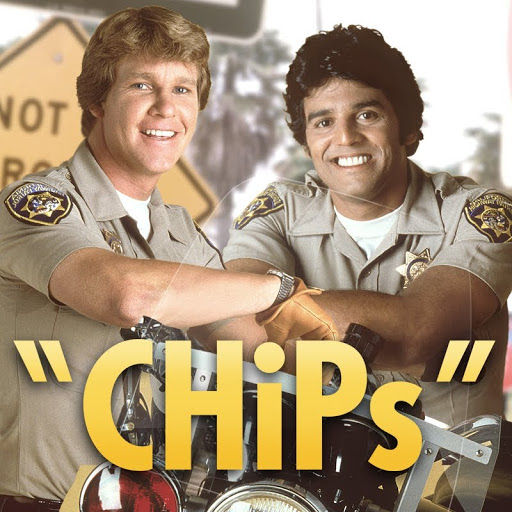
Late Night Retro Television Review: CHiPs 3.15 “Christmas Watch”


Welcome to Late Night Retro Television Reviews, a feature where we review some of our favorite and least favorite shows of the past!  On Mondays, I will be reviewing CHiPs, which ran on NBC from 1977 to 1983.  The entire show is currently streaming on Prime!

Merry Christmas!

Episode 3.15  “Christmas Watch”

(Dir by Phil Bondelli, originally aired on December 15th, 1979)

It’s Christmas in Los Angeles!  Bob (Don Reid) and Alice Piermont (Pamela Susan Shoop) are a married couple who drive around in a blue van and rob people.  They steal a 15 century bell from an orphanage!  How can the orphans have a merry Christmas without their bell!?

Don’t worry, Ponch is on the case!  Ponch will not only find their bell but he’ll date their teacher as well.  Of course, Ponch is feeling a little down because his family is in Chicago.  But then his mother (Anna Navarro) shows up and, in a rare nod to continuity from this show, his mother is played by the same actress who played her the last time that she came down to Los Angeles.  Ponch not only get to spend time with his mother but he also gets a boost when a businessman who was earlier cited for driving while intoxicated shows up at the station so that he can thank Ponch in person.  The lesson this Christmas?  Ponch can do no wrong.

The thieving couple is caught after the are involved in a accident and, instead of waiting for the police to arrive, they just slip a few thousand to the other driver and then try to escape.  No such luck.  They are captured and the kids get back their bell.  Merry Christmas to all, except for the couple going to jail.

This was a typical episode of CHiPs, in which the California sun continued to shine while everyone celebrated Christmas.  There were a few decent chases and some nice shots of the local scenery.  In the end, Ponch did everything right and got a date.  Merry Christmas!  It wasn’t a bad episode, especially if you’re a fan of Erik Estrada.  Larry Wilcox fans will probably be a little disappointed in how little there was for him to do.  It’s the holidays and CHiPs is all about Ponch.


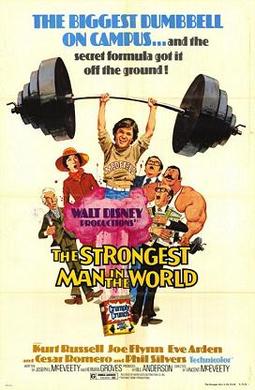
I Watched The Strongest Man In The World (1975, Dir. by Vincent McEveety)


Dexter Riley (Kurt Russell) is back, again!  He still hasn’t graduated from Medfield College and Medfield is still on the verge of going broke.  Dean Higgins (Joe Flynn) discovers that the reason Medfield can never get out of the red is because the science class and students like Dexter are spending so much money on their experiments.  The Dean fires the science professor and threatens to expel Dexter!  But when Dexter’s latest experiment develops a type of milk that gives the drinker super strength, the Dean might have to change his mind.

A cereal company wants to buy the supermilk, which would get Medfield out of the hole.  But a rival cereal company just wants to steal the formula for the milk so they hire disgraced businessman and gangster A.J. Arno (Cesar Romero) to once again try to thwart the best laid plans of Medfield College.  Meanwhile, Dexter competes in a contest to prove that the supermilk has truly made him into the strongest man in the world.

The plot of the last Dexter Riley movie somehow manages to be even dumber than the first two and it was high time for Dexter to graduate and get on with his life but The Strongest Man In The World did make me laugh a few times.  Because this entry in the series involved super strength instead of invisibility or merging with a computer, it allowed for more physical comedy and it felt less dates than the other two movies.  The action is pretty much nonstop, as Dexter gets into one scrape after another and the cast is likable even if they all were getting a little old to still be playing college students.  Like the other Dexter Riley films, The Strongest Man In The World is too innocent and good-natured not to enjoy on some level.

I guess Dexter finally graduated after this movie.  Both he and Kurt Russell went on to better things.

I Watched The Computer Wore Tennis Shoes (1969, Dir. by Robert Butler)


Medfield College has a problem.  No one takes the college seriously.  Maybe if the college could win the big college quiz show, people would finally stop laughing at Medfield but the students are not academically talented.  Professor Quigley (William Schallert) thinks that the college needs to finally buy a new-fangled device called a computer.  The Dean (Joe Flynn) says that there’s no way any college can afford something as expensive as that!  Luckily, businessman and gangster A.J. Arno (Cesar Romero) is willing to donate one of his computers.  It takes several students to move the computer into the lab because the computer is huge.

Medfield finally has a computer but are the students smart enough to win that quiz show?  Popular jock Dexter Riley (Kurt Russell) happens to be in the lab during a freak thunderstorm.  When both he and the computer get struck by lightning at the same time, it leads to Dexter becoming a human computer.  He suddenly knows everything.  He can speak any language and solve any equation.  He can answer any question/  Whenever anyone shines a light into Dexter’s ear, they see circuit boards.  No one really cares that none of this makes sense.  Medfield is going to win that quiz show for sure!  But first, Dexter is going to have to escape from Arno, who fears Dexter now knows all the details about his gambling ring.

Watching this Disney film was a real eye-opener for me.  Computers are such a part of my everyday life that it was strange seeing a college making such a big deal about getting one.  The computer that Medfield got looked more like the type of computer that NASA used to go to the moon than the ones that were in my high school computer lab.  I was worried that no one seemed to care that Dexter had a circuit board in his head.  Not even Dexter seemed to care.  It was also funny to me that all he had to do was get struck by lightning while standing near a computer and suddenly, he knew how to speak every language and solve every problem.  I use a computer everyday and I can still only speak English and Spanish.  I feel like I’m getting cheated.

The whole movie was absolutely ludicrous but I did enjoy watching this movie.  It was too sweet, innocent, and good-natured not to enjoy.  There was nothing realistic about the movie but it was nice to imagine a world where everyone gets along, the bad guys are all too buffoonish to really be dangerous, and a serious knock on the head leads to thing returning to normal instead of permanent brain damage.  Kurt Russell was only 18 when he made The Computer Wore Tennis Shoes but he could already carry a movie.

Horror On TV: One Step Beyond 1.6 “Epilogue” (dir by John Newland)


Carl Archer (Charles Aidman) is a recovering alcoholic who returns home after an extended stay in a rehab.  His wife (Julie Adams, of Creature of the Black Lagoon and The Last Movie fame) is skeptical about whether or not Carl has really sobered up and is prepared to be a responsible father to their son, Steve (Charles Herbert).  When Steve gets trapped in a cave, will Carl be able to use their psychic connection to find and rescue him?

Can you prove this didn’t happen!?

This episode originally aired on February 24th, 1959.

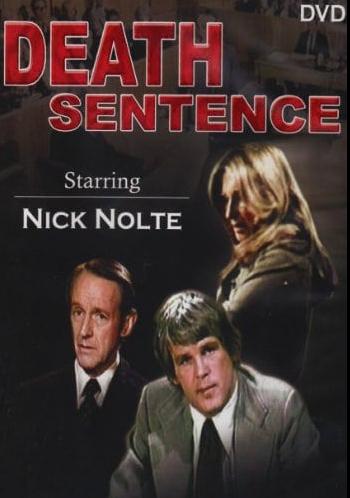
Retro Television Reviews: Death Sentence (dir by E.W. Swackhamer)


Welcome to Retro Television Reviews, a feature where we review some of our favorite and least favorite shows of the past!  On Sundays, I will be reviewing the made-for-television movies that used to be a primetime mainstay.  Today’s film is 1974’s Death Sentence!  It  can be viewed on YouTube!

There’s been a murder!

A young woman has been strangled in her own home.  The nosy neighbor (Hope Summers) testifies that the woman often argued with her woman and that she heard the woman yelling on the night of the murder.  The husband, John Healy (Nick Nolte), is found in a neighborhood bar and, when he’s brought back to his house, his drunken reaction to seeing his dead wife doesn’t do much to keep him from looking totally guilty.

However, the viewer knows that John is innocent because the viewer has already seen that the woman was murdered by Don Davies (Laurence Luckinbill), the man with whom she was having an affair.  She demanded that he leave his wife for her and Don, realizing that his cheating was about to revealed, responded by strangling her.

Don’s wife is Susan Davies (Cloris Leachman), who knows that she and Don have been going through a rough patch but who certainly had no idea that Don was cheating on her.  Shortly after the murder, Susan is called up for jury duty.  She’s placed on the jury and told that she will be an important part of a major trial.  As a result, she and the other jurors will be sequestered in a hotel….

And who is the defendant in this trial?  John, of course!

As opposed to the other members of the jury, who are ready to convict John even before the first bit of testimony is heard, Susan pays attention to what is said in the courtroom.  She listens to Lubell (Alan Oppenheimer), the prosecutor.  She listens to Tanner (William Schallert), the defense attorney.  She comes to believe that John is innocent but will she be able to hold her own against the rest of the jury?  And will she ever figure out that the murder was actually committed by her husband?

It’s an intriguing premise, even if it is a bit far-fetched.  I mean, it really is an amazing coincidence that Susan just happened to end up on the jury for a case involving a murder that was actually committed by her husband.  However, this is a made-for-television movie and, as soon as “Produced by Aaron Spelling” appears on the screen, most viewers should be savvy enough to know what they’re getting into.  Instead, the main problem with the film is that it opens by showing us who the murderer is.  Therefore, there’s really zero suspense as to who actually committed the crime.  Instead, the viewer spends the entire movie waiting for Susan to catch up.  Since the majority of the film takes place in court, it’s a very talky film but there’s no joy to be found in paying close attention to every word said and picking up on the details that will allow you to solve the crime for yourself.  This is a case where the film spoils its biggest twist and, despite good performances from Leachman and Luckinbill, it’s a bit dull.

(Nick Nolte, for his part, spends most of the movie silently sitting in the courtroom.  He’s not bad and his look of anguish is believable but it’s hardly a starring role, regardless of what the film’s video packaging might otherwise claim.)

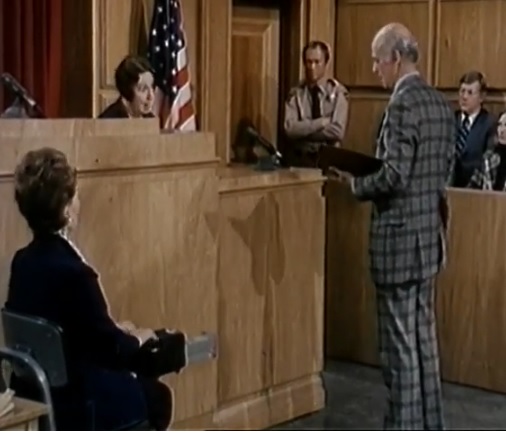
In the end, what I’ll mostly remember about Death Sentence were the atrocious fashion choices made by the prosecutor.  Seriously, would you trust a man wearing this suit?

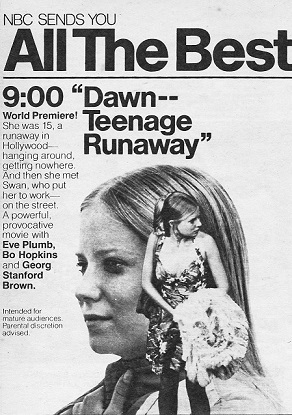
Retro Television Reviews: Dawn: Portrait of a Teenage Runaway (dir by Randal Kleiser)


Welcome to Retro Television Reviews, a feature where we review some of our favorite and least favorite shows of the past!  On Sundays, I will be reviewing the made-for-television movies that used to be a primetime mainstay.  Today’s film is 1976’s Dawn: Portrait of a Teenage Runaway!  It  can be viewed on YouTube!

Dawn Wetherby (Eve Plumb) is fifteen years old.  She’s naive.  She’s innocent.  She’s …. well, let’s just be honest and admit that she’s not particularly bright.  Sick of being embarrassed by her alcoholic mom (Lynn Carlin), Dawn decides to hop on a bus and travel to Hollywood.  Maybe she can make a new life for herself in California.

Of course, it doesn’t take long for Dawn to discover that Los Angeles is not a city where dreams magically come true.  It’s a tough and harsh town and it’s not like Dawn has any money or any particular skills.  When she tries to get a job, she’s told that she’s too young.  When she tries to rent a room, she’s told that ten dollars is not enough to cover two weeks rent.  When she gives a dollar to a boy who says that he needs it, he responds by mugging her for the rest of her cash.  A prostitute named Frankie Lee (Marguerite DeLain) takes some sympathy on Dawn and tells her to call if she ever wants to make some money.

Eventually, a nasty cough leads to Dawn going to the free clinic.  That’s where she meets Alexander (Leigh McCloskey).  Alexander is a teen runaway, just like Dawn.  However, Alexander also can somehow afford an apartment and food to eat.  Alexander invites Dawn to live with him and Dawn, realizing she has no where else to go, agrees.  Alexander offers to look after her but, after Dawn discovers that Alexander makes his money by working as a male prostitute, Dawn decides that she needs a job of her own.

It’s time to call Frankie Lee!  And it’s time for Frankie Lee to introduce Dawn to Swan (Bo Hopkins), a pimp who lives in a nice house and who offers to put Dawn to work….

Dawn: Portrait of a Teenage Runaway is an earnest film that was obviously made with the best of intentions and which actually did have something say, in its melodramatic way, about the dangers of running away from home and trying to make it on your own when you’re not even old enough to drive.  That said, I imagine that most people who go through the effort to track down this film will do so because it stars The Brady Bunch‘s Eve Plumb as an underage runway who ends up walking the streets and taking men back to her motel room.  The movie might as well be called Jan Brady Goes Bad, because Eve Plumb does essentially give the same performance that she gave when she was playing the whiniest member of the Brady Bunch.  There’s nothing tough or streetwise about her, which works for the first half of the film but not during the second half.  Once Dawn has been on the streets for a bit, you would expect her to toughen up a bit but she still comes across like she’s mad at Greg and Bobby for tying up the phone.  Dawn goes through a lot and becomes a bit jaded as a result but, every time she speaks, you expect her to exclaim, “Why does Marcia get to runaway from home but I don’t?  It’s not fair!”  Far more impressive are the performances of Bo Hopkins and, in the role of Dawn’s probation officer, George Stanford Brown.  William Schallert also has a good bit as Dawn’s first client, who ends up feeling so sorry for Dawn that he just give her twenty dollars and then tells her to go back home.

Dawn: Portrait of a Teenage Runway is one of those film that was obviously designed to make parents worry about their kids.  It seems to be asking, “Do you know where your children are tonight?”  In 1976, I imagine they were busy watching Jan Brady try to make it on the mean streets of Hollywood.

Retro Television Reviews: Under the Influence (Dir by Thomas Carter)


Welcome to Retro Television Reviews, a feature where we review some of our favorite and least favorite shows of the past!  On Sundays, I will be reviewing the made-for-television movies that used to be a primetime mainstay.  Today’s film is 1986’s Under the Influence!  It  can be viewed on YouTube!

Noah Talbot (Andy Griffith) is an upstanding member of the community.  He owns a hardware store.  He has a large family.  He’s known as a gruff but folky storyteller.  He’s a deacon in his church and helps to collect the offering every Sunday.

He’s also a drunk and a bit of a bully.  His family walks on eggshells around him, fearful of setting him off on one of his benders.  He occasionally spends the night in jail, arrested for trying to drive drunk.  Even when he gets bailed out, his first instinct is to go back to the bar.  The folks at the bar love him, don’t you know.  The people at the bar are always happy to see him and never bother him about whether he’s had too much.  The people at the bar never let him down the way that he feels his family has left him down.

The members of his family each cope in their own individual way.  Noah’s wife (Joyce Van Patten) is in denial and spends a lot of her time popping pills.  His oldest daughter, Ann (Season Hubley), is driven to succeed at work and spends all of her time both hating her father and desperately hoping for his approval.  (When she tells him that she got a raise at work, he berates her for only getting a 6% increase in her salary.  “That’s just a cost of living increase!” he snaps at her.)  His eldest son, Stephen (Paul Provenza), fled to Los Angeles and is trying to make a career as stand-up comedian.  (“You’re no David Letterman,” Noah tells him.)  His youngest daughter, Terri (Dana Anderson), secretly replaces Noah’s liquor with water and food-coloring.  And his youngest son, Eddie (Keanu Reeves), is becoming an alcoholic himself.

Having read all that, you may be wondering just how exactly Keanu Reeves could be the son of Andy Griffith and it’s a fair question.  This was one Keanu Reeves’s first acting roles and he does a pretty good job in the role of Eddie.  That said, he looks so totally different from both Andy Griffith and Joyce Van Patten and the actors playing his siblings that I was half-expecting someone to mention that Eddie had been adopted.  Then again, Paul Provenza doesn’t really bear much of a resemblance to the actors playing his parents either.  Dana Anderson and Season Hubley do, at least, look like sisters.

Lack of family-resemblance aside, all of the actors in Under the Influence do a good job of inhabiting their characters.  For those who are used to seeing Andy Griffith playing friendly Southerners in reruns of The Andy Griffith Show and Matlock, it’s shocking and a little disturbing to see him playing an abusive, alcoholic jerk in Under the Influence.  Noah is someone who would not only destroy his own family to get a drink but who would then blame them for it happening in the first place.  Noah may be under the influence of alcohol but the entire family is suffering because they’re under the influence of Noah.  By the time Noah is spitting up blood and demanding that his youngest son sneak liquor into his hospital room, the viewer knows there is no hope for Noah but hopefully, his family will escape.

It doesn’t make for a particularly happy movie but, speaking as someone who grew up in an alcoholic household, I can attest that it does make for an honest portrayal of what addiction does not just to the addict but also to the people around the addict.  I cringed in sympathy through nearly the entire film, especially as I watched three of the four children react in the same ways that I did.  (Unlike Eddie, I never became much of a drinker and instead developed an aversion to alcohol in general.)  It’s a film that feels real and one’s heart aches for the entire family.  If it could happen to Andy Griffith, it could happen to anyone.