Retro Television Review: Miami Vice 5.2 “Redemption In Blood”


Welcome to Retro Television Reviews, a feature where we review some of our favorite and least favorite shows of the past!  On Mondays, I will be reviewing Miami Vice, which ran on NBC from 1984 to 1989.  The entire show can be purchased on Prime!

This week, Sonny Burnett continues his reign of terror!

Episode 5.2 “Redemption in Blood”

(DIr by Paul Krasny, originally aired on November 11th, 1988)

When last we checked in with Miami Vice, Sonny thought he was a drug lord named Sonny Burnett and he was firing his gun at Tubbs, who he had just recognized as a cop.  This episode reveals that Sonny didn’t shoot Tubbs.  Instead, he aimed at a wall, firing while Tubbs made his escape.

Working with the psychotic Cliff King (Matt Frewer), Sonny takes over his late boss’s drug empire and continue to fight a war against El Gato (Jon Polito).  El Gato is meant to be a “flamboyant” drug dealer, which is a polite way of saying that Polito overacts through the entire episode.

The show hedges its bets by having Cliff commit all of the murders while Sonny rises to power.  In fact, when Sonny catches Cliff torturing two of El Gato’s men, Sonny orders Cliff to stop and then offers them jobs in the Burnett operation.  Amazingly, over the course of the entire three-episode Burnett arc, Sonny manages to get through the whole thing only killing people in self-defense.  Even the cop that he killed at the end of the previous season was a dirty cop who had been sent to kill him.  I get that the show couldn’t take Sonny totally over to the dark side but it’s still hard to believe that Burnett took over the Miami underworld without getting his hands a bit more dirty than he did.

A car bomb (courtesy of El Gato) knocks Sonny unconscious and, when he wakes up, he suddenly starts to remember who he actually is.  Finally realizing that his name is Crockett, Sonny turns himself into the Vice Squad and is promptly arrested while Kate Bush sings, “Don’t give up.”  Sonny tells Castillo, Switek, and Tubbs that he’s ready to acccept the consequences of whatever he did during his previous bout of amnesia.  But then Sonny escapes custody and sets up both Cliff and El Gato for a great fall so I guess he wasn’t totally ready to turn himself in and head off to prison.

Tubbs, who now trusts Sonny, helps him take out Cliff King and the Burnett organization.  Sonny shoots Cliff to save Tubbs.  With Tubbs dangling off of a walkway, Sonny pulls him back up to safety.  Sonny then goes back to his mansion where he and his girlfriend (Debra Feuer) are taking hostage by a gun-wielding El Gato.  “Where is the safe?” El Gato demands.  Sonny tricks El Gato into thinking the safe is in the room where he keeps his pet panther.  (Apparently, all drug lords were given either a tiger, a panther, a cheetah, or a leopard.)  El Gato gets mauled to death as the episode ends.

This episode suggests that Sonny is going to be let off the hook because he finally remembered he was.  I don’t really think that it would really work like that.  Sonny has multiple warrants out and he also killed a cop, albeit a corrupt one.  If Sonny isn’t on trial in next week’s episode, I’m going to be a little annoyed.

This episode ended the Burnett trilogy about as well as it could be ended.  The idea that all Sonny needed was to survive a second near-fatal explosion made me smile.  What if El Gato hadn’t tried to blow him up?  I guess it’s a good thing that he did!  While Polito went overboard, Matt Frewer gave a very good performance as the villainous Cliff King.  It’s a bit of a shame that he died so dramatically because Cliff would have made a good recurring villain.

This episode was definitely better than anything from season 4.  It’ll be interesting to see how the rest of season 5 plays out.
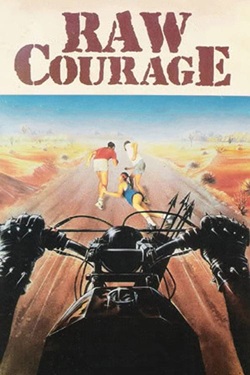
Raw Courage (1984, directed by Robert L. Rosen)


Three friends (Ronny Cox, Art Hindle, and Tim Maier) leave their families behind and go on a 72-mile run through the desert of New Mexico.  They’re marathon runners and they are trying to survive the ultimate challenge.  Instead, they run into a right-wing militia led by “Colonel” Crouse (M. Emmet Walsh) and Sonny (William Russ).  Soon, the joggers are being chased through the desert.  Their survival depends on if they have the raw courage to make it back to civilization.

Raw Courage was written and produced by Ronny Cox and I like to think that he made this movie as his way to get back at everyone who typecast him as a victim after Deliverance.  Cox’s jogger never gives up in Raw Courage, even while being chased through the broiling desert by a bunch of madmen on motorcycles.  Cox and Art Hindle both give good performances and their well-matched by Walsh and Russ.  (Unfortunately, Walsh’s role in pretty small.  Most of the actual villainy is committed by William Russ.)  Cox and Hindle both play intelligent men who just happened to find themselves in the wrong place at the wrong time.  That the victims are sympathetic and you actually care about whether or not they make it back to their families elevates the film.

The film does start to run out of gas towards the end.  The scenes of our heroes running through the desert start to get repetitive.  Raw Courage is still an exciting action film and it’s flat, made-for-TV look is probably less of a problem when viewed on YouTube than it was when the movie was initially released.  The film provides a rare starring role for Ronny Cox, four years before Robocop typecast him as everyone’s favorite corporate villain.  Cox delivers.  It’s a shame he didn’t get to play more heroes.

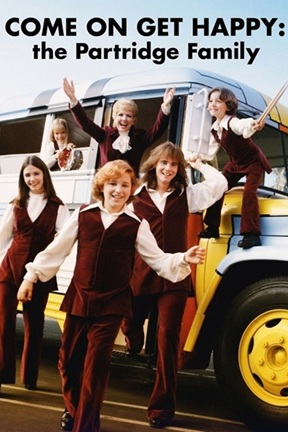
Come On Get Happy: The Partridge Family Story (1999, directed by David Burton Morris)


In 1969, a group of television network executives get together and decide the world needs a sitcom that will mix music with family comedy.  The result is The Partridge Family.  While Shirley Jones (Eve Gordon) tries to keep her television family safe from the networks and, in some cases, their own dysfunctional families, David Cassidy (Rodney Scott) struggles with being a teen idol and Danny Bonaduce (Shawn Pyfrom) deals with living with an abusive father (William Russ).  Danny finds a new father figure in the form of co-star Dave Madden (Michael Cheiffo) while Danny dates his tv sister, Susan Dey (Kathy Wagner).

This was one of the many made-for-TV movies that took advantage of boomer nostalgia at the turn of the 20th Century.  Like most of those movies, Come On Get Happy is on the shallow side, providing the details that everyone had already heard without digging too far underneath the surface.  The main thing that sets this film apart from so many other behind-the-scenes movies is that the cast, for the most part, actually resemble the real-life people that they’re playing.  That’s especially true in the case of Shawn Pyfrom.  If you’re a fan of the show or Cassidy’s music, this movie might appeal to you.  I Think I Love You is still a banger.

It’s well-made but it’s still hard not to feel that it would have been more entertaining just to watch a 2-hour interview with the real-life Danny Bonaduce.

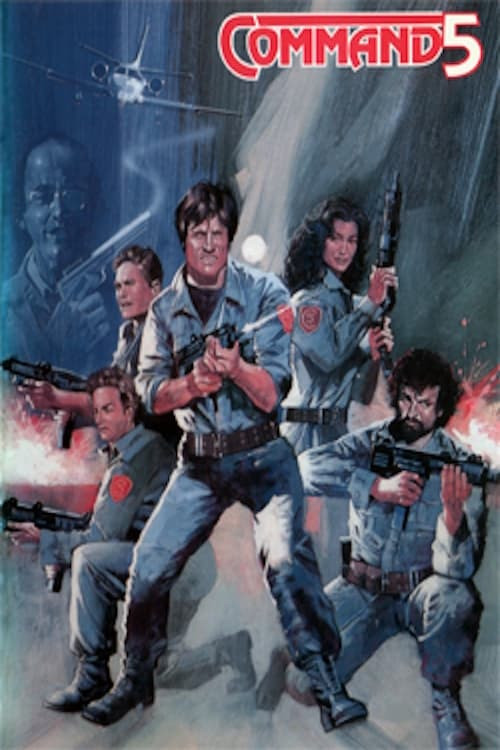
Command 5 (1985, directed by E.W. Swackhamer)


Morgan (Stephen Parr) is a mysterious government operative who puts together a special paramilitary force to take on extreme threats.  He says that only misfits are allowed to join his group because they have the edge he needs.  Smith (William Russ) is a wild Texan who drives like a maniac.  Psychiatrist Winslow (Sonja Smits) can fire an Uzi better than any man.  Kowalski (John Matuszak) is a demolitions expert who listens to Beethoven.  Jack Coburn (Wings Hauser) is a rebellious detective who is good with a throwing knife.

After a montage of their extensive training and a scene where our heroes take a look at the bullet-proof RV that they’ll be traveling the country in, the movie finally gets down to business.  A motorcycle-riding terror cult led by Delgado (Gregory Sierra) has taken an entire town hostage and is threatening to kill everyone unless they’re given a flight out of the country.  Our heroes drive their bulletproof van into town and try to defeat the bad guys.  There’s one good scene where the RV is driving down the town’s main street and getting hit nonstop with bullets.  The scene was obviously ripped off from the end of Clint Eastwood’s The Gauntlet but it’s still exciting to watch.  Otherwise, the action in this one is pretty rudimentary.

I guess Command 5 was supposed to be a pilot for television show that never went into production.  It is very much a television production.  There’s a lot of shooting but no blood.  Wings Hauser is less dangerous than usual.  The whole thing ends with Command 5 looking forward to adventures that were never to come.  Watching the pilot, you can see why it never became a show.  The characters were all thinly-written and never seemed to have much of a connection with each other and Hauser and Russ both seemed to be competing to be the loose cannon of the group.  This one is for Wings Hauser completists only.

Lisa Marie Reviews An Oscar Nominee: The Right Stuff (dir by Philip Kaufman)


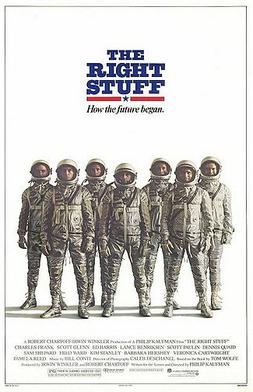
There’s a brilliant scene that occurs towards the end of 1983’s The Right Stuff.

It takes place in 1963.  The original Mercury astronauts, who have become a symbol of American ingenuity and optimism, are being cheered at a rally in Houston.  Vice President Lyndon Johnson (Donald Moffat) stands on a stage and brags about having brought the astronauts to his supporters.  One-by-one, the astronauts and their wives wave to the cheering crowd.  They’re all there: John Glenn (Ed Harris), Gus Grissom (Fred Ward), Alan Shephard (Scott Glenn), Wally Schirra (Lance Henrisken), Deke Slayton (Scott Paulin), Scott Carpenter (Charles Frank), and the always-smiling Gordon Cooper (Dennis Quaid).  The astronauts all look good and they know how to play to the crowd.  They were chosen to be and sold as heroes and all of them have delivered.

While the astronauts are celebrated, Chuck Yeager (Sam Shepard) is at Edwards Air Force Base.  Yeager is the pilot who broke the sound barrier and proved that the mythical “demon in the sky,” which was whispered about by pilots as a warning about taking unnecessary risks, was not waiting to destroy every pilot who tried to go too fast or too high.  Yeager is considered by many, including Gordon Cooper, to be the best pilot in America.  But, because Yeager didn’t have the right image and he had an independent streak, he was not ever considered to become a part of America’s young space program.  Yeager, who usually holds his emotions in check, gets in a jet and flies it straight up into the sky, taking the jet to the edge of space.  For a few briefs seconds, the blue sky becomes transparent and we can see the stars and the darkness behind the Earth’s atmosphere.  At that very moment, Yeager is at the barrier between reality and imagination, the past and the future, the planet and the universe.  And watching the film, the viewer is tempted to think that Yeager might actually make it into space finally.  It doesn’t happen, of course.  Yeager pushes the jet too far.  He manages to eject before his plane crashes.  He walks away from the cash with the stubborn strut of a western hero.  His expression remains stoic but we know he’s proven something to himself.  At that moment, the Mercury Astronauts might be the face of America but Yeager is the soul.  Both the astronauts and Yeager play an important role in taking America into space.  While the astronauts have learned how to take care of each other, even the face of government bureaucracy and a media that, initially, was eager to mock them and the idea of a man ever escaping the Earth’s atmosphere,  Chuck Yeager reminds us that America’s greatest strength has always been its independence.

Philip Kaufman’s film about the early days of the space program is full of moments like that.  The Right Stuff is a big film.  It’s a long film.  It’s a chaotic film, one that frequently switches tone from being a modern western to a media satire to reverent recreation of history.  Moments of high drama are mixed with often broad humor.  Much like Tom Wolfe’s book, on which Kaufman’s film is based, the sprawling story is often critical of the government and the press but it celebrates the people who set speed records and who first went into space.  The film opens with Yeager, proving that a man can break the sound barrier.  It goes on to the early days of NASA, ending with the final member of the Mercury Seven going into space.  In between, the film offers a portrait of America on the verge of the space age.  We watch as John Glenn goes from being a clean-cut and eager to please to standing up to both the press and LBJ.  Even later, Glenn sees fireflies in space while an aborigines in Australia performs a ceremony for his safety.  We watch as Gus Grissom barely survives a serious accident and is only rescued from drowning after this capsule has been secured.  The astronauts go from being ridiculed to celebrated and eventually respected, even by Chuck Yeager.

It’s a big film with a huge cast.  Along with Sam Shepherd and the actors who play the Mercury Seven, Barbara Hershey, Pamela Reed, Jeff Goldblum, Harry Shearer, Royal Dano, Kim Stanley, Scott Wilson, and William Russ show up in roles both small and large.  It can sometimes be a bit of an overwhelming film but it’s one that leaves you feeling proud of the pioneering pilots and the brave astronauts and it leaves you thinking about the wonder of the universe that surrounds our Earth.  It’s a strong tribute to the American spirit, the so-called right stuff of the title.

The Right Stuff was nominated for Best Picture but, in the end, it lost to a far more lowkey film, 1983’s Terms of Endearment.  Sam Shepard was nominated for Best Supporting Actor but lost to Jack Nicholson.  Nicolson played an astronaut.

#SundayShorts – WANTED DEAD OR ALIVE (1986) 


Since Sunday is a day of rest for a lot of people, I present #SundayShorts, a weekly mini review of a movie I’ve recently watched. Today’s movie is WANTED DEAD OR ALIVE from 1986. 

Former CIA agent Nick Randall (Rutger Hauer) now works as a bounty hunter. After the authorities find out that Malak Al Rahim (Gene Simmons) is responsible for blowing up buildings in Los Angeles, Nick’s former employers request his assistance. With the help of his old friend Philmore (Robert Guillaume), Nick signs on to take Malak out and end his reign of terror! 

WANTED DEAD OR ALIVE is one of those movies I enjoyed watching back in the mid-80’s as a junior high teenager. Rutger Hauer makes for a badass bounty hunter and Gene Simmons makes for a mean villain. Robert Guillaume plays Hauer’s friend and primary law enforcement contact in the movie. He was just coming off his 158 episode run on the TV show BENSON (1979-1986). Although he was good in the film, I still remember being surprised when Benson kept saying the F-word. If you like 80’s action movies and Rutger Hauer, like I do, WANTED DEAD OR ALIVE is still a fun watch. 

Five Fast Facts:

  1. Rutger Hauer plays Nick Randall, a descendant of Josh Randall, who was played by Steve McQueen on the WANTED DEAD OR ALIVE TV series that ran from 1958-1961. 
  2. Actor Ted White who portrays Pete, Charlie Higgins friend in the bar & the store robbery, also portrayed killer Jason Voorhees in FRIDAY THE 13TH: THE FINAL CHAPTER (1984).
  3. According to writer and director Gary Sherman, Mel Gibson was also considered for the part of Nick Randall since he was still largely unknown outside of Australia at the time. The producers settled on Rutger Hauer for the role because it would have cost twice as much to get Gibson for the role.
  4. Gary Sherman also directed the 1982 film VICE SQUAD starring Season Hubley, Gary Swanson, and Wings Hauser. I loved Rutger Hauer and Wings Hauser in the 80’s. Wings’ son Cole plays Rip Wheeler on the YELLOWSTONE TV series. 
  5. Gene Simmons from the rock band KISS specialized in playing bad guys on screen in the 1980’s. Aside from WANTED DEAD OR ALIVE, he was also a villain in RUNAWAY (1984) and NEVER TOO YOUNG TO DIE (1986). 

I’ve included the trailer for WANTED DEAD OR ALIVE below.

The TSL’S Horror Grindhouse: Death Bed, The Bed That Eats (dir by George Barry)


Perhaps one of the most brilliant films ever, the 1977’s Death Bed: The Bed That Eats is a film about a bed that eats people.  Yes, just like the title says.

Seriously, that’s almost the entire film.  The bed sits in an abandoned, dilapidated mansion that appears to be located out in the middle of nowhere.  People break into the mansion.  People find the bed, which is surprisingly well-cared for considering the fact that it’s sitting in the middle of a dusty, abandoned house.  Some people make love.  Some people try to get some sleep.  Some people just sit down so they can take off their shoes.  But in the end, all of them get eaten.

The bed is vaguely alive, which is to say that, if you listen carefully, you can hear it breathing and chewing.  Many years ago, the bed was conjured up by a demon who needed a place to make love to his girlfriend.  Unfortunately, his girlfriend died while they were having sex which caused the demon to cry.  The demon’s tears brought the bed to life and now, every ten years or so, it has to feed.

We know all of this because the painter Aubrey Beardsley tells us so.  Much like Paganini Horror, Death Bed is unique in that it features an actual historical figure as a key part of the story.  Aubrey Beardsley was an English illustrator who specialized in pictures of the grotesque, the decadent, and the erotic.  Beardsley was only 25 years when he lost his life to tuberculosis, dying in France in 1898.  However, Death Bed suggests that Beardlsey did not actually die but was instead imprisoned for eternity inside one of his paintings, forced to helplessly watch as Death Bed feasted.  Though Beardsley knows how to destroy the Death Bed, no one can hear his words.

One of the more interesting things about Death Bed is that we actually get to see the inside of the bed while it’s digesting it’s victims.  The bed literally eats everything that’s dropped on it, except for one woman who reminds the bed of the woman whom the demon loved.  Whenever the bed sees this particular woman, it cries out in pain and we get a shot of red blood shooting through the inside of the bed.

The woman is Sharon (Rosa Luxemburg), a runaway who has come to the mansion with two of her friends.  Why they’re at the mansion is never really quite clear, beyond the fact that they want to take care of the place for some reason.  Suzan (Julie Ritter) brings flowers, just for Diane (Demene Hall) to point out that the mansion is in the middle of the wilderness and is therefore already surrounded by flowers! The bed eats Suzan and half of Diane.

Meanwhile, Sharon’s brother shows up and, believe it or not, he’s played by a vaguely recognizable actor, William Russ.  (Russ is probably best known for playing Cory’s father on Boy Meets World.)  Sharon’s brother — who doesn’t get a name beyond that — gets his hands eaten down to the bone by the bed but it doesn’t seem to bother him that much.  He just sits there and stares down at his skeletal fingers.  Can Sharon and her brother end the bed’s reign of terror?  Will Aubrey Beardsley ever find peace?

Earlier, I called Death Bed brilliant and I was not joking.  Death Bed plays out like a dream, full of weird images and off-kilter dialogue and strangely subdued performances.  As odd as the story may be, the film delivers exactly what it promises.  This is a film the promises a bed that eats people and that’s exactly what this bed does.  The film plays out in a collection of strange, vaguely-connected images, mixed in with odd moments of humor.  There’s a random shot of an elderly woman reading hardcore pornography.  The bed drinks pepto bismol after having too much to eat.  William Russ explains why his bony hands are falling apart.  Death Bed is a dream of dark and disturbing things, a film that creates its own reality and dares you to stop watching.  Much like An American Hippie In Israel, there’s no other film like it and therefore, it’s important that it be watched and appreciated.  Death Bed is a unique spectacle, one that exists in a universe of its very own.

Cold Terror: Dead of Winter (1987, directed by Arthur Penn)


Katie (Mary Steenburgen) is a struggling actress with an out-of-work husband (William Russ) and a deadbeat brother (Mark Malone).  Desperately in need of money, Kate goes to an open audition and is immediately hired by Mr. Murray (Roddy McDowall), who explains that Katie will have to meet with one of the film’s investors, the wheelchair-bound Dr. Lewis (Jan Rubes).  In the middle of a raging snowstorm, they go to Dr. Lewis’s home and, once they’ve arrived, Katie discovers that she is meant to replace an actress who looked exactly like her but who Dr. Lewis claims had a nervous breakdown.  She’s told that she must stay the night so she can meet the director in the morning and when she tries to call her husband to let him know where she is, the line is dead.  (For those born after 1996, the line being dead was the 80s equivalent of not being able to get a signal.)  Dr. Lewis says it must be due to the storm but he promises to have Mr. Murray take her into town in the morning.  Of course, the next morning, the car doesn’t start and it becomes clear that Dr. Lewis is not planning on ever letting Katie leave his home.

Dead of Winter is a throw-back to the type of gothic, damsel-in-distress films that actresses like Nina Foch, Ingrid Bergman, and Linda Darnell used to make back in the 1940s and 50s.  If you can accept that anyone could ever be as naive as Katie, it’s not that bad of a thriller.  Director Arthur Penn fills his movie with homages to Hitchcock and the scene where a drugged Katie wakes up to discover that she’s missing a finger is an effectively nasty shock.  By the end of the movie, Mary Steenburgen has played three different characters and she does a good job as all three of them.  Jan Rubes makes Dr. Lewis’s too obviously evil but Roddy McDowall is great as the polite but psychotic Mr. Murray.  When Mr. Murray sees that Katie has tried to escape by climbing out a window, he yells, “Oh dear!” and only Roddy McDowall could have pulled that off.

Dead of Winter was Arthur Penn’s second-to-last theatrical film.  After making films like Bonnie and Clyde, Little Big Man, and Alice’s Restaurant, Penn’s career went into decline as the American film industry became increasingly centered around blockbusters and Penn’s cerebral approach fell out of favor.  After Dead of Winter, Penn would direct Penn & Teller Get Killed before returning to his roots as a television director.  Penn ended his long and distinguished career as an executive producer on Law & Order.