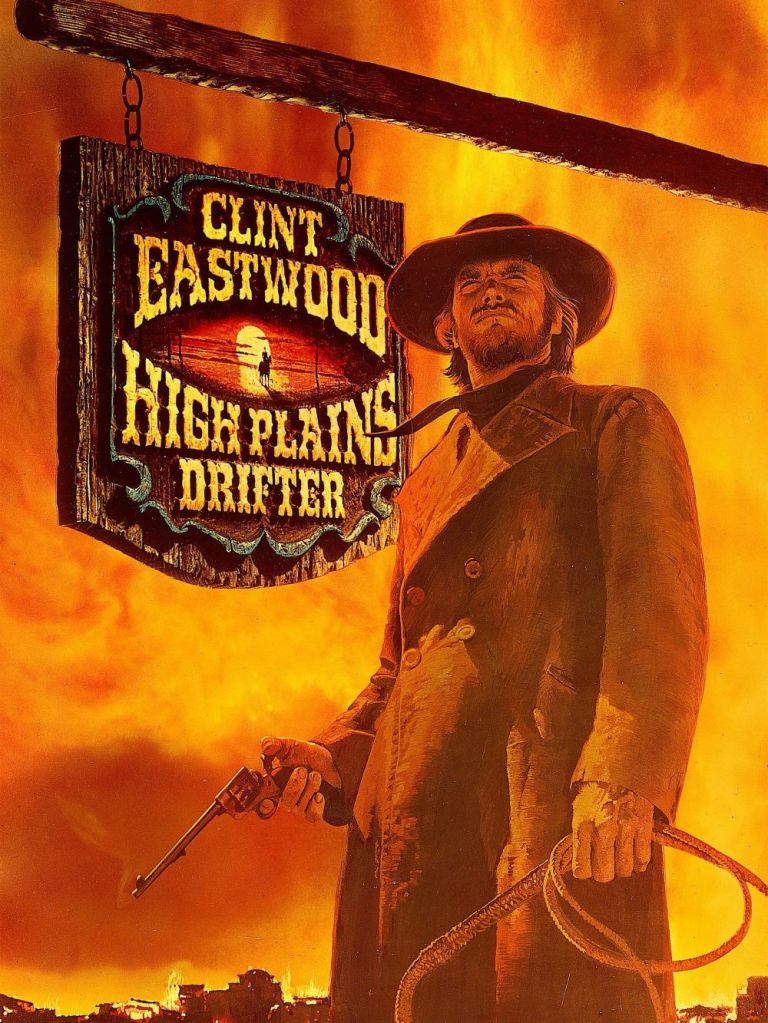
Horror Review: High Plains Drifter (dir. by Clint Eastwood)


“Don’t count on me to make you feel safe.” — The Stranger

High Plains Drifter stands as one of the bleakest, most enigmatic entries in Clint Eastwood’s filmography—a Western that bleeds unmistakably into the realms of psychological and supernatural horror. This 1973 film is not just another dusty tale of lone gunfighters and frontier justice. It’s a nightmare set in broad daylight, a morality play whose hero is more monster than man.

Eastwood’s Stranger comes riding into the town of Lago from the shimmering desert, a silhouette both akin to and apart from his famed Man With No Name persona. The townsfolk are desperate, haunted by fear—less afraid of imminent violence, more of the sins they’ve half-buried. This is a place where a lawman was brutally murdered by outlaws while the townspeople looked away, their silence paid for with cowardice and greed. When the Stranger assumes command, he does so with often-gleeful sadism—kicking people out of their hotel rooms, replacing the mayor and sheriff with the dwarf Mordecai, and ordering that the entire town be painted red before putting “Hell” on its welcome sign.

There’s a surface plot: the Stranger is hired to protect Lago from the same three outlaws who once butchered its marshal. But he’s there for far more than that. The story unspools through dreamlike sequences, flashbacks that suggest the Stranger may well be an avenging spirit or a revenant—the dead lawman, spectral and merciless, returned to claim what the townsfolk owe to Hell itself.

The horror here isn’t about jump scares or gothic haunted houses. The supernatural lurks everywhere and yet nowhere. The Stranger moves with the implacable calm—and violence—of a slasher villain, transforming Lago into his personal stage for retribution. His nightmares, full of images of past atrocities, are painted with the same vivid brutality as the daytime violence. Eastwood’s use of silence, the squint of a face, the twitch of a pistol replaces musical cues in amplifying dread. The sound design evokes otherness—a howling wind, footsteps echoing across empty streets—that builds a shadow of terror around the Stranger’s presence.

This violence is hurried and brutal; its sexual politics unflinching. When the Stranger enacts revenge, he punishes not just the outlaws, but the townsfolk complicit in their crimes. There is little comfort in his sense of justice—the pleasures he takes border on sadistic. The film’s moral ambiguity cuts deeper than most Westerns or horrors: this is not a clear-cut tale of good versus evil, but a brutal reckoning of collective guilt, cowardice, and corruption.

Lago itself acts almost like a town stuck in purgatory—a holding pen between redemption and eternal damnation. The infamous “Welcome to Hell” sign the Stranger paints at the town’s entrance serves as a grim message. It’s no welcome to law and order, but a symbolic beacon to the very outlaws the Stranger is hired to confront, suggesting that Lago is a place where sin festers and punishes itself. The town’s dance with Hell is both literal and metaphorical. The inhabitants aren’t just awaiting judgment; they have invited it in their desperate attempts to hide their cowardice and greed under the guise of civilization.

This notion of Lago as purgatory stands in sharp contrast to other recent horror Westerns, which serve as prime examples of the genre’s thematic spectrum. These films tend to focus on the primal terror of nature barely held at bay by the fragile veneer of civilization the settlers claim. They pit human beings against the ancient, untamed forces of the wilderness—whether monstrous creatures or surreal phenomena—emphasizing that the supposed order and progress of the West remain fragile and constantly threatened. This dynamic symbolizes the uneasy balance between civilization’s reach and nature’s primal power, often revealing how thin and tenuous that barrier truly is.

Among these, Bone Tomahawk and Ravenous stand out as vivid examples. Bone Tomahawk confronts menacing cannibals lurking in the wild, reminding viewers that the West’s order is fragile and under perpetual threat from untamed wilderness. Ravenous uses cannibalism and survival horror as metaphors for nature’s savage predation hidden beneath the polite façade of civilization—nature’s horrors masked but not erased.

By contrast, High Plains Drifter directs its horror inward, exposing the corruption that manifest destiny imposed on settlers themselves. Instead of fearing nature as an external force, the film presents settlers as haunted by their own moral failures and complicity in violence and betrayal. The Stranger’s vengeance is a reckoning with the darkness festering inside the community, a brutal meditation on guilt, collective cowardice, and the price of greed disguised as progress.

Eastwood’s film strips away the mythic promises of the American West as a land of freedom and opportunity, revealing instead the brutal reality of communities locked in complicity, violence masquerading as justice, and the moral rot at the heart of manifest destiny. This moral ambiguity and psychological depth give High Plains Drifter a unique position in the horror Western subgenre, elevating it beyond simple scares to a profound exploration of American cultural myths.

The Stranger is not a traditional hero but a spectral judge, embodying divine or supernatural retribution. His calm yet ruthless punishment exposes the cruelty, cowardice, and malevolence within Lago’s population, meting out a justice that is neither neat nor forgiving. His supernatural aura and sadistic tendencies make him an unforgettable figure of terror and fate.

Visually, the film’s harsh daylight contrasts with the romanticized Western landscapes of earlier films. Instead of shadows hiding evil, blinding light exposes the town’s moral decay. Characters are reduced to symbols of greed, fear, and cruelty, highlighting that the true horror lies within human nature and the failure to uphold justice.

High Plains Drifter operates on multiple levels—a Western, a ghost story, a horror film, and a dark morality play. It is a relentless meditation on justice and punishment and a dismantling of the traditional Western hero myth. Through layered narrative, stark visuals, and Eastwood’s chilling performance, it remains an essential entry in the horror Western canon.

For those seeking a Western that doesn’t just entertain but unsettles and challenges, High Plains Drifter offers an unforgiving descent into darkness. It strips away the comforting myths of the frontier and exposes the raw, rotting core beneath. Unlike other modern horror Westerns such as Bone Tomahawk and Ravenous, which confront external terrors lurking in the wilderness, this film turns its gaze inward—on the moral decay, guilt, and violence festering within the settlers themselves. It’s a brutal, haunting reckoning, and Eastwood’s Stranger is the cold, relentless agent of that reckoning. This is a journey into a hell both literal and psychological, where justice is merciless and safety is a long-forgotten promise.
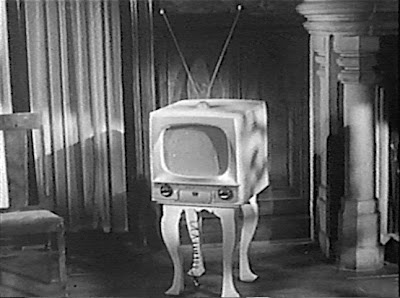
Horror On TV: The Dead Don’t Die (dir by Curtis Harrington)


For today’s horror on television, we have a 1975 made-for-television movie called The Dead Don’t Die!

The Dead Don’t Die takes place in Chicago during the 1930s.  George Hamilton is a sailor who comes home just in time to witness his brother being executed for a crime that he swears he didn’t commit.  Hamilton is convinced that his brother was innocent so he decides to launch an investigation of his own.  This eventually leads to Hamilton not only being attacked by dead people but also discovering a plot involving a mysterious voodoo priest!

Featuring atmospheric direction for Curtis Harrington and a witty script by Robert Bloch, The Dead Don’t Die is an enjoyable horror mystery.  Along with George Hamilton, the cast includes such luminaries of “old” Hollywood as Ray Milland, Ralph Meeker, Reggie Nalder, and Joan Blondell.  (Admittedly, George Hamilton is not the most convincing sailor to ever appear in a movie but even his miscasting seems to work in a strange way.)

And you can watch it below!

Enjoy!

Film Review: Every Which Way But Loose (dir by James Fargo)


In 1978’s Every Which Way But Loose, Clint Eastwood plays Philo Beddoe.

Philo’s an ordinary guy with beautiful hair and a way with throwing punches.  He’s a truck driver.  He enjoys a cold beer.  He enjoys country music.  He makes some extra money by taking part in bare-knuckle brawls.  Everyone says that he could be the next Tank Murdock, a legendary fighter.  Philo is just a simple, blue collar guy who lives in a small house, next door to his best friend Orville (Geoffrey Lewis) and Orville’s profanity-loving mother (Ruth Gordon).  Philo also owns an orangutan named Clyde.  He saved Clyde from being sent to live in a “desert zoo.”

(Actually, now that I think about it, most blue collar guys don’t own monkeys but whatever.  Clyde’s cute and Eastwood’s Eastwood.)

When Philo meets a country singer named Lynn Halsey-Taylor (Sondra Locke), he is immediately smitten.  When Lynn disappears and leaves Philo a cryptic note, Philo decides to go looking for her.  Clyde, Orville, and Philo hit the road.  Along the way, Orville meets and picks up a woman named Echo (Beverly D’Angelo).  This is a road movie so, of course, Clyde, Orville, Philo, and Echo have their adventures on the way to Colorado.  They end running afoul both a corrupt cop and a gang of buffoonish bikers.  Philo enters a fight whenever they need money and one occasionally gets the feeling that Eastwood took this role to show off the fact that, for someone approaching 50, he still looked good without a shirt on.  And good for him!  Because, seriously, Clint does look good in this movie….

I have to admit that, for all of my attempts at sophistication, my roots are in the country and I’ve traveled down enough dirt roads that I find it hard to resist a good redneck story.  And really, there aren’t many films that as proudly and unashamedly redneck than Every Which Way But Loose.  It’s a film that has a laid back, take-it-as-it-comes vibe to it.  Philo may be looking for Lynn but he seems to be okay with taking a few detour along the way.  There’s no real sense of urgency to any part of the movie.  Instead, Every Which Way But Loose was made for people who like a cold beer at the end of the day and who find Ruth Gordon to be hilarious when she curses.  Myself, I don’t drink.  That’s one part of the country lifestyle that passed me over.  But I did enjoy seeing Ruth Gordon cuss out the Nazi biker gang.

Eastwood, Lewis, and D’Angelo have a likable chemistry and the monkey’s cute.  Unfortunately, Sondra Locke isn’t particularly well-cast in the role of Lynn.  (Considering that she was in a relationship with Eastwood, it’s amazing how little chemistry they have in this movie.)  As I watched the film, it occurred to me that it probably would have worked better if Locke and D’Angelo had switched roles.  Locke’s character is supposed to be a femme fatale type but she gives a boring performance and, as a result, the revelation that Philo has misjudged her doesn’t really carry any emotional weight.

That said, this film features some beautiful shots of the wilderness, a charming romance between Lewis and D’Angelo, and a shirtless Clint Eastwood beating folks up.  That’s more than enough to please this secret country girl.

Film Review: The Outlaw Josey Wales (dir by Clint Eastwood)


Towards the end of 1976’s The Outlaw Josey Wales, Josey (played by Clint Eastwood) says, “I guess we all died a little in that damned war.”

He’s referring to the American Civil War and the film leaves you with no doubt that Wales knew what he was talking about.  A farmer living in Missouri, Josey Wales wasn’t involved in the Civil War until a group of guerillas, the Redlegs, raided his home and killed his family.  Seeking vengeance, Wales joined the Bushwackers, a group of Confederate guerillas that were led by the infamous “Bloody Bill” Anderson.  After Anderson’s death and the South’s surrender, Senator James H. Lane (Frank Schofield) offers amnesty to any of the Bushwackers willing to surrender and declare their loyalty to the United States.  Fletcher (John Vernon), the leader of the surviving Bushwackers, thinks it’s a good idea and his men eventually agree to surrender.

Everyone except for Josey Wales.

Fletcher tells Josey that he’ll be an outlaw and that Lane will send his men to capture and execute him.  “I reckon so,” Josey Wales replies.  It’s not that Josey was particularly a fan of the Confederate cause.  Instead, having lost his family and his home and having seen hundreds of men killed, Josey no longer cares.  He’s got a death wish, something that becomes apparent when he later sneaks over to Lane’s camp and discovers that the leader of the Redlegs, Terrill (Bill McKinney), has been made a captain in the Union Army.  The surrendering Bushwackers, with the exception of Fletcher and a young man named Jamie (Sam Bottoms), are gunned down as they swear allegiance to the United States.  Joey springs into action, hijacking a Gatling gun and mowing down soldiers.  It’s a suicidal move and Josey appears to be willing to die, until he sees that Jamie has been wounded.  Josey and Jamie go on the run, pursued by soldiers and bounty hunters.

It sounds like the start of typical Clint Eastwood film and, make no mistake about it, The Outlaw Josey Wales features everything that most people have come to expect from Eastwood.  Josey Wales is an expert shot, often firing two guns while charging forward on his horse.  Josey has a way of words, explaining the purpose of getting “plain man dog mean” and telling a bounty hunter that there are better ways to make a living.  The main difference, though, is that Josey is no longer seeking revenge.  He’s lost his family and his home and he knows nothing is going to bring them back.  He sought revenge during the Civil War and saw so many people killed that, much like Jimmy Stewart in Broken Arrow, he just wants to disappear from civilization.

The problem is that men like Lane and Terrill have no intention of letting Josey Wales disappear.  The sociopathic Terrill sees it as almost being his God-given duty to kill Josey Wales and anyone else that he dislikes.  The bounty hunters are also after Josey Wales.  As Fletcher explains it, bounty hunting is the only way that many former soldiers can make money and feed their families.  As Josey moves through the southwest, his legend grows.  Every town that Josey stops in, he hears stories about the growing number of men that he has supposedly killed.

Josey also discovers that he can’t do it all alone.  He soon finds himself as a part of a new family, a collection of misfits that don’t have a home in Senator Lane’s America.  Lone Waite (Chief Dan George) is an elderly Cherokee man who suggests that Josey head for Mexico.  Little Moonlight (Geraldine Keams) is a Navajo woman who Josey rescues from two bounty hunters.  Sarah Turner (Paula Trueman) and her granddaughter, Laura Lee (Sondra Locke), are rescued from Comancheros.  Josey negotiates the release of two of Sarah’s ranch hands and befriends Chief Ten Bears (Will Sampson) while doing so.  Slowly, Josey comes out of his shell and starts to embrace life once again.  Josey goes from searching for death to searching for peace.

It’s one of Eastwood’s best films, ending on a note of not violence but instead sad regret.  It’s not only a portrait of a man learning to embrace life but it’s also a portrait of a country trying to figure out how to come back together after the bloody savagery of the Civil War.  Some, like Fletcher and Josey, want to move on.  Others, like Terrill, don’t have an identity beyond fighting and killing.  Eastwood gives a good performance but, as a director, he gives every member of the cast a chance to shine.  If you only know John Vernon as Dean Wormer from Animal House, his sad-eyed performance here will be a revelation.

Originally, The Outlaw Josey Wales was meant to be directed by Phillip L. Kaufman but Eastwood felt that Kaufman was taking too long to set up his shots and worrying about details that really didn’t matter.  Reportedly, while Kaufman was away from the set, spending hours searching for a historically-correct beer bottle to be used in a bar scene, Eastwood directed the scene himself and then convinced producer Robert Daley to fire Kaufman and allow Eastwood to direct the film.  (Kaufman also objected to the script’s anti-government subtext but seriously, that’s pretty much the subtext of every film that Eastwood has ever been involved with.)  The DGA later instituted a rule that, on productions in which the director was fired,  the replacement could not be a member of his crew or an actor in the cast but that was too late to help out Kaufman.

(Rumor has it that another reason Kaufman was fired was because he and Eastwood both “liked” Sondra Locke.  This was the first of six films that Eastwood and Locke would do together.)

To be honest, I think it worked out in the film’s favor.  It’s a little surprising that someone other than Eastwood was ever considered as director to be begin with, so perfectly does the story and the lead character fit with Eastwood’s persona.  Eastwood captures both the beauty of the untouched land and also the bloody violence of combat.  In many ways, this film almost feels like a prequel to UnforgivenThe Outlaw Josey Wales is Eastwood at his best.

Film Review: High Plains Drifter (dir by Clint Eastwood)


In 1973’s High Plans Drifter, Clint Eastwood plays …. The Stranger.

No, not the Man With No Name.  The Stranger has a name but he chooses not to share it.  That said, when one person says that he doesn’t even know the Stranger’s real name, the Stranger replies, “Yes, you do.”  The Stranger appears to emerge from the heat of the desert, riding into the small mining town of Lago and gunning down the three bullies that the townspeople hired to protect them after the murder of their town marshal.  With no other option, the townspeople accept the Stranger as the town’s new protector.

The Stranger is drawn to the town and the townspeople but he doesn’t seem to particularly like any of them, with the exception of Mordecai (Billy Curtis), the dwarf that the Stranger appoints as the town’s new sheriff.  The townspeople, the majority of whom are cowardly and motivated by greed, aren’t particularly likable themselves.  The Stranger rules the town like a dictator, kicking everyone out of the hotel so that he can have it for himself and ordering that every building in the town be painted red.  Over the town’s welcome sign, he paints one word: “Hell.”  When the townspeople see how well the Stranger can shoot, they celebrate in the belief that they’ll always be safe.  The Stranger responds by leaving town just as three sadistic outlaws, led by Stacey Bridges (Geoffrey Lewis), approach.  The Stranger may be looking for revenge on Bridges but he also seems as if he wants to make the town suffer for its sins as well.

Much as with the case of The Man With No Name, the Stranger is not motivated by kindness or any sort of concern for the safety of the townspeople.  He often shows a cruel-streak when it comes to dealing with the cowardly townspeople.  He doesn’t attack unless he’s attacked first but once you’re on his bad side, he’ll gun you down without a hint of emotion.  When the Stranger sleeps, he is haunted by nightmares of the previous marshal (played by Buddy Van Horn, Clint Eastwood’s stunt double) being murdered by Bridges and his men while the townspeople stood by and did nothing.  We learn that the townspeople, worried that it might be bad for their business interests, didn’t even give the late marshal a decent headstone after his death.  One woman mentions that spirits can’t rest unless they have a proper marker….

Getting the idea?

High Plains Drifter is probably the closest that Eastwood has ever come to making a supernatural horror film.  The Stranger may or may not be a vengeful ghost (the movie leaves that for you to decide) but he turns the small town of Lago into his own personal version of Hell and, when he attacks the men who killed the marshal, he moves with the ruthless determination of a slasher villain.  The scene where Bridges and his men ride into the town is like a filmed nightmare.  This is a dark film, one in which Eastwood’s Stranger is not the hero because he’s particular heroic but just because everyone else in the film is so bad.

This was also Eastwood’s second film as a director (following Play Misty For Me) and also the first of many westerns that Eastwood would direct.  The imagery is often haunting, all the more so because some of the most violent scenes take place in broad daylight.  The scenes where the Stranger seems to materialize out of the desert’s heatwaves perfectly capture the mythology of the old west and its “heroes.”  Eastwood gets good performances out of his ensemble cast and, even more importantly, he shows that Eastwood the director had a perfect understanding of Eastwood the actor.  As the Stranger, Eastwood says more with a snarl or a half-smile than most actors could say with a multi-page monologue.

High Plains Drifter is violent, often disturbing, and ultimately unforgettable.

Horror On The Lens: The Dead Don’t Die (dir by Curtis Harrington)


For today’s horror on the lens, we have a 1975 made-for-television movie called The Dead Don’t Die!

The Dead Don’t Die takes place in Chicago during the 1930s.  George Hamilton is a sailor who comes home just in time to witness his brother being executed for a crime that he swears he didn’t commit.  Hamilton is convinced that his brother was innocent so he decides to launch an investigation of his own.  This eventually leads to Hamilton not only being attacked by dead people but also discovering a plot involving a mysterious voodoo priest!

Featuring atmospheric direction for Curtis Harrington and a witty script by Robert Bloch, The Dead Don’t Die is an enjoyable horror mystery.  Along with George Hamilton, the cast includes such luminaries of “old” Hollywood as Ray Milland, Ralph Meeker, Reggie Nalder, and Joan Blondell.  (Admittedly, George Hamilton is not the most convincing sailor to ever appear in a movie but even his miscasting seems to work in a strange way.)

And you can watch it below!

Enjoy!

Horror On The Lens: The Dead Don’t Die (dir by Curtis Harrington)


For today’s horror on the lens, we have a 1975 made-for-television movie called The Dead Don’t Die!

The Dead Don’t Die takes place in Chicago during the 1930s.  George Hamilton is a sailor who comes home just in time to witness his brother being executed for a crime that he swears he didn’t commit.  Hamilton is convinced that his brother was innocent so he decides to launch an investigation of his own.  This eventually leads to Hamilton not only being attacked by dead people but also discovering a plot involving a mysterious voodoo priest!

Featuring atmospheric direction for Curtis Harrington and a witty script by Robert Bloch, The Dead Don’t Die is an enjoyable horror mystery.  Along with George Hamilton, the cast includes such luminaries of “old” Hollywood as Ray Milland, Ralph Meeker, Reggie Nalder, and Joan Blondell.  (Admittedly, George Hamilton is not the most convincing sailor to ever appear in a movie but even his miscasting seems to work in a strange way.)

And you can watch it below!

Enjoy!