Retro Television Review: Baywatch 1.2 “Heat Wave”


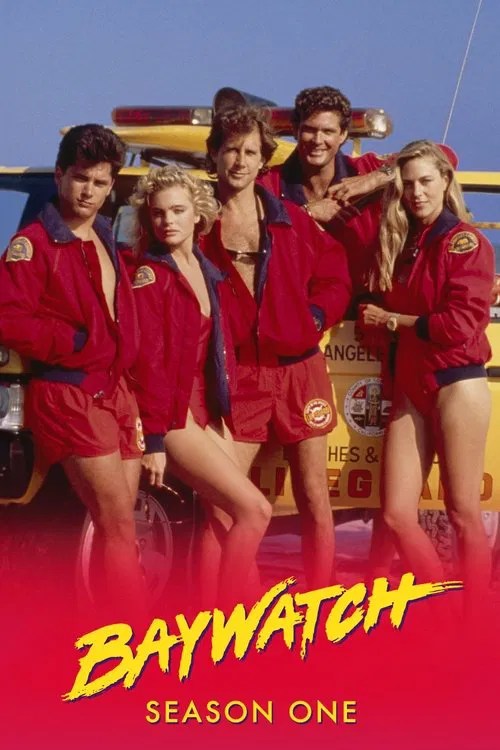
Welcome to Retro Television Reviews, a feature where we review some of our favorite and least favorite shows of the past!  On Saturdays, I will be reviewing Baywatch, which ran on NBC and then in syndication from 1989 to 2001.  The entire show can be purchased on Tubi.
Save me!

Episode 1.2 “Heat Wave”

(Dir by Gus Trikonis, originally aired on September 29th, 1989)

Not much of an episode this week, I’m afraid.

California is dealing with a heat wave and no one has air conditioning (really?) so everyone in Los Angeles is heading down to the beach so that they can relax in the hot sand.  Eddie and Trevor keep giving each other the side eye because Eddie is a Baywatch lifeguard and Trevor is a country club life guard.  Eddie tries to hit on a woman who has spent the entire day relaxing near his tower but it turns out that she’s visiting from Australia and only has eyes for Trevor.  “Maybe next time,” she tells Eddie.

Craig is told by his boss that he has to choose between being a lawyer at a big firm or a lifeguard.  Craig’s wife, Gina, suggests that Craig quit the law firm and become a beachfront lawyer.  She says that he can still be a lifeguard and he can just use their kitchen table as his desk.  I don’t know if I would be as understanding as Gina.  Craig was making a lot of money as a big corporate lawyer, even if he apparently couldn’t afford to get an air conditioner.

(What the Heck, California?  How are you surviving with air conditioning!?)

Meanwhile, two stupid kids get trapped in a storm drain.  Mitch sends the junior lifeguards out to look for them.  Hobie asks, “What can a bunch of junior lifeguards do?”  Mitch replies that this is an opportunity for the junior lifeguards to go to all the places that they’re usually not allowed to go.  So, basically, Mitch’s plan to find the missing kids is to put a bunch of other kids at risk.  I guess that’s why he’s the lieutenant.

Luckily, the two dumb kids are rescued.  One of the kids is the son of Steve Humboldt (Jeffrey Byron), a former Baywatch lifeguard.  It turns out that Steve lost custody of his kid in a court case and he basically abducted him.  But, after the kid nearly dies, Steve is like, “We’re going to call your mom and go home!” and that apparently makes everything okay under the “He Changed His Mind Afterwards” clause.

This was all pretty dumb.  Stay out of the storm drain, kids!  It’s not that difficult.

Shattered Politics #34: The Parallax View (dir by Alan J. Pakula)


Parallax_View_movie_poster

Judging from the films that the decade produced, the 1970s were truly a paranoid time.  (Of course, 2015 is a paranoid time as well, which is probably why so many of the classic films of the 70s still feel incredibly relevant.)  Some weekend, you should watch a marathon of 1970s films and I guarantee that, by the time Monday rolls around, you will be looking for lurkers in every shadow and automatically distrusting any and all authority figures.  The 1970s were a good time to be paranoid.

And it’s really not surprising at all.  The previous decade was a time of turmoil and upheavel, a time when some people feared protestors and some people feared the establishment but, ultimately, everyone was afraid of someone.  When you think of the 1960s, you think about all the leaders who were violently assassinated — John F. Kennedy, Malcolm X, Martin Luther King, Robert F. Kennedy, and more.  (And that’s just in America!)  And then the 70s came along, with Watergate and the revelations about the CIA partnering up with the Mafia to try to kill Fidel Castro.

The 70s were a good time to be paranoid and the films of the 70s reflected that fact.

Take for instance, 1974’s The Parallax View.  The Parallax View opens and ends with assassination.  In both cases, the victims are U.S. politicians who are running for President and whose ambitions have caused concern for the shadowy and rarely seen leaders of the established order.  In both cases, the official story is that the assassin was a lone gunman, a nut with a gun and absolutely no political or religious motivations.  Of course, both accused assassins were apparently involved with the shadowy Parallax Corporation and, over the course of the film, anyone who knows anything about Parallax ends up dying.  Reporter Joe Frady (Warren Beatty) goes undercover to investigate the group but, as he does so, he grows increasingly paranoid and unstable, until finally  it’s easy to mistake him for any other paranoid madman, ranting in the street and, in many ways, indistinguishable from the accused assassins that he’s been investigating.  In many ways, Joe becomes like a character in a H.P. Lovecraft short story who, upon laying eyes on Cthulhu, is driven mad as punishment.

It’s a good film, one that’s enhanced by Gordon Willis’s trademark shadowy cinematography and the convincing desperation of Warren Beatty’s performance.  In the film’s best scene, Frady applies for a job with the Parallax Corporation.  As a part of his job interview, he’s taken a dark room and he’s told to watch a short film.  His reactions will help to determine what role he could possibly play at Parallax.

Needless to say, The Parallax View feels just as relevant today as it did when it was first released.  We still live in paranoid times and hints of conspiracy are still everywhere to be seen.  Perhaps the only thing that has changed is that, back in 1974, conspiracies could still take people be surprise.

Now, we just take them for granted.