Film Review: The Outlaw Josey Wales (dir by Clint Eastwood)


Towards the end of 1976’s The Outlaw Josey Wales, Josey (played by Clint Eastwood) says, “I guess we all died a little in that damned war.”

He’s referring to the American Civil War and the film leaves you with no doubt that Wales knew what he was talking about.  A farmer living in Missouri, Josey Wales wasn’t involved in the Civil War until a group of guerillas, the Redlegs, raided his home and killed his family.  Seeking vengeance, Wales joined the Bushwackers, a group of Confederate guerillas that were led by the infamous “Bloody Bill” Anderson.  After Anderson’s death and the South’s surrender, Senator James H. Lane (Frank Schofield) offers amnesty to any of the Bushwackers willing to surrender and declare their loyalty to the United States.  Fletcher (John Vernon), the leader of the surviving Bushwackers, thinks it’s a good idea and his men eventually agree to surrender.

Everyone except for Josey Wales.

Fletcher tells Josey that he’ll be an outlaw and that Lane will send his men to capture and execute him.  “I reckon so,” Josey Wales replies.  It’s not that Josey was particularly a fan of the Confederate cause.  Instead, having lost his family and his home and having seen hundreds of men killed, Josey no longer cares.  He’s got a death wish, something that becomes apparent when he later sneaks over to Lane’s camp and discovers that the leader of the Redlegs, Terrill (Bill McKinney), has been made a captain in the Union Army.  The surrendering Bushwackers, with the exception of Fletcher and a young man named Jamie (Sam Bottoms), are gunned down as they swear allegiance to the United States.  Joey springs into action, hijacking a Gatling gun and mowing down soldiers.  It’s a suicidal move and Josey appears to be willing to die, until he sees that Jamie has been wounded.  Josey and Jamie go on the run, pursued by soldiers and bounty hunters.

It sounds like the start of typical Clint Eastwood film and, make no mistake about it, The Outlaw Josey Wales features everything that most people have come to expect from Eastwood.  Josey Wales is an expert shot, often firing two guns while charging forward on his horse.  Josey has a way of words, explaining the purpose of getting “plain man dog mean” and telling a bounty hunter that there are better ways to make a living.  The main difference, though, is that Josey is no longer seeking revenge.  He’s lost his family and his home and he knows nothing is going to bring them back.  He sought revenge during the Civil War and saw so many people killed that, much like Jimmy Stewart in Broken Arrow, he just wants to disappear from civilization.

The problem is that men like Lane and Terrill have no intention of letting Josey Wales disappear.  The sociopathic Terrill sees it as almost being his God-given duty to kill Josey Wales and anyone else that he dislikes.  The bounty hunters are also after Josey Wales.  As Fletcher explains it, bounty hunting is the only way that many former soldiers can make money and feed their families.  As Josey moves through the southwest, his legend grows.  Every town that Josey stops in, he hears stories about the growing number of men that he has supposedly killed.

Josey also discovers that he can’t do it all alone.  He soon finds himself as a part of a new family, a collection of misfits that don’t have a home in Senator Lane’s America.  Lone Waite (Chief Dan George) is an elderly Cherokee man who suggests that Josey head for Mexico.  Little Moonlight (Geraldine Keams) is a Navajo woman who Josey rescues from two bounty hunters.  Sarah Turner (Paula Trueman) and her granddaughter, Laura Lee (Sondra Locke), are rescued from Comancheros.  Josey negotiates the release of two of Sarah’s ranch hands and befriends Chief Ten Bears (Will Sampson) while doing so.  Slowly, Josey comes out of his shell and starts to embrace life once again.  Josey goes from searching for death to searching for peace.

It’s one of Eastwood’s best films, ending on a note of not violence but instead sad regret.  It’s not only a portrait of a man learning to embrace life but it’s also a portrait of a country trying to figure out how to come back together after the bloody savagery of the Civil War.  Some, like Fletcher and Josey, want to move on.  Others, like Terrill, don’t have an identity beyond fighting and killing.  Eastwood gives a good performance but, as a director, he gives every member of the cast a chance to shine.  If you only know John Vernon as Dean Wormer from Animal House, his sad-eyed performance here will be a revelation.

Originally, The Outlaw Josey Wales was meant to be directed by Phillip L. Kaufman but Eastwood felt that Kaufman was taking too long to set up his shots and worrying about details that really didn’t matter.  Reportedly, while Kaufman was away from the set, spending hours searching for a historically-correct beer bottle to be used in a bar scene, Eastwood directed the scene himself and then convinced producer Robert Daley to fire Kaufman and allow Eastwood to direct the film.  (Kaufman also objected to the script’s anti-government subtext but seriously, that’s pretty much the subtext of every film that Eastwood has ever been involved with.)  The DGA later instituted a rule that, on productions in which the director was fired,  the replacement could not be a member of his crew or an actor in the cast but that was too late to help out Kaufman.

(Rumor has it that another reason Kaufman was fired was because he and Eastwood both “liked” Sondra Locke.  This was the first of six films that Eastwood and Locke would do together.)

To be honest, I think it worked out in the film’s favor.  It’s a little surprising that someone other than Eastwood was ever considered as director to be begin with, so perfectly does the story and the lead character fit with Eastwood’s persona.  Eastwood captures both the beauty of the untouched land and also the bloody violence of combat.  In many ways, this film almost feels like a prequel to UnforgivenThe Outlaw Josey Wales is Eastwood at his best.
Film Review: Buffalo Bill and the Indians, or Sitting Bull’s History Lesson (dir by Robert Altman)


1976’s Buffalo Bill and the Indians, or Sitting Bull’s History Lesson takes place in the waning years of the Old West.  Civilization is coming to America and the “wild” west’s days are numbered.  And yet, even as the days of outlaws and gunslingers come to an end, America is already in the process of building up its own mythology.

Buffalo Bill (Paul Newman) owns a popular wild west show, one where his stars put on a show that claims to recreate the great moments of western history.  The show is made up of a motely collection of performers, some of whom are more talented than others.  This is a Robert Altman film and, as usual, the emphasis is more on watching how his large ensemble of actors interact as opposed to highlighting any one actor.  Indeed, it can be hard to keep everyone in the film straight and one gets the feeling that this was intentional on Altman’s part.  Buffalo Bill and the Indians may be a revisionist western and a satire of American history but it’s also a showbiz film.  The emphasis is on people continually coming and going, sticking around long enough to either prove their worth as a performer or moving on to a hopefully more receptive audience.

Geraldine Chaplin plays Annie Oakley, the sharp shooter who takes joy in firing her gun and who barely seems to notice that her husband (John Considine) is terrified of getting shot.  Joel Grey serves as the unflappable manager of the show while Harvey Keitel is miscast as Buffalo Bill’s somewhat nerdy assistant.  (Keitel, with his natural intensity, seems like he’s desperately waiting for a chance to explode, a chance that never really comes.)  Burt Lancaster plays Ned Buntline, the writer who made Buffalo Bill into a celebrity and who provides a somewhat sardonic commentary as Bill’s current activities.  Shelley Duvall shows up as the wife of President Grover Cleveland (played by Pat McCormick), who comes to the show and is amused until an Indian points a gun towards the president.

Throughout it all, Buffalo Bill enjoys his fame and pushes his vision of the Old West on those who come to see his show.  Newman plays Bill as being a blowhard, an eccentric who is obsessed with opera and whose entire persona is a fake.  He can’t shoot straight.  He can barely ride a horse.  His trademark long hair is actually a wig.  The only people who take Bill seriously as those who come to see his show.  Those who know him view him as being a buffoon but they also understand that he’s a very successful and very famous buffoon and that ultimately matters more than any sort of historical truth.

What conflict there is in the film occurs when Sitting Bull (Frank Kaquitts) and his translator (Will Sampson) arrive on the scene.  Sitting Bull has agreed to appear in the show but only under his own terms.  Buffalo Bill grows frustrated with Sitting Bull and his refusal to pretend to be a savage but he also knows that this audience wants to see the last remaining great Indian chief.

It’s a big and sprawling film and it’s really not entirely successful.  Altman was an intelligent director who was willing to take risks and no one deserves more credit for popularizing the idea of the ensemble film.  That said, he could also be a bit heavy-handed and that’s certainly the case here.  It takes a certain amount of courage to cast a star like Paul Newman as a thoroughly unlikable character and it also took a bit of courage on Newman’s part to give the performance that he did.  At the same time, neither the shallow Buffalo Bill nor the dignified Sitting Bull are really compelling enough characters to carry a film that runs for more than two hours.  The film’s message is an obvious one and it’s also one that Altman handled in a much more memorable way with Nashville.

That said, the film is a memorable misfire.  It’s at its best when it abandons the politics and just concentrates on the community of performers that popular Buffalo Bill’s show.  The film’s best moments are not the ones with Paul Newman growling but instead the ones with John Considine hoping that Geraldine Chaplin won’t accidentally shoot him.  As with many of Altman’s film, Buffalo Bill and the Indians works best when it focuses on the misfit community at the center of its story.


Lisa Reviews An Oscar Winner: One Flew Over The Cuckoo’s Nest (dir by Milos Forman)


Technically, the 1975 film One Flew Over The Cuckoo’s Nest is not a horror film.

Though it may take place in a creepy mental hospital, there are no ghosts or zombies.  There’s no masked killer wandering the halls.  The shadows do not leap off the walls and there are no ghostly voice in the night, unless you count the rarely heard voice of Will Sampson’s Chief Bromden.

Admittedly, the cast is full of horror and paranormal veterans.  Michael Berryman, of the original Hills Have Eyes, plays a patient.  Louise Fletcher, who won an Oscar for playing the role of Nurse Ratched, went on to play intimidating matriarchs in any number of low-budget horror movies.  Vincent Schiavelli, a patient in this film, played the angry subway ghost in Ghost.  Another patient, Sidney Lassick, played Carrie’s condescending English teacher in Carrie.  Brad Dourif, who received an Oscar nomination for playing the meek Billy Bibbit, has become a horror mainstay.  Will Sampson appeared in the Poltergeist sequel.  Both Scatman Crothers and Jack Nicholson would go on to appear in The Shining.

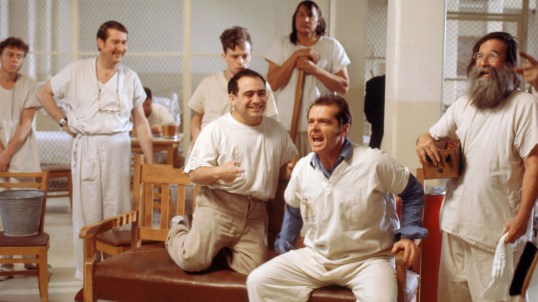
Nicholson plays Randle Patrick McMurphy, a career criminal who, hoping to get out of prison early, pretends to be mentally ill.  He ends up getting sent to an Oregon mental institution, where his rebellious ways upset the administrators while, at the same time, inspiring the patients to actually try to take some control over their lives.  The film is, in many ways, a celebration of personal freedom and rebellion.  The only catch here is that, in One Flew Over The Cuckoo’s Nest, being a little bit too rebellious can lead to not only electroshock treatment but also a lobotomy.  Those in charge have a way of making you permanently compliant.

And really, to me, that’s what makes One Flew Over The Cuckoo’s Nest a horror film.  It’s about the horror of conformity and bureaucracy.  The film may start out as something of a comedy and Nicholson brings a devil-may-care attitude to the role of McMurphy but then, eventually, you reach the scene where McMurphy is tied down and given electrical shocks to make him compliant.  You reach the scene where Ratched coldly informs Billy Bibbit that she will be telling his mother that Billy lost his virginity to a prostitute and Billy reacts by slicing open his wrists.  Finally, you reach the scene where McMurphy returns to the ward having had a bit of his brain removed.  In those scenes, One Flew Over The Cuckoo’s Nest becomes a horror movie.  The monster is not a ghost or a demon or a serial killer.  Instead, it’s a system that is determined to squash out any bit of rebellion or free thought.

What makes Nurse Ratched such a great villain is the fact that, as opposed to being some sort of a maniacal force of evil, she’s really just someone doing her job and refusing to question her methods.  She’s the ultimate symbol of bland authoritarianism.  Her job is to keep the patients from getting out of control and, if that means lobotomizing them and driving one of them to suicide …. well, that’s what she’s going to do.  For all the time that Ratched spends talking about therapy, her concern is not “curing” the patients or even helping them reach a point where they can leave the hospital and go one with their lives.  Ratched’s concern is keeping everyone in their place.  As played by Fletcher, Ratched epitomizes the banality of evil.  (That’s one reason why it was so silly for Ryan Murphy to devote his most recent Netflix series to giving her an over-the-top origin story.  Ratched is a great villain because she doesn’t have any complex motivations.  She’s just doing whatever she has to do to keep control of the people are on her ward.  Part of keeping control is not to allow anyone to question her methods.  Everyone has had to deal with a Nurse Ratched at some point in the life.  With the elections coming up, we’re about to be introduced to whole new collection of Nurse Ratcheds.)

I like One Flew Over The Cuckoo’s Nest, even though it’s an undeniably dated film.  That said, it’s not as dated as the novel on which it’s based, nor is it as appallingly misogynistic.  Jack Nicholson’s rough but charismatic performance holds up wonderfully well.  (I don’t know if an actor has ever matched a character as perfectly as Nicholson does with McMurphy.)  Louise Fletcher brings a steely resolve to the role of Nurse Ratched.  Fans of spotting character actors in early roles will probably get a kick out of spotting both Danny DeVito and Christopher Lloyd as patients.  The movie skillfully combines drama with comedy and the ending manages to be both melancholy and hopeful.

When it comes to the 1975 Oscar race …. well, I don’t know if I would argue that One Flew Over The Cuckoo’s Nest deserved to win Best Picture over Nashville, Dog Day Afternoon, or Barry Lyndon or Jaws.  Dog Day Afternoon and Nashville feel as if they were ahead of their time, with their examination of the media and politics.  Jaws set the template for almost every blockbuster that would follow and it’s certainly one of the most influential horror films ever made.  Barry Lyndon is a stunning technical achievement.  Compared to those films, One Flew Over The Cuckoo’s Nest seems rather simplistic.  Watching it today, you’re very much aware of how much of the film’s power is due to Jack Nicholson’s magnetic screen presence.  Nicholson definitely deserved his Oscar but it’s debatable whether or not the same can be said of One Flew Over The Cuckoo’s Nest as a whole.

So no, I wouldn’t necessary say that One Flew Over The Cuckoo’s Nest was the best of the films nominated that year.  Still, it’s an entertaining film and a helluva ride.  It’s a great film to watch whenever you’re sick of faceless bureaucrats trying to tell you what to do.  And, in its own odd way, it’s a great film for Halloween season.

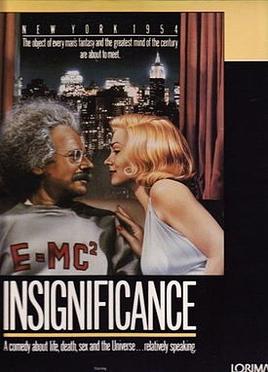
Film Review: Insignificance (dir by Nicolas Roeg)


The 1985 film, Insignificance, opens in New York City in the 1950s.

On the streets of New York, a crowd has gathered to watch as the Actress (Theresa Russell), a famous sex symbol, is filmed standing on a grate while wearing a white dress.  Beneath the street and the Actress, a fan has been set up and the crowd of onlookers cheers as the Actress’s skirt is blown up around her hips, again and again.  Standing in the crowd, the Actress’s husband, the Ballplayer (Gary Busey), watches and shakes his head in disgust.  After the scene has been shot, the Actress hops in a taxi while the Ballplayer chases after her.  A very famous man is in town and the Actress is on her way to pay him a visit.

In a nearby bar, the Senator (Tony Curtis), drinks and talks and sweats.  Though it may not be obvious from looking at him, the Senator is a very powerful man.  He’s leading an investigations into subversives who may be trying to bring down the United States government.  He may look like a small-time mobster but the Senator can make and destroy people on a whim.  He’s come to New York on a very specific mission.  He and his goons are planning on pressuring another famous man into testifying before the Senator’s committee.

Though they don’t know it, both the Actress and the Senator are planning on dropping in on the same man.  The Professor (Michael Emil) is a world-renowned genius.  When we first see him, he is sitting alone in a hotel room and looking at a watch that has stopped at 8:15.  The public may know the Professor for his eccentricities but, in private, he is a haunted man.  The Professor’s work was instrumental in the creation of the first atomic bomb.  And now, with both the U.S. and Russia stockpiling their atomic arsenals and the world seemingly on the verge of war, the Professor fears that his work will be the end of humanity.

Though none of the characters are actually named over the course of the film, it should be obvious to anyone with even a slight knowledge of American history that the four main characters are meant to be versions of Marilyn Monroe, Joe DiMaggio, Joe McCarthy, and Albert Einstein.  Insignificance imagines a meeting between these four cultural icons and really, it’s not difficult to imagine a scenario in which they all could have met.  Joe DiMaggio actually was present during the filming of the subway grate scene from The Seven Year Itch and most accounts record his reaction as being not that different from what’s portrayed in Insignificance.  Albert Einstein was suspected of having communist sympathies and several scientific figures (including many who worked on the Manhattan Project) were investigated during the McCarthy era.  Finally, Marilyn Monroe was often frustrated by her “dumb blonde” image and said that she found Albert Einstein to be a very attractive man.  When she died, a biography of Einstein was reportedly found on her nightstand.

In the film, the Senator pressures The Professor to appear before his committee.  It’s not long after the Senator leaves that the Actress arrives.  The Actress announces that she’s fascinating by the theory of relativity and, using balloons, toys, and a flashlight, she proceeds to demonstrate the theory for the Professor.  The befuddled Professor is impressed.  The Actress informs the Professor that he’s at the top of her list.  Meanwhile, downstairs in another hotel room, the Senator is met by a prostitute who bears a resemblance to the Actress. The Ballplayer sits in the hotel bar, tearing up a picture of the Actress and wondering why their marriage is failing.

Because this film was directed by Nicolas Roeg, the film is full of seemingly random flashbacks.  We see the Senator as an altar boy, trying to impress a smiling priest.  We see the Ballplayer getting yelled at by his domineering father.  We see the Actress, growing up poor and being ogled, at first by the young boys at an orphanage and later by Hollywood execs.  Meanwhile, The Professor continually sees the destruction of Hiroshima.  His visions are apocalyptic and, towards the end of the film, he even gets a glimpse into a possible future of atomic hellfire.  It’s a film about fame and cultural transition, a film where people look to celebrities for hope while doomsday comes closer and closer.

Or something like that.  To be honest, I wanted to like Insignificance more than I actually did.  As is typical with so many of Nicolas Roeg’s films, Insignificance has an intriguing premise but the execution is a bit uneven.  There are moments of absolute brilliance.  Theresa Russell and Gary Busey both give perfect performances and the film’s final apocalyptic vision will haunt you.  And then there are moments when the film becomes a bit of a slog and the dialogue starts to get a bit too pretentious and on-the-nose.  Michael Emil has some good moments as the Professor but there are other moments when he seems to be lost.  Meanwhile, Tony Curtis gives such a terrible performance as The Senator that he throws the entire film off-balance.  Curtis bulges his eyes like a madman and delivers his lines like a comedian doing a bad 1930s gangster impersonation.

That said, Insignificance is still an interesting film.  It’s uneven but intriguing.  Though the film may take place in the 50s and may deal with a quartet of historical figures, it’s themes are still relevant in 2020.  People still tend to idealize celebrities.  Politicians still hold onto power by exploiting fear.  The possibility that everything could just end one day is still a very real one.  Insignificance is a film worth watching, even if it doesn’t completely work.

A Movie A Day #56: The White Buffalo (1977, directed by J. Lee Thompson)


whitebuffalo1977The year is 1874 and James Otis (Charles Bronson) is traveling through the Dakota Territory.  Everywhere that James Otis goes, someone tries to shoot him.  This is because James Otis is actually the infamous Wild Bill Hickcock and everyone this side of Deadwood has a reason to want him dead.  Hickcock has returned to the territory because he is losing his eyesight and he fears that he may be dying.  Hickcock has been having nightmares about a giant albino buffalo and believes that it is his destiny to either kill it or be killed himself.

Meanwhile, a young indian chief (Will Sampson) is also seeking the White Buffalo.  The buffalo previously attacked his village and killed his son.  The chief must now get revenge or lose his power in the tribe.  He is now known as Worm.  Before the buffalo attack, his name was Crazy Horse.

Crazy Horse eventually teams up with Hickcock and a one-eyed hunter named Charlie Zane (Jack Warden).  They work out an uneasy alliance but who, of the three, will finally get the chance to kill the buffalo?

When Dino De Laurentiis produced The White Buffalo, he was hoping to combine the popularity of Jaws with the star power of Charles Bronson.  It should have been a hit but instead, The White Buffalo was one of the many flops that temporarily killed the western as a commercial genre.  (Before there was Heaven’s Gate, there was The White Buffalo.)  The reason why is obvious: while audiences loved to watch Bronson shoot muggers in New York, they were less willing to sit through a pseudo-intellectual western version of Moby Dick that featured more conversation than gunplay.  The obviously fake buffalo did not help matters.

I still like The White Buffalo, though.  Because of the movie’s cheap sets, fake snow, and some inconsistent rear projection work, The White Buffalo is sometimes so surreal that it could pass for a Spaghetti Western.  (When I saw Bronson, Sampson, and Warden huddled in a cardboard cave while it fake snowed outside, I immediately thought of Sergio Corbucci’s The Great Silence.)  Charles Bronson, always an underrated actor, gave one of his best performances as the haunted Hickcock.  The White Buffalo was, up until his small role in Sean Penn’s The Indian Runner, the last time that Bronson would allow himself to appear as anyone other than Charles Bronson on-screen.

When watching The White Buffalo, keep an eye out for several Hollywood veterans in minor roles.  Kim Novak plays a prostitute.  Stuart Whitman is a thief.  Slim Pickens drives a stagecoach.  Clint Walker’s an outlaw and Ed Lauter plays the younger brother of Gen. Custer.  The town’s undertaker is John Carradine.  The cameos don’t add up too much but it’s still good to see everyone.