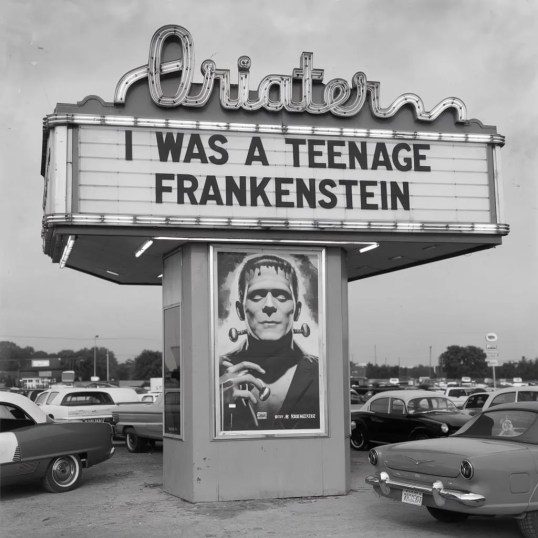
This film was produced as a direct result of the box office success of I Was A Teenage Werewolf. Just as in Teenage Werewolf, Whit Bissell plays a mad scientist who makes the mistake of trying to play God. (He also makes the mistake of keeping an alligator in his lab but that’s another story.) The end result …. Teenage Frankenstein!
The makeup on the Teenage Frankenstein is probably the best thing about this film. If nothing else, this film features a monster who actually looks like he was stitched together in a lab.
1957’s I Was A Teenage Werewolf combines two genres that were very popular in the late 50s.
On the one hand, it’s a film about a teenage rebel. Tony Rivers (Michael Landon) is a teenager that means well but he keeps losing his temper. If he can’t learn to control his anger, he could very well be looking at a life behind bars.
On the other hand, it’s also a horror film. When Tony visits a hypnotist (Whit Bissell), the end result is Tony turning into a werewolf and going on a rampage, all while still wearing his letterman jacket.
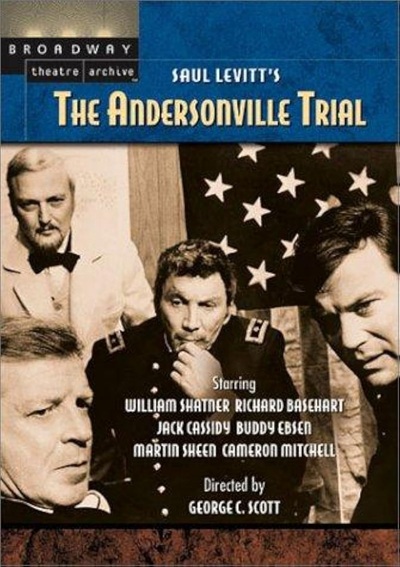
1970’s The Andersonville Trial takes place in one muggy military court room. The year is 1865. The Civil War is over but the wounds of the conflict are still fresh. Many of the leaders of the Confederacy are still fugitives. Abraham Lincoln has been dead for only a month. The people want someone to pay and it appears that person might be Captain Henry Wirz (Richard Basehart).
Originally born in Switzerland and forced to flee Europe after being convicted of embezzlement, Henry Wirz eventually ended up in Kentucky. He served in the Confederate Army and was eventually named the commandant of Camp Sumter, a prison camp located near Andersonville, Georgia. After the war, Captain Wirz is indicted for war crimes connected to his treatment of the Union prisoners at the camp. Wirz and his defense counsel, Otis Baker (Jack Cassidy), argue that the prison soon became overcrowded due to the war and that Wirz treated the prisoners as well as he could considering that he had limited resoruces. Wirz points out that his requests for much-needed supplies were denied by his superiors. Prosecutor Norton Chipman (William Shatner) argues that Wirz purposefully neglected the prisoners and their needs and that Wirz is personally responsible for every death that occurred under his watch. The trial is overseen by Maj. General Lew Wallace (Cameron Mitchell), the same Lew Wallace who would later write Ben-Hurand who reportedly offered a pardon to Billy the Kid shortly before the latter’s death. Wallace attempts to give Wirz a fair trial, even allowing Wirz to spend the trial reclining on a couch due to a case of gangrene. (Agck! The 19th century was a scary time!)
The Andersonville Trial started life as a 1959 Broadway production. On stage, George C. Scott played Chipman, an experience he described as difficult because, even though Chipman was nominally the play’s hero, Wirz was actually a much more sympathetic character. When the play was adapted for television in 1970, Scott returned to direct. Admittedly, the television version is very stagey. Scott doesn’t make much effort to open up the play. Almost all of the action is confined to that courtroom. We learn about the conditions at Fort Sumter in the same way that the judges learned about the conditions. We listen as the witnesses testify. We listen as a doctor played by Buddy Ebsen talks about the deplorable conditions at Fort Sumter. We also listen as a soldier played by Martin Sheen reports that Wirz has previously attempted to suicide and we’re left to wonder if it was due to guilt or fear of the public execution that would follow a guilty verdict. We watch as Chipman and Baker throw themselves into the trial, two attorneys who both believe that they are correct. And we watch as Wirz finally testifies and the play hits its unexpected emotional high point.
As most filmed plays do, The Andersonville Trial demands a bit of patience on the part of the viewer. It’s important to actually focus on not only what people are saying but also how they’re saying it. Fortunately, Scott gets wonderful performances from his ensemble cast. Even William Shatner’s overdramatic tendencies are put to good use. Chipman is outraged but the play asks if Chipman is angry with the right person. With many of the Confederacy’s leaders in Canada and Europe, Wirz finds himself standing in for all of them and facing a nation that wants vengeance for the death of their president. Wirz claims and his defense attorney argues that Wirz was ultimately just a soldier who followed orders, which is what soldiers are continually told to do. The Andersonville Trial considers when military discipline must be set aside to do what is morally right.
Admittedly, when it comes to The Andersonville Trial, it helps to not only like courtroom dramas but to also be a bit of a history nerd as well. Fortunately, both of those are true of me. I found The Andersonville Trial to be a fascinating story and a worthy production.
Charles Bronson starred in four movies and one TV show in 1958. Two of those movies were produced by Harold Knox, written by Louis Vittes, and directed by Gene Fowler, Jr. The first of the two films was SHOWDOWN AT BOOT HILL, an excellent low budget western that featured Bronson as a bounty hunter with a chip on his shoulder and love in his heart. The second film was GANG WAR.
In GANG WAR, Charles Bronson plays Alan Avery, a high school teacher in Los Angeles who’s walking home one night and happens to witness a gangland killing. He calls the police to report the murder, but he doesn’t want to get any further involved so he doesn’t give them his name. Avery was on his way home from a trip to the pharmacy where he had picked up a prescription for his pregnant wife (Gloria Henry) who is suffering from migraines. In the stress of the moment, he left the pharmacy sack in the phone booth and the police are able to track him down to his home. After being pressed by the police, Avery reluctantly agrees to testify. He’s a great witness as he’s able to give the police a description of the car and its license plate number. His information leads to the arrest of Joe Reno, the second in command to mobster Maxie Meadows (John Doucette). Maxie sends his attorney Bryce Barker (Kent Taylor) over to the police station to see Captain Finch. Finch happens to be on Maxie’s payroll, and he immediately tells Barker about the witness. He even leaks it to the press so they can run a story revealing Avery’s name and address. Maxie would prefer to buy Avery’s silence, but he also wants a little insurance, so he sends his punch drunk henchman Chester over to slap around Avery’s wife. This order is akin to asking Lennie Small from OF MICE AND MEN to go play with some puppies. Simple-minded Chester proceeds to kill Mrs. Avery. When Avery comes home and finds his wife dead, he heads directly to Maxie’s house to kill him. The cab driver who took Avery to Maxie’s place just happened to see his gun, so he called the cops. Just before Avery can squeeze off a kill shot, the police show up and arrest him. Pissed that Avery was able to get so close to killing him, Meadows puts an actual hit out on him this time. Will the high school teacher be able to survive his battle against the mob?!!
(Note: The analysis below ventures into spoiler territory for both GANG WAR and SHOWDOWN AT BOOT HILL. You may want to watch these films prior to reading the rest of the review.)
As a lifelong fan of Charles Bronson, I really appreciate his work with director Gene Fowler, Jr. in 1958. Fowler recognized Bronson’s charismatic screen presence, but he also recognized something deeper in the legendary icon… his heart. SHOWDOWN AT BOOT HILL seemed to be giving us Bronson as a typical western hero, only to reverse course and turn Bronson into a romantic lead who would choose to throw down his guns so he could establish roots in a community and spend his life with the woman he loves. In a similar way, GANG WAR seems to be setting Bronson up to be a vigilante, not much different than the type of character he would be portraying throughout the 70’s and 80’s. But when 70’s and 80’s Bronson would be pulling his trigger, Fowler presents a more thoughtful Bronson who recognizes that the best revenge can sometimes be in letting someone live with the consequences of their own decisions. This allows him to lower his gun, walk away and continue his life free of the guilt and the legal consequences that would undoubtedly come with taking another person’s life. This decision honors his wife’s legacy much more than murder and a lifetime in jail ever would.
There are many good performances in this little gem. Bronson may not have been a “star” when this film was made, but there is no doubt that he was ready. He simply commands every frame that he appears in from the beginning to the end. John Doucette and Kent Taylor are also memorable as the gangster and his paid off lawyer, respectively. Doucette’s Maxie Meadows is certainly a stereotype of the gangsters in TV’s and movies at the time, but he plays the part well, saving his very best for his last moments of the film. Kent Taylor has the movie’s best story arc. When we meet him, he’s an alcoholic who can’t stand what he’s allowed himself to become, yet he continues to run every time Maxie calls. It’s a strong moment when he decides he won’t do it anymore. And Jennifer Holden is simply gorgeous as Marie, Maxie’s woman. Speaking of nice scenery, it was also fun seeing a Los Angeles that included landmarks like the Capitol Records Building and the old Nickodell Restaurant. So much of the action in GANG WAR takes place against these iconic backdrops, and for a guy who’s never been to LA, seeing these places again almost makes me feel like a resident.
Overall, while GANG WAR does feel like an old fashioned 50’s movie, it has plenty of things to recommend it, not the least of which is an excellent performance from a young Charles Bronson. At a 75 minute run time, it’s definitely worth a viewing.
When it comes to conspiracy theories involving presidential assassinations, the theories surrounding JFK may get all the attention but it’s the theories surrounding the death of Abraham Lincoln are usually far more plausible.
Unless, of course, it’s the theories that are pushed in the 1977 docudrama, The Lincoln Conspiracy.
A mix of documentary-style narration and really cheap-looking historical reenactments, The Lincoln Conspiracy essentially indicts almost everyone who was alive in 1865 as being a part of either the conspiracy or the subsequent cover-up. Really, it’s remarkable how many historical figures are implicated in this film.
With the Civil War coming to a close, President Lincoln (John Anderson) hopes to pursue a generous reconstruction policy for the former Confederate States. Secretary of War Edwin Stanton (Robert Middleton), Senator Ben Wade (Dick Callinan), and a host of other are all opposed to this plan, both because they want vengeance and they also want to make as much money as possible off of the Southern cotton fields. They come up with a plan to impeach Lincoln but, in order to draw up the articles, they have to make sure that Lincoln is not seen for a few days. When Col. Lafayette Baker (John Dehner) discovers that an actor named John Wilkes Booth (Bradford Dillman) is planning on kidnapping Lincoln, Stanton and his conspirators decide to give Booth their unofficial support. However, when the plan changes at the last minute and Stanton decides that it would actually be a bad idea to kidnap Lincoln, an angry Booth decides to just kill Lincoln, Andrew Johnson, and William Seward.
Booth succeeds in shooting Lincoln and making his escape. The other members of Booth’s group all fail in their assignments. Andrew Johnson becomes president. Though grievously wounded, William Seward survives. Booth flees to Canada and …. oh, you thought Booth died? No, that was just a look alike who was shot by a bizarre soldier named Boston Corbett. By allowing everyone to believe that Booth was killed, Stanton is able to cover up any role he and his allies played in inspiring the assassination. Unfortunately, Col. Baker keeps a diary and it seems like he might be planning on revealing the truth but he dies mysteriously before he can.
(And, to give the film some credit, Col. Baker’s sudden death at 41 was an odd one. And, though it’s not really explored in the film, Boston Corbett, the man who shoot Booth, really was a weirdo who was described by contemporaries as being a religious fanatic who castrated himself and claimed to hear the voice of God.)
It’s a big conspiracy theory that is presented in The Lincoln Conspiracy. In fact, it’s a bit too big to really be taken seriously. The film pretty much accuses everyone in Washington of having a part in the assassination. The film itself has the cheap look of a community theater production and the use of Dr. Samuel Mudd as a narrator only adds to the film’s silliness. If you’re a fan of gigantic and thoroughly implausible conspiracy theories, as I am, the film is entertaining in its way. If nothing else, Bradford Dillman certainly looks like how most people probably imagine John Wilkes Booth to have looked. Otherwise, The Lincoln Conspiracy is far-fetched and not at all realistic, which is why I assume that a lot of people in 1977 probably believed every word of it.
This film was produced as a direct result of the box office success of I Was A Teenage Werewolf. Just as in Teenage Werewolf, Whit Bissell plays a mad scientist who makes the mistake of trying to play God. (He also makes the mistake of keeping an alligator in his lab but that’s another story.) The end result …. Teenage Frankenstein!
The makeup on the Teenage Frankenstein is probably the best thing about this film. If nothing else, this film features a monster who actually looks like he was stitched together in a lab.
1957’s I Was A Teenage Werewolf combines two genres that were very popular in the late 50s.
On the one hand, it’s a film about a teenage rebel. Tony Rivers (Michael Landon) is a teenager that means well but he keeps losing his temper. If he can’t learn to control his anger, he could very well be looking at a life behind bars.
On the other hand, it’s also a horror film. When Tony visits a hypnotist (Whit Bissell), the end result is Tony turning into a werewolf and going on a rampage, all while still wearing his letterman jacket.
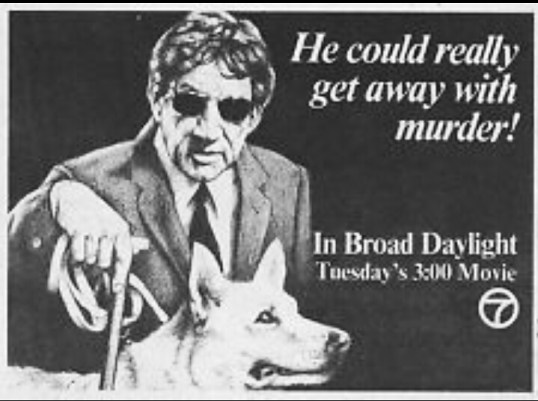
Welcome to Retro Television Reviews, a feature where we review some of our favorite and least favorite shows of the past! On Sundays, I will be reviewing the made-for-television movies that used to be a primetime mainstay. Today’s film is 1971’s In Broad Daylight! It can be viewed on YouTube.
Tony Chappel (Richard Boone) is an actor who has just recently lost his sight as a result of an accident. Released from the hospital, Tony struggles to adjust to living in a world without his vision. When one cab driver says to him, “Didn’t you used to be Tony Chappel?,” he flinches as he realizes that his career as a famous actor is now considered to be over. One day, he comes home early and overhears his wife (Stella Stevens) fooling around with his lawyer and “best friend” (Fred Beir). Tony promptly decides to murder his wife and frame his friend for the crime.
Tony decides to use his acting skills to his advantage. He memorizes the the area around him so that he can make his way through it by memory. He puts on a fake beard, speaks with Greek accent, and makes a point of carrying a camera with him. He starts taking public transportation and going out of his way to be talkative and social Everyone that he meets, he tells them about how he’s been taking pictures of the city and how he can’t wait to see how they come out. When his wife is eventually murdered, the police receive a reports of a mysterious Greek man, one who was definitely not blind, in the area. However, Lt. Bergman (John Marley) has his doubts and comes to suspect that Tony is the killer.
In Broad Daylight was made from an early script written by Larry Cohen, who would later go on to direct films like God Told Me To. It’s a clever script, one that sets up an intriguing premise and which ends on a properly twisty and satisfactory note. The film works because it is as much of a character study as a thriller. Tony’s wife not only cheats on him but also betrays him at the moment when he needs her and his friends the most. Tony has gone from being a movie star to being a man who can barely walk from one room to another. He’s already angry. Discovering that his wife is laughing at him behind his back is the last straw.
Larry Cohen reportedly felt that Richard Boone was miscast as Tony. I felt that Boone did a pretty good job, even if he did overact a bit while Tony was trying to convince everyone that he was a Greek tourist. Stella Stevens is perfectly cast as his wife and Suzanne Pleshette is sympathetic as his nurse. Godfather fans will be happy to see John Marley not having to deal with a horse’s head but instead playing the clever detective who attempts to solve the murder.
In Broad Daylight is a clever and entertaining thriller and character study.
Welcome to Retro Television Reviews, a feature where we review some of our favorite and least favorite shows of the past! On Sundays, I will be reviewing the made-for-television movies that used to be a primetime mainstay. Today’s film is 1971’s A Tattered Web! It can be viewed on YouTube!
Sgt. Ed Stagg (Lloyd Bridges) is a good cop and an overprotective father. Ever since his wife left him, Ed has been determined to make sure that his daughter, Tina (Sallie Shockley), has a good life. So, as you can probably guess, Ed is not amused when he finds out that Tina’s husband, Steve (Frank Converse), has been cheating on her with Louise Campbell (Anne Helm). Ed has never liked Steve and would love it if his daughter left him. But, Ed still doesn’t want want Tina to have to go through the pain of knowing that her husband is seeing another woman.
Ed decides to drop by Louise’s apartment and talk to her himself. Louise, however, is not willing to let some old stranger tell her how to live her life. After all, she’s heard from Steve about what a terrible and judgmental father-in-law Ed is. Ed gets frustrated and shoves Louise. Louise stumbles back, hits her head, and …. uh-oh. Louise is dead! To be honest, it didn’t really look like she hit her head that hard. In fact, I had to rewatch the scene to see if she actually hit her head at all. But no matter. Louise is dead and Ed’s responsible.
The next morning, when Ed and his partner, Joe (Murray Hamilton), are called in to investigate Louise’s homicide, Ed is approached by Louise’s neighbor (John Fiedler), who gives him a description of a young man who he says he frequently saw going up to Louise’s apartment. The description perfectly describes Steve. The police sketch artist draws a picture that looks like just like Steve. Joe thinks that Steve is responsible. Not wanting his daughter to think that her husband’s a murderer, Ed decides to frame Willard Edson (Broderick Crawford), an alcoholic who frequently comes into the station and confesses to crimes so that he can have a place to sleep for the night.
Yes, it’s a tattered web indeed. Ed is able to talk Edson into confessing to the crime but then Steve does his own detective work and realizes that Edson couldn’t be the murderer. Ed tells Steve that he should just let the police arrest Edson because, otherwise, they’re going to come after Steve. Steve, however, says that he would rather be arrested and be given a chance to prove his innocence than just stand by idly while an innocent man goes to jail. Being a veteran cop, Ed wasn’t expecting everyone to be so damn honest!
A Tattered Web isn’t bad for a 70-minute made-for-TV movie. The film’s main strength is the cast, with Lloyd Bridges, Murray Hamilton, and especially Broderick Crawford giving strong performances. The scene where Ed talks Edson into confession is especially well-done, with Crawford giving a performance of growing desperation while Bridges himself appears to be on the verge of tears as Ed realizes what his life has become. Like his sons Jeff and Beau, Lloyd Bridges is such a likable actor that it’s hard not to care about what happens to the characters that he’s playing, even when he’s playing a murderer. A Tattered Web is an effective thriller that reminds viewers that guilt cannot be escaped.
According to this 1958 film, the man to ask is Pete Dumond!
As played by Robert H. Harris, Pete Dumond is the chief make-up artist at American International Pictures. He’s so good that he can easily transform handsome teen idols like Tony Mantell (Gary Conway) and Larry Drake (Gary Clarke) into convincing monsters. Everyone loves Pete but there’s a problem. As the new studio head explains it, horror just isn’t that popular anymore. Teenagers are no longer interested in seeing movies about werewolves and Frankenstein’s Monster. Instead, teens now only care about rock and roll. Elvis has killed horror!
(Actually, the film argues that a recording artist named John Ashley killed horror. At the time this movie was made, John Ashley was under contract to American International Pictures and the film even includes a dance number where Ashley performs his latest hit. Ashley wasn’t a bad singer but it’s still hard to believe that he could have killed horror. That said, the choreography is fun and every horror movie needs at least one random dance number.)
Sadly, Pete is about to be out of a job. However, what the studio heads don’t realize is that Pete is more than just a makeup artist! He’s also a master hypnotist! Soon, Pete is using a special foundation cream to hypnotize Tony and Larry. Once he has them under his control, he sends them, in full costume, on a mission to kill anyone who thinks that horror is dead!
There’s a lot of enjoyment to be found in How To Make A Monster. The film not only takes place at American International Pictures but it was produced by AIP as well, so the entire movie is basically full of in-jokes that would only be appreciated by B-movie fans. For instance, the makeup effects that Pete creates are the same ones that were used in I Was A Teenage Frankenstein and I Was A Teenage Werewolf. (Gary Conway wore the Frankenstein makeup in both Teenage Frankenstein and this film.) Towards the end of the film, when Larry and Tony confront Pete at his home, the walls are decorated with all of the monsters that Pete has created throughout the years and attentive viewers will recognize them as coming from such previous AIP films as The She-Creature, It Conquered The World, and Invasion of the Star Creatures. (Seriously, I loved seeing the big crab monster from It Conquered The World hanging on Pete’s wall. I’m sure horror and sci-fans in the 1950s felt the same way.) While the majority of the film is in black-and-white, the scenes in Pete’s home are in full and vibrant color, as if AIP was announcing, “This is what makes the movies fun!”
Needless to say, How To Make A Monster is not a film that was ever meant to be taken seriously. Instead, it’s a rather cheerful send-up of both the film business and AIP’s own status as a B-studio. (At times, I felt like the film could just as easily have been called Sam Arkoff’s The Player.) Watching the film, one gets the feeling that it was largely made as a lark, an inside joke amongst friends. As such, it’s impossible to dislike this energetic little film. Director Herbert L. Strock keep the action moving along and, in the lead role, Robert H. Harris gives exactly the type of over-the-top performance that this material needs.
If you’re a fan of 50s drive-in movies, How To Make A Monster is a film that you simply must see!