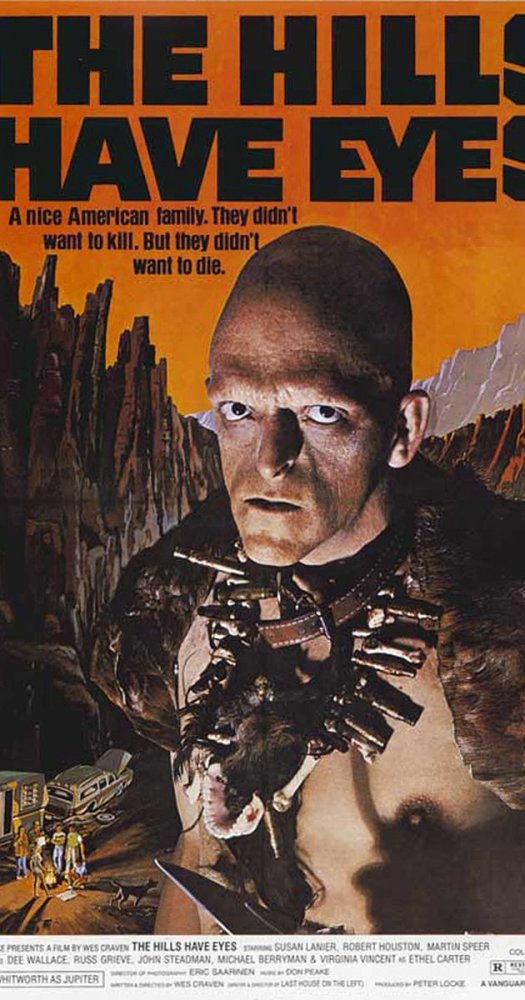
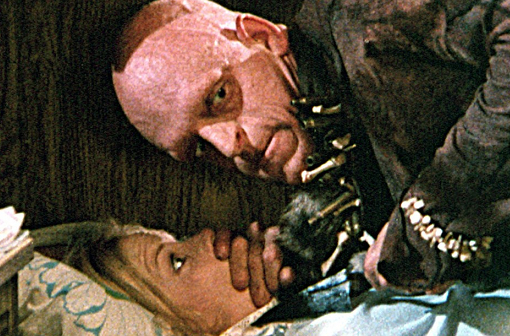
Wes Craven (1939-2015) left us with many nightmares: LAST HOUSE ON THE LEFT, NIGHTMARE ON ELM STREET, SCREAM. But you haven’t lived until you’ve met Papa Jupiter and his feral family of cannibals in Craven’s THE HILLS HAVE EYES, as outlandish and frightening a horror film as there ever was. HILLS was so shocking the censor board gave it an X rating until it was cut enough to qualify for an R. It still packed enough violence and brutality to make even the heartiest exploitation enthusiast squeamish.
The Carter clan has travelled from Cleveland to the Nevada desert on their way to California. They stop at a gas station where an old geezer is about to leave. The geezer warns them about his son, born mutated and mean as the devil, living somewhere in the hills. While driving down the long. lonesome highway, fighter jets from a nearby airbase cause…
In 1986, nerds could build robots that displayed human feelings.
Angry old neighbors hate robots.
If a nerd can build a robot that displays human feelings, then he can also bring his girlfriend back to life by putting a computer chip from the robot in her brain.
Once brought back to life, the girlfriend will start to behave just like the robot.
Basketballs can be used to do anything.
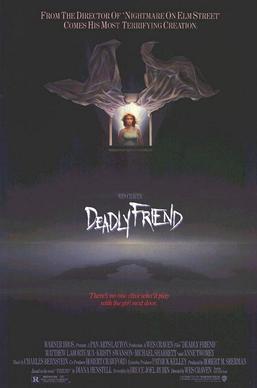
Deadly Friend is best remembered for the scene where the newly revived Samantha (Kristy Swanson) throws a basketball with such force that it causes the head of her neighbor (Anne Ramsey) to explode. It is also remembered for BB, the big yellow robot that was built by Paul (Matthew Laborteaux). Deadly Friend starts out as the ultimate nerd fantasy: a beautiful girlfriend. a big robot, and a killer basketball. By the end of the movie, the fantasy has turned into a nightmare.
Deadly Friend was Wes Craven’s follow-up to A Nightmare on Elm Street. Craven intended for the film to be a dark love story between a teenage outcast and his zombie girlfriend, with a strong emphasis on the hypocrisy of the adults around them. Craven said that, in his version of Deadly Friend, people like Samantha’s abusive father were meant to be scarier than Zombie Samantha With A Microchip In Her Brain. Warner Bros. wanted a film that would appeal to teenage horror fans and demanded Elm Street-stlye nightmares and buckets of more blood. As a result, Craven practically disowned the finished movie and Deadly Friend is a tonally inconsistent, with sentimental first love scenes competing for space with heads exploding and necks being snapped. Despite good performances from Laborteaux and Swanson, the final film is too much of a mess to work. However, I know that I will never look at a basketball the same way again.
4 Shots From 4 Films is just what it says it is, 4 shots from 4 of our favorite films. As opposed to the reviews and recaps that we usually post, 4 Shots From 4 Films is all about letting the visuals do the talking.
This October, I am going to be using our 4 Shots From 4 Films feature to pay tribute to some of my favorite horror directors, in alphabetical order! That’s right, we’re going from Argento to Zombie in one month!
Today’s director is the great Wes Craven!
4 Shots From 4 Films
A Nightmare on Elm Street (dir. by Wes Craven)
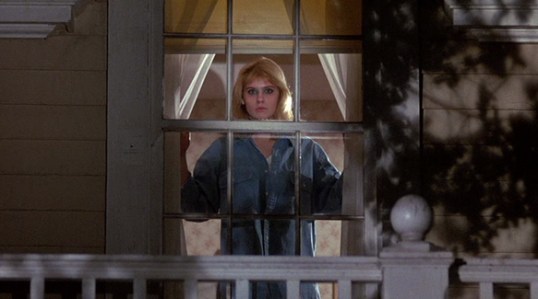
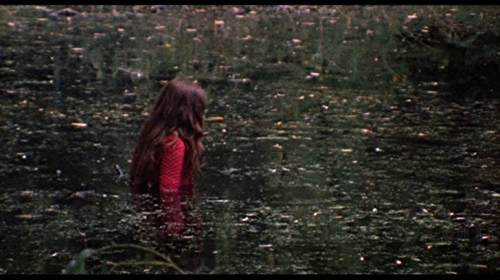
Deadly Friend (1986, dir by Wes Craven)
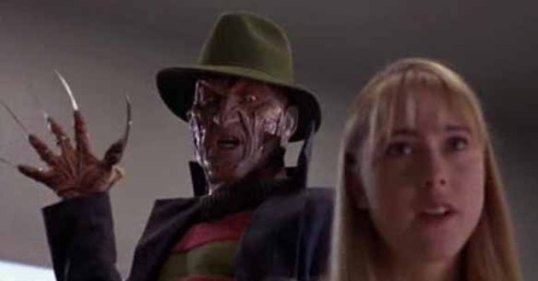
Wes Craven’s New Nightmare (1994, dir by Wes Craven)
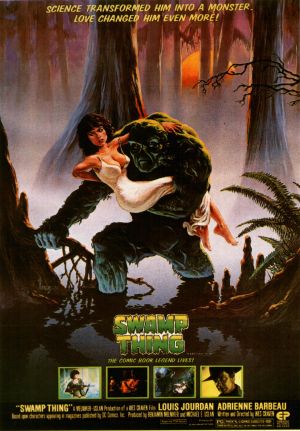
Ever since I decided that, while we are reviewing every episode of Twin Peaks, that every entry in Movie A Day would have a connection with the show, I knew that I would have to eventually review Swamp Thing. I didn’t want to because I hate Swamp Thing but, outside of his work as Leland Palmer, it is also Ray Wise’s most famous role. One of the good things about Twin Peaks is that it saved Ray Wise from being forever known as Swamp Thing.
Of course, Ray Wise does not really play Swamp Thing. He plays Alec Holland, the human scientist who is working on a formula that will allow animals and plants to thrive in extreme environments. When the evil Dr. Arcane (Louis Jourdan) sends his henchmen (including veteran bad guys David Hess and Nicholas Worth) to steal the formula, Alec gets set on fire and runs into the Louisiana bayou. When Alec emerges, he has become Swamp Thing, half-human and half-plant. He is also now played by Dick Durock. Swamp Thing must protect both bodacious Alice Cable (Adrienne Barbeau) and streetwise swamp kid Jude (Reggie Batts) while trying to prevent Arcane from using the formula to turn himself into a werewolf and conquer the world.
Despite the easily mocked name, Swamp Thing has often been one of the best characters in the DC universe. The movie does not being to do the character justice. At the time, Wes Craven was best known for movies like Last House on the Left and The Hills Have Eyes. Swamp Thing was an attempt to show that he could direct a big-budget, studio production. Unfortunately, Craven takes a deliberately campy approach to the material, to the extent that, if not for a handful of scenes like Swamp Thing crushing David Hess’s skull, Swamp Thing could have easily been directed by Joel Schumacher during his Batman years. Just the name Swamp Thing is campy enough. There’s no need to toss in Louis Jourdan turning into a werewolf. Fans of Adrienne Barbeau will do better to rewatch Escape from New York than sit through Swamp Thing.
Fortunately, for Ray Wise, Twin Peaks came along and saved him from forever being known as Swamp Thing.
This October, I’m going to be doing something a little bit different with my contribution to 4 Shots From 4 Films. I’m going to be taking a little chronological tour of the history of horror cinema, moving from decade to decade.
Today, we continue the 90s!
4 Shots From 4 Films
Dellamorte Dellamore (1994, dir by Michele Soavi)
In the Mouth of Madness (1994, dir by John Carpenter)
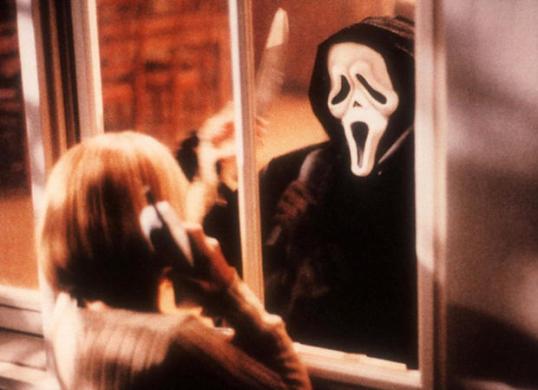
Scream (1996, dir by Wes Craven)
From Dusk Till Dawn (1996. dir by Robert Rodriguez)
This October, I’m going to be doing something a little bit different with my contribution to 4 Shots From 4 Films. I’m going to be taking a little chronological tour of the history of horror cinema, moving from decade to decade.
This October, I’m going to be doing something a little bit different with my contribution to 4 Shots From 4 Films. I’m going to be taking a little chronological tour of the history of horror cinema, moving from decade to decade.
Today, we start the savage 70s!
4 Shots From 4 Films
The Shiver of the Vampires (1970, dir by Jean Rollin)
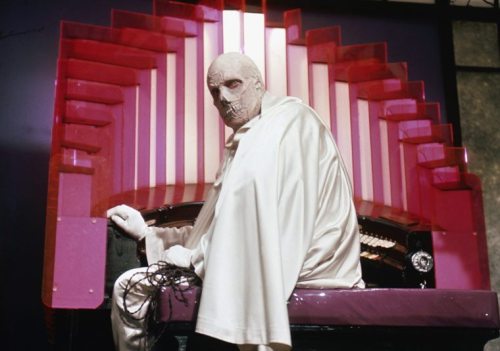
The Abominable Dr. Phibes (1971, dir by Robert Fuest)
The Last House On The Left (1972, dir by Wes Craven)
John Carpenter’s contribution and influence in horror and genre filmmaking could never be disputed. This man’s films, especially his work from the 70’s and early 80’s have made him one of the undisputed masters of horror (joined by such contemporaries as Wes Craven and George A. Romero). While his worked had become so-so at the tail-end of the 1990’s and quite sparse during the 2000’s his name still evokes excitement whenever something new comes out where he’s intimately involved in it’s creation (these days a series of synth-electronic albums).
It was during the mid-1990’s that we saw a John Carpenter already tiring of constantly fighting the Hollywood system, yet still game enough to come up with some very underrated and underappreciated horror and genre films. One such film was 1995’s In the Mouth of Madness. This was a film that didn’t so well in the box office yet has become a cult horror classic since. Part of his unofficial Apocalypse Trilogy (The Thing and Prince of Darkness the other two), In the Mouth of Madness combined Lovecraftian eldritch horror with the horror of the mundane that made Stephen King so popular with the masses.
This scene early in the film just showcases not just Carpenter’s masterful camera and editing work, but was ahead of its time in exploring the toxic nature of fandoms and groupthink. In 1995 such a concept might have been relegated to B-movie horror, but in 2016 it’s become synonymous with such everyday occurrences and topics as Gamergate, Tea Party and Trump supporters to SJW crusaders, Marvel vs. DC and Democrats and Republicans. Everyone believes their group to be the only righteous in whatever argument they happen to be part of and everyone else must be silenced (and in the scene below silenced equates to death).
John Carpenter might have turned into that old and cantankerous, albeit cool, dude who couldn’t care less what you thought of him, but it seems that he saw what was happening today as far back as the 1990’s.
As for me, I’m going to share an anecdote and then, I’m going to pay tribute to Wes with a six trailer salute.
First, the anecdote. I can still remember the first time that I ever watched Last House On The Left. It was a film that I had mixed feelings about. On the one hand, as a horror lover, I could not help but be impressed by the terrifying performances of Fred Lincoln and David Hess. I could not help but by moved by the way Hess’s haunting song, Now You’re All Alone, was used in the film. And, as low-budget and exploitive as the film may have been, I could see that Wes Craven was more interested in critiquing sadism than in celebrating it.
At the same time, it was still an unpleasant film for me, as a woman, to watch and the addition of some clumsy humor pretty much confirmed that Craven was still finding his way as a filmmaker. It was one of those films that I knew, as a horror fan, I had to watch but I wouldn’t say that I enjoyed it.
However, that night, I did end up watching the movie twice. I watched it a second time so that I could listen to the commentary from Wes Craven and producer Sean S. Cunningham. And — oh my God — both of these guys were so funny and charming! Craven, especially, seemed to enjoy pointing out scenes that didn’t quite work and the frequently awkward dialogue that he had written. Craven and Cunningham both came across as being two of the nicest guys in the world and it was indeed an experience to hear them cheerfully talking while these absolutely vile images were flickering by onscreen.
And really, that taught me an important lesson and it’s one that I remember to this day. Whenever I hear some judgmental know-it-all claiming that only a sick person could direct or write a horror movie, I remember that charming Wes Craven audio commentary.
And now, here are six trailers for six of Wes Craven’s films.
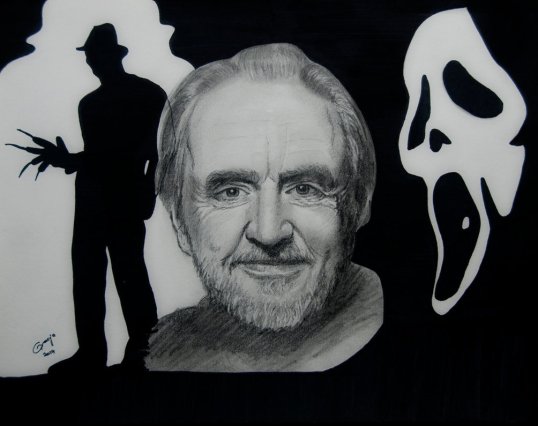
If I had a dime for every time I heard “I didn’t even know Wes Craven was ill” today, I’d be a very wealthy man. And if I could add in the times I said it myself, I’d be doubly rich. Sadly, no one’s paying me for either either hearing or saying it, so all that means is that we’re stuck with the shitty reality that one of the true masters of modern horror is no longer with us. And I’m still broke. The latter,can probably be fixed — the former, tragically, can’t.
Brain cancer is an especially horrific way to go, and I hope that Wes was surrounded by family and friends and went peacefully into the land of eternal sleep and nightmare. I add “nightmare” in there because, let’s face it, he’d probably be bored in an afterlife that was all rainbows, candy, sunshine, and smiles. I’m sure…


 I have been dreading this moment for a while.






 Through the Shattered Lens