Trailer: The Dark Knight Rises (3rd Official)


With the North American release of Marvel Studios’ The Avengers just days away it looks like DC Films’ parent company, Warner Brothers Pictures, is playing a little bit of gamesmanship by releasing a brand new trailer for their own superhero blockbuster offering this summer in The Dark Knight Rises .

The third film in Christopher Nolan’s Dark Knight trilogy and one that has much to live up to with the financial and critical success of the previous film, The Dark Knight. With no Heath Ledger to help anchor this third film it looks like the final leg in this trilogy will have to rely on the addition of Bane as Batman’s main antagonist. The film will also see the return of one Selina Kyle aka Catwoman who may or may not be a character Batman has to treat as an enemy as well.

From the previous teasers and trailers released for this film fans of the franchise will have a story that’s much more epic in scope than the previous two, but also one that seem to have the hit-or-miss of the three. Film trilogies rarely finish off as well as it starts with a few exceptions and hopefully Nolan’s final entry in his gritty take on the Dark Knight will be one of those exceptions.

The Dark Knight Rises is set for a July 20, 2012 release.

Source: The Dark Knight Rises Official Website

Trailer: The Dark Knight Rises


There’s nothing much else to say other than 2012 looks to be the year of The Dark Knight Rises.

2005 saw the reboot of the Batman film franchise. This first film in the new trilogy put Christopher Nolan on the map as an action filmmaker. 2008’s The Dark Knight with it being such a huge critical and, more importantly, a mega-blockbuster made Christopher Nolan a filmmaker who could do anything he wants and with whatever budget he asks for. Nolan was able to cash in some of that cred to make 2010’s Inception which was also a runaway success.

2012 is just around the corner and we have the third and final leg to Nolan’s Dark Knight trilogy. With the success and popularity of the two previous films to say that the hype and anticipation for this third film has reached stratospheric levels would be an understatement. This is not to say the film can’t flop, but with Nolan’s track record I am in the camp of highly doubt it.

The Dark Knight Rises is set for a July 20, 2012 release in both regular and IMAX (though not in 3D).

Trailer: Wrath of the Titans


2010’s Clash of the Titans remake wasn’t what fantasy fans were expecting. Yes, it had spectacle and taking advantage of 3D (rage of the time due to the success of Avatar), but how the film ended up quality-wise left much to be desired. For an epic summer blockbuster film (as hyped by it’s ads and marketing push) the film felt very underwhelming. It showed in the box-office as it failed to generate Olympian-level cash though it still generated a little under $500million worldwide. I’m guessing it’s this number which greenlit a sequel to a remake of a film that never had one.

Wrath of the Titans forgoes having just two titans battle it out with Perseus (Sam Worthington) stuck in the middle. This time around the sequel will deal with the weakening of the Olympian Gods as human worship wanes while at the same time the powers of the imprisoned Titans rise. So, from the trailer alone this looks to have action that’s even more amped up than it’s predecessor. Previous director Louis Leterrier has stepped aside as director and in his place for the sequel is Jonathan Liebesman (Battle: Los Angeles…which I thought was actually quite good despite what my partner-in-writing Lisa Marie says about the film).

Sam Worthington, Liam Neeson and Ralph Fiennes return to their roles from the previous film. Replacing Alexa Davalos in the role of Princess Andromeda from the first film is Rosamund Pike who now takes the role as Queen Andromeda. Bill Nighy and Danny Huston join the cast as Hephaestus and Poseidon respectively.

Wrath of the Titans is set for a March 30, 2012 release which just reinforces my point that the summer blockbuster season seem to be encroaching into Spring with each passing year.

Quick Review: Contagion (dir. by Steven Soderbergh)


Note that this isn’t the only review for Contagion.

Arleigh has an in-depth review of the film, which is also available to see, whereas this is more of a summary. As it’s for the same film, I’ve used the same tags that were in Arleigh’s post.

Before I start, I have to say that I haven’t had a theatre be so quiet during a film since I went to see Mirrors, and that was because there was no one there. My showing for Contagion was packed, but no one made a sound throughout the film. I coughed twice (because I had to), and you wouldn’t believe how many heads turned in my general direction. If nothing else, it shows that the movie had some impact to the audience, and that’s always (okay, usually) interesting to see. By the time the movie is over, you will probably pay attention to how many times you touch your face or the objects around you.

If there’s one thing I can give director Steven Soderbergh, it’s that he has a great ability to work with ensemble casts. He did a great job in getting everyone to work together on the Oceans Eleven remake and sequels. He also walked away with a Best Director Oscar for Traffic. His films have the ability to avoid having his stars chew up enough screen time that they appear to be an actual center character. Catherine Zeta-Jones’ had a character who’s story was just as strong as Benecio Del Toro’s.

On this, Contagion is no different. In essence, it’s almost like watching cameos in a miniseries.

Although the film is peppered with various actors, no one person can be considered the main character of the film. Soderbergh is able to get them all to play their roles well. He and Scott Z. Burns – one of the writers on The Bourne Ultimatum and a collaborator with Soderbergh – give us a number of perspectives for this story and damn, the whole thing is very tight overall. The movie has very little wasted space.

Like the story itself, the movie moves at a great pace, opening with Elizabeth Emhoff (Gwenyth Paltrow) on her second day after exposure to the virus after returning from a trip to Hong Kong. This eventually escalates to other infections reported in other areas around the world. In an effort to contain and understand what they’re dealing with, the Center for Disease Control starts an investigation. Lead by Dr. Ellis Cheever (Lawrence Fishburne), he sends Dr. Erin Mears (Kate Winslet) to Minnesota to determine the scale of the problem.

In addition to the CDC’s efforts, the World Health Organization also gets involved, sending their own field agent to Hong Kong, played by Marion Cotillard. Both doctors come up with information that appear to be helpful for the overall investigation in various ways.

The other two angles in the film are through a conspiracy theory blogger / investigative reporter played by Jude Law and Mitch Emhoff (Matt Damon), who has to deal with the impact of his wife’s sickness. Enrico Colantoni, Brian Cranston, Sanaa Lathan, Elliot Gould and Jennifer Ehle round out the cast. It should be noted that Ehle is the daughter of Kenneth Branaugh’s Hamlet actress Rosemary Harris, who looks remarkably like her mother. That’s just something that caught my eye.

In terms of the Kid Factor, I would be hesitant to take kids to see this unless they had a pretty clear handle on death or getting sick. Teens and adults could probably handle the film, but anyone under than that may freak out a little. Mind you, there’s very little gore in this film. When I think about it, there’s not even a whole lot of blood. There is some violence though as the story escalates and humanity goes wild, but it’s not that far a cry from many zombie movies. It’s up to the parents discretion on whether their kids should see this.

I should also point out that the music in this film is also very good. Cliff Martinez, who also worked on the score for Drive (also out this month) did an impressive job with an electronic score that sits in the background of the film, but also fits the pacing of the film well. It’s worth giving it a listen if at all possible. This quick review was actually written to the Contagion score.

Contagion is definitely worth seeing, easily recommended, but if you happen to be particular about germs, note that this may not be the most comfortable film to watch. Don’t be shocked if you end up hugging yourself while watching this in the theatre. With Soderbergh moving away from film directing to pursue other interests, Contagion is a nice final bow to his career.

Review: Contagion (dir. by Steven Soderbergh)


In a world where almost every season news media both traditional and on-line warn the population of what could be an outbreak of a new super-virus that could cause a new pandemic similar to the Spanish Flu of 1918. This was a pandemic which occurred before transcontinental travel was the norm and the virus still managed to kill 1% of the world’s population. Now, it’s 2011 and with warnings of swine flu, bird flu, Ebola, SARS and any number of infectious diseases still in the public’s consciousness we get a new film from filmmaker Steven Soderbergh which seriously explores a world discovering a new deadly disease and how the world responds and deals with the crisis.

Contagion begins with a simple “Day 2” caption as we see one Beth Emhoff (Gwyneth Paltrow) awaiting her flight to board in O’Hare at Chicago. There’s a bit of character building about this character who we see as already in the early stages of what looks to be the flu. From there Soderbergh does an interesting bit where he lets the camera linger for just a split second longer whenever Beth touches something. Soderbergh does this many times that the audience will soon get used to it and forget the significance of the act. We see Beth get a ride home from a colleague back to her home where she’s welcomed home by her husband Mitch and her young son Clark who runs to her and gives her a big hug.

The story really hits the ground running as Beth and soon those she has come into contact with begin to show similar symptoms and quickly die. The CDC and it’s head administrator, Dr. Ellis Cheever (Laurence Fishburne), soon begin to see a pattern to the deaths and the similarity to their symptoms. We soon see another aspect of the story begin with the arrival of Dr. Erin Mears whose job is to investigate the circumstance which seems to be leading into a cluster case starting with Beth and the area she lives in.

The third aspect of this film throws in internet news blogger Alan Krumwiede (Jude Law) who begins to suspect that several deaths around the world looks to be interconnected in someway and that the government, the CDC and the WHO (World Health Organization) are trying to hide these disturbing facts from the general public. Krumwiede becomes the purveyor of unfiltered news which seems to do more harm than good as more and more people begin to believe his conspiracy theories about what looks to be a growing global pandemic cause by an unknown virus every expert brought in to help cannot seem to figure out.

Let me just first say that to call Contagion a thriller in the traditional sense would be flimsy at best. Soderbergh and the film’s writer, Scott Z. Burns, have made a thriller but in a sense that it skews heavily on using realism and an almost docudrama style to push the film’s narrative. The thriller aspect comes from the notion that this film’s plot is not far off from actually becoming a real event. There’s no usage of dramatic tropes from past disaster and apocalyptic films to manipulate the audience. The film as a thriller would be quite mundane when stacked up against films like Outbreak and The Andromeda Strain. It’s the realness of the story, the events taking place on the screen which gives the film it’s dramatic heft.

We begin to see what Soderbergh is trying to accomplish with this film. How transcontinental travel which took weeks during the 1918 Spanish Flu pandemic now can spread a highly infectious disease in a manner of less than a day’s plane flight over one ocean. The film shows in disturbing detail just how easily we as a people can spread a disease just by doing the most innocuous thing like absently touching one’s face many times a minute then transferring whatever we had to any surface we touch. Contagion definitely will add to the paranoia of those who already have an unhealthy habit of disinfecting everything before they even touch it.

The film doesn’t just touch upon the medical side of solving the growing crisis, but also explores how the governmental response and sociological reaction to the epidemic. For the former we see how protocols and the need to slowly disseminate information to the public only adds to the public’s mistrust of the very agencies created to help them in case of such an event. Soderbergh doesn’t condemn or praise these agencies for their bureaucracy. We see the reason why places like the CDC take their time to finally inform the public as we get the unfiltered and manipulative news blog side of the news media in the form of Krumwiede’s blog. While he does dare to ask the questions other more traditional news organizations fail to ask he also becomes too enamored with how many people read his blog that he’s willing to manipulate the news itself in order to gain more followers.

Contagion hits the second half of the film with the world in full crisis mode and the film taking on a more apocalyptic tone. We see streets in San Francisco full of garbage bags as agencies who used to pick them up have either gone on strike or have stopped their daily runs in fear of infection. Then there are the riots at pharmacies and stores as interstate commerce grounds to a halt and no new supplies of goods and sundries make it to stores. Society itself begin to devolve as everyone and every group start to look after their own and begin to turn on others for the dwindling supplies.

It’s here in the second half that we see the film take on some of the more traditional aspects of a thriller, but even here Soderbergh doesn’t seem to want to linger on the more sensational side of the story. He continues, for good or ill, on the narrative style he began with and that’s to see the epidemic from beginning to conclusion in as clinical a manner as possible. It’s for this reason that at times the more intimate and personal side of the film’s story involving the Emhoff family seemed like it was from a different film. The Emhoff’s end up becoming the heart of the film, but it’s this emotional center that never seemed to fit with the sterile and cold narrative style Soderbergh chose to tell the film’s story.

The performances by the star-studded cast was quite good, but no one person really stood out. If I had to choose one it would have to be Kate Winslet’s Dr. Mears who goes out into the field early in the crisis investigating the early stages of the epidemic. We see her frustration at having to deal with local governmental agencies who fear the hit a quarantine would put on local economies (as if people dying in droves wouldn’t be a bigger hit) and the very danger of contracting the disease itself since having no knowledge of how it works she must use means of protection that may or may not protect her. While her story-arc in the film was just one of several it was her’s which really showed a major impact at how impersonal can be and how no one is truly safe.

Contagion is a film that tells a story about the possibility of such an event occurring and does it well, if not in a very clinical way, but it also shows just how unprepared we truly are when it comes to the smallest of creatures who sees us as nothing more than living forms of intercontinental travel. It’s exploration of such a global crisis in all it’s aspects (medical, research, governmental, media and sociological) makes it seem more like a docudrama more at home in the Discovery Channel, The Science Channel and the like instead of a cinema multiplex. It’s all due to Soderbergh’s storytelling skills that he’s able to pull off such a non-traditional thriller and make people more afraid about their surroundings coming out of the film than they were going into it. It’s not one of Soderbergh’s best films, but it’s a strong offering from him and one of the better films to come out in 2011.

Review: V for Vendetta (dir. by James McTeigue)


“Remember, remember the fifth of November, the gunpowder treason and plot. I know of no reason why the gunpowder treason should ever be forgot.”

Alan Moore’s decision to want his name off the final credits for the film adaptation of V for Vendetta now makes sense. Moore has had a hate/hate relationship with Hollywood and the film industry in general. They’ve taken two of his other works in The League of Extraordinary Gentlemen and From Hell. and bollocks’d them up (to borrow a term used quite a bit in V for Vendetta). Outside of Watchmen, Alan Moore sees V for Vendetta as one of his more personal works and after reading the screenplay adaptation of the graphic novel by The Wachowski Brothers his decision afterwards was to demand his name be removed from the film if it was ever made. Part of this was his hatred of the film industry for their past mistakes and another being his wish for a perfect adaptation or none at all. Well, V for Vendettaby James McTeigue and The Wachowski Brothers is not a perfect film adaptation. What it turns out to be is a film that stays true to the spirit of Moore’s graphic novel and given a modern, up-to-the-current news retelling of the world’s state of affairs.

V for Vendetta starts off with abit of a prologue to explain the relevance of the Guy Fawkes mask worn by V throughout the film and the significance of the date of the 5th of November. I think this change in the story from the source material may be for the benefit of audiences who didn’t grow up in the UK and have no idea of who Guy Fawkes was and what his Gunpowder Plot was all about. The sequence is short but informative. From then on we move on to the start of the main story and here the film adheres close enough to the source material with a few changes to the Evey character (played by Natalie Portman) but not enough to ruin the character. Caught after curfew and accosted by the ruling government’s secret police called Fingermen, Evey soon encounters V who saves her not just from imprisonment but rape from these so-called Fingermen.

Right from the start the one thing McTeigue and The Wachowski Brothers got dead-on was casting Hugo Weaving as the title character. Voice silky, velvety and sonorous, Weaving infuses V with an otherworldly, theatrical personality. Whether V was speaking phrases from Shakespeare, philosophers or pop culture icons, the voice gave a character who doesn’t show his face from behind the enternally-smiling Guy Fawkes mask real life. I’d forgiven the makers of this films for some of the changes they made to the story and some of the characters for keeping V as close to how Moore wrote him. Once V and Evey are thrown in together by the happenstance of that nightly encounter their fates became intertwined. Portman plays the reluctant witness to V’s acts of terrorism, murders and destruction in the beginning, but a poignant and emotionally powerful sequence to start the second half of the film soon brings Evey’s character not much towards V’s way of doing things, but to understanding just why he’s doing them. This sequence became the emotional punch of the whole film and is literally lifted word for word from the graphic novel. This is the sequence in the film which should resonate the loudest for most people whether they buy into the rest of the film or not.

The rest of the cast seemed like a who’s who of the British acting community. From Stephen Rea’s stubborn and dogged Chief Inspector Finch whose quest to find V leads him to finding clues about his government’s past actions that he’d rather not have found. Then there’s Stephen Fry’s flamboyant TV show host who becomes Evey’s only other ally whose secret longings have been forbidden by the government, but who’s awakened by V’s actions to go through with his own form of rebellion. Then there’s John Hurt as High Chancellor Adam Sutler who’s seen chewing up the scenery with his Hitler-like performance through Big Brother video conferences (an ironic bit of casting since John Hurt also played Winston Smith in the film adaptation of the Orwell classic 1984). I really couldn’t find any of the supporting players as having done a bad job in their performances. Even Hurt’s Sutler might have seemed over-the-top to some but his performance just showed how much of a hatemonger Sutler and, in the end, his Norsefire party really were in order to stay in power.

The story itself, as I mentioned earlier, had had some changes made to it. Some of these changes angered Moore and probably continues to anger his more die-hard fans. I count myself as one of these die-hards, but I know how film adaptations of classic literary works must and need to trim some of the fat from the main body and theme of the story to fully translate onto the silver screen. The Wachowski Brother’s screenplay did just that. They trimmed some of the side stories and tertiary characters from the story and concentrated on V, Evey and Inspector Finch’s pursuit of both the truth of V and his own journey in finding that truth. This adaptation wa much closer to how Peter Jackson adapted The Lord of the Rings. As a fan of Moore I understood why he was unhappy with the changes, but then Moore was and still is an avowed perfectionist and only a perfect adaptation would do.

Critics on both sides of the aisle have called V for Vendetta revolutionary, subversive, daring to irresponsible and propagandist. All because the film dares to ask serious questions about the nature and role of violence as a form of dissent. But the granddaddy question the film brings up that has people talking is the question: terrorist or freedom fighter? Is V one or the other or is he both? Make no mistake about it, V for all intents and purposes is a terrorist if one was to use the definition of what a terrorist is. The makers of this film goes to great lenghts to describe throughout the film just how Sutler and his Norsefire (with its iconic Nazi-like imagery and extreme fundamentalist Christian idealogy) party rose to power in the UK. Partly due to what seemed like the failed US foreign policy and its subsequent and destructive decline as a superpower and the worldwide panic and fear it caused as a result. V for Vendetta also ask just who was to blame for allowing such individuals to rule over them. V has his reasons for killing these powers-that-be, but he also points out that people really should just look in the mirror if they need to know who really was to blame. For it was the population — whose desire to remain safe and have a semblance of peace — gave up more and more of their basic liberties and rights for a return to order. If one was to look at the past 100 years they would see that it’s happened before. There was the regime of Pol Pot in Cambodia, Milosevic’s Greater Serbia, and the king of the hill of them all being Adolf Hitler and his Nazi Inner Circle.

Another thing about V for Vendetta that will surely talked about alot will be the images used in the film. Not just images and symbols looking so much like Nazi icons, but images from the events of the past decade which have become symbols of oppression and censorship. The film shows people bound and hooded like prisoners from Abu Ghraib. The reason of the war on terror used time and time again by Sutler to justify why England and its people need him and his group to protect them by any means necessary. V for Vendetta seems like a timely film for our current times. Even with the conclusion of the film finally accomplishing what Guy Fawkes failed to do that night of November 5th some 400 plus years ago, V for Vendetta doesn’t give all the answers to all the questions it raises. I’m sure this would be something that’ll frustrate them some audiences. So much of people who go to watch thought-provoking films want their questions answered as clearly as possible and all of them. V for Vendetta doesn’t answer them but gives the audience enough information to try and work it out themselves.

In final analysis, V for Vendetta accomplishes in bringing the main themes of Alan Moore’s graphic novel to life and even does it well despite some of the changes made. It is a film that is sure to polarize the extreme left and right of the political pundits and commentators. But as a piece of thought-provoking and even as a politically subversive film, V for Vendetta does it job well. It is not a perfect film by any respect, but the story and message it tries to convey in addition to its value as a piece of entertainment mor than makes up for its flaws. Alan Moore and his followers might not love and approve of this film, but it doesn’t mean the film in and of itself wasn’t a good one. Sometimes calls for literal adaptations of beloved works or no adaptation at all also becomes a form of creative oppression and censorship.

Review: Summer Wars (dir. by Hosada Mamoru)


Anime films have been the type to make a major crossover from Japan to the United States when it comes to the US mainstream audience. While anime series typically still remain the realm of the hardcore fans of the genre the stand-alone films get much more love from mainstream critics and audiences in addition to the hardcore. One such film which looks to have made a successful mainstream crossover to the United States was the anime film Summer Wars which was originally released in Japan in August 1, 2009. The film saw it’s American debut at film festivals around the country in 2010, but since I saw it in late May 2011 I consider it a 2011 release for me thus qualifying it as one of the best films of 2011.

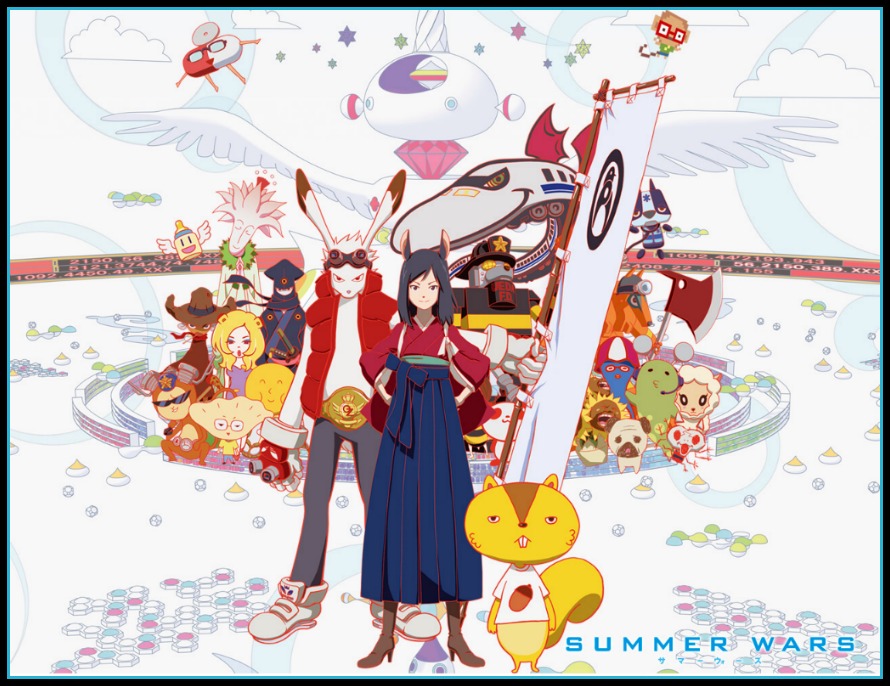
Summer Wars was the project of director Hosada Mamoru whose previous stand-alone anime film, The Girl Who Leapt Through Time, was well-received by fans and critics alike. Working from a screenplay by Okudera Satoko (adapted from a story written by Hosada himself), Summer Wars was a nice blend of science-fiction, romance and Japanese slice-of-life. The story begins with the introduction and explanation of the OZ on-line community which becomes a major focal point to the film’s story and the many characters in it. OZ was explained as an on-line, social networking community which has become so ingrained in the world community that everything anyone does was done through it’s portals. Think of OZ was an amalgamation of Facebook, Second Life, iTunes, Netflix and every other social networking site all working under one umbrella. It’s a virtual world where people just don’t socially interact through games and chat lobbies, but also a place where every real-world store has a portal where people could purchase things online. It’s also become a palce where governments from local cities to whole countries have set-up their own areas that would control their cities and countries’ infrastructures. It’s Facebook on steroids.

One of the film’s main characters happens to work as a part-time moderator for OZ. Koiso Keiji also happens to be a 17-year old math whiz who would become instrumental in the story to come. The bulk of the story has Keiji being invited by a high school friend in Shinohara Natsuki (explained to him as a job she needs for him to do) to come with her to her family estate where he ends up meeting the rest of Natsuki’s very extended family and also it’s soon-to-be 90-year old matriarch in Jinnouich Sakae. This part of the film makes up the romance and it’s comedic aspect as Keiji gets introduced by Natsuki to her great grandmother Sakae as her boyfriend and future fiance much to Keiji’s surprise. As Keiji tries to awkwardly play along with Natsuki’s plan the second part of the film’s story kick’s in as he inadvertently assist someone or something into hacking into OZ and begin a sequence of events which threatens every account in OZ, but later on even threaten the world.

This part of the story actually worked quite well due to the recent major hacking of Sony’s Playstation and Qriocity networks which gave hackers access to tens of millions of account users’ info. It was hard not to think about this real-life event as something similar (albeit much more massive and danegrous in scope) occurred in Summer Wars. The fact that the film was completed in 2009 and the Sony hack happened just a month ago was real life copying fiction instead of the other way around. It’s this part of the story’s plot which added to the thrilling aspect of the film as Keiji and others (mostly the extended Jinnouichi Clan he meets) try to take on the cause of the OZ hack (which we quickly learn wasn’t a person but an advanced A.I. program released by the U.S. Army into OZ to test it’s capabilities not knowing it would become self-aware and hard to control).

Weaving in and around this science-fiction are some of what makes some Japanese anime so easily accessible to those outside of Japan. We see a slice-of-life that, at first looks to be typical Japanese daily life, but as the story moves along becomes something that everyone would recognize and have some sort of kinship with no matter their race or culture. It’s the theme of family togetherness even through adversity and the occassional disagreements between family members. It’s here we see Natsuki’s great grandmother Sakae show the need for the family to always find time to sit down and eat dinner together no matter what problems each and everyone may be having. It’s these very serene, at times quite hilarious, scenes of family life with the Jinnouichi Clan that Summer Wars will tug at audiences’ heartstrings and cause more than just a few to tear up. Some have said these scenes were too maudlin and corny, but I look at that complaint as people trying to project their own cynical nature on what was really an honest look at family life and how keeping a family together through adversity (both big and small) becomes a reward unto itself.

The Japanese voice cast did quite a good job bringing their animated characters to life from the main leads in Keiji, Natsuki and Sakae right up to the little children who added some levity to the situation. While I try to always watch anime with the Japanese language on with English subtitles for Summer Wars I also watched it with the English-voice dubbing. I was surprised to hear that the English-dubbed version was not as bad as most anime dubs and was actually quite good. Summer Wars looks to boast a who’s-who of English dub voice actors which probably lent itself to a quality dubbing in the end.

Summer Wars was produced by one of Japan’s major animation studios with Madhouse and the look of the film bears this out. The virtual world which made up OZ looked beautiful and made great use of CGI-animation. The avatars used by OZ account members were inventive and a menagerie of characters that all looked to be very distinct each and everytime a new one came on the screen. The animation for the real-world aspect of the film used traditional hand-drawn animation. While it didn’t have the sheen and flash of most anime series the flat-look and natural color scheme used for scenes when outside OZ lent a sense of realism and the natural that made it easier to get into the film. These two contrasting animation styles really helped in pointing out just how different OZ was to everything else.

Hosada Mamoru’s direction keeps everything from becoming a jumbled mess as the film juggles not just two major plot threads concurrently but smaller subplots involving certain individual family members of the Jinnouichi Clan. It’s a testament to his handling of the film that we’re never lost as the film’s story unfolds. Whether it’s the fake relationship between Keiji and Natsuki becoming something more real to the prodigal son coming back to the family after a self-imposed exile of ten years right up to a high school baseball tournament involving one of the family’s younger members who also happens to be a star pitcher.

In the end, Summer Wars should be seen as a landmark film that officially heralds the arrival of one of anime’s great filmmakers. With the untimely passing of Satoshi Kon there’s been a scramble within the anime community to find his heir apparent. Hayao Miyazaki will continue to be one of anime’s godfathers and pillar of quality work, but amongst the younger generation there was really no one stepping up the way Satoshi Kon did in so short a time. I think with Summer Wars it wouldn’t be too farfetched to say that Hosada Mamoru has also stepped up to join Miyazaki as one of the creative geniuses in the anime world. It also shows younger anime filmmakers that there is success to be had doing anime outside the usual mecha, mahou shoujo and shonen series which remains the backbone and meal-ticket for animation studios in Japan.

Summer Wars is an anime film that I’d highly recommend to all whether they’re fans of anime or have no idea what an anime was. This anime is that good and one that deserves to be called just film without the anime tag. It will be interesting to see what Hosada Mamoru comes up with next. I, for one, can’t wait to see what it is. Also, I recommend people watch this on Blu-Ray. The difference in how the animation comes across between Blu-Ray and DVD is leagues apart.

Original Japanese Trailer