Late Night Retro Television Review: Friday the 13th: The Series 3.20 “The Charnel Pit”


Welcome to Late Night Retro Television Reviews, a feature where we review some of our favorite and least favorite shows of the past! On Fridays, I will be reviewing Friday the 13th: The Series, a show which ran in syndication from 1987 to 1990. The entire series can be found on YouTube!

This week, we say goodbye to Friday the 13th.

Episode 3.20 “The Charnel Pit”

(Dir by Armand Mastroianni, originally aired on May 14th, 1990)

All things come to an end and that includes the adventures of Micki, Jack, and Johnny.

Friday the 13th: The Series ends with an episode about a professor (Vlasta Vrana) who owns a two-sided painting that he can use to send people into the past.  He sends female victims back to the time of the Marquis de Sade (Neil Munro) and the Marquis sends the professor his unpublished works.  If you’ve ever seen an episode of this show, you will not be surprised to learn that eventually Micki is sent back to the Marquis and briefly finds herself fascinated by the man for whom sadism is named.  Micki  gets to dress up in a cleavage-baring costume and Neil Munro plays another villain.  All the bad guys end up dead and the painting is tossed in the Curious Goods vault.  It’s Friday the 13th!

It might not seem like much of a finale.  Unfortunately, the cast and crew were not informed that the series wouldn’t be returning for a fourth season until they were almost finished filming this episode.  As a result, Friday the 13th did not get a proper send-off.  The series ended with many of the cursed antiques still out there and Jack, Micki, and Johnny apparently destined to spend the rest of their lives searching for them.

On the one hand, I enjoyed this series and I regret that it didn’t get a proper ending.  Micki, Jack, and even Johnny suffered so much that it seemed like they deserved to end things with some sort of triumph.  At the same time, it does feel appropriate that — after a season that featured some ill-thought experimentation with the show’s format — Friday the 13th went out with a traditional episode.  This show was always at its best when it focused on antiques and creepy villains.  That’s certainly the way that I’ll remember the show.

I enjoyed watching and reviewing Friday the 13th.  Was it uneven?  Sure.  It was a low-budget, syndicated show.  A certain uneveness is a part of the package.  At its best, though, it was a genuinely creepy show that was blessed with some wonderful chemistry between Chris Wiggins, Robey, and John D. LeMay.  (The show never really recovered from LeMay’s exit.)  On the whole, the good definitely outweighed the bad, even during the final season.  And who knows?  Perhaps, if there had been a fourth season, the writers would have finally figured out a way to make Johnny into a compelling character.

I’ll miss reviewing this series.

Next week, something new will premiere in this time slot.  What will it be?  You’ll find out next week!
Late Night Retro Television Review: Friday the 13th: The Series 3.7 “Hate On Your Dial”


Welcome to Late Night Retro Television Reviews, a feature where we review some of our favorite and least favorite shows of the past! On Fridays, I will be reviewing Friday the 13th: The Series, a show which ran in syndication from 1987 to 1990. The entire series can be found on YouTube!

This week, Johnny screws up, making the type of mistake that Ryan never would have!

Episode 3.7 “Hate On Your Dial”

(Dir by Allan Eastman, originally aired on November 6th, 1989)

This week’s cursed antique is an old car radio from 1954.  Smear it with the blood of someone who has just died and the car will transport you back to …. 1954.  That seems like an oddly specific curse and a kind of pointless one.  What if the car radio ends up in the possession of someone who doesn’t care about 1954?

(And, to make clear, Jack does specifically state that the curse involves going back to 1954.)

The car radio does end up in the possession of Ray Pierce (Michael Rhoades), a racist auto mechanic who uses the car to go back to 1954 so that he can hang out with his father in Mississippi.  His father (Martin Doyle) is a member of the Klan, along with his friend, Joe (played, in an early performance, by Henry Czerny).  The 1954 scenes are filmed in black-and-white.  When the show travels back 1954, the first thing we see is an “I Like Ike” billboard, featuring Dwight Eisenhower and a Confederate flag.  Obviously, someone in the show’s Canadian writer’s room didn’t know who supported segregation in 50s and who didn’t.  There was a political party wrapping itself in the Confederate flag in 1950s Mississippi but it wasn’t the Republicans and their candidate wasn’t Dwight Eisenhower.

This episode features Johnny making another one of his trademark mistakes, this time selling the cursed radio to Ray’s “slow” brother, Archie (played by Cronenberg regular Robert A. Silverman).  Only after Johnny sells it does he realize it was probably cursed.  Micki yells at him for not checking the manifest before selling it.  Then Jack yells at him too.  Jack remains angry with him for nearly the entire episode.  It’s understandable that Jack would be upset but then again, maybe they shouldn’t have left inexperienced Johnny alone in the shop in the first place.  Maybe they shouldn’t even be selling antiques at all.  That would definitely solve the problem.

Anyway, this episode featured some of the worst Southern accents that I’ve ever heard and it also featured a cursed objects that didn’t make much sense.  Johnny learned an important lesson about being careful about selling things and I guess that’s a good thing.  That said, Ryan never would have made that mistake!

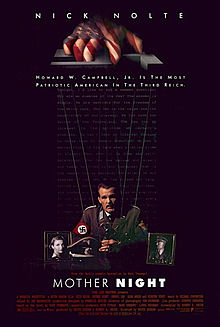
A Movie A Day #113: Mother Night (1996, directed by Keith Gordon)


Four years after she played the mysterious (and dead) Laura Palmer in Twin Peaks, Sheryl Lee starred as another mysterious (and possibly dead) woman in Mother Night.

Lee is cast as Helga Noth, the German wife of American expatriate Harold W. Campbell (Nick Nolte).  Harold is a playwright, living in Berlin and doing propaganda broadcasts for the Nazis.  Working with Frank Wirtanen (John Goodman), a military intelligence officer, Campbell has developed a series of verbal tics that are meant to secretly deliver information to the Allied Forces.  It is never clear whether Harold’s information serves any real purpose just as it is left ambiguous as to whether Harold believes any of the anti-Semitic propaganda that he broadcasts over the airwaves.  Working as both a propagandist and a double agent, Harold serves both the Allies and the Axis.

In the final days of the war, Helga is reportedly killed on the Eastern Front and Harold is captured by the Americans.  Frank arranges for Harold to be quietly sent to New York City but tells him that the government will never admit that they used him as a double agent.

Harold spends the next fifteen years living an isolated life in New York.  His only friend is an elderly painter, Kraft (Alan Arkin), with whom he plays chess.  Eventually, Harold opens up to the painter and talks about his past.  Kraft, for his own shady reasons, reveals Harold’s identity to a group of neo-Nazis.  Though Harold initially wants nothing to do with them, this changes when they reveal that they have Helga.

Or do they?  Almost no one in Mother Night is who they claim or what they seem to be, especially not Harold.

Based on a novel by Kurt Vonnegut, Mother Night suffers from the same uneven quality that seems to afflict most films based on Vonnegut’s work.  It is easy to go overboard when it comes to bringing Vonnegut’s unique mix of drama and satire to the screen and Mother Night does that in a few scenes, especially once Harold reaches New York.  It is still an intriguing and thought-provoking film, though.  Nick Nolte gives one of his best performances as Harold and Sheryl Lee does a good job in a difficult role.

The pinnacle of Vonnegut films remains George Roy Hill’s version of Slaughterhouse-Five but Mother Night is still superior to something like Alan Rudolph’s adaptation of Breakfast of Champions.

Playing Catch Up With The Films of 2016: Race (dir by Stephen Hopkins)


race

Do you remember Race?

It came out in February of this year and it was kind of a big deal for a week.  I think everyone was expecting it to be a big hit, just because there’s never much competition in February.  Race is a biopic of Jesse Owens, the African-American runner who sets world records and won gold medals at the 1936 Berlin Olympics, defeating a legion of Aryan athletes while Adolf Hitler watched from the stands.  Not only is that a compelling story but 2016 was also an Olympic year.  Eddie The Eagle had already been a success due to the Olympic connection.  Add to that, Focus Features promoted the Hell out of this film.  In they weeks leading up to its release, I saw commercials for it on a nearly hourly basis.  The reviews, when the came, were mixed but generally positive.

I’m not really sure how Race did at the box office.  According to Wikipedia, on its opening weekend, it was sixth at the box office.  Apparently, the film only had a budget of five million and ultimately made a profit of $20,000,0000.  I guess that would make it a success.  All I know is that it seems like, for all the hype, Race just kind of came and went.

In fact, I didn’t see Race until about two months ago.  It’s one of those films that’s not really great but it’s certainly not bad.  It’s pretty much the epitome of being adequate.  It was well-made and generally well-acted.  Director Stephen Hopkins occasionally struggled to maintain a consistent pace (Race is over 2 hours long and feels longer) but he still did a good job filming the scenes of Owens of running and competing.  In the role of Jesse Owens, Stephan James was well-cast.  You not only believed him in the dramatic scenes but he was also believable as a record-setting athlete.  He had some great scenes with Jason Sudekis, who was surprisingly believable in the role of Jesse’s coach.

With all that in mind, why didn’t Race make more of an impression?  I think that, too often, Hopkins allowed the film’s focus to wander away from Jesse and the inner conflict he felt as he won medals for a country where he was treated like a second-class citizen.  There were too many random scenes of Jeremy Irons and William Hurt, playing Olympic officials and debating whether or not to boycott Hitler’s Olympics.  During the second half of the film, Leni Riefenstahl (Carice van Houten) showed up and we got a few scenes of her trying to film Jesse’s triumph at the Olympics despite the interference of Nazi propaganda minister, Joseph Goebbles (Barnaby Metschurat).  All of these extra scenes are supposed to set Jesse’s struggle in a historic context but they’re unnecessary and distracting.  All the context that the film needs can be found in the fact that Jesse was a black man living in America in the 1930s.

For the most part, Race is uneven but occasionally the film delivers a powerful scene or two.  One of the most powerful parts of the film comes when Jesse, after setting world records and being proclaimed as a hero across the world, is informed that he still can’t enter a New York club through the front door.  As well, the scenes depicting Jesse’s friendship with German jump Luz Long (David Kross) are poignant.  In fact, they’re so poignant that I initially assumed that they were fictionalized for the film but actually, Jesse and Luz Long did become good friends during the 1936 Olympics.

Race is uneven but it’s not bad.  Stephan James gives a good performance as Jesse and, if nothing else, the film provides a worthy history lesson.

Boobs, Music, and Sci-Fi: Heavy Metal (1981, directed by Gerald Potterton)


Heavy MetalI think I was twelve when I first saw Heavy Metal.  It came on HBO one night and I loved it.  So did all of my friends.  Can you blame us?  It had everything that a twelve year-old boy (especially a 12 year-old boy who was more than a little on the nerdy side) could want out of a movie: boobs, loud music, and sci-fi violence.  It was a tour of our secret fantasies.  The fact that it was animated made it all the better.  Animated films were not supposed to feature stuff like this.  When my friends and I watched Heavy Metal, we felt like we were getting away with something.
Based on stories from the adults-only Heavy Metal Magazine, Heavy Metal was divided into 8 separate segments:

Soft Landing (directed by Jimmy T. Murakami and John Bruno, written by Dan O’Bannon)

Heavy Metal opens brilliantly with a Corvette being released from a space shuttle and then flying down to Earth, surviving reentry without a scratch.  Who, after watching this, has not wanted a Space Corvette of his very own?

http://www.youtube.com/watch?v=DWMPe3wF9jQ

Grimaldi (directed by Harold Whitaker)

On Earth, a terrified young girl listens a glowing green meteorite called the Loc-Nar tells her that it is the source of all evil in the universe.  This sets up the rest of the film, which is made up of stories that the Loc-Nar tells about its influence.  The Loc-Nar is the film’s MacGuffin and, seen today, one of Heavy Metal’s biggest problems is that it has to find a way to force the Loc-Nar into every story, even if it meant sacrificing any sort of consistency about what the Loc-Nar was capable of doing.  Even when I was twelve, I realized that the Loc-Nar was not really that important.

Harry Canyon (directed by Pino Van Lamsweerde, written by Daniel Goldberg)

In this neo-noir tale, futuristic cabby Harry Canyon (voiced by Richard Romanus) is enlisted to help an unnamed girl (voiced by Susan Roman) to find the Loc-Nar.  Slow and predictable, Harry Canyon does feature the voice of John Candy as a police sergeant who attempts to charge Harry for police work.

den_1268427864Den (directed by Jack Stokes, written by Richard Corben)

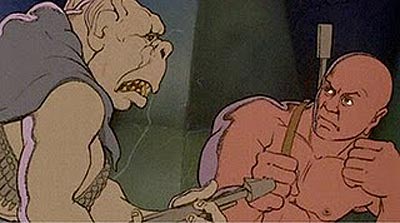
Nerdy teenager David (voiced by John Candy) finds a piece of the Loc-Nar and is transported to the world of Neverwhere, where he is transformed into Den, a muscular, bald warrior.  As Den, David gets to live out the fantasies of Heavy Metal‘s target audience.  On his new planet, Den rescues an Earth woman from being sacrificed, overthrows an evil queen and a sorcerer, and gets laid.  A lot.  Den is the best segment in Heavy Metal, largely because of the endearing contrast between the action onscreen and John Candy’s enthusiastic narration.

Captain Sternn (directed by Paul Sebella and Julian Harris, written by Bernie Wrightson)

heavy-metal_captain-sternOn a space station orbiting the Earth, Captain Lincoln F. Sternn is on trail for a countless number of offenses.  Though guilty, Captain Sternn expects to be acquitted because he has bribed the prosecution’s star witness, Hanover Fiste.  However, Hanover is holding the Loc-Nar in his hand and it causes him to tell the truth about Captain Sternn and eventually turn into a bloodthirsty giant. Captain Sternn saves the day by tricking Hanover into getting sucked out of an air lock.
Captain Sternn was a reoccurring character in Heavy Metal Magazine and his segment is one of the best.  Eugene Levy voices Captain Sternn while Joe Flaherty voices his lawyer and Dean Wormer himself, John Vernon, is the prosecutor.  Even National Lampoon co-founder Douglas Kenney provided a voice.

 B-17 (directed by Barrie Nelson, written by Dan O’Bannon)

After the Loc-Nar enters Earth’s atmosphere, it crashes into a bullet-riddled World War II bomber, causing the dead crewmen within to reanimate as zombies.  Scored to Don Felder’s Heavy Metal (Takin’ a Ride), B-17 is one of the shorter segments and its dark and moody animation holds up extremely well.

http://www.youtube.com/watch?v=ELUP-oZQKM4

So Beautiful and So Dangerous (directed by John Halas, written by Angus McKie)

Nubile Pentagon secretary Gloria is beamed aboard a spaceship that looks like a giant smiley face.  While she has sex with the ship’s robot captain, the two crew members (voiced by Harold Ramis and Eugene Levy) pour out a long line of cocaine and shout “Nosedive!” before snorting up every flake.  So Beautiful and So Dangerous is so juvenile and so ridiculous that it is actually all kinds of awesome.

Taarna

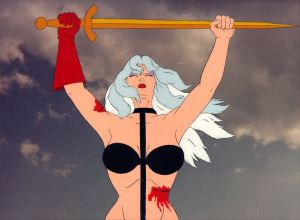
SacrificedIn the film’s final and most famous segment, Taarna, the blond warrior was featured on Heavy Metal‘s poster, rides a pterodactyl across a volcanic planet, killing barbarians, and finally confronting the Loc-Nar.  She sacrifices herself to defeat the Loc-Nar but no worries!  We return to Earth where, for some reason, the Loc-Nar explodes and the girl from the beginning of the film is revealed to be Taarna reborn.  She even gets to fly away on her pterodactyl.  Taarna was really great when I was twelve but today, it is impossible to watch it without flashing back to the Major Boobage episode of South Park.
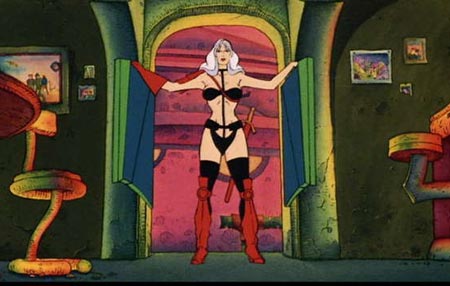
Much like Taarna, Heavy Metal seems pretty silly when I watch it today.  But when I was twelve, it was the greatest thing ever.

Taarna_Heavy_Metal