When it comes to reviewing mob movies, I usually describe them as either being “an offer you can refuse” or “an offer you can’t refuse.”
Usually, it’s not that difficult to decide which ranking I should use. If the film is well-acted and if the action unfolds at a steady pace and if there’s plenty of tommy gun action and/or a stylish recreation of the Golden Age of American Gangsterism, chances are that the film will be an offer that you can’t refuse.
Now, if it’s a movie that just features a bunch of guys sitting around trying to sound tough and if it doesn’t really do much to recreate the gangster milieu and if the dialogue sounds like it was cribbed from a hundred other gangster films, it’ll probably be an offer you can refuse.
It’s simple and usually, it only takes me a few minutes to realize which description I’m going to use. But I have to admit that I went back and forth on 1975’s Lepke. To refuse or not to refuse, that was the question.
Lepke is a biographic film about Louis “Lepke” Buchalter, an early American gangster who came to prominence in the early days of the National Crime Syndicate. An ally of Lucky Luciano’s, Lepke was the mastermind behind what became known, in the press, as Murder, Inc. (Lepke himself was smart enough not to name the organization.) If the Mob wanted someone killed, they would contact Albert Anastasia who would then contact Lepke who would then assign the job to someone else. The actual assassin rarely knew who had actually ordered the hit and Lepke was such a feared figure that it was assumed that no one was ever going to turn informant. Lepke was responsible for some of the most infamous gangland killings of the 20s and 30s, including the murder of Dutch Schultz. Unfortunately, for Lepke, someone eventually did turn informant and he ended up as one of the few gangster to meet his end in the electric chair.
Lepke features Tony Curtis as the title character. The film follows him from his youth as a member of a street gang to his early days with the National Crime Syndicate and eventually to his final days at Sing Sing. Michael Callan plays Lepke’s childhood friend, who goes straight. Gianni Russo plays Albert Anastasia while Vic Tayback plays Lucky Luciano. Lepke’s wife, Bernice, is played by Anjanette Comer. Though the beefy and rather loud Tayback is miscast as Luciano, the cast does a fairly good job. Comedian Milton Berle gives a surprisingly strong performance as Lepke’s father-in-law. There’s a great scene in which he interrogates his future son-in-law about what he’s going to get in exchange for giving away his daughter. Curtis is convincingly tough and menacing as Lepke, who this film presents as being a working class family man whose job just happens to be killing people. (Tony Curtis later wrote that he was on a cocaine high while filming Lepke, which perhaps explains the intensity of his performance.)
Lepke definitely holds your interest. There’s enough mob hits and bursts of gunfire to satisfy most gang movie aficionados. At the same time, the film’s recreation of the 20s and 30s is almost too generic and clean. For all the tough talk and the gangland violence, there’s a definite lack of grittiness to the film’s recreation of one of the most violent eras in American history, which is why I found myself conflicted on whether to recommend it or not. I decided that, in the end, the film does enough right to make it worth watching, even if it does still feel more like a made-for-TV crime flick than the gangster epic that so obviously aspires to be,
Historically, this film is important because it was the first American film to be directed by Menahem Golan and produced by Golan and Yoram Globus. Four years after Lepke, Golan and Globus would purchase Cannon Films and go on to make some of the most deliriously entertaining films of all time.
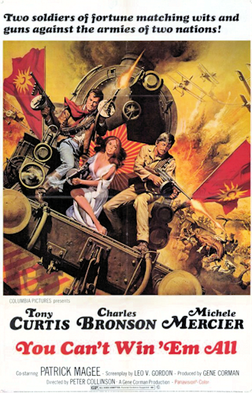
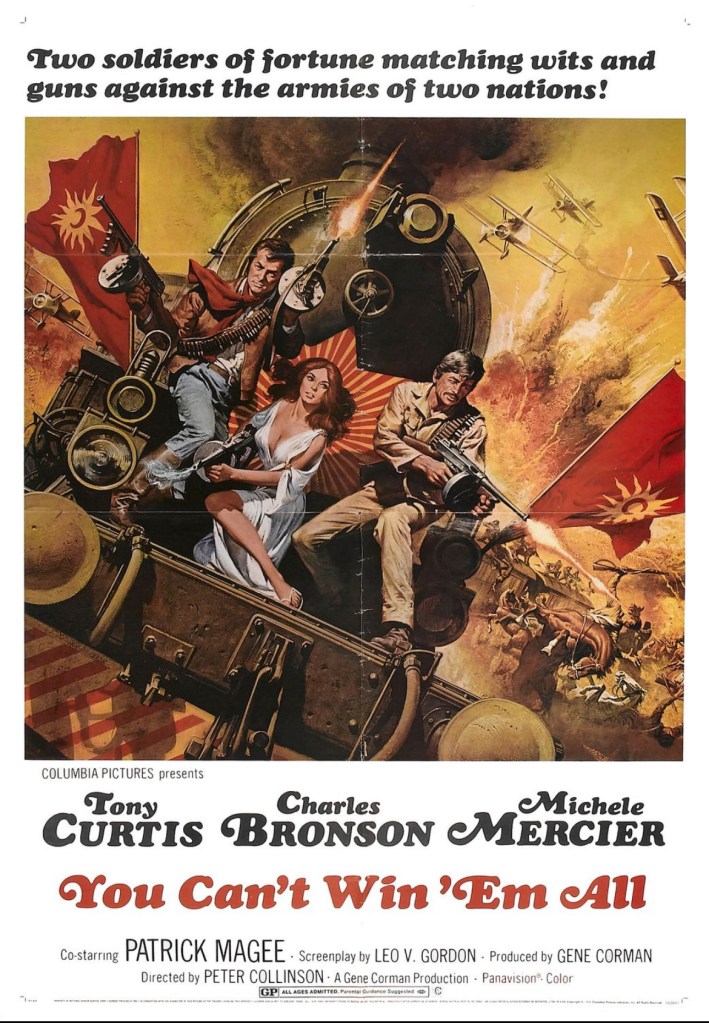
Two Americans meet up in Turkey in 1922. Josh Corey (Charles Bronson) is a cynical soldier-of-fortune who, along with his mercenary crew, is hoping to make money out of the ruins of the Ottoman Empire. Adam Dyer (Tony Curtis) is the heir to a shipping company and is hoping to get his last remaining boat out of the Turkish dock where it’s been interned since World War I. Osman Bey (Gregorie Aslan), one of the local powerbrokers who has risen to power since the Turkish Revolution, hires Josh and Adam to escort his daughters and their protector, Alia (Michele Mercier), to Mecca. Actually, the plan is for them to instead go to Cairo to recover a priceless treasure. The journey to Cairo is filled with action and betrayal as Josh and Adam try to navigate the upheaval of the post-war Middle East.
You Can’t Win ‘Em All is a mix of action and comedy, an adventure that owes more than a little to the other big budget heist films of the 60s and 70s. (Director Peter Collinson was hired due to his work on The Italian Job.) The film’s humor comes from the partnership of the stoic Bronson with the talkative Tony Curtis. In fact, the film’s main flaw is that Tony Curtis talks too much. Curtis simply will not shut up. After about fifteen minutes, I was tired of listening to him. Curtis’s acting limitations really come through the more that he talks and, as a result, Bronson walks away with the entire movie by saying next to nothing. Bronson keeps largely quiet because he doesn’t have to speak to make an impression. His stare says everything that needs to be said.
You Can’t Win ‘Em All is uneven but it has a few good action sequences and Bronson doing what Bronson did best. Watching this movie made me appreciate Charles Bronson all the more. Even when working with a less-than-great script and a miscast co-star, Bronson still had the undefinable quality that made him a star.
Tony Curtis would have been 100 years old today! Back in 1970, Curtis worked with my all time favorite actor Charles Bronson on the film YOU CAN’T WIN ‘EM ALL. Interestingly, the screenplay for this film was written by actor Leo Gordon. The movie is pretty much forgotten these days, but Bronson and Curtis have a nice, easy going chemistry that I’ve always enjoyed. In honor of the Curtis centennial, I’m sharing this fun little scene from YOU CAN’T WIN ‘EM ALL! Enjoy, my friends!
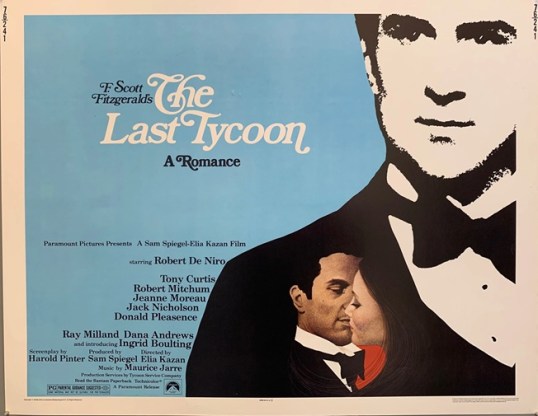
Based on the final (and unfinished) novel by F. Scott Fitzgerald, 1976’s The Last Tycoon tells the story of Monroe Stahr (Robert De Niro).
Monroe Stahr is the head of production at a film studio during the early days of Hollywood. Stahr is an unemotional and seemingly repressed man who only shows enthusiasm when he’s talking about movies. He may not be able to deal with real people but he instinctively knows what they want to see on the big screen. Stahr is a genius but he’s working himself to death, ignoring his health concerns while trying to create the perfect world through film. He’s haunted by a lost love and when he meets Kathleen Moore (Ingrid Boulting, giving a remarkably dull performance), he tries to find love with her but, naturally, he doesn’t succeed. Meanwhile, he has to deal with his boss (Robert Mitchum), his boss’s daughter (Theresa Russell), a neurotic screenwriter (Donald Pleasence), an impotent actor (Tony Curtis), and a lowdown dirty communist labor organizer (Jack Nicholson)! Sadly, for Stahr, McCarthyism is still a few decades away.
There’s a lot of talented people in The Last Tycoon and it’s undeniably interesting to see old school stars — like Mitchum, Curtis, Dana Andrews, Ray Milland — acting opposite a Method-driven, 30-something Robert De Niro. This is one of those films where even the minor roles are filled with name actors. John Carradine plays a tour guide. Jeff Corey plays a doctor. This is a film about Golden Age Hollywood that is full of Golden Age survivors. It’s a shame that most of them don’t get much to do. The Last Tycoon is a very episodic film as Stahr goes from one crisis to another. Characters show up and then just kind of disappear and we’re never quite sure how Stahr feels about any of them or how their existence really shapes Stahr’s worldview. Robert De Niro may be a great actor but, as portrayed in this film, Monroe Stahr is a boring character and De Niro’s trademark tight-lipped intensity just makes Stahr seem like someone who doesn’t have much to offer beyond employment. This is one of De Niro’s least interesting performances, mostly because he’s playing a not-particularly interesting person. Mitchum, Pleasence, and the old guard all make an impression because they’re willing to coast by on their bigger-than-life personalities. De Niro is trapped by the Method and a total lack of chemistry with co-star Ingrid Boulting.
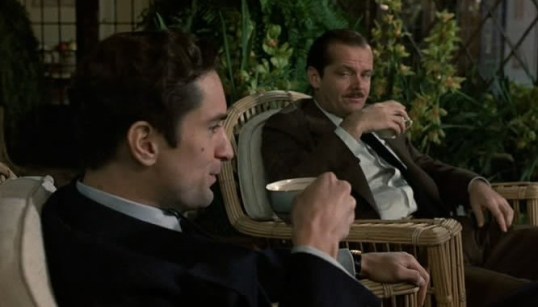
Still, this is the only film to feature both De Niro and Jack Nicholson. (The Departed was originally conceived as a chance to bring De Niro and Nicholson together, with De Niro being the original choice for the role eventually played by Martin Sheen.) Nicholson’s role is small and he doesn’t show up until the film is nearly over. He and De Niro have an intense table tennis match. Nicholson doesn’t really dig deep into Brimmer’s character. Instead, he flashes his grin and let’s the natural sarcasm of his voice carry the scene. It’s nowhere close to being as emotionally satisfying as the De Niro/Pacino meeting in Heat. That said, Jack Nicholson at least appears to be enjoying himself. His natural charisma makes his role seem bigger than it actually is.
Why was The Last Tycoon such a disappointment? Though unfinished, the book still featured some of Fitzgerald’s best work and there’s a huge amount of talent involved in this film. The blame mostly falls on Elia Kazan, who came out of retirement to direct the film after original director Mike Nichols left the project. (Nichols reportedly objected to casting De Niro as Stahr. While it’s tempting to think that Nichols realized that De Niro’s intense style wouldn’t be right for the role, it actually appears that Nichols and De Niro sincerely disliked each other as Nichols also abandoned the next film he was hired to direct when he was told that De Niro wanted the lead role. Nichols choice for Monroe Stahr was Dustin Hoffman, which actually would have worked. If nothing else, it would have provided a Graduatereunion.) Kazan later said that he did the film solely for the money and it’s obvious that he didn’t really care much about the film’s story. The film has some good scenes but, overall, it feels disjointed and uneven. Kazan doesn’t really seem to care about Monroe Stahr and, as a result, the entire film falls flat.
Welcome to Retro Television Reviews, a new feature where we review some of our favorite and least favorite shows of the past! On Fridays, I will be reviewing Half Nelson, which ran on NBC from March to May of 1985. Almost all nine of the show’s episodes can be found on YouTube!
The year was 1985 and actor/singer Joe Pesci was at an interesting place in his film career.
In 1980, Joe Pesci was nominated for Best Supporting Actor for his performance as Robert De Niro’s brother in Raging Bull. Raging Bull was Pesci’s second film and he earned critical acclaim for his performance as the second most angry member of the LaMotta family. In the years immediately following his first Oscar nomination, Pesci went on to play character roles in a handful of other films, including Dear Mr. Wonderful, Easy Money,Once Upon A Time In America, and Eureka. While no one could deny Pesci’s talent or his unique screen presence, it was also obvious that Hollywood wasn’t quite sure what to do with him. While Pesci was apparently high on everyone’s list when it came to playing gangsters with hair-trigger tempers, no one was willing to give Pesci a starring role.
Fortunately, television always has room for an Oscar nominee and, in 1985, Half Nelson came calling. Created by veteran television producers Glen A. Larson and Lou Shaw, Half Nelson was a detective show. Joe Pesci starred as Rocky Nelson, a tough New York cop who relocated to Los Angeles to pursue his acting career. While waiting for his big break, Rocky worked for Beverly Hills Security and lived in Dean Martin’s guest room. And when I say that Rocky was living in Dean Martin’s guest house, what I mean is that Dean Martin actually appeared on the show, playing himself.
NBC liked the idea enough to air the pilot film and then schedule the show as a mid-season replacement. Audiences were a bit less interested in the show and Half Nelson was canceled after only 8 weeks. Pesci went on to win an Oscar for Goodfellas and he never starred in another television show. Half Nelson would probably be forgotten if not for the fact that someone recently came across the opening credits on YouTube. When shared on Twitter, this video went viral as “the most 80s thing” ever created.
After I watched that video, I knew I simply had to review Half Nelson as soon as I finished up The Brady Bunch Hour. Fortunately, almost all of the episodes have been uploaded to YouTube so, for the next few weeks, I’ll be taking a look at HalfNelson, starring Joe Pesci!
Episodes 1 & 2 “The Pilot”
(Dir by Bruce Bilson, originally aired on March 24th, 1985)
Half Nelson begins in New York City, with NYPD’s finest, Detective Rocky Nelson (Joe Pesci), disguising himself as a waiter and sneaking into a mafia-owned restaurant. After punching out two guards, Rocky enters a backroom and discovers a group of guys with a lot of heroin. Rocky arrests them and becomes a hero. As Rocky explains in a voice-over, it’s the biggest drug bust in history. When Hollywood asks for the rights to the story, Rocky insists that he be allowed to audition for the lead role. Rocky quits the NYPD and heads out to Los Angeles. Rocky’s going to be a star!
And, at first, it seems like Rocky’s dream might actually come true. The film’s director (played by the veteran TV character actor, George Wyner) watches Rocky’s audition and announces that Rocky has the screen presence and talent of Al Pacino. Unfortunately, Rocky is also only 5’3. “You’re too short to play Rocky Nelson,” the director explains.
“But I am Rocky Nelson!” Rocky exclaims.
Despite the fact that Rocky’s telling the truth, it doesn’t matter. A tall British actor is cast in the film. As a dejected Rocky leaves the audition, he’s approached by a security guard who offers Rocky a job with Beverly Hills Patrol, a private security firm. Rocky’s skeptical until the security guard mentions that Rocky will get to live in Dean Martin’s guest house.
We jump forward six months. Rocky is now a trusted employee of Beverly Hills Patrol. When he’s not working as a bodyguard, he’s auditioning for roles. At the office, his boss is Chester (Fred Williamson) and the office manager is Annie O’Hara (Victoria Jackson). Chester is cool and all-business. Annie is flighty and has an obvious crush on Rocky. She also gives Rocky a pit bull named Hunk. Hunk is very loyal but also very quick to attack anyone who isn’t Rocky. I don’t know if a show could get away with a comic relief pit bull today but whatever. Hunk is a cute dog with a ferocious bark.
In just six months, Rocky has become surprisingly well-known in L.A. Some of that might be because he lives with Dean Martin. Martin appears in three scenes of the pilot and, to be honest, he definitely looks and sounds a bit worse for wear. Half Nelson was Dean’s final acting role. (He died ten years after the show was canceled.) But even though Dean was clearly not in the best shape when he appeared in the pilot, his natural charisma still shines through and there’s a lot of pleasure to be found in his scenes with Joe Pesci. For one thing, Pesci himself seems to be genuinely excited about acting opposite Martin.
Along with becoming friends with Dean Martin, Rocky has also befriended Parsons (George Kennedy), a Los Angeles police chief who is eager for Rocky to quit the Beverly Hills Patrol and to join the LAPD. Rocky turns down the offer, however. Rocky is done with police work. He’s going to be a star!
Of course, he’ll also find time to solve some crimes along the way.
For instance, in the pilot, Rocky investigates the death of his best friend and co-worker, Jerry (Nicholas Surovy). Parsons insists that all the evidence shows that Jerry murdered his girlfriend, Monika (Morgan Brittany), and then shot himself. However, Rocky doesn’t think Jerry would do something like that. When Jerry’s father (veteran screen actor Rory Calhoun) asks Rocky to find the people who killed his son, Rocky doesn’t have to be asked twice.
It turns out that Jerry and Monika were taking money from a tabloid magazine publisher (Terry Kiser). They had a video tape that would have been very embarrassing to some prominent Angelinos, including a businessman (Rod Taylor), a restauranter (Tony Curtis), a general (Mills Watson), an astronaut (Gary Lockwood), and a television executive (Bernie Kopell). Rocky assumes that the people on the tape ordered the murders but then he learns that, while the general did send two government agents to find the tape, he also made clear that no one was supposed to be killed. Instead, someone else who wanted the tapes committed the murders on his own.
Searching for the killer means that Rocky will have to assume many disguises and show off his acting skills. As an actor, he’s able to wander into the local movie studio and not only raid their wardrobe department but also borrow their cars. Over the course of the film, Rocky disguses himself as both a cowboy and a traffic cop. He also drives a Ferrari, a Cadillac, a jeep, a motorcycle, and KITT, the talking car from Knight Rider. (KITT, unfortunately, does not talk in Half Nelson.) On the one hand, the use of disguises is a little bit silly because Joe Pesci is always going to be Joe Pesci regardless of what costume he is wearing. The pilot’s silliest scene involves Rocky dressed up like a cop to confront two men who have been following him. Somehow, they fail to pick up on the fact that the 5’3 cop with the New York accent is the same 5’3 New Yorker who they’ve been tailing for the last few days. And yet, it’s one of those things that’s so ludicrous that you can’t help but think that the show was showing a bit of self-awareness and commenting on just how ludicrous most television shows tend to be.
Eventually, Rocky figures out that the killer is …. SPOILER ALERT …. Parsons! That’s right. The same police chief who kept offering Rocky a job with the LAPD turned out to be the murderer for whom Rocky was looking. What’s interesting is that, after realizing that Parsons is the killers, Rocky doesn’t arrest Parsons or attack him or do any of the other things that a typical TV detective might. And Parsons doesn’t try to flee or fight. Instead, the two men take a leisurely drive and talk about life, morality, and regret. Parsons talks about how he was once an honest cop but Los Angeles corrupted him. Rocky expresses some sympathy and says that he hates that he discovered that Parsons was the murderer. It’s a well-acted and surprisingly well-written scene. When Rocky asks Parsons about the murders, Parsons replies, “I had to empty my gun, just to drown out their screams.” (Yikes!) Parsons lets Rocky out of the car and tells him, “Don’t let them get to you, kid.” Parsons then drives the car over a cliff as Roberta and Chester (who have been tailing Parsons) run up to Rocky.
“Hard to believe that a man like that would kill himself!” Roberta says.
“That’s just the funeral,” Rocky replies as Parsons car explodes, “He died a long time ago.”
Wow, that’s dark! Fortunately, the mood is lightened during the show’s final scene, in which Rocky’s pit bull attacks boxer Larry Holmes.
The pilot for Half Nelson was nicely done. It set up the series and it gave us an introduction to the characters, which is exactly what a pilot is supposed to do. The cast showed off their chemistry and the final scene between Parsons and Rocky indicated that the show had the potential to be something more than just another mid-80s detective show. The pilot’s greatest strength, not surprisingly, was Joe Pesci. Pesci has played so many mobsters and crooked lawyers that it’s easy to forget what a likable actor he can be. The pilot featured Pesci at his most amiable and it also gave him a chance to show off his comedic timing. All-in-all, the pilot was a success and I could understand why NBC would have ordered more episodes after watching it.
But what about the series? Would the series live up to the promise of the pilot or would it just become another generic detective show? We’ll find out over the next 8 weeks!
93 years ago, on this date, Menahem Golan was born in Israel. After serving in the Israeli Air Force, Golan would attend the Old Vic Theater School in London before returning to Israel and launching his legendary career in film. With his cousin, Yoram Globus, and using Roger Corman as both a mentor and a inspiration, Golan would go on to producer and direct some of the most successful films in Israeli history. Eventually, Golan and Globus would purchase Cannon Films and would be responsible for some of the greatest (in a fashion) films of the 80s.
Though Golan was best-known as a producer, he never stopped directing. Today, on what would have been his birthday, Lisa Marie’s Favorite Grindhouse Trailers presents 6 trailers for 6 Golan films!
Lepke (1975)
After finding great success in Israel, Golan first attempted to break into the American market with this biopic about the head of the Mafia’s Murder, Inc., Louis “Lepke” Buchalter. Though the budget was low, Golan managed to get a name — in this case, Tony Curtis — to play the lead role. As you can tell, the trailer wanted to make sure that you knew that this film was about Lepke.
2. Enter the Ninja (1981)
This was, I think, the first film that Golan directed after buying Cannon Films. How great is Enter the Ninja? It stars Franco Nero as a ninja! Seriously, you don’t get much greater than that. Anyway, as I think I’ve stared on this site before, Enter the Ninja is a lot of fun and Franco Nero was the sexiest ninja of the 80s.
3. The Delta Force (1986)
Chuck Norris was a Cannon mainstay and it seems appropriate that he starred in The Delta Force, a film that was very important to Golan. The Delta Force was essentially a remake of an 1977’s Operation Thunderbolt, an Israeli film that earned Golan his only Oscar nominations when it was nominated for Best Foreign Language Film. The Delta Force did not receive any Oscar nominations but it has a legion of fans. Our own Jedediah Leland has frequently described this film as being the greatest ever made. I don’t know if I’d go that far but still, it is always satisfying to see Chuck blow up the bad guys at the end of the movie.
4. Mack the Knife (1989)
Menahem Golan directs a musical! Unfortunately, this film has never received a proper DVD or Blu-ray release. Though it was a Cannon production, Golan and Globus had a falling out (one that was, at least partially, caused by Golan spending money on films like Mack The Knife) and Golan ended up distributing this film himself. I find the trailer to be intriguing. The film itself is on YouTube so I’ll watch it someday …. maybe.
5. Hit The Dutchman (1992)
Much like Lepke, this film is about a real-life gangster. In this case, the gangster was Dutch Schultz. Interestingly enough, the trailer suggest that Al Capone was active in New York whereas everyone knows that, though Capone did get his start in New York, he didn’t become a prominent gangster until he relocated to Chicago.
6. Crime and Punishment (2002)
Finally, this adaptation of the great novel was a bit of passion project for Golan. He filmed it in Russia in 1993 but, because of financial difficulties, it was not given a release until 2002.
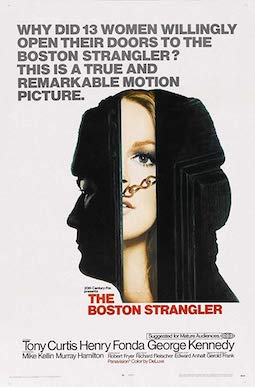
Between June 14, 1962 and January 4, 1964, 13 women between the ages of 19 and 85 were murdered in the Boston area. It was felt that they had all been killed by the same man, a monster known as The Boston Strangler. Though the police investigated many suspects, they never made an arrest. (One should remember that this was before the time of DNA testing or criminal profiling. The term “serial killer” had not even been coined. Today, sad to say, we take the existence of serial killers for granted. In the 60s, it was still an exotic concept.)
In October of 1964, a man named Albert DeSalvo was arrested and charged with being “the Green Man,” a serial rapist who pretended to be a maintenance man in order to gain access to single women’s apartments. After he was charged with rape, detectives were surprised when DeSalvo confessed to being the Boston Strangler. When confessing to the murders, DeSalvo got a few minor details wrong but he also consistently included other details that the police hadn’t released to the general public. Even when put under hypnosis, DeSalvo’s recalled those previously unreleased details. Because DeSalvo was already going to get a life sentence on the rape charges and because there wasn’t any physical evidence that, in those pre-DNA, could have conclusively linked DeSalvo to the crimes, he was never actually charged with any of the murders. Still, with his confessions, the cases were considered to be closed.
In 1966, before DeSalvo was even sentenced for the Green Man rapes, Gerold Frank wrote The Boston Strangler, a book about the murders, the investigations, and DeSalvo’s confessions. It was one of the first true crime books and, in 1968, it was adapted into one of the first true crime films.
Directed by Richard Fleischer (whose filmography somehow includes not only this film but also Dr. Dolittle, Fantastic Voyage, 20,000 Leagues Under the Sea, Conan The Destroyer, and Red Sonja), The Boston Strangler is really two films in one. The first half deals with the crimes and the police (represented by Henry Fonda, George Kennedy, Murray Hamilton, and James Brolin) investigation. This half of the film is pulpy and crudely effective, full of scenes of the cops rounding up every sex offender who they can find. There’s a scene where Henry Fonda talks to a prominent man in a gay bar that’s handled with about as much sensitivity as you could expect from a 1960s studio film. (On the one hand, the man is portrayed with respect and dignity and he’s even allowed to call out the patron saint of 1960s mainstream liberal piety, Henry Fonda, for being close-minded. On the other hand, everyone else in the bar is a stereotype and we’re meant to laugh at the idea that anyone could think that Henry Fonda could be gay.) Director Richard Fleischer makes good use of split screens, creating an effective atmosphere of paranoia. The scene where a woman tries to keep an obscene caller on the phone long enough for the police to trace his location made my skin crawl and served as a reminder that perverts predate social media. Another scene where a flamboyant psychic tries to help the police goes on for a bit too long but, at the same time, you’re happy for a little relief from crime scenes and terrified, elderly women discovering that their neighbors have been murdered.
The second half of the film features Tony Curtis as Albert DeSalvo. Curtis is effective as DeSalvo, playing him as being a self-loathing brute who is incapable of controlling his impulses. (Before committing one of his crimes, DeSalvo watches the funeral of John Kennedy, his face wracked with pain. Is the film suggesting that DeSalvo murdered to deal with the stress of life in America or is it suggesting that the hate that killed Kennedy was a symptom of the same sickness that drove DeSalvo? Or is the film just tossing in a then-recent event to get an easy emotional reaction from the audience?) As one might expect from a mainstream film made in 1968, The Boston Strangler takes something of a wishy washy approach to the question of whether DeSalvo’s crimes were due to sickness or evil. Yes, the film says, DeSalvo was bad but it’s still society’s fault for not realizing that he was bad. It’s the type of approach designed to keep both the law-and-order types and the criminal justice reformers happy but it ultimately feels a bit like a cop out. Still, the shots of DeSalvo isolated in his padding cell have an undeniable power and Curtis is both pathetic and frightening in the role. In its more effective moments, the second half of the film works as a profile of a man imprisoned both physically and mentally.
Watching the film today, it’s hard not to consider how different The Boston Strangler is from the serial killer films that would follow it. DeSalvo is not portrayed as being some sort of charming or interesting Hannibal Lecter or Dexter-type of killer. Instead, he’s a loser, a barely literate idiot who struggled to articulate even the simplest of thoughts. The cops aren’t rule-breakers or renegades. Instead, they’re doing their jobs the best that they can. Though the film ends with a title card saying that it’s important for society to make more of an effort to spot people like DeSalvo before they kill, The Boston Strangler has a surprising amount of faith in both the police and the law and it assumes that you feel the same way. It’s a film that takes it for granted the audience respects and trusts authority. It’s portrayal of the police is quite a contrast to the rebel cops who dominate pop culture today.
After the film came out, DeSalvo recanted his confessions and said that he had never killed anyone. He was subsequently murdered in prison in 1971, not due to his crimes but instead because he was independently selling drugs for prices cheaper than what had been agreed upon by the prison’s syndicate. After his death, many books were written proclaiming that DeSalvo was innocent and that the real Boston Strangler was still on the streets. Others theorized that the actual Strangler was DeSalvo’s cellmate and DeSalvo, knowing he was going to prison for life regardless, confessed in return for money being sent to his family. That said, in 2013, DNA evidence did appear to conclusively link DeSalvo to the murder of 19 year-old Mary Sullivan. Of course, that doesn’t mean that DeSalvo necessarily committed the other 12 murders. In fact, from what we’ve since learned about the pathology of serial killers, it would actually make more sense for the murders to have been committed by multiple killers as opposed to just one man.
Regardless of whether DeSalvo was guilty or not, The Boston Strangler is an uneven but ultimately effective journey into the heart of darkness.
The 1985 film, Insignificance, opens in New York City in the 1950s.
On the streets of New York, a crowd has gathered to watch as the Actress (Theresa Russell), a famous sex symbol, is filmed standing on a grate while wearing a white dress. Beneath the street and the Actress, a fan has been set up and the crowd of onlookers cheers as the Actress’s skirt is blown up around her hips, again and again. Standing in the crowd, the Actress’s husband, the Ballplayer (Gary Busey), watches and shakes his head in disgust. After the scene has been shot, the Actress hops in a taxi while the Ballplayer chases after her. A very famous man is in town and the Actress is on her way to pay him a visit.
In a nearby bar, the Senator (Tony Curtis), drinks and talks and sweats. Though it may not be obvious from looking at him, the Senator is a very powerful man. He’s leading an investigations into subversives who may be trying to bring down the United States government. He may look like a small-time mobster but the Senator can make and destroy people on a whim. He’s come to New York on a very specific mission. He and his goons are planning on pressuring another famous man into testifying before the Senator’s committee.
Though they don’t know it, both the Actress and the Senator are planning on dropping in on the same man. The Professor (Michael Emil) is a world-renowned genius. When we first see him, he is sitting alone in a hotel room and looking at a watch that has stopped at 8:15. The public may know the Professor for his eccentricities but, in private, he is a haunted man. The Professor’s work was instrumental in the creation of the first atomic bomb. And now, with both the U.S. and Russia stockpiling their atomic arsenals and the world seemingly on the verge of war, the Professor fears that his work will be the end of humanity.
Though none of the characters are actually named over the course of the film, it should be obvious to anyone with even a slight knowledge of American history that the four main characters are meant to be versions of Marilyn Monroe, Joe DiMaggio, Joe McCarthy, and Albert Einstein. Insignificance imagines a meeting between these four cultural icons and really, it’s not difficult to imagine a scenario in which they all could have met. Joe DiMaggio actually was present during the filming of the subway grate scene from The Seven Year Itch and most accounts record his reaction as being not that different from what’s portrayed in Insignificance. Albert Einstein was suspected of having communist sympathies and several scientific figures (including many who worked on the Manhattan Project) were investigated during the McCarthy era. Finally, Marilyn Monroe was often frustrated by her “dumb blonde” image and said that she found Albert Einstein to be a very attractive man. When she died, a biography of Einstein was reportedly found on her nightstand.
In the film, the Senator pressures The Professor to appear before his committee. It’s not long after the Senator leaves that the Actress arrives. The Actress announces that she’s fascinating by the theory of relativity and, using balloons, toys, and a flashlight, she proceeds to demonstrate the theory for the Professor. The befuddled Professor is impressed. The Actress informs the Professor that he’s at the top of her list. Meanwhile, downstairs in another hotel room, the Senator is met by a prostitute who bears a resemblance to the Actress. The Ballplayer sits in the hotel bar, tearing up a picture of the Actress and wondering why their marriage is failing.
Because this film was directed by Nicolas Roeg, the film is full of seemingly random flashbacks. We see the Senator as an altar boy, trying to impress a smiling priest. We see the Ballplayer getting yelled at by his domineering father. We see the Actress, growing up poor and being ogled, at first by the young boys at an orphanage and later by Hollywood execs. Meanwhile, The Professor continually sees the destruction of Hiroshima. His visions are apocalyptic and, towards the end of the film, he even gets a glimpse into a possible future of atomic hellfire. It’s a film about fame and cultural transition, a film where people look to celebrities for hope while doomsday comes closer and closer.
Or something like that. To be honest, I wanted to like Insignificance more than I actually did. As is typical with so many of Nicolas Roeg’s films, Insignificance has an intriguing premise but the execution is a bit uneven. There are moments of absolute brilliance. Theresa Russell and Gary Busey both give perfect performances and the film’s final apocalyptic vision will haunt you. And then there are moments when the film becomes a bit of a slog and the dialogue starts to get a bit too pretentious and on-the-nose. Michael Emil has some good moments as the Professor but there are other moments when he seems to be lost. Meanwhile, Tony Curtis gives such a terrible performance as The Senator that he throws the entire film off-balance. Curtis bulges his eyes like a madman and delivers his lines like a comedian doing a bad 1930s gangster impersonation.
That said, Insignificance is still an interesting film. It’s uneven but intriguing. Though the film may take place in the 50s and may deal with a quartet of historical figures, it’s themes are still relevant in 2020. People still tend to idealize celebrities. Politicians still hold onto power by exploiting fear. The possibility that everything could just end one day is still a very real one. Insignificance is a film worth watching, even if it doesn’t completely work.
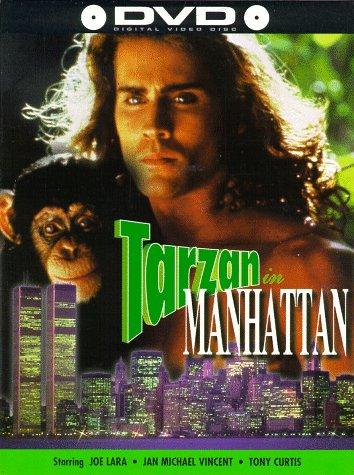
An evil businessman named Brightmore (Jan-Michael Vincent) abducts Cheetah the Chimpanzee from Africa and takes him back to Manhattan. It’s up to Cheetah’s best friend, Tarzan (Joe Lara), to rescue him. Tarzan goes to New York where he meets a cabbie named Jane (Kim Crosby) and her father, a tough private investigator named Archimedes (Tony Curtis). Tarzan is also briefly detained for being in the country illegally but he pulls the bars out of his cell window and escapes. Presumably, so does everyone else in the jail. Way to go, Tarzan.
Lisa and I discovered this playing on the Z-Living Channel last night and we watched it because it was either watch this or start binging the Police Academy films on Netflix. That’s what this damn pandemic is leading to. We know we’re probably going to have to watch the entire Police Academy franchise at some point but we’re trying to put it off. So, we watched Tarzan in Manhattan. Damn you, COVID-19!
It was bad. It was really, really bad. It was obviously meant to be a pilot for television series but I guess it didn’t happen. The timing was off. If Tarzan in Manhattan had been made in the 90s, it probably would have led to a syndicated series that would currently be airing on H&I, next to episodes of Renegade and Sheena. It came out in 1989, though, too early to cash in on the wave of syndicated crap that was unleashed after the success of Baywatch proved that you didn’t have to produce a quality show to find success in syndication. Because it came out too early, we were spared annual Tarzan in Manhattan conventions. Let that sink in and be happy.
Plus, it’s just really, really bad. Did I say that already? It’s true. There’s nothing consistent about Tarzan in Manhattan. It wants to be a comedy, it wants to be a drama. It wants to be an updated version of Tarzan but it still wants him to be confused by the modern world. The movie also doesn’t seem to know if Tarzan is famous or not. It seems like he must be because Brightmore went through a lot of trouble to kidnap his chimpanzee. But, in Manhattan, no one seems to know who he is. The movie also doesn’t get Tarzan’s famous jungle call right, either. This Tarzan just yells, without any special inflection to let the world know that he’s Tarzan. Instead of It’s like he’s not Tarzan at all. Jan-Michael Vincent and Tony Curtis both seem bored while Joe Lara has the right look for Tarzan but not much else to recommend him. The chimpanzee survives without being used to test makeup or whatever it was Brightmore was planning on doing with him so at least the movie has that going for it.
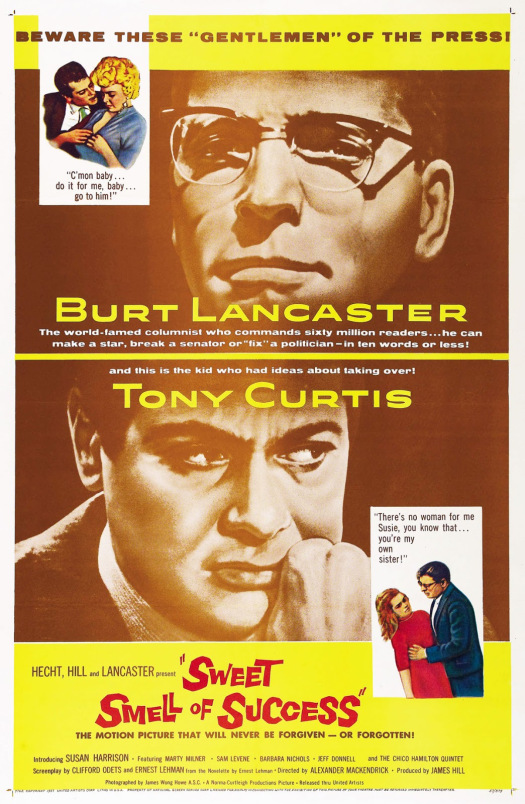
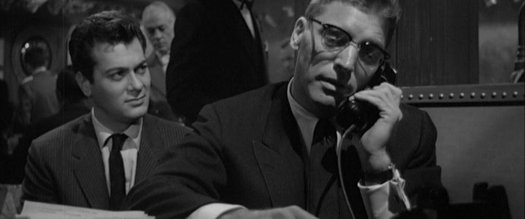
Watching SWEET SMELL OF SUCCESS is like taking a slog through a sludge-filled, rat infested sewer. It’s “a cookie full of arsenic”, with two of the most repellant characters to ever worm their way across the silver screen. It’s also a brilliant film, with superb performances from stars Burt Lancaster and Tony Curtis, wonderfully quotable dialog by Clifford Odets and Ernest Lehman, tense direction by Alexander Mackendrick, and stunning black and white photography by James Wong Howe . It’s a movie that demands repeated viewings; just make sure to take a shower after each one!
Powerful Broadway columnist J.J. Hunsecker is dead set on destroying the relationship between his kid sister Susie and up-and-coming jazz guitarist Steve Dallas. To achieve this goal, he uses his toady, press agent Sidney Falco. Sidney, forever trying to curry favor with the great Hunsecker, pimps out cigarette girl Rita to rival columnist Otis Elwell, in exchange for…




 Through the Shattered Lens