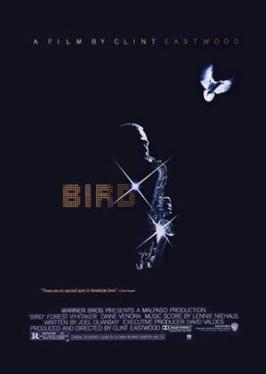
Bird (1988, directed by Clint Eastwood)


Forest Whitaker stars as the legendary saxophonist Charlie “Bird” Parker.  The film, which is structured around flashbacks and time jumps and features some of the most beautifully-done transitions that I’ve ever seen, follows Parker as he plays his saxophone, challenges the jazz purists who his own individual style, and looks for work in both America and France.  Along the way, we watch as he befriends and learns from Dizzy Gillespie (Samuel Wright), mentors a young trumpet player named Red Rodney (Michael Zelniker), and has a complex relationship with a white jazz lover named Chan Parker (Diane Venora).  Throughout his life, Charlie Parker struggles with his addiction to heroin and alcohol, occasionally getting clean to just then fall back into his habit.  To its credit, the film avoids most of the biopic cliches when it comes to portraying Parker’s addiction.  Parker accepts that he’s an addict, just as he accepts that he has a talent that is destined to revolutionize American music.

Director Clint Eastwood has always been a fan of jazz and he actually saw Charlie Parker perform when he was a young man.  His love of jazz had been present in almost every modern-era film that he has directed, staring with Play Misty For Me’s lengthy trip to the Monterey Jazz Festival.  Bird was a passion project for Eastwood, the first film that Eastwood directed without also appearing in.  (Eastwood doesn’t star in his second directorial effort, Breezy, but he does have a brief and silent cameo as a man standing on pier.)  Eastwood takes a nonlinear approach to telling the story, eschewing the traditional bopic format and instead putting the focus on Parker’s music.  Eastwood was able to get several never bef0re-released recordings of Parker performing and, when Whitaker is blowing into his saxophone in the film, we’re actually hearing Parker.  Eastwood’s direction captures the smoky atmosphere of the jazz clubs where Parker and Gillespie made their name while the nonlinear style reflects the feeling of just letting a song take you to wherever it’s going.  This is a movie about jazz that plays out like a jazz improvisation.

Forest Whitaker gives an amiable and charismatic performance as Charlie Parker, playing him as someone who has found both an escape and peace in his music, even as he physically struggles with the ravages of his drug addiction.  Whitaker won the Best Actor at Cannes for his performance in Bird.  Eastwood received the Golden Globe for Best Director.  Bird feels like it was labor of love for both of them.  Bird may not have set the box office on fire when it was originally released but it remains one of the best jazz films.

Spaceballs (1987, directed by Mel Brooks)


°ëØ

A long time ago, in a galaxy far far away…

President Skroob (Mel Brooks), the evil and incompetent leader of Planet Spaceball, has squandered all of the air on his planet and is planning on stealing the atmosphere of the planet Druida.  To pull this off, he arranges for the idiotic Prince Valium (Jim J. Bullock) to marry Vespa (Daphne Zuniga), the princess of Druida.  (All together now: “She doesn’t look Druish.”)  Vespa and her droid, Dot Matrix (voice by Joan Rivers), flee Druida with Lord Dark Helmet (Rick Moranis) and Colonel Sandurz (George Wyner) in pursuit.

In debt to the intergalactic gangster, Pizza the Hut (voiced by Dom DeLuise), a mercenary named Lone Star (Bill Pullman) and his associate, the man-dog hypbrid Barf (John Candy), accept a contract from Vespa’s father (Dick Van Patten) to track down his daughter.  They take off in their space Winnebago to bring Vespa home.  Though they start only interested in money, Lone Star and Barf come to learn about love, freedom, and a mystical power known as the Schwartz.  (“No, the Schwartz!”)

Back when I was growing up and just being able to have HBO made you the coolest guy on the block, Spaceballs was one of my favorite movies.  I watched it every time that it came on cable.  As usual with Mel Brooks, there were a lot of double entendres that went over my young head but there was also enough goofy humor that I could laugh at what was going on.  I could quote all the lines.  I laughed whenever Rick Moranis showed up in his Darth Vader-costume.  I laughed at John Candy’s facial expressions.  I laughed when Mel Brooks showed up as Yogurt, the Spaceballs version of Yoda.  Pizza the Hut?  That’s hilarious when you’re a kid!

I recently rewatched the film.  Revisiting it was a lesson in how your memory can trick you.  I could still quote most of the lines with reasonable accuracy but nothing was quite the way I remembered it.  Rick Moranis and John Candy were still hilarious and, being older, I could better appreciated the frustration felt by George Wyner’s Colonel Sandurz.  I also realized what a good performance Bill Pullman gave as Lone Star.  While everyone else mugged for the camera, Pullman played his role straight.

I also discovered that a lot of the scenes that I remembered as being hilarious were actually just mildly amusing.  Mel Brooks was always hit-and-miss as a director, the type who would toss everything and the kitchen sink into his films.  Spaceballs has a lot of hilarious scenes but it’s obvious that Brooks didn’t have the same affection for the source material as he did with Young Frankenstein or Blazing Saddles or even High Anxiety.  Brooks is poking fun at Star Wars because it’s popular but he doesn’t seem to have any strong feelings, one way or the other, about George Lucas’s space epic.

I still laughed, though.  Even if Spaceballs wasn’t the masterpiece that I remembered it being, I still enjoyed rewatching it.  The jokes that hit were funny enough to make up for the ones that missed.  Even with his weaker films, Mel Brooks is a national treasure.

Smokey Bites The Dust (1981, directed by Charles B. Griffith)


Sheriff Hugh “Smokey” Turner (Walter Barnes) of Cyco County, Arkansas is determined to capture teenage car thief and prankster, Roscoe Wilton (Jimmy McNichol).  Roscoe is determined to disrupt the high school homecoming dance by abducting the homecoming queen, Peggy Sue (Janet Julian).  Peggy Sue is, at first, determined to escape from Roscoe but changes her mind as they flee from her father, who just happens to be Sheriff Turner.

From producer Roger Corman, Smokey Bites The Dust is an 88-minute car chase film where the most spectacular getaways and crashes are lifted from other Roger Corman productions.  Eagle-eyed viewers will spot footage from Eat My Dust, Grand Theft Auto, and Moving Violations.  In order to explain why the cars keep changing from scene to scene, the chase moves from county-to-county where both Roscoe and Sherriff Turner inevitably end up ditching (or crashing) their old car and then stealing a new vehicle to continue the pursuit.

That’s not much of a plot so the run time is padded out with several subplots.  A local moonshiner tries to sell his special brew to a group of Arabs.  Peggy Sue’s boyfriend, Kenny (William Forsyth, in one of his first films), joins in the chase.  Dick Miller flies around in a helicopter and also gets involved in the chase.  None of it makes any sense and none of it is particularly amusing but Roger Corman undoubtedly made a lot of money pushing this thing into Southern drive-ins and letting people assume it was some sort of a sequel to Smokey and the Bandit.

Most of the acting is pretty bad.  When it comes to being an incompetent sheriff, Walter Barnes is no Jackie Gleason.  Jimmy McNichol comes across as being seriously disturbed.  Of the main cast, Janet Julian is alone in giving an appealing and naturalistic performance as Peggy Sue.  While Julian (who has since retired from acting) never became the star she deserved to be, she is remembered for her later turn as Christopher Walken’s lawyer and girlfriend in 1990’s King of New York.

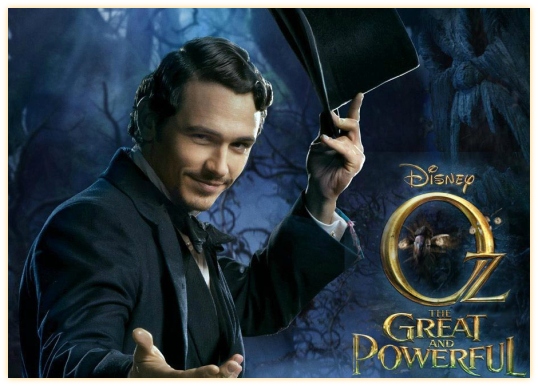
Trailer: Oz the Great and Powerful (Super Bowl Exclusive)


OzTheGreatandPowerful

Oz the Great and Powerful is the first film by Sam Raimi since he was removed as director of the Spider-Man franchise. While he tried to go back to his horror roots with the underappreciated Drag Me to Hell he’s back to doing big-budget event films.

The film looks to tell the story of the Great Wizard of Oz prior to Dorothy’s arrival in the original film. James Franco takes on the title role with Mila Kunis, Michelle Williams and Rachel Weisz all taking on the roles of the three witches of Oz. The film’s plot looks to be a sort of hero’s journey as Oscar Diggs must discover his true self once he lands in the otherworldly realm of Oz.

Could this film be a return to fantasy form for Sam Raimi or will it be a film thats visually stunning but spiritually empty like Tim Burton’s Alice In Wonderland?

Only time will tell and while Raimi always delivers a visual treat and an entertaining film they sometimes don’t resonate with the general audience.

Oz the Great and Powerful is set for a March 8, 2013 release date.