Will Randall (Jack Nicholson), the editor-in-chief of a New York Publishing house, doesn’t get much respect, not from his wife (Kate Nelligan), not from his boss (Christopher Plummer), and certainly not from Stuart Swinton (James Spader), the sleazy executive who is plotting to steal his job and destroy his marriage. But then, one night, Will runs over a black wolf on a country road. When he tries to helps it, the wolf bites him. Soon after, Will starts to feel different whenever the moon is full.
I remember that, when Wolf came out in 1994, some people said that casting Jack Nicholson as a werewolf seemed like typecasting. Nicholson apparently understood this as well so he actually downplays his usual mannerisms for the first part of the movie and gives a convincing performance as a harried executive who is worried he’s about to lose his job. It’s only after he is bitten that Will Randall starts to come alive. Not only does he develop the predator instinct necessary to survive in New York City but he also, without fear, pursues his boss’s daughter, Laura (Michelle Pfeiffer, at her most beautiful). Typecast or not, Jack Nicholson is excellent in Wolf. Equally good is James Spader as Will’s business rival, who starts to show some predator-like aspects of his own.
Director Mike Nichols was not normally a horror director and, around the midway point, his direction falters and there are times when he just seems to be going through the motions. He gets good performances from his cast but doesn’t know how to craft a good jump scare. The best parts of the movie are when Wolf uses lycanthropy as a metaphor for petty office politics, with Will “marking” his territory while talking to Stewart and showing a renewed killer instinct. Wolf works better as a social satire than as a horror movie.
Fans of Frasier will be happy to see David Hyde Pierce in a small but key role. He delivers the film’s best line. Fans of Friends may also notice David Schwimmer in a small role. He says nothing worth remembering. Their presence, though, is a reminder of just how much American culture changed in 1994. By the end of the year, both went from small roles in Wolf to co-starring in the two of the most popular sitcoms in America.
On February 22nd, 1980, the U.S. Olympic Hockey team pulled off one of the greatest upsets in sports history when they defeated the Soviet team during the Winter Olympics. At a time when America was struggling under Jimmy Carter and the Soviet Union appeared to be winning the propaganda war, a group of unheralded college students brought the U.S. together in celebration as they defeated the Soviets and then went on to defeat Finland for the gold medal.
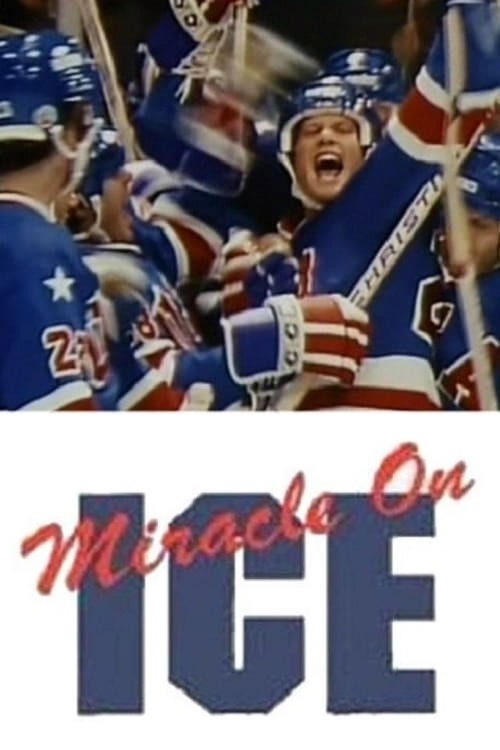
Everyone knows that the Miracle On Ice, as it was called, served as the basis of the Disney film Miracle, with Kurt Russell playing coach Herb Brooks. What is now forgotten is that the story was first recreated in 1981, with a made-for-tv movie called Miracle On Ice. Who played Herb Brooks in that movie?
Karl Malden.
Keep in mind, Herb Brooks was 42 years-old when the U.S. team defeated the Soviets and he was a former player himself. Malden was 69 when he starred in Miracle On Ice and didn’t look like he had ever worn skates in his life. Malden is convincingly grumpy and hard-nosed as Brooks but he’s still very miscast and the movie misses the point that one of the reasons why Brooks could coach the young American team was because he was still relatively young himself. The actors playing the members of the team are better cast, with Andrew Stevens playing team leader Mike Eruzione and Steve Guttenberg cast as goalie Jim Craig. A lot of time is devoted to Craig’s financial difficulties and his fear that remaining an amateur for the Olympics, instead of going pro, will continue to make life difficult for his family. On the one hand, it is messed up that the U.S., at the time, did not allow its Olympians to turn professional. On the other hand, the fact all of the players were considered to be “amateurs’ made their victory over the Soviets all the more special.
It takes a while for MiracleonIce to get to the main event. There’s a lot of scenes of Brooks dealing with everyone’s skepticism and Eurozione trying to keep the players from giving up in the face of the Soviet Union’s previous domination of the game. Once the movie does finally reach the Winter Olympics, it relies on actual footage from the game, which is actually pretty cool. Watching the real footage, you can still feel the growing excitement in both the stadium and the broadcast booth as people started to realize that the American team was going to pull it off and defeat the Soviets. It’s impossible not to be inspired by the Soviet Union getting humiliated by a bunch of American college players. The Soviets may have had the performance enhancing drugs but the Americans had the spirit!
Of the two films about America’s victory, Miracle is definitely the one to see but Miracle On Ice still pays tribute to a great moment.
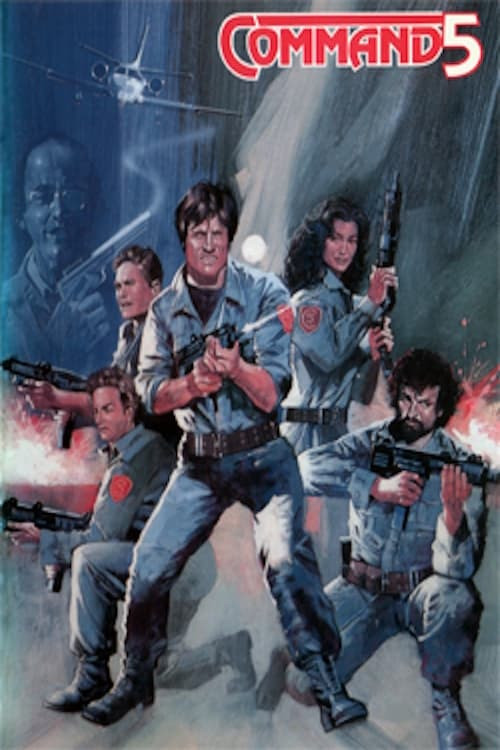
Morgan (Stephen Parr) is a mysterious government operative who puts together a special paramilitary force to take on extreme threats. He says that only misfits are allowed to join his group because they have the edge he needs. Smith (William Russ) is a wild Texan who drives like a maniac. Psychiatrist Winslow (Sonja Smits) can fire an Uzi better than any man. Kowalski (John Matuszak) is a demolitions expert who listens to Beethoven. Jack Coburn (Wings Hauser) is a rebellious detective who is good with a throwing knife.
After a montage of their extensive training and a scene where our heroes take a look at the bullet-proof RV that they’ll be traveling the country in, the movie finally gets down to business. A motorcycle-riding terror cult led by Delgado (Gregory Sierra) has taken an entire town hostage and is threatening to kill everyone unless they’re given a flight out of the country. Our heroes drive their bulletproof van into town and try to defeat the bad guys. There’s one good scene where the RV is driving down the town’s main street and getting hit nonstop with bullets. The scene was obviously ripped off from the end of Clint Eastwood’s The Gauntlet but it’s still exciting to watch. Otherwise, the action in this one is pretty rudimentary.
I guess Command 5 was supposed to be a pilot for television show that never went into production. It is very much a television production. There’s a lot of shooting but no blood. Wings Hauser is less dangerous than usual. The whole thing ends with Command 5 looking forward to adventures that were never to come. Watching the pilot, you can see why it never became a show. The characters were all thinly-written and never seemed to have much of a connection with each other and Hauser and Russ both seemed to be competing to be the loose cannon of the group. This one is for Wings Hauser completists only.
I’m on Day 2 of my discussion of Charles Bronson’s DEATH WISH series in chronological order. This series has brought me countless hours of entertainment over the last 40 years, so enjoy and let me know your thoughts!
Charles Bronson returns as vigilante Paul Kersey in DEATH WISH II. In this installment, Kersey is trying to get his life back on track in Los Angeles with his daughter Carol, who’s still traumatized from the events of the first film, and with his new lady friend Geri Nichols (Jill Ireland). One day when he takes these two out for a fun day of shopping and ice cream, Kersey runs afoul of a group of young thugs who take his wallet. They use the wallet to find Kersey’s address, stand outside his house and make a plan like they’re diagramming a back yard football play, and then break in and rape his housekeeper. They set up shop to wait on Kersey to come home. When Kersey and his daughter finally arrive, the thugs knock out Kersey and kidnap his daughter. They take her back to their warehouse / hideout, where they rape her and she then falls to her death trying to escape. After this series of horrific events, Paul Kersey again turns vigilante to hunt down and kill every person responsible.
DEATH WISH II (1982) came along at a time in Charles Bronson’s career when he needed a box office hit. His prior three movies, DEATH HUNT, BORDERLINE & CABOBLANCO, had barely made a dent at the box office. Around the same time that Bronson needed a hit, the infamous Cannon Films, recently purchased by cousins Menahem Golan & Yoram Globus, was also looking to make a big splash in the American movie market. Cannon decided that a sequel to DEATH WISH was just what they needed, and with a big paycheck, they were able to convince Bronson to come along for the ride. Director Michael Winner was also hired to direct. The resulting film was a big success, earning back eight times its production budget at the box office alone. Its success also started a relationship between Bronson & Cannon Films that lasted for a total of eight films all the way to the end of the 1980’s.
Now that we’ve discussed how important DEATH WISH II was to extending Charles Bronson’s leading man career and providing Cannon Films a needed hit, let’s talk about the movie itself. I’m just going to say upfront that it’s my least favorite of the DEATH WISH series. Even though it presents itself as a serious film, it’s more of an exploitative retread of the 70’s classic than a realistic continuation of the Kersey character. And the first thirty minutes is hard to watch. Not content with just allowing Kersey to lose a beloved family member, Winner has crafted two graphic rape and murder sequences. These scenes are rough. While they do make sure we want to see Paul Kersey get his revenge, they leave a bad taste in our mouth that doesn’t go away as the creeps are being dispatched one by one. Vincent Gardenia returns as Frank Ochoa, the New York detective who investigated the original vigilante killings in DEATH WISH. Gardenia was so good in the original, but he’s not given much to do here. Jill Ireland doesn’t really add much either as his new lady friend.
This is a Charles Bronson film though, so there are definitely some things about DEATH WISH II that I really do like. First, I think Bronson looks like a total badass in his beanie that he wears when he’s hunting down the creeps on the mean streets of LA. It’s a classic 80’s Bronson look. Second, Kersey has some cool sayings as he dispatches the bad guys. The “Do you believe in Jesus” exchange is the best example. Third, it’s fun seeing a young Laurence Fishburne show up as one of the creeps, extending the franchise’s ability to cast future big stars as horrific rapists. Jeff Goldblum had that distinction in DEATH WISH. And finally, Led Zeppelin guitarist Jimmy Page composed the music for DEATH WISH II. It’s a memorable soundtrack that’s different than just about anything I’ve ever heard. It’s the most unique thing about the entire movie!
The bottom line is that I would watch Charles Bronson read a phone book, so I will always find something to enjoy about his films. Well, maybe every one but LOLA. DEATH WISH II isn’t as fun as most Bronson movies, even if it does have some good moments. I’m glad DEATH WISH 3 went a completely different direction with Kersey’s character.
BONUS: Robert “Bobby” Lyons had a part in DEATH WISH II. On our THIS WEEK IN CHARLES BRONSON PODCAST, my partner Eric Todd and I interviewed Bobby about his time on DEATH WISH II and a whole bunch of other topics. He has some interesting stories to tell about working with Charles Bronson, as well as clashing on the DEATH WISH II set with Michael Winner. Give it a listen if you get a chance!
To quote John McClane, “How can the same shit happen to the same guy twice?”
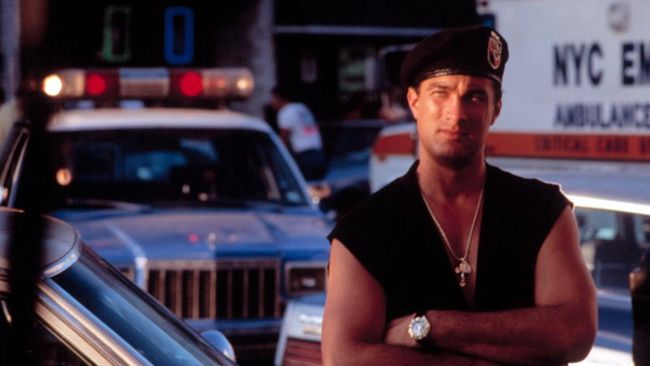
It has been eight years since Paul Kersey (Charles Bronson) lost his wife and single-handedly cleaned up New York City. The first Death Wish ended with Paul in Chicago, preparing to gun down a new group of criminals. I guess Chicago didn’t take because, at the start of Death Wish II, Paul is in Los Angeles and he’s working as an architect again. He has a new girlfriend, a bleeding heart liberal reporter named Geri (Jill Ireland, Bronson’s real-life wife) who is against the death penalty and who has no idea that Paul used to be New York’s most notorious vigilante. Having finally been released from the mental institution, Carol (Robin Sherwood) is living with her father but is now mute.
Crime rates are soaring in Los Angeles and why not? The legal system is more concerned with the rights of the criminals than the victims and Paul has retired from patrolling the streets. But when a group of cartoonish thugs rape and kill his housekeeper and cause his daughter to fall out of a window while trying to escape them, Paul picks up his gun and sets out for revenge.
Death Wish II was not the first sequel to Death Wish. Brian Garfield, the author of the novel on which Death Wish was based, never intended for Paul to be seen as a hero and was disgusted by what he saw as being the film’s glorification of violence. As “penance,” he wrote a sequel called Death Sentence, in which Paul discovered that he had inspired an even more dangerous vigilante. When Menahem Golan and Yoram Globus bought the rights to produce a second Death Wish film, they decided not to use Garfield’s sequel and instead went with a story that was co-written by Golan.
It’s the same basic story as the first film. Again, Paul is a mild-mannered architect who is a liberal during the day and a gun-toting reactionary at night. Again, it’s a home invasion and a death in the family that sets Paul off. Again, Paul gets help from sympathetic citizens who don’t care that the police commissioner (Anthony Franciosa) wants him off the streets. Jeff Goldblum played a rapist with a switch blade in the first film. This time, it’s Laurence Fishburne who fills the role. (Fishburne also carries a radio, which he eventually learns cannot be used to block bullets.) Even Detective Ochoa (Vincent Gardenia) returns, coming down to Los Angeles to see if Paul has returned to his old ways.
The main difference between the first two Death Wish films is that Death Wish II is a Cannon film, which means that it is even less concerned with reality than the first film. In Death Wish II, the criminals are more flamboyant, the violence is more graphic, and Paul is even more of a relentless avenger than in the first film. In the first Death Wish, Paul threw up after fighting a mugger. In the second Death Wish, he sees that one of the men who raped his daughter is wearing a cross, leading to the following exchange:
“Do you believe in Jesus?”
“Yes, I do.”
“Well, you’re going to meet him.”
BLAM!
Death Wish II is the best known of the Death Wish sequels. It made the most money and, when I was a kid, it used to show on TV constantly. The commercials always featured the “You believe in Jesus?” exchange and, every morning after we saw those commercials, all the kids at school would walk up to each other and say, “You believe in Jesus? Well, you’re going to meet him.” It drove the teachers crazy.
Overall, Death Wish II is a lousy film. Michael Winner, who was always more concerned with getting people into the theaters than anything else, directs in a sledgehammer manner that makes his work on the first film look subtle. He obscenely lingers over every rape and murder, leaving no doubt that he is more interested in titillating the audience than getting them to share Paul’s outrage. The script is also weak, with Geri so poorly written that she actually gets more upset about Paul going out at night than she does when she learns that Paul’s daughter has died. When Paul sets out to track down the gang, his method is to merely wander around Los Angeles until he stumbles across them. It doesn’t take long for Paul to start taking them out but no one in the gang ever seems to be upset or worried that someone is obviously stalking and killing them.
There are a few good things about the film. Charles Bronson was always a better actor than he was given credit for and it’s always fun to watch Paul try to balance his normal daily routine with his violent night life. Whenever Geri demands to know if he’s been shooting people, Paul looks at her like he is personally offended that she could possibly think such a thing. Also, the criminals themselves are all so cartoonishly evil that there’s never any question that Paul is doing the world a favor by gunning them down. For many otherwise sensible viewers, a movie like Death Wish II may be bad but it is also cathartic. It offers up a simple solution to a complex issue. In real life, a city full of Paul Kerseys would lead to innocent people getting killed for no good reason. But in the world of Death Wish II, no one out after nightfall is innocent so there’s no need to worry about shooting the wrong person.
Finally, the film’s score was written by the legendary Jimmy Page. The studio wanted Isaac Hayes to do the score but Winner asked his neighbor, Page. Page took the film, retreated into his studio, and returned with a bluesy score that would turn out to be the best thing about the movie. The soundtrack was the only one of Page’s solo projects to be released on Led Zeppelin’s record label, Swan Song Records.
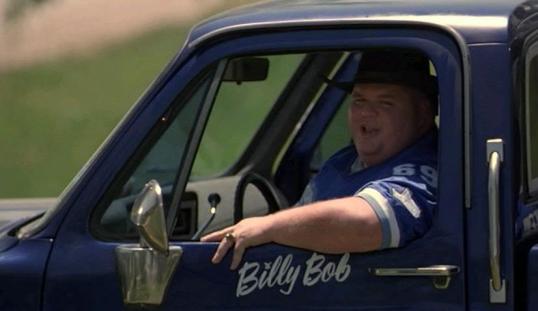
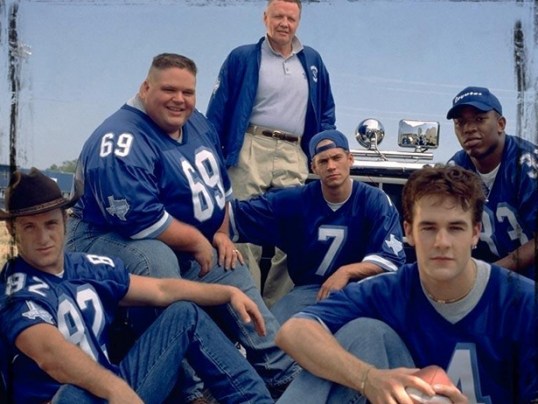
Don’t get me wrong. I had seen bits and pieces of it over the years. I knew that it was set in Texas. I knew Jon Voight played a fanatical football coach. I knew that James Van Der Beek played an idealistic quarterback who clashed with the coach. I knew that there was a fat guy named Billy Bob, mostly because every time an out-of-state director makes a film about Texas, there’s a fat guy named Billy Bob. I knew about as much as one could learn from that episode of The Office where Michael Scott shows the film during “Movie Monday.”
“I don’t want your truck.”
But I had never seen the whole film so I decided, why not? After all, I had already decided to review several other Texas-set high school films — The Last Picture Show, Dazed and Confused, Dancer, Texas, and Rushmore. And hey those films were all good so maybe Varsity Blues would be good too!
Bleh.
One of the big clichés about Texas is that the entire state is obsessed with football. (The other big cliché, of course, is saying that “everything is bigger in Texas.” As if being a tiny state like Vermont is somehow preferable…) I’ve always found the whole “Texas worships football” thing to be amusing because I’m a Texas girl and I don’t know a thing about football. People tend to talk about Texas and football as if there aren’t any fanatical football fans in New York or California. Ultimately, of course, it has little do with football and everything to do with the fact that the rest of the country loves to hate my home state. If Vermont was known for being obsessed with football, there’d probably be thousands of articles about the “proud history of Vermont football.” But since it’s Texas, we end up with movies like Varsity Blues.
“I don’t want your painfully obvious attempt at social commentary.”
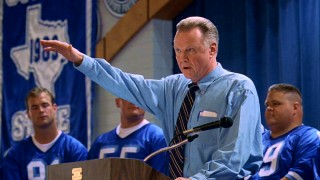
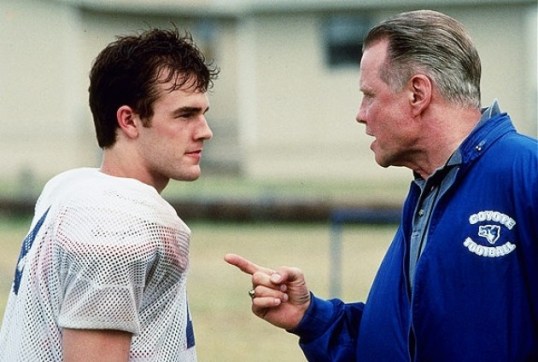
Anyway, Varsity Blues tells the story of Mox (James Van Der Beek), who is a backup quarterback for the championship-winning West Caanan High School football team. However, Mox isn’t just your average jock. For one thing, he’s seen reading Kurt Vonnegut’s Slaughterhouse Five. (It’s indicative of this film’s approach to characterization that we never learn whether Mox actually understands or even likes Slaughterhouse Five. We’re just supposed to be impressed by the fact that he owns a copy of the book.) Mox wants to leave Texas to go to an Ivy League school. He doesn’t want to play under the legendarily abusive Coach Kilmer (Jon Voight). (How evil is Kilmer? So evil that he poses for pictures like the one above.) And Mox resents the pressure put on him by his football-crazed father. (“You throw that fucking pigskin!” his dad shouts at one point.) As Mox puts it, “I don’t want your life!” and the line is just hilarious because Van Der Beek’s attempt to sound like a Texan is hilarious.
(Tip for actors: If you can’t do the accent, don’t try. Because I guarantee, if I ever meet James Van Der Beek, I’m going to tell him that his accent sucked and then I’m going to laugh and laugh. It probably won’t do much for his self-image. Sorry, James.)
“Get me on Hawaii 5-0 because I don’t want James Van Der Beek’s career.”
Anyway, when star quarterback Lance (Paul Walker) is injured, Mox is suddenly the team’s starting quarterback. And you know what? Mox is going to play the game his way! Soon, he is standing up the cartoonishly evil Coach Kilmer and challenging small town Texas’s obsession with high school football.
And here’s the thing: this is a film that wants to have it both ways. It wants to challenge the philosophy of winning at all costs and it also pretends to be about the unfair pressure that high school athletes are put under. But you better believe that the film ends with Mox leading his team to victory. And it’s not so much that Mox wins as much as it’s the fact that you know the film would never have the courage to actually have Mox lose. The film wants to be celebration of rebellion but, ultimately, it’s just a standard sports film.
And, even beyond that, it’s just not a very good film. I was shocked, when I checked with the imdb, to discover that Varsity Blues was actually filmed in Texas because the film feels like it was made in California. It has no authentic Texas flavor to it. What it does have is some of the worst fake accents that I’ve ever heard in my life.
Mox may not want his father’s life but I don’t want this stupid film.