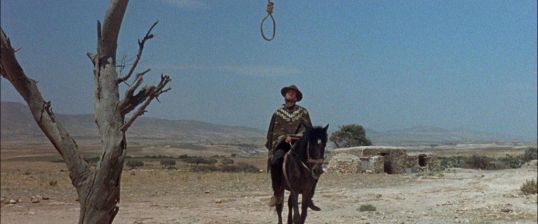
The Adventures of the Man With No Name: A Fistful Of Dollars, For A Few Dollars, The Good, The Bad, and the Ugly


Originally, Sergio Leone envisioned none other than Henry Fond as The Man With No Name.

The year was 1964 and Sergio Leone was searching for the right actor to star in the movie that would become A Fistful Of Dollars.  The film, which reimagined Akira Kurosawas’s Yojimbo as a western, centered around a mysterious, amoral gunslinger whose name was unknown.  Leone needed an American or a British name to star in the film so that it could get distribution outside of Italy.  Leone had grown up watching Henry Fonda movies, all dubbed into Italian.  He later said he wanted to cast Fonda because he always wondered what Fonda’s voice actually sounded like.

After realizing that a major Hollywood star would never agree to star in a low-budget Italian western, Leone then offered the role to Charles Bronson.  Bronson read the script and said it didn’t make sense to him.  Leone went on to offer the role to Henry Silva, Rory Calhoun, Tony Russel, Steve Reeves, Ty Hardin, and James Coburn.  Everyone was either too expensive or just not interested.  Finally, it was actor Richard Harrison who, after tuning down the part himself, suggested that Leone offer the role to Clint Eastwood.  Eastwood, then starring on the American western Rawhide, could play a convincing cowboy.  Leone followed Harrison’s advice and Eastwood, eager to break free of his nice guy typecasting and hoping to restart his film career, accepted.  The rest is history.

Eastwood would only play The Man With No Name in three films but, in doing so, he changed the movies and the popular conception of the action hero forever.

All three of the Man With No Name movies have been reviewed on this site.  But, since today is Clint’s birthday, I thought I’d take a look at how these classic films are holding up, over 60 years since the Man With No Name made his first appearance.

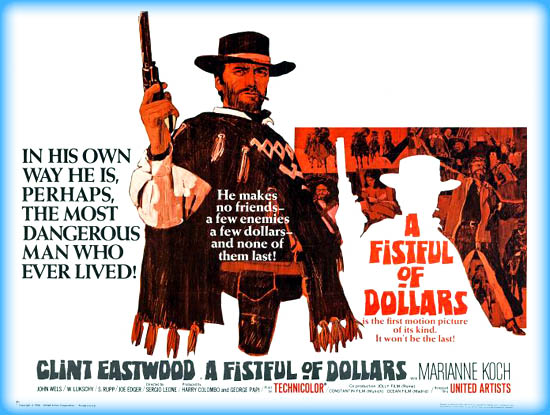
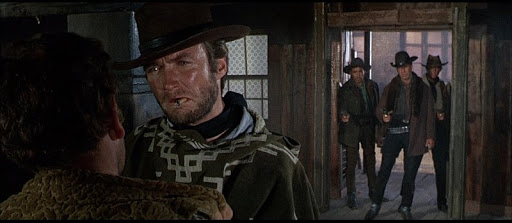
A Fistful Of Dollars (1964)

Having now seen both this film and Yojimbo, it’s remarkable how closely A Fistful of Dollars sticks to Kurosawa’s original film.  Interestingly, it’s clear that Eastwood patterned his performance of Toshiro Mifune’s in Yojimbo and yet, at the same time, he still managed to make the role his own.  The Man With No Name rides into a western town, discovers that there are two groups fighting for control of the area, and he coolly plays everyone against each other.  Whether it’s planting the seeds of distrust, exploiting an enemy’s greed, or being the quickest on the draw, the Man With No Name instinctively knows everything that he has to do.  Even when he’s getting beaten up by the bad guys, The Man With No Name always seems to be one step ahead.  Today, a western in which everyone is greedy and looking out for themselves isn’t going to take anyone by surprise.  But if you’ve watched enough westerns from the 40s and 50s, you’ll understand how unique of a viewpoint Leone brought to the genre.  Eastwood’s amoral gunslinger was such a surprise that, when the film aired on television, a scene was shot by the network in which Harry Dean Stanton played a prison warden who released The Man With No Name (seen only from behind) on the condition that he clean up the town.

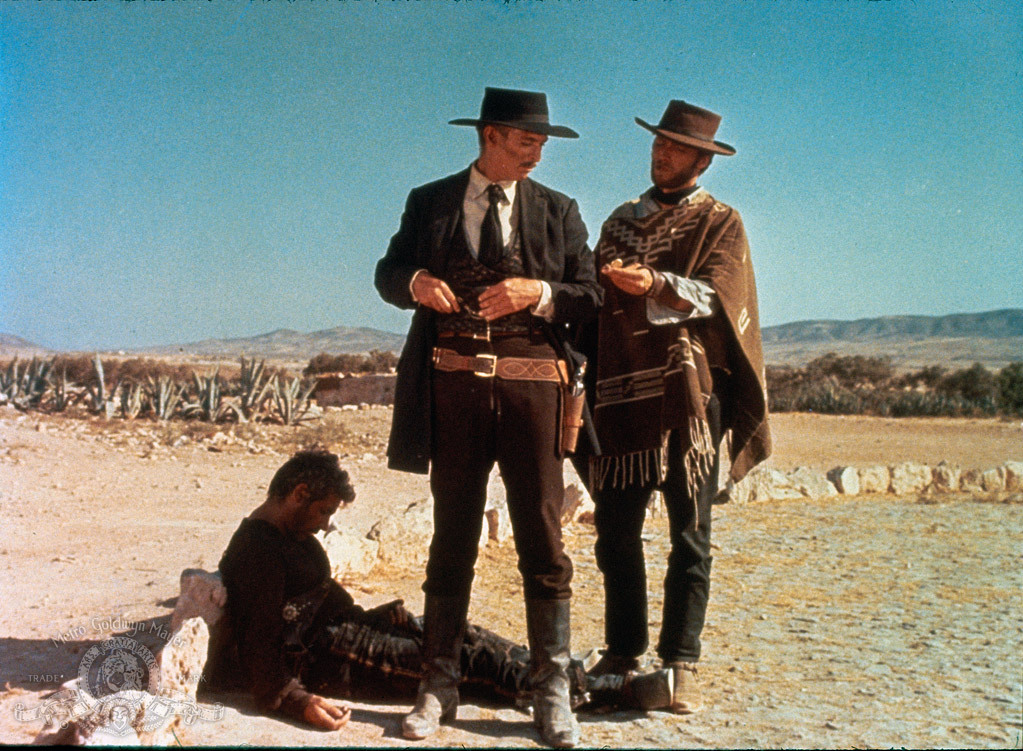
For A Few Dollars More (1965)

For A Few Dollars More finds The Man With No Name working as a bounty hunter and teaming up with Colonel Mortimer (Lee Van Cleef) to take down El Indio (Gian Maria Volonte) and his gang (including Klaus Kinski as a hunchback.)  This is my least favorite of the trilogy but that doesn’t mean that For A Few Dollars More is a bad film.  Being the least of three masterpieces is nothing to be ashamed of.  Eastwood and Van Cleef were two of the best and it’s interesting to see them working together.  El Indo is a truly loathsome villain and the members of his gang are all memorably horrid.  If it’s my least favorite, it’s just because I prefer the wit of A Fistful of Dollars and the epic storytelling of The Good, The Bad, and The Ugly.  Speaking of which…

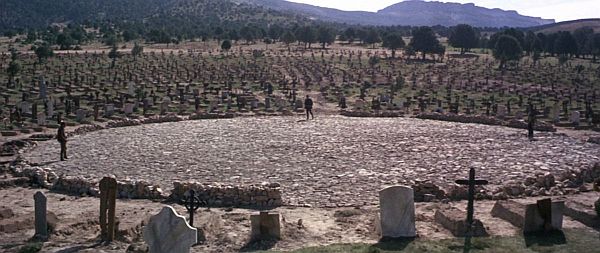
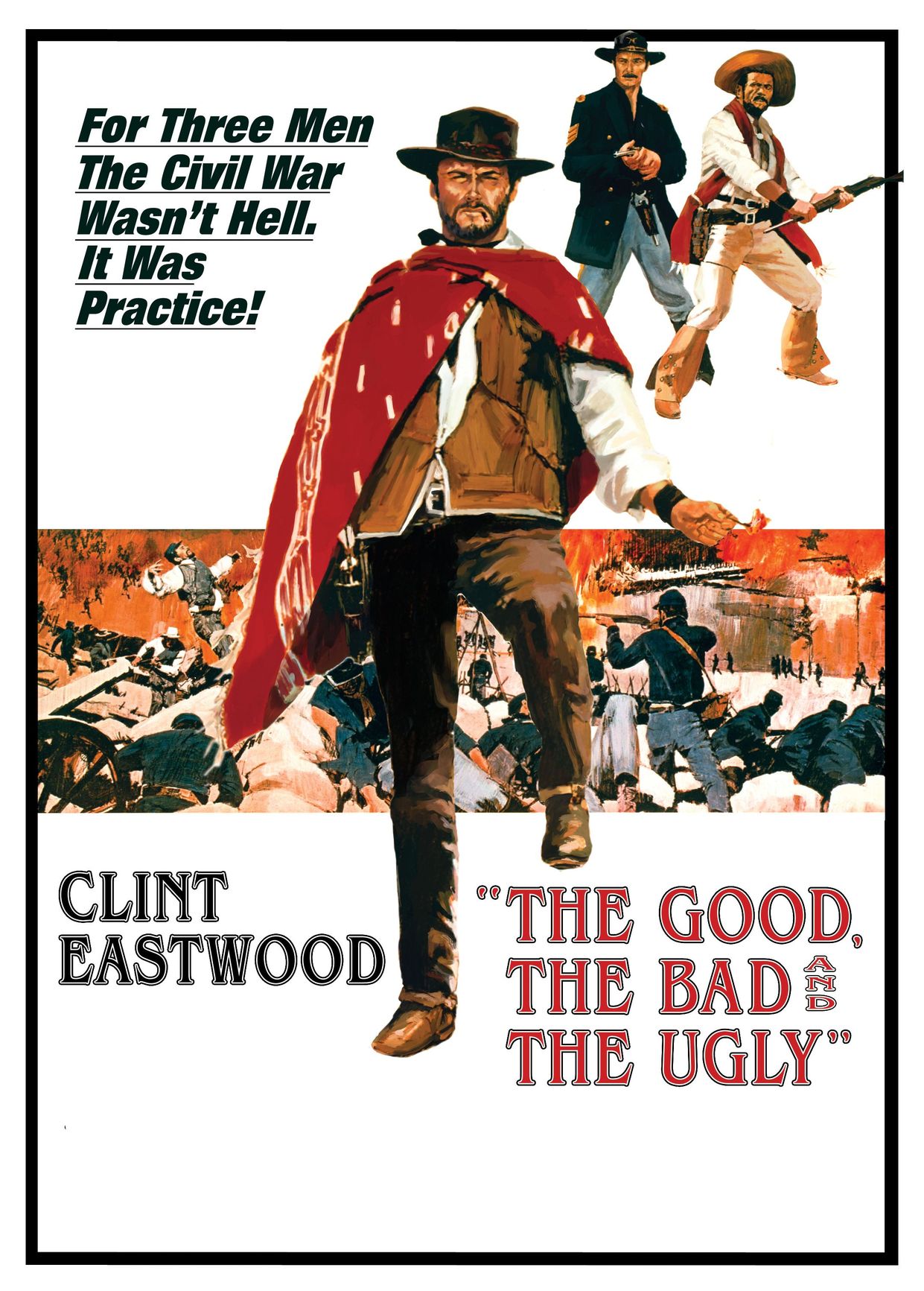
The Good, The Bad, and The Ugly (1966)

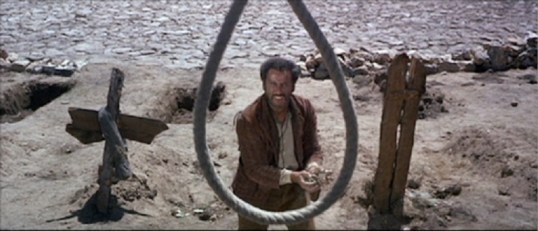
This is it.  The greatest western ever made, an epic film that features Leone’s best direction, Ennio Morricone’s greatest score, and brilliant performances from Eastwood, Van Cleef, and especially Eli Wallach.  It’s hard to know where to start when it comes to praising The Good, The Bad, and The Ugly.  It’s a nearly three-hour film that doesn’t have a single slow spot and it has some of the most iconic gunfights ever filmed.  Leone truly found his aesthetic voice in this film and that it still works, after countless parodies, is evidence of how great it is.  I appreciate that this film added a historical context to the adventures of The Man With No Name.  (Personally, I think this film is meant to be a prequel to A Fistful of Dollars, just because The Man With No Name is considerably kinder in this film than he was in the first two movies.  The Man With No Name that we meet in A Fistful of Dollars would never have gotten Tuco off that tombstone.)  The Good, The Bad, and The Ugly takes place during the Civil War and, along with everything else, it’s an epic war film.  While America fights to determine its future, three men search for gold.  The cemetery scene will never be topped.

American critics did not initially appreciate these films but audiences did.  Clint Eastwood may have been a television actor when he left for Italy but he returned as an international star.  And, to think, it all started with Sergio Leone not being able to afford Henry Fonda.

Song of the Day: The Good, The Bad, and the Ugly — Main Theme (composed by Ennio Morricone)


In honor of Sergio Leone’s birthday, today’s song of the day is the main theme from Leone’s best-known film, The Good, The Bad, and The Ugly.

Ennio Morricone’s score is as much of a character in this film as the ones played by Clint Eastwood, Eli Wallach, and Lee Van Cleef.  It perfectly sets the moods, telling us that we’re about to see something that is truly epic.  The opening notes, which have so often been parodied but which have never lost their power, truly capture the feel of Sergio Leone’s mythical vision of the old west.

4 Shots From 4 Films: Special Sergio Leone Edition


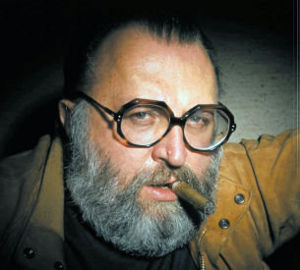
Sergio Leone (1929 — 1989)

4 Or More Shots From 4 Or More Films is just what it says it is, 4 shots from 4 of our favorite films. As opposed to the reviews and recaps that we usually post, 4 Shots From 4 Films lets the visuals do the talking!

96 years ago today, Sergio Leone was born in Rome, Italy.  The son of actor/screenwriter Vincenzo Leone and silent actress Edvige Valcarenghi, Sergio was born into the Italian film industry.  He began his career in the post-war rebuilding period, working as an assistant to Vittorio De Sica and, as an assistant director, for American films that were shot in Italy.  (Albeit uncredited, he worked on two Oscar-nominated Biblical epics, Quo Vadis and Ben-Hur.)

After making his directorial debut with The Colossus of Rhodes, Leone went on to direct the films that would change the face of international cinema.  Though he was hardly the first director of Spaghetti westerns, he was was the first to achieve far-reaching acclaim.  With the Dollars Trilogy, he made Clint Eastwood a star and Eastwood has often said that the majority of what he knows about directing, he learned from working with Leone and later Don Siegel.  Leone went on to direct the brilliant Once Upon A Time In The West and Once Upon A Time in America, two epic visions of American history that, sadly, were not initially treated well by their distributors.

Though Leone is only credited with directing eight films, his influence cannot be underestimated.  As both a visual artist and a cultural and political commentator, his films continue to influence directors to this day.

For that reason, it’s time for….

4 Shots From 4 Sergio Leone Films

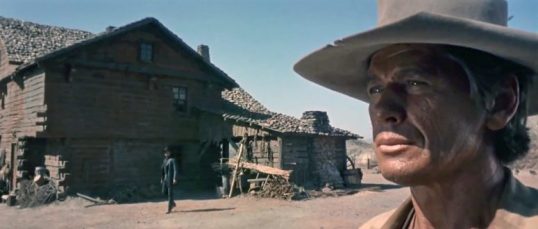
The Good, The Bad, and the Ugly (1966, dir by Sergio Leone, DP: Tonino Delli Colli)

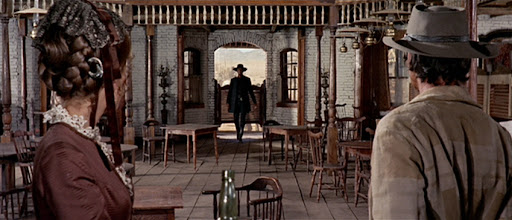
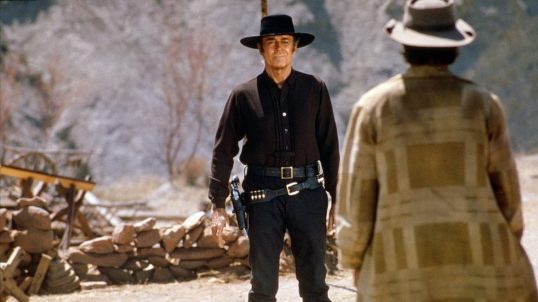
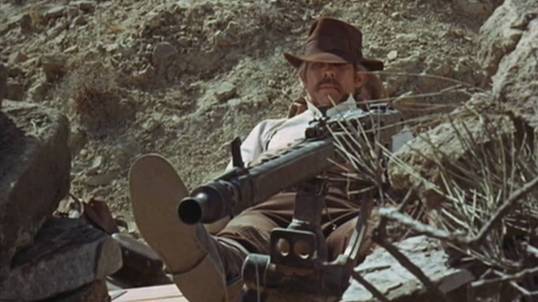
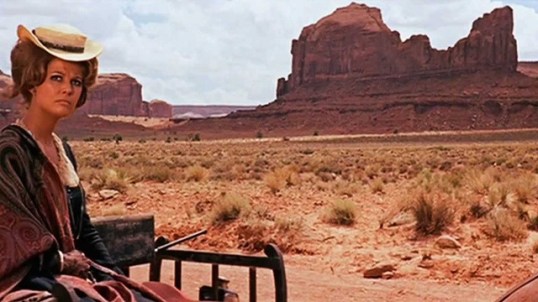
Once Upon A Time In The West (1968, dir by Sergio Leone, DP: Tonino Delli Colli)

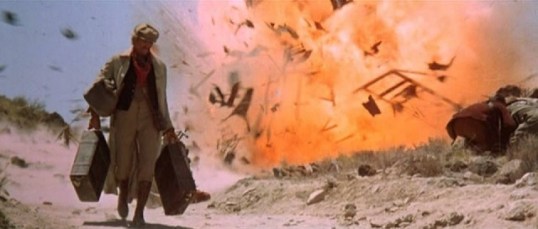
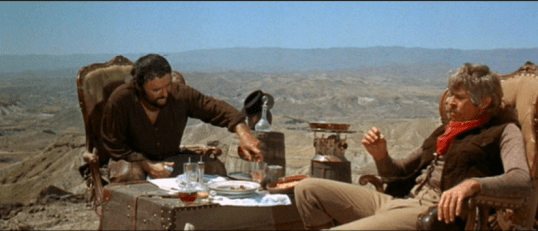
Duck, You Sucker (1971, dir by Sergio Leone, DP: Giuseppe Ruzzolini)

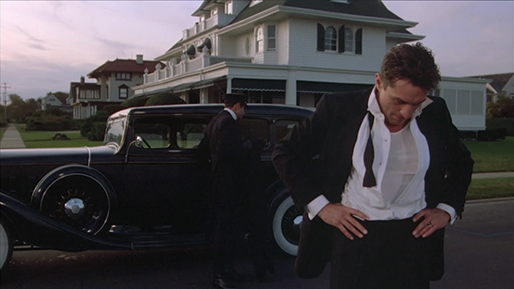
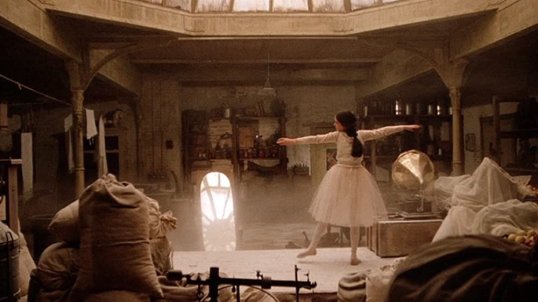
Once Upon A Time In America (1984, dir by Sergio Leone, DP: Tonino Delli Colli)

4 Shots From 4 Films: Special Sergio Leone Edition


Sergio Leone (1929 — 1989)

4 Or More Shots From 4 Or More Films is just what it says it is, 4 shots from 4 of our favorite films. As opposed to the reviews and recaps that we usually post, 4 Shots From 4 Films lets the visuals do the talking!

95 years ago today, Sergio Leone was born in Rome, Italy.  The son of actor/screenwriter Vincenzo Leone and silent actress Edvige Valcarenghi, Sergio was born into the Italian film industry.  He began his career in the post-war rebuilding period, working as an assistant to Vittorio De Sica and, as an assistant director, for American films that were shot in Italy.  (Albeit uncredited, he worked on two Oscar-nominated Biblical epics, Quo Vadis and Ben-Hur.)

After making his directorial debut with The Colossus of Rhodes, Leone went on to direct the films that would change the face of international cinema.  Though he was hardly the first director of Spaghetti westerns, he was was the first to achieve far-reaching acclaim.  With the Dollars Trilogy, he made Clint Eastwood a star and Eastwood has often said that the majority of what he knows about directing, he learned from working with Leone and later Don Siegel.  Leone went on to direct the brilliant Once Upon A Time In The West and Once Upon A Time in America, two epic visions of American history that, sadly, were not initially treated well by their distributors.

Though Leone is only credited with directing eight films, his influence cannot be underestimated.  As both a visual artist and a cultural and political commentator, his films continue to influence directors to this day.

For that reason, it’s time for….

4 Shots From 4 Sergio Leone Films

The Good, The Bad, and the Ugly (1966, dir by Sergio Leone, DP: Tonino Delli Colli)

Once Upon A Time In The West (1968, dir by Sergio Leone, DP: Tonino Delli Colli)

Duck, You Sucker (1971, dir by Sergio Leone, DP: Giuseppe Ruzzolini)

Once Upon A Time In America (1984, dir by Sergio Leone, DP: Tonino Delli Colli)

10 Oscar Snubs From The 1960s


Ah, the 60s. Both the studio system and the production code collapsed as Hollywood struggled to remain relevant during a time of great social upheaval. The Academy alternated between nominating films that took chances and nominating films that cost a lot of money. It led to some odd best picture lineups and some notable snubs!

1960: Psycho Is Not Nominated For Best Picture and Anthony Perkins Is Not Nominated For Best Actor

To be honest, considering that the Academy has never really embraced horror as a genre and spent most of the 60s nominating big budget prestige pictures, it’s a bit surprising that Psycho was actually nominated for four Oscars.  Along with being nominated for its production design and its cinematography, Psycho also won nominations for Alfred Hitchcock and Janet Leigh.  However, Anthony Perkins was not nominated for Best Actor, despite giving one of the most memorable performances of all time.  The film literally would not work without Perkins’s performance and, considering that Perkins pretty much spent the rest of his career in the shadow of Norman Bates, it’s a shame that he didn’t at least get a nomination for his trouble.  Psycho was also not nominated for Best Picture, despite being better remembered and certainly more influential than most of the films that were.

1962: The Man Who Shot Liberty Valance Is Almost Totally Snubbed

The Man Who Shot Liberty Valance was not totally snubbed by the Academy.  It received a nomination for Best Costume Design.  But still, it deserved so much more!  John Ford, James Stewart, John Wayne, Lee Marvin, Vera Miles, and the picture itself were all worthy of nominations.  Admittedly, 1962 was a year full of great American films and there was a lot of competition when it came to the Oscars.  Still, The Man Who Shot Liberty Valance definitely deserved a best picture nomination over the bloated remake of Mutiny on the Bounty.  Today, if the first Mutiny on the Bounty remake is known for anything, it’s for Marlon Brando being difficult on the set.  But The Man Who Shot Liberty Valance is still remembered for telling us to always print the legend.
1964: From Russia With Love Is Totally Snubbed

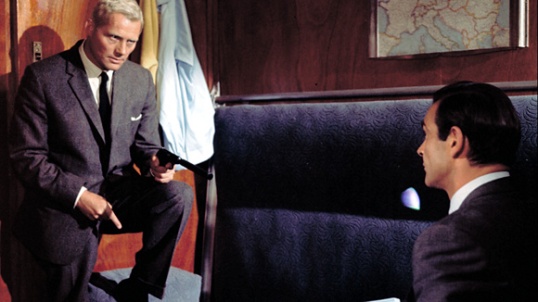
The same year that the Academy honored George Cukor’s creaky adaptation of My Fair Lady, it totally ignored my favorite James Bond film.  From Russia With Love is a Bond film that works wonderfully as both a love story and a thriller.  Sean Connery, Lotte Lenya, Robert Shaw, and Terence Young all deserved some award consideration.  From Russia With Love was released in the UK in 1963.  In a perfect world, it would have also been released concurrently in the U.S., allowing From Russia With Love to be the film that gave the the Academy the chance to recognize the British invasion.  Instead, Tom Jones was named the Best Picture of 1963 and From Russia With Love had to wait until 1964 to premiere in the U.S.  It was snubbed in favor of one of old Hollywood’s last grasps at relevance.

1964: Slim Pickens Is Not Nominated For Best Supporting Actor

Playing three separate roles, Peter Sellers dominates Dr. Strangelove: Or How I Learned To Stop Worrying And Love The Bomb.  But, as good as Sellers is, the film’s most memorable image is definitely Slim Pickens whooping it up as he rides the bomb down to Earth.  George C. Scott and Sterling Hyaden also undoubtedly deserved some award consideration but, in the end, Pickens is the one who brings the film to life even as he helps to bring society to an end.

1967: In Cold Blood Is Not Nominated For Best Picture

In Cold Blood, though not a perfect film, certainly deserved a nomination over Dr. Doolittle.  In Cold Blood is a film that still has the power to disturb and haunt viewers today.  Dr. Doolittle was a box office debacle that was nominated in an attempt to help 20th Century Fox make back some of their money.

1967: Sidney Poitier Is Not Nominated For Best Actor For In The Heat Of The Night

In 1967, Sidney Poitier starred in two of the films that were nominated for Best Picture but somehow, he did not pick up a nomination himself.  His restrained but fiercely intelligent performance in In The Heat Of The Night provided a powerful contrast to Rod Steiger’s more blustery turn.  That Poitier was not nominated for his performance as Virgil Tibbs truly is one of the stranger snubs in Academy history.  (If I had to guess, I’d say that the Actors Branch was split on whether to honor him for In The Heat of the Night or Guess Who’s Coming To Dinner or even for To Sir With Love and, as a result, he ended up getting nominated for none of them.)

1968: 2001: A Space Odyssey and Planet of the Apes Are Not Nominated For Best Picture

Neither one of these classic science fiction films were nominated for Best Picture, despite the fact that both of them are far superior and far more influential than Oliver!, the film that won that year.

1968: The Good, The Bad, and the Ugly Is Totally Ignored

Not even Ennio Morricone’s score received a nomination!

1968: Petulia Is Totally Snubbed

Seriously, I don’t know what was going on with the Academy in 1968 but it seems they went out of their way to ignore the best films of the year.  Richard Lester’s Petulia is usually cited as one of the definitive films of the 60s but it received not a single Oscar nomination.  Not only did the film fail to receive a nomination for Best Picture but Richard Lester, George C. Scott, Julie Christie, Shirley Knight, Richard Chamberlain, and the film’s screenwriters were snubbed as well.

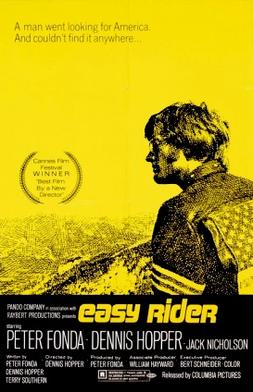
1969: Easy Rider Is Not Nominated For Best Picture

Yes, I know.  Easy Rider is a flawed film and there are certain moments that are just incredibly pretentious.  That said, Easy Rider defined an era and it also presented a portrait of everything that was and is good, bad, and timeless about America.  The film may have been produced, directed, and acted in a drug-razed haze but it’s also an important historical document and it was also a film whose success permanently changed Hollywood.  Certainly, Easy Rider’s legacy is superior to that of Hello, Dolly!

Agree? Disagree? Do you have an Oscar snub that you think is even worse than the 10 listed here? Let us know in the comments!

Up next: It’s the 70s!
4 Shots From 4 Films: Special Sergio Leone Edition


Sergio Leone (1929 — 1989)

4 Or More Shots From 4 Or More Films is just what it says it is, 4 shots from 4 of our favorite films. As opposed to the reviews and recaps that we usually post, 4 Shots From 4 Films lets the visuals do the talking!

94 years ago today, Sergio Leone was born in Rome, Italy.  The son of actor/screenwriter Vincenzo Leone and silent actress Edvige Valcarenghi, Sergio was born into the Italian film industry.  He began his career in the post-war rebuilding period, working as an assistant to Vittorio De Sica and, as an assistant director, for American films that were shot in Italy.  (Albeit uncredited, he worked on two Oscar-nominated Biblical epics, Quo Vadis and Ben-Hur.)

After making his directorial debut with The Colossus of Rhodes, Leone went on to direct the films that would change the face of international cinema.  Though he was hardly the first director of Spaghetti westerns, he was was the first to achieve far-reaching acclaim.  With the Dollars Trilogy, he made Clint Eastwood a star and Eastwood has often said that the majority of what he knows about directing, he learned from working with Leone and later Don Siegel.  Leone went on to direct the brilliant Once Upon A Time In The West and Once Upon A Time in America, two epic visions of American history that, sadly, were not initially treated well by their distributors.

Though Leone is only credited with directing eight films, his influence cannot be underestimated.  As both a visual artist and a cultural and political commentator, his films continue to influence directors to this day.

For that reason, it’s time for….

4 Shots From 4 Sergio Leone Films

The Good, The Bad, and the Ugly (1966, dir by Sergio Leone, DP: Tonino Delli Colli)

Once Upon A Time In The West (1968, dir by Sergio Leone, DP: Tonino Delli Colli)

Duck, You Sucker (1971, dir by Sergio Leone, DP: Giuseppe Ruzzolini)

Once Upon A Time In America (1984, dir by Sergio Leone, DP: Tonino Delli Colli)

6 Classic Trailers For January 8th, 2022


Since this week started with Sergio Leone’s birthday, it only seems appropriate that today’s edition of Lisa Marie’s Favorite Grindhouse Trailers should be dedicated to the Western.  Here are 6 classic Spaghetti western trailers!

  1. The Good, the Bad, and the Ugly (1966)

It only makes sense that we should start things off with a trailer from a Leone film and it makes further sense that film should be The Good, The Bad, and the Ugly.  It’s all here, from the classic Ennio Morricone score to the unforgettable staring contest between Clint Eastwood, Lee Van Cleef, and Eli Wallach.

2. Sabata (1969)

While Clint Eastwood was able to use his appearances in Leone’s westerns to restart his American film career, Lee Van Cleef remained in Italy.  After playing the villainous Angel Eyes, Van Cleef played the hero Sabata.  This trailer is very, very 60s.

3. Django (1966)

Franco Nero never appeared in a Sergio Leone film but he was a favorite of the famous “other Sergio,” Sergio Corbucci.  In Corbucci’s Django, Nero played the haunted title character, making his way across the west with a deadly coffin.

4. Django Kill (1967)

Django was such a hit that a number of other films were made about other haunted, amoral gunslingers named Django.  Whether or not they were all the same Django was left to the audience to decide.  In Django Kill, Tomas Milian played the title character and found himself in a surreal hellscape, surrounded by people who were obsessed with gold.

5. The Great Silence (1968)

The Great Silence was one of the greatest of the spaghetti westerns, featuring Klaus Kinski in one of his best and most villainous roles.  Unfortunately, like many of the better spaghetti westerns, it initially did not get a proper release in the States.  Fortunately, it has since been rediscovered.

6. Once Upon A Time In The West (1968)

And finally, to close things out, here’s one last Sergio Leone trailer.  Sadly underappreciated when first released, Once Upon A Time In The West has since come to be recognized as a masterpiece.

4 Shots From 4 Films: Special Sergio Leone Edition


Sergio Leone (1929 — 1989)

4 Or More Shots From 4 Or More Films is just what it says it is, 4 shots from 4 of our favorite films. As opposed to the reviews and recaps that we usually post, 4 Shots From 4 Films lets the visuals do the talking!

93 years ago today, Sergio Leone was born in Rome, Italy.  The son of actor/screenwriter Vincenzo Leone and silent actress Edvige Valcarenghi, Sergio was born into the Italian film industry.  He began his career in the post-war rebuilding period, working as an assistant to Vittorio De Sica and, as an assistant director, for American films that were shot in Italy.  (Albeit uncredited, he worked on two Oscar-nominated Biblical epics, Quo Vadis and Ben-Hur.)

After making his directorial debut with The Colossus of Rhodes, Leone went on to direct the films that would change the face of international cinema.  Though he was hardly the first director of Spaghetti westerns, he was was the first to achieve far-reaching acclaim.  With the Dollars Trilogy, he made Clint Eastwood a star and Eastwood has often said that the majority of what he knows about directing, he learned from working with Leone and later Don Siegel.  Leone went on to direct the brilliant Once Upon A Time In The West and Once Upon A Time in America, two epic visions of American history that, sadly, were not initially treated well by their distributors.

Though Leone is only credited with directing eight films, his influence cannot be underestimated.  As both a visual artist and a cultural and political commentator, his films continue to influence directors to this day.

For that reason, it’s time for….

4 Shots From 4 Sergio Leone Films

For A Few Dollars More (1965, dir by Sergio Leone, DP: Massimo Dallamano)

The Good, The Bad, and the Ugly (1966, dir by Sergio Leone, DP: Tonino Delli Colli)

Once Upon A Time In The West (1968, dir by Sergio Leone, DP: Tonino Delli Colli)

Once Upon A Time In America (1984, dir by Sergio Leone, DP: Tonino Delli Colli)


4 Shots From 4 Films In Honor Of Sergio Leone’s Birthday


Sergio Leone (1929 — 1989)

4 Shots From 4 Films is just what it says it is, 4 shots from 4 of our favorite films. As opposed to the reviews and recaps that we usually post, 4 Shots From 4 Films lets the visuals do the talking.

91 years ago today, Sergio Leone was born in Rome.  He went to school with future composer and collaborator, Ennio Morricone.  He saw, first hand, the horrors of living under an authoritarian regime and, though it wasn’t always appreciated at the time, all of his film had an anti-fascist political subtext that was informed by growing up under Mussolini.  He went to college to be a lawyer but quickly dropped out and instead, at the age of 18, started a long apprenticeship in the Italian film industry.  He started his career by working as an assistant to Vittorio De Sica on Bicycle Thieves, which is a pretty good way to start things.  Eventually, he went on to become one of the most influential directors of all time.

Taking into mind just how influential his work would be, it’s can be easy to forget that Leone is only credited with having directed 7 films and the majority of those films were not immediately embraced.  (Though it’s generally agreed that Leone was, for all intents and purposes, the co-director of My Name Is Nobody, he was only officially credited with coming up with the film’s story.)  In the 60s, highbrow critics turned their noses up at his spaghetti westerns, even while audiences ate them up and made Clint Eastwood into a film star.  (Eastwood would later dedicate his Oscar-winning Unforgiven to Sergio Leone and Don Siegel.)  The Good, The Bad, and the Ugly and Once Upon A Time In The West are now recognized as two of the greatest westerns ever made but, at the time they were released, they were criticized for being too long and (oddly enough) thematically shallow.  Leone even had to suffer that indignity of having his final (and, in my opinion, best) film, Once Upon A Time In America, edited down by a studio that cared little about the intricate structure that Leone had crafted for his tale of greed, crime, and redemption in America.

Leone died when he was only 60, felled by a heart attack.  However, his legacy remains alive, as his films continue to inspire directors and writers and other film lovers to this day.  His two greatest films — Once Upon A Time In The West and Once Upon A Time In America — have been rediscovered and rescued from the studio hacs who previously served him so badly.  Just last year, Quentin Tarantino paid tribute to Leone with the title of his best film-to-date, Once Upon A Time In Hollywood.

On this day, we honor the legacy of a cinematic great.

4 Shots From 4 Sergio Leone Films

A Fistful of Dollar (1964, dir by Sergio Leone, DP: Massimo Dallamano)

The Good, The Bad, and the Ugly (1966, dir by Sergio Leone, DP; Tonino Delli Colli)

Once Upon A Time In The West (1968, dir by Sergio Leone, DP: Tonino Delli Colli)

Once Upon A Time In America (1984, dir by Serigo Leone, DP: Tonino Delli Colli)

Song of the Day: The Main Theme From The Good, The Bad, and the Ugly by Ennio Morricone


You knew this one was coming, right?  Seriously, no tribute to Ennio Morricone is complete without the main theme from The Good, The Bad, and the Ugly

Morricone’s score is as much of a character in this film as the ones played by Clint Eastwood, Eli Wallach, and Lee Van Cleef.  It perfectly sets the moods, telling us that we’re about to see something that is truly epic.  The opening notes, which have so often been parodied but which have never lost their power, truly capture the feel of Sergio Leone’s mythical vision of the old west.

So, without further rambling from me, here it is:

https://www.youtube.com/watch?v=h1PfrmCGFnk

Previous Entries In Our Tribute To Morricone:

  1. Deborah’s Theme (Once Upon A Time In America)
  2. Violaznioe Violenza (Hitch-Hike)
  3. Come Un Madrigale (Four Flies on Grey Velvet)
  4. Il Grande Silenzio (The Great Silence)
  5. The Strength of the Righteous (The Untouchables)
  6. So Alone (What Have You Done To Solange?)
  7. The Main Theme From The Mission (The Mission)
  8. The Return (Days of Heaven)
  9. Man With A Harmonic (Once Upon A Time In The West)
  10. The Ecstasy of Gold (The Good, The Bad, and the Ugly)