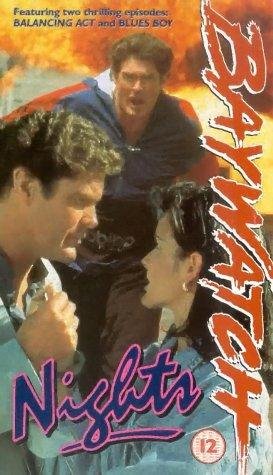
Welcome to Late Night Retro Television Reviews, a feature where we review some of our favorite and least favorite shows of the past! On Tuesdays, I will be reviewing Baywatch Nights, a detective show that ran in Syndication from 1995 to 1997. The entire show is currently streaming on YouTube!
This week, Baywatch Nights tries to open an X-File.
Episode 2.18 “Symbol of Death”
(Dir by Richard Friedman, originally aired on April 19th, 1997)
After he’s found wandering around the city and babbling incoherently, Daimont Teague is taken to the hospital. Mitch and Ryan are called to come get him but, by the time they show up, Teague has already wandered off. Teague’s doctor hands Ryan a blue rock that Teague wanted her to have. Suddenly, there’s an explosion in the hospital. Mitch falls to the floor, holding his knee. A wild-eyed man wearing a beret (Terry Kiser) grabs Ryan’s purse. Ryan chases after him and beats him up in the parking lot. Ryan is more upset over her purse nearly being stolen than she is over an apparent terrorist bombing at a hospital. And I don’t blame her! I’d kill to protect any of my purses.
The purse thief turns out to be George Wilson. Wilson explains that he’s a writer and an expert on UFOs. He believes that aliens are already on the Earth and that there’s a huge interstellar conspiracy that controls everything that happens on this planet. (Of course, this show has already established that it’s actually the Knights Templar who control everything.) The blue rock contains some sort of alien presence that apparently possessed Teague and is currently causing him to stumble around the city. Wilson and Ryan team up to track down Teague and protect him from the aliens. It doesn’t make any damn sense but let’s just go with it.
Due to Mitch injuring his knee when that bomb went off, the Hoff is barely in this episode. For that matter, neither Griff nor Donna are in this episode, either. I’m going to guess that this was a cost-cutting measure on the part of the producers because, if there’s any episode in which it would have made sense to call in Griff and Donna, it’s this episode. They could have helped in the search for Teague. As it is, it falls to Ryan and Wilson to do most of the searching. Terry Kiser, who is best known for playing the titular Bernie in Weekend at Bernie’s, is always an amusing presence and he seems to be having a ball playing such a paranoid character. That said, it’s hard not to be a little bit amazed at how quickly Ryan is willing to forgive him for trying to steal her purse.
This episode owed a lot to the X-Files, with its aliens and its murky talk of conspiracies. Unfortunately, it lacks all of the atmosphere necessary to really make its conspiracy-fueled plotline compelling. Despite all of the Dutch angles that are used in this episode, this is still basically a sunny and rather corny Baywatch spin-off. Rather than leaving me feeling paranoid, this episode just let me thinking about silly this whole series truly is. Don’t get me wrong, of course. It’s fun. But it’s also definitely very, very silly.
There’s only four more episodes of Baywatch Nights left to review. I’m going to miss this show after I finish.
Welcome to Retro Television Reviews, a new feature where we review some of our favorite and least favorite shows of the past! On Fridays, I will be reviewing Half Nelson, which ran on NBC from March to May of 1985. Almost all nine of the show’s episodes can be found on YouTube!
The year was 1985 and actor/singer Joe Pesci was at an interesting place in his film career.
In 1980, Joe Pesci was nominated for Best Supporting Actor for his performance as Robert De Niro’s brother in Raging Bull. Raging Bull was Pesci’s second film and he earned critical acclaim for his performance as the second most angry member of the LaMotta family. In the years immediately following his first Oscar nomination, Pesci went on to play character roles in a handful of other films, including Dear Mr. Wonderful, Easy Money,Once Upon A Time In America, and Eureka. While no one could deny Pesci’s talent or his unique screen presence, it was also obvious that Hollywood wasn’t quite sure what to do with him. While Pesci was apparently high on everyone’s list when it came to playing gangsters with hair-trigger tempers, no one was willing to give Pesci a starring role.
Fortunately, television always has room for an Oscar nominee and, in 1985, Half Nelson came calling. Created by veteran television producers Glen A. Larson and Lou Shaw, Half Nelson was a detective show. Joe Pesci starred as Rocky Nelson, a tough New York cop who relocated to Los Angeles to pursue his acting career. While waiting for his big break, Rocky worked for Beverly Hills Security and lived in Dean Martin’s guest room. And when I say that Rocky was living in Dean Martin’s guest house, what I mean is that Dean Martin actually appeared on the show, playing himself.
NBC liked the idea enough to air the pilot film and then schedule the show as a mid-season replacement. Audiences were a bit less interested in the show and Half Nelson was canceled after only 8 weeks. Pesci went on to win an Oscar for Goodfellas and he never starred in another television show. Half Nelson would probably be forgotten if not for the fact that someone recently came across the opening credits on YouTube. When shared on Twitter, this video went viral as “the most 80s thing” ever created.
After I watched that video, I knew I simply had to review Half Nelson as soon as I finished up The Brady Bunch Hour. Fortunately, almost all of the episodes have been uploaded to YouTube so, for the next few weeks, I’ll be taking a look at HalfNelson, starring Joe Pesci!
Episodes 1 & 2 “The Pilot”
(Dir by Bruce Bilson, originally aired on March 24th, 1985)
Half Nelson begins in New York City, with NYPD’s finest, Detective Rocky Nelson (Joe Pesci), disguising himself as a waiter and sneaking into a mafia-owned restaurant. After punching out two guards, Rocky enters a backroom and discovers a group of guys with a lot of heroin. Rocky arrests them and becomes a hero. As Rocky explains in a voice-over, it’s the biggest drug bust in history. When Hollywood asks for the rights to the story, Rocky insists that he be allowed to audition for the lead role. Rocky quits the NYPD and heads out to Los Angeles. Rocky’s going to be a star!
And, at first, it seems like Rocky’s dream might actually come true. The film’s director (played by the veteran TV character actor, George Wyner) watches Rocky’s audition and announces that Rocky has the screen presence and talent of Al Pacino. Unfortunately, Rocky is also only 5’3. “You’re too short to play Rocky Nelson,” the director explains.
“But I am Rocky Nelson!” Rocky exclaims.
Despite the fact that Rocky’s telling the truth, it doesn’t matter. A tall British actor is cast in the film. As a dejected Rocky leaves the audition, he’s approached by a security guard who offers Rocky a job with Beverly Hills Patrol, a private security firm. Rocky’s skeptical until the security guard mentions that Rocky will get to live in Dean Martin’s guest house.
We jump forward six months. Rocky is now a trusted employee of Beverly Hills Patrol. When he’s not working as a bodyguard, he’s auditioning for roles. At the office, his boss is Chester (Fred Williamson) and the office manager is Annie O’Hara (Victoria Jackson). Chester is cool and all-business. Annie is flighty and has an obvious crush on Rocky. She also gives Rocky a pit bull named Hunk. Hunk is very loyal but also very quick to attack anyone who isn’t Rocky. I don’t know if a show could get away with a comic relief pit bull today but whatever. Hunk is a cute dog with a ferocious bark.
In just six months, Rocky has become surprisingly well-known in L.A. Some of that might be because he lives with Dean Martin. Martin appears in three scenes of the pilot and, to be honest, he definitely looks and sounds a bit worse for wear. Half Nelson was Dean’s final acting role. (He died ten years after the show was canceled.) But even though Dean was clearly not in the best shape when he appeared in the pilot, his natural charisma still shines through and there’s a lot of pleasure to be found in his scenes with Joe Pesci. For one thing, Pesci himself seems to be genuinely excited about acting opposite Martin.
Along with becoming friends with Dean Martin, Rocky has also befriended Parsons (George Kennedy), a Los Angeles police chief who is eager for Rocky to quit the Beverly Hills Patrol and to join the LAPD. Rocky turns down the offer, however. Rocky is done with police work. He’s going to be a star!
Of course, he’ll also find time to solve some crimes along the way.
For instance, in the pilot, Rocky investigates the death of his best friend and co-worker, Jerry (Nicholas Surovy). Parsons insists that all the evidence shows that Jerry murdered his girlfriend, Monika (Morgan Brittany), and then shot himself. However, Rocky doesn’t think Jerry would do something like that. When Jerry’s father (veteran screen actor Rory Calhoun) asks Rocky to find the people who killed his son, Rocky doesn’t have to be asked twice.
It turns out that Jerry and Monika were taking money from a tabloid magazine publisher (Terry Kiser). They had a video tape that would have been very embarrassing to some prominent Angelinos, including a businessman (Rod Taylor), a restauranter (Tony Curtis), a general (Mills Watson), an astronaut (Gary Lockwood), and a television executive (Bernie Kopell). Rocky assumes that the people on the tape ordered the murders but then he learns that, while the general did send two government agents to find the tape, he also made clear that no one was supposed to be killed. Instead, someone else who wanted the tapes committed the murders on his own.
Searching for the killer means that Rocky will have to assume many disguises and show off his acting skills. As an actor, he’s able to wander into the local movie studio and not only raid their wardrobe department but also borrow their cars. Over the course of the film, Rocky disguses himself as both a cowboy and a traffic cop. He also drives a Ferrari, a Cadillac, a jeep, a motorcycle, and KITT, the talking car from Knight Rider. (KITT, unfortunately, does not talk in Half Nelson.) On the one hand, the use of disguises is a little bit silly because Joe Pesci is always going to be Joe Pesci regardless of what costume he is wearing. The pilot’s silliest scene involves Rocky dressed up like a cop to confront two men who have been following him. Somehow, they fail to pick up on the fact that the 5’3 cop with the New York accent is the same 5’3 New Yorker who they’ve been tailing for the last few days. And yet, it’s one of those things that’s so ludicrous that you can’t help but think that the show was showing a bit of self-awareness and commenting on just how ludicrous most television shows tend to be.
Eventually, Rocky figures out that the killer is …. SPOILER ALERT …. Parsons! That’s right. The same police chief who kept offering Rocky a job with the LAPD turned out to be the murderer for whom Rocky was looking. What’s interesting is that, after realizing that Parsons is the killers, Rocky doesn’t arrest Parsons or attack him or do any of the other things that a typical TV detective might. And Parsons doesn’t try to flee or fight. Instead, the two men take a leisurely drive and talk about life, morality, and regret. Parsons talks about how he was once an honest cop but Los Angeles corrupted him. Rocky expresses some sympathy and says that he hates that he discovered that Parsons was the murderer. It’s a well-acted and surprisingly well-written scene. When Rocky asks Parsons about the murders, Parsons replies, “I had to empty my gun, just to drown out their screams.” (Yikes!) Parsons lets Rocky out of the car and tells him, “Don’t let them get to you, kid.” Parsons then drives the car over a cliff as Roberta and Chester (who have been tailing Parsons) run up to Rocky.
“Hard to believe that a man like that would kill himself!” Roberta says.
“That’s just the funeral,” Rocky replies as Parsons car explodes, “He died a long time ago.”
Wow, that’s dark! Fortunately, the mood is lightened during the show’s final scene, in which Rocky’s pit bull attacks boxer Larry Holmes.
The pilot for Half Nelson was nicely done. It set up the series and it gave us an introduction to the characters, which is exactly what a pilot is supposed to do. The cast showed off their chemistry and the final scene between Parsons and Rocky indicated that the show had the potential to be something more than just another mid-80s detective show. The pilot’s greatest strength, not surprisingly, was Joe Pesci. Pesci has played so many mobsters and crooked lawyers that it’s easy to forget what a likable actor he can be. The pilot featured Pesci at his most amiable and it also gave him a chance to show off his comedic timing. All-in-all, the pilot was a success and I could understand why NBC would have ordered more episodes after watching it.
But what about the series? Would the series live up to the promise of the pilot or would it just become another generic detective show? We’ll find out over the next 8 weeks!
Someone is murdering models and trying to frame Larry Roberts (Albert Finney), a plastic surgeon. Larry suspects that the actual murderer is somehow involved with the Digital Matrix research firm, a shadowy organization that is headed by James Coburn and Leigh Taylor Young. Digital Matrix has developed a new technique where they digitally scan a model’s body and then generate a 3-D duplicate that can be used in commercials and on film. The real-life models stand to make a fortune from the royalties, assuming that they are physically perfect and they do not end up getting murdered immediately after being scanned. Larry’s girlfriend, Cindy (Susan Dey), is just the latest model to have been scanned and now Larry suspects that she might be targeted for death as well.
When I was growing up, Looker was one of those movies that always seemed to be on HBO. I don’t know why this box office bomb was so popular on cable but I do remember seeing it several times. I guarantee you that anyone who has ever came across this movie on HBO in the 80s and 90s will remember it. They might not remember the title but they will remember that the bad guys used light guns that would cause people to briefly go into a catatonic state. Everyone who has ever seen this movie remembers the model standing frozen in the doorway of her apartment.
As for the movie itself, the guns are cool and so is the scene where Susan Dey gets scanned but otherwise, Looker is not very good. Michael Crichton later said that he had conflicts with Warner Bros during the editing of Looker and, as a result, there were some important scenes that did not make it into the final cut. For instance, it is never really explained why the models are being killed. Albert Finney was in one of his periodic career slumps when he starred as Larry and he looks uncomfortable going through the motions of being an action star. Two years after Looker came out, Finney’s career would be reinvigorated when he received an Oscar nomination for The Dresser and three years later, he would give his career best performance in Under the Volcano.
As it typical of Michael Crichton’s work, Looker was ahead of its time in predicting the use of CGI in media but otherwise, it’s nothing special. If you want to see a good Crichton-directed film, stick with Westworld and The Great Train Robbery.
Monroe (C. Thomas Howell) is a young lawyer who moves to California and gets a job working for his Uncle Max (Terry Kiser). Max wants Monroe to concentrate on evicting beach bums. Monroe wants to play beach volleyball. Together, they solve crimes. No, actually, Max orders Monroe to evict Zack (Peter Horton), a former volleyball champion who was once “king of the beach.” Zack agrees to coach Monroe and his goofball friend, Wiley (Christopher Rydell) in a volleyball tournament. But when Zack misses a match because he is having underlit, PG-13 sex with his ex-wife (Harley Jane Kozak), uncoached Monroe accidentally breaks Wiley’s arm. Now, Zack has to step in as Monroe’s partner and reclaim his status as king of the beach!
When I was a kid, Side Out was a HBO perennial, which is not the same thing as being a good movie. There have not been many movies made about beach volleyball and Side Out shows us why. Beach volley ball is just not that exciting to watch, especially when the main competitors are two out of shape actors. All the jump cuts and close-ups in the world can’t disguise the fact that neither actor looks like he could get the ball over the net, never mind playing for over ten minutes without getting out of breath. In Side Out, beach volleyball teamwork comes down to a lot of yelling and whenever Monroe yells at either Wiley or Zack, he sounds just like the “Put him in a body bag, Johnny!” guy from The Karate Kid.
At least Kathy Ireland has a small role. Also, in the role of Zack’s friend, keep an eye out for Duke himself, the great Tony Burton!
I recently saw the 1968 best picture nominee Rachel, Rachel on TCM and I have to say that, at first, I was rather underwhelmed by it. Don’t get me wrong. I thought it was well-acted. I thought it managed to capture a lot of details of small town life. I thought that, for a film made in 1968, it was surprisingly mature and nonjudgmental when it came to exploring feminine sexuality. I was even more surprised to see a nearly 50 year-old movie that actually featured a sympathetic portrayal of a lesbian. Just consider that the homophobic The Sweet Ride was released at the same time and you can see just how unusually progressive Rachel, Rachel was as far as this was concerned.
And yet, when I first watched Rachel, Rachel, it was difficult for me to connect with it. And I really wasn’t sure why. I mean, it is true that Rachel, Rachel is one of those films that moves at a very deliberate post but, trust me, I’ve seen and enjoyed many films that were a helluva lot slower than Rachel, Rachel. But, for whatever reason, it took me two viewings to really appreciate Rachel, Rachel as a surprisingly sensitive character study.
The film is about Rachel (Joanne Woodward), a 35 year-old virgin who lives with her mother in a small Connecticut town. Since the death of her stern and overbearing father, Rachel has lived with her mother. She’s a withdrawn and meek woman who has frequent fantasies that veer between unrealistic happiness and nightmarish morbidity. Her best friend, another unmarried teacher named Calla (Estelle Parsons), invites Rachel to a revival meeting and, for the first time in her life, Rachel actually allows herself to be openly passionate. After the meeting, Calla suddenly kisses her. Shocked, Rachel temporarily ends their friendship.
Even before the revival meeting, Rachel has run into Nick (James Olsen), a friend from high school who is in town to visit his family. After getting kissed by Calla, Rachel ends up turning to Nick and losing her virginity to him. Rachel believes that she’s in love with Nick and is soon fantasizing about their future children. However, it’s obvious to everyone (except for Rachel) that Nick doesn’t quite feel the same way…
When I first saw Rachel, Rachel, I had a hard time relating to the character of Rachel. I watched and, as much as I tried to be sympathetic, I still found myself wondering how anyone could possibly still be a virgin at the age of 35. I mean, I understand that times were different and all but seriously! I guess back then, people actually were serious about the whole “no sex before marriage” thing. (That probably explains why people used to get married when they were 17.) The film is full of largely silent flashbacks to Rachel’s youth and we see that she was raised in an emotionally repressed environment. She was raised to wait for the right man to come along and, when he didn’t, Rachel eventually found herself as a 35 year-old virgin.
And, without getting too TMI here, let’s just say that I couldn’t relate to Rachel’s situation.
But, when I watched the film for a second time, I discovered that even if I don’t know what it’s like to be a 35 year-old virgin, a lot of Rachel’s experiences were, in their way, universal. Consider the scene at the start of the film where Rachel fantasizes that everyone in town is staring at her as she walks down the sidewalk, all because her slip is showing. Who hasn’t, at some point in their life, felt like everyone was staring at her and judging? And, for that matter, who hasn’t had a Nick in their life?
Interestingly enough, Rachel, Rachel was the directorial debut of the iconic actor Paul Newman. One thing that I’ve noticed about films directed by actors (especially first films) is that the actor-turned-director often seems to feel that he has to prove himself by indulging in as much showy cinematic technique as possible. (And if you don’t understand what I mean, check out George Clooney’s Confessions of a Dangerous Mind.) And, as much as I hate to admit it because I’ve never read one negative word about Paul Newman, I have to admit that Newman’s direction was one of the reasons why, at first, I found myself feeling detached from the film.
While Newman tells most of Rachel’s story in an admirably straight-forward way, he also included just a few too many arty flashbacks and fantasies. Some of the fantasies — like the one at the start of the film that I mentioned two paragraphs ago — are handled well but others are distracting and they remind the viewer that they’re watching a film. And Rachel, Rachel is a film that works best when it’s naturalistic. Whenever it gets too self-consciously cinematic, it takes the viewer a few minutes to get sucked back into Rachel’s story.
But, and this is the important thing, Paul Newman also gets some great work out of his actors. Judging from some other films in which I’ve seen him, James Olson was not a particularly good actor but he was great in Rachel, Rachel. Estelle Parsons has been an overdramatic presence in a few films and a lot of tv shows but she’s great in Rachel, Rachel. And then there’s Joanne Woodward, who was great in a lot of films, including Rachel, Rachel. Newman and Woodward were married when they made Rachel, Rachel and were still married when Newman died 40 years later. Newman reportedly directed Rachel, Rachel because he wanted Woodward to have a great role. Woodward is on-screen throughout the entire film and Newman’s love for her is obvious in every frame.
Rachel, Rachel is a flawed and imperfect film but it’s still worth catching the next time that it shows up on TCM.
Hi, did everyone out there have a good Easter? I did! My entire family got together up at my Uncle’s place. There was a big Easter egg hunt and me and Erin smuggled in extra Easter eggs which we then “helped” our niece and nephew discover. Usually, going to my Uncle’s place means a day spent laying out near the pool in a bikini and trying to work on my tan. (Though, to be honest, I’m a redhead so I don’t so much tan as I just burn.) However, this Easter, it rained so most of the day was spent inside and watching figure skating with my sisters and cousins. I hope everyone else had a good Easter as well and I hope you’ll forgive me for being a little late with my latest review in my series looking at the Friday the 13th franchise. In this post, I review 1988’s Friday the 13th Part VII: The New Blood.
(Minor Spoilers Follow)
As I mentioned in my review of Jason Lives, The New Blood was the first of what I like to call Friday the 13th’s gimmick films. In these films, Paramount Pictures (and later New Line Cinema) attempted to revive the franchise’s declining profits by adding a gimmick. No longer would it be enough for Jason to simply show up and stalk unfortunate campers. Previous installments had their gimmicks (such as Part 3 being filmed in 3D) but they all stuck with the same basic story and structure. However, from now on, Jason would no longer just be a silent antagonist in a communal cinematic nightmare. From now on, he would fight psychics and Freddy Krueger and go to both outer space and New York City. (And don’t even get me started on the film where he was revealed to actually be some sort of weird space slug. Not yet, anyway…)
The problem with the gimmick films is that, along with dealing with the gimmick, they still had to deal with the business of killing summer counselors and other random campers. Whereas previous film made at least a little effort to provide the viewers with interesting and/or attractive characters, the gimmick films are distinguished by a real laziness when it comes to characterization. Ironically enough, surrounding the gimmick with such weak material only served to remind the viewer just how gimmicky the gimmick ultimately was. That is why the gimmick films are my least favorite of the franchise.
That said, The New Blood is probably the best of the gimmick films. Anyone who doesn’t think that being called the best of the worst is much of a compliment has obviously never been in a community theater production of Little Shop of Horrors.
The New Blood of the title is a girl named Tina Shepherd. When we first meet Tina, she’s ten years old and living in a house that sits on the shores of Crystal Lake. (Apparently, the residents of Forrest Green decided to change the name of the town back to Crystal Lake sometime after Jason Lives. If nothing else, these two films convinced me of the importance of zip codes.) One night, as Tina listens to her father and her mother fight, she runs out to a nearby dock, gets in a canoe, and starts to float away. Her father runs out onto the dock and shouts at her to return. Tina yells back and suddenly, the entire dock collapses and her father drowns. As all of this is going on, we discover that Jason just happens to be in the lake, chained to a rock below the dock. (You have to wonder what having a zombie serial killer chained up a yard away from your house does to property values. Nothing good, I imagine but then again, what do I know about real estate?)
Anyway, jump forward ten years. Tina (now played by Lar Park Lincoln) has just been released from a mental asylum and returns to Crystal Lake with her psychiatrist Dr. “Bad News” Crews (played by a wonderfully evil Terry Kiser). Dr. Crews claims to be helping her deal with her feelings of guilt but actually, he’s seeking to exploit the fact that Tina has latent psychic abilities. What all can Tina do? Well, that’s a good question because the film itself seems to be unsure of just what exactly Tina is capable of. As a result, Tina often seems to have whatever psychic abilities are most convenient for whatever’s happening on-screen at the moment. While most of the time Tina seems to be telekinetic, there are other times when she can see the future, set fires, and even raise the dead.
It’s this last power that gets everyone in trouble when, one night after getting annoyed with Dr. Crews, Tina runs out to the lake and attempts to bring her father back to life. While she fails to bring back her dad, she does manage to free Jason (played here, for the first time, by Kane Hodder) from his chains. By this action, Tina joins the long line of horror film heroines who are ultimately responsible for every death that occurs over the course of the movie.
That’s pretty bad news for the vapid collection of potential victims who are trying to throw a surprise birthday party in the house next door. Among those potential victims: nice guy Nick (Kevin Butler) who falls in love with Tina, evil Melissa (Susan Jennifer Sullivan) who wants Nick, Eddie (Jeff Bennett) who spends his time talking about a sci-character called “Space Mummy,” and about a half-dozen other people whose names I didn’t manage to catch. Seriously, this is the most empty-headed and shallow collection of dumbfug toadsuckers ever! As opposed to previous installments (in which the actors at least had enough chemistry that you believed that they just might actually spend a weekend at the lake together), the victims in New Blood feel as if they were just randomly dropped in the house just so that Jason could kill them. They’re such a vacous, spiteful collection of people that, for the first time in the series, you truly find yourself rooting for Jason.
Anyway, the birthday boy never shows up for his party but that doesn’t really worry anyone at the house. As one of them puts it. “You know Michael. Guy probably got arrested for drunk driving and spent the night in jail.” (Sounds like a great guy, no?) No, Michael’s not in jail. Michael’s dead because Tina brought Jason back to life and soon, so is just about everyone else. It all leads to a final apocalyptic battle between Jason and Tina that manages to be both silly and exciting at the same time. It also goes a long way towards making up for what we’ve had to sit through in order to reach it.
One of my favorite chapters of Peter M. Bracke’s excellent oral history of the franchise, Crystal Lake Memories, deals with the making of The New Blood. Say whatever else you will about this film’s cast, they’re some of the most outspoken in the history in the history of the franchise. Reading their memories about making this film, three things quickly become clear:
1) Everyone was scared of Kane Hodder.
2) Lar Park Lincoln didn’t like the majority of the cast.
3) The majority of the cast didn’t like Lar Park Lincoln.
In fact, quite a few really nasty things are said about Lar Park Lincoln but you know what? Outside of Kane Hodder and Terry Kiser, Lar Park Lincoln probably comes the closest to giving an actual performance than anyone else in the cast and I think it can be argued that she makes Tina into one of the few truly strong female characters ever to be found in a Friday the 13th film. Take it from a former community theatre ingenue: it takes as much talent to make a slasher film “final girl” credible as it does to play Margaret Thatcher. As for the rest of the cast of disposable victims, they’re some of the most forgettable of the series. In the role of Nick, Kevin Blair (who reportedly did not get along with Lincoln and who has absolutely no chemistry with her on-screen) is stiff but handsome and Susan Jennifer Sullivan has a lot of style as the bitchy Melissa. Otherwise, they’re a pretty bland group and director Buechler doesn’t seem to have much use for them other than to make sure that they’re in the right position to be killed by Kane Hodder.
The New Blood is best remembered for introducing Kane Hodder in the role of Jason Voorhees. Though I personally believe that The Final Chapter’s Ted White was the best Jason (he was certainly the most ruthless), it can’t be denied that Kane Hodder was the perfect embodiment of the version of Jason that came to dominate the last few films in the original series. Whereas Ted White’s Jason was a calculating killer, Hodder’s Jason is a machine that happens to be designed for killing and little else. He kills not so much out of anger or pain as much as he kills, like any good zombie, just because that’s the only thing he knows how to do. One reason why this film’s final battle is actually exciting to watch is because it’s set up as a confrontation between the literally cerebral Lar Park Lincoln and the overwhelmingly physical Kane Hodder. Hodder, famously, is the only actor have played Jason in multiple films and he earned that right with his performance here.
And make no mistake about it: Hodder gives a performance in this film and, as a result, The New Blood is a lot more watchable than it has any right to be.
(I would also suggest that if you do watch this movie on DVD, be sure to listen to Hodder and Buechler’s commentary track. Both of them seem to be having so much fun watching the film that it actually makes the film more enjoyable.)
While The New Blood did, ultimately, make more money than the previous Jason Lives, it still failed the match the box office success of the first few films in the series. Though Lar Park Lincoln apparently wrote a script for a sequel that would have featured Tina and Jason once again going to war (interestingly enough, it’s rumored that Lincoln’s script opened with Kevin Blair getting killed off), Paramount decided to try out another gimmick and abandoned the new blood for Manhattan. The end result was one of the worst films in the series but we’ll deal with that in my next post.

 Someone is murdering models and trying to frame Larry Roberts (Albert Finney), a plastic surgeon. Larry suspects that the actual murderer is somehow involved with the Digital Matrix research firm, a shadowy organization that is headed by James Coburn and Leigh Taylor Young. Digital Matrix has developed a new technique where they digitally scan a model’s body and then generate a 3-D duplicate that can be used in commercials and on film. The real-life models stand to make a fortune from the royalties, assuming that they are physically perfect and they do not end up getting murdered immediately after being scanned. Larry’s girlfriend, Cindy (Susan Dey), is just the latest model to have been scanned and now Larry suspects that she might be targeted for death as well.
 Monroe (C. Thomas Howell) is a young lawyer who moves to California and gets a job working for his Uncle Max (Terry Kiser). Max wants Monroe to concentrate on evicting beach bums. Monroe wants to play beach volleyball. Together, they solve crimes. No, actually, Max orders Monroe to evict Zack (Peter Horton), a former volleyball champion who was once “king of the beach.” Zack agrees to coach Monroe and his goofball friend, Wiley (Christopher Rydell) in a volleyball tournament. But when Zack misses a match because he is having underlit, PG-13 sex with his ex-wife (Harley Jane Kozak), uncoached Monroe accidentally breaks Wiley’s arm. Now, Zack has to step in as Monroe’s partner and reclaim his status as king of the beach!


 Through the Shattered Lens