The TSL Horror Grindhouse: The Dunwich Horror (dir by Daniel Haller)


Look at me/I’m Sandra Dee….

First released in the groovy and psychedelic year of 1970, The Dunwich Horror stars Sandra Dee as Nancy, an somewhat innocent grad student at Massachusetts’s Miskatonic University.  When the mysterious Wilbur Wheatley (Dean Stockwell) comes to the university and asks to take a look at a very rare book called The Necronomicon, Nancy agrees.  She does so even though there’s only one edition of The Necronomicon in existence and it’s supposed to be protected at all costs.  Maybe it’s Wilbur’s hypnotic eyes that convince Nancy to allow him to see and manhandle the book.  Prof. Henry Armitage (Ed Begley) is not happy to see Wilbur reading the book and he warns Nancy that the Wheatleys are no good.

Nancy still agrees to give Wilbur a ride back to his hometown of Dunwich.  She finds herself enchanted by the mysterious Wilbur and she’s intrigued as to why so many people in the town seem to hate Wilbur and his father (Sam Jaffe).  Soon, she is staying at Wilbur’s mansion and has apparently forgotten about actually returning to Miskatonic.  She has fallen under Wilbur’s spell and it soon becomes clear that Wilbur has sinister plans of his own.  It’s time to start chanting about the Old Ones and the eldritch powers while naked cultists run along the beach and Nancy writhes on an altar.  We are in Lovecraft county!

Actually, it’s tempting to wonder just how exactly H.P. Lovecraft would have felt about this adaptation of his short story.  On the one hand, it captures the chilly New England atmosphere of Lovecraft’s work and it features references to such Lovecraft mainstays as Miskatonic University, the Necronomicon, and the Old Ones.  As was often the case with Lovecraft’s stories, the main characters are students and academics.  At the same time, this is very much a film of the late 60s/early 70s.  That means that there are random naked hippies, odd camera angles, and frequent use of the zoom lens.  The film makes frequent use of solarization and other psychedelic effects that were all the rage in 1970.  Lovecraft may have been an unconventional thinker but I’m still not sure he would have appreciated seeing his fearsome cult transformed into a bunch of body-painting hippies.

Really, the true pleasure of The Dunwich Horror is watching a very earnest Sandra Dee act opposite a very stoned Dean Stockwell.  Stockwell was a charter member of the Hollywood counterculture, a friend of Dennis Hopper’s who had gone from being a top Hollywood child actor to playing hippie gurus in numerous AIP films.  As for Sandra Dee, one gets the feeling that this film was an attempt to change her square image.  When Wilbur tells Nancy that her nightmares sound like they’re sexual in origin and then explores her feelings about sex, Nancy replies, “I like sex,” and it’s obviously meant to be a moment that will make the audience say, “Hey, she’s one of us!”  But Sandra Dee delivers the line so hesitantly that it actually has the opposite effect.  Stockwell rather smoothely slips into the role of the eccentric Wilbur.  Wilbur is meant to be an outsider and one gets the feeling that’s how Stockwell viewed himself in 1970.  Sandra Dee, meanwhile, seems to be trying really hard to convince the viewer that she’s not the same actress who played Gidget and starred in A Summer Place, even though she clearly is.  It creates an oddly fascinating chemistry between the two of them.  Evil Wilbur actually comes across as being more honest than virtuous Nancy.

Executive produced by Roger Corman, The Dunwich Horror is an undeniably campy film but, if you’re a fan of the early 70s grindhouse and drive-in scene, it’s just silly enough to be entertaining.  Even when the film itself descends into nonsense, Stockwell’s bizarre charisma keeps things watchable and there are a few memorable supporting performances.  (Talia Shire has a small but memorable roll as a nurse.)  It’s a film that stays true to the spirit of Lovecraft, despite all of the hippies.

Catching Up With The Films of 2024: Megalopolis (dir by Francis Ford Coppola)


It’s hard to know where to really start with Megalopolis.

Directed, written, produced, and financed by Francis Ford Coppola, Megalopolis takes place in an alternate version of the United States of America.  In this alternative world, New York is called New Rome and it is dominated by a handful of wealthy families.  Former District Attorney Franklyn Cicero (Giancarlo Esposito) has been elected mayor.  Everyone seems to hate Cicero and the character tends to come across as being a bit whiny so you really do have to wonder how he got elected in the first place.

Cicero is obsessed with the powerful Crassus-Catallina family, which is headed by banker Hamilton Crassus III (Jon Voight).  Hamilton’s nephew is Cesar Catallina (Adam Driver), a brilliant architect who won a Nobel Prize for inventing a type of invisible material.  Ever since Cesar’s wife vanished under mysterious circumstances, a cloud of scandal has hung over Cesar’s name and with that scandal has come popularity with both the masses and the tabloid press.  When Cesar was tried for murder, the prosecutor was Franklin Cicero.  Cesar was acquitted but he now spends his time drinking and mourning his wife.  Cesar also has the power to stop time for everyone but him.  Why he has this power and how he came to possess it is never made clear, though Cesar compares it to the way that a great painter or writer can capture one moment for eternity.

Cesar is driven through the rainy streets of New York by his chauffeur, Fundi Romaine (Laurence Fishburne).  Fundi also serves as the film’s narrator, ruminating about how the Roman Empire eventually became a victim of its own decadence.  Just in case the viewer somehow doesn’t pick up on the fact that the movie is comparing modern America to ancient Rome, Fundi informs us of this fact.  Thanks, Fundi!

After Cesar publicly denounces Cicero’s plans to turn New Rome into a casino, Cicero’s daughter Julia (Nathalie Emmanuel) decides to take a break from decadent partying to follow Cesar around and try to discover whether or not he actually murdered his wife.  Julia discovers that Cesar is not only still mourning his wife but she also witnesses him stopping time.  Soon, Julia is working for Cesar’s design firm.  At some point, she and Cesar become lovers.

Meanwhile, Cesar’s former lover, Wow Platinum (Aubrey Plaza), has married Crassus and is plotting to take control of his bank.  Working with Wow is Cesar’s buffoonish cousin, Clodio Pulcher (Shia LaBeouf), who organizes the angry citizens of New Rome into a mob that threatens the safety and power of both Cicero and Cesar.  “Make Rome Great Again,” a sign reads at one of Clodio’s rallies, just in case anyone was missing Coppola’s point.

Clodio is obsessed with destroying Cesar.  First, he frames Cesar for deflowering New Rome’s vestal virgin, the singer Vesta Sweetwater (Grace VanderWaal).  Then, he sends a 12 year-old assassin after Cesar.  Cesar fears that he’s lost his ability to stop time.  Julia falls more and more in love with him.  Cicero gets booed everywhere he goes and, after his fixer (Dustin Hoffman) is mysteriously killed, he finds himself helpless against Clodio’s mob.  Can Cesar be convinced to abandon his self-pity long enough to stand up to Clodio?

And what about the Russian spy satellite that just crashed into New Rome?  Who will rebuild the city?

And …. well, let’s just say that there’s a lot going on in New Rome.

Francis Ford Coppola originally came up with the idea for Megalopolis in 1977 and he spent decades trying to bring the film to the big screen.  Eventually, Coppola ended up producing and financing the film himself.  From 2023 to the the day of the film’s Cannes premiere, the trade papers were full of stories about how difficult the production had been, with the underlying theme being that everything was Francis Ford Coppola’s fault and that the movie would be an unmitigated disaster.  (In the coverage found in both Variety and The Hollywood Reporter, there seemed to be a good deal of hostility directed at Coppola’s decision to work outside of the Hollywood system.)  Disgruntled members of the crew complained that Coppola was an undisciplined director who spent most of the production high.  A half-baked attempt to generate a #MeToo scandal around the film made it obvious that Coppola had burned a lot of bridges with both Hollywood and the media.  The film was released to critical derision and poor box office returns.  Coppola is 85 years old and it’s entirely possible that Megalopolis will be his final film.

Critics be damned, I liked the majority of Megalopolis.  Though the film may be thematically and narratively incoherent, it is a feast for the eyes and it’s hard not to respect the fact that, in this age of overwhelming conformity, Coppola brought his own unique vision to the screen.  There are a few moments of genuinely macabre beauty to be found in the film.  When the Russian satellite crashes into New York, we don’t see the impact but, on the city walls, we do see the shadows of people screaming in fear.  When a drunk Cesar is driven through New Rome, he sees gigantic statues stepping off of their bases and slumping to the ground, exhausted with being on display.  Coppola films New Rome like a beautiful, open-air prison.  It’s an amazing view but don’t even think about trying to escape.  The scenes in New Rome’s Coliseum are filled with an epic yet seedy grandeur.  At times, the film’s scenes seem to be almost randomly assembled, leaving us to wonder if we’re seeing the past, the present, or maybe just something that Cesar is imagining in his head.

What is the film actually about?  It’s not always easy to say.  Even in his best films, Coppola has had a tendency to be self-indulgent.  Sometimes, that self-indulgence pays off.  Though few would admit it now, The Godfather Part II is one of the most self-indulgent films ever made.  But it’s also brilliant so it doesn’t matter.  However, with Megalopolis, it’s hard not to feel that this film was such a passion project for Coppola that he didn’t stop to consider whether or not he really had anything new to say.  Megalopolis is hardly the first film to compare the supposed decline of America to the fall of the Roman Empire.  As much as I enjoyed the film’s visuals, I cringed at the film’s ending.  One can only imagine how a past Coppola collaborator like John Milius would have reacted to a bunch of children reciting a pledge to take care of the “one Earth.”

It’s a random film, one in which plot points are raised and often quickly abandoned.  At one point, Cesar starts to recite Hamlet’s famous “to be or not to be” soliloquy.  The cast is huge and everyone seems to be acting in a different movie.  Surprisingly enough, neither Esposito nor Adam Driver are particularly believable in their roles, though I think that has more to do with the film’s loose narrative structure than anything else.  Shia LaBeouf is convincingly feral as Clodio while Jon Voight seems to be having fun as the wealthy and crude Crassus.  The best performance in the film comes from Aubrey Plaza, who plays her role like a vampish femme fatale who has somehow found herself in a science fiction story.  Plaza holds nothing back with her performance and she actually manages to bring some genuine human emotion to Coppola’s surreal epic.

Megalopolis is a monument to self-indulgence but it’s always watchable.  Coppola may not know what he’s trying to say but he captures the surreal beauty that comes from getting trapped in one’s own imagination.  Megalopolis is not a film for everyone but I’m glad it exists.  At a time when artistic freedom seems to be under constant attack, it’s hard not to be happy that Coppola did things his way.

Documentary Review: Sly (dir by Thom Zimmy)


Now streaming on Netflix, Sly is a documentary about the life and career of Sylvester Stallone.

The documentary opens with Stallone watching as all of his belongings in his Hollywood mansion are packed in boxes so they can be shipped to his new home in New York.  As I listened to Stallone talk about how you sometimes have to return to your roots to discover who you truly are, it occurred to me that Stallone is one of those people who is never not playing a role.  Even when he’s not Rocky Balboa or John Rambo or any of the other characters that he’s played in the movies (or, less frequently on television), he’s still playing Sylvester Stallone, the bigger-than-life movie star who has been an inescapable part of the American pop cultural landscape for longer than I’ve been alive.  Watching Stallone talk about what it’s like to go, overnight, from being an unknown to being a celebrity, I never doubted his sincerity but I was always aware of how carefully chosen his words seemed to be.  Sylvester Stallone lets the audience in but he’s still careful about how much he reveals about himself.

The same can be said of the documentary, which largely focuses on Rocky, Rambo, and The Expendables, with a little Lords of Flatbush, F.I.S.T., Paradise Alley, and Cop Land trivia tossed in as well.  Stallone admits that he’s not proud of all of the films that he’s made, citing Stop!  Or My Mom Will Shoot! as his biggest regret.  (Arnold Schwarzenegger pops up to brag about how he was smart enough to turn down the script when it was originally sent to him.)  That said, there’s not much attention given to Stallone’s films with Roger Corman or for the films that he did for Cannon.  Sorry, there’s no Over The Top trivia.  There are a few clips from Cobra and Rhinestone but not much more.  If you’re looking for a documentary about the B-movies of Sylvester Stallone, this is not it.  (Interestingly enough, even films like Demolition Man — which was one of Stallone’s better non-Rocky and non-Rambo films — are also glossed over.)  Beyond talking his troubled relationship with his father, mentioning his love for daughters, and a moment where he gets noticeably emotional while talking about his late son, there’s not much information here about Stallone’s private life.  And again, it’s not that Stallone owes anyone any of that information.  At one point, Stallone says that he hasn’t had a moment of privacy since the release of Rocky and he’s probably right.  He’s earned the right to keep some things private.

Also interviewed in the documentary are Frank Stallone, Quentin Tarantino, film critic Wesley Morris, director John Herzfeld, and Talia Shire.  Frank comes across as a lot more genuine here than he did in his own documentary while Talia does the best job of understanding the appeal of Rocky.

This is a documentary that will probably best be appreciated by people who are already fans of Stallone.  Stallone doesn’t attempt to win over his doubters but, having been a star for nearly 50 years, Stallone can definitely argue that his doesn’t owe his doubters any effort.  Watching the documentary, it became clear to me that Stallone is one of those pop cultural figures who it is impossible not to love.  Everything about him, from the rough Hell’s Kitchen childhood to his decision to write a movie for himself to his decision to move into the director’s chair, is pure Americana.  There’s a reason why Rocky Balboa often appears with an American flag.

(That said, I still think that Stallone’s best performance was in First Blood and, in this documentary, Stallone gets genuinely emotional as he discusses when he discusses why he felt it was important for Rambo to survive the end of the film.)

He’s a survivor and he’s confident enough to admit that he got a bit arrogant after the success of Rocky.  Stallone still has that confidence that borders on arrogance but he’s aging well and it’s hard not to feel that he’s earned the right to brag on himself.  (It helps, of course, that he’s become a better actor as he’s aged.)  Stallone may not totally open up but he still has his movie star charisma.  When he talks, you listen.  When he moves, you watch.  We’ll miss him when he’s gone.


Horror Film Review: Prophecy (dir by John Frankenheimer)


First released way back in 1979, Prophecy is one of those films where a big evil corporation is selfishly polluting the environment and a group of noble Native Americans is convinced that a vengeful spirit of the forest has been awakened as a result.

We’re told that the vengeful spirit is named Katahdin and that it’s “as large as a dragon and has the eyes of a cat.” We’re also told, by someone who claims to have actually seen it, that the Katahdin is a combination of several different creatures, “a part of everything that is God’s creation.”

Sound pretty scary, right?

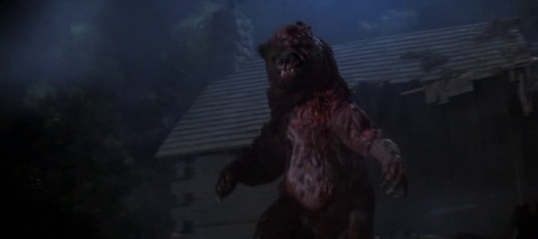
Well, it is until the bear itself actually shows up on screen. That’s when we find ourselves confronted with this:

I mean, don’t get me wrong. He certainly is ugly. But he just looks so silly and …. well, fake.

The lesson here, and it’s an important one, is that you should never put your monster onscreen unless it can actually live up to all the hype. Take a lesson from Spielberg. When it became obvious that the shark in Jaws looked like a tin model, Spielberg made the decision to not show the shark. Instead, he gave us a lot of point of view shots and, by the time the shark did appear, audiences were so frightened that it didn’t matter whether it looked convincing or not. Prophecy makes the mistake of having its monster all over the place and it just doesn’t work.

Of course, once the EPA’s Dr. Robert Verne (Robert Foxworth) shows up with his pregnant wife (Talia Shire, who somehow went from The Godfather and Rocky to this), he discovers that one reason why the Katahdinh doesn’t live up to all the hype is because it’s just a mutant bear. It turns out that all that pollution led to some crazy results and now every logger, Native American activist, and camper in the area is in danger! Can Dr. Verne and a team of disposable, forgettable characters end the threat of Katahdinh!?

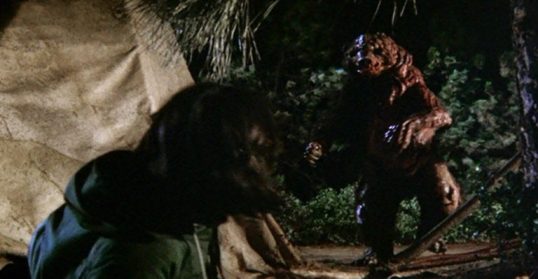
Prophecy is a big, dumb movie that’s never as much fun as you want it to be. There is one early scene that features a camper trying to hop away from Katahdinah while zipped up in a sleeping bag. That scene — which ends with one ruined sleeping back and lot of feathers floating around — is just demented enough to be kind of fun:

Otherwise, the entire film is slow-moving and rather dull. Part of the problem is that it was directed by John Frankenheimer, a major and important filmmaker who had entirely the wrong sensibility for this film. Frankenheimer was a legitimately great director (among his good credits: The Manchurian Candidate, Birdman of Alcatraz, Ronin, Seconds) but he takes the material too seriously. He spends so much time trying to sell the film’s environmental message that he forgets that the majority of the audience for a film like this isn’t watching because they want to become a better person. They’re watching for mutant bear mayhem! This is the type of film that needed to be directed by someone from the Roger Corman school of quick thrills and shameless shlock.

So, here are the twin lessons of Prophecy: know your audience and make sure your monster can live up to its reputation! Otherwise, you’ll just be known for that one scene with the exploding sleeping bag.

Film Review: Rad (dir by Hal Needham)


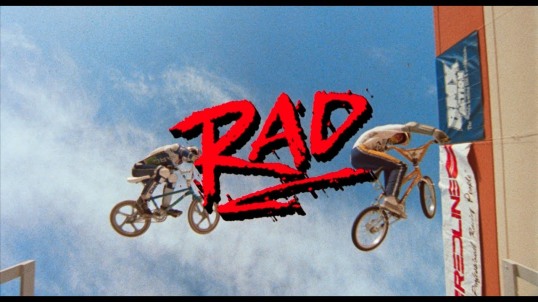
The 1986 film, Rad, tells the story of Christopher “Cru” Jones (Bill Allen).  Cru lives in a small, kind of ugly town in middle America.  Cru has a job delivering newspapers so, every morning, he rides around town on a bicycle and he throws rolled-up copies of USA Today at people.  He throws the papers fairly aggressively and doesn’t seem to have much concern about riding his bike through backyards or using his bike to jump over (or sometimes, onto) cars.  And yet, no one can stay mad at Cru because he has a plucky, can-do attitude and he can do all sorts of tricks on his bicycle.

Cru has a decision to make.  He can either go to college or he can compete in a bicycle race.  If he goes to college, he might actually be able to get a career and actually have a future.  If he wins the bicycle race, he’ll get a car and $100,000.  His mother (Talia Shire) feels that Cru should go to college.  Cru, however, says that his gut is telling him to enter the race….

Hey, Cru, your gut is lying to you!  Seriously, I’m all for Cru competing and showing off how good he is at a rather mundane and kind of boring sport but college is college.  There’s a scene early on in the film where one of Cru’s classmates is talking about all the schools to which he’s applied.  “UCLA, Princeton, SMU, Harvard….” Cru rides by and laughs but, 35 years later, who do you think currently has the nicer house?

Of course, despite his willingness to give up his future for $100,000 and a new car, it turns out that Cru might not even be able to compete.  The race’s evil sponsor (Jack Weston) is determined to make sure that his tea, wins the race and he keeps changing the rules to prevent Cru from being able to enter.  He demands that Cru find an official sponsor so Cru starts his own business.  He then demands that the business be worth at least $50,000!  Cru doesn’t have that type of money but — wait a minute — is that Ray Waltson, playing an eccentric businessman!?  Maybe he’s got $50,000!

Still, does Cru have the confidence necessary to enter the race and beat the best in the country?  Don’t worry, Cru’s little sister designs a t-shirt that reads, “Cru is Rad!”  Seriously, just try to beat that encouragement!

Anyway, you may be thinking that Rad sounds like it’s a pretty silly movie and it is.  Having now watched Rad, BMX Bandits, and Quicksilver, I am ready to announce that, in the 80s, there was absolutely no way to make BMX racing cinematic.  At the end of the movie, Cru performs a series of tricks while the end credits role and, instead of being impressed, you just notice how much Cru is struggling to maintain his balance.  Neither Bill Allen nor Bart Conner (who plays Cru’s main rival) have much screen presence and the whole film just looks and feels cheap.

And yet….

To be honest, it’s difficult to really dislike Rad.  For all of its many flaws, it’s all just so damn sincere.  Cru just wants to win that race so badly that it’s hard not to root for him and it is kind of touching to see the way the entire town rallies around him.  While the lead racers may have been blandly portrayed, Talia Shire, Jack Weston, Ray Waltson, and Lori Loughlin all turn in effective performances.  In fact, you could probably argue that Talia Shire is almost too good in her role.  She so effectively portrays the anguish of a mother watching her son throw his future away that you really do find yourself worrying about what’s going to happen to Cru when he’s older and he can’t get a job because he blew off college.  (I’m going to guess that Talia Shire’s presence in this film is due to the fact that it was produced by her late husband, Jack Schwartzman.)

Rad is sincere and unpretentious and rather silly.  Like a lot of 80s movies, it’s got a good soundtrack.  It especially makes good use of the song Send Me An Angel.  There’s also an out-of-nowhere scene where Cru and Lori Loughlin do a series of impromptu freestyle bike tricks on the middle of a dance floor and it’s just surreal enough to be memorable.

Rad is a simple but inoffensive tribute to throwing your life away.


4 Film Reviews: Bridge To Silence, The Chocolate War, Kiss The Bride, Wedding Daze


Last week, I watched six films on This TV.

Which TV?  No, This TV!  It’s one of my favorite channels.  It’s not just that they show a lot of movies.  It’s also that they frequently show movies that are new to me.  For instance, last week, This TV introduced me to both Prison Planet and Cherry 2000.

Here are four other films, two good and two not so good, that This TV introduced to me last week.

First up, we have 1989’s Bridge to Silence.

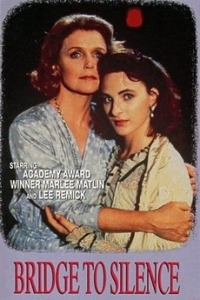
Directed by Karen Arthur, Bridge To Silence was a made-for-TV movie.  Lee Remick plays Marge Duffield, who has a strained relationship with her deaf daughter, Peggy (Marlee Matlin).  After Peggy’s husband is killed in a traffic accident, Peggy has a nervous breakdown.  Marge and her husband, Al (Josef Sommer) take care of Peggy’s daughter, Lisa, while Peggy is recovering.  However, even as Peggy gets better, Marge still doesn’t feel that she can raise her daughter so Marge files a lawsuit to be named Lisa’s legal guardian.  While all of this is going on, Peggy is starring in a college production of The Glass Menagerie and pursuing a tentative romance with the play’s director (Michael O’Keefe).

Bridge to Silence is one of those overwritten but heartfelt melodramas that just doesn’t work.  With the exception of Marlee Matlin, the cast struggles with the overwrought script.  (Michael O’Keefe, in particular, appears to be miserable.)  The film’s biggest mistake is that it relies too much on that production of The Glass Menagerie, which is Tennessee Williams’s worst play and tends to be annoying even when it’s merely used as a plot device.  There’s only so many times that you can hear the play’s director refer to Peggy as being “Blue Roses” before you just want rip your hair out.

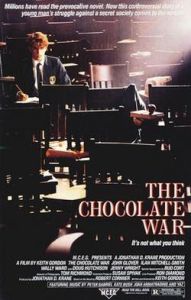
Far more enjoyable was 1988’s The Chocolate War.

Directed by Keith Gordon, The Chocolate War is a satirical look at conformity, popularity, rebellion, and chocolate at a Catholic boys school.  After the manipulative Brother Leon accidentally purchases too much chocolate for the school’s annual sale, he appeals to one of his students, Archie Costello (Wallace Langham), to help him make the money back.  Archie, who is just as manipulative as Leon, is the leader of a secret society known as the Vigils.  However, Archie and Leon’s attempt to manipulate the students runs into a roadblack when a new student, Jerry Renault (Illan Mitchell-Smith) refuses to sell any chocolates at all.  From there, things get progressively more complicated as Archie tries to break Jerry, Jerry continues to stand up for his freedom, and Leon … well, who knows what Leon is thinking?

The Chocolate War was an enjoyable and stylish film, one that featured a great soundtrack and a subtext about rebellion and conformity that still feels relevant.  John Glover and Wallace Langham both gave great performances as two master manipulators.

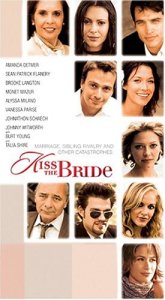
I also enjoyed the 2002 film, Kiss The Bride.

Kiss The Bride tells the story of a big Italian family, four sisters, and a wedding.  Everyone brings their own personal drama to the big day but ultimately, what matters is that family sticks together.  Directed by Vanessa Parise, Kiss The Bride featured believable and naturalistic performances from Amanda Detmer, Talia Shire, Burt Young, Brooke Langton, Monet Mazur, and Parise herself.

I have to admit that one reason why I liked this film is because it was about a big Italian family and it featured four sisters.  I’m the youngest of four sisters and, watching the film, I was reminded of my own big Irish-Italian family.  The movie just got everything right.

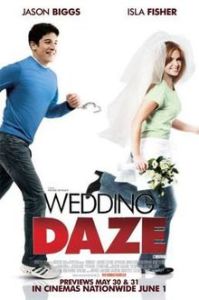
And then finally, there was 2006’s Wedding Daze.

Wedding Daze is a romantic “comedy.”  Anderson (Jason Biggs) asks his girlfriend to marry him, just to have her drop dead from shock.  Anderson’s best friend is afraid that Anderson will never get over his dead girlfriend and begs Anderson to not give up on love.  Anderson attempts to humor his friend by asking a complete stranger, a waitress named Katie (Isla Fisher), to marry him.  To everyone’s shock, Katie says yes.

From the get go, there are some obvious problems with this film’s problem.  Even if you accept that idea that Katie would say yes to Anderson, you also have to be willing to accept the idea that Anderson wouldn’t just say, “No, I was just joking.”  That said, the idea does have some comic potential.  You could imagine an actor like Cary Grant doing wonders with this premise in the 30s.  Unfortunately, Jason Biggs is no Cary Grant and the film’s director, comedian Michael Ian Black, is no Leo McCarey.  In the end, the entire film is such a misjudged failure that you can’t help but feel that Anderson’s ex was lucky to die before getting too involved in any of it.

Music Video of the Day: Nothing To Believe In by Cracker (1996, dir. Samuel Bayer)


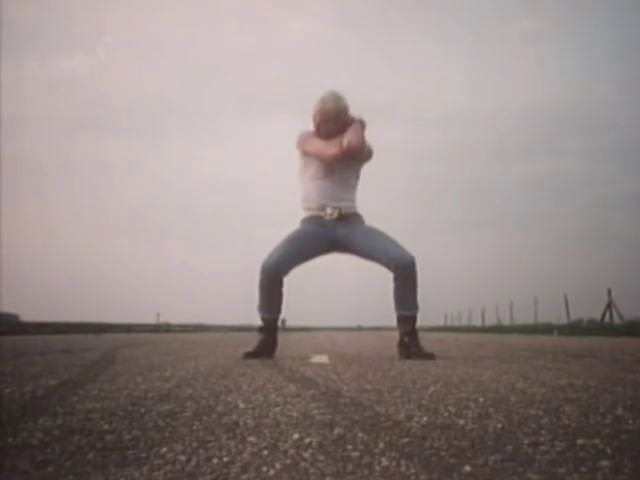
Today’s Harry Dean Stanton video is doubly-sad. That’s because we not only have the recently departed Stanton.

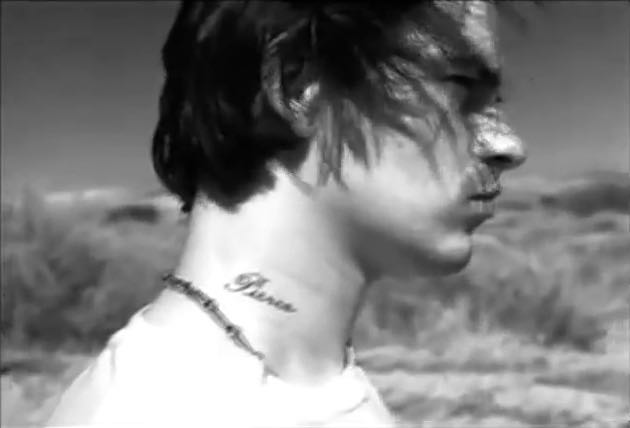
We also have Justin Pierce four years before his suicide. You would know him from Kids (1995).

Talia Shire shows up in the video as well.

I don’t know anyone else in the video other than lead-singer David Lowry. Thank goodness for Wikipedia. I knew of Cracker because of the song Low. I knew of Camper Van Beethoven because of the song Take The Skinheads Bowling. But I would have never noticed that Lowry fronted both bands even though it’s obvious to me now listening to this song and Take The Skinheads Bowling.

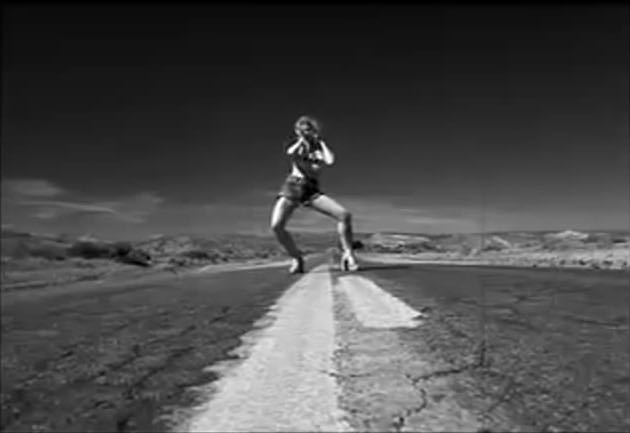
I wish I could at least find out who this lady is…

that is doing her best Rob Halford.

Heading Out To The Highway by Judas Priest (1981)

She is prominently featured, but all I could find is that Harry Dean Stanton did two more music videos than I originally thought. It never fails. I’ll do them as well.

The video was directed by Samuel Bayer of…

Smells Like Teen Spirit by Nirvana fame. Did Lowry ask for the Cobain treatment? In addition, I know Bayer directed Bullet With Butterfly Wings one year prior to this one. Still, was Goth-Stanton something people were clamoring for?

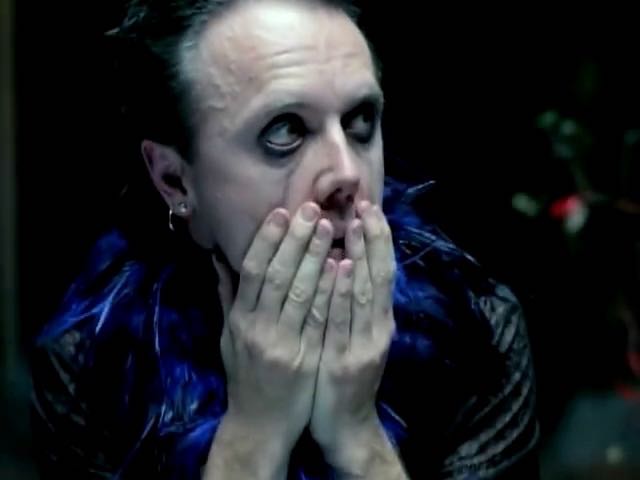
I mean he looks like Lars Ulrich in Until It Sleeps.

Until It Sleeps by Metallica (1996)

Yes, that one was also directed by Bayer. And if you are thinking he probably directed some videos for Garbage and Hole based on the woman I couldn’t identify, then you’d be right.

The casting director on this one was Crystal Lujan. Her music video credits alone are close to 100. She has done some acting too. I guess she was one of the cult members in that unfortunate Clive Barker movie with Scott Bakula, Lord Of Illusions (1995).

Enjoy!

Harry Dean Stanton Retrospective:

  1. Heart Of Stone by Dwight Yoakam (1996, dir. Dwight Yoakam)
  2. Sorry You Asked? by Dwight Yoakam (1996, dir. Dwight Yoakam)

The Measure of a Man: The Life and Career of Rocky Balboa


rocky-and-apollo-02

Have you heard the rumor?

Rocky Balboa, also know as the Italian Stallion and the former heavyweight champion of the world, is going to die.
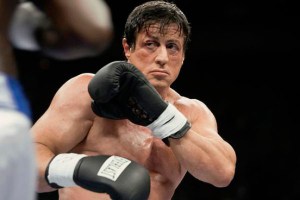
2013Rocky_SylvesterStallone_PA-14110031250713At least that is what some people think after reading the official plot synopsis of the upcoming boxing film Creed.  Here is the press release from MGM and Warner Brothers:

From Warner Bros. Pictures and Metro-Goldwyn-Mayer Pictures comes award-winning filmmaker Ryan Coogler’s “Creed.” The film explores a new chapter in the “Rocky” story and stars Academy Award nominee Sylvester Stallone in his iconic role. The film also reunites Coogler with his “Fruitvale Station” star Michael B. Jordan as the son of Apollo Creed.

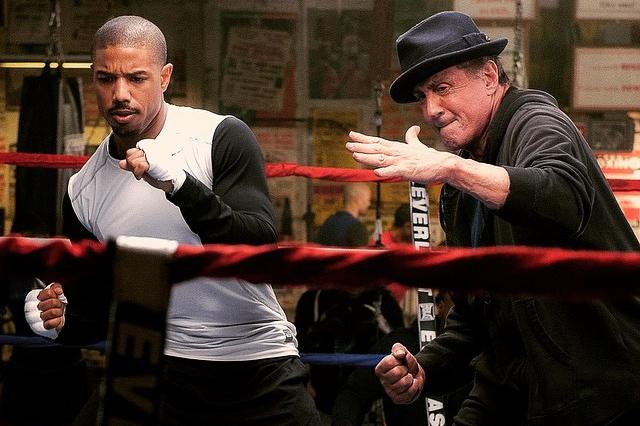
Adonis Johnson (Jordan) never knew his famous father, world heavyweight champion Apollo Creed, who died before he was born. Still, there’s no denying that boxing is in his blood, so Adonis heads to Philadelphia, the site of Apollo Creed’s legendary match with a tough upstart named Rocky Balboa.

Once in the City of Brotherly Love, Adonis tracks Rocky (Stallone) down and asks him to be his trainer. Despite his insistence that he is out of the fight game for good, Rocky sees in Adonis the strength and determination he had known in Apollo—the fierce rival who became his closest friend. Agreeing to take him on, Rocky trains the young fighter, even as the former champ is battling an opponent more deadly than any he faced in the ring.

With Rocky in his corner, it isn’t long before Adonis gets his own shot at the title…but can he develop not only the drive but also the heart of a true fighter, in time to get into the ring?

Sylvester-Stallone-creedMany have interpreted that to mean that, while training Adonis, Rocky will be battling cancer.  With the exception of the first one and Rocky V, every installment in the Rocky franchise has featured a character either dying or coming close.  Since Paulie will apparently not be appearing in Creed, that leaves Rocky himself as the most likely candidate to tragically pass away before or after the big fight.  In death, Rocky would not only pass on his legacy Adonis Creed but Sylvester Stallone would pass on the Rocky franchise to Ryan Coogler and Michael B. Jordan.

With his days possibly numbered, I decided to take a look back at Rocky Balboa’s amazing career.

Rocky (1976)

Sylvester Stallone was just another out-of-work actor when, one night in 1975, he saw a little known boxer named Chuck Wepner go 15 rounds against the reigning heavyweight champion, Muhammad Ali.  Inspired by the fight, Stallone wrote the first draft of Rocky in three days.  When he sold his script, he did so with one condition: that he be allowed to play Rocky Balboa.  You know the rest of the story: Directed by John G. Avildsen, Rocky became a huge box office hitwon the Oscar for best picture of the year, and made Sylvester Stallone into an unlikely star.
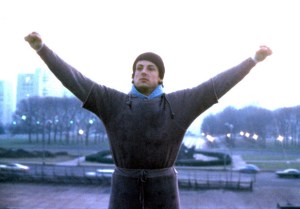
618_movies_rocky_10Rocky Balboa is an aging boxer and a collector for Philadelphia loan shark, Tony Gazzo (Joe Spinell).  The current heavyweight champion, Apollo Creed (Carl Weathers), is scheduled to fight a match in Philadelphia in honor of America’s bicentennial.  When his opponent injures his hand, Apollo decides to give a local boy a chance and the unknown Rocky gets a once-in-a-lifetime shot at the title.  Nobody gives Rocky a chance, except for Rocky.  With the help of grizzled trainer Mickey (Burgess Meredith) and alcoholic best friend, Paulie (Burt Young), Rocky prepares for the fight.  After a training montage (the first of many) that ends with Rocky running up the steps of the Philadelphia Museum of Art, Rocky shocks everyone by going the distance against Apollo.  Though he loses by a split decision, Rocky wins both his self-respect and the love of Paulie’s sister, Adrian (Talia Shire).

Rocky holds up as one of the best boxing movies ever made and it set the standard by which almost all future underdog sports movies have been judged.  Rocky may have ended with Rocky ready to take off his gloves and concentrate on his life with Adrian but the box office demanded that Rocky get another once-in-a-lifetime shot.

Rocky II (1979)

The first Rocky may have ended with Apollo saying there would be no rematch and Rocky replying that he did not want one but the film’s box office success said otherwise.  In Rocky II, Apollo is stung by criticism over how he nearly lost his first fight against Rocky and demands a rematch.  At first, Rocky refuses but, with no prospects and a wife, son, and alcoholic brother-in-law to support, Rocky finally agrees to a rematch.  What follows is largely a repeat of the first film, except this time Rocky has a lot more fans following him through the streets of Philadelphia during his training montage and Rocky actually wins the fight, becoming the heavyweight champion of the world.
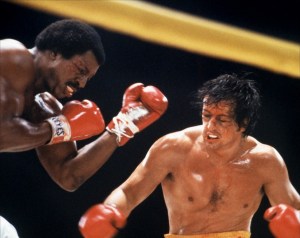
rocky-ii-1979-01-gThe best thing about Rocky II is that it fleshes out the character of Apollo.  No longer is he just the cocky villain from the first film.  Instead, he is revealed to be a proud man, a fierce competitor, and a worthy opponent. Though he may lose the final fight, Apollo regains the respect that he sacrificed as the end of the first film.

Rocky II is also notable for being the first film in the franchise to be directed by Sylvester Stallone.  Stallone would direct all of the subsequent installments, with the exception of the John G. Avildsen-directed Rocky V.

Rocky III (1982)
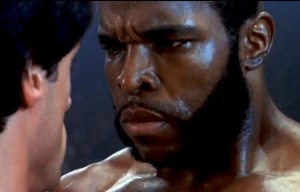
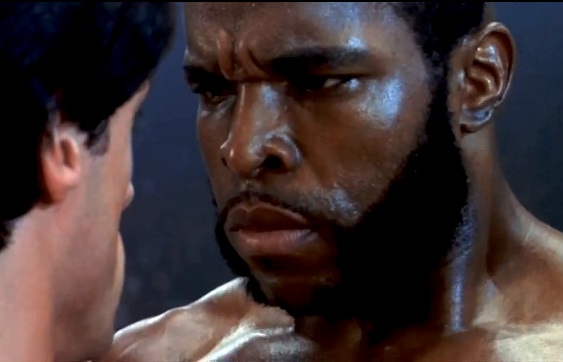
mr-t-plays-clubber-in-rocky-iiiRocky III has the best opening of the franchise.  While Rocky does commercials and trades jokes with Kermit and Miss Piggy on The Muppet Show, Clubber Lang (Mr. T) relentlessly trains and savagely knocks out every opponent that he faces in the ring.  The premise of the first two films has been reversed.  Now, Rocky is the overconfident champion who does not take his latest fight seriously while Clubber Lang is the challenger who is hungry for victory.  Clubber has the “eye of the tiger” and is determined to win.  Rocky is busy doing charity events with Hulk Hogan and bailing alcoholic freeloader Paulie out of jail.

Rocky III features the first death of the franchise, when Clubber shoves Mickey so hard that Mickey ends up having a heart attack and dying almost immediately after Clubber defeats Rocky and becomes the new heavyweight champion of the world.  As if Rocky needed another reason to demand a rematch, Mickey’s death makes it personal.  Unfortunately, Rocky has lost his hunger.  He no longer has the eye of the tiger.

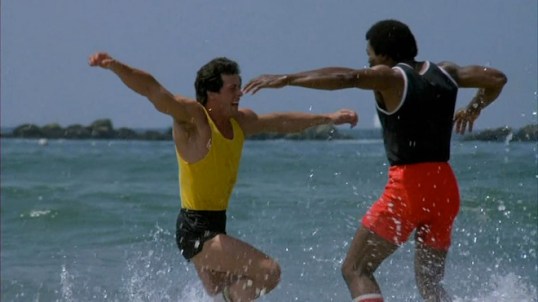
Fortunately, Rocky’s former rival, Apollo Creed, is there to help him get it back.  Taking over as Rocky’s trainer, Apollo gets the former champion back into fighting shape.  This means that it is time for a training montage!  This one ends with a great moment in bromance history as Rocky and Apollo embrace while jumping up and down in the ocean.

2009654-rocky_iii_l_oeil_du_tigre_1983_07_gRocky III ends with what may be the best fight in the history of the franchise.  It is also the only fight to be shown straight from beginning to end, without jumping to future rounds.  From the start of the fight, it is obvious that Clubber is stronger than Rocky but, taking a page from the rope-a-dope strategy that Muhammad Ali used on George Foreman in Zaire, Rocky knows that Clubber is so aggressive that he will tire himself out before the end of the fight.  Once Clubber has exhausted himself, Rocky sends him down to the canvas.

At the end of the film, Rocky and Apollo square off one last time to see who is truly the best boxer.  The film ends before the first punch is thrown and we never find out who won.  I like to think that it was Apollo, if just because I know what is going to happen to him in Rocky IV.

Rocky IV (1985)
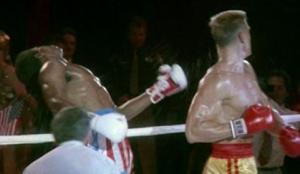
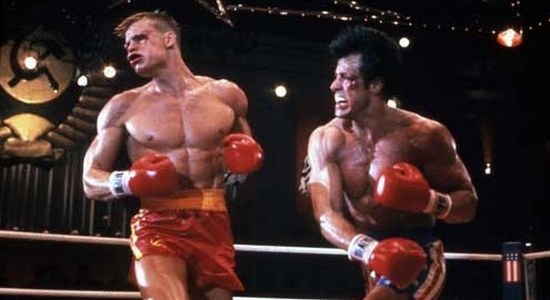
Ivan_kills_ApolloHaving defeated every contender in the U.S., it only made sense that Rocky’s next opponent would come from the evil empire itself, the Soviet Union.  But before Rocky could battle Ivan Drago (Dolph Lundgren), someone had to die.  This installment’s sacrificial victim was none other than Apollo Creed.  Apollo dies in the ring, beaten to death by the robotic Russian.  Of all the deaths in the Rocky franchise, Apollo’s was the most shocking and the most traumatic.  After Apollo falls face forward onto the mat, his body is still twitching even as Ivan says, “If he dies, he dies.”

Knowing that he should have been in the ring instead of Apollo, Rocky challenges Drago to a rematch, to be held in Moscow on, of all days, Christmas.  Leaving behind his mansion, his son, and his robot (yes, Rocky owns a robot in this one), Rocky goes to Siberia and that means that it is time for a training montage!  While Drago trains with machines and shoots steroids, Rocky trains by chopping wood and running in the snow.
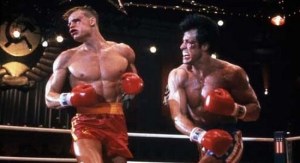
lXRPTbIt’s a tough fight.  At first, Drago does not even seem to feel Rocky’s punches.  The Soviet audience (including someone who looks a lot like Mikhail Gorbachev) chants Drago’s name.  Just like in Philadelphia, Rocky refuses to go down.  The crowd starts to chant Rocky’s name.  When Drago’s manager demands that he win the fight in the name of communism, Drago shouts that he does not fight for the Soviet Union, he fights for himself.  Finally, with seconds left in the final round, Rocky knocks Drago out.
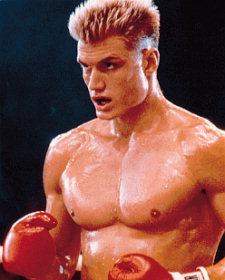
Lundgren_Ivan_DragoAs a bloody Drago looks on, Rocky literally wraps himself in an American flag and gives a speech.  Rocky thanks the Americans and the Soviets for supporting him and then says, “”If I can change, and you can change, then everybody can change!”  Gorbachev stands and applauds.  Is it just a coincidence that, four years later, the Berlin Wall fell and the Cold War ended?

Rocky IV may be the best remembered of all of the Rocky films.  Ivan Drago was Rocky’s greatest and most imposing opponent and it is not surprising that, despite killing Apollo, he still has a strong fan base.  Unlike Clubber Lang, Ivan is a cold and methodical machine.  Rocky’s improbable win over him is not just a victory for America but a victory for humanity as well.

Rocky V (1990)

Is Rocky V canonical?  A lot of fans consider this to be the weakest film in the franchise.  Despite writing the film’s screenplay, Sylvester Stallone reportedly hates Rocky V and ignored it when he made Rocky Balboa.
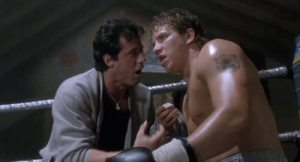
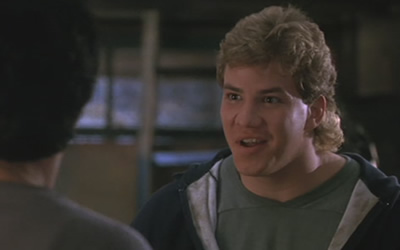
rocky-5Rocky V starts with Rocky retiring after being told that his battle with Drago has left him with permanent brain damage.  Paulie, proving once again that he’s the worst best friend that anyone could hope for, loses all of Rocky’s money.  Rocky, Adrian, and Rocky, Jr. (now played by Sage Stallone) move back to the old neighborhood.  Following in the footsteps of Mickey and Apollo, Rocky trains a mulletheaded young boxer named Tommy Gunn (Tommy Morrison).  Instead of a training montage, we get a fight montage as Tommy becomes a champion but rejects Rocky’s management and signs with Don King George Washington Duke (Richard Gant).  Tommy and Rocky eventually face off in a street fight.  Originally, the plan was for Rocky to die at the end of the fight but, fortunately, someone in production realized that nobody would want to see Rocky Balboa beaten to death by Tommy Morrison.
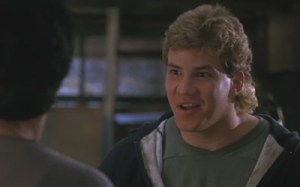
551-3Tommy Morrison was a real-life boxer.  Rocky V was his only film role and he’s almost too convincing as the dim-witted Tommy Gunn.  In the real world, Tommy Morrison was suspended from boxing in 1996 when he tested positive for HIV.  He spent the rest of his life loudly insisting that the test was a false positive and trying to make a comeback.  He was 44 years old when he died of AIDS in 2013.

Rocky V suffers because Tommy Gunn and George Washington Duke cannot begin to compare to great Rocky opponents like Clubber Lang and Ivan Drago.  However, Rocky V does feature one of the franchise’s best endings.  Rocky and Rocky, Jr. jog up the steps of the Philadelphia Museum of Art and, father and son together, they finally decide to enter the building and discover what’s inside.

Rocky Balboa (2006)

After the critical and box office failure of Rocky V, it seemed like Rocky Balboa had retired for good.  However, after 16 years of well-deserved retirement, Rocky followed the path of George Foreman, Larry Holmes, and Riddick Bowe and decided to make a comeback.

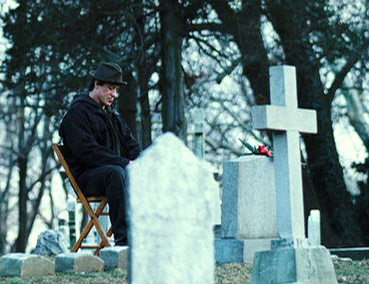
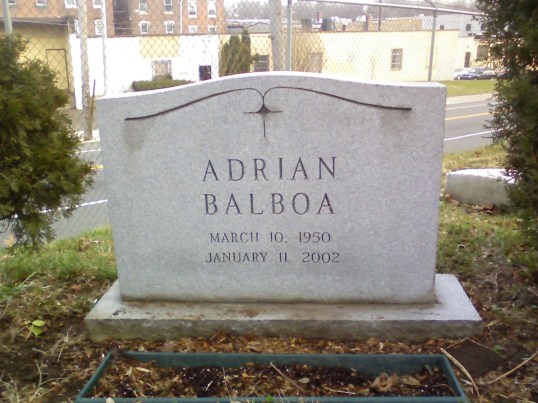
guide_cemeteryAs Rocky Balboa begins, Rocky is a widower and owns an Italian restaurant named Adrian’s, where he spends most of his time telling patrons stories about his fighting career.  He is estranged from his son, who now wants to be called Robert and is played by Milo Ventimiglia, but Rocky still has his best friend Paulie.  If not for Rocky, Paulie would probably be living in a cardboard box.  After a computer simulation suggests that Rocky, in his prime, could have defeated the reigning heavyweight champion, Mason Dixon (Antonio Tarver), Rocky comes out of retirement for one last fight.  With the help of Apollo’s former trainer, Duke (Tony Burton), Rocky proves that he can still go the distance, even though he ultimately loses the fight in a split decision.

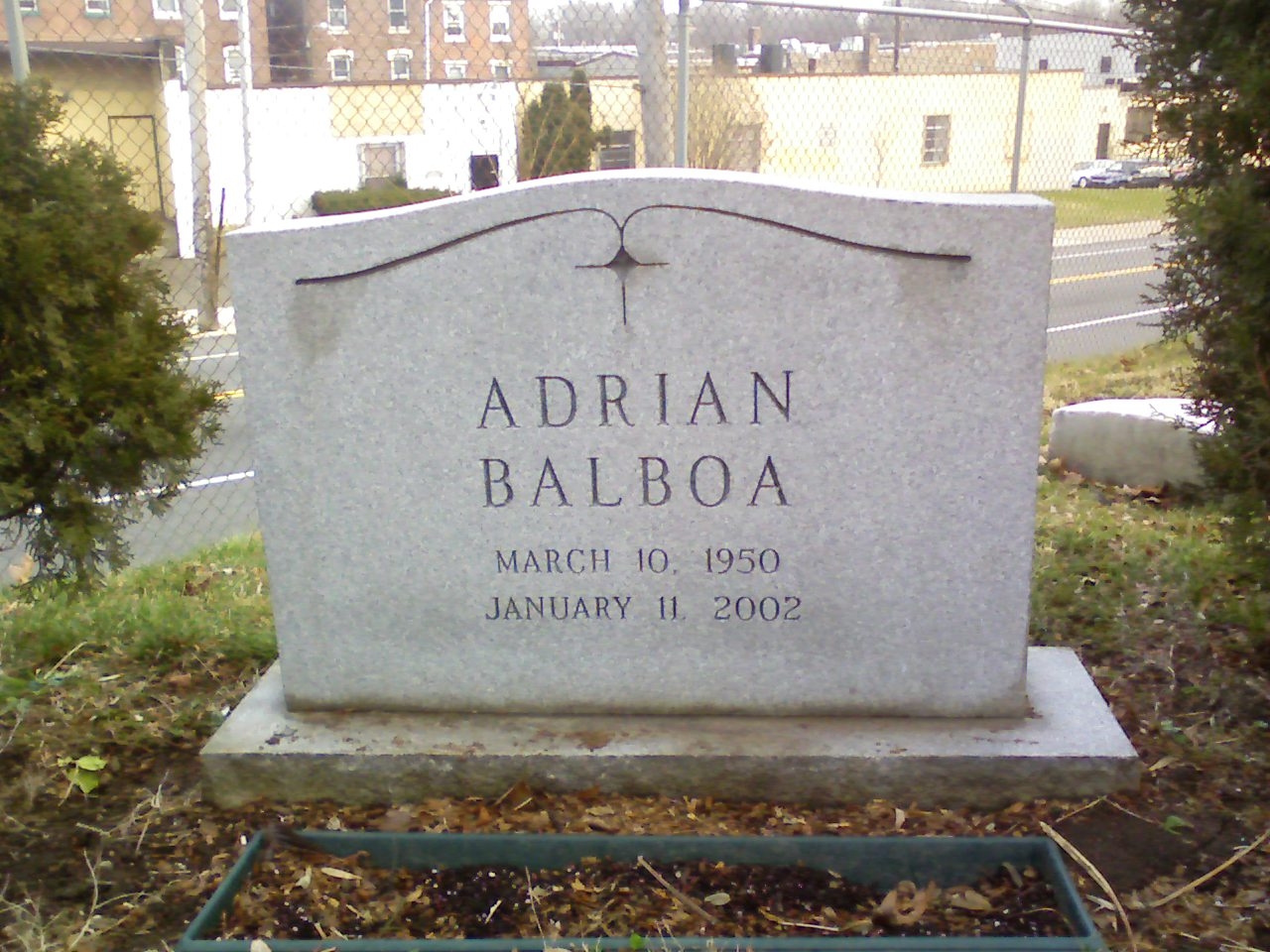
At the start of the film, Adrian has been dead for four years.  However, her ghost haunts the film.  Rocky regularly visits her grave and the film ends with him at her grave and saying, one last time, “Yo Adrian, we did it.”  Stallone may be the battered face of the Rocky franchise but Talia Shire was the heart.  Though she’s only seen in flashback, Rocky Balboa is a tribute to the way that Talia Shire brought Adrian to life.

Sentimental and nostalgic, Rocky Balboa felt like the perfect way to end the franchise.  However, Rocky will be returning for at least one more fight when Creed is released on November 25th.
01070815061

Shattered Politics #53: The Godfather Part III (dir by Francis Ford Coppola)


GodfatherIII2

Well, it’s come to this.

First released in 1990, The Godfather Part III was nominated for best picture (it lost to Goodfellas Dances With Wolves) but it’s got a terrible reputation.  Over the past two weeks, whenever I’ve mentioned that I was planning on reviewing The Godfather and The Godfather Part II for this series of reviews, everyone who I talked to mentioned that they loved the first two Godfather films and that they hated the third one.  Quite a few, in fact, suggested that I shouldn’t even bother reviewing the third one.  In their eyes, The Godfather Part III was like that one cousin who you know exists but, because he got caught cashing your grandma’s social security check, you never send a Christmas card.

But you know what?

It was never even an option for me to skip reviewing The Godfather, Part III.  First off, I’m a completist.  It’s long been my goal to review every single best picture nominee and, regardless of how much some people may dislike it, that’s exactly what The Godfather Part III is.

Plus, I love the Godfather movies.  I’m a fourth Italian (and, much like the Corleones, my Italian side comes from Southern Italy) and I was raised Catholic.  Let’s face it — The Godfather movies were made for me.  Even Part III.

So, with all that in mind, I recently sat down and rewatched The Godfather Part III.  And I’m not saying that it was an easy film to watch.  It’s a flawed film and those flaws are made even more obvious when you compare it to the previous two Godfathers.  It’s hard to follow up on perfection.  And I have to admit that, even though I had seen Part III before, I was still expecting it to be better than it actually was.  I had forgotten just how many slow spots there were.  I had forgotten how confusing the plot could get.  I had forgotten….

Okay, I’m really starting to sound negative here and I don’t want to sound negative.  Because I like The Godfather, Part III.  I think it’s a good but uneven film.  Some of my favorite films are good but uneven…

But this is a Godfather film that we’re talking about here!

The Godfather Part III opens in 1979, 20+ years since the end of the second film.  Tom Hagen has died off-screen (booo!) and Michael (Al Pacino) is nearly 60 and looking forward to retirement.  He’s handed the Corleone criminal empire over to the flamboyant Joey Zasa (Joe Mantegna).  Michael has finally become a legitimate businessman but he’s lost everyone that he loved.  Kay (Diane Keaton) has divorced him.  His son, Anthony (Franco D’Ambrosio), knows that Michael was responsible for killing Uncle Fredo and wants nothing to do with the family business.  Instead, Anthony wants to be an opera singer.  Meanwhile, his daughter Mary (Sofia Coppola) is headstrong and rebellious.  (Or, at least, she’s supposed to be.  That’s what the audience is told, anyway.  None of that really comes across on the screen.)

Now, the first two Godfather films featured their share of melodrama but neither one of them comes close to matching all of the schemes, betrayals, and plots that play out over the course of Godfather, Part III.  Let’s see if I can keep all of this straight:

As the film opens, Michael is receiving an award from the Vatican.  Kay, who is now married to a judge, shows up with Mary and Anthony.  Michael is obviously happy to see her.  Kay glares at him and says, “That ceremony was disgusting!”  (Damn, I thought, Kay’s suddenly being kind of a bitch.  Fortunately, later on in the movie, Kay’s dialogue was both better written and delivered.)

Then, Vincent (Andy Garcia) shows up!  Vincent is one of those handsome, sexy gangsters whose every action is followed by an exclamation point!  Vincent is Sonny’s illegitimate son!  He wears a cool leather jacket!  He openly flirts with his cousin Mary!  He has sex with Bridget Fonda!  He kills Joey Zasa’s thugs!  He convinces Michael to mentor him!

And, as soon as Vincent enters the film, suddenly every scene starts to end with an exclamation point!

And then, Michael goes to Sicily!  He gets swindled by the corrupt Archbishop Gilday (Donal Donnelly)!  He gets targeted by a corrupt Italian politician!  He confesses his sins to Cardinal Lamberto (Raf Vallone)!  Lamberto later becomes Pope!

Meanwhile, Don Altobello (Eli Wallach) is conspiring to kill Michael!  Because that’s what elderly Mafia dons do!  And then Kay, Anthony, and Mary all come to Sicily!  Anthony is going to be making his opera debut!  And soon Vincent is sleeping with Mary, even though they’re first cousins!

And even more people want Michael dead and I’m not really sure why!  Everyone goes to the opera!  We sit through the entire opera!  Meanwhile, enemies of the Corleones are killed!  And some Corleones are killed!  And it all ends tragically!

Okay, I’m starting to get snarky here and it’s probably getting a little bit hard to believe that I actually do like The Godfather, Part III.  And, as much as I hate to do it, there are a few more flaws that I do need to point out.  Sofia Coppola is one of my favorite directors and she has really pretty hair and we both have similar noses but …. well, let’s just say that it’s probably a good thing that Sofia pursued a career as a director and not as an actress.  Reportedly, Sofia was a last minute pick for the role, cast after Winona Ryder suddenly dropped out of the production.  It’s not so much that her performance is terrible as much as it’s not up to the level of the rest of the cast.  Watching this Godfather, you’re acutely aware of how much of what you’re seeing on screen was determined by Sofia’s inexperience as an actress.

And then there’s that opera.  Now, I know that I’m supposed to love opera because I’m a girl and I’m a fourth Italian.  And I do love big emotions and big drama and all the rest.  But oh my God, the opera at the end of the movie went on and on.  There’s only so much entertainment you can get out of watching actors watch other actors.

But, at the same time, for every flaw, there’s a part of the film that does work.  First off, the film itself is gorgeous to look at, with a lot of wonderfully baroque sets and scenes taking place against the beautiful Italian landscape.  Al Pacino brings a very real gravity to the role of Michael and it’s fun to watch him trying to win back Diane Keaton.  (In those brief scenes, The Godfather Part III almost becomes a romantic comedy.)  Talia Shire is obviously having a lot of fun playing Connie as being a Lady MacBeth-type of character.  (In fact, they needed to give Connie a film of her own where she could poison anyone who get on her nerves.)  And Andy Garcia does a great job as Vincent.  You watch him and you never have any doubt that he could be Sonny’s son.

The Godfather Part III may not live up to the first two Godfather films but what film could?

Shattered Politics #36: The Godfather, Part II (dir by Francis Ford Coppola)


Godfather_part_ii

Believe it or not, The Trial of Billy Jack was not the only lengthy sequel to be released in 1974.  Francis Ford Coppola’s The Godfather Part II was released as well and it went on to become the first sequel to win an Oscar for best picture.  (It was also the first, and so far, only sequel to a best picture winner to also win best picture.)  Among the films that The Godfather, Part II beat: Chinatown, Coppola’s The Conversation, and The Towering Inferno.  1974 was a good year.

Whenever I think about The Godfather, Part II, I find myself wondering what the film would have been like if Richard Castellano hadn’t demanded too much money and had actually returned in the role of Clemenza, as was originally intended.  In the first Godfather, Clemenza and Tessio (Abe Vigoda) were Don Corleone’s two lieutenants.  Tessio was the one who betrayed Michael and was killed as a result.  Meanwhile, Clemenza was the one who taught Michael how to fire a gun and who got to say, “Leave the gun.  Take the cannoli.”

Though Castellano did not return to the role, Clemenza is present in The Godfather, Part II.  The Godfather, Part II tells two separate stories: during one half of the film, young Vito Corleone comes to America, grows up to be Robert De Niro and then eventually becomes the Godfather.  In the other half of the film, Vito’s successor, Michael (Al Pacino), tries to keep the family strong in the 1950s and ultimately either loses, alienates, or kills everyone that he loves.

During Vito’s half of the film, we learn how Vito first met Clemenza (played by Bruno Kirby) and Tessio (John Aprea).  However, during Michael’s half of the story, Clemenza is nowhere to be seen.  Instead, we’re told that Clemenza died off-screen and his successor is Frankie Pentangeli (Michael V. Gazzo).  All of the characters talk about Frankie as if he’s an old friend but, as a matter of fact, Frankie was nowhere to be seen during the first film.  Nor is he present in Vito’s flashbacks.  This is because originally, Frankie was going to be Clemenza.  But Richard Castellano demanded too much money and, as a result, he was written out of the script.

And really, it doesn’t matter.  Gazzo does fine as Frankie and it’s a great film.  But, once you know that Frankie was originally meant to be Clemenza, it’s impossible to watch The Godfather Part II without thinking about how perfectly it would have worked out.

If Clemenza had been around for Michael’s scenes, he would have provided a direct link between Vito’s story and Michael’s story.  When Clemenza (as opposed to Frankie) betrayed Michael and went into protective custody, it would have reminded us of how much things had changed for the Corleones (and, by extension, America itself).  When Tom Hagen (Robert Duvall) talked Clemenza (as opposed to Frankie) into committing suicide, it truly would have shown that the old, “honorable” Mafia no longer existed.  It’s also interesting to note that, before Tessio was taken away and killed, the last person he talked to was Tom Hagen.  If Castellano had returned, it once again would have fallen to Tom to let another one of his adopted father’s friends know that it was time to go.

Famously, the Godfather, Part II ends with a flashback to the day after Pearl Harbor.   We watch as a young and idealistic Michael tells his family that he’s joined the army.  With the exception of Michael and Tom Hagen, every character seen in the flashback has been killed over the course of the previous two films.  We see Sonny (James Caan), Carlo (Gianni Russo), Fredo (John Cazale), and even Tessio (Abe Vigoda).  Not present: Clemenza.  (Vito doesn’t appear in the flashback either but everyone’s talking about him so he might as well be there.  Poor Clemenza doesn’t even get mentioned.)

If only Richard Castellano had been willing to return.

Clemenza_and_Vito

Clemenza and Vito


But he didn’t and you know what?  You really only miss him if you know that he was originally meant to be in the film.  With or without Richard Castellano, The Godfather, Part II is a great film, probably one of the greatest of all time.  When it comes to reviewing The Godfather, Part II, the only real question is whether it’s better than the first Godfather.

Which Godfather you prefer really depends on what you’re looking for from a movie.  Even with that door getting closed in Kay’s face, the first Godfather was and is a crowd pleaser.  In the first Godfather, the Corleones may have been bad but everyone else was worse.  You couldn’t help but cheer them on.

The Godfather Part II is far different.  In the “modern” scenes, we discover that the playful and idealistic Michael of part one is gone.  Micheal is now cold and ruthless, a man who willingly orders a hit on his older brother and who has no trouble threatening Tom Hagen.  If Michael spent the first film surrounded by family, he spends the second film talking to professional killers, like Al Neri (Richard Bright) and Rocco Lampone (Tom Rosqui).  Whereas the first film ended with someone else closing the door on Kay, the second film features Michael doing it himself.  By the end of the film, Michael Corleone is alone in his compound, a tyrant isolated in his castle.

Michael’s story provides a sharp contrast to Vito’s story.  Vito’s half of the film is vibrant and colorful and fun in a way that Michael’s half is not and could never be.  But every time that you’re tempted to cheer a bit too easily for Vito, the film moves forward in time and it reminds you of what the future holds for the Corleones.

So, which of the first two Godfathers do I prefer?  I love them both.  If I need to be entertained, I’ll watch The Godfather.  If I want to watch a movie that will truly make me think and make me question all of my beliefs about morality, I’ll watch Part Two.

Finally, I can’t end this review without talking about G.D. Spradlin, the actor who plays the role of U.S. Sen. Pat Geary.  The Godfather Part II is full of great acting.  De Niro won an Oscar.  Pacino, Gazzo, Lee Strasberg, and Talia Shire were all nominated.  Diane Keaton, Robert Duvall, and John Cazale all deserved nominations.  Even Joe Spinell shows up and brilliantly delivers the line, “Yeah, we had lots of buffers.”  But, with each viewing of Godfather, Part II, I find myself more and more impressed with G.D. Spradlin.

Sen. Pat Geary doesn’t have a lot of time on-screen.  He attends a birthday party at the Corleone Family compound, where he praises Michael in public and then condescendingly insults him in private.  Later, he shows up in Cuba, where he watches a sex show with obvious interest.  And, when Michael is called before a Senate committee, Geary gives a speech defending the honor of all Italian-Americans.

G.D. Spradlin as Sen. Pat Geary

G.D. Spradlin as Sen. Pat Geary

But the scene that we all remember is the one where Tom Hagen meets Sen. Geary in a brothel.  As Geary talks about how he passed out earlier, the camera briefly catches the sight of a dead prostitute lying on the bed behind him.  What’s especially disturbing about this scene is that neither Hagen nor Geary seem to acknowledge her presence.  She’s been reduced to a prop in the Corleone Family’s scheme to blackmail Sen. Geary.  His voice shaken, Geary says that he doesn’t know what happened and we see the weakness and the cowardice behind his almost all-American facade.

It’s a disturbing scene that’s well-acted by both Duvall and Spradlin.  Of course, what is obvious (even if it’s never explicitly stated) is that Sen. Geary has been set up and that nameless prostitute was killed by the Corleones.  It’s a scene that makes us reconsider everything that we previously believed about the heroes of the Godfather.

For forcing us to reconsider and shaking us out of our complacency, The Godfather, Part II is a great film.

(Yes, it’s even better than The Trial of Billy Jack.)