Rest in peace, Suzanne Somers. Whether she was mouthing “I Love You” to Richard Dreyfuss in American Graffiti or playing Chrissy Snow on Three’s Company or playing the mother of a blended family on Step ByStep, Suzanne Somers was long a part of our shared pop culture.
In 1991, after having been out of the spotlight for a few years, Suzanne Somers made a comeback with The Thighmaster.
Today, it’s hard to explain just how popular this commercial was in 1991. Adding to its notoriety was that many stations would not play the commercial except as a part of their late night programming. In the days before YouTube and DVRs, people would actually stay up late to catch the Suzanne Somers Thighmaster commercial. For a while, this commercial revived Somers’s career as an actress and a talk show host. Needless to say, it also sold a lot of Thighmasters.
Welcome to Retro Television Reviews, a feature where we review some of our favorite and least favorite shows of the past! On Wednesdays, I will be reviewing the original Love Boat, which aired on ABC from 1977 to 1986! The series can be streamed on Paramount Plus!
Welcome aboard, it’s love!
Produced by Aaron Spelling, The Love Boat is one of the signature shows of the 70s and the 80s. Each week, the Pacific Princess would set off for a different location with a different group of guest stars. Typically, each episode would feature three stories. One story would be silly fun. One story would be a dramedy. And then one story would typically feature a member of the Love Boat crew either falling in love or worrying about losing their job. It was a tremendously silly show but, from the episodes I’ve seen, it was also very likable. If nothing else, the ship looked really nice.
While the passengers changed from week-to-week, the crew largely remained the same. During the show’s first season, the crew was made up of:
Captain Merrill Stubing (Gavin MacLeod), who started out as a stern, no-nonsense captain but who became significantly nicer and a good deal goofier as the series progressed,
Adam “Doc” Bricker (Bernie Kopell), the ship’s doctor who hit on every woman who boarded the boat and who probably would have been an HR nightmare if the show actually took place in the real world,
Gopher (Fred Grandy), the ship’s purser who …. well, I’m not sure what a purser does but hopefully it wasn’t too important of a job because Gopher was always getting into weird situations,
Isaac (Ted Lange), the ship’s bartender who spent the entire cruise getting people drunk,
and Julie (Lauren Tewes), the cheerful cruise director.
And, of course, we can’t forget the true star of the show, the theme song!
Before the series, there were three made-for-television movies: The Love Boat (1976), The Love Boat II (1976), and finally The New Love Boat (1977). These movies served as pilots for the show. The first movie featured an entirely different cast playing the ship’s crew. Kopell, Lange, and Grandy first played their roles in The Love Boat II. MacLeod and Tewes came aboard in The New Love Boat. Unfortunately, these pilots aren’t available on Paramount Plus but, fortunately, the rest of the series is.
So, let’s set sail on a course for adventure with the first episode of The Love Boat!
Episode 1.1 “Captain & The Lady/Centerfold/One If By Land….”
(Directed by Richard Kinon, Stuart Margolin, and Alan Rafkin, originally aired on September 24th, 1977)
The Pacific Princess is about to set sail but all is not right on the cruise ship that some call The Love Boat.
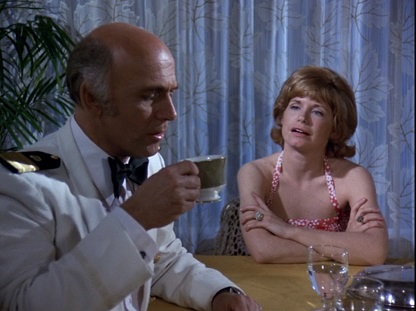
Ginny O’Brien (Brenda Sykes) just wants to get away from her longtime boyfriend, Ronald (Jimmie Walker). Ginny wants to marry Ronald but Ronald just wants to have a good time. When Ginny boards the cruise, Ronald decides to follow her. The only problem is that the cruise is sold out and Ronald can’t break the law by stowing away. (I was actually surprised that didn’t happen. I can imagine The Love Boat writers room descending into chaos as the writers argued about whether or not it was too early to do a stowaway story.) Ronald decides to follow the Love Boat from port to port, just so he can show Ginny that he is committed to something. Ginny ends up spending her entire cruise wondering if Ronald is going to be make it to every port. To me, it felt as if her cabinmate (Suzanne Somers) seemed to be kind of annoyed about getting sucked into all of Ginny’s personal drama but that could just be projection on my part. I know that I would certainly get annoyed by it.
Meanwhile, Congressman Brad Brockway (Shelly Novack) has set sail with his fiancée, Sandy (Meredith Baxter-Birney). When Sandy was younger, she posed for a sleazy photographer. Now that she’s engaged to the Congressman, a tabloid has published those pictures. Sandy spends the entire cruise trying to keep Brad from seeing any copies of the magazine. The only problem is that the magazine is sold in ship’s gift shop! (Did most cruise ships sell adult magazines in their gift shop? I supposed it’s possible. It was the 70s….) Sandy manages to get almost every copy of the magazine but misses the copy that Doc keeps in his examination room. Doc looks at the pictures and tells her that she has nothing to be ashamed of because the pictures look good. That really wasn’t her main concern, Doc. Anyway, it turns out that the Congressman doesn’t care. Personally, I would have preferred that the story had ended with Sandy announcing that she was the one who didn’t care.
Finally, Captain Stubing is a nervous wreck because an executive of the cruise line named Aubrey Skogstad (Robert Symonds) is on the cruise and so is his wife, Stacy (Bonnie Franklin). While Aubrey is quiet and polite, Stacy proceeds to tell every member of the crew that they are inadequate and that she will personally make it her duty to get them all fired. It turns out that Stacy is hostile because she’s Captain Stubing’s ex-wife. Since Captain Stubing is still new to the ship and has kept himself aloof from the rest of the crew, they wonder if he’ll ever stand up for them. Eventually, the captain tells Stacy off and, in doing so, he finally wins the loyalty of his crew. Yay!
Anyway, the first episode of The Love Boat was very, very 70s. The only thing that could have made it more 70s would have been a disco ball on the lido deck. Fortunately, as our long-time readers know, I’m a total history nerd so I enjoyed the show as a floating time capsule. It’s one thing to watch a movie that’s set in the 70s and which features everyone going out of their way to bring to life every stereotype. It’s another thing to actually view something that was specifically made during the time period.
Unfortunately, the stories and the passengers themselves were pretty forgettable. The whole thing about the Stacy and the Congressman was slightly interesting just because, with the rise of social media, everyone’s got smutty pictures out there now. For the most part, though, this first episode was about introducing Captain Stubing and the crew and the cast did display a good deal of chemistry together. They were all likable. Even Doc Bricker, with his stash of cruise porn, seemed to be well-intentioned. They came across as people who most viewers would want to take a cruise with, which is exactly what the show required to be a success.
Next week …. more love, more 70s fashion, and more intrusive laugh tracks as we set sail on another voyage!
Today’s horror on the lens is a made-for-TV movie from 1977. This movie has many different names: Panic at Lakewood Manor, It Happened At Lakewood Manor, and Ants.
Panic at Lakewood Manor is a mix of different genres. It’s a disaster film, a soap opera, and ultimately a revenge-of-nature horror film. The film begins with our cast gathering at Lakewood Manor, a luxury hotel that’s only partially finished. In fact, the owners are so determined to complete construction that they ignore the threat posed by …. KILLER ANTS!
Anyway, this is a made-for-TV movie from the 70s so it’s never as graphic as what we’d expect to see today. That said, I once accidentally stepped on a fire ant mound while I was barefoot and OH MY GOD DID THAT EVER HURT! AGCK!
If you’re a fan of old movies, you’ll enjoy seeing a lot of familiar faces in this one. Even Myrna Loy shows up!
(Incidentally, this film was written by Guerdon Trueblood, who directed the brilliant The Candy Snatchers.)
Now, it may seem strange to think of someone like Billy Jack being appointed to the U.S. Senate. Over the course of the previous three films in the franchise, Billy had been shot in the back, shot in the leg, arrested for murder, convicted of manslaughter, and then shot by the National Guard. In Billy Jack and The Trial of Billy Jack, Billy goes as far as to state that he does not feel the laws of the United States apply to him.
And then, when you consider that the three previous films all featured old, rich, white guys plotting to kill Billy, you would be justified in wondering how he would ever find himself appointed to serve in the senate.
But it happened!
And we’ve got a movie to prove it.
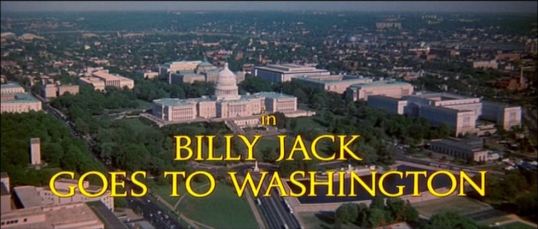
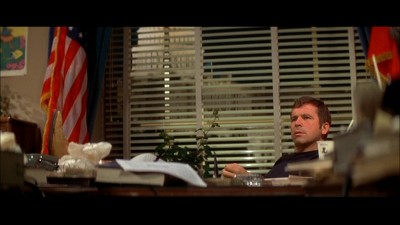
Directed by and starring Tom Laughlin, Billy Jack Goes To Washington is actually a remake of Mr. Smith Goes To Washington.(To the film’s credit, it’s honest enough to actually give credit to Mr. Smith‘s screenwriters in the opening credits.) What’s remarkable is just how faithful a remake Billy Jack Goes To Washington actually is. All the scenes made famous by Jimmy Stewart — the scene where the newest member of the Senate attempts to introduce his first bill, the scene where he’s shocked to discover that Sen. Paine (played here by E.G. Marshall) takes orders from Boss Bailey (Sam Wanamaker), the scene where cynical Saunders (Lucie Arnaz) tells the senator that he should leave Washington, and, of course, that famous filibuster — are all faithfully recreated here. The only difference, of course, is that it’s no longer idealistic Jimmy Stewart proving himself to be incredibly naive about politics. Instead, it’s a former Green Beret, half-Indian, judo master named Billy Jack.
Tom Laughlin was a good actor, which is something that’s often overlooked by reviewers writing about the Billy Jack films. As flawed as The Trial of Billy Jack may have been, Tom Laughlin was a compelling enough presence that the film itself remains a compulsively watchable 3-hour mess. Laughlin had a very authoritative presence. You looked at him and you knew that he knew what he was doing. He was someone who you automatically wanted on your side, a natural born leader who knew how to get things done. However, in Billy Jack Goes To Washington, Laughlin attempts to play Billy Jack as the type of naive neophyte who would be shocked to discover that politicians are corrupt. But surely, after spending three films being harassed by every authority figure in America, Billy would have already realized that. There’s nothing about Laughlin’s screen presence that suggests he could ever be that innocent.
And that’s the main problem with Billy Jack Goes To Washington. For the film to have any chance of working, you have to forget everything that you’ve learned about Billy Jack over the previous three films. However, if you haven’t seen any of the other Billy Jack films, then you probably wouldn’t be watching Billy Jack Goes To Washington in the first place.
Of course, since this is a Billy Jack film, there are a few scenes that were nowhere to be found in Mr. Smith Goes To Washington. For instance, Saunders’s husband is murdered when he threatens to reveal the truth about Bailey’s operation. Later, Billy, Jean (Delores Taylor), and Carol (Teresa Laughlin) are confronted by a gang of Bailey’s assassins and, for the only time in the entire movie, Billy goes through that whole routine where he takes off his boots while slowly speaking and then kicks everyone’s ass. (Jean and Carol get to join in the ass-kicking as well and good for them!)
And, of course, there’s the scene where Billy, Jean, and the kids from the Freedom School (who are apparently now known as Billy’s Raiders) have a meeting with two liberal social activists. It’s an interesting scene because it was clearly unscripted and it has a naturalistic feel to it that’s lacking from the rest of the film. However, that does not mean that it’s a particularly good scene. If I learned anything from Billy Jack Goes To Washington, it’s that self-righteous activists in 1977 were just as boring as self-righteous activists in 2015.
And yet, as I’ve said about all of the other Billy Jack films, I can’t bring myself to be too hard on Billy Jack Goes To Washington. Again, it all comes down to sincerity. It’s clear that Laughlin and Taylor felt they were making a difference with their films and that sincerity comes through in a way that makes Billy Jack Goes To Washington a likable, if rather inept, film.
Billy Jack Goes To Washington ran for a week in one theater in 1977 and was reportedly such a box office disaster that it couldn’t get a wider release. (In a commentary track that he recorded for the film’s DVD release, Laughlin suggests the film was the victim of shadowy government forces.)* While Laughlin and Taylor would later try to make The Return of Billy Jack, that film was left uncompleted at the time of Laughlin’s death. So, the last time that filmgoers would see Billy Jack, he would still be U.S. Sen. Billy Jack.
And really, that’s the perfect ending for the saga of Billy Jack. Starting out as a loner who protected a small California town from a biker gang to eventually becoming the protector of the Freedom School to finally embracing both non-violence and his love for Jean, Billy Jack earned himself a happy ending.
Having now watched and reviewed all four of the Billy Jack films, all I can do is say thank you to Delores Taylor and the spirit of Tom Laughlin. It was great ride.
—-
* To be honest, the commentaries that Laughlin and Taylor recorded for the Billy Jack films are actually very informative and interesting. Laughlin actually had a far better sense of humor than you might guess from some of the movies he directed.
Well, this is certainly intimidating. I know I’ve said this many time before but it deserves to be repeated: it’s often a hundred times more difficult to review a great film than it is to review a merely mediocre one. When a film fails, it’s usually easy to say why. The acting was bad. The directing was uninspired. The plot didn’t make any sense. Or maybe the film has been so overpraised that you, as a reviewer, are almost obligated to be tougher on it than you would be with any other film. However, it’s never as easy to put into words just what exactlyit is that makes a movie great.
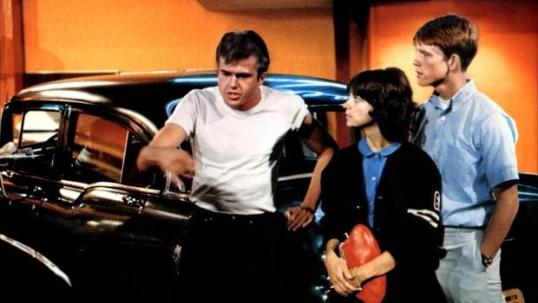
Take the 1973 Best Picture nominee American Graffiti for instance. I could tell you that this is a very well-acted film and that it features an ensemble of very likable performers, many of whom subsequently went on to become stars and celebrated character actors. Then again, you can say the same thing about countless other films.
I could say that director George Lucas does such a good job putting this film together that it’s hard to believe that he’s the same man who would later be responsible for all three of the Star Wars prequels. Then again, I could also say the same thing about how odd it is that the same man who directed the entertaining Final Destination 5was also responsible for the far less enthralling Into The Storm.
I could tell you that the film serves as a valuable time capsule in that not only does it feature a loving recreation of small town America in the early 60s but that it’s also a chance to see what Richard Dreyfuss, Ron Howard, and Charles Martin Smith all looked like when they still had hair. But then again, I also praised The Young Graduates for being a time capsule as well.
Let’s face it — it’s difficult to define the intangible qualities that make a film great. Often times, it’s a case of simply knowing it when you see it. I’ve seen American Graffiti a few times. The last time I saw it was at a special Sunday showing at the Alamo Drafthouse. And, on that early Sunday afternoon, the theater was packed with people who had paid for the chance to see the 40 year-old film on the big screen. I’m 28 years old and it’s significant that, while the majority of the audience was older than me, there were quite a few people who were younger. American Graffiti is one of those films that obviously spoke to audiences when it was first released and continues to speak to audiences today.
As I mentioned in my review of Rebel Without A Cause, films about teens tend to age quickly and, often times, one generation’s masterpiece will turn out to be a later generation’s joke. When a film like Rebel or American Graffiti survives the test of time, it’s because the film has managed to capture a universal truth about what it means to be young and to have your entire life ahead of you.
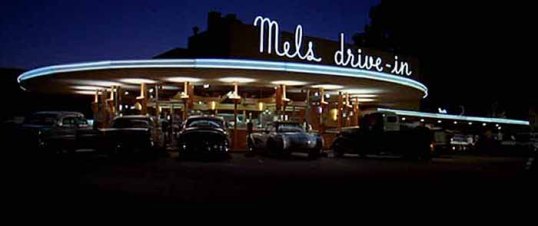
American Graffiti takes place over the course of one long night in Modesto, California in 1962. The film follows several different characters, the majority of whom have just graduated from high school. What these characters all have in common is that one phase of their life has ended and a new one is about to begin. Over the course of that one night, all of them are forced to say goodbye to their past identities and, in some instances, are forced to face their future.
For instance, there’s Curt (an amazingly young Richard Dreyfuss), a neurotic intellectual who spends the night trying to decide whether or not he actually wants to leave for college in the morning. Complicating Curt’s decision is a mysterious blonde who mouths “I love you” at him before driving away. While searching for her, Curt finds himself unwillingly recruited into the Pharoahs, a somewhat ludicrous small town gang that’s led by Joe (played, in hilariously clueless fashion, by Bo Hopkins.) Curt, incidentally, is my favorite character in the film. He’s just adorable, which admittedly is not a reaction that one often has to Richard Dreyfuss.
(Curt is also featured in one of my favorite scenes, in which he smokes a cigarette with a lecherous teacher named Mr. Wolf.)
Curt’s sister (Cindy Williams) is dating Steve Bolander (Ron Howard). Steve is the former class president and, unlike Curt, he’s very excited about leaving home. Ron Howard gives such a likable performance that it actually takes a few viewing to realize just how big of a jerk Steve really is.
And then there Terry (Charles Martin Smith) who wears big glasses and has bad skin. Terry gets to spend the night driving around in Steve’s car and manages to pick up a girl named Debbie (Candy Clark). For Terry, this is his night to actually be somebody and what makes it all the more poignant is just how obvious it is that Terry will probably never get another chance. Though he may not realize it, those of us watching understand that this is literally going to the be the best night of Terry’s life.
(Incidentally, much like Ron Howard, Charles Martin Smith would go on to become a film director and gave the world the amazingly sweet Dolphin Tale.)
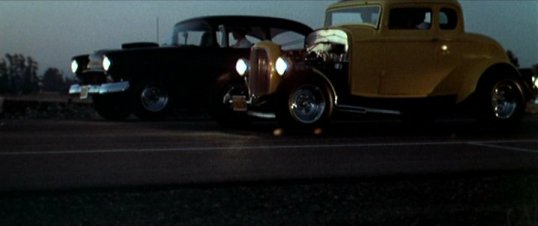
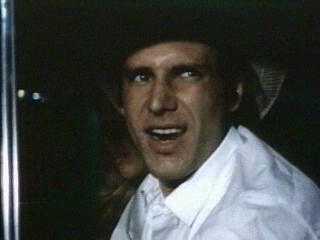
And finally, there’s John Milner (Paul Le Mat). John is a little older than the other main characters. He spends most of his time in his car, driving around and getting challenged to race. He’s the epitome of late 50s/early 60s cool, with an attitude and a look that he obviously borrowed from James Dean and Marlon Brando. Over the course of the night, he is forced to deal with a bratty 13 year-old stowaway (MacKenzie Phillips) and a mysterious challenger named Bob Falfa (played by a youngish Harrison Ford, who wears a cowboy hat and speaks with a country twang).
The film follows these characters through the night and then, at the end of it, we get the famous epilogue where we discover that all of the male characters have pretty much ended up exactly how we thought they would. In some cases, that’s a good thing. And in other cases, it’s not. It’s a good ending that’s kept from being great by the fact that none of the film’s female characters rate so much as even a mention.
So, what else can be said about American Graffiti?





 Through the Shattered Lens