It’s Time For The Annual Self-Important Post About The Year In Film So Far


For the entire past week, something has been nagging at me.  I knew that there was something that I needed to do but I couldn’t remember what it was.  Earlier today, however, I was reading the latest critical blathering about the state of cinema over at AwardsDaily.  As usual, that site’s editors were whining about the fact that the Social Network didn’t win best picture and also the fact that my generation is apparently the “WORST.  GENERATION.  EVER” and blah blah blah. 

Fortunately, however, reading that  post reminded me of what I had forgotten: We are now at the halfway mark as far as 2012 is concerned.  This is the time of year that self-important film critics (both online and elsewhere) tell their readers what type of year it’s been so far. 

So, without further ado — what type of year has 2012 been so far?

(By the way, you can also check out my thoughts from July of 2011 and July 2010 as well.)

(Also, please understand that the act of me posting this in no way guarantees that I won’t change my mind several times within the next hour.)

Best Film Of The Year (So Far): Cabin In The Woods. Compared to both 2010 and 2011, this has been a pretty slow year so far.  There really hasn’t been a Hanna or an Exit Through The Gift Shop type of film so far.  Instead, there’s been a handful of nice surprises, quite a few pleasant but somewhat forgettable films, and then quite a few films that i wish were forgettable.  Cabin In The Woods, however, was a nice little valentine to horror fans like me and it’s a film that actually gets even better with repeat viewings.  Runners up include Bernie, Damsels in Distress, Brave, The Hunger Games, Safety Not Guaranteed, Moonrise Kingdom, For Greater Glory, Jeff, Who Lives At Home, and the Avengers.

Best Male Performance Of The Year (So Far): Jack Black in Bernie.  Runners up include Andrew Garfield in The Amazing Spider-Man and Jason Segal in Jeff, Who Lives At Home.

Best Female Performance of the Year (So Far): Jennifer Lawrence in The Hunger Games.  Seriously, just try to imagine that film with someone else in the lead role.  Runners up include Susan Sarandon in Jeff, Who Lives At Home, Aubrey Plaza in Safety Not Guaranteed, and Greta Gerwig in Damsels in Distress.

Best Voice-Over Performance Of The Year (So Far): Kelly MacDonald in Brave.

Best Ending Of The Year (So Far): A 3-way tie between The Cabin In The Woods, Safety Not Guaranteed, and Jeff, Who Lives At Home.

Best Horror Film Of The Year (So Far): The Cabin In The Woods

Most Underrated Film Of The Year (So Far): The Five-Year Engagement, a sweet and funny movie that was just a tad bit too long.

Best Bad Film of the Year: Battleship.  Yes, the movie represented some of the worst impulses of big-budget filmmaking but I had a lot of fun watching it and Alexander Skarsgard was to die for in that white Navy uniform.

Worst Film Of The Year (So Far): The Wicker Tree.  I could make an argument for both Rock of Ages and The Devil Inside here but no…just no.  As the Trash Film Guru put it, “BURN THE WICKER TREE!”

Biggest Example Of A Missed Opportunity For This Year (So Far): Seeking a Friend For The End of the World.  A great performance from Steve Carrel can’t save a film that has no idea what it wants to be.

The Get Over It Already Award For The First Half of 2012: The Devil Inside, for being the most tedious example of a “found footage” horror film yet.  Coming in second: Rock of Ages, for reminding me that my parents had terrible taste in music.

The Trailer That Has Most Outgrown Its Welcome: The Perks of Being a Wall Flower.  “Be aggressive…passive aggressive…” Okay, shut up, already.

The Cameron/Fincher Bandwagon Trophy (Awarded To The Upcoming Film That, Regardless Of Quality, Will Probably Be So Violently Embraced By People Online That You’ll Be Putting Your Life In Danger If You Dare Offer Up The Slightest Amount Of Criticism): The Dark Knight Rises

The Ebert Award (Awarded to the upcoming film that will probably get  positive reviews based on the film’s political context as opposed to the film itself): Zero Dark Thirty

The Sasha Award (Awarded To The Film That I Am Predicting Will Be The Most Overrated Of The Year): Lincoln.

The Roland Emmerich/Rod Lurie Award For The Film That I’m Predicting Will Be The Worst Of 2012: Honestly, it’s really hard to imagine a worse film than The Wicker Tree (though, to be honest, Rock of Ages comes pretty close). 

Films I’m Looking Forward To Seeing In The Future (An incomplete list): On The Road, Lawless, The Dark Knight Rises, Cosmopolis, Django Unchained, The Hobbit, The Great Gatsby, and especially The Master and Joe Wright’s Anna Karenina.

And there you have it.  2012 hasn’t been a great year so far but there’s still a lot of time left.

Unless, of course, the Mayans were correct.

Film Review: Joe (dir. by John G. Avildsen)


(Warning: This review contains some spoilers.)

On Monday night, my movie before bedtime was an old one from 1970, John G. Avildsen’s Joe.  Though Joe is an occasionally uneven and rather heavy-handed film, it’s also a brutally effective one that I haven’t been able to get out of my mind since watching it.

Joe opens with Melissa Compton (played by Susan Sarandon, in her film debut) and her boyfriend, Frank Russo (Patrick McDermott).  It is quickly established that Melissa is a “rich girl” who has dropped out of society while Frank is a drug dealer.  Frank, incidentally, is probably one of the least likable characters in the history of cinema.  When we first meet Frank, he’s taking a bath but it makes no difference as the character just seems to covered in a permanent layer of grime.  Both Frank and Melissa are also drug addicts.

Patrick McDermott (left) and Susan Sarandon

When Melissa has a drug overdose and ends up in the hospital, Frank doesn’t really care but her father, advertising executive Bill Compton (Dennis Patrick) does.  He promptly goes over to Frank’s apartment and after Frank taunts him by saying that Melissa “had a real hang-up about you,” Bill beats Frank to death in a fit of rage.  Shaken by his actions, Bill goes to a neighborhood bar where he runs into a factory worker named Joe Curran (Peter Boyle).   A drunken Joe rants about how much he would like to kill a hippie.  Bill replies, “I just did.”

This leads to an odd relationship between the two men.  While Bill originally fears that Joe wants to blackmail him, Joe appears to just want to be his friend.  Soon, Joe is introducing Bill to his bowling league and Bill introduces Joe to his colleagues at the advertising firm.  Bill and his wife even have a memorably awkward dinner with Joe and his wife.  Bill’s wife worries that Joe might be dangerous but Bill smugly assures her that he is Joe’s hero.

Meanwhile, Melissa is released from the hospital and moves back in with her parents.  One night, she hears them talking about how Bill killed Frank.  Melissa flees from the apartment and when Bill chases after her, she shouts at him, “Are you going to kill me too!?” before disappearing into the New York night.

Searching for Melissa, Bill and Joe go to various hippie hangouts in Manhattan.  Every hippie they meet tends to be dismissive of the suit-wearing Bill and the uneducated Joe.  However, once Bill reveals that his car is full of drugs that he stole from Frank, the hippies are suddenly a lot more friendly.  A group of hippies take Joe and Bill back to their apartment.  At Bill’s insistence, both of the men smoke weed for the first time and then have sex with two of the hippie girls.  While they’re busy doing it, the rest of the hippies steal their money and all of the drugs.

Suddenly, Joe takes charge of the situation, leaving Bill to watch helplessly as Joe repeatedly slaps one of the girls until she tells them where her friends have gone.  (I’ve seen a lot of movies and I like to think that there’s little I can’t handle watching but the scene where Joe interrogates the girl was genuinely disturbing and I actually had a hard time watching it.  This was largely due to the intensity of Boyle’s performance.)  Joe drags Bill to the commune where the hippies live.  Standing outside the house, as snow falls around them, Joe gets two hunting rifles out of his car and tosses one to Bill before the film reaches its inetivable conclusion. 

Joe With Friend

Like many films released in the early 70s, Joe is distinguished by a continually shifting tone. The film’s opening (which feature Susan Sarandon getting naked and then watching her disturbingly unhygienic boyfriend shooting up) feels almost like it’s composed of outtakes from some lost Andy Warhol Factory film while the scenes immediately following Melissa’s drug overdose feel like a melodramatic Lifetime special.  After Bill kills Frank, the film briefly becomes a Hitchcockian thriller just to then segue into heavy-handed social satire as we watch the development of Joe and Bill’s unlikely, hate-fueled friendship.  The awkward comedy continues for a while until, somewhat jarringly, Joe suddenly becomes a violent revenge film.  While many films have been doomed by the lack of a consistent tone, it actually works here.  Joe‘s odd mishmash of comedy, tragedy, and exploitation actually perfectly reflects the uncertain worldview and hidden fears of Bill Compton.  Much as the audience is often times left uncertain whether they’re watching a comedy or a tragedy, Bill is a man who is no longer sure how to react to the world around him.

And make no doubt about it, Joe may be the title character but the film is truly about Bill Compton.  It’s Bill’s repressed anger (and desire for his own daughter) that fuels the plot.  As played by Dennis Patrick, Bill Compton is the type of smugly complacent figure whose outward confidence hides the fact that he’s been rendered impotent by the world changing around him.  For the majority of the film, Bill looks down on both sides of the cultural divide, looking down on both his daughter’s hippie friends and his new blue-collar acquaintance Joe.  (He assures his wife that Joe would never attempt to blackmail him because Joe “looks up” to him.)  It’s only at the film’s conclusion that Bill realizes just how powerless he is to control anything.  In those final scenes, Dennis Patrick’s face reveals what the audience has already figured out.  By trying to place himself above it all, he’s left himself with nowhere to go. 

Dennis Patrick (left) and Peter Boyle

That said, the film truly is dominated by Peter Boyle’s demonic performance as Joe.  For much of the movie, Joe is a buffoonish figure (he even gets his own mocking theme song “Hey Joe” which plays as he wanders around his house and scratches his navel) and it’s sometimes hard not to feel like you’re watching a long-lost episode of Everybody Loves Raymond where Frank Barone remembers the time that he killed a lot of hippies.  However, once Bill and Joe find themselves searching for Melissa among the hippies, Boyle slowly starts to pull back the layers and a new, far more threatening Joe emerges.  By the end of the film, Joe has become a nightmarish figure and we’re forced to reconsider everything that we’ve previously assumed.  By the film’s end, Joe almost seems to be a direct personification of Bill’s Id, a man who exists solely to force Bill to do what he’s always secretly wanted to do.*

When Joe was first released back in 1970, it apparently made a lot of money, generated a lot of controversy, and even managed to score an Oscar nomination for best original screenplay.  Oscar nomination aside, Joe is the epitome of a well-made and effective exploitation film.  While Joe and Bill are basically counter-culture nightmares of a murderous American establishment, the film’s hippies are portrayed as being so smug and so scummy that I’m not surprised to read that apparently audiences cheered once Joe and Bill started gunning them down.  (Peter Boyle, however, was apparently so shocked that he swore he would never make another film that “glamorized violence.”)  By embracing the best traditions of the grindhouse and attempting to appeal to both sides of the cultural divide in the crudest way possible, the filmmakers ended up making a film that, over 40 years later, somehow feels more honest than most of the other “generation gap” films of the 60s and 70s. 

As any film lover knows, any film made between 1966 and 1978 tends to age terribly, to the extent that often times they’re impossible to take seriously when watched today.  (And anyone who doubts me on this should track down films like R.P.M, Thank God It’s Friday, Skatetown  U.S.A.,  Getting Straight, and Zabriskie Point.)  However, watched today in our present age of Occupiers and Tea Partiers, Joe still feels relevent and, at times, downright prophetic.

—-

* In many ways, Joe Curran is a cruder, balder version of Tyler Durden.

Poll: Which Movie Should Lisa Marie Watch on March 20th?


Anyone who knows me knows that sometimes I just can’t help but love being dominated. 

That’s why, on occasion, I’ll give you, our beloved readers, the option of telling me which film to watch and review.  In the past, you’ve commanded me to watch and review Anatomy of a Murder, Eternal Sunshine of the Spotless Mind, and Logan’s Run

Well, here’s your chance to, once again, tell me what to do.  I’ve randomly selected 12 films from my film collection.  Whichever film gets the most votes will be watched and reviewed by me next Tuesday, March 20th.

Here are the films up for consideration:

1) Black Jesus (1968) — This Italian film stars Woody Strode as an African rebel leader who is captured by his country’s right-wing, American-backed dictatorship. 

2) Capote (2005) — Philip Seymour Hoffman was an Oscar for best actor for playing writer Truman Capote in this film that details how Capote came to write his true crime classic, In Cold Blood.  This film was also nominated for best picture.

3) Chappaqua (1966) — In this underground cult classic, drug addict Conrad Rooks seeks treatment in Switzerland while being haunted by a scornful William S. Burroughs.  This film features cameo from Allen Ginsberg, The Fugs, and just about every other cult figure from 1966.

4) Crazy/Beautiful (2001) — Jay Fernandez and Kirsten Dunst have lots and lots of sex.  This was like one of my favorite movies to catch on cable back when I was in high school. 🙂

5) An Education (2008) — In my favorite movie from 2008, Carey Mulligan is a schoolgirl in 1960s England who has a secret affair with an older man (played by Peter Sarsgaard), who has plenty of secrets of his own.  Co-starring Rosamund Pike, Emma Thompson, Alfred Molina, and Dominic Cooper (who is to die for, seriously).

6) Female Vampire (1973) — In this atmospheric and ennui-filled film from the infamous Jesus Franco, a female vampire spends the whole movie wandering around naked and dealing with the lost souls who want to join the ranks of the undead. 

7) Nightmare City (1980) — In this gory and fast-paced film from Umberto Lenzi, an accident at a nuclear plant leads to a bunch of blood-thirsty zombies rampaging through both the city and the countryside.  Hugo Stiglitz plays Dean Miller, zombie exterminator!  Nightmare City is probably most remembered for introducing the concept of the fast zombie and for serving as an obvious inspiration for Danny Boyle’s 28 Days Later.

8) The Other Side of Midnight (1977) — Based on a best-selling novel, The Other Side of Midnight tells the story of a poor French girl who becomes a world-famous actress and who ends up sleeping with apparently every wealthy man in the world.  Meanwhile, the man she loves ends up marrying Susan Sarandon.  Eventually, it all ends with both a hurricane and a murder.  Apparently, this film cost a lot of money to make and it was a notorious box office bomb.  It looks kinda fun to me.

9) Peyton Place (1957) — Also based on a best-selling novel, Peyton Place is about love, sex, and scandal in a small town.  Lana Turner is a repressed woman with a past who struggles to keep her daughter from making the same mistakes.  At the time it was made, it was considered to be quite racy and it was even nominated for best picture.  This film is a personal favorite of mine and it’s pretty much set the template for every single film ever shown on Lifetime.

10) Rosebud (1975) — From director Otto Preminger comes this film about what happens when a bunch of rich girls on a yacht are taken hostage by Islamic extremists.  The film’s diverse cast includes Peter O’Toole, Richard Attenborough, Cliff Gorman, former New York Mayor John Lindsay, former Kennedy in-law Peter Lawford, Raf Vallone, Adrienne Corri, Lalla Ward, Isabelle Huppert, and Kim Cattrall.

11) Valley of the Dolls (1967) — Oh my God, I love this movie so much!  Three aspiring actresses move to the big city and soon become hooked on pills and bad relationship decisions. Every time I watch this movie, I spend hours yelling, “I’m Neely O’Hara, bitch!” at the top of my lungs.

12) Zombie Lake (1981) — From my favorite French director, Jean Rollin, comes this extremely low budget film about a bunch of Nazi zombies who keep coming out of the lake and attacking the nearby village.  Some people claim that this is the worst zombie films ever made.  I disagree.

Please vote below for as many or as few of these films as you want to.  The poll will remain open until March 20th and whichever film gets the most votes will be watched and reviewed by me.

Happy voting!

A Quickie with Lisa Marie: Wall Street: Money Never Sleeps (Dir. by Oliver Stone)


Sometimes, words escape even me. 

I’ve been trying for about three days now to figure out how to explain why Wall Street: Money Never Sleeps is one of the most disappointing films of 2010.  Notice I didn’t use the term “worst film.”  There’s enough in the movie that works (Michael Douglas is fun to watch as Gordon Gekko and there’s a handful of scenes that perfectly capture the modern atmosphere of financial panic) to keep it from being a truly awful movie.  But just because the movie isn’t awful, that  doesn’t necessarily mean that it’s any good.

Oh, Wall Street — how did you fail?  Let me count the ways.

1) Michael Douglas gives a great performance but he actually has less screen time here than he did in the original Wall Street.  Yes, it’s fun to watch Gekko claw his way back up to the top but, once you take those scenes out of the equation, you still have about 1oo minutes of non-Gekko material to slog through.

2) Instead most of the screen time goes to Shia LeBouf.  Let me repeat that — most of the screen time goes to Shia LeBouf.  In this film, Shia plays a cocky young financial genius.  Let me repeat that.  In this film, Shia LeBouf plays a genius.  Back before Shia became the human face of the Transformers franchise, I’ll admit that I thought he was kinda cute in his geeky, awkward way.  However, in Wall Street, his character isn’t supposed to be geeky or awkward.  He’s supposed to be some sort of financial genius.

3) We’re also supposed to automatically sympathize with Shia LeBouf’s character because, while he’s a part of the system that created the recession, he’s also dedicated to funding some sort of green energy project.  Much like James Cameron in Avatar, Oliver Stone trots out a simplistic environmental theme here and expects to be praised just for mentioning it.  The message is: “Love my film or Mother Earth gets it.”

4) The film’s plot: Shia LeBouf’s mentor and boss — played by Frank Langella — commits suicide after being run out of business by evil millionaire Josh Brolin.  So, Shia takes a job working with Brolin.  Meanwhile, Shia is also engaged to the daughter of Gordon Gekko.  This leads to him taking Gekko on as a mentor.  Shia apparently wants to take Brolin down.  Or does he?  Unfortunately, LeBouf doesn’t seem to know for sure and that comes across in his performance.  As a result, the majority of the film is about as exciting as watching anyone else go to work.

5) Josh Brolin’s the villain here.  We know he’s a villain because everyone else in the film keeps insisting he’s the villain and Brolin plays the role as if he’s auditioning for a role in the next James Cameron film.  Which is to say, Brolin gives a dull and lifeless performance.

6) The little guy who is creating this alternate source of energy that Shia is so obsessed with?  The little guy is played by Austin Pendleton who, I swear to God, is one of the most annoying character actors ever.  Seriously, Pendleton, stop fucking smiling all the time! 

7) Having seen both this and the original Wall Street, I can now say that I have no idea how the stock market works and I really don’t care to learn.  I just want everyone to stop yelling and throwing paper all over the place.  Seriously, Stone tries to make the “market” scenes exciting here but, once you get over the fact that Stone knows how to use a zoom lens, they’re pretty dull.  Lucio Fulci and Jean Rollin — they would have found a cool way to film those scenes.  Stone just resorts to the same old tricks.

8) That little smiley face looks so cute with his sunglasses on.

9) As with the original Wall Street, this is yet another film about little boys and their daddy issues.  Which father figure will Shia choose?  Meanwhile, Shia’s mother (a grating performance from Susan Sarandon) and his girlfriend (Carey Mulligan) are portrayed as total fools.  Mulligan, after her performance in An Education, especially deserve better than to be stuck playing some sexist fantasy of a human being.  Sarandon is blamed for the housing collapse while Mulligan’s character is cheated out of a fortune towards the end of the film.  The message here, I guess, is don’t let women have money because we’ll just fuck everything up.  I love how I can always count on “progressive” filmmakers to prove themselves to be a bunch of pigs at heart.

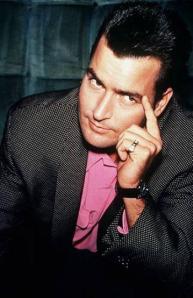
10) Charlie Sheen shows up for a really awkward cameo.  He’s supposed to be playing his Bud Fox character from the original film but, watching his performance, you get the feeling that Charlie doesn’t remember being in the original film.  Showing up at a charity dinner with a separate date on either ar, Bud Fox is presented as being just as corrupt as Gordon Gekko.  Michael Douglas, quite frankly, looked somewhat embarrassed by the whole scene.  However, as awkward as the scene was, it did manage to perfectly capture the theme of this movie:

Eventually, even Bud Fox will grow up to be Charlie Sheen.