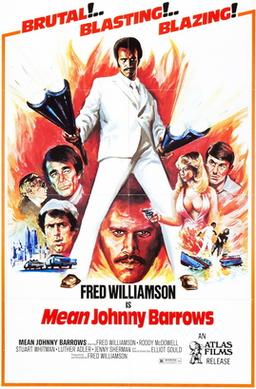
“Dedicated to the veteran who traded his place on the front line for a place on the unemployment line. Peace is Hell.”
— the end credits of Mean Johnny Barrows (1976)
“He’s not that mean.”
— Me, while watch Mean Johnny Barrows
Who is Johnny Barrows? As played by blaxploitation star Fred Williamson, Johnny Barrows is a former football great who later served in Vietnam and won several silver stars. As a soldier, he killed an untold number of people but he is always quick to explain that he wouldn’t do the same thing as a civilian. Even after the war ended, Johnny remained in the army, teaching new recruits. He was good at his job but, one day, a racist officer decided to play a stupid trick on Johnny. During a training exercise, that officer put a live landmine out on the training grounds. After defusing the mine, Johnny promptly punched the officer. The result? A dishonorable discharge and the lesson that peace is Hell.
Johnny returns to Los Angeles and discovers that the country he fought for isn’t willing to fight for him. Because of his dishonorable discharge, Johnny can’t find a good job. Because he can’t find a job, he can’t afford a place to live. Johnny stays on the streets. His only friend is a self-described philosophy professor (Elliott Gould, in an amusing cameo) who teaches Johnny all about soup kitchens.
When Johnny steps into an Italian restaurant and asks for food, he is shocked to discover that the owner, Mario Racconi (Stuart Whitman), knows who he is. Mario says that he played against Johnny in a high school football game. (Perhaps Johnny’s shock is due to the fact that Mario appears to be at least ten years older than him.) Mario gives Johnny something to eat and even offers him a job. Realizing that the work is mob-related, Johnny says that he’s not interested. He’s not going to break the law…
And here’s where we run into a problem with the film’s title. The film is entitled Mean Johnny Barrows but, so far, he’s been almost painfully nice. Then again, Mild Johnny Barrows doesn’t have much of a ring to it.
Anyway, Johnny does try to stay out of trouble. He even manages to land a demeaning job cleaning the toilets at a gas station. But his boss (R.G. Armstrong) is a real jerk and Johnny has his dignity, no matter how much the world wants to take it away from him. Finally, Johnny agrees to work with the Racconi Family. Not only does he become friends with Mario but he also falls for Mario’s girlfriend, Nancy (Jenny Sherman).
Unfortunately, not all Mafia families are as kind-hearted and generous as the Racconi Family. The Da Vinci family wants to flood Los Angles with drugs. It’s all the master plan of Tony Da Vinci (Roddy McDowall). Tony is eager to prove himself to his father and what better way to do that than to smuggle heroin? Tony also loves flowers because … well, why not? Anyway, when the Racconis object to Tony’s scheme, a mob war erupts. Nearly all of the Racconis are killed. It looks like it’s time for Johnny Barrows to put on his white suit, pick up a gun, and get vengeance for his surrogate family.
There are some pretty obvious problems with Mean Johnny Barrows, not the least of which is the casting of Roddy McDowall — perhaps the least Italian actor in the history of cinema — as a ruthless mafioso. After having starred in several successful blaxploitation films, Fred Williamson made his directorial debut with Mean Johnny Barrows. Williamson’s inexperience as director shines through almost every minute of Mean Johnny Barrows. Though he does well with the action scenes, there are other parts of the film where Williamson doesn’t even seem to be sure where he should point the camera. With almost every role miscast, the performances are pretty inconsistent but Williamson gives a good performance (it’s obvious that he understood his strengths and weaknesses as an actor) and Elliott Gould is an entertaining oddity as the Professor.
If anything saves the film, it’s that Williamson’s anger at the way America treats its veterans feels sincere. The heart of the film is in the first half, which details Johnny’s struggle to simply survive from one day to the next. Even if Williamson’s direction is often shaky, the film’s rage is so authentic that you do get caught up in Johnny’s story. The film ends on a properly down note, suggesting that, for men like Johnny Barrows, there is no hope to be found in America.
To quote the film’s theme song: Peace is Hell.

 The year is 1874 and James Otis (Charles Bronson) is traveling through the Dakota Territory. Everywhere that James Otis goes, someone tries to shoot him. This is because James Otis is actually the infamous Wild Bill Hickcock and everyone this side of Deadwood has a reason to want him dead. Hickcock has returned to the territory because he is losing his eyesight and he fears that he may be dying. Hickcock has been having nightmares about a giant albino buffalo and believes that it is his destiny to either kill it or be killed himself.
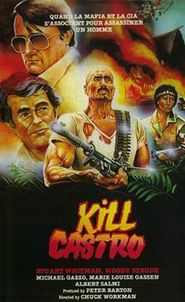 One of my earliest memories of staying up late and watching cheesy movies on local television was the sight of Robert Vaughn standing on a beach and cursing, “Damn you, Kennedy!” An echo effect kicked in, making the line: “Damn you, Kennedy Kennedy Kennedy Kennedy Kennedy!”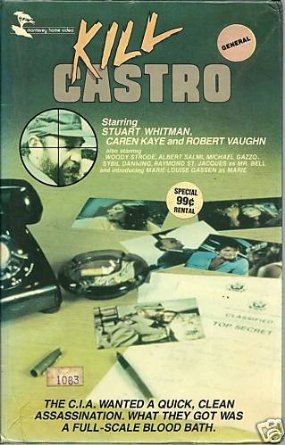

 Through the Shattered Lens