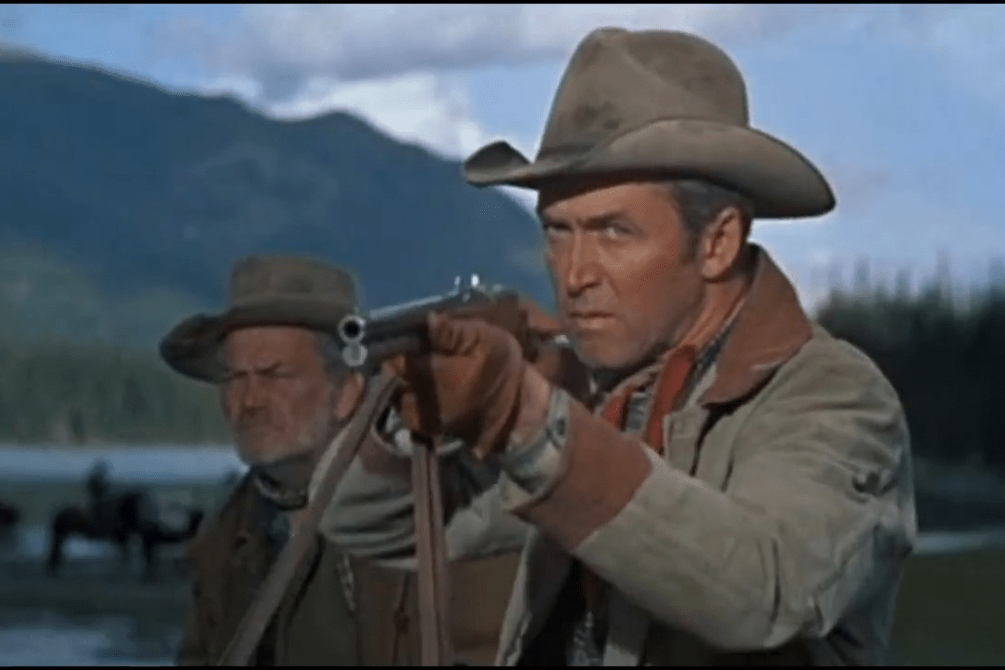
THE FAR COUNTRY (1954) – James Stewart and Walter Brennan head North to make their fortune!


James Stewart is one of the great movie stars of all-time. His work with Frank Capra (MR. SMITH GOES TO WASHINGTON, IT’S A WONDERFUL LIFE) and Alfred Hitchcock (REAR WINDOW, VERTIGO) is legendary. In my household, Stewart’s work with director Anthony Mann is celebrated just as much as those other classics. Mann and Stewart made five classic westerns, beginning with WINCHESTER ‘73 in 1950 and ending in 1955 with THE MAN FROM LARAMIE. I own them all on DVD and watch them quite often. It’s very cold in Arkansas today, so I decided to write about the Yukon-set THE FAR COUNTRY, from 1954. 

Jeff Webster (James Stewart) and his crusty ol’ coot of a partner Ben Tatem (Walter Brennan) head North towards Dawson City, in the Yukon Territory, with a herd of cattle. The two men encounter a variety of problems along the way, with the biggest being the corrupt Judge Gannon (John McIntire) of Skagway, Alaska. When Jeff finds himself in front of the judge for killing two cowhands who tried to steal his herd, Gannon acquits him on the charges but decides to keep his herd as payment for the court fees. With their cattle taken away from them, Jeff and Ben sign up to help business lady Ronda Castle (Ruth Roman) take supplies to Dawson City, where she plans to set up shop. After their first day on the trip, Jeff and Ben double back to Skagway and re-take their herd and take off towards Dawson as fast as they can go, with Gannon and his men in hot pursuit. They’re able to make it into Canada, so Gannon and his goons turn back, determined to hang the men if they ever come back through Skagway.

So Jeff and Ben make it to Dawson City with their cattle where they sell them off for $2 per pound to Ronda. Suddenly flush with cash, the two partners buy a gold claim and proceed to find some nice golden nuggets! When they head back into town, they find that Judge Gannon has now come to Dawson City and is in partnership with Ronda. Of course, that bastard immediately starts cheating the miners out of their claims, this time with gunman Madden (Robert J. Wilke) by his side, enforcing his corrupt actions with lead. Jeff and Ben decide they’re going to sneak out of town with their loot, but Gannon finds out about it and sends his men to stop them. Ben is killed in the process and Jeff is seriously injured. Jeff has tried his best up to this point to not get involved with the mess in Dawson City, but with his best friend now dead, he decides it’s time for Judge Gannon and his thugs to be stopped. 

James Stewart is just so good as Jeff Webster. The best thing about his work with Mann is how each of the movies would give him a meaty role that capitalized on his basic decency, while simultaneously making him a more complex, layered man, miles away from the likes of Mr. Smith or George Bailey. In THE FAR COUNTRY, he’s as tough as nails, but he really doesn’t want to get involved with the people around him. It takes the death of his best friend for him to finally commit to helping them stand up against the bad guys. Stewart’s work here, and in the other Mann westerns, ranks with his very best. 

The remainder of the cast is uniformly excellent. Three time Oscar winner Walter Brennan is always a welcome presence in a movie I’m watching. While he’d pretty much settled into the “old coot” role that would come to personify the later part of his career, his character is a valuable conscience for Stewart a couple of times in the story. I thought that John McIntire and Ruth Roman really stood out in their respective roles as the corrupt Judge Gannon and the stubbornly, independent businesswoman Ronda Castle. Both give excellent performances. The cast is rounded out with a who’s who of character actors like Jay C. Flippen, Harry Morgan, Robert J. Wilke, Royal Dano, and Jack Elam. It’s always nice seeing these familiar faces pop up in these old westerns.

I love it when movies are filmed on location in beautiful places. THE FAR COUNTRY was filmed at the Jasper National Park in Alberta, Canada, which added another interesting element to the film. The final thing I want to say about the film is that the screenplay for THE FAR COUNTRY was written by Borden Chase, who had penned RED RIVER a few years earlier. Not only would Chase write this movie, he would also write the screenplays for WINCHESTER ‘73 and BEND OF THE RIVER, both westerns that paired Anthony Mann and Jimmy Stewart. Chase was an excellent writer of western material, and his strong work in this group of films is crucial to their enduring success. 

Overall, I confidently recommend THE FAR COUNTRY to any person who enjoys westerns or Jimmy Stewart. I might rank THE NAKED SPUR and THE MAN FROM LARAMIE slightly above this one in the Mann / Stewart westerns, but the truth is that you can’t go wrong with any of them. 

I’m sharing the trailer for THE FAR COUNTRY below:
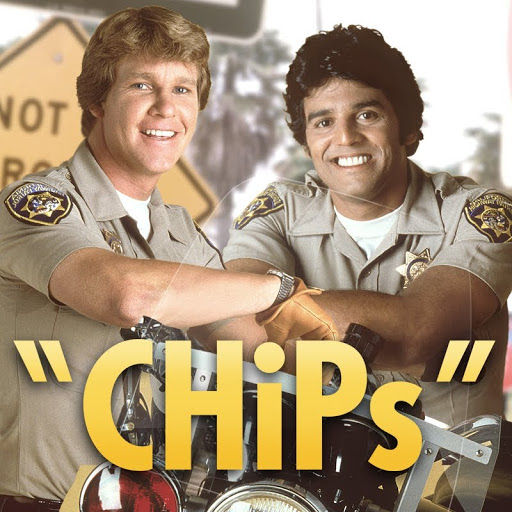
Late Night Retro Television Review: CHiPs 2.19 “Bio-Rhythms”


Welcome to Late Night Retro Television Reviews, a feature where we review some of our favorite and least favorite shows of the past!  On Mondays, I will be reviewing CHiPs, which ran on NBC from 1977 to 1983.  The entire show is currently streaming on Freevee!

This week, it’s all about bio-rhythms!

Episode 2.19 “Bio-Rhythms”

(Dir by Don Weis, originally aired on February 17th, 1979)

The Davis family is back!

Now, if you don’t remember the Davises. they were the family of independent truckers who appeared in an episode called The Volunteers.  Patriarch Charley Davis (Tige Andrews) is taciturn and protective.  Their friend, Sam (Steve Franken), is taciturn and protective …. actually, to be honest, he and Charley are kind of interchangeable.  Daughter Robbie (Katherine Cannon) is in charge of the business and is being pressured by another trucker (Michael Conrad), who is willing to resort to sabotage to keep Robbie from making her deliveries.  It’s a good thing that Robbie has got Ponch on her side!

Technically, Robbie also has Baker on her side but this is definitely a Ponch episode.  Baker is present but he does very little.  Instead, it’s Ponch who flirts with Robbie.  It’s Ponch who stops by Robbie’s apartment and uses her shower.  It’s Ponch who spends an extended period of time wearing just a towel.  Somewhat inevitably, Charley shows up around the same time that Ponch steps out of the shower.  Ponch is kicked out of the apartment and his clothes are tossed out the window.  Ponch loses his towel while retrieving his clothing.  Cue the close-ups of an old woman staring at him with a impressed look in her eyes and Erik Estrada flashing his Estrada smile.  It’s not that Erik Estrada wasn’t nice to look at.  It’s just that he was so obviously aware that he was nice to look at that the whole scene ends up feeling rather smarmy.  One gets the feeling that there was a clause in Estrada’s contract specifying that he, and only he, would be allowed to show off on the show.

While Ponch helps Robbie deal with her rivals, he also learns about biorhythms, the pseudo-science that says that, by calculating how long someone’s been alive, it can be determined which days are going to be good for them and which days are going to be bad.  Sindy Cahill is doing a study on biorhythms for her master’s degree.  Getraer tells his squad that the department is also very interested in whether or not biorhythms effect an officer’s productivity.  Baker is skeptical about biorhythms but Ponch believes in them and even buys a biorhythm calculator.

Believing the Baker’s biorhythms have him at peak physical perfection, Ponch arranges for Baker to play handball against Getraer.  Ponch even takes bets.  Unfortunately, Ponch spent so much time figuring out Baker’s biorhythms that he never stopped to consider Getraer’s.  The episode ends with Getraer on his way to victory and Baker looking embarrassed.

Handball?  Biorhythms?  Corrupt labor unions?  Could this episode be more Californian?

This episode was fairly dull.  A huge problem was that the Davis family and their drama are never as interesting as the show seems to think that they are.  Much as with The Volunteers, I felt like I was watching a backdoor pilot for a show about the Davises when I really just wanted to watch a show about the Highway Patrol.  This episode didn’t do much for me.  Maybe everyone’s biorhythms were off when they filmed it.

Late Night Retro Television Review: CHiPs 2.2 “The Volunteers”


Welcome to Late Night Retro Television Reviews, a feature where we review some of our favorite and least favorite shows of the past!  On Mondays, I will be reviewing CHiPs, which ran on NBC from 1977 to 1983.  The entire show is currently streaming on Freevee!

This week, we’ve got ourselves a convoy!

Episode 2.2 “The Volunteers”

(Dir by John Florea, originally aired on September 23rd, 1978)

After a high-speed chase causes a robbery suspect to crash his car into a chemical storage facility (which subsequently explodes), three truckers have to get their trucks full of chlorine gas to the next available facility.  Unfortunately, it’s a 170-mile drive over rough terrain and it’s a very hot day.  If the gas gets to hot, it’ll explode.  If It doesn’t get to the storage facility in time, it’ll explode.  In fact, it appears that just about anything can make chlorine gas explode.  Californians might love chlorine for their pool but they don’t want it in the air.

Getraer assigns Ponch, Baker, Baricza, and Jane Turner to escort the trucks to the facility.  Jane Turner (Rana Ford) is a new member of the highway patrol.  She drives a squad car and she’s the first woman and only the second black person who we’ve seen working for the highway patrol on this show.  She doesn’t really do much in this episode and, about halfway through, she breaks off from the main group to help deal with a highway pile-up.  For that matter, Getraer and Baricza end up vanishing as well.  As usual, it’s all on Ponch and Baker.

Despite the danger of a chemical spill killing the population of Los Angeles county, Ponch spends most of this episode trying to get laid.  The episode opens with him leering at a jogging stewardess (Anna Upstrom) and then bragging about how he has a date with her later that night.

“She doesn’t smoke, drink, or dance,” Ponch says.

“What are you two going to do?” Baker earnestly asks.

Ponch arches his eyebrow and grins.

But Ponch is soon distracted by one of the truck drivers, a woman named Robbie Davis (Katherine Cannon), who is quick to yell that not only can she drive a truck but she can vote as well.  Ponch arches his eyebrow and grins.  Baker gets in on the action by saying, “Prettiest little truck driver I’ve ever seen.”

Robbie’s father (Tige Andrews) and the other trucker (Sam Brodie) all totally think Robbie should hook up with Ponch but they’re still amused when, late in the episode, Ponch accepts a ride from a blonde in a convertible.  Ponch arches and eyebrow and grins as he gets in the car.  WE GET IT, PONCH!

It’s not easy transporting chlorine gas.  Along with rough desert terrain, there’s also a group of beer-drinking rednecks who drive by in a pickup truck and threaten to shoot one of the tanks.  All of that drunk driving leads to another multi-car pile-up.  For some reason, one of the vehicles in the pile-up was transporting a tiger, which promptly gets loose and enters a grocery store.  Ponch and Baker grab raw meat from the butcher’s station and use it to trick the tiger into entering an office.  After they shut the door, the owner of the store yells at them for wasting meat.  There’s also a town puts up a roadblock to keep the trucks from coming through because they don’t want chlorine gas getting into the air.  And then there’s an avalanche, which causes chlorine gas to leak out of Robbie’s truck, sending her to the hospital.

Considering everything that happens in this episode, it’s odd that it all feels rather boring.  The best episodes of CHiPs focus on fast motorcycles and beautiful scenery.  This episode featured slow-moving trucks and the desert.  Bleh.  I hate the desert.  This episode also featured a lot of interaction between Robbie, her father, and their friend.  In fact, they were so prominently featured that it wouldn’t surprise me if this episode was meant to be a backdoor pilot for a trucking show.  (This episode aired in 1978, which was a big year for trucker movies.)  But the Davis family just wasn’t that interesting.

This episode didn’t really capture my attention.  Hopefully, next week will see a return of fast bikes and nice scenery.

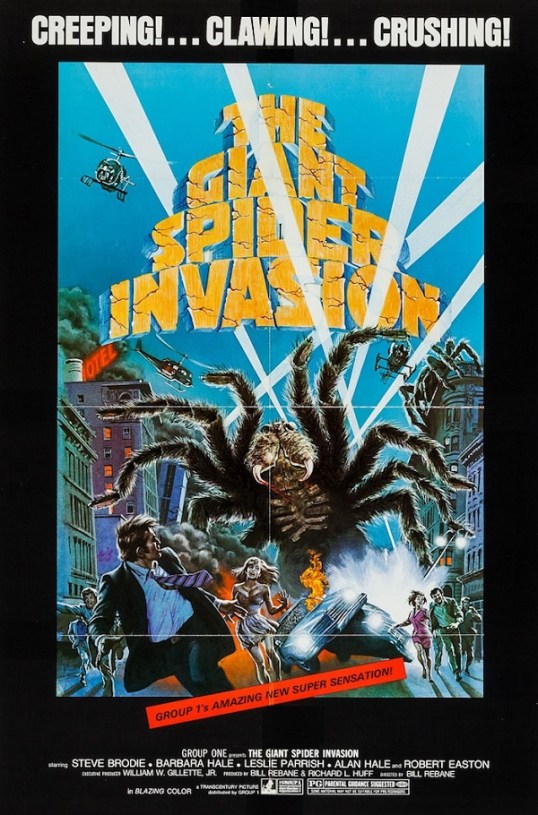
Horror on the Lens: The Giant Spider Invasion (by Bill Rebane)


For today’s Horror on the Lens we have the 1975 classic, The Giant Spider Invasion!

Directed by Wisconsin’s own Bill Rebane, The Giant Spider Invasion works specifically because it delivers exactly what the title promises.  The title says that you’re going to see giant spiders invading the Earth and that’s exactly what happens!  And, as someone who cannot stand spiders, I can only say, “AGCK!”

This is a fun movie.  Sadly, I don’t think it would be as entertaining if it were made today.  The budget would be too high.  The actors wouldn’t be in on the joke.  The whole production would be more concerned with creating the perfect CGI spider than just having fun with the concept.  For a film like this to work, you need someone who is willing to work with a low budget and you need someone willing to fully embrace the the idea of spiders invading the farmlands of Wisconsin and wrecking havoc, regardless of how silly it might seem.  You need a director like Mr. Bill Rebane.

Enjoy!

https://www.youtube.com/watch?v=ffn3T6vcm4I

The TSL’s Horror Grindhouse: The Giant Spider Invasion (dir by Bill Rebane)


Welcome to rural Wisconsin, where everyone’s running around in their underwear and getting attacked by giant spiders!

That’s not meant to be a dig at the 1975 film, The Giant Spider Invasion, either.  I mean, let’s be honest.  If you’re going to be running around the trailer park in your underwear, the last thing that you want to do is walk straight into a giant spider web.  That happens a few times in The Giant Spider Invasion and I cringed every time because …. AGCK!  I mean, it’s a scary thought and The Giant Spider Invasion understands that.  Years ago, I was riding a horse and I rode head first into a spider web and oh my God!  I lost track of how many hours I spent washing my hair afterwards.  Of course, fortunately, I wasn’t in my underwear when I rode into that spider web.  So, it wasn’t as bad as it could have been.

Anyway, The Giant Spider Invasion opens with a meteorite crashing down to Earth.  As I previously mentioned, it lands in Wisconsin.  I can’t help but think that the alien spiders were a bit disappointed when they emerged out of their meteorite and discovered that they were in Wisconsin.  One would imagine that they were probably aiming for Washington D.C. and maybe they got off track.  Still, it works to the spiders’ advantage in that they’ve managed to land in a place so filthy and messy that no one is going to notice a few extra tarantulas crawling around.  Or, at least, they don’t notice until the tarantulas are gigantic and wandering through the fields.

(Go ask Alice …. when she’s ten feet tall…..)

We follow as various people deal with the giant spider invasion.  What we quickly discover is that, in 1975, America just wasn’t ready to make contact with alien spiders.  While Dr. Langer (Barbara Hale) and Dr. Vance (Steven Brodie) investigate the meteorite crash, the rest of the town is too busy with their own personal dramas to be of much help.  The Sheriff (Alan Hale, Jr.) is a buffoon who tries to coordinate a response from the safety of his office.  Dan (Robert Easton) and Ev (Leslie Parrish) obsess on whether or not the meteorites contain diamonds as well as spiders.  Dan has an affair with barmaid Helga (Christine Schmidtmer) while Ev’s younger sister, Terry (Dianne Lee Hart) dates Dave (Kevin Brodie), the son of the local newspaper editor.  Every 15 minutes or so, a crazed-looking preacher pops up and starts ranting about how the world’s going to end because of the sins of people like Dan, Eve, and Helga and, to be honest, the preacher seems to be the only person in town who understands just how much trouble they’re all in.

It’s all kind of silly but, because this is a Bill Rebane film, it all plays out with a certain unbridled enthusiasm that’s impossible to resist.  Rebane was never one to let a low-budget get in the way of his ambitions and the special effects in The Giant Spider Invasion may be cheap but they still have a charm all their own.  I mean, let’s face it.  Spiders are scary and any scene that features a giant one sneaking up on someone is going to be at least somewhat effective.  (I’ll even go on to say that a shot of a “giant” spider super-imposed over a field was actually rather effective and creepy.)  Add to that, The Giant Spider Invasion has only an 84-mintue running time so it doesn’t waste any time getting to the spiders.  This is a fun movie and a perfect one to watch in October.

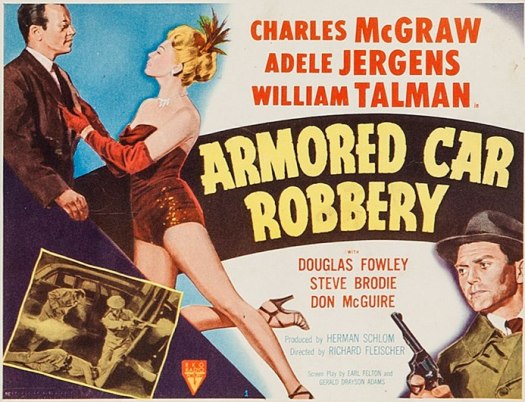
Dirty Deeds Done Dirt Cheap: ARMORED CAR ROBBERY (RKO 1950)


gary loggins's avatarcracked rear viewer

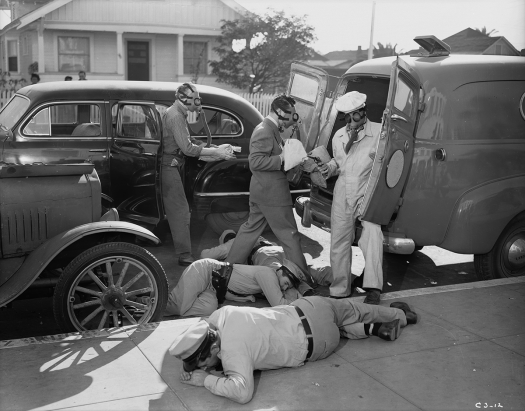
Looking for a tough, no-frills ‘B’ crime drama? Look no further than ARMORED CAR ROBBERY, which is just what it says it is, the planning, execution, and aftermath of said dirty deed, with a cast of rugged mugs and hard-hearted dames directed by Richard Fleischer during his salad days at RKO. The movie echoes Robert Siodmak’s CRISS CROSS in its heist scene, and I’m sure Stanley Kubrick watched and remembered it when he made his film noir  masterpiece THE KILLING .

Make no mistake, ARMORED CAR ROBBERY isn’t on a par with those two films. It is, however, an enjoyable little 67 minutes of cops vs crooks. Criminal mastermind Dave Purvis assembles a gang of low-lives to pull the caper off, killing a cop in the process. The cop’s partner, Lt. Jim Cordell, is now determined to hunt the crooks down and avenge him. One of the participants, Benny McBride…

View original post 402 more words

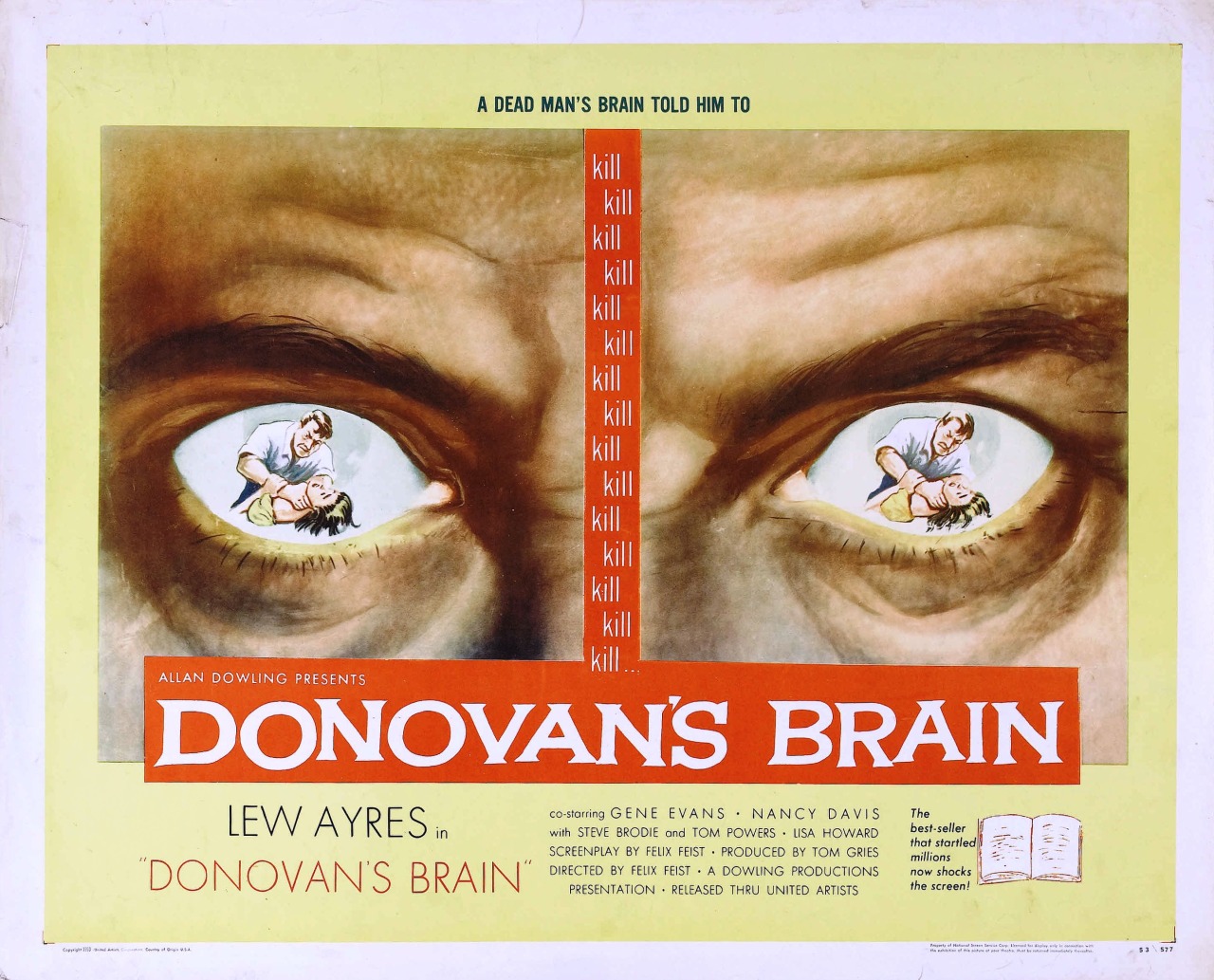
Halloween Havoc!: DONOVAN’S BRAIN (United Artists 1953)


gary loggins's avatarcracked rear viewer

donovan1

No, this is not a movie about the mind of the 60’s Scottish folk singer responsible for “Sunshine Superman” and “Mellow Yellow”. DONOVAN’S BRAIN is a sci-fi/horror hybrid based on the 1942 novel by Curt Siodmak, responsible for THE WOLF MAN and other Universal monster hits. It was first made as a 1944  Republic Pictures effort titled THE LADY AND THE MONSTER with Erich Von Stroheim (why Universal didn’t buy the rights is a mystery to me). This is one of those rare cases where the remake is better than the original!

donovan22

The story concerns Dr. Pat Cory, a scientist experimenting with keeping the brain of a monkey alive without a body. After several failures, Cory and his assistant, alcoholic Dr. Frank Schratt, have finally succeeded. A nearby plane crash leaves three dead, and multi-millionaire Warren H. Donovan in critical condition. Donovan dies on the table, but his brain is still registering…

View original post 466 more words

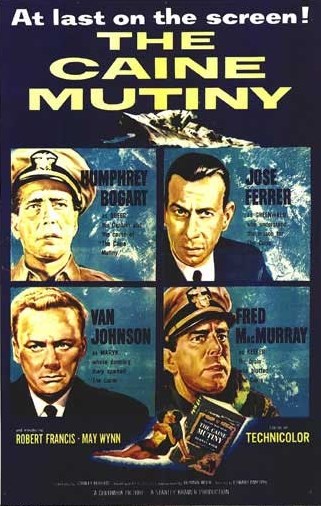
Lisa Reviews An Oscar Nominee: The Caine Mutiny (dir by Edward Dmytryk)


Mutiny_0

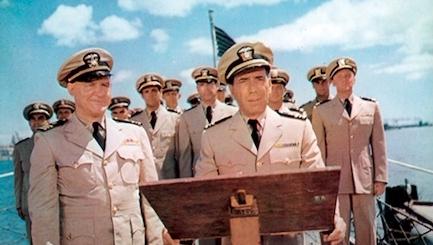
It’s the 1940s and World War II is raging.  The U.S. Navy is model of military discipline and efficiency.  Well, except for the U.S.S. Caine, that is.  The Caine is something of a disorganized mess, where no one takes his job seriously and sailors have names like Meatball (Lee Marvin) and Horrible (Claude Akins).  The men love Lt. Commander DeVriess (Tom Tully), largely because he has given up on trying to enforce any sort of discipline.  However, DeVriess has recently been relieved of his command.  As he leaves, Meatball gives him a new watch, a gift from all the men.  DeVriess admonishes them, snapping that the gift is violation of Naval regulations.  He then puts the watch on his wrist and leaves the ship.

DeVriess’s replacement is Captain Francis Queeg and, at first, we have reason to be hopeful because Captain Queeg is being played by Humphrey Bogart.  Surely, if anyone can get this ship into shape, it’ll be Humphrey Bogart!  From the moment he arrives, Queeg announces that he’s going to enforce discipline on the Caine and if that means spending hours yelling at a man for not having his shirt tucked in, that’s exactly what Queeg is prepared to do.  However, it also quickly becomes apparent that the awkward Queeg has no idea how to talk to people.  He is also overly sensitive and quick to take offense.  Whenever Queeg makes a mistake (and he does make a few), he’s quick to blame everyone else.

the-caine-mutiny-deck

Realizing that the men are turning against him, Queeg even begs his officers for their help.  He asks them if they have any suggestions.  They all sit silently, their heads bowed as Queeg somewhat poignantly rambles on about how his wife and his dog both like him but the crew of the Caine does not.

Queeg’s officers are a diverse bunch, none of whom are quite sure what to make of Queeg or the state of the Caine.  Ensign Willie Keith (Robert Francis) is a wealthy graduate of Princeton University who, at first, likes Queeg but quickly comes to doubt his abilities.  On the other hand, Lt. Steve Marsyk (Van Johnson) has doubts about Queeg from the start but, as a career Navy man, his natural instinct is to respect the chain of command above all else.

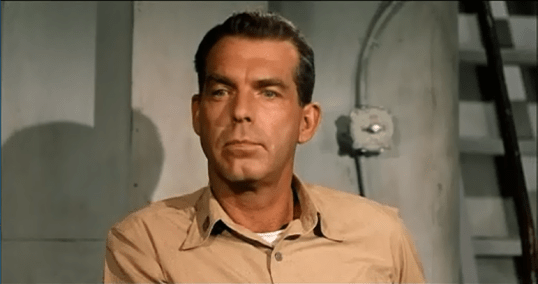
And then there’s Lt. Tom Keefer (Fred MacMurray).  Keefer is a self-styled intellectual, a novelist who is always quick with a snarky comment and a cynical observation.  (If The Caine Mutiny were remade as a B-horror film, Lt. Keefer’s name would probably be Lt. Sardonicus.)  From the minute the viewers meet Lt. Keefer, our inclination is to like him.  After all, he seems to be the only person in the film who has a sense of humor.  If we had to pick someone to have dinner with, most of us would definitely pick the erudite Tom Keefer over the humorless and socially awkward Francis Queeg.  As such, when Keefer starts to suggest that Queeg might be mentally unstable, our natural impulse is to agree with him.

It’s Tom Keefer who first suggests that it may be necessary to take the command away from Queeg.  And yet, when it comes time to take action, it’s Keith and Marsyk who do so while Keefer stands to the side and quietly watches.  And, once the Caine arrives back in the U.S., it Keith and Marsyk who are court martialed.  Will they be found guilty of treason or will their lawyer, Lt. Barney Greenwald (Jose Ferrer), prove that Queeg was unfit for command?

the-caine-mutiny-ferrer

Made in 1954 and based on a novel by Herman Wouk, The Caine Mutiny is one of those big and glossy 1950s productions that holds up a lot better than you might expect.  The film has its flaws.  In the role of Keith, Robert Francis is a bit on the dull side and a subplot in which he courts May Wynn feels unneccessary and only serves to distract from the main story.  But, for the most part, it’s an intelligent and well-directed film.  Humphrey Bogart turns Queeg into a pathetic and lonely figure and you can’t help but feel sorry for him when he talks about how his dog loves him.  Van Johnson also does well as Marsyk, effectively portraying a well-meaning character who is in over his head.  Jose Ferrer gets a great drunk scene at the end of the film and, of course, you can’t go wrong with Lee Marvin as a smirking sailor, even if Marvin only appears for a handful of minutes.

Fred MacMurray The Caine Mutiny

But for me, my favorite character (and performance) was Fred MacMurray’s Tom Keefer.  Technically, Keefer is not meant to be a likable character.  He’s totally passive aggressive.  He’s pretentious.  He’s smug.  At times, he’s rather cowardly.  And yet, Tom Keefer remains the most memorable and interesting character in the entire film.  He gets all of the good one-lines and MacMurray delivers them with just the right amount of barely concealed venom.  (“If only the strawberries were poisoned…” he says as he considers dinner aboard the Caine.)  It’s a great role and Fred MacMurray gives a great performance.  And you know what?  I don’t care how bad a character he may have been.  I still want to read Tom Keefer’s book!

The Caine Mutiny was nominated for best picture of 1954.  However, it lost to On The Waterfront.

Happy Birthday Robert Mitchum: OUT OF THE PAST (RKO 1947)


gary loggins's avatarcracked rear viewer

out3

One of my favorite actors, the laconic, iconic Robert Mitchum was born August 6, 1917 in Bridgeport, Connecticut. Rugged Robert had a wandering spirit, riding the rails in the days of the Depression, and even did time on a Georgia chain gang. Mitchum eventually ended up in California , and was bitten by the acting bug. After small roles in Laurel & Hardy comedies and Hopalong Cassidy oaters, Mitchum got noticed in a series of B-Westerns based on the novels of Zane Grey. His big break came as a tough sergeant in 1945’s THE STORY OF G.I. JOE, which he received an Oscar nomination for Best Supporting Actor. But the role that made him a star was world-weary private eye Jeff Bailey in the film noir classic OUT OF THE PAST.

We meet Bailey running a gas station in the small town of Bridgeport, California (an homage to Mitchum’s hometown, perhaps?) He has a mute…

View original post 758 more words

A Quickie With Lisa Marie: Crossfire (dir. by Edward Dmytryk)


I recently decided that I wanted to watch and review every single movie ever nominated for the Academy Award for best picture.  As part of that mission, I recently rewatched one of my favorite also-rans, 1947’s Crossfire.

Crossfire is a message movie disguised as a B detective flick.  A group of soldiers who have just returned from World War II decide to get together for a drink.  At the bar, they run into a civilian named Joseph Samuels (Sam Levine).  The soldiers end up going back to Samuels’s apartment and the next morning, Samuels is found dead.  Obviously, he was killed by one of the soldiers but which one.  Suspicion falls on the meek (and missing) Floyd Bowers (Steve Brodie) but police detective Finlay (Robert Young) and Sgt. Peter Keeley (Robert Mitchum) both (correctly) suspect that Samuels was actually murdered by the far more outspoken and imposing Montgomery (Robert Ryan).  It quickly becomes obvious that Montgomery is an anti-Semite who killed Samuels solely because he was Jewish.  However, neither Finlay or Keeley can prove it.  The film quickly becomes a darkly intense duel between these three men as Finlay and Keeley attempt to trick Montgomery into implicating himself while Montgomery attempts to further frame Bowers for the murder.

Before Crossfire, director Edward Dmytryk specialized in making low-budget “B” movies and he brings that noir, near-grindhouse sensibility to Crossfire.  As a result, Crossfire is a one of those rare “message” films that is actually entertaining.  Only a few times does the film start to feel preachy and luckily, Robert Mitchum is there being his usual cynical self.  If anyone could deflate the pompous nature of the mid-40s message movie, it was Robert Mitchum.  The film says, “Love one another.”  Mitchum replies, “Baby, I just don’t give a damn,” and he keeps things from getting too heavy-handed.  Mitchum is one of three Roberts to star in this film.  Robert Young plays the police inspector with just the right amount of world-weary indignation while Robert Ryan is a force of nature as the film’s brutal murderer.  Don’t get me wrong.  You can pretty much peg Ryan as a killer from the first minute he shows up on-screen.  If Mitchum and Young smartly underplay their roles, Ryan goes the exact opposite direction.  He’s an obvious brute but he’s also totally believable.  You look at his character and it’s not difficult to imagine him passing the collection plate at Westboro Baptist Church.  As well, Crossfire also features an excellent supporting term by one of my favorite noir actresses, the great and wonderful Gloria Grahame.  She plays Bowers’ married girlfriend and gives a compellingly, real performance that suggests that maybe Hollywood in the 40s wasn’t quite as clueless as we all like to assume.

Crossfire was nominated for Best Picture of 1947 but it lost to another film about anti-Semitism, Elia Kazan’s Gentleman’s Agreement.  (Oddly enough, both Kazan and Dmytryk would end up naming names during the McCarthy Era.)  Like Gentleman’s Agreement, Crossfire was based on a novel.  However, in the original novel, the victim was not Jewish but instead was gay.  However, back in the 1940s, the Hollywood Production Code specifically forbade any open depiction of homosexuality and so, the crime went from being motivated by homophobia to anti-Semitism.