Late Night Retro Television Review: Pacific Blue 1.10 “Captive Audience”


Welcome to Late Night Retro Television Reviews, a feature where we review some of our favorite and least favorite shows of the past! On Tuesdays, I will be reviewing Pacific Blue, a cop show that aired from 1996 to 2000 on the USA Network!  It’s currently streaming everywhere, though I’m watching it on Tubi.
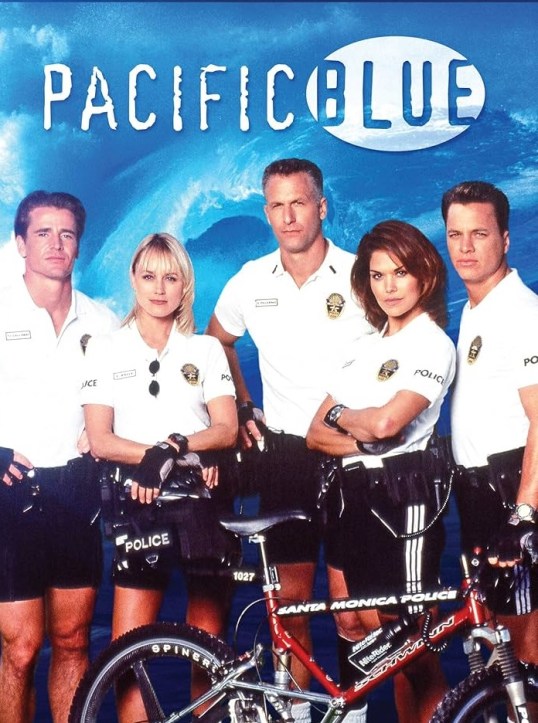
I’m a little bit late with this review but so what?  I mean, what’s Pacific Blue going to do?  Chase me on their bicycles?

Episode 1.10 “Captive Audience”

(Dir by Terrence O’Hara, originally aired on May 4th, 1996)

The local bank is being robbed!  The three robbers — desperate and murderous criminals all — have taken hostages, including TC and Cory.  TC just wanted to check out his safe deposit box.  Cory just wanted to withdraw some money so she could buy a motorcycle.  (If she had been withdrawing the money to buy another bicycle, I would have thrown a shoe at my television.)  TC is in uniform.  The robbers know he’s a cop.  Cory is not in uniform and she and TC are pretending not to know each other.  There’s also a pregnant woman in the bank who goes into labor, which means that Cory is going to have to get over her loathing of babies to help deliver one!

*Sigh*

I think I’ve said before that I hate cop shows that feature people being held hostage.  It’s always the same thing.  The robbers threaten a lot of people.  The hostages get beaten and abused.  Outside the bank, the negotiator says, “You have to give me more time!”  On Pacific Blue, the negotiator is Captain Palermo and there’s something just silly about him, in his shorts and crisp polo shirt, directing a bunch of rough-and-ready SWAT team members who are in protective gear.  Hostage situations are serious and potentially deadly but Palermo chasing the robbers are on his bicycle just made me laugh and laugh.  I also laughed when the SWAT team first arrived at the bank and spotted Cory and TC’s bicycles sitting outside the building.  “There might be cops in there,” someone says.  Apparently, they’re unsure about whether or not bike cops should be considered real police or not.  I’m glad I’m not the only one.

It falls to Del Toro and Chris to track down Doc Mueller (Charley Lang), a paranoid electronics expert who lives in a tent on the beach.  He agreed to help disable the bank’s alarm so that the SWAT team can sneak inside.  He also taps into the head robber’s “cellular phone” so that the cops can see who he is working with on the outside.  Shows from the 90s are always amusing because everyone’s always like, “He’s got a cellular phone!”  In 1996, those were still unusual and only used by desperate bank robbers.

(On a positive note, one of the robbers is played by a handsome young actor named Walton Goggins.  What ever happened to him?  Seriously, there’s not much about his performance here that indicates the type of actor he would become but still …. WALTON GOGGINS!)

Everything works out, of course.  The main bank robber tries to escape in a helicopter but Palermo chases him — on his bike! — and manages to jump into the helicopter.  It would have been really impressive if not for the bicycle and the fact that the Pacific Blue uniforms — those shorts and those blindingly white shirts — make all of the characters look really silly.  It’s hard to take a cop seriously when he’s dressed like an aging track coach.  The important thing, though, is that Cory gets over her hatred of babies and Palermo shows that bike cops deserve as much respect as real cops.

Eh.  Who cares?
 

Ghosts of Sundance Past: In The Company Of Men (dir by Neil LaBute)


The Sundance Film Festival is currently underway in Utah.  For the next few days, I’ll be taking a look at some of the films that have previously won awards at Sundance.

1997’s In The Company of Men is a film about two guys playing a series of very viscous jokes.

Howard (Matt Malloy) and Chad (Aaron Eckhart) are two mid-level executives who have been sent to work at a branch office for six weeks.  While Chad is talkative and aggressive, Howard is much more meek and often seems to be in awe of the far more confident Chad.  What the two men have in common is a lot of resentment and bitterness towards women.  Chad suggests that they should both date a woman at the same time and fool her into falling for both of them.  Then, they’ll both dump her at the same time.  Chad has even picked out a victim, Christine (Stacy Edwards), a deaf and introverted co-worker.

That Chad would come up with such a cruel scheme really isn’t a surprise.  From the first minute that we see Chad, we think we can tell what type of person he is.  Because this is a movie, we hold on to hope that Chad will somehow reveal that he’s not as bad as he seems but, in the end, the whole point of the film is that Chad is not only as bad as we initially think he is but he’s actually even worse.  Howard, on the other hand, comes across like a rather mild-mannered guy, the stereotypical nerdy mid-level manager who no one ever notices.  Howard could never come up with a scheme like this on his own but, once Chad suggests it, Howard agrees.  Howard is a natural follower.  He looks at Chad and he sees who he wants to be.  Chad looks at Howard and sees someone who he can easily manipulate.

Chad and Howard set their plan in motion and yes, it is difficult to watch as they both pretend to be falling in love with the sensitive Christine while making cruel fun of her behind her back.  Again, we know that at least one of the men is going to have second thoughts and try to back out of the plan.  We know this because we’re watching a movie.  We spend most of the movie hoping that Chad is going to be the one to find his conscience because Aaron Eckhart is the more charismatic of the two men and Chad is the one with whom Christine seems to be truly falling in love.  Instead, it’s Howard who falls in love with Christine while Chad remains as sociopathic as ever.  By the end of the film, Chad reveals just how manipulative he truly is and Howard discovers that Christine was not the only victim of Chad’s joke.

In The Company Of Men is not an easy film to watch.  The comments that Chad and Howard make are shockingly cruel, though one gets the feeling that they’re probably an accurate reflection of what men like Chad and Howard sound like when they’re in private.  Director Neil LaBute doesn’t make any effort to soften or excuse their misogyny.  It’s a testament to the talents of Eckhart, Malloy, and Edwards that we stick with the film.  In the end, In The Company Of Men is an unsettling portrait of misogyny and toxic masculinity, one that is made all the more disturbing by Aaron Eckhart’s charismatic performance as a truly despicable person.  The film uses Eckhart’s middle-American good looks to subversive effect and, even when he’s playing such a hateful character, there’s something undeniably fascinating about him.  You watch his performance of Chad and you’re almost desperate to find some sort of good inside of him.  It’s not there, though.  That’s what is truly frightening about In The Company Of Men.

As the 1997 Sundance Film Festival, In The Company Of Men won the Filmmaker’s Trophy.

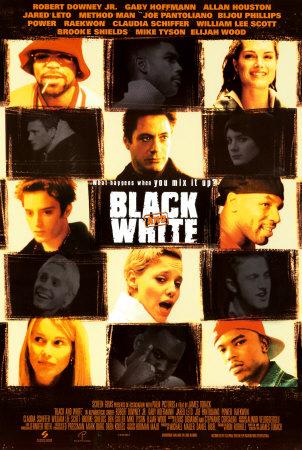
Cleaning Out The DVR Yet Again #31: Black and White (dir by James Toback)


(Lisa recently discovered that she only has about 8 hours of space left on her DVR!  It turns out that she’s been recording movies from July and she just hasn’t gotten around to watching and reviewing them yet.  So, once again, Lisa is cleaning out her DVR!  She is going to try to watch and review 52 movies by the end of Wednesday, December 7th!  Will she make it?  Keep checking the site to find out!)

black_and_white_black_white-681253575-large

On November 15th, I recorded the 1999 melodrama, Black and White, off of Encore.

Black and White is a film that I’ve seen several times and I’ve always meant to review it.  It’s an attempt to explore the state of race, rap, crime, and sex in the late 20th century.  It’s also a James Toback film, which means that it contains all of the stuff that appears in every James Toback film: a threesome in the park, improvised dialogue, cameos from famous people playing themselves, an obsession with college basketball games, casual sexism, and a lot of talk about why you should never send “a little boy to do a man’s job.”  By his own admission, the white Toback is obsessed with the black experience but, when you watch a James Toback film, you get the feeling that his entire knowledge of African-American culture comes from watching other movies.

In short, Black and White is probably one of the silliest and most misjudged films that I’ve ever seen.  In fact, it’s so misjudged that it’s compulsively watchable.  Though I’m always hesitant to casually toss around the term “guilty pleasure,” that’s exactly what Black and White is.

Black and White tells several different stories, some of which are connected and some of which are not.  Sam Donager (Brooke Shields) is an independent filmmaker who is attempting to make a documentary about white people who try to act black.  Her husband, Terry (Robert Downey, Jr.), is gay and hits on every man (and boy) that he sees.  Sam and Terry start following around a group of privileged white kids who are obsessed with rap music.  Sam asks them if they want to be black.  They say that they’re going through a phase.

One of the kids is named Wren and he’s played by Elijah Wood.  He doesn’t really do much but every time he shows up in the film, you go, “It’s Elijah Wood!”  And then there’s Marty King (Eddie Kaye Thomas) who is the son of the Manhattan District Attorney (Joe Pantoliano).  Marty’s older brother is Will (William Lee Scott) ,who is some sort of low-level criminal.  And finally, the unofficial leader of the kids is Charlie (Bijou Phillips) and she gets to give a long monologue explaining the various uses of the n-word.

(Their teacher, incidentally, is played by Jared Leto.  If you’ve ever wanted to listen to Jared Leto lecture about the relationship between Othello and Iago, this is the film to see.  That said, the whole Othello and Iago lecture is just kinda randomly tossed in and doesn’t really pay off.)

Charlie is one of the many girlfriends of Rich Bower (Power), who is not only an up-and-coming rap producer but he’s also the head of a criminal organization.  (There’s a lengthy and kinda pointless scene where he and his associates demand money from a club manager played by Scott Caan.)  Rich is also friends with Mike Tyson.  Tyson plays himself and he gets to deliver an entire monologue about how Rich should never send a boy to do a man’s job.

But we’re not done!  Rich’s cousin is Dean Carter (Allan Houston), a college basketball player.  Dean is dating an anthropology graduate student (Claudia Schiffer, giving a hilariously terrible performance) who is obsessed with fertility symbols.  Dean is also being blackmailed by a corrupt cop named Mark Clear.  Guess who plays Mark Clear?

BEN FREAKING STILLER!

Needless to say, Ben Stiller is massively miscast.  He delivers he lines in his trademark comedic fashion, which makes it next to impossible to take him seriously as any sort of threat.  He also has a backstory that is needlessly complex but at least it allows him to say, “I’m Saul of Fucking Tarsus!”

Anyway, almost the entire film was improvised, which is one of those things that probably seemed like a good idea at the time.  A few of the actors do well with the improvisation.  Stiller may be miscast but at least he can come up with stuff to say.  Robert Downey, Jr.’s character may seem out-of-place but again, Downey knows how to keep things interesting.  But the rest of the cast seems to be a bit stranded so we end up with a lot of lengthy scenes of characters struggling to make some sort of sense of Toback’s storyline.

It’s obvious that James Toback felt that this film had something important to say but, instead of any insight, it can only offer up the occasionally strange-as-Hell scene.

Like this scene, for instance, in which Mike Tyson literally attempts to kill Robert Downey, Jr:

Or this weird little scene between Ben Stiller and Joe Pantoliano, which is dominated by Stiller’s odd delivery of his lines:

Or the closing montage, which is actually rather well-put together and makes great use of Michael Fredo’s Free:

Sadly, the video above ends before it gets to the part where we see Claudia Schiffer on a date with Mike Tyson, telling him about fertility symbols.

Anyway, Black and White is one of those films that wants to say something despite not being sure what.  Again, it may ultimately be rather silly but it’s still compulsively watchable.

(For the record, Marla Maples — who also appeared in Maximum Overdrive and was married to future President Donald Trump when this movie was made — has a cameo as a character named Muffy.  We live in a strange fucking world, don’t we?)

What Lisa Watched This Afternoon #114: Babysitter’s Black Book (dir by Lee Friedlander)


Earlier today, I watched last night’s Lifetime original movie, Babysitter’s Black Book!

babysitters-black-book-lifetime

Why Was I Watching It?

I love Lifetime movies about out-of-control teenagers.

What Was It About?

Ashley (Spencer Locke) wants to go to a good college and is terrified of getting stuck at a community college.  She’s even started a babysitting service in order to help pay for school.  However, she soon finds herself having an affair with one of her clients (Ryan McPartin).  Meanwhile, one of her employees has turned the babysitting service into a prostitution ring.

And while that may seem extreme to some, never underestimate the lengths people will go to avoid having to enroll in a community college…

What Worked?

Before I watched this film, I thought there was a very good chance that either Sugar Daddies or Back to School Mom would be the best Lifetime film of 2015.  But then I watched Babysitter’s Black Book and oh my God!  Babysitter’s Black Book is one of the best Lifetime films that I have ever seen.  How good was it?  It’s almost as good as Confessions of a Go Go Girl!

(And that’s pretty freaking good…)

Babysitter’s Black Book features everything that you could possibly want from a Lifetime film.  Melodrama, comedy, pretty clothes, sordid happenings in artfully decorated settings, and wonderfully over-the-top dialogue.  When Rachel tries to convince her friends to have sex for money, she very reasonably says, “Use it before you lose it.”  When Mark offers Ashley something to eat, he tells her, “Try it and you’ll never want to have another thing in your mouth.”  How can you not love this film?

The film was also remarkably well-directed and acted.  In the role of the greedily pragmatic Rachel, Angeline Appel stole every scene that she appeared in.  Another scene stealer was an actor named Jeff L. Williams.  Playing the role of the decadent Walker, Williams only appeared in a handful of scenes but he definitely made an impression.  The minute he smirked and said, “Let’s take some real pictures,” you just knew that bad things were going to happen.

This was exactly the type of film that we watch Lifetime to see.

What Did Not Work?

It all worked.  This was a perfect Lifetime movie.

“Oh my God!  Just like me!” Moments

Not that we ever would but, if for some reason we did decided to start a prostitution business, I would hope that my best friends and I would be as cheerful, giggly, and supportive about it as the girls in this film.  And I really do think we would be.  That’s one of the best things about Babysitter’s Black Book.  It’s a film that — much like Sofia Coppola’s Bling Ring — is honest about the fact that sometimes it’s fun to be bad.  (Especially when you’re still too sheltered and naive to understand the consequences…)

Babysitter’s Black Book perfectly captured the feeling of just how exhilarating and scary it can be to have your entire future in front of you.  Whenever Ashley dreaded the prospect of having to stay home and attend a community college, I found myself nodding and thinking, “Oh my God.  Just like me….”

Lessons Learned

Actions have consequences but it’s still fun to have money.

7_14

Shattered Politics #63: Primary Colors (dir by Mike Nichols)


Primaryposter

Jack Stanton (John Travolta) is the charismatic governor of an unnamed Southern state.  After spending his entire life in politics, Jack is finally ready to run for President.  Even more ready is his equally ambitious wife, Susan (Emma Thompson).  Jack proves himself to be a strong candidate, a good speaker who understands the voters and who has the ability to project empathy for almost anyone’s situation. He’s managed to recruit a talented and dedicated campaign staff, including the flamboyant Richard Jemmons (Billy Bob Thornton), Daisy Green (Maura Tierney), and journalist Henry Burton (Adrian Lester).  Henry is the son of a civil rights leader and, as soon as they meet, Jack talks about the first time that he ever heard Henry’s father speak.  Within minutes of first meeting him, Henry believes in Jack.

The problem, however, is that there are constant hints that Jack may not be worthy of his admiration.  There’s the fact that he’s a compulsive womanizer who is given to displays of temper and immaturity.  When one of Jack’s old friends reveals that Jack may have impregnated his daughter, Jack and Susan respond with a pragmatic ruthlessness that takes Henry by surprise.

When one of Jack’s mistresses threatens to go public, Henry is partnered up with Libby (Kathy Bates) and sent to dig up dirt on her and her sponsors.  When the former governor of Florida, Freddie Picker (Larry Hagman), emerges as a threat to derail Jack’s quest for the nomination, Henry and Libby are again assigned to research Picker’s background.  Libby is perhaps the film’s most interesting character.  Recovering from a mental breakdown, Libby has no trouble threatening to shoot one political opponent but she’s still vulnerable and idealistic enough that it truly hurts her when Jack and Susan repeatedly fail to live up to her ideals.  As an out lesbian, Libby is perhaps the only character who has no trouble revealing her true self and, because of her honesty, she is the one who suffers the most.

First released in 1998 and based on a novel by Joe Klein, Primary Colors is an entertaining and ultimately rather bittersweet dramedy about the American way of politics.  John Travolta and Emma Thompson may be playing Jack and Susan Stanton but it’s obvious from the start that they’re meant to be Bill and Hillary Clinton.  And while it takes a few minutes to get used to Travolta’s attempt to sound Southern, this is ultimately one of his best performances.  As played by Travolta, Jack Stanton is charming, compassionate, self-centered, and ultimately, incredibly frustrating.  One reason why Primary Colors works is because we, as an audience, come to believe in Jack just as much as Henry does and then we come to be just as disillusioned as Libby.  Emma Thompson’s performance is a little less obviously based on Hillary.  Unlike Travolta, she doesn’t attempt to imitate Hillary’s voice or mannerisms.  But she perfectly captures the steely determination.

Primary Colors captures both the thrill of believing and the inevitability of disillusionment.  It’s definitely a film that I will rewatch in the days leading up to 2016.

Back to School #76: The Bling Ring (dir by Sofia Coppola)


Bling-Ring-large

The Bling Ring was one of the more divisive films of 2013.  As often seems to happen with the work of Sofia Coppola, viewers either loved it as a stylish look at America’s self-destructive love affair with fame or else they felt that it was a shallow celebration of the very lifestyle that it claimed to be satirizing.  Personally, I felt it was both, which is one reason why I enjoyed The Bling Ring.

The Bling Ring is based on the true story of a bunch of California teenagers who made headlines by breaking into the mansions of their idols.  Over the course of several months, they burglarized everyone from Paris Hilton to Lindsay Lohan to Orlando Bloom.  While they may have been smart enough to use social media to discover when their targets would be out of town, they weren’t smart enough to not use social media to brag about their crimes.  Eventually, they were arrested and, for a brief period of time, they were as famous as the people they robbed.  One of them even got her own reality show out of the whole thing.  I watched an episode or two.  It wasn’t very good.

Though the names have been changed, Coppola pretty much tells the story as it happened.  New kid in school Marc (Israel Broussard) meets Rebecca (Kate Chang), who is obsessed with celebrities.  Rebecca is also something of an obsessive thief and soon, she and Marc are breaking into the houses of their rich neighbors and acquaintances, stealing money, and going on shopping sprees.  Their thievery allows them to leave a lifestyle where every day is just another makeover montage from a romantic comedy.  Eventually, they are joined by Nicki (Emma Watson), Sam (Taissa Farmiga), and Chloe (Claire Julien).

One thing that quickly becomes clear is that the members of the Bling Ring are not exactly the smartest group of thieves around.  Along with getting increasingly reckless while committing their crimes, they also make the mistake of showing off stolen jewelry at parties and posting pictures of Facebook.  When the police eventually do track them down, Marc is a convenient scapegoat, Rebecca is hiding out in Las Vegas with her father, and Nicki becomes a minor celebrity as she and her mother exploit her newfound notoriety for all the publicity that they can get.

I liked The Bling Ring.  It’s stylish, all of the actors look good and they’re all wearing beautiful outfits, and I loved seeing all of the houses that they broke into.  (Some of the film was shot in the actual residences that were burglarized.)  On the one hand, it doesn’t really dig too deeply into the nature of fame in America but, on the other hand, does it really need to?  We all know the culture that we live in and, at its best, The Bling Ring forces us to ask whether we would rather be one of the people on the outside looking in or if we would want to be one of the people who broke in by any means necessary.

Add to that, it has a great soundtrack!

(Now, as I said, not everyone agrees with me about The Bling Ring.  For an opposite reaction to The Bling Ring, check out Ryan The Trash Film Guru’s review.)

The-Bling-Ring-Wallpapers

Back to School #69: Superbad (dir by Greg Mottola)


Superbad

One of the great things about the 2007 comedy Superbad is that it has a title that allows for snarky but overworked reviewers like me to come up with an easy review.

For instance, if I disliked Superbad, I could just say, “Superbad more than lives up to its name!”  However, since I happen to like Superbad, I can say that Superbad is supergood, supercool, and superfun!

See how easily that works?

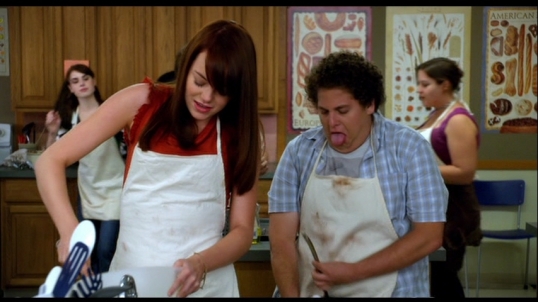
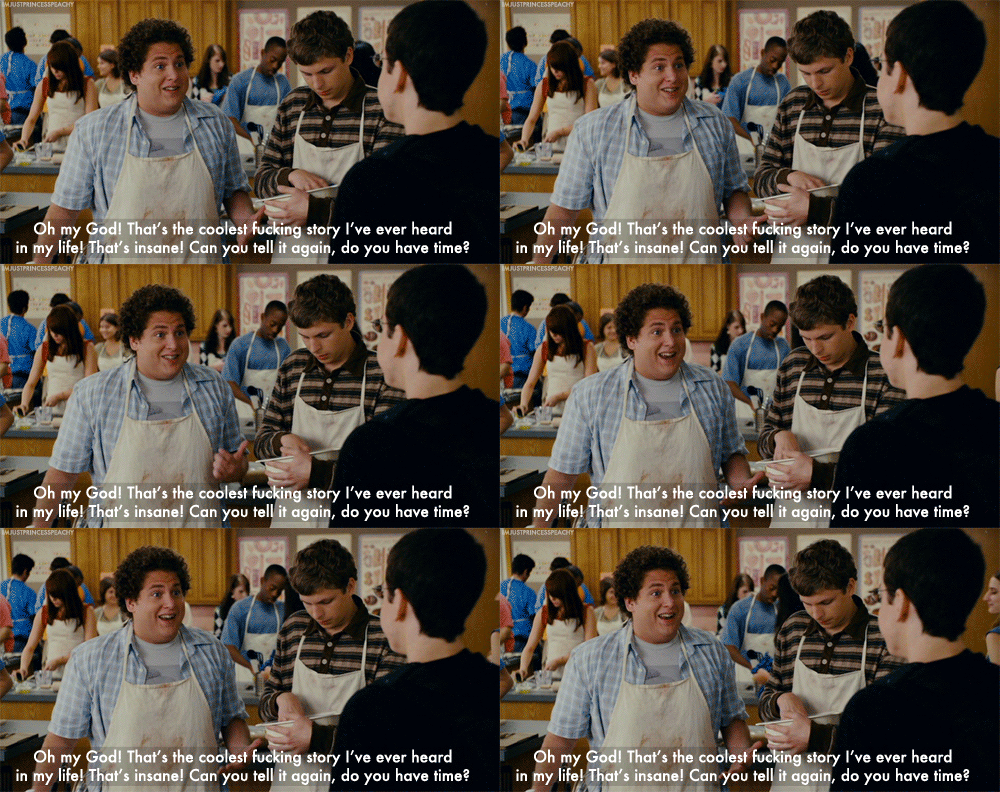
Plotwise, Superbad tells a story that will be familiar to anyone who has ever seen a teen comedy.  Three guys try to get laid.  Seth (Jonah Hill) is the rotund and boisterous one, the one who has a crush on Jules (Emma Stone), who is your basic good girl with a wild side.  Evan (Michael Cera) is the sweet and sensitive one.  And then there’s Fogell (Christopher Mintz-Plasse), the nerdy one with the thick glasses.  Fogell is the one who gets a hilariously bad fake ID, one that tells the world that his name is McLovin.

Superbad2

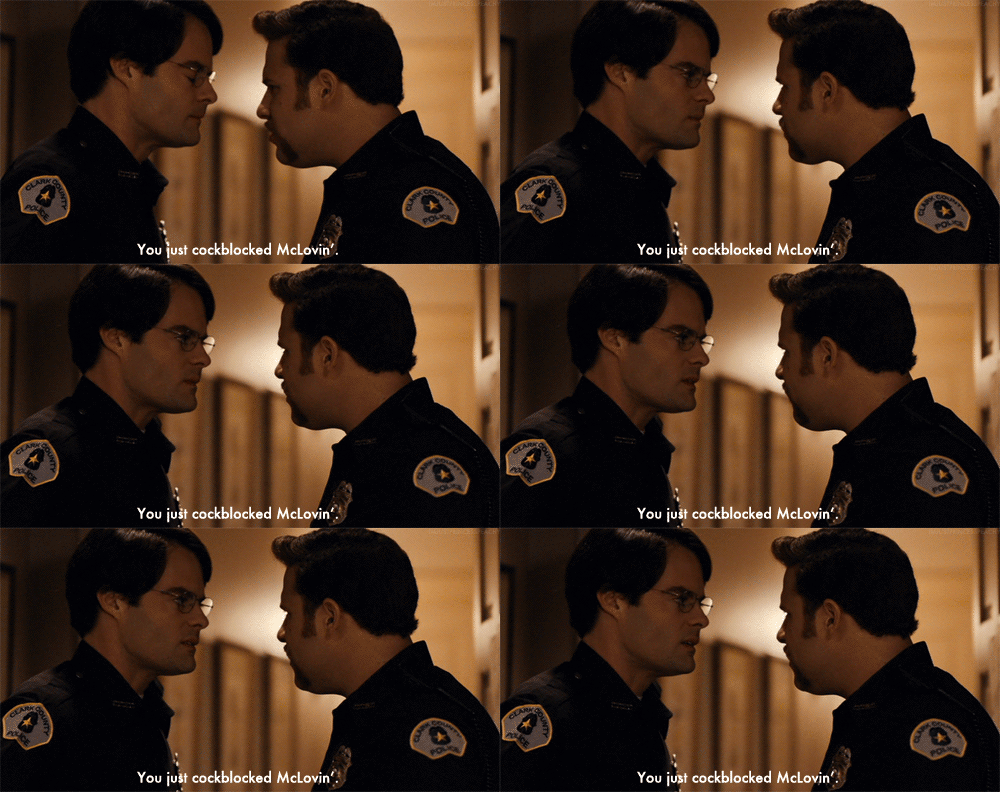
After Jules invites Seth to a party, he and Evan enlist Fogell to use his fake ID to buy them alcohol.  However, as often happens in the type of films, things get complicated.  While Fogell is buying the beer, the convenience store is held up.  The police arrive and Evan and Seth panic and run off.  Meanwhile, Fogell is befriended by the two cops (played by Seth Rogen and Bill Hader), both of whom are incredibly impressed that their new friend has as wonderful a name as McLovin.

(“You’re name’s McLovin?  That’s badass!”

Superbad23

And so, while McLovin bonds with his new cop friends, Seth and Evan continue to try to find beer and make their way to Jules’s party….

Superbad was produced by Judd Apatow and it features his usual combination of raunchy humor and sentimental bromance.  In fact, it’s such a male-centered film that I’m always a little bit surprised at how much I enjoy it.  However, Superbad is a seriously funny movie.  The script (which Seth Rogen and Evan Goldberg reportedly starting on when they were 13 years old) is full of great lines and Michael Cera and Jonah Hill make for an adorable comedy team.  And then there’s Christopher Mintz-Plasse who takes the character of Fogell to his most logical extreme and then just keeps going.  McLovin’s adventures may not be the most realistic or subtle part of the movie but they are still a lot of fun to watch.

Speaking of McLovin and his adventures with the cops, I love the performances of both Seth Rogen and Bill Hader.  If you don’t laugh at the way Seth Rogen says, “Oh no!  It’s the cops!,” then you need to be worried about your sense of humor.

Superbad is supergood, supercool, superfun, supersweet, and just plain super.

Superbad