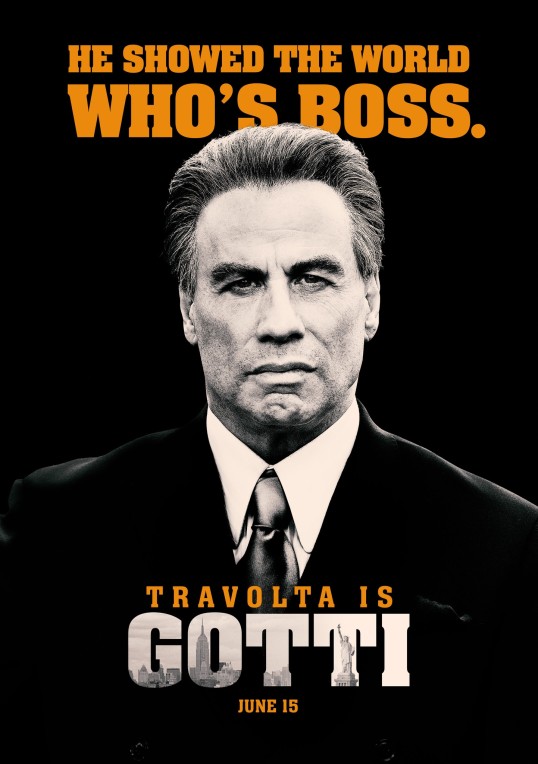
An Offer You Can’t Refuse #23: Gotti (dir by Kevin Connolly)


Few recent films have been as misunderstood as Gotti.

When this film was first released in 2018, it was slammed by critics and it flopped at the box office.  On Rotten Tomatoes, it managed a score of 0% from the critics.  At the same time, the opening day audience score was 80%.  (Over subsequent days, the audience score would drop to 46%.)  This disparity was blamed on studio employees inflating the audience score, though I think it’s more likely that, after months of negative press about the film’s troubled productions, critics were already looking forward to slamming the film before they even had a chance to see it.  At the same time, the buzz on Gotti was so bad that the opening day audience was made up of a combination of John Travolta die-hards (whoever they may be) and people who were expecting such a trainwreck that all Gotti had to do to surpass their expectations was to occasionally be in focus.

Then again, it could be that some members of the audience understood what I instinctively understood when I first watched GottiGotti is not really a film about John Gotti, the flamboyant New York mob boss who ruled the streets with an iron fist and who eventually ended up dying of cancer in prison.  Instead, whether it was the filmmaker’s actual intention or not, Gotti is a film about the audience’s fascination with not only gangsters but also the movies that have been made about them.

It’s true that John Travolta may be playing someone namned John Gotti but the film goes out of its way to remind you that he’s not the real John Gotti.  The film is full of archival news footage of the real John Gotti, either laughing it up with reporters or smirking while sitting in a courtroom.  Every time that we’re shown footage of the real John Gotti, we’re reminded of the fact that, at not point during the film, does Travolta look anything like John Gotti.  Add to that, the real Gotti is always smirking whereas Travolta always looks somewhat grim.  At the time this film came out, many claimed that this was evidence of lazy filmmaking but I viewed it as being a Brechtian distancing device.  Whenever the real Gotti makes an appearance, we’re reminded that we’re just watching a movie and then we’re encouraged to ask ourselves why we would want to watch a movie about such a disreputable figure.

The movie opens with John Travolta standing next to the Brooklyn Bridge and speaking directly to the camera.  Though Travolta is meant to be speaking to us as John Gotti, the sight of him standing near a bridge in New York will automatically remind some viewers of a previous Travolta film, Saturday Night Fever.  The character that Travolta played in Saturday Night Fever, Tony Manero, has come to epitomize New York in the 70s.  The film suggests that, in much the same way, Gotti epitomized New York in the 80s and 90s.  Gotti, the film is saying, is as much of an icon of the popular imagination as Tony Manero dancing in a white suit.

Why is Gotti speaking directly to us in that scene?  It may seem like a framing device until, a few minutes later, we see a bald and sickly Gotti in a prison meeting room, telling his life story to his son, John, Jr. (Spencer LoFranco).  Gotti talking in prison is then established as the narrative’s other framing device.  So, why was Gotti speaking to us on the bridge and why did he look so healthy and have a full of head of hair when the film has made it clear that the newly bald Gotti is going to die in prison?  When I first saw the film, my initial thought was that the Gotti who speaks directly to the audience was meant to be a ghost.  But then it occurred to me that he’s actually not meant to be John Gotti at all.  Instead, the Gotti who talks to us on the bridge is meant to be our popular conception of what gangsters like John Gotti as like.  He’s what we imagine gangsters to be — i.e., tough-talking, well-dressed, and played by an iconic actor.  As such, the film’s narration is not being provided by John Gotti.  Instead, it’s being provided by the person that we imagine someone like Gotti to have been.

Is the imprisoned Gotti meant to be the real Gotti?  Perhaps.  However, it’s hard not to notice that, over the course of the film, Gotti’s son never ages.  Though several decades pass, Gotti’s son always looks like he’s in his mid-twenties.  When he visits his father in prison and talks about having teenage children of his own, it feels odd because he barely looks old enough to be out of high school.  That may seem like lazy filmmaking but again, I would argue that this is a distancing device.  It’s a reminder that we’re not watching reality.  Instead, we’re choosing to watch actors pretending to be gangsters.

Once you accept that Gotti is a film not about John Gotti but instead about those of us in the audience who are watching, the film makes a lot more sense.  The film’s cliches about life in the Mafia are revealed to be not so much the result of an uninspired script as they’re an homage to American folklore.  Of course, there’s going to be a scene where Gotti tells his children never to rat on their friends.  Of course, there’s going to be random shootings and burly men demanding respect.  This is a gangster movie, after all.  By populating the cast with people who you normally wouldn’t expect to see playing members of the Mafia — Stacy Keach, Chris Mulkey, Pruitt Taylor Vince — Gotti continually reminds you that you’re watching a movie.  The real mafia isn’t like this, Gotti is saying, but the mafia of the popular imagination is.  Why are we horrified by real-life crime and yet we flock to movies that claim to recreate it for our entertainment?  This is the issue at the heart of Gotti.

Gotti’s flaws are there to remind us that we’re just watching a movie.  They’re also there to make us wonder why we’re watching that particular movie.  Gotti asks us why audience idolize killers like John Gotti.  Why do we turn them into folk heroes?  Is it because we imagine them to be characters in films as opposed to actual human beings?  Whether or not one feels that the film succeeded in its goal, this is an offer that you cannot refuse.
Previous Offers You Can’t (or Can) Refuse:

  1. The Public Enemy
  2. Scarface (1932)
  3. The Purple Gang
  4. The Gang That Could’t Shoot Straight
  5. The Happening
  6. King of the Roaring Twenties: The Story of Arnold Rothstein 
  7. The Roaring Twenties
  8. Force of Evil
  9. Rob the Mob
  10. Gambling House
  11. Race Street
  12. Racket Girls
  13. Hoffa
  14. Contraband
  15. Bugsy Malone
  16. Love Me or Leave Me
  17. Murder, Inc.
  18. The St. Valentine’s Day Massacre
  19. Scarface (1983)
  20. The Untouchables
  21. Carlito’s Way
  22. Carlito’s Way: Rise To Power

6 More Film Reviews From 2014: At Middleton, Barefoot, Divergent, Gimme Shelter, The Other Woman, and more!


Let’s continue to get caught up with 6 more reviews of 6 more films that I saw in 2014!

At Middleton (dir by Adam Rodgers)

“Charming, but slight.”  I’ve always liked that term and I think it’s the perfect description for At Middleton, a dramedy that came out in January and did not really get that much attention.  Vera Farmiga is a businesswoman who is touring colleges with her daughter (Taissa Farmiga, who is actually Vera’s younger sister).  Andy Garcia is a surgeon who is doing the same thing with his son.  All four of them end up touring Middleton College at the same time.  While their respective children tour the school, Vera and Andy end up walking around the campus and talking.  And that’s pretty much the entire film!

But you know what?  Vera Farmiga and Andy Garcia are both such good performers and have such a strong chemistry that it doesn’t matter that not much happens.  Or, at the very least, it doesn’t matter was much as you might think it would.

Hence, charming but slight.

http://www.youtube.com/watch?v=i-b_mPVuNOI

Barefoot (dir by Andrew Fleming)

Well, fuck it.

Sorry, I know that’s not the best way to start a review but Barefoot really bothered me.  In Barefoot, Scott Speedman plays a guy who invites Evan Rachel Wood to his brother’s wedding.  The twist is that Wood has spent most of her life in a mental institution.  Originally, Speedman only invites her so that he can trick his father (Treat Williams) into believing that Speedman has finally become a responsible adult.  But, of course, he ends up falling in love with her and Wood’s simple, mentally unbalanced charm brings delight to everyone who meets her.  I wanted to like this film because I love both Scott Speedman and Evan Rachel Wood but, ultimately, it’s all rather condescending and insulting.  Yes, the film may be saying, mental illness is difficult but at least it helped Scott Speedman find love…

On the plus side, the always great J.K. Simmons shows up, playing a psychiatrist.  At no point does he say, “Not my tempo” but he was probably thinking it.

Divergent (dir by Neil Burger)

There’s a lot of good things that can be said about Divergent.  Shailene Woodley is a likable heroine.  The film’s depiction of a dystopian future is well-done. Kate Winslet has fun playing a villain.  Miles Teller and Ansel Elgort are well-cast.  But, ultimately, Divergent suffers from the same problem as The Maze Runner and countless other YA adaptations.  The film never escapes from the shadow of the far superior Hunger Games franchise.  Perhaps, if Divergent had been released first, we’d be referring to the Hunger Games as being a Divergent rip-off.

However, I kind of doubt it.  The Hunger Games works on so many levels.  Divergent is an entertaining adventure film that features a good performance from Shailene Woodley but it’s never anything more than that.  Considering that director Neil Burger previously gave us Interview with the Assassin and Limitless, it’s hard not to be disappointed that there’s not more to Divergent.

Gimme Shelter (dir by Ron Krauss)

Gimme Shelter, which is apparently based on a true story, is about a teenage girl named Apple (Vanessa Hudgens) who flees her abusive, drug addicted mother (Rosario Dawson).  She eventually tracks down her wealthy father (Brendan Fraser), who at first takes Apple in.  However, when he discovers that she’s pregnant, he demands that she get an abortion.  When Apple refuses, he kicks her out of the house.  Apple eventually meets a kindly priest (James Earl Jones) and moves into a shelter that’s run by the tough Kathy (Ann Dowd).

Gimme Shelter came out in January and it was briefly controversial because a lot of critics felt that, by celebrating Apple’s decision not to abort her baby, the movie was pushing an overly pro-life message.  Interestingly enough, a lot of those outraged critics were men and, as I read their angry reviews, it was hard not to feel that they were more concerned with showing off their political bona fides than with reviewing the actual film.  Yes, the film does celebrate Apple’s decision to keep her baby but the film also emphasizes that it was Apple’s decision to make, just as surely as it would have been her decision to make if she had chosen to have an abortion.

To be honest, the worst thing about Gimme Shelter is that it doesn’t take advantage of the fact that it shares its name with a great song by the Rolling Stones.  Otherwise, it’s a well-done (if rather uneven) look at life on the margins.  Yes, the script and the direction are heavy-handed but the film is redeemed by a strong performance from Vanessa Hudgens, who deserves to be known for more than just being “that girl from High School Musical.”

Heaven is For Real (dir by Randall Wallace)

You can tell that Heaven is For Real is supposed to be based on a true story by the fact that the main character is named Todd Burpo.  Todd Burpo is one of those names that’s just so ripe for ridicule that you know he has to be a real person.

Anyway, Heaven Is For Real is based on a book of the same name.  Todd Burpo (Greg Kinnear) is the pastor of a small church in Nebraska.  After Todd’s son, Colton, has a near death experience, he claims to have visited Heaven where he not only met a sister who died before he was born but also had a conversation with Jesus.  As Colton’s story starts to get national attention, Todd struggles to determine whether Colton actually went to Heaven or if he was just having a hallucination.

You can probably guess which side the movie comes down on.

Usually, as a self-described heathen, I watch about zero faith-based movies a year.  For some reason, I ended up watching three over the course of 2014: Left Behind, Rumors of War, and this one.  Heaven is For Real is not as preachy (or terrible) as Left Behind but it’s also not as much fun as Rumors of War.  (Rumors of War, after all, featured Eric Roberts.)  Instead, Heaven Is For Real is probably as close to mainstream as a faith-based movie can get.  I doubt that the film changed anyone’s opinion regarding whether or not heaven is for real but it’s still well-done in a made-for-TV sort of way.

http://www.youtube.com/watch?v=oDcaZ3StTfI

The Other Woman (dir by Nick Cassavetes)

According to my BFF Evelyn, we really liked The Other Woman when we saw it earlier this year.  And, despite how bored I was with the film when I recently tired to rewatch it, we probably did enjoy it that first time.  It’s a girlfriend film, the type of movie that’s enjoyable as long as you’re seeing it for the first time and you’re seeing it with your best girlfriends.  It’s a lot of fun the first time you see it but since the entire film is on the surface, there’s nothing left to discover on repeat viewings.  Instead, you just find yourself very aware of the fact that the film often substitutes easy shock for genuine comedy. (To be honest, I think that — even with the recent missteps of Labor Day and Men, Women, and Children — Jason Reitman could have done wonders with this material.  Nick Cassavetes however…)   Leslie Mann gives a good performance and the scenes where she bonds with Cameron Diaz are a lot of fun but otherwise, it’s the type of film that you enjoy when you see it and then you forget about it.