Happy Birthday in Heaven to one of my all time favorite actors, Rutger Hauer. I was so happy when his career hit a resurgence in 2005 with roles in SIN CITY and BATMAN BEGINS. Today, I’m celebrating my wife’s birthday, and I’m also celebrating Rutger’s birthday by sharing this scene from the amazing SIN CITY.
Enjoy my friends, and Happy Birthday Rutger! You have brought me so much joy over the years!
Hard to imagine it’s been 9 years since the original Sin City hit the big screen. It was a comic book adaptation that many thought wouldn’t work, especially how Rodriguez envisioned it to be slavishly loyal to not just Miller’s dialogue but also his unique art style.
The original film’s success quickly ramped up rumors that a sequel was already being planned using the second graphic novel in the Sin City series. Rodriguez himself stated he wanted Angelina Jolie for the role of Ava Lord, the titular “Dame to Kill For”, but after years and years of delay the role finally landed on Eva Green‘s lap (not a bad choice and one I fully support).
So, we’re now going back to Basin City for more tales of booze, broads and bullets in this hyper-noir film that should be loved or hated in equal measures by those who have followed Frank Miller’s career. Once again the directing duties have been split between Rodriguez and Miller. Here’s to hoping that Miller has learned how to be a much better directer after his last film, The Spirit, tanked.
Sin City: A Dame to Kill For is set for an August 22, 2014 release date.
Last Friday, I went and saw Zack Snyder’s new film Sucker Punch with my sister Erin and a group of our friends. Sucker Punch was a film that I had been looking forward to seeing for a while and not even all of the scathingly negative reviews that I read before leaving for the theater could dampen my enthusiasm. Somehow, I knew I would love this film (despite the fact that Zack Snyder is, usually, one of my least favorite directors). And you know what? I did love it.
The plot has been criticized for being both overly complicated and not being complicated enough and I actually think that a case can be made for either one of those complaints. The film opens in the 1950s. Teenage Babydoll (Emily Browning) is sent to a mental asylum by her evil father. Her father has made a deal with an orderly named Blue (Oscar Isaac) to have Babydoll lobotomized. (By the way, this was actually a pretty common thing back in the 50s. I shudder to think what would have been done to me if I had been born five decades earlier.) As Babydoll waits for her lobotomy (scheduled to occur at the end of her first week as a patient), she is subjected to the therapy of Dr. Gorski (Carla Gugino) who plays music and encourages her (all female) patients to find peace by controlling their fantasies.
Suddenly, we’re in a fantasy (just who exactly is having the fantasy is one of the film’s mysteries that’s never really explained but is actually kinda fun to debate). In the fantasy, the insane asylum is actually a brothel/dance hall that is owned by Blue. Gorski is a choreographer. The patients are now all lingerie-clad dancers/prostitutes. Babydoll is the latest girl to be put into service in the brothel and she is being held over for “the High Roller” who is expected to show up in five days.
(The fact that the movie explicitly compares forced lobotomy to rape is one of the many interesting facts that the majority of negative reviews have chosen to ignore.)
Babydoll soon discovers that 1) she’s such a good dancer that when she does dance, men can only watch in stunned silence and 2) whenever she does dance, she finds herself transported into a fantasy world where, along with getting advice from the Wise Old Man (Scott Glenn), she also battles (and defeats) everything from giant Samurai to dead Nazis who have been reanimated by “steam power” to a dragon. These battle scenes, as odd as they are, are actually pretty exciting. Say what you will, Snyder knows how to direct a battle scene and Browning and the rest of the almost entirely female cast all seem to be having a blast getting to do the type of things that usually, only boys are allowed to do.
Anyway, as a result of her fantasies, Babydoll comes up with a plan to escape the brothel. She quickly recruits four other girls into her plan — Amber (Jamie Chung), Blondie (Vanessa Hudgens), the free-spirited (and really, really cool) Rocket (Jena Malone) and finally Rocket’s older sister, the world-weary Sweatpea (Abbie Cornish). In order to escape, they need to steal four different items. While Babydoll distracts their captors by dancing (and therefore going into one of her battle fantasies), the others steal whatever is needed. And everything works out just fine. Until it doesn’t….
Sucker Punch is a glorious mess of a movie and, perhaps because I’m a glorious mess myself, I loved it. In fact, it’s probably my favorite film of 2011 so far. In this regard, I know I’m going against the majority but so what? Throughout history, if one thing has always been consistent, it is that the majority sucks. Yes, Sucker Punch is a deeply flawed film that runs on for at least half-an-hour too long. And yes, I think it can be argued quite convincingly that this film is ultimately a happy accident, a film that’s strength comes not from directorial design but instead as the result of a few random elements that resonate in the subconscious. But no matter — happy accident or not, I loved Sucker Punch and I’m not ashamed to admit it.
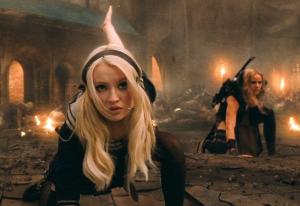
Hmmm…that’s a familiar pose.
Let’s start with a few obvious points. As even those who hate this film seem to be admitting, it’s visually stunning. The battle scenes are kinetic and exciting, the film’s over-the-top production design (a mix of German Expressionism, 50s film noir, Bob Fosse choreography and old Zack Snyder films) is always a blast to look at, and the soundtrack kicks ass. Like other films in the so-called “Girls with Guns” genre, Sucker Punch allows its actresses to be something other than just scenery or helpless damsels.
Interestingly enough, for a film that takes place mostly in the world of fantasy, there’s no attempt to really make this film’s version of “reality” come across as anything other than an elaborate fantasy as well. The film’s opening scenes are played out in slow-motion and the film’s asylum (which, like most movie asylums, appears to have been borrowed from The Cabinet of Dr. Caligari) is so gray that the film might as well be in black-and-white. Blue and Babydoll’s father hold a melodramatic conference while standing directly behind Babydoll, their three heads filling the screen like flashes of manic paranoia. As such, the film — at times — becomes a fantasy taking place in a fantasy taking place in a fantasy. It takes a while for the viewer to get used to this and, at times, it can seem like there’s really nothing to give the film any sort of grounding. However, for me, the opening sequences are not meant to be “real” as much as they serve as a reflection for the way that the real world can imprison anyone but women in particular. As women, we know what its like to look up and suddenly realize that our entire world has somehow become gray and cold without our knowledge. Throughout history, when everything else has been taken away from us, fantasy has been our escape and salvation, our imagination being the one of those precious things that our fathers, our husbands, and our bosses would never be able to deny us.
One problem I did have with the film is that, for all the talk about how Babydoll’s dancing is essential to the escape plan, we never actually see her dance. Instead, we see Browning start to sway a little, her eyes cast down and then suddenly, we’re transported into a fantasy involving zombie Nazis or giant samurai. Once this fantasy mission has been completed, we’re suddenly back in the brothel where we see Babydoll ending her dance while her audience applauds.
To a large extent, I actually agree with Snyder’s approach here because I know, for me much as with the characters in this film, dance always presented an escape from the grayness of being. When I was dancing, I was literally living a fantasy and this seems to be the case with Babydoll as well. However, from simply a cinematic point of view, the constant talk of the importance of Babydoll’s dance leads the audience to naturally expect that they’ll get to see at least a little bit of the dance in question. When you don’t, it’s hard not to feel as if you’ve been teased. (I have to admit, as well, that all this dance talk got my competitive streak going as well. As I whispered to Erin, “They should see me dance.” “It’s a movie, Lisa Marie, not a challenge.” Erin replied.) Snyder, as a director, certainly probably has a strong enough visual sense that he could have found a way to make any dance that Emily Browning came up with look impressive and other worldly.
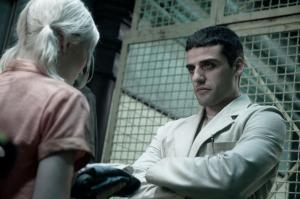
Oscar Isaac
As Arleigh has pointed out on both twitter and this site, Zack Snyder is a director who concentrates almost all of his effort on producing memorable visuals. That’s how he tells his stories and gets the whatever response he wants from his audience. Characters and dialogue are often kept simple so that they don’t get in the way of his visuals. Typically, I hate films like this and I’m hardly a fan of Snyder’s previous work. However, it didn’t bother me so much here, perhaps because I could relate to the overall theme of feeling trapped and needing an escape. (More on that later.) As with previous Snyder films, the performances here are mostly in service of the visuals. The actors don’t so much perform as much as they just pose against the stunning backdrops. As such, Emily Browning, Vanessa Hudgens, and Jamie Chung don’t really get much of a chance to make an individual impression. Playing sisters, Abbie Cornish and Jena Malone don’t have a lot to work with but they both are strong enough personalities that they manage to bring some life to their characters beyond simply serving as figures on a landscape.
(I should also mention — and Arleigh had the same reaction — that Cornish and Malone and their character’s relationship reminded me a lot of my relationship with my older sister, Erin — especially all the times that Rocket attempted to keep things fun and interesting just to be told, by Sweetpea, that she wasn’t being boring enough. I definitely related to that. Erin, for her part, says that she related to all the scenes where Sweatpea nearly got killed “because her bratty, little sister did something stupid that made absolutely no sense.”)
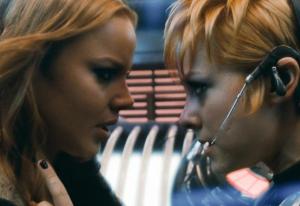
Abbie Cornish and Jena Malone (or Erin and Lisa) In Sucker Punch
I also have to mention Oscar Isaac and Carla Gugino, both of whom seem to understand just how far they can go with their characters without descending to the level of camp. Gugino — after this film, Sin City , and Watchmen — has got to be the Queen of digital filmmaking. She’s also the closest thing that American film has to an old school femme fatale right now. As well, as I told Erin as we watched the film, I can only hope that my tits look that good when I’m 60 years old. And speaking of looking good, Oscar Isaac certainly does look good here. Even when he has dark circles under his eyes and sports a glowering scowl, I would still throw Isaac on the ground and lick his face. Plus, he and Gugino contribute a great performance of Love Is The Drug which plays over the end credits.
Finally, Scott Glenn — looking a lot like the late David Carradine — plays the “Wise Old Man” who pops up as a father figure of sorts in Babydoll’s fantasies. Glenn does okay with his role though I wish his character had been a bit more clear. To be honest, simply from the point of view of empowerment, I kinda wish his character had been known as the “Wise Woman” and had been played by Cate Blanchett.
One huge issue that seems to be coming up a lot when people talk about Sucker Punch is the issue of “empowerment.” Does this film, which indulges in a massive schoolgirl fetish even while portraying girls kicking ass, empower or degrade women? Well, first off, I would suggest that the question itself is an inappropriate one because to argue that a film is either “empowering” or “degrading” and nothing else is basically the same as arguing that all women are going to have the exact same response to what they see regardless of their own life experiences or personal outlook. Quite frankly, because of some of my own personal experiences, I find the infamous, much-maligned 1970s rape/revenge film I Spit On Your Grave to be very empowering and I’m not alone in that regard. At the same time, I also know many very intelligent, very strong women who would consider that film to be anything other than empowering. It’s simply a matter of perspective.
I think the same can be said about Sucker Punch. To me, Sucker Punch was a very empowering film and, honestly, that’s the main reason that I loved it even with its flaws. First off, I think that any film in which women are allowed to do something other than stand around and panic until they’re rescued by a man, is going to be empowering because, far too often, we are taught that waiting for the right man to arrive is the only option available to us. As well, the main theme of Sucker Punch was the theme of escape, whether that escape was physical or mental. While I won’t presume to speak for all women, I can say that for many of us, escape is the usually the root of all fantasy and, at least to some extent, the ultimate goal. As I watched Sucker Punch on Friday night, it seemed to me that, for far too many of us, life is a series of prisons and asylums in which the walls are constructed out of the harsh judgments of patriarchal society. We allow ourselves to become trapped by the need to be a mother or a wife or a nurturer or a seductress or a whatever it is that society says a good woman has to be on any given day. The women in Sucker Punch are imprisoned because they’ve gone against the expectations of society and now, whether being lobotomized or sacrificing their bodies in the fantasy brothel, they are allowing their role and personality to be defined by men. Therefore, when Babydoll and her crew fight for their freedom, we can relate to them because that’s what we have to do every day of our lives.
My Dream Is Yours
But, the argument goes, how this be considered to be empowering when all the female images in the film are so hyper-sexualized? And it’s true that even when the film is supposed to be portraying reality, the camera does linger over the bodies of the actresses. In the brothel sequences, the film often looks like an outtake for some anime-inspired Victoria’s Secret fashion show. (Seriously, this film has a major lingerie fetish but you know what? So do I. Lingerie is fashion poetry and when I’m wearing something pretty, I feel like a poem.) Finally, there’s the image of Babydoll fighting her enemies and dodging explosions while flashing her underwear to the viewer. Many have argued that this is a degrading image, that it encourages male viewers to leer and to ogle.
Well, the fact of the matter is that this film was directed by a man and often times it is obvious that we’re watching the action through a male gaze. But, so what? Just as I believe that women should not be ashamed of their sexuality, I don’t see why men should be expected not to look. (Looking is not the problem. It’s the assumption that the right to look also gives one the right to judge.) And ultimately, I would argue, that being sexy is empowering because society, with its fucked up view of human sexuality in general, is so quick to tell us that the ideal woman is unaware of her sexuality or, at the very least, she should either hide it behind a facade of demure humility or else flaunt it to such an extent as to suggest that it’s all actually a sign of some deeper neurosis. What is rarely given as an option is the idea that we might want to show off a little just as a matter of pride. Men are applauded for showing off their muscles yet we are still expected to blush if we show a little cleavage. Being sexy is not degrading. What’s degrading are the conditions that society has attempted to impose on the right to be sexy. To me, it’s very empowering to see strong, independent women standing up for themselves and looking good while doing it.
Sexual Empowerment
And therefore, for me, Sucker Punch was a very empowering film. It’s entirely possible that this empowerment could be the result of a happy accident and that Snyder had no idea he was actually making a film that celebrated third wave feminism. In fact, I’m sure that’s probably the case.
Even with as much as I enjoyed Sucker Punch, I’m still not really sold on Zack Snyder as a director When his films work, they almost work despite his directorial flourishes than because of them. The slow-mo action thingee was kinda fun at first but now, everyone’s doing it and it’s hard to see why it was so exciting in the first place. Add to that, whenever I hear his name mentioned, I think about the Zach was on both seasons of Paradise Hotel and who, at one point, did this priceless drunken monologue about how he was apparently descended from lawyers. Seriously, he was such a tool. Well, why take my word for it? Here’s a clip of Zach that I found on YouTube…
But anyway, what about Zack Snyder? As I’ve mentioned earlier, there’s a lot of people right now who are gleefully hating on Sucker Punch in general and Zack Snyder in specific. What’s really odd is, to judge from twitter, a lot of these haters are people who previously loved Snyder’s more male-centric films. Which just goes to show what I’ve always said — men suck. Well, that and nothing breeds contempt quicker than success. The fact of the matter is that it was time, in the eyes many, for Snyder to take a fall. Personally, I think Zack Snyder could be a truly noteworthy director but his style — the slow-mo action and all that — is running the risk of becoming less a storytelling tool and more of a nervous tic.
In many ways, Sucker Punch is a happy accident, a film that works despite itself. I think that’s probably why so many male filmgoers are having such a negative reaction to it — in order to surrender to a happy accident, one has to surrender the illusion of control and men aren’t exactly good at that. (Of course, neither are most women but seriously, at least we’ll admit to being lost. I mean, goddamn, guys — if you don’t know where you are, you’re lost. Just deal with it.) I expect to have a lot of people disagree with me concerning my opinion of this film and I expect those same people will probably use Sucker Punch as some sort of code word for a “bad” or “disappointing” film from now until whenever David Fincher releases his Girl with The Dragon Tattoo remake. But I think, as time goes on, Sucker Punch will probably be one of the few Zack Snyder films to truly become a cult film. 300 will be forgotten but Sucker Punch will remain.
I missed out on the initial release for 100 Bullets, but I’ve since rectified that problem.
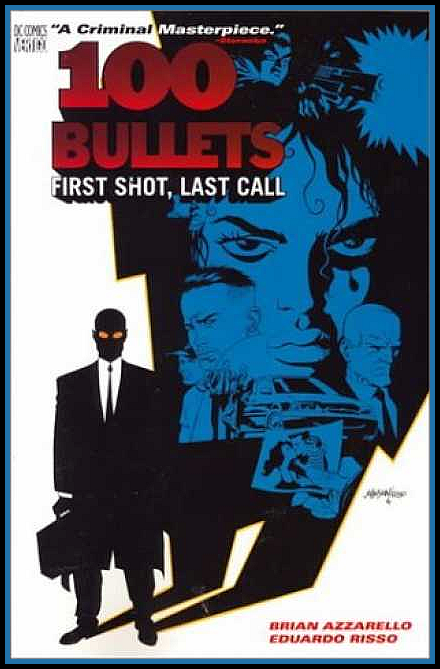
Brian Azzarrello’s 100 Bullets continues the long line of excellent mature comic titles from DC Comic’s Vertigo line. Azzarrello’s hardboiled, crime-thriller noir series brings to mind classic detective-noir works by Hammett, Spillane and Chandler. It’s a more complex continuation of the hyper-noir series Frank Miller began with his Sin City series. I’ve heard people say that this series was better than Sin City and to some respect it was. The stories in each issue contained in this first volume (issues 1 through 5) were abit more complex in nature and execution than Miller’s more simple noir tales. The five stories in this collected volume also laid the basic groundwork for what’ll turn out to be one long-running series lasting exactly 100-issues. Where Sin City‘s simplicity in its storytelling and artwork lay its strength, it’s in the complexities in the tales and the detailed, but economical artwork that 100 Bullets shined through.
In First Shot, Last Call we’re introduced to the gamemaster of the tale: Agent Graves. Looking like an ever-present government agent who has seen all that life has thrown at him and ready for more, Agent Graves picks a recently paroled Latino lass by the name of Dizzy Cordova with a proposition. He offers Dizzy an attache case with a gun and 100 bullets that’re untraceable and definite proof that certain individuals caused her heartache and grief that has ruined her life. He only offers her the attache case, its content and the proof within. The choice is Dizzy’s to make on what she should do with what’s offered her. This set-up and premise is the beauty of 100 Bullets. The story’s basically a morality tale of choices offered to the characters. Will they use the offer to exact vengeance and get away with it scott-free, or will they refuse the offer and live on with their life. The choice of revenge really doesn’t bring back lost time and loved ones and only feeds the need for retribution. Agent Graves doesn’t really force Dizzy’s hand, but a supporting character knowledgable of the offer does — for his own agenda not yet known — prods, pushes and guides her to picking the more primal choice. Dizzy’s choice in the end was both understandable and in the end inevitable.
The second story arc deals with Lee Dolan who also has had his life turned upside-down by people unknown to him. His life and family taken away by the stink of a child pornography accusation in the past. Agent Graves makes him the same offer of the attache case and its untraceable 100 bullets. Dolan’s reaction to this offer is different from that of Dizzy’s, but in the end his ultimate choice doesn’t give him the same resolution and new life path that Dizzy made. It’s a tribute to Azzarrello’s great writing that the decision both Dizzy Cordova and Lee Dolan made were understandable when taken into context of their personalities and yearning to fix the problem that led them to their current state in their lives.
To complement Azzarrello’s words perfectly were Eduardo Risso’s artwork. It would be a misnomer to say that Risso’s art style was minimalist like those of Frank Miller’s woodcut-engraving style for Sin City or Mike Mignola’s chiasroscuro-style for his Hellboy series. There’s a sense of the cinematic in Risso’s work. The scenes were always drawn with a mind for action even when it’s just people standing around. Risso has quite the filmmaker’s eye in how he’s drawn 100 Bullets which just adds to its noirish feel. The characters and environment were drawn not to scale and real-world proportion, but just enough not to look cartoonish. I would agree that there’s an abundance for cleavage on the women drawn, but Risso doesn’t do it gratuitously. Instead he uses this detail to showcase the sexuality of the strong female characters. It paints the female characters like Dizzy Cordova and Megan Dietrich with a sense of both strength and sensuality without pandering to the teenage boy demographic. Plus, he gives these ladies their own personality and character with how he draws them. Dizzy truly has the Latina sensual curves while Megan has the icy-cold Aryan beauty that serves her well.
100 Bullets: First Shot, Last Call was a great discovery and a wonderful beginning to a very mature, intelligent and hardhitting comic series. Congratulations must got to its creator Brian Azzarrello for writing such great characters and memorable stories. I can’t forget the work of his artist and partner-in-crime, Eduardo Risso. Risso’s artwork has stamped themselves in my mind as the only way to see 100 Bullets in. Both Azzarrello and Risso complement each other well and their continued collaboration right up to the end of the series helped make this series one of the best of the past decade.




 Through the Shattered Lens