Made For TV Horror: Death Car On The Freeway (dir by Hal Needham)


I, for one, am tired of the stereotype that women cannot drive.

I’m a woman and I can tell you right now that I am an above average driver.  I’ve only had one major accident.  Admittedly, I did smash into a parked car but it was raining and I really couldn’t see that well because I was driving convertible and the window was fogged up.  Plus, whoever parked that car must have done a bad job and left it sitting out in the middle of the street.  For the record, my convertible flipped over on impact so the parked car did far more damage than I did.

Other than that, I usually manage to stop in time for red lights.  I’ve only driven through a few stop signs and that was just because I didn’t notice them. I’ve very rarely been given a speeding ticket.  Instead, the police have always been very polite about just giving me a warning.  And yes, it is true that I have trouble with curbs and turns and going in reverse and all that but I’ve seen plenty of men do the same thing.

The statistics show that, while women are involved in more accidents, the accidents are more likely to be fatal if a man is driving.  Men are also more prone to get upset and pull a gun during a road rage incident whereas women just give other drivers the finger.  Women are not inherently bad or dangerous drivers.  The one exception, at least down here in Texas, are middle-aged women who drive SUVs with faded Beto stickers.  You really don’t want to get stuck behind one of them in traffic.

I found myself thinking about the misogyny behind the “women-are-bad-drivers” stereotype as I watched 1979’s Death Car On The FreewayDeath Car On The Freeway features a madman who is so sick of women driving in Los Angeles that he starts using his Dodge van to cause them to have accidents.  We don’t actually see his face or really learn much about him.  What we do see are his black-gloved hands on his steering wheel, which is a nifty homage to the giallo genre.  (Giallo killers have a thing for black gloves.)  Whenever the driver does try to force a woman into a fatal accident, he pops in an 8-track of hyperactive fiddle music.  The fiddle has never sounded more menacing than it does in Death Car On The Freeway.  It’s almost like prog rock fiddling.  Imagine a country western fiddler who has just done a mountain of cocaine and you’ll get a feeling for this guy’s taste in music.

News reporter Shelley Hack thinks that the public has the right to know that there’s a man causing women to crash their cars.  Her ex-husband, played to smarmy perfection by George Hamilton, thinks that Shelley should quit her current job and come work with him.  Meanwhile, police inspector Peter Graves is concerned that the media going to start a panic and make it more difficult for him to track down the “Freeway Fiddler.”  (One gets the feeling that Graves feels this entire mess could have been avoided if women had never been allowed to drive in the first place.)  At one point, Hack meets with a defensive driver instructor and he’s played by the film’s director, Hal Needham.

Oh, how I love this film!  Seriously, it’s got car chases, car crashes, 70s outfits, George Hamilton, Peter Graves, and a genuinely frightening villain.  This is one of those films where you might be tempted to be dismissive.  Folks like Dinah Shore, Sid Haig, and Abe Vigoda show up in small roles, reminding you that this really is a 70s made-for-TV movie.  But then, that fiddling explodes on the soundtrack, that van starts tailgating someone, and Death Car On The Freeway suddenly becomes a cinematic nightmare.  It’s not a surprise that Hal Needham was able to stage some impressive driving stunts in Death Car On The Freeway.  That was Hal Needham’s thing.  But Needham also manages to craft a compelling and, at times, genuinely frightening film.  Anyone who has ever glanced into their rearview mirror and suddenly realized that another vehicle is following them will be able to relate to the fear of the Fiddler’s victims.

This is a great movie and a reminder that women are not the most dangerous drivers on the streets.  Unless, of course, they’re driving an SUV with a faded Beto sticker….
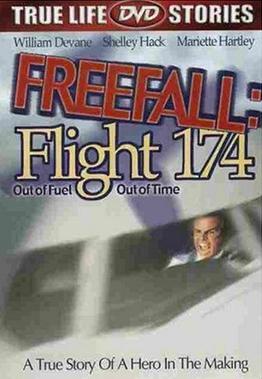
Freefall: Flight 174 (1995, directed by Jorge Montesi)


During a routine flight from Montreal to Edmonton, the two pilots (played by William Devane and Scott Hylands) discover that they do not have enough fuel to make it to their destination.  Their aircraft was one of the first in the fleet to use the metric system but a conversion era led to the ground crew measuring the plane’s fuel in pounds instead of kilograms.  With the help of an air  traffic controller (Nicholas Turturro), the pilots try to land their plane before it falls out of the sky.

Based on a true story, Freefall is one of the many airflight disaster films that were made for television in the 80s and 90s.  (Not surprisingly, the genre became less popular after 9-11.)  The emphasis is on the pilots and ground control remaining calm and professional in the face of seemingly insurmountable odds.  While Devane and Hylands look for a place to land, flight attendant Shelley Hack keeps the passengers from panicking.  In typical disaster movie style, the passengers have their own dramas that are wrapped up as they wait for the plane to either land or crash.  It’s a low-budget movie but the cast does a good job.  William Devane is one of those actors who just looks credible flying an airplane.

The movie’s main lesson?  Don’t use the Metric System unless you absolutely have to,


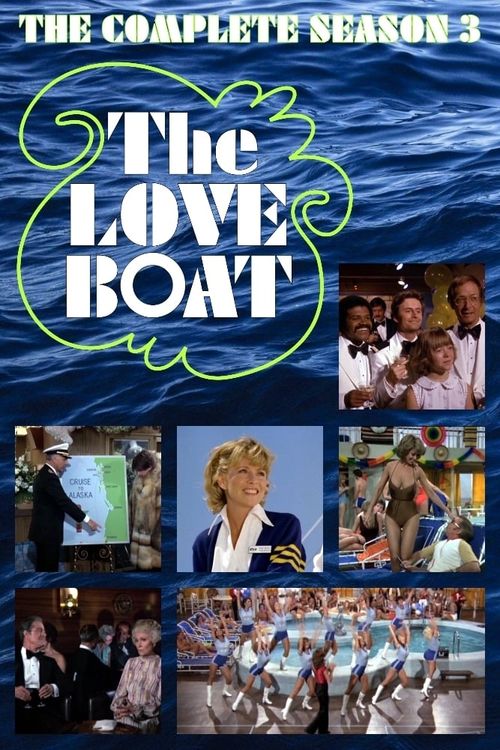
Retro Television Reviews: The Love Boat 3.24 “Dumb Luck/Tres Amigos/Hey, Jealous Lover”


Welcome to Retro Television Reviews, a feature where we review some of our favorite and least favorite shows of the past!  On Wednesdays, I will be reviewing the original Love Boat, which aired on ABC from 1977 to 1986!  The series can be streamed on Paramount Plus!

The week, the crew is surprisingly incompetent.

Episode 3.24 “Dumb Luck/Tres Amigos/Hey, Jealous Lover”

(Dir by Roger Duchowny, originally aired on March 15th, 1980)

The members of the crew really disappointed me this week.

For instance, Gertrude (Jayne Meadows) and Milton Benson (James Gregory) are on the cruise.  Gertrude is friendly and tries to talk to everyone.  Whenever Milton sees any man talking to his wife, he flies into a jealous rage and threatens them.  The crew reacts to this not by telling Milton to calm down but instead, by hiding whenever they see Milton or Gertrude on the boat.  They’re terrified of Milton and yet, somehow, members of the crew keep ending up in the cabin with Gertrude.

Finally, at the end of the cruise, Milton shows up at the captain’s cabin and …. OH MY GOD, HE’S GOT A GUN!  Goper, Doc, Isaac, and Stubing all end up diving to the floor.  Milton explains that he acts jealous because he wants his wife to still feel as if she’s as desirable as the day they first met.  He also says that he’s giving the gun to Stubing as a gift to thank him for the enjoyable cruise.

Later, as she prepares to leave the ship, Gertrude tells Gopher and Isaac that she knows that Milton can be jealous so she specifically dresses as drably as possible so that he won’t have to worry about any other men hitting on her.  In the name of love, she tries to look ugly and he acts like a homicidal lunatic.  Well, whatever works for them!  They seemed to be happy together.  Still, it must be said that the crew could have handled the whole situation better.  Hiding in hallways and under desks is not what I expect from an experienced group of sailors.

Meanwhile, Julie’s friend, Carol Ketay (Shelley Hack), is on the cruise.  Carol is a nuclear physicist and a member of a think tank.  Julie is worried that men are intimidated by Carol being too smart.  Julie also mentions that she’s never had that problem.  Julie takes Carol aside and tell her that she needs to learn how to “talk dumb” if she wants to get a man.  After borrowing a dress from Julie, Carol goes out of her way to sound like an idiot and she immediately catches the attention of Chris (Kevin Tighe).  Chris and Carol have a great time on the ship but Carol is shocked to learn that Chris doesn’t want to date her on dry land because he thinks she’s too dumb.  Carol reveals that she’s actually a nuclear physicist and they leave the boat arm-in-arm.  Good for them!  Julie really gave terrible advice but then again, I think she just wanted her friend to get laid.  She wasn’t really that concerned with Carol getting a long-term relationship.

Finally, Vicki gets to do something this cruise.  She befriends Keith (Ronnie Scribner), the young son of Alice (Jennifer Darling) and Floyd Gaines (John Gabriel).  While exploring the ship, Vicki and Keith meet a young stowaway named Luis (Tony Ramirez).  Though Vicki is not enthused about hiding a stowaway from her father, she still takes a blood oath and promises to protect Luis.  (This would be ground for Vicki being fired if she was actually a paid member of the crew as opposed to just someone who pretends tp have a job.)  As for Keith, he steals $200 from his parents and gives it to Luis.  His parents freak out when they can’t find the money and they accuse the crew of robbing them!  (The crew can’t even handle a jealous husband.  How are they going to steal $200?)  While searching for the money, Gopher and Julie discover Luis.

So, I guess Luis is going into the juvenile justice system, right?  No, not on The Love Boat!  Keith’s parents allow Luis to have the money and Stubing and Vicki pay for Luis’s ticket so Luis is no longer a stowaway.  This storyline was okay.  All of the kids were natural actors so things never got overly cutesy.  That said, I can’t help that notice that a lot of people have stowed away on the ship over the years.  Captain Stubing might want to talk to his crew about that.

Next week …. an agent of Child Protective Services takes a cruise.  Look out, Vicki!

Horror Film Review: Troll (dir by John Carl Buechler)


The 1986 film, Troll, opens with Harry Potter moving into a San Francisco townhouse.

Okay, it’s not that Harry Potter.  Troll was produced long before the first Harry Potter book was even published so it’s fair to assume that it’s just a coincidence that this film — about trolls, magic, and faeries — just happens to feature not just one but two characters named Harry Potter.  Harry Potter, Sr. (Michael Moriarty) is a typical, dorky father figure.  Indeed, he’s such a conventional figure that it’s a bit hard to understand why the always neurotic Michael Moriarty was cast in the role.  Harry’s son is named Harry Potter, Jr. (Noah Hathaway).  Harry, Jr. is a teenager who is shocked by how bratty his little sister, Wendy (Jenny Beck), becomes after the family moves into their new apartment.

Why is Wendy acting like such a brat?  It’s because Wendy has been kidnapped by Torok the Troll (Phil Fondacaro), a grotesque creature who not only abducts Wendy but also steals her appearance so that he can safely move around the world of the humans.  Torok, himself, was once a powerful wizard but, centuries ago, he and an army of faeries tried to destroy all the humans in the world.  Their plan didn’t work and, as punishment, Torok was turned into a troll.

But now, somehow, Torok is free and he’s taking over the apartment building.  One by one, he tracks down each tenant and casts a spell which turns them into a mythological creature, like a gnome or a wood nymph.  All of the apartments turns into lushly overgrown forests.  Among those tenants that get transformed are Sonny Bono and a young Julia Louis-Dreyfus.  I have a feeling that, when Sonny later ran for Congress, he did not include his appearance in Troll in any of his campaign literature.  As for Louis-Dreyfus, she was reportedly angered once when a talk show host (I think it was Jay Leno) showed footage from this film while interviewing her.  It’s not so much that Julia Louis-Dreyfus isn’t a convincing wood nymph as much as it’s the fact that she’s Julie Louis-Dreyfus and it’s just difficult to imagine her appearing in such a stupid role.  This, of course, was her first film and everyone has to start somewhere.

Anyway, realizing that he has to rescue his little sister, Harry Potter, Jr. gets some help from the local witch, Eunice St. Clair (Joan Lockhart).  Eunice gives Harry a magic spear to take with him in his quest.  It’s not really that much of quest, however.  Troll is a low-budget film that was produced by Albert Band so this is not the film to watch if you’re expecting some sort of elaborate fantasy epic.

One positive thing that I will say for Troll is that some of the troll makeup is effective.  The plot maks absolutely zero sense but Director John Carl Buechler specialized in creating memorable monsters on a budget and he manages to do that with Troll.  And, despite all of the people getting turned into monsters, Troll is a largely good-natured film.  It’s not a deliberately cruel or even gory film.  It’s a dumb little horror/fantasy film that features Sonny Bono turning into a plant and Julie Louis-Dreyfus turning into a wood nymph.  It’s dumb but it’s mild and generally inoffensive.

Finally, I should also note that it is in no way connected to Troll 2.  Troll 2, after all, is about goblins.

A Perry Mason Mystery: The Case Of The Wicked Wives (1993, directed by Christian Nyby II)


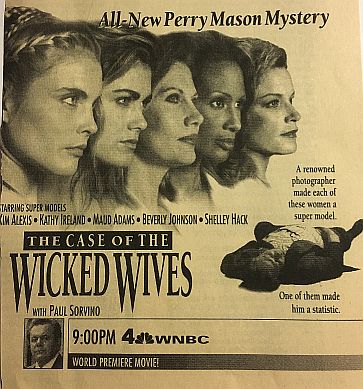
Famed fashion photographer David Morrison (Eric Braeden) has fallen on hard times but things are looking up.  The American Museum of Art wants to do a retrospective of his work.  He just has to get the permission of his current wife, Dee (Kathy Ireland), and his four ex-wives (Shelley Hack, Kim Alexis, Maud Adams, and Beverly Johnson).  All of them are super models who owe their careers to David but four of them hate his guts and Dee isn’t happy when she sees evidence that he has been cheating on her.  When David turns up dead, Dee is arrested.  She claims that she’s innocent but the prosecution is sure that they have an airtight case.

This sounds like a case for Perry Mason!

However, Perry’s out of town so it falls to Perry’s never previously mentioned best friend, Tony Caruso (Paul Sorvino), to solve The Case of the Wicked Wives!  With the help of Perry’s tireless associates, Della Street (Barbara Hale) and Ken Malansky (William R. Moses), Caruso works to solve the case and prove the Dee is innocent.  He also prepares many pasta dinners and frequently sings.

So, where was Perry?  As everyone knows, Raymond Burr played Perry Mason for 9 seasons in the 50s and the 60s.  20 years after the show aired its final episode, Burr returned to the role in a series of highly rated, made for television movies.  Unfortunately, Burr died in 1993 with several movies left to be filmed.  In his will, Burr specifically requested that production on the remaining films continue so that the cast and crew wouldn’t lose their jobs.  Since the role of Mason obviously could not be recast that soon after Burrs’s death, it was decided that the remaining movies would feature guest lawyers.  Enter Paul Sorvino.

The Case of the Wicked Wives was the first Perry Mason film to be made after Burr’s death.  As his replacement, Tony Caruso has much in common with Mason, including the ability to make the guilty confess in open court.  Unlike Mason, Caruso is also obsessed with cooking elaborate spaghetti dinners and singing operatic arias.  This movie came out just a year after Sorvino left Law & Order to specifically pursue his opera career.  Sorvino sings a lot in The Case of the Wicked Wives, sometimes in court.  Unfortunately, a love of singing and pasta are the only two personality traits that are really given to Caruso.  Through no fault of Paul Sorvino’s, Caruso is never as compelling a character as the coolly calculating Mason.  Mason could trick anyone into confessing through perfectly asked questions.  Caruso is more into courtroom stunts that would get most lawyer disbarred.

Because the mystery itself is a dud, the main reason to watch The Case of the Wicked Wives is for the wives.  Who wouldn’t want to keep Kathy Ireland from being wrongly convicted?  All of the wives get at least one big moment to shine and tear up the scenery.  You’ll guess who the murderer is long before anyone else in court.

Wait Until Dark With Shelley Hack: Blind Fear (1989, directed by Tom Berry)


Three criminals, two men and a woman, go from robbing an armored car to invading a seemingly deserted New England inn.  Led by psycho Ed (Kim Coates, of course), they kill the elderly caretaker (Jan Rubes) and then settle in to wait for the arrival of their contact.  However, when a pizza is delivered, they notice that only half of the pizza has anchovies.  “Not everyone likes anchovies!”  Ed declares.  That means that the pizza was ordered for two and there’s someone else in the Inn!

That other person is Erica (Shelley Hack), who was the inn’s switchboard operator.  She’s now hiding in the inn, desperately trying to figure out how to avoid getting captured by Ed and the gang.  Complicating things for Erica is that she’s blind.  Complicating things for the criminals is that they’re no match for her other heightened senses.  While the gang searched the inn, Erica kills the lights and sets some traps of her own.

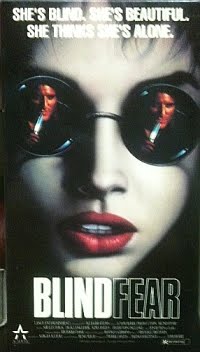
The VHS box art for Blind Fear (which I don’t think has ever been released on DVD), says, “She thinks she’s alone,” which is actually the exact opposite of the film’s plot.  (it also features Erica wearing tinted glasses, something that she doesn’t do in the actual film.) Erica never thinks that she’s alone and spend almost the entire film in hiding because she knows that she’s not alone.  Ed and the criminals briefly think that they’re alone but then the pizza arrives and the anchovies give everything away.  I guess “She thinks she’s alone” sounded better than “Shelley Hack spends 90 minutes in the dark.”

Imagine a remake of Wait Until Dark starring the least interesting star of Charlie’s Angels and you have a pretty good idea of what this efficient but forgettable Canadian thriller is like.  As an actress, Shelley Hack never had much screen presence but she’s not really bad in this movie, in which she spends most of the runtime crawling around in the dark while never getting a single blonde curl out of place.  Not surprisingly, the best performance in the film comes from Kim Coates, who has been playing psychos and lowlifes for almost longer than I’ve been alive.  Nobody does it better than Kim Coates!

Horror Film Review: The Stepfather (dir by Joseph Ruben)


Who is Jerry Blake?

That is the question at the heart of the classic 1987 horror thriller, The Stepfather.

Most of the people who know Jerry (brilliantly played by Terry O’Quinn) would say that he’s just a really nice guy.  He’s responsible.  He’s a good employee.  He can be trusted.  He works in real estate and spends his days selling perfect homes to perfect families.  Jerry always has a friendly smile and hearty manner.  He’s the perfect neighbor, precisely because he’s so boring.  You don’t have to worry about Jerry not taking care of his yard or throwing a loud party or … well, doing anything anyone else would do.  Sure, Jerry seems to be a little bit old-fashioned and sure, sometimes he’s a little bit too good to be believed.  But what’s wrong with that?  I mean, the man makes birdhouses!  Jerry is so dedicated to creating perfect families that he even tries to make the perfect home for the birds in his back yard!

In fact, the only person who seems to have any doubts about Jerry is his new stepdaughter, Stephanie (Jill Schoelen).  Stephanie is a teenager so, occasionally, she’s less than perfect.  Sometimes, she gets into a fight at school.  Sometimes, she talks back.  To be honest, to me, nothing she does seems like it’s really that big of a deal.  But Jerry simply cannot handle the fact that Stephanie is making his new family just a little less than perfect.  When Jerry catches Stephanie and her boyfriend sharing a very chaste kiss, he freaks out.  KISSING!?  Why that could only lead to one thing…

But it’s not just that Jerry is kind of controlling and seems to be living in a 1950s sitcom.  There’s also the fact that sometimes, Jerry goes down in the basement and just starts yelling and throwing stuff.  That’s what Jerry does when he gets angry.  He hides in the basement and he totally loses control.  When Stephanie overhears him, Jerry just gives her a bland smile and says that he was blowing off some steam.

Stephanie suspects that something’s wrong with Jerry but, of course, no one believes her.  However, we know that Stephanie’s right to be suspicious.  At the start of the film, we saw Jerry walking out of his old house, leaving behind the dead bodies of his wife and children.  At that time, of course, Jerry’s name was Henry Morrison.  Henry’s previous family disappointed him so he killed them and then vanished, changing his identity and marrying Stephanie’s mother, Susan (Shelley Hack).

Jerry wants everything to be perfect.  He’s an old-fashioned guy with old-fashioned values and, whenever anyone disappoints him, he kills them and changes his identity once again.  He’s the type who will kill you but then make sure that your seat belt is fastened when he puts you back in your car.  “Buckle up for safety,” Jerry says.

There’s a 2009 remake of The Stepfather.  For some reason, it regularly shows up on Lifetime.  Ignore the remake and track down the original.  Long before he played John Locke on Lost, Terry O’Quinn gave a simply amazing performance in the role of Jerry Blake.  Jerry is so friendly and likable that, even though we know he’s a murderer, it’s still hard not to fall under his spell.

Why, we wonder, can’t the world be as perfect as Jerry wants it to be?

Because Jerry’s world is not the real world.  In the real world, family are never perfect but they love each other anyway.  In Jerry’s world, it’s more important that things appear to be perfect than that anyone actually be honest or, for that matter, happy.

The Stepfather is a chillingly effective thriller, featuring a brilliant performance from Terry O’Quinn.  If you haven’t seen it, see it!

Film Review: The King of Comedy (dir by Martin Scorsese)


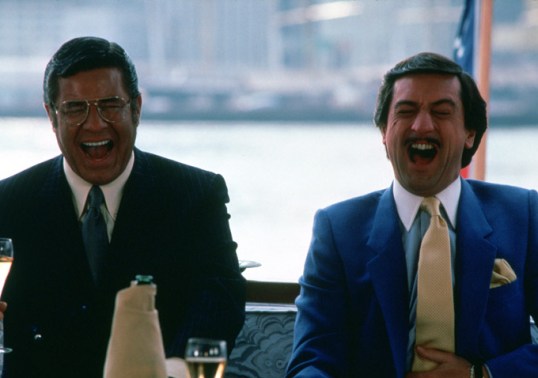
Kingofcomedy

Oh my God, do y’all want to see a really great film?

Then you need to do what I did earlier tonight.  You need to sit down and watch Martin Scorsese’s 1983 media satire, The King of Comedy.

Want to know more about The King of Comedy?  Then read on!  But be aware that there are spoilers in the review below!

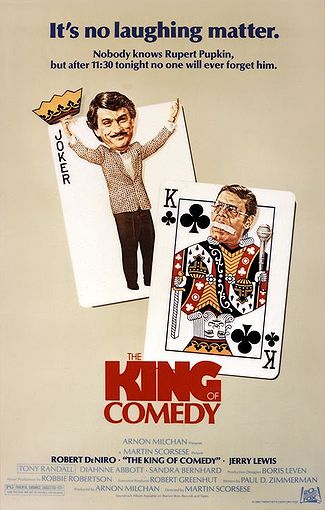
The King of Comedy tells the story of … well, it actually tells the story of several people.  On the one hand, it’s the story of Jerry Langford (played by Jerry Lewis, who gives a performance that is so good that you might even forget that he directed The Day The Clown Cried), a comedian who has his own late night talk show.  Jerry is a celebrity, the type who is mostly famous for being himself.  He makes his living by interviewing people at night but, in his daily life, he struggles to interact with the world at large.  Whenever Jerry steps outside, people start yelling at him.  When he walks away from one elderly fan, she responds by screaming insults at him.  If Jerry seems to be paranoid, it’s because he has good reason to be.

For instance, Masha (a chillingly unhinged performance from Sandra Bernhard) is obsessed with him.  When we first see Masha, she is jumping inside of Jerry’s limousine and refusing to leave.  When she finally gets a chance to be alone with her idol, her manner alternates between desire and hostility.  She may love Jerry but she could just as easily kill him.

And then there’s Rupert Pupkin (Robert De Niro).  Rupert is the character who brings Jerry and Masha together.  He’s a stand-up comedian, the self-described “king of comedy.”  He’s convinced that he can be a star if he can just get on Jerry’s show.  Rupert spends his time imagining the great friendship that he and Jerry could have, if only Jerry would let him on TV.  In his mind, he plays out the scene in which Jerry begs Rupert to take over the show.  Of course, in reality, Rupert lives in his mother’s basement and is surrounded by card-board cutouts of celebs that he will never meet.  When we first see Rupert, his only real skill seems to be the ability to get on everyone’s last nerve.

It’s a little hard to believe now but, when De Niro started his career, he almost exclusively played fuck-ups.  True, he may have won an Oscar for playing Vito Corleone in The Godfather, Part II.  But even while he was playing Vito, he was also playing the erratic and perpetually in debt Johnny Boy in Mean Streets.  In Taxi Driver, he was the delusional Travis Bickle and, in Raging Bull, he was a boxer who managed to alienate just about everyone in the world before finally ending up as an obese self-parody.  But, out of all the fuck-ups that the young(ish) Robert De Niro played, perhaps none was a bigger fuck-up than Rupert Pupkin.

Rupert Pupkin is a character whose sole purpose in life seems to be to make other people cringe with embarrassment.  He is the type of guy who will always come on too strong and say the wrong thing.  Even when Rupert manages to meet Jerry, he is so annoying that Jerry can barely wait to get away from him.  He is the type who asks if you want to see a picture of his “pride and joy” and then shows you a picture of two bottles of dishwashing liquid.  It undoubtedly took some courage to so fully commit to such an off-putting character but that’s exactly what De Niro did.  Rupert is perhaps one of the most annoying characters in cinematic history and yet, perhaps because he’s played by Robert De Niro, you can’t help but feel sorry for him.  You never exactly like him.  But you can’t help but feel a little bit sorry for him.  He is just so clueless!

Of course, what Rupert lacks in common sense, he makes up for in ambition.  He truly believes that he’s destined to be the king of comedy and if he and Masha have to kidnap Jerry Langford for that to happen, so be it.  It is perhaps not surprising that Rupert and Masha would kidnap Jerry and threaten to kill him unless Rupert is invited to appear on the show.  What is surprising is the fact, once we finally see Rupert’s act, we discover that it’s not as bad as we were expecting:

Apparently, when the film was first released, there was some controversy over whether or not Rupert actually appeared on TV and became a star or if it was just another of his delusions.  What’s funny is that there wouldn’t be any controversy today.  In 1983, the idea of someone going to such extremes to be famous may have seemed over-the-top.  In 2016, however, we all know Rupert would eventually end up with his own reality show.  In its way, The King of Comedy is one of the most prophetic films ever made.

The King of Comedy is a great film that, even after all these years, still deserves to be seen.  In fact, it’s probably even more relevant today than when it was first released.

the-king-of-comedy-deniro


Embracing the Melodrama Part II #62: Time After Time (dir by Nicholas Meyer)


TimeAfterTime79So, I just gave the 1979 film Home Before Midnight a fairly negative review but I simply cannot end the 70s section of Embracing the Melodrama on such a negative note!  So, before we move on to the 80s, allow me to suggest another film from 1979 that you could watch while you’re not watching Home Before Midnight!

Time After Time opens in London.  The year is 1893.  Writer H.G. Wells (Malcolm McDowell) is having a dinner party so that he can show off his latest invention, a time machine.  Among his guests is a surgeon named John Stevenson (David Warner).  What nobody at the party suspects is that Stevenson also goes by the name Jack the Ripper and that he enjoys killing prostitutes.  When a detective from Scotland Yard shows up at Wells’s home, Stevenson jumps into the time machine and escapes into the future.  Since Stevenson does not have the “non-return key,” the machine returns back to 1893 but Stevenson has apparently escaped.

Wells uses the machine to pursue Stevenson and soon finds himself in 1979 San Francisco.  Wells had expected to find that the future would be a utopia but instead, he discovers the world of 1979 is loud, polluted, violent, angry, and dangerous.  (Kinda like the world of 2015…)  As Wells pursues Stevenson, he struggles to adjust to the world of the “future,” and he also meets a bank clerk, Amy Robbins (Mary Steenburgen).

Time After Time is probably the sweetest movie ever made about Jack the Ripper and that’s largely because of the romance between both Wells and Amy and the two actors who played them.  After watching Time After Time, I was not surprised to learn that McDowell and Steenburgen got married shortly after appearing in this film.  They were so incredibly sweet together!

Add to that, considering the he’s best known for playing villains and other menacing types, it’s interesting to see Malcolm McDowell plays such a gentle and nice character.  Wells’ befuddlement is charming to watch.  There’s a great scene where Amy calls Wells on a landline phone and Wells stares down at the receiver in frightened amazement.

Time After Time is a really good and likable movie.  It’s sweet and it proves that even hunting for Jack the Ripper can be a romantic experience if it’s done with the right person.  Watch it and enjoy!