Welcome to Retro Television Reviews, a feature where we review some of our favorite and least favorite shows of the past! On Sundays, I will be reviewing Homicide: Life On The Street, which aired from 1993 to 1999, on NBC! It can be viewed on Peacock.
Today, I take a look at the pilot for a show that has been called one of the best of all time.
Episode 1.1 “Gone For Goode”
(Directed by Barry Levinson, originally aired on January 31st, 1993)
The opening credits for the first episode of Homicide: Life on the Street immediately announce that the show is not going to be a typical network cop show. The music starts out as moody and low-key before eventually being dominated by a pulsating beat. The images of dirty streets and crumbling rowhouses and of a dog running around behind a fence are all in black-and-white. The faces of the cast appear, the majority of them in harsh close-up. When viewed today, most of the faces are familiar. Daniel Baldwin, Ned Beatty, Andre Braugher, Clark Johnson, Yaphet Kotto, Melissa Leo, Jon Polito, and Kyle Secor all flash by and the thing that the viewer will immediately notice is that it’s almost as if they’ve been filmed to remove any hint of glamour or attractiveness. (Out of that impressive cast, only Baldwin, Johnson, Leo, and Secor are still with us.)
Gone for Goode tells several stories, introducing the detectives as they investigate various murders in Baltimore. Meldrick Lewis (Clark Johnson) and Steve Crosetti (Jon Polito) are first seen searching for a bullet in a dark alleyway and arguing in only the way that two people who have worked with each other for a long time can argue. Lewis continually refers to Crosetti as a “salami-head,” and Crosetti, who claims that he’s being kept up at night by his doubts about whether or not John Wilkes Booth was actually Lincoln’s assassin, repeatedly says that Lewis will regret that. Later, Crosetti writes a complaint about the ethnic insults that he’s been forced to listen to but apparently, he never actually sends it.
When not arguing with each other, Crosetti and Lewis investigate “Aunt Calpurnia,” who has buried five husbands and whose niece has nearly been murdered three times. Aunt Calpurnia has life insurance policies out on everyone. While digging up Calpurnia’s former husband, Lewis comments that the body in the grave doesn’t look as large as the man in the picture that he’s been given. The cemetery’s caretaker replies, “Nobody stays fat down there.” Technically, that’s true but it also turns out that the wrong man was buried in the grave and the caretaker has no idea where anyone is actually buried.
Detective Felton (Daniel Baldwin) and Detective Howard (Melissa Leo) investigate the murder of a man who was found decaying in a basement. Howard is the primary detective on the case because Felton, being a screw-up, has too many unsolved cases under his name on the dry-erase board that dominates the squad room. Howard currently has a streak of solved homicides and that continues for her when the murderer just happens to call the crime scene and then agrees to come in for a talk.
Detective Stanley Bolander (Ned Beatty) guilts Detective John Munch (Richard Belzer, who would play the same character years later on Law & Order: SVU) into investigating a hit-and-run that happened months ago. Munch, who earlier tells a suspect that he is not Montel Williams (“So don’t like to me like I’m Montel Williams”) and leaves both Bolander and the suspect confused as to who Montel Williams is, eventually discovers that the murder was committed by a brain-dread idiot who can only repeat, “I was drinking,” when he’s confronted with his guilt.
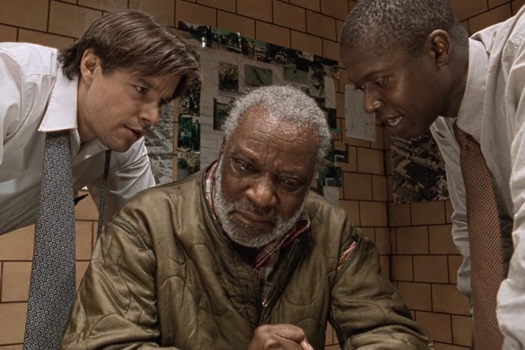
Finally, Lt. Al Giardello (Yaphet Kotto) assigns Felton to work with Frank Pembleton (Andre Braugher), a brilliant but arrogant detective who insists on working alone. Pembleton and Felton’s partnership begins with Pembleton spending an hour in the station’s garage, searching for his squad car because Pembleton forgot to write down the parking space on the back of his keys. (Of course the garage is full of identical white cars.) When Felton says suggests just going upstairs and getting a new set of keys, Pembleton shouts that the next car he tries to unlock could be the right car.
Needless to say, the Pembleton/Felton partnership does not last and Pembleton instead ends up working with an eager newcomer to the squad, Tim Bayliss (Kyle Secor). They two of them work surprisingly well together until Bayliss objects to Pembleton “fooling” a suspect into waving his right to an attorney.
As the episode comes to a close, Bayliss answers his first call in the squad room. At the crime scene, in the middle of a torrential storm, he discovers the body of a small girl.
I have to say that the idea of trying to review Homicide: Life on The Street is a bit intimidating, just because the show has got an almost legendary reputation. It’s often described as being the best cop show of the 90s, as well as being held up as a perfect example of a show that was too good to last. It was never a hit in the ratings and came close to being canceled several times. Because it was filmed in Baltimore, it was viewed as being an outsider amongst the New York and Hollywood-produced shows that dominated the airwaves. Executive produced by Barry Levinson (who also directed Gone for Goode) and based on a non-fiction book by David Simon, Homicide is the show that is often cited as the precursor for The Wire, another show that was loved by the critics but not by its network or the Emmy voters.
The pilot is intriguing, largely because it seems determined to scare off its audience. Unlike other television detectives, who are inevitably portrayed as being crusaders who are obsessed with justice, the detectives in Homicide are a blue collar bunch who, for the most part, are just doing their job. Sure, someone like Frank Pembleton might be brilliant. And Stanley Bolander might truly mean it when he tells Munch that “we speak for the dead.” And Bayliss does seem to be very enthusiastic about being a “thinking” policeman. But the show suggests that most detectives are like Felton, Lewis, and Much. They’re not particularly brilliant and their approach to the job can sometimes seem callous. But occasionally, they get lucky and a murder is solved. Indeed, if there is any real message to the pilot, it’s that criminals are stupid. They get caught not because of brilliant police work but because they do stupid things, like calling the crime scene or failing to ditch the car that they sole.
That said, the pilot also does what a pilot is supposed to do. It introduces the characters and gives them just enough space to make an impression, along with also leaving enough room for them to grow. The characters may not all be instantly likeable but, fortunately, the strong cast holds your interest. The pilot is very much a product of the 90s, with Munch ranting about Montel Williams and Crosetti mentioning Madonna at one point. But, at the same time, it still feels relevant today. Pop culture might change but murder remains the same.