
It’s an understatement to say that Wes Anderson’s films tend to divide viewers. It seems like critics either love his excessively stylized and quirky vision or else they dismiss him as being a pretentious, overrated, and overly concerned with the problems of the rich and the suburban. Even among the writers here at the Shattered Lens, there are conflicting opinions. Leon the Duke gave Moonrise Kingdom a rave review. On the other hand, I know that Ryan The Trashfilm Guru is not particularly a fan of Anderson’s films.
Myself, I always find it usually takes me a while to warm up to an Anderson film. With the exception of The Fantastic Mr. Fox, I always seem to find myself somehow both impressed and slightly disappointed after seeing an Anderson film for the first time. Perhaps it’s because Anderson is such a highly praised director with such a recognizable style that I always tend to go into his film with my expectations set way too high. And so, I often times end up watching the latest Anderson film and thinking about how much I loved the film’s production design and some of the performances but often times feeling that, narratively, there was something missing. On first viewing, Anderson’s trademark quirkiness can be overwhelming. Usually it’s not until a second or third viewing that I really start to appreciate an Anderson film for something more than just the way it looks. Eventually, I came to love Moonrise Kingdom and The Grand Budapest Hotel but it took me a while.
However, there is an exception to every rule. And, as far as my reaction to Wes Anderson’s films are concerned, 1998’s Rushmore is that exception. Rushmore is a film that I have unquestionably loved since the very first time I saw it. Maybe it’s because, while Rushmore is undeniably quirky, that quirkiness doesn’t overwhelm the human aspect of the film’s story. Maybe it’s because Rushmore — along with Bottle Rocket — is the most identifiably Texan of all of Anderson’s films. Or maybe it’s just because Bill Murray gives such a great performance.
Seriously, Bill Murray makes any movie better.
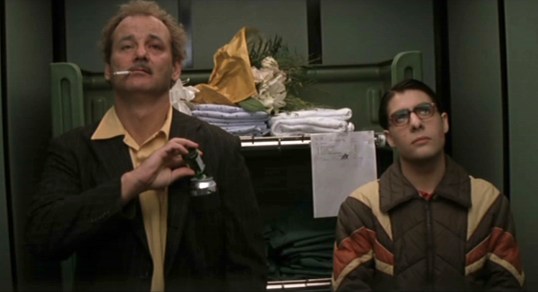
Rushmore is named after Rushmore Academy, a private school in Houston. (Rushmore is quite obviously based on St. Mark’s, which is perhaps the most exclusive private school down here in Dallas. Owen Wilson, who collaborated on Rushmore‘s script with Anderson, was expelled from St. Mark’s in the 10th Grade.) 15 year-old Max Fischer (Jason Schwartzman, who gives a sympathetic performance as a potentially off-putting character) loves attending Rushmore. He’s involved in a countless number of extracurricular activities and has written and directed several plays, the majority of which are based on films from the 70s. (We see his stage version of Serpico and it’s hilarious.)

Unfortunately, Max has a few problems. For one thing, unlike most of his peers, he’s not rich. He tells everyone that his father (Seymour Cassel) is a neurosurgeon but actually, he’s a barber. Even more seriously, Max spends so much of his time starting clubs and writing plays that he doesn’t ever bother to study. Max is on the verge of flunking out and, despite numerous warnings from Dr. Guggenheim (Brian Cox), he refuses to do anything to improve his grades.
Instead, Max is more interested in pursuing a crush he has on an older teacher, the widowed Rosemary Cross (Olivia Williams). What Max doesn’t realize is that his mentor, industrialist Herman Blume (Bill Murray), also has a crush on Ms. Cross.

While Max may be the film’s main character, Herman Blume is, without a doubt, the film’s heart. Blume is a Viet Nam vet (“You were in the shit?” Max asks. “Yes, I was in the shit,” Blume replies) who has literally gone from rags to riches. And now that he is rich, he finds himself living an empty life with a wife who doesn’t respect him and two sons who are total idiots. When Blume starts to mentor Max and pursue Ms. Cross, he starts to care about living once again.
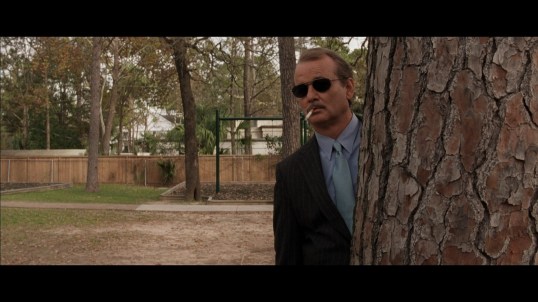
Meanwhile, Max attempts to impress Ms. Cross by building an aquarium on the school’s baseball field. This leads to Max getting expelled and having to enroll in a public school. (Max continues to wear a suit and tie, even after being expelled.) However, Max then discovers that Blume has been seeing Ms. Cross and soon, the mentor and the student become rivals…
And a lot of other stuff happens but you know what? I’m not going to tell you what because if you haven’t seen Rushmore, you need to see it and discover all of this for yourself. You won’t be sorry!
It may be named after the school but Rushmore is ultimately about how love and our dreams make life worth living. For Max, Rushmore is his fantasy ideal, a world that he loves because it provides him a sanctuary from the harshness of the real world. When Mr. Blume says, about Ms. Cross, “She’s my Rushmore,” we understand exactly what he means. But, and this is what distinguishes Rushmore from so many other films about quirky love triangles, is that Ms. Cross is just as independent and important a character as Max and Mr. Blume. Blessed with excellent performances from Seymour Cassel, Brian Cox, Jason Schwartzman, Olivia Williams, and especially Bill Murray, Rushmore is one of Wes Anderson’s best films.

 Edward Furlong is Ron Decker, a spoiled 18 year-old from a rich family who is arrested and sent to prison when he’s caught with a small amount of marijuana. Being younger and smaller than the other prisoners, Ron is soon being targeted by everyone from the prison’s Puerto Rican gang to the sadistic Buck Rowan (Tom Arnold). Fortunately, for Ron, prison veteran Earl Copen (Williem DaFoe) takes him under his wing and provides him with protection. Earl is the philosopher-king of the prison. As he likes to put it, “This is my prison, after all.” If he can stay out of trouble, Ron has a chance to get out early but, with Buck stalking him, that’s not going to be easy.


 Through the Shattered Lens