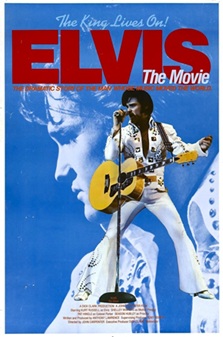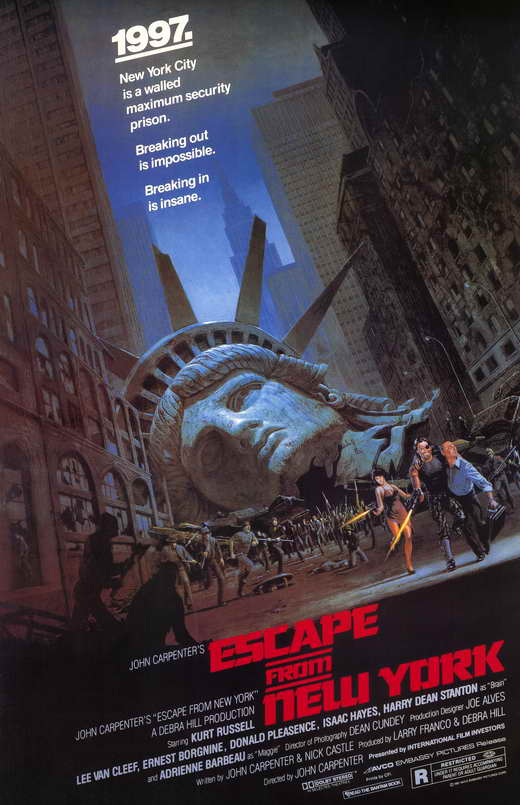
Elvis (1979, directed by John Carpenter)


Elvis, not to be confused with the later film starring Austin Butler, is a historically-interesting film for a number of reasons.

Made for television, it was the first of many biopics to be made about the King of Rock and Roll.  Seeing as how it went into production just a year after Elvis’s death and that its script was vetted and approved by Priscilla Presley herself, it’s not surprising that Elvis doesn’t really delve into the darker aspects of his life.  Elvis shoots a television, gets frustrated with his bad movies, and wonders who he can trust but we don’t see him get fat nor do we see him popping pills.  The movie ends with Elvis making his comeback in 1969, allowing a happy ending for the title character.

The film was directed by John Carpenter.  It was his first film to be released after the monster success of Halloween, though Carpenter actually started work on Elvis before Halloween was released.  Though the film’s television origins means there aren’t many examples of Carpenter’s signature style in Elvis, Carpenter does a good job recreating Elvis’s performances and, most importantly, he comes up with a film that holds your interest for three hours.

Finally, the role of Elvis is played by Kurt Russell, who was at the time still struggling to prove himself as being something more than just a Disney star.  Russell, who made his film debut kicking Elvis in the shins, throws himself into playing the role and captures the look, the swagger, and the voice of Elvis without ever descending into caricature.  His singing voice is dubbed for the performances but Russell is still convincing as the King.  It takes skill to wear that white jumpsuit without looking like you’re wearing a bad Halloween costume.  While this film showed that Russell was capable of more than just Disney films, it even more importantly launched his friendship with John Carpenter.  Escape From New York, The Thing, and Big Trouble In Little China all began with Elvis.

The movie doesn’t really tell us anything that we didn’t already know about Elvis but its entertaining and it has a big, colorful cast that include Pat Hingle as Tom Parker, Shelley Winters as Elvis’s mother, and Bing Russell (Kurt’s father) as Elvis’s father.  Priscilla is played by the beautiful Season Hubley, who married Kurt Russell shortly after filming.  (They divorced in 1983.)  Joe Mantegna, Ed Begley Jr., Ellen Travolta, and Dennis Christopher all appear in small roles and do their part to bring Elvis’s world to life.  Elvis is a fitting tribute to the King of Rock and Roll, one that gave Elvis a happy ending and started a great collaboration between a director and his star.

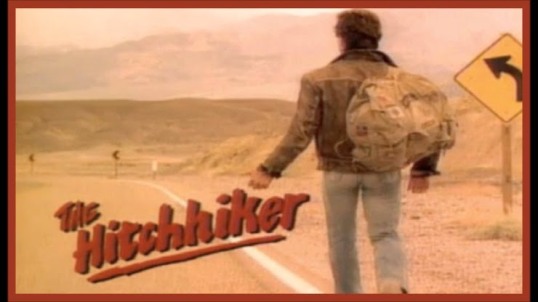
Horror On TV: The Hitchhiker 4.13 “Cabin Fever” (dir by Clyde Monroe)


On tonight’s episode of The Hitchhiker, Michael Woods plays a cocky gigolo who spends the weekend at a cabin with an alcoholic director (Jerry Orbach) and his sultry wife (Season Hubley).  When Hubley suggests that Woods murder her husband, it seems like a standard noir-situation but it become obvious that Orbach is not quite as clueless as Woods assumed.  Who is playing which game?

This is an enjoyable episode, largely due to the performance of the wonderful Jerry Orbach.  This episode originally aired on May 12th, 1987.

Retro Television Reviews: Under the Influence (Dir by Thomas Carter)


Welcome to Retro Television Reviews, a feature where we review some of our favorite and least favorite shows of the past!  On Sundays, I will be reviewing the made-for-television movies that used to be a primetime mainstay.  Today’s film is 1986’s Under the Influence!  It  can be viewed on YouTube!

Noah Talbot (Andy Griffith) is an upstanding member of the community.  He owns a hardware store.  He has a large family.  He’s known as a gruff but folky storyteller.  He’s a deacon in his church and helps to collect the offering every Sunday.

He’s also a drunk and a bit of a bully.  His family walks on eggshells around him, fearful of setting him off on one of his benders.  He occasionally spends the night in jail, arrested for trying to drive drunk.  Even when he gets bailed out, his first instinct is to go back to the bar.  The folks at the bar love him, don’t you know.  The people at the bar are always happy to see him and never bother him about whether he’s had too much.  The people at the bar never let him down the way that he feels his family has left him down.

The members of his family each cope in their own individual way.  Noah’s wife (Joyce Van Patten) is in denial and spends a lot of her time popping pills.  His oldest daughter, Ann (Season Hubley), is driven to succeed at work and spends all of her time both hating her father and desperately hoping for his approval.  (When she tells him that she got a raise at work, he berates her for only getting a 6% increase in her salary.  “That’s just a cost of living increase!” he snaps at her.)  His eldest son, Stephen (Paul Provenza), fled to Los Angeles and is trying to make a career as stand-up comedian.  (“You’re no David Letterman,” Noah tells him.)  His youngest daughter, Terri (Dana Anderson), secretly replaces Noah’s liquor with water and food-coloring.  And his youngest son, Eddie (Keanu Reeves), is becoming an alcoholic himself.

Having read all that, you may be wondering just how exactly Keanu Reeves could be the son of Andy Griffith and it’s a fair question.  This was one Keanu Reeves’s first acting roles and he does a pretty good job in the role of Eddie.  That said, he looks so totally different from both Andy Griffith and Joyce Van Patten and the actors playing his siblings that I was half-expecting someone to mention that Eddie had been adopted.  Then again, Paul Provenza doesn’t really bear much of a resemblance to the actors playing his parents either.  Dana Anderson and Season Hubley do, at least, look like sisters.

Lack of family-resemblance aside, all of the actors in Under the Influence do a good job of inhabiting their characters.  For those who are used to seeing Andy Griffith playing friendly Southerners in reruns of The Andy Griffith Show and Matlock, it’s shocking and a little disturbing to see him playing an abusive, alcoholic jerk in Under the Influence.  Noah is someone who would not only destroy his own family to get a drink but who would then blame them for it happening in the first place.  Noah may be under the influence of alcohol but the entire family is suffering because they’re under the influence of Noah.  By the time Noah is spitting up blood and demanding that his youngest son sneak liquor into his hospital room, the viewer knows there is no hope for Noah but hopefully, his family will escape.

It doesn’t make for a particularly happy movie but, speaking as someone who grew up in an alcoholic household, I can attest that it does make for an honest portrayal of what addiction does not just to the addict but also to the people around the addict.  I cringed in sympathy through nearly the entire film, especially as I watched three of the four children react in the same ways that I did.  (Unlike Eddie, I never became much of a drinker and instead developed an aversion to alcohol in general.)  It’s a film that feels real and one’s heart aches for the entire family.  If it could happen to Andy Griffith, it could happen to anyone.

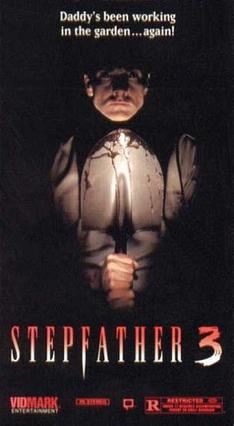
Stepfather III (1992, directed by Guy Magar)


As if Stepfather II was not bad enough on its own, 1992 saw the release of Stepfather III.

Once again, Jerry Blake/Gene Clifford manages to survive being mortally wounded at the end of the previous film.  After he recovers, he is sent to the exact same institution that he previously escaped from.  Guess what happens?  He escapes again!  Now using the name Keith, he marries Christine Davis (Priscilla Barnes) and become stepfather to her son, Andy (David Tom).  Andy is in a wheelchair.  Keith is convinced that Andy is faking his condition and keeps calling him “slugger.”  When Andy doesn’t respond, Keith prepares to move on to another single mother (Season Hubley).  But, before he can move on, Keith needs to take care of his current family.  Good thing that he has a woodchipper.

Terry O’Quinn did not return for Stepfather III.  The Stepfather is played by Robert Wightman, who looked and sounded nothing like Terry O’Quinn.  The film tries to explain it away by saying that the Stepfather got plastic surgery after he escaped from the institution but, unless the plastic surgeon was God, there’s no way that Jerry/Gene could ever have become Keith.

Stepfather III goes through the motions and even repeats the first film’s “buckle up for safety” gag.  By repeating all of the key scenes from the first (and even the second) movie, the third movie only succeeds in reminding us that The Stepfather doesn’t work without Terry O’Quinn’s performance and Joseph Ruben’s intelligent direction.  Keith becomes a standard movie slasher with a wood chipper.  He does inspire Andy to get out of his wheelchair, in a scene that will inspire more laughter than cheers.

One positive note: Season Hubley is in this movie!  Much as with Jill Schoelen in the first movie and Meg Foster in Stepfather II, this franchise had a way of attracting actresses who deserved better.

Dirty Boulevard: George C. Scott in HARDCORE (Columbia 1979)


gary loggins's avatarcracked rear viewer

Cracked Rear Viewer: “Back in the day….”

Dear Readers: (groaning) “There he goes again. Another history lesson!”

CRV: “B-but it’s important to put things in their proper historical context!”

DRs: (sigh) “We guess you’re right. Sorry.”

CRV: (beaming) “No problem! Now, like I was saying…”

Back in the day, every major urban city, and many smaller sized ones, had what was known as a “Red Light District”, where sex workers plied their trade. These streets were loaded with sex shops, peep shows, massage parlors, strip joints, and Triple-X movie palaces, with hookers and drug dealers hawking their wares. New York City had its Times Square/42nd Street area, Boston had The Combat Zone near Chinatown, and Montreal the infamous St. Catherine Street. For Los Angeles, the action was on Sunset Boulevard, and it’s into this seedy milieu that writer/director Paul Schrader plunges George C. Scott in 1979’s HARDCORE, which isn’t about…

View original post 999 more words

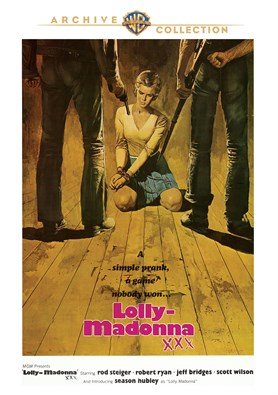
A Movie A Day #354: Lolly-Madonna XXX (1973, directed by Richard C. Sarafian)


In the backwoods of Hicksville, USA, two families are feuding.  Laban Feather (Rod Steiger, bellowing even more than usual) and Pap Gutshall (Robert Ryan) were once friends but now they are committed rivals.  They claim that the fight started when Pap bought land that once belonged to Laban but it actually goes back farther than that.  Laban and Pap both have a handful of children, all of whom have names like Thrush and Zeb and Ludie and who are all as obsessed with the feud as their parents.  When the Gutshall boys decide to pull a prank on the Feather boys, it leads to the Feathers kidnapping the innocent Roonie (Season Hubley) from a bus stop.  They believe that Roonie is Lolly Madonna, the fictional fiancée of Ludie Gutshall (Kiel Martin).  Zack Feather (Jeff Bridges), who comes the closest of any Feather to actually having common sense, is ordered to watch her while the two families prepare for all-out war.  Zack and Roonie fall in love, though they do not know that another Feather brother has also fallen in love with Gutshall daughter.  It all leads to death, destruction, and freeze frames.
Lolly-Madonna XXX is a strange film.  It starts out as a typical hicksploitation flick before briefly becoming a backwoods Romeo and Juliet and finally ending up as a heavy-handed metaphor for both the Vietnam War and the social upheaval at home.  Along with all the backwoods drama, there is a fantasy sequence where Hawk Feather (Ed Lauter) briefly imagines himself as an Elvis-style performer.  (Hawk also dresses up in Roonie’s underwear.)  Probably the most interesting thing about Lolly-Madonna XXX is the collection of actors who show up playing Feathers and Gutshalls.  Along with Steiger, Ryan, Martin, Bridges, and Lauter, everyone from Randy Quaid to Paul Koslo to Scott Wilson to Gary Busey has a role to play in the feud.  Lolly-Madonna XXX is too uneven and disjointed to really be considered a good movie but I can say that I have never seen anything else like it.

One final note: Lolly-Madonna XXX was directed by Richard Sarafian, who is best known for another early 70s cult classic, Vanishing Point.

Embracing the Melodrama Part II #59: Hardcore (dir by Paul Schrader)


Hardcore_(1979_film)

“Turn it off…turn it off…turn it off…TURN IT OFF!” — Jake Van Dorn (George C. Scott) in Hardcore (1979)

Jake Van Dorn (George C. Scott) is a businessman who lives in Grand Rapids, Michigan.  He’s a deeply religious man, a sincere believer in predestination and the idea that only an elite few has been prelected to go to Heaven.  Jake is divorced (though he occasionally tells people that his wife died) and is the father of a teenage girl named Kristen (Ilah Davis).

One of the first things that we notice about Jake is that there appears to be something off about his smile.  There’s no warmth or genuine good feeling behind it.  Instead, whenever Jake smile, it’s obvious that it’s something he does because that what he’s supposed to do.  Indeed, everything Jake does is what he’s supposed to do and he expects his daughter to do the same.

When Kristen goes to a church camp in California, she soon disappears.  Jake and his brother-in-law, Wes (Dick Sargent), fly down to Los Angeles and hire a sleazy private investigator, Andy Mast (Peter Boyle), to look for her.  A few weeks later, Andy shows Jake a pornographic film.  The star?  Kristen.

Jake is convinced that Kristen has been kidnapped and is being held captive.  Wes tells Jake that he should just accept that this is God’s will.  Andy tells Jake that, even if he does find Kristen, Jake might not want her back.  Finally, Jake tells off Wes, fires Andy, and ends up in Los Angeles himself.  Pretending to be a film producer and recruiting a prostitute named Nikki (Season Hubley) to serve as a guide, Jake searches for his daughter.

The relationship between Jake and Nikki is really the heart of the film.  For Jake, Nikki becomes a temporary replacement for his own daughter.  For Nikki, Jake appears to be the only man in the world who doesn’t want to use her sexually.  But, as Jake gets closer and closer to finding his daughter, Nikki realizes that she’s getting closer and closer to being abandoned.

Hardcore is a pretty good film, one that was shot in location in some of the sleaziest parts of 70s Los Angeles.  Plotwise, the film is fairly predictable but George C. Scott, Season Hubley, and Peter Boyle all give excellent performances.  (The scenes were Scott pretends to be a porn producer are especially memorable, with Scott perfectly capturing Jake’s discomfort while also subtly suggesting that Jake is enjoying himself more than he wants to admit.)  And, even if you see it coming from miles away, the film’s ending will stick with you.