4 Shots From 4 Films is just what it says it is, 4 shots from 4 of our favorite films. As opposed to the reviews and recaps that we usually post, 4 Shots From 4 Films is all about letting the visuals do the talking.
Admittedly, the Friday the 13th films aren’t exactly known for being the most visually impressive horror films ever made. That’s especially true of the first 8 films, which were all shot on a low budget and in a hurry. That said, today is Friday the 13th and there’s no way that I, as a lover of the horror genre, couldn’t use the 4 Shots format to pay a little bit of tribute to one of the most successful and influential horror franchises of all time.
So, with that in mind, here are….
4 Shots From 4 Friday the 13th Films
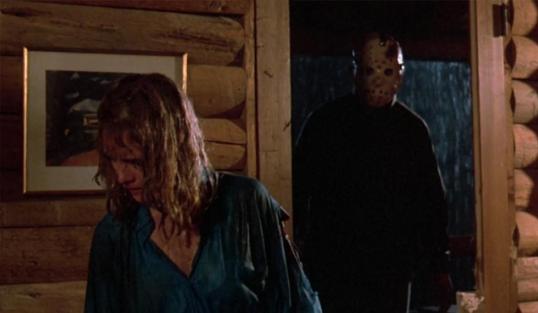
Friday the 13th (1980, dir by Sean S. Cunningham)
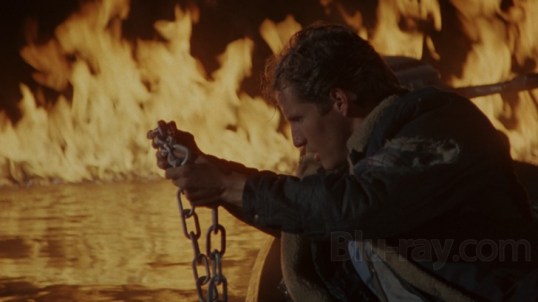
Friday the 13th: The Final Chapter (1984, dir by Joseph Zito)
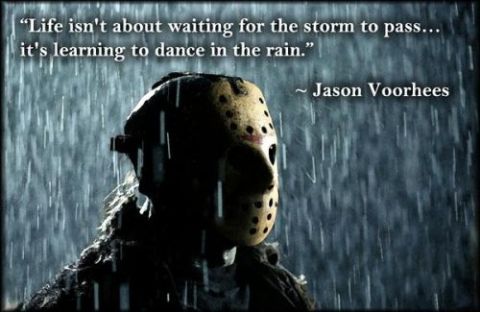
Friday the 13th Part VI: Jason Lives (1986, dir by Tom McLoughlin)
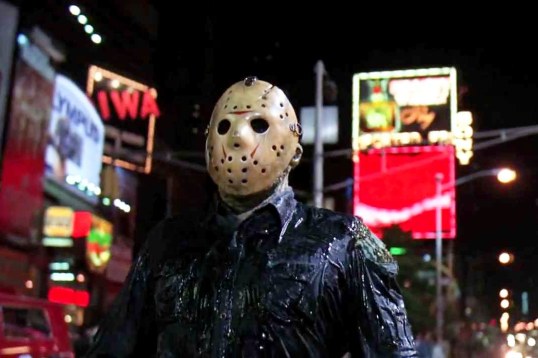
Friday the 13th Part VIII: Jason Takes Manhattan (1989, dir by Rob Hedden)
Back in 2012, I reviewed every single film in the Friday the 13th film franchise! It was a lot of fun!
As we all know, with one notable exception, the majority of the cast of the original Friday the 13th didn’t exactly go on to greater heights of stardom. The movie may have made a lot of money but it didn’t lead to bigger roles for Laurie Bartram and Mark Nelson. When the movie was released in 1980, Betsy Palmer was the best known member of the cast and, according to the book Crystal Lake Memories, the cast of Friday the 13th Part 2 used to joke that maybe the cast of the first film actually had been murdered in the woods because no one ever saw them again.
Of course, today, no one can watch Friday the 13th without saying, “Oh my God, Kevin Bacon’s wearing a speedo!” but, at the time he was cast as doomed Jack, he was just another struggling actor. However, if things had gone as originally planned, today Bacon would not be the only respected actor with Friday the 13th on his resume. When the film was in pre-production, director Sean Cunningham originally tried to get a star to play the role of Alice, the only camp counselor to make it out of Camp Crystal Lake alive.
Who was that star?
Sally Field.
The future multiple Oscar-winner was seriously pursued for the role of Alice. She did not, as some sources claim, audition for the role. Instead, she merely turned it down and went on to win her first Oscar for Norma Rae. Once it became obvious that Field had no interest in going to Camp Crystal Lake, Cunningham decided to go with a cast of unknowns and Adrienne King was given the role of Alice.
Personally, I think that worked out for the best. Not only was Adrienne King perfect for the role but the use of unknowns undoubtedly made the film more effective when it was released. After all, everyone knows that a star is going to survive. (That’s one reason why, when seen today, it’s still jarring to see Kevin Bacon get dispatched.)
Here’s a few more bits of trivia to make your Friday the 13th a good one:
2. After the success of Friday the 13th, Adrienne King was stalked by an obsessed fan and, when she was asked to return for 1981’s Friday the 13th Part 2, she requested that her role be as small as possible. As a result, Alice showed up just long enough to be killed off. Amy Steel replaced King as the film’s heroine. Steel would later go on to star in another classic slasher film, April Fool’s Day.
3. Originally, 1982’s Friday the 13th Part 3 was envisioned with Steel returning to play Ginny. However, Steel turned down the chance to return, leading to the filmmakers instead simply remaking the first film (in 3D!). After being cast in the lead role, Dana Kimmel requested that the sex and drugs featured in the original script be toned down. That’s just one of many reasons why many consider Friday the 13th Part 3 to be the worst film in the series.
4. Even if she didn’t return for Part 3, Amy Steel was instrumental in convincing her friend, actor Peter Barton, to appear in 1984’s Friday the 13th — The Final Chapter. Barton’s likable performance as the handsome but definitely doomed Doug was a highlight of the film. Another highlight was Ted White’s performance as Jason. As opposed to the character he played, White once threatened to quit the film because he didn’t like the way the director was treating the film’s cast.
5. The working title for 1985’s Friday the 13th: A New Beginningwas Repitition. Having killed Jason at the end of The Final Chapter, Corey Feldman returned for a cameo that he shot at the same time that he was filming The Goonies for Richard Donner. Along with the first film, this is the only one to not feature Jason Voorhees committing any murders (unless you count the ones that he committed in Tommy’s nightmare) and the film’s ending was specifically set up so that Tommy could take over Jason’s murderous ways. However, the film’s disappointing box office reception led to Jason returning as a zombie in the next film.
6. With its intentional comedy and its emphasis on action over blood, 1986’s Friday the 13th: Jason’s Lives is a rarity in that it was a Friday the 13th film that actually got somewhat good reviews. John Shepherd, who played Tommy in a New Beginning, was offered a chance to return to the role but turned it down, saying that the film’s went against his religious beliefs. As a result, Thom Matthews was cast as Tommy. Matthews also played the lead in another horror comedy, Return of the Living Dead.
7. 1988’s Friday the 13th Part VII: The New Blood was originally envisioned as being a cross-over with A Nightmare on Elm Street. However, when Paramount (who held the rights to Jason) and New Line Cinema (who held the rights to Freddy) could not come to an agreement, the project was temporarily abandoned. According to Crystal Lake Memories, the film’s executive producer, Barbara Sachs, wanted Friday the 13th Part VII to be the first Friday the 13th to win an Academy Award and came with an extremely ambitious storyline that she envisioned being directed by none other than Federico Fellini. Cooler heads prevailed and, instead, The New Blood found Jason battling a young woman with psychic powers.
8. The initial working script for 1989’s Friday the 13th Part VIII: Jason Takes Manhattanwas entitled “Ashes to Ashes.” The film’s anemic box office convinced Paramount to sell the franchise to New Line Cinema.
9. After New Line purchased the franchise, the first film’s director, Sean S. Cunningham, returned to produce 1993’s Jason Goes To Hell: The Final Friday. Much like The New Blood, this was originally envisioned as being a Freddy vs. Jason film but that plan was, again, abandoned. Freddy Krueger does make one brief appearance, when his clawed hand appears and drags Jason’s hockey mask to Hell. Director Adam Marcus also included a shot of a book that was meant to be the Necronomicon as an attempt to link Jason to the Evil Dead universe as well. Because New Line did not own the rights to Evil Dead, Marcus did not tell them what he was planning to do and instead asked Sam Raimi if he could borrow the prop. Raimi thought it was a great idea. Less amused was Tom Sullivan, the man who actually created the prop and who received no money for its use in Jason Goes To Hell.
10. The 8 year gap between the release of Jason Goes To Hell and 2001’s Jason Xwas a result of Freddy vs. Jason being stuck in development Hell. Jason X was largely produced to keep audiences from forgetting about Jason. Screenwriter Todd Farmer appeared in Jason X, playing a character named Dallas (a nod to the original Alien).
11. After spending two decades in development, 2003’s Freddy vs Jason finally brought the two infamous serial killers together. Kane Hodder, who had played Jason in every film since New Blood, was not asked to return for Freddy vs. Jason, supposedly because the film’s director wanted Jason to tower over Freddy and it was felt that Hodder was not tall enough. At one point, Freddy vs. Jason was envisioned as ending with Pinhead appearing and defeating both of them but New Line could not secure the rights to the Hellraiser character.
12. 2009’s Friday the 13thwas meant to reboot the series. Perhaps the less said about it, the better. Plans for a sequel to the reboot are currently trapped in the same development Hell that once imprisoned Freddy vs. Jason.
This October, I’m going to be doing something a little bit different with my contribution to 4 Shots From 4 Films. I’m going to be taking a little chronological tour of the history of horror cinema, moving from decade to decade.
4 Shots From 4 Films is just what it says it is, 4 shots from 4 of our favorite films. As opposed to the reviews and recaps that we usually post, 4 Shots From 4 Films is all about letting the visuals do the talking.
Happy Thursday the 12th! Guess what tomorrow is? That’s right, it’s Friday the 13th, my favorite day of the year!
These 4 Shots From 4 Films will help you get into the spirit!
4 Shots From 4 Films
Friday the 13th (1980, directed by Sean S. Cunningham)
Friday the 13th Part 2 (1981, dir by Steve Miner)
Friday the 13th: A New Beginning (1985, dir by Danny Steinmann)
Friday the 13th Part 7: The New Blood (1988, dir by John Carl Buechler)
Back in 2012, I reviewed every single film in the Friday the 13th film franchise! It was a lot of fun!
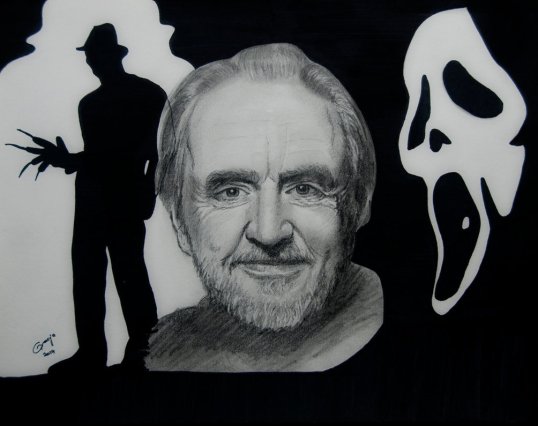
As for me, I’m going to share an anecdote and then, I’m going to pay tribute to Wes with a six trailer salute.
First, the anecdote. I can still remember the first time that I ever watched Last House On The Left. It was a film that I had mixed feelings about. On the one hand, as a horror lover, I could not help but be impressed by the terrifying performances of Fred Lincoln and David Hess. I could not help but by moved by the way Hess’s haunting song, Now You’re All Alone, was used in the film. And, as low-budget and exploitive as the film may have been, I could see that Wes Craven was more interested in critiquing sadism than in celebrating it.
At the same time, it was still an unpleasant film for me, as a woman, to watch and the addition of some clumsy humor pretty much confirmed that Craven was still finding his way as a filmmaker. It was one of those films that I knew, as a horror fan, I had to watch but I wouldn’t say that I enjoyed it.
However, that night, I did end up watching the movie twice. I watched it a second time so that I could listen to the commentary from Wes Craven and producer Sean S. Cunningham. And — oh my God — both of these guys were so funny and charming! Craven, especially, seemed to enjoy pointing out scenes that didn’t quite work and the frequently awkward dialogue that he had written. Craven and Cunningham both came across as being two of the nicest guys in the world and it was indeed an experience to hear them cheerfully talking while these absolutely vile images were flickering by onscreen.
And really, that taught me an important lesson and it’s one that I remember to this day. Whenever I hear some judgmental know-it-all claiming that only a sick person could direct or write a horror movie, I remember that charming Wes Craven audio commentary.
And now, here are six trailers for six of Wes Craven’s films.
I think I may have made a mistake. When I started reviewing beach films, I did so because it’s currently spring break for thousands of college students across the country and, right now, they’re all probably having a good time on the beach. Unfortunately, what I didn’t consider was that watching and reviewing these films would make me start to wish that I was currently there with them.
Don’t get me wrong. It’s not that I want to go hang out on the beach and party and flirt and get high and live for the moment and … well, no, actually, that’s exactly what I wish I was doing right now. None of the beach films that I’ve watched so far have been good exactly but they do all get at a larger truth.
We all need some sort of spring break.
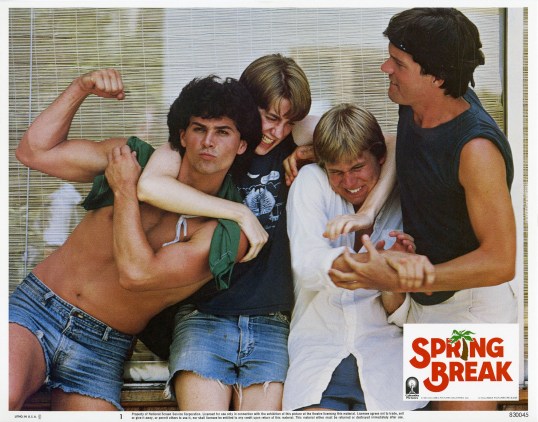
That’s certainly the theme of the 1983 comedy, Spring Break.
The heroes of Spring Break
Perhaps the most surprising thing about Spring Break is that, unlike Malibu Beach and The Beach Girls, it was not produced by Crown International Pictures. It certainly feels like a Crown International movie. The film is a largely plotless collection of scenes, all of which take place over the course of spring break in Ft. Lauderdale. It starts out as a comedy and then gets strangely dramatic towards the end. It features a lot of nudity for male viewers but luckily, it has two hot guys for me so it all works out in the end.
Two nerdy students, Nelson (David Knell) and Adam (Perry Lang) go down to Florida for spring break. Nelson does this despite the fact that he had promised that he would spend spring break working on his politically ambitious stepfather’s campaign. When Nelson and Adam’s picture ends up in the paper, Nelson’s stepfather (Donald Symington) sends his operatives down to Florida to basically kidnap Nelson and drag him home. Along the way, the stepfather also somehow gets involved in a plot to take over the motel where Nelson and Adam are staying.
Uhmmm…what?
Yes, it doesn’t make much sense but then again, the plot is never that important in these type of films. What is important is that the motel is overbooked and, as a result, Nelson and Adam find themselves roommates with two hot guys from New York, Stu (Paul Land) and O.T. (Steve Bassett).
One thing that I did like about this movie is that it didn’t waste any time pretending that Stu and O.T. wouldn’t become best friends with Nelson and Adam. Instead, the four of them start bonding as soon as they meet and they were all best friends within the first 15 minutes of the film. Yay for another successful bromance! But seriously, it is kind of sweet.
And it’s also fortunate because, once Nelson is kidnapped and held prisoner on a boat by his stepfather, who better to rescue him than two guys from Brooklyn?
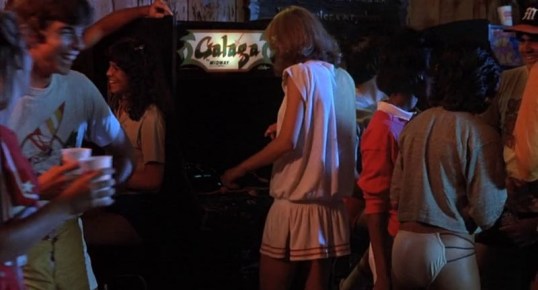
Yes, it’s all pretty stupid but, as far as teen sex comedies from the early 80s are concerned, this is one of the better of them. At the very least, Knell and Lang are both likeable and Land and Bassett are both hot and that really is about the best that you can hope from a film like this. Add to that — and this is a theme that I seem to keep returning to as far as these beach films are concerned — Spring Break is a time capsule. Though Spring Break was released before I was born, I feel like, having seen it, that I now have some firsthand experience of what it was like to be alive in 1983.
So 80s….
As I mentioned at the start of this review, Spring Break feels like a Crown International Picture but, actually, it was released by Columbia Pictures. And it was directed by Sean S. Cunningham, who is probably best known for directing the original Friday the 13th! Harry Manfredini even provided the music for both films. That said, the fun-loving teenagers of Spring Break come to a much happier end than the ones at Camp Crystal Lake.
This month, the 13th is going to fall on a Friday so I figured what better time would there be to watch and review the Friday the 13th franchise? Through April 13th, I’ll be reviewing each film in the franchise. Some of these reviews will be positive and quite a few of them will not. Let’s get things started with the one that started it all, the original 1980 Friday the 13th.
Is there anyone out there who does not know the plot of Friday the 13th? For those who don’t, here’s a spoiler-filled refresher. In the late 50s, at the rather crummy looking Camp Crystal Lake in New Jersey, two counselors sneak off from a sing-along so that they can do whatever it was that young people used to do in the 50s. Suddenly, someone else walks into the room. “Uhmm, we weren’t doing anything,” one of the counselor says right before a machete is plunged into his stomach.
Jump forward 25 years. Annie (Robbi Morgan), a bubbly young woman who won’t stop talking about how much she loves children, hitchhikes into Crystal Lake. She tells the townspeople that she’s looking for a ride to Camp Crystal Lake and everyone give her that “Oh no you didn’t” look. Crazy old Ralph (played by Walt Gorney) tells her, “You’re doomed.” Since this is a slasher film, Annie ignores him and ends up getting her throat slashed in the woods by an unseen assailant wearing black gloves.
Meanwhile, at Camp Crystal Lake, the somewhat jerky Steve Christy (played by an actor named Peter Brouwer who never gets enough credit for giving a good performance here) is working hard to get the long-since deserted camp up and ready for its grand reopening. Helping him out are his fellow camp counselors — lovers of life and fun Marcie (Jeannine Taylor) and Jack (The Kevin Bacon, who is like such a total hottie in this film I don’t even know where to start), boring Bill (Harry Crosby), bossy meanie Brenda (Laurie Bartram), obnoxious practical joker Ned (Mark Nelson), and finally Steve’s girlfriend, Alice (Adrienne King). Steve tells his counselors to get the camp ready and then heads off to pick up supplies in town. (Or at least, that’s what Steve says he’s doing. As far as I can tell, the only thing he does when he gets to town is head over to the local diner and start flirting with the 90 year-old waitress…)
With jerky old Steve gone for the day, the counselors decide to spend their time swimming (and, in Ned’s case, pretending to drown), having sex, smoking pot, and eventually getting killed one-by-one by an unseen murderer. Eventually, once Alice is the only counselor left alive, she runs into a nice, older woman named Pamela Voorhees (played, with a lot of genuine menace, by Betsy Palmer). When Alice explains that everyone’s dead, Pamela responds by mentioning that her own son — Jason — drowned at the camp 25 years ago because the counselors were too busy “making love.” Pamela then tries to kill Alice and Alice ends up chopping Pamela’s head off and then floating out onto the lake in a canoe. (Meanwhile, the camp is nowhere close to being ready for opening day.)
The next morning, Alice wakes up in the canoe and spots a bunch of police officers on the shore. As she starts to call out to them, a deformed boy suddenly jumps out of the water and grabs her. This, of course, is one of the most famous scenes in the history of horror and one that has been parodied and ripped off numerous times. However, when I first saw Friday the 13th, that scene made me scream and, even today, I still find my heart racing just a little bit faster whenever I know that it’s coming up.
The first time I ever saw the original Friday the 13th, I was either 8 or 9 and it was all incredibly daring because I was staying up way too late with my older sisters and watching a cable station for grownups that I knew I wasn’t supposed to be watching. We didn’t want to wake up mom or dad so we had the volume turned down as low as it would go and we whispered our comments of “Ewwww!” and “Agck!” (Yes, even at the age of 8, I was already saying “agck.”) Even though I couldn’t hear the film, I could see it and the end result was thatm when I did eventually go to sleep, I was awake after about an hour, screaming because I had a Friday-inspired nightmare. I doubt that the movie would scare me as much today because today,I know who Tom Savini is and, if I need proof that Kevin Bacon was actually not killed by Mrs. Voorhees hiding underneath the bed, I can watch my DVD of Crazy,Stupid Love. But when I was younger, Friday the 13th was the fuel of nightmares and, seeing as I’ve always had my little morbid streak, I think that’s why the franchise continues to interest me.
If there’s one thing that everyone seems to agree about when it comes to Friday the 13th, it’s that the true stars of the film were the disturbingly plausible gore effects designed Tom Savini. Even when I rewatched the film before writing this review, I was surprised by not only just how bloody a movie Friday the 13th was but also at how realistic it all looked (especially when compared to the intentionally over-the-top gore effects that Savini provided for Dawn of the Dead). There’s a surprising brutality to the film that reminds us that — unlike future installments in the franchise — the original Friday the 13th was not made for mainstream audiences but instead for the audiences who populated New York grindhouses and dark Southern drive-ins. The special effect that every other reviewer always seems to point out is the scene where the arrow bursts through Kevin Bacon’s neck. While that scene is indeed shocking (and sad too, because it’s Kevin Bacon dying), I’m always more disturbed by the scene that immediately follows, where Marcie gets hit in the face with the axe. That’s the scene that showed up in my nightmare after I watched the film for the first time.
Director Sean Cunningham has said, in numerous interviews, that he was inspired to make Friday the 13th largely because of the box office success of Halloween and there are some pretty obvious similarities between the two films. What is less often commented upon is just how much of the original Friday the 13th was inspired by the Italian giallo films of Mario Bava and Dario Argento. Whether it’s the focus on the killer’s black gloves or the use of Harry Manfredini’s iconic theme to signal when something bad is about to happen, the giallo influence is pretty obvious. Sean Cunningham was hardly an innovative director but when he stole, he stole from the best and the end result, crude as it may have sometimes been, was undeniably effective.
In Peter Bracke’s fascinating history of the franchise, Crystal Lake Memories, there’s an interesting quote from Jeannine Taylor, the actress who played Marcie. When discussing her reaction after first reading the script, Taylor says, “To me, this was a small independent film about some very carefree teenagers who are having a great time at summer camp where they happen to be working as counselors. Then they just happen to get killed.” Taylor’s comment gets at one reason why Friday the 13th — out of all the slasher films to come out after Halloween — continues to be watched by even people like me who weren’t even alive when it was first released. Uniquely among the films in the franchise, Friday the 13th is a true ensemble film and, though the performances are somewhat uneven and the characters are pretty one-dimensional, the cast has an easy and likable chemistry. Watching the film today, it’s a bit hard not to concentrate on the fact that you’re seeing Kevin Bacon in a low-budget slasher film but once you get over that, you realize that Bacon and the entire cast are totally believable as bunch of likable, carefree kids who end up in the wrong place at the wrong time. A lot of critics have complained that the first half of the film drags as we just watch everyone goofing off around camp. To me, those early scenes make the film because they get us to care about the characters just enough so that we don’t necessarily want to see them killed.
Another frequent critical complaint is that it’s difficult to have much sympathy for characters who consistently do stupid things that ultimately lead to them getting killed. Viewers tend to shake their heads as they watch Ned go wandering into a deserted cabin or when Brenda just happens to wander out on the archery range. Myself, I always tend to roll my eyes whenever the film reaches the point that Marcie decides to run out into the rainy night in just her panties and a shirt. I always find myself going, “Yeah, like anyone’s really that stupid…”
Of course, even as I type this review, I’m thinking about how, a few nights ago, I thought I heard a catfight at 3 in the morning and my immediate response was to run outside and walk up and down in the alley, wearing only a t-shirt and a thong, calling my cat’s name.* Even as I searched for our cat, I found myself muttering, “This is like a slasher movie waiting to happen.” However, I still kept wandering around that alley in my half-naked state because, at the time, I was pretty confident that there weren’t any masked maniacs around.
That’s what people who criticize films like Friday the 13th for featuring stupid characters refuse to admit. We all do more stupid things than we care to admit because we’re usually pretty confident that there won’t be any negative consequences to our stupidity. We all know that there are evil psychopaths out there but we’re also confident that we won’t run into them. The reason why the slasher genre has remained popular is because it forces us to confront our deepest fear, which is that we might not be as safe or have as much control over our fate as we tell ourselves.
Not surprisingly, Friday the 13th and its subsequent sequels has never been as popular with critics as they have with audiences. In fact, critical reaction upon the initial release of Friday the 13th was so hostile that one critic even printed Betsy Palmer’s address and invited outraged filmgoers to write her letters of protest. The standard critical complaint about Friday the 13th was that it presented death as a punishment for having sex and smoking weed and here I would say that the critics were mistaken. While it is true that Jack and Marcie die after doing both of these things, I think there’s actually a far more relevent message to be found within the film. Consider this: Ned dies after he spots someone in a deserted cabin and says, “Can I help you?” Steve Christy is killed because he spots someone out in the rain and approaches them, saying, “What are you doing out in this mess?” Brenda thinks that she hears a child crying for help outside of her cabin and foolishly goes walking around in the middle of hurricane in her nightgown, calling out, “Hello!?” until she’s killed off-screen. What the critics, so caught up in their moral panic, failed to understand was that the message of Friday the 13th is not that people shouldn’t have sex. The message is that people shouldn’t offer to help random strangers.
Despite the amount of critical scorn heaped upon it, Friday the 13th was a box-office success and the 18th highest grossing film of 1980. At the time, for a low-budget, independent film, this was highly unusual. Despite the fact that Friday the 13th ended with Mrs. Voorhees losing her head and Jason still in that lake, there would be a Friday the 13th Part 2.
We’ll deal with that tomorrow. Until then, don’t help any random strangers…
——
*Doc, our cat, was fine, by the way. It turned out, he was sitting in the kitchen the whole time I was outside desperately searching for him.
It seems like I’m always taking a chance when I listen to a DVD commentary track. Occasionally, a commentary track will make a bad film good and a good film even better. Far too often, however, listening to a bad or boring commentary track will so totally ruin the experience of watching one of my favorite movies that I’ll never be able to enjoy that movie in the same way again. I’ve learned to almost always involve any commentary track that involves anyone credited as being an “executive producer.” They always want to tell you every single detail of what they had to do to raise the money to make the film. Seriously, executive producers suck.
However, there are more than a few commentary tracks that I could listen to over and over again. Listed below are a few of them.
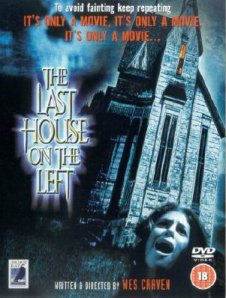
10) Last House On The Left (The Original) — Apparently, there’s a DVD of this film that features a commentary track in which stars David Hess and Fred Lincoln nearly come to blows while debating whether or not this movie should have been made. The DVD I own doesn’t feature that commentary but it does feature a track featuring writer/director Wes Craven and producer Sean S. Cunningham. The thing that I love about their commentary is that they both just come across as such nice, kinda nerdy guys. You look at the disturbing images onscreen and then you hear Cunningham saying, “We shot this scene in my mom’s backyard. There’s her swimming pool…” Both Craven and Cunningham are remarkably honest about the film’s shortcomings (at one point, Craven listens to some of his more awkward dialogue and then says, “Apparently, I was obsessed with breasts…”) while, at the same time, putting the film’s controversy into the proper historical context.
9) Burnt Offerings— When Burnt Offerings, which is an occasionally interesting haunted house movie from 1976, was released on DVD, it came with a commentary track featuring director Dan Curtis, star Karen Black, and the guy who wrote the movie. This commentary track holds a strange fascination for me because it, literally, is so mind-numbingly bad that I’m not convinced that it wasn’t meant to be some sort of parody of a bad commentary track. It’s the commentary track equivalent of a car crash. Curtis dominates the track which is a problem because he comes across like the type of grouchy old man that Ed Asner voiced in Up before his house floated away. The screenwriter, whose name I cannot bring myself to look up, bravely insists that there’s a lot of nuance to his painfully simple-minded script. Karen Black, meanwhile, tries to keep things positive. The high point of the commentary comes when Black points out that one actor playing a menacing chauffeur is giving a good performance (which he is, the performance is the best part of the movie). She asks who the actor is. Curtis snaps back that he doesn’t know and then gets testy when Black continues to praise the performance. Finally, Curtis snaps that the actor’s just some guy they found at an audition. Actually, the actor is a veteran character actor named Anthony James who has accumulated nearly 100 credits and had a prominent supporting role in two best picture winners (In the Heat of the Night and Unforgiven).
8 ) Cannibal Ferox — This is a good example of a really unwatchable movie that’s made watchable by an entertaining commentary track. The track is actually made up of two different tracks, one with co-star Giovanni Lombardo Radice and one with director Umberto Lenzi. Lenzi loves the film and, speaking in broken English, happily defends every frame of it and goes so far as to compare the movie to a John Ford western. The wonderfully erudite Radice, on the other hand, hates the movie and spends his entire track alternatively apologizing for the movie and wondering why anyone would possibly want to watch it. My favorite moment comes when Radice, watching the characters onscreen move closer and closer to their bloody doom, says, “They’re all quite stupid, aren’t they?”
7) Race With The Devil— Race with the Devil is an obscure but enjoyable drive-in movie from the 70s. The DVD commentary is provided by costar Lara Parker who, along with providing a lot of behind-the-scenes information, also gets memorably catty when talking about some of her costars. And, let’s be honest, that’s what most of us want to hear during a DVD commentary.
6) Anything featuring Tim Lucas — Tim Lucas is the world’s foremost authority on one of the greatest directors ever, Mario Bava. Anchor Bay wisely recruited Lucas to provide commentary for all the Bava films they’ve released on DVD and, even when it comes to some of Bava’s lesser films, Lucas is always informative and insightful. Perhaps even more importantly, Lucas obviously enjoys watching these movies as much as the rest of us. Treat yourself and order the Mario Bava Collection Volume 1 and Volume 2.
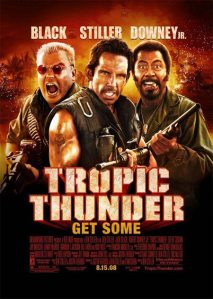
5) Tropic Thunder— The commentary track here is provided by the film’s co-stars, Jack Black, Ben Stiller, and Robert Downey, Jr. What makes it great is that Downey provides his commentary in character as Sgt. Osiris and spends almost the entire track beating up on Jack Black. This is a rare case of a great movie that has an even greater commentary track.
4) Strange Behavior— This wonderfully offbeat slasher film from 1981 is one of the best movies that nobody seems to have heard of. For that reason alone, you need to get the DVD and watch it. Now. As an added bonus, the DVD comes with a lively commentary track featuring co-stars Dan Shor and Dey Young and the film’s screenwriter, Bill Condon (who is now the director that Rob Marshall wishes he could be). Along with providing a lot of fascinating behind-the-scenes trivia, the three of them also discuss how Young ended up getting seduced by the film’s star (Michael Murphy, who was several decades older), how shocked Condon was that nobody on the set seemed to realize that he’s gay, and why American actors have so much trouble speaking in any accent other than their own. Most memorable is Young remembering the experience of sitting in a theater, seeing herself getting beaten up onscreen, and then listening as the people sitting around her cheered.
3) Imaginationland — As anyone who has ever listened to their South Park commentaries knows, Matt Stone and Trey Parker usually only offer up about five minutes of commentary per episode before falling silent. Fortunately, those five minutes are usually hilarious and insightful. Not only are Parker and Stone remarkably candid when talking about the strengths and weaknesses of their work but they also obviously enjoy hanging out with each other. With the DVD release of South Park’s Imaginationland trilogy, Matt and Trey attempted to record a “full” 90-minute commentary track. For the record, they manage to talk for 60 minutes before losing interest and ending the commentary. However, that track is the funniest, most insightful 60 minutes that one could hope for.
2) Donnie Darko — The original DVD release of Donnie Darko came with 2 wonderful commentary tracks. The first one features Richard Kelley and Jack Gyllenhaal, talking about the very metaphysical issues that the film addresses. Having listened to the track, I’m still convinced that Kelley pretty much just made up the film as he went along but its still fascinating to the hear everything that was going on his mind while he was making the film. However, as good as that first track is, I absolutely love and adore the second one because it features literally the entire cast of the movie. Seriously, everyone from Drew Barrymore to Jena Malone to Holmes Osborne to the guy who played Frank the Bunny is featured on this track. They watch the film, everyone comments on random things, and it’s difficult to keep track of who is saying what. And that’s part of the fun. It’s like watching the film at a party full of people who are a lot more interesting, funny, and likable than your own actual friends.
1) The Beyond — This movie, one of the greatest ever made, had one of the best casts in the history of Italian horror and the commentary here features two key members of that cast — Catriona MacColl and the late (and wonderful) David Warbeck. The commentary, which I believe was actually recorded for a laserdisc edition of the film (though, to be honest, I’ve never actually seen a “laserdisc” and I have my doubts as to whether or not they actually ever existed), was recorded in 1997, shortly after the death of director Lucio Fulci and at a time when Warbeck himself was dying from cancer. (Warbeck would pass away two weeks after recording this commentary). This makes this commentary especially poignant. Warbeck was, in many ways, the human face of Italian exploitation, a talented actor who probably deserved to be a bigger star but who was never ashamed of the films he ended up making. This commentary — in which MacColl and Warbeck quite cheerfully recall discuss making this underrated movie — is as much a tribute to Warbeck as it is to Fulci. Highpoint: MacColl pointing out all the scenes in which Warbeck nearly made her break out laughing. My personal favorite is the scene (which made it into the final film) where Warbeck attempts to load a gun by shoving bullets down the barrel. The wonderful thing about this track is that Warbeck and MacColl enjoy watching it too.






 Through the Shattered Lens