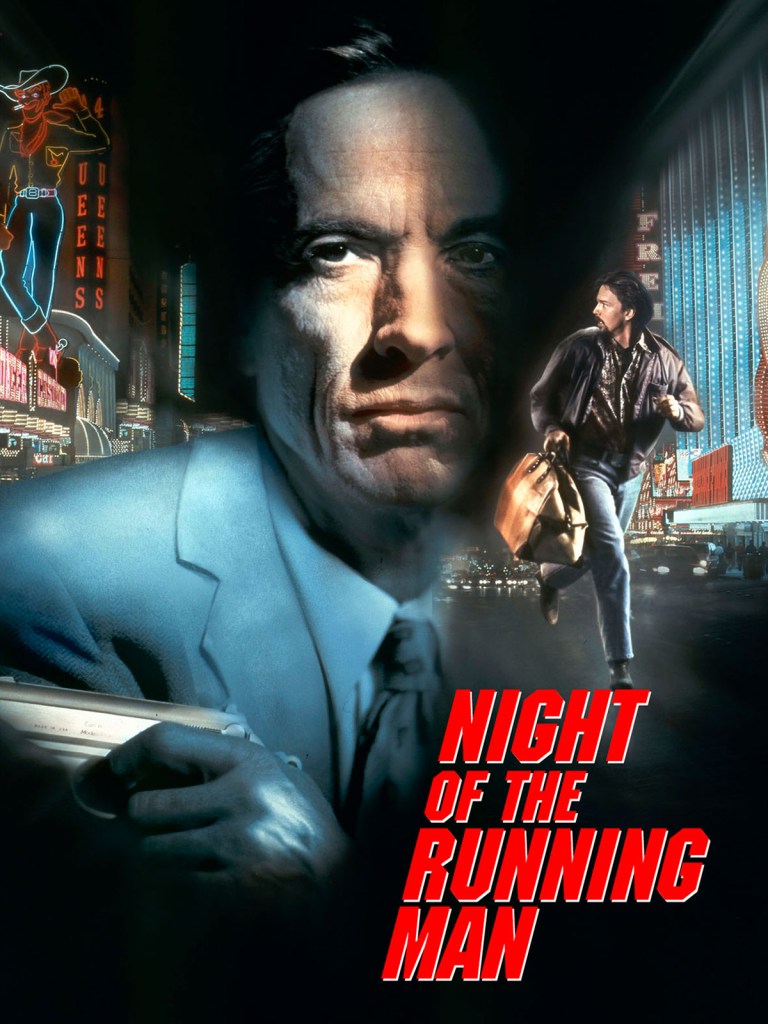
Every Monday night at 9:00 Central Time, my wife Sierra and I host a “Live Movie Tweet” event on X using the hashtag #MondayMuggers. We rotate movie picks each week, and our tastes are quite different. Tonight, Monday January 6th, we’re watching NIGHT OF THE RUNNING MAN, starring Scott Glenn, Andrew McCarthy, and John Glover.
In a nutshell, this movie is about a Las Vegas cab driver (McCarthy) who discovers a million dollars of stolen money in his cab. He is then tracked by a relentless and cold-blooded assassin (Glenn) sent to retrieve the money.
So why did Sierra pick NIGHT OF THE RUNNING MAN, you might ask? Well I asked her and she said, “I like that guy, Andrew McCarthy.” And that was it! I do remember watching the first hour or so of this movie on cable TV late one night about 25 years ago or so. I remember thinking it was pretty good prior to falling asleep. I’ve always liked Scott Glenn, even though he was a jerk in URBAN COWBOY. He’s a pretty vicious killer here so that should be fun. And John Glover is one of those guys I just enjoy seeing pop up in any movie. His bad guy in 52 PICK-UP is one of my all time favorite villains. Plus, this was directed by Mark L. Lester, the director of TRUCK STOP WOMEN, ROLLER BOOGIE, CLASS OF 1984, and COMMANDO. That’s quite a variety of flicks! And hell, it will be nice for me to see how the movie ends after all these years.
So join us tonight to for #MondayMuggers and watch NIGHT OF THE RUNNING MAN. It’s on Amazon Prime, as well as Tubi and Freevee.
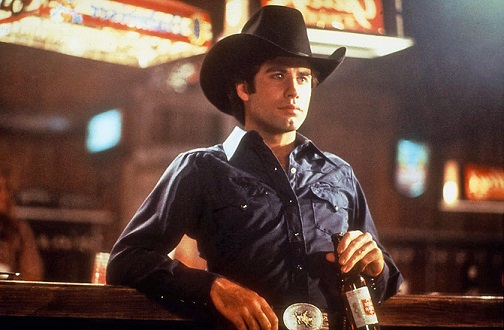
Last night, I watched the 1980 film, Urban Cowboy. This was a film that had been sitting on my DVR for over a year. For some reason, I had never actually gotten around to watching it. There were many times when I started to watch it but I always ended up stopping after a few minutes. I was never quite sure why as everything that I had heard about the film was positive. Having finally watched it last night, I think I hesitated because I instinctively knew that John Travolta would look silly wearing a cowboy hat.
And let’s just be honest. He does. I mean, Travolta actually gives a fairly good performance in Urban Cowboy. He plays Bud, a kid from West Texas who moves to Houston so that he can work on an oil rig with his uncle, Bob (Barry Corbin). At first, he only wants to stay in Houston long enough to raise the money to buy some land back home. But, he soon falls in love with the Houston nightlife and the local country-western bar. (He’s Travolta so, of course, he can dance.) He also falls in love with and eventually marries Sissy (Debra Winger).
Travolta is believable as an impulsive young adult who might not be particularly smart but who makes up for it with a lot of determination. And he even does an okay job when it comes to capturing the country accent of West Texas. But that said, whenever he puts on that cowboy hat, the viewer is immediately reminded that Travolta is actually from New Jersey and probably never even attended a rodeo until he was cast in Urban Cowboy. The hat feels like an affectation, an attempt by a city boy to be more country as opposed to a country boy trying to hold onto his identity in the city. Ironically, the term “urban cowboy” has come to mean someone who, despite having never left the city, dresses like they’re heading out to herd the cattle and rope some steers. However, in the film itself, the hat is meant to be a natural part of Bud’s persona but it never quite feels that way.
Far more credible as a cowboy is a youngish Scott Glenn, who plays Wes Hightower. After Bud’s chauvinistic and abusive behavior drives Sissy away, she ends up with Wes. Wes teaches Sissy how to ride a mechanical bull, which is something Bud tried to forbid her from doing. Wes is confident and dangerously sexy and he can even make the fact that he lives in a run-down trailer work for him. Unfortunately, Wes also turns out to be even more controlling and abusive than Bud. Even though Bud still loves Sissy and Sissy still loves him, Bud soon hooks up with Pam (Madolyn Smith), the daughter of a wealthy oilman.
Many more complications follow and, of course, there’s one big tragedy that causes Bud to reexamine his life. Not surprisingly, the film’s conclusion all comes down to who can stay on that mechanical bull for the longest….
The best thing that Urban Cowboy has going for it is not Travolta or Glenn but instead, it’s Debra Winger, who gives a believable and relatable performance as Sissy, playing her as someone who may not have much but who refuses to surrender her pride. She knows that she deserves better than both Bud and Wes, even if she is hopelessly in love with one of them. Winger has chemistry with both Travolta and Scott Glenn, which makes the film’s love triangle feel like something more than just a typical story about a girl who can’t resist a bad boy. She grounds the film in reality and, as such, there are real stakes to the film’s story. Thanks to Winger, Urban Cowboy becomes about something more than just a fight over a mechanical bull.
The second best thing that Urban Cowboy has going for it is that it does manage to capture the atmosphere of a good country-and-western bar. It’s place where people go to relax after a hard day’s work. Unlike the discotheques that Travolta frequented in Saturday Night Fever, the bars in Urban Cowboy eschew glamour and artifice. Instead, they’re all about proving yourself not on the dance floor but on the back of a mechanical bull. For Sissy, the bull symbolizes freedom. For men like Bud and Wes, it symbolizes survival. Myself, I’m not a drinker so my bar experience is limited. And, though I may be from Texas and I spent a lot of time in the country while I was growing up, I’ve never been a fan of country music. That said, I’ve danced to a few country songs and I’ve certainly stopped by a few bars, even if I was usually the one who annoyed my family and friends by just asking for a glass of water. I’ve been to the rodeo and I’ve seen people get trampled. I’ve also seen a few people get tossed off a mechanical bull. I’ve never been on a mechanical bull myself but I did buy one for my Sims. (They loved it but, sadly, I had to get rid of it because they spent so much time riding it, they kept missing work and getting fired.) From my limited experience, I can say that Urban Cowboy got most of the details right. Even though it was made 42 years ago, it still feels authentic.
That said, Travolta still looks odd wearing a cowboy hat.
That, in a nutshell, is the main theme of the 1984 film, Countdown to Looking Glass. It’s a film that imagines the events leading up to an atomic war between the United States and Russia. It’s designed to look like a newscast. A distinguished anchorman named Dan Tobin (played by a real-life anchorman named Patrick Watson) gravely discusses the conflict between the two countries. Another reporter (played, somewhat jarringly given the film’s attempt to come across as authentic, by Scott Glenn) reports from an aircraft carrier. We see a lot of stock footage of planes taking off and world leaders meeting and people fleeing from cities.
There are a few scenes that take place outside of the newscast. They involve a reporter named Dorian Waldorf (Helen Shaver) and her boyfriend Bob Calhoun (Michael Muprhy). (If your name was Dorian Waldorf, you would kind of have to become a television news reporter, wouldn’t you?) Bob works for the government and has evidence that the world is a lot closer to ending than anyone realizes. Dorian tries to put the evidence on air but Dan tells her that they can’t run a story like that with just one source. It would be irresponsible…. when was this film made? I guess 1984 was a lot different from 2020 because I can guarantee you that CNN, Fox, and MSNBC would have had no problem running Dorian’s story and creating a mass panic.
(If Dan Tobin’s ethics didn’t already make this film seem dated, just watch the scene where Tobin announces that, because of the growing crisis, the networks will now be airing the news for 24 hours a day. From the way its announced, it’s obvious that this must have been a radical and new idea in 1984.)
Still, despite those dramatic asides, Countdown to Looking Glass is largely set up to look like a real newscast. We get stories about people naively singing up to serve in the army because they think war will be fun. We get interviews with a group of experts playing themselves. (The only one who I recognized was Newt Gingrich.) Everyone discusses the dangers of nuclear war and also whether or not humanity could survive an exchange of nuclear weapons. No one sounds particularly hopeful. Dan Tobin says that he always believed that nuclear war was inevitable but that the sight of all of the destruction would cause the combatants to come to their senses. That sounds a bit optimistic to me and the film suggests that Dan has no idea what he’s talking about.
In the end, Countdown to Looking Glass is a victim of its format. The newscast itself is rather dull, as most newscasts tend to be. Even the scenes that take place outside of the newscast tend to feel rather awkward, as if Murphy and Shaver were recruited for their roles at the last minute. In the end, Countdown to Looking Glass works best as a historical artifact. This is what a news report about the end of the world would have looked like in 1984. Watch it and compare it to how the news is covered in 2020.
Speaking of watching it …. well, it’s not easy. It’s never been released on video but you can watch it on YouTube. The upload’s not great but that’s pretty much your only option.
Oh, The Silence of the Lambs, I have such mixed feelings about you.
On the one hand, I’m a horror fan and Silence of the Lambs is a very important film in the history of horror. Back in 1992, it was the first horror film to win the Academy Award for Best Picture! It even made history by winning all of the big “five” awards — Picture, Director, Actor, Actress, and Adapted Screenplay! It was the first film since One Flew Over The Cuckoo’s Nest and It Happened One Night to pull that off!
Beyond that, it’s one of the most influential films ever made. Every erudite serial killer owes a debt to Anthony Hopkins’s performance as Hannibal Lecter. Every competent but untested and unappreciated female FBI agent owes a debt to Jodie Foster’s performance as Clarice Starling. Even though the whole criminal profiler craze probably owes more to Manhunter (a film to which Silence of the Lambs is a sequel, though that often seems to go unacknowledged) than to anything else, this Oscar winner still definitely played a part. I mean, how many people watched Manhunter for the first time, specifically because Lecter mentioned the events in that earlier film in Silence of the Lambs?
Plus, this won an Oscar for Jonathan Demme, one of my favorite directors! And while I’m sure Jodie Foster would have gone on to have a strong career regardless of whether she had played Clarice Starling or not, it’s generally acknowledged that Silence of the Lambs revitalized the career of Anthony Hopkins. So for that, we should all be thankful.
And yet, it can be strange to watch Silence of the Lambs today. All of the imitations (not to mention some ill-thought sequels and prequels) have lessened its bite. I can only imagine how it must have freaked out audiences when it was first released but I have to admit that I was slightly disappointed the first time that I watched the film. Looking back, I can see that disappointment was due to having been told that it were one of the scariest movies of all time but, because, I had seen a countless number of imitations, parodies, and homages, I felt as if I had already watched the film. So, I wasn’t shocked when Lecter turned out to be ruthlessly manipulative and dangerously charismatic. Nor was I shocked when he managed to escape and poor Charles Napier ended up strung up in that cage. I’m sure that audiences in 1991 were freaked out, though.
Actually, as good as Foster and Hopkins and Scott Glenn are, I think the best performance in the film comes from Ted Levine, playing Buffalo Bill. Seriously, Levine’s performance still freaks me out. It’s the voice and the way he says, “Precious.” Levine’s performance, I found to be a hundred times more frightening than Anthony Hopkins’s and I think it’s due to the fact that Hannibal Lecter was clearly an author’s invention while Levin’s Buffalo Bill came across like he might very will be hiding in an alley somewhere, waiting for one of your friends to walk by. (Interestingly enough, I had the same reaction when I first saw Manhunter. Brian Cox did a good job as Lecter but he still came across as a bit cartoonish. Meanwhile, Tom Noonan was absolutely terrifying.) Levine has subsequently gone on to play a lot of nice guy roles. He was a detective on Monk, for instance. Good for him. I’m glad to see he was able to escape being typecast. Admittedly, I do kinda wonder how many serial killer roles he had to turn down immediately after the release of The Silence Of The Lambs.
Still, it’s a good film. Time may have lessened it’s power but The Silence of the Lambs is still an effective and well-directed thriller. It’s impossible not to cheer for Clarice. It’s impossible not to smile at the fun that Anthony Hopkins seems to be having in the role of Lecter. Jonathan Demme creates a world of shadows and darkness and still adds enough little quirks to keep things interesting. (I especially liked Lecter watching a stand-up special in his cell.) It’s the little details that makes the world of The Silence of the Lambs feel lived in, like Clarice’s nervous laugh as she gives a civilian instructions on what to do in case she accidentally gets trapped in a storage locker. Even the film’s final one liner will make you smile, even though it’s the type of thing that every film seemed to feel the need to do nowadays. It’s still a good movie, even if it no longer feels as fresh as it once may have.
For today’s horror on the lens, we have a made-for-TV monster movie from 1972, Gargoyles!
What happens when a somewhat condescending anthropologist (Cornel Wilde) and his daughter (Jennifer Salt) head out to the desert? Well, they stop by a crazy old man’s shack so that they can look at his genuine monster skeleton. Before Wilde can thoroughly debunk the old man’s claims, the shack is attacked by real monsters!
That’s right! Gargoyles exist and they apparently live in Arizona!
(And, hey, why wouldn’t gargoyles live in Arizona? I mean, they have to live somewhere, right? Real estate is not cheap.)
This film was introduced to me by TSL contributor and Late Night Movie Gang founder Patrick Smith and we had an absolute blast watching it. There’s nothing particularly surprising about the plot but the gargoyles are memorable creations and Bernie Casey gives a good performance as their leader. The gargoyle makeup was designed by none other than Stan Winston, who won an Emmy for his work here and who went on to win Oscars for his work on Aliens, Terminator 2, and Jurassic Park.
As well, a very young Scott Glenn shows up in the cast. I like to think that he’s playing the same character in both Gargoyles and Sucker Punch.
Like all good people, I am currently obsessed with the Olympics. I was hoping that I would be able to post an Olympic-related film review every day during the games but, unfortunately, regular life got in the way and it didn’t happen. I’ll try to post what I can today and then, for the rest of this upcoming week, I will be concentrating on reviewing films that have been nominated for best picture.
(Interestingly enough, only one Olympic-related film has been nominated for best picture and I reviewed Chariots of Fireyears ago.)
The 1982 film Personal Best is a movie that I recorded off of Cinemax last year, specifically so I could review it during the Winter Games. That may have been a mistake on that part because Personal Best doesn’t actually deal with the Winter Games. Though it’s a film about athletes training to compete in the Olympics, they’re all runners, swimmers, and pole vaulters. In short, they’re all hoping to compete at the Summer Games (which, for my money, are nowhere near as much fun as the Winter Games). On top of that, no one in Personal Best actually gets to compete at the Olympics.
Of course, that wasn’t how things were supposed to go originally. While doing research for this review, I discovered that Personal Best had quite a long and somewhat tortured production history. The directorial debut of the famous (and famously slow) screenwriter Robert Towne, Personal Best was originally meant to showcase athletes preparing for the 1980 Summer Olympics. However, shortly after production began in 1980, it was announced that the United States would be boycotting the Olympic Games and the script was hastily changed to reflect that fact. Shortly after the boycott was announced, production was put on hold when the Screen Actors Guild went on strike. In what the New York Times described as being “a ploy to allow the movie to become an independent production and resume shooting during the strike,” Towne filed a lawsuit against Warner Bros. The end result of that lawsuit was that David Geffen stepped in and financed the film.
This led to yet another lawsuit, this one filed by Towne against Geffen. Towne claimed that Geffen forced him to sign a “coerced agreement” that not only lost him the rights to a script he had been working on about Tarzan but also left him dead broke. Geffen, in that same New York Times article, is quoted as saying, “Robert Towne took a picture budgeted at $7 million – ‘Personal Best’ – and made it incompetently for $16 million,” and that he agreed to take over financing because, ‘no other studio would pick the film up because Robert Towne had spent $5 million, and there wasn’t a coherent scene in the entire movie.”
I know what you’re saying. “That’s great, Lisa, but what’s the actual film about?”
Personal Best, for the most part, is about bodies in motion. Oh, don’t get me wrong. There’s a plot. Chris Cahill (Mariel Hemingway) is a young runner who hopes to someday compete in the Olympics. She finds herself torn between following the advice of her lover, Torry (Patrice Donnelly) and the advice of her manipulative coach (Scott Glenn) and things get even more complicated when she enters into a heterosexual romance with a swimmer named Denny (Kenny Moore). Both Towne and the film deserve credit for the forthright way that it portrays Chris and Torry’s relationship and also for its unapologetic portrayal of women who are just as competitive and determined to win as men.
But really, the film doesn’t seem to be that concerned with the story that it’s telling. The film itself is far more interested in the images of professional athletes competing and training. This is one of those films that is full of slow-motion scenes of people running down tracks and attempting to jump over hurdles. Most of the cast was made up of actual athletes and Towne’s camera lovingly captures every single ripple of muscle as they move across the screen. Watching the film, it was hard not to be reminded of the way Leni Reifenstahl fetishized athleticism in Olympia. This is a film that loves, celebrates, and comes close to worshiping athletes. That wouldn’t be a problem, except for the fact that the film lingers for so long on those bodies that it’s hard not to eventually get bored with them. I mean, there’s only so many times you can watch someone jump over a hurdle in slow motion before you don’t care anymore.
And it turns out that, no matter how impressive the athletes may look, you do need to tell a compelling story, especially if, like Personal Best, your film is over two hours long. As written, Chris Cahill is not particularly likable or even that interesting. Her life revolves around competition and she really has no other interests. That may be a realistic portrayal of what it takes to be the best but there’s a reason why most sports biopics are heavily fictionalized. Chris spends a lot of time getting mad and crying and it gets a little bit old after a while. Perhaps it would be different if we believed that Chris actually was one of the best runners in the world but the film never quite convinces us. (It doesn’t help that Mariel Hemingway spends the entire film surrounded by actual track and field athletes. Hemingway does her best with the role but it’s always easy to tell who is actually an athlete and who is just acting.) On the other hand, the coach and Torry are far more interesting characters but both of them keep getting pushed to the side.
Personal Best is a film that will be best appreciated by people who are as obsessed with athletics as the film is.
For today’s horror on the lens, we have a made-for-TV monster movie from 1972, Gargoyles!
What happens when a somewhat condescending anthropologist (Cornel Wilde) and his daughter (Jennifer Salt) head out to the desert? Well, they stop by a crazy old man’s shack so that they can look at his genuine monster skeleton. Before Wilde can thoroughly debunk the old man’s claims, the shack is attacked by real monsters!
That’s right! Gargoyles exist and they apparently live in Arizona!
This film was introduced to me by TSL contributor and Late Night Movie Gang founder Patrick Smith and we had an absolute blast watching it. There’s nothing particularly surprising about the plot but the gargoyles are memorable creations and Bernie Casey gives a good performance as their leader. The gargoyle makeup was designed by none other than Stan Winston, who won an Emmy for his work here and who went on to win Oscars for his work on Aliens, Terminator 2, and Jurassic Park.
As well, a very young Scott Glenn shows up in the cast. I like to think that he’s playing the same character in both Gargoyles and Sucker Punch.
“I accept your conviction. The lone man who thinks he can make a difference.” — Wilson Fisk
Today we saw the release of the official trailer for Netflix and Marvel Television’s first of five series based on characters from the Marvel Universe. Daredevil will be the first out of the gate and it looks to darken things a bit in the Marvel Cinematic Universe by bringing to the small screen one of it’s street-level heroes.
Daredevil (aka Matt Murdock) will soon be joined by Jessica Jones, Luke Cage and Iron Fist in their own web series on Netflix before teaming up for the Defenders series.
Under the guiding hands of showrunner (and Whedon alum) Stephen S. DeKnight, Daredevil will soon be available for bingewatchers everywhere on April 10, 2015.
“Bless me father for I have sinned.” — Matt Murdock
Marvel has pretty much been dominating the big-screen with it’s yearly event offerings. 2015 will not be an exception with Avengers: Age of Ultron set for a summer release expected to rake in the box-office by the money bins. Now, Marvel has set it’s site on the small-screen with it’s first Netflix Original Series that will be the first link in a five series set that will culminate in a team-up series called the Defenders.
This first link will be a new, and hopefully better take, on the street-level superhero Daredevil aka the Man With No Fear. The blind lawyer by day and vigilante by night whose blindness since childhood has helped him developed the rest of his senses beyond human levels. We shall not speak of the film adaptation starring Ben Affleck over ten years ago.
Marvel’s Daredevil will release all 10-episodes on Netflix this April 10, 2015.




 Through the Shattered Lens