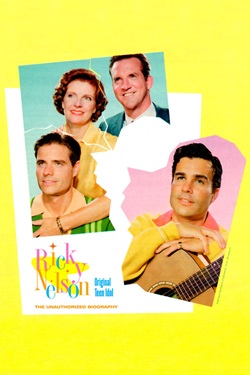
Ricky Nelson (Greogry Calpakis) is a star on his parents’s TV show but what he really wants to be is a rock and roll singer. Ozzie (Jamey Sheridan) and Harriet Nelson (Sara Botsford) don’t know much about the strange rock and roll music but they do know that girls love it when Ricky plays the guitar and sings. Ricky becomes a star and a teen idol but chafes at his parents’s attempts to control his music and his image.
This is another one of those behind-the-scenes entertainment biopics that were all the rage of television for a while. This one was made for VH-1 instead of the any of the major networks and, as a result, it’s a little bit explicit in its depiction of Ricky’s sex life and his later drug use. Ricky goes from being a teen idol to being a long-haired proto-hippie, getting booed by all the squares who only want to hear the oldies. Not surprisingly, it’s a pretty shallow movie. Ricky is played by Gregory Calpakis, who appears to be the same age of Jamey Sheridan, who plays his father.
Movies like this will never go out of style. It’s inevitable that eventually, there will be biopics of Cobain, Bradley Nowell, Mac Miller, and all the rest. They’ll be AI-generated which will make them seem even worse.
If there’s any true crime book that I recommend without hesitation, it’s Our Guys by Bernard Lefkowitz.
First published in 1997, Our Guys deals with a terrible crime that occurred in the leafy suburban community of Glen Ridge, New Jersey. In 1989, it was an affluent community that loved its high school football team and where conformity and financial success were the most valued qualities the someone could have. On March 1st, a 17 year-old girl was invited to a house party where, after she was convinced to head down to the basement, she was raped with a broomstick and a baseball bat by several members of the football team. The girl was intellectually disabled and was later determined to have an IQ of 64. Her name has never been revealed to the public. In his book, Lefkowitz assigned her the pseudonym of Leslie Faber.
The crime was terrible. So was the aftermath. When one of the witnesses went to a teacher with what he saw happen in the basement, the town responded by rallying around the accused. Initially, Leslie was accused of lying. Then, as it became clear that something actually had happened in that basement, Leslie was accused of bringing it on herself. Leslie, who was desperate to have friends and who was later determined to be psychologically incapable of saying “no” or even understanding what consent meant, was cast as a wanton seductress who led the members of the football team astray. A girl who went to school with Leslie even tape recorded a conversation with Leslie in which Leslie was manipulated into saying that she had made the entire thing up. It also undoubtedly didn’t help that some of the accused boys had fathers who were on Glen Ridge’s police force.
It’s a book that will leave you outraged. Lefkowitz not only examined the crime itself but also the culture of the town and its general attitude that “boys will be boys.” Despite the fact that they had a losing record and the fact that one of them was infamous for exposing himself every chance that he got, the football team was viewed as being made up as winners. They were allowed to party every weekend with their parties becoming so legendary that they bragged about them in their yearbook quotes. With a group of supportive girlfriends doing their homework for them, the football team was free to do whatever they wanted and, by the time they were seniors, they were infamous for being voyeurs. While one football player would have sex, all the others would hide in a closet and watch. When one of the football players stole $600 from one of his classmates, his father paid back the money and no one was ever punished. In a town that valued material success above all else and viewed being different as a sign of weakness, Leslie and her family were treated as being outcasts. In the end, three of the football players were sentenced to prison. One was sentenced to probation. A few others accepted plea deals and had their arrests expunged from the record. Years later, one of the guys who was in the basement but not charged would murder his wife while home on leave from the military.
In 1999, Our Guys was adapted into a made-for-television movie. Featuring Heather Matarazzo as Leslie, Ally Sheedy as the detective who investigated her rape, Eric Stoltz as the lawyer who prosecuted the case, and Lochlyn Munro as a cop who starts out on the side of the football team before realizing the truth, Our Guys simplifies the story a bit. While the book focused on Glen Ridge and the culture of celebrating winners no matter what, the film focuses on Sheedy as the detective and her disgust with the suburbs in general. Unfortunately, by not focusing on the culture of the town, the film presents the rape as being the bad actions of a group of dumb jocks as opposed to an expression of Glen Ridge’s contempt for anyone who was viewed as being on the outside. What Lefkowitz showed through a precise examination of the town and its citizens, the film quickly dispenses by having Stoltz and Sheedy make a few pithy comments about how much the town loves it football team. The story will still leave you outraged and Heather Matarazzo gives a heart-breaking performance as Leslie. But, for those wanting the full story of not only what happened in Glen Ridge but also how it happened, the book is the place to find it.
What’s an Insomnia File? You know how some times you just can’t get any sleep and, at about three in the morning, you’ll find yourself watching whatever you can find on cable? This feature is all about those insomnia-inspired discoveries!
If last night, at 1:30 in the morning, you were having trouble getting to sleep, you could have turned on the TV, changed the channel to your local This TV station, and watched 1982’s Still Of The Night.
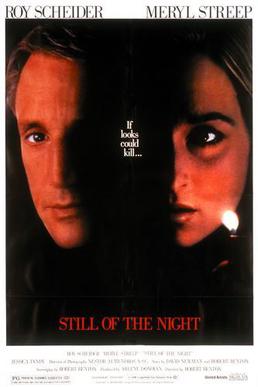
Still of the Night actually tells two stories. The first story deals with Dr. Sam Rice (Roy Scheider), a psychiatrist who is living a perfectly nice, mild-mannered, upper class existence in Manhattan. His patients are rich and powerful and his sessions with them provide him with a view of the secrets of high society.
One of Sam’s main patients is George Bynum (Josef Sommer), who owns an auction house and who is a compulsive cheater. George tells Sam that he’s haunted by strange nightmares and that he is also worried about a friend of his. George says that this friend has murdered in the past and George fears that it’s going to happen again. When George is murdered, Sam wonders if the murder was committed by that friend. He also wonders if that friend could possibly have been one of George’s mistresses, the icy Brooke Reynolds (Meryl Streep).
The second story that Still of the Night tells is about our endless fascination with the films of Alfred Hitchcock. Still of the Night is such an obvious homage to Hitchcock that it actually starts to get a little bit silly at times. Almost every scene in the film feels like it was lifted from a previous Hitchcock film. At one point, there’s even a bird attack! (Add to that, Scheider’s mother is played by Jessica Tandy, who previously played Rod Taylor’s mother in The Birds.) Meryl Streep is specifically costumed and made up to remind viewers of previous Hitchcock heroines, like Grace Kelly, Kim Novak, Eva Marie Saint, and Tippi Hedren.
Unfortunately, considering the talent involved, Still of the Night never really works as well as it should. Both Scheider and Streep seem to be miscast in the lead roles. If Still of the Night had been made in the 50s, one could easily imagine James Stewart and Grace Kelly playing Sam and Brooke and managing to make it all work through screen presence along. However, Scheider and Streep both act up a storm in the lead roles, attacking their parts with the type of Actor Studios-gusto that seems totally out-of-place in an homage to Hitchcock. Scheider is too aggressive an actor to play such a mild character. As for Streep, she’s miscast as a noir-style femme fatale. Streep’s acting technique is always too obviously calculated for her to be believable as an enigma.
That said, there were still some effective moments in Still of the Night. The majority of the dream sequences were surprisingly well-done and effectively visualized. I actually gasped with shock while watching one of the dreams, that’s how much I was drawn into those scenes.
According to Wikipedia, Meryl Streep has described Still of the Night as being her worst film. I think she’s being way too hard on the movie. It’s nothing special but it is an adequate way to kill some time. Certainly, I’d rather watch Still of the Night than sit through Florence Foster Jenkins.
 It’s a story as old as time.

 Through the Shattered Lens