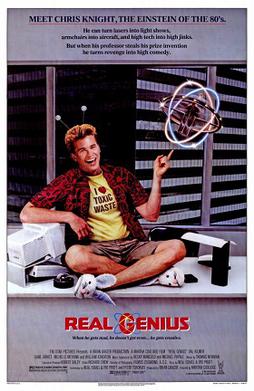
Real Genius (1985, directed by Martha Coolidge)


Mitch Taylor (Gabriel Jarrett) is a teenage genius who is recruited by Prof. Jerry Hathaway (William Atherton) to study at Pacific Tech University.  The real reason why Hathaway has recruited Mitch is because Chris Knight (Val Kilmer), another genius, has been slacking on developing the power source for an experimental laser called “crossbow.”  Hathaway hopes that Mitch can get Chris to take his work seriously and to focus on the project.  Instead, Chris teaches Mitch that he has to learn how to enjoy life or his great intelligence will become a burden and he’ll end up burned out and living in the tunnel underneath the university.  That’s what happened to Laszlo Holyfield (Jon Gries).  That’s what nearly happened to Chris.  Chris is determined not to let it happen to Mitch.

Real Genius combines college hijinks with a serious examination of the pressures of being a “real genius.”  Mitch knows everything about laser physics but he still misses his parents and cries after getting yelled at by Prof. Hathaway.  He’s just a kid, no matter how smart he is.  Chris proves himself to be a good friend, encouraging Mitch to relax and enjoy life.  Just because you’re a genius doesn’t mean that you can’t have fun.  As played by Val Kilmer, Chris Knight is the best friend that everyone wishes they could have, whether they’re a genius or not.  Even when the film gets sophomoric, Kilmer plays his role seriously and never loses sight of Chris’s humanity or why it’s so important to Chris that Mitch not become consumed by the pressure of being smarter than almost everyone else in the room.  This is one of the early Val Kilmer performances that showed just how good an actor he truly was.  With Chris’s encouragement, Mitch pursues a romance with Jordan Cochran (Michelle Meyrink) and gets revenge (more than once) on the arrogant Kent (Robert Prescott).

Eventually, Chris and Mitch realize that their research is being used to construct a weapon for the CIA and this leads to the film’s famous ending.  Ever since this movie came out, there’s been a debate over whether or not a laser could be used to make popcorn and, even more importantly, whether or not a gigantic amount of popcorn could actually destroy someone’s house.  I don’t know the answers to those questions but I’d like to think that Real Genius got it right and I have no interest in any evidence that suggests otherwise.  Sometimes, you owe it yourself to believe in the power of lasers and popcorn.  The next person who takes advantage of your hard work, destroy his house with popcorn and then sing Everybody Wants To Rule The World.  Learn the lessons of Real Genius.

Finally, when I was growing up, Real Genius was one of those films that seemed to be on HBO all the time.  Somehow, I always turned it on right when the popcorn started popping.  That popcorn-filled house, followed by Everybody Want To Rule The World, was a huge part of my childhood.  Real Genius will always bring back good memories for me.
A Blast From The Past: Testing Dirty (dir by Lynn Hamrick)


Our regularly scheduled review of Degrassi High will not be posted tonight so that we can bring you this special presentation.

My Retro Television Reviews will return on Monday but for now, check out this 1990 program called Testing Dirty!  In this short film, Christopher Daniel Barnes (best known for playing Greg Brady in The Brady Bunch Movie) is a high school athlete who tests positive for drugs despite not using them.  As he tries to clear his name, the adults in his community debate whether or not random drug tests are actually fighting or helping the problem.  That’s an important topic but, for the most part, this film is best-known for a cameo appearance by Adam Sandler as a drug dealer.

And now, without further ado …. it’s time for Testing Dirty!

Retro Television Review: St. Elsewhere 1.3 “Down’s Syndrome”


Welcome to Retro Television Reviews, a feature where we review some of our favorite and least favorite shows of the past! On Fridays, I will be reviewing St. Elsewhere, a medical show which ran on NBC from 1982 to 1988.  The show can be found on Hulu!

This week, we get to know a very bad doctor.

Episode 1.3 “Down’s Syndrome”

(Dir by Mark Tinker, originally aired on November 16th, 1982)

St. Eligius is home to several doctors, some of whom are good at their job and some of whom are really, really bad.

One of the bad ones appears to be Dr. Peter White (Terrence Knox), a resident who was in the background during the previous two episodes but who was at the center for a good deal of this episode.  Peter has a terrible bedside manner, absolutely no social skills, and his knowledge of medicine appears to be subpar at best.  When a homeless man comes in and complains of pain, Peter gives him a dose of potassium that nearly kills him.  (Only the quick thinking of Dr. Ehrlich — who himself hardly appears to be the perfect doctor — keeps the patient alive.)  Dr. White seems to be overwhelmed and it certainly doesn’t help that his wife is constantly calling the hospital and demanding to speak to him about every little thing.  That said, it’s hard to have much sympathy for Dr. White.  Yes, he’s overwhelmed but his mistakes nearly kill a man.

I have to admit that, as I watched Dr. Peter White on this week’s episode, I kept thinking about some of the doctors who treated my father after he had his car accident in May.  Whenever I spoke to them, they would brusquely answer my questions, usually in technical language that reflected that it had been a long time since they talked anyone who hadn’t gone to medical school.  At the time, I made the same excuses for them that I just made for Dr. White.  They were young, they were busy, and they were overwhelmed.  After my father died, though, I stopped making excuses for them and I instead just accepted that they weren’t very good at their job.  And perhaps Dr. White should admit the same.

It doesn’t help that Dr. White is contrasted with Dr. Auschlander, a kind and elderly liver specialist who is battling cancer but who still manages to treat all of his patients with kindness and respect.  The episode made it clear that all of the residents should hope to become a doctor like Dr. Auschlander.  While Peter snaps at his patients and nearly kills a man, Auschlander takes the time to play cards with a woman who is dying.  We should all be so lucky as to have an Auschlander in our life.

Finally, Brian Whitehill (Tony Bill) and his pregnant wife, Denise (Maureen Whitehill) are informed that their baby will be born with Down’s Syndrome.  In a scene that brings to mind Icelandic eugenics, Brian suggests that Denise get an abortion but Denise refuses, especially when she learns that she’s going to have a son.  (She already has two daughters.)  A day later, Brian comes home from work and tells Denise that he’s realized that she’s right and he’s prepared to be the father of a special needs child.  Denise replies that she had the abortion earlier in the day.  Seriously, what a depressing story!  That said, I respected what the show was doing here.  The patients are just as important as the doctors.

(And while Denise is getting an abortion, Dr. Morrison is learning that he’s going to be a father and, in contrast to Brian Whitehill, joyfully cheering in the hospital stairwell.)

As with the previous episode, there was a lot going on in the background.  Dr. Beale attempted to analyze terrorist Andrew Reinhardt (Tim Robbins), who is still basically acting like an arrogant prick.  Kathleen McAllister, the victim of Reinhardt’s attack, is still in a coma.  Dr. Westphall gave a tour of the hospital to two community leaders who both suggested that St. Eligius should shut down and move its operations to a wealthier neighborhood.  Dr. Fiscus got a blow job in an elevator from Kathy Martin.  (“Going down?” Fiscus asked the next guy who got on the elevator.)  It was a busy day at the hospital!  It was a good episode, even if it didn’t really have any of the big wow moments that the previous two episodes featured.  This episode was more about following a few days in the life of a hospital and the emphasis was on the nonstop flow of patients and doctors, some of whom were doing their best and some of whom were on the verge of giving up.  In the end, the main thing I took away from this episode was that there may not be enough Aucschlanders to make up for all the Peter Whites.


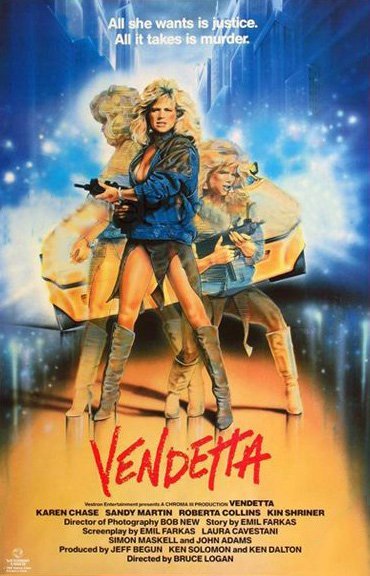
Vendetta (1986, directed by Bruce Logan)


After killing her rapist in self-defense, young and pretty Bonnie (Michelle Newkirk) is sentenced to two years in prison.  It’s one of those tough women’s prisons where all of the inmates dress like they’ve just come back from shooting an 80s music video and where the prisoners only have arcade games, a Olympic-size swimming pool, and a fully stocked gym to help them pass the time.  It’s so tough that, when it comes to conjugal visits, the prisoners have to settle for being driven to a nearby motel.  It’s the toughest prison since Leavenworth.

Because she’s blonde and innocent-looking, Bonnie is targeted by the predatory Kay Butler (Sandy Martin).  After Bonnie rejects Kay’s advances in the public shower room (while all of the other prisoners watch), Kay get her revenge by giving Bonnie a hot dose and then shoving her over a railing.  Even though all the evidence indicates that Bonnie was murdered, the official cause of death is ruled to be suicide.

What no one considered was that Bonnie’s older sister, a Hollywood stuntwoman named Laurie (played by real-life stuntwoman Karen Chase), would want revenge.  Determined to investigate the prison on her own, Laurie steals a judge’s car.  When that same judge attempts to suspend Laurie’s sentence, Laurie attacks him in the courtroom.  (Why would a judge be allowed to oversee a trial that directly involved him as a witness?)  Laurie finally gets her wish and is sentenced to prison.  Having now compiled the type of criminal record that will probably make her unemployable for the rest of her life, Laurie sets out to discover who is responsible for the death of her sister.  Soon, Laurie is tracking down and murdering every member of Kay’s gang, all the while trying to avoid getting caught by the head guard, Miss Dice (Roberta Collins).

In many ways, Vendetta is a typical 80s women-in-prison movie.  It has everything that you would expect to find in one of these movies: predatory lesbians, a victimized innocent, corrupt guards, and a gratuitous shower scene.  What sets Vendetta apart from similar films is that the prison is more of a health club than a prison and, while she’s hardly the world’s greatest actress, Karen Chase looks very credible when she’s beating the other inmates to death.  As a result, the fight scenes are more exciting than they usually are in a film like this and Karen Chase’s Laurie is a stronger heroine.  She can hold her own against anyone who comes at her.  Sandy Martin is also an effective villain and there’s actually some unexpected depth to her character.  She actually gets upset when her gang start to get killed, not just because she’s losing people who are willing to do her bidding but also because she’s losing the only people that she feels close to.  Thanks to Karen Chase’s fight skills and Sandy Martin’s unexpected performance, Vendetta is better the than the average 80s prison flick.