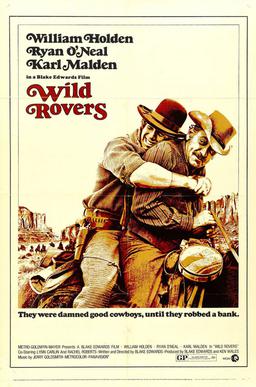
Wild Rovers (1971, directed by Blake Edwards)


In Montana, Walter Buckman (Karl Malden) runs his ranch with an iron hand, warning his neighbor, Hansen (Sam Gilman) not to even think of allowing his sheep to graze on his land.  Walter has two sons, hot-headed John (Tom Skerritt) and the laid back and good-natured Paul (Joe Don Baker).  When Walter learns that two of his ranch hands — aging Ross Bodine (William Holden) and young Frank Post (Ryan O’Neal) — have robbed a bank and are heading down to Mexico, he sends John and Paul to bring them back.  Walter is a big believer in the law and he’s not going to allow any of his people to get away with breaking it.

Ross is a veteran cowboy, who only robbed the bank after Walter withheld his pay to cover the damage of a saloon fight between Ross and Hansen’s men.  Frank is the wilder of the two.  He looks up to Ross and Ross is protective of Frank, even if he has a hard time admitting it.  Ross and Frank are heading down to Mexico so Ross can retire in peace.  Instead of going straight to Mexico, though, they make the mistake of stopping by a small town so Frank can play a little poker and visit the town’s brothel.

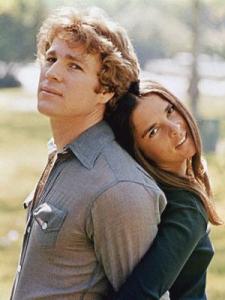
Wild Rovers was Blake Edwards’s attempt to make an epic, revisionist western and he includes plenty of shots of the sun setting over the mountains as well as several violent shoot-outs that are shot in Peckinpah-style slow motion.  Unfortunately, the story itself isn’t really strong enough to support Edwards’s ambitions and all of the shots of the countryside, while nice to look at, don’t really add up too much.  Wild Rovers was also a troubled production, with MGM slashing Edwards’s original three-hour film down to 106 minutes and advertising it with a poster featuring O’Neal hugging Edwards from behind, making the film look like a buddy comedy in the style of Butch Cassidy and the Sundance Kid (or an early version of Brokeback Mountain) as opposed to a violent and elegiac western.  (In 1986, a director’s cut was released, which ran for 136 minutes.)  If you only know Blake Edwards from his Pink Panther movies, the grim and tragedy-filled Wild Rovers will come as a surprise.

One thing that Wild Rovers does have going for it is a good cast.  William Holden and an energetic Ryan O’Neal are a solid team and Karl Malden, Tom Skerritt, Rachel Roberts, James Olson, and Moses Gunn all give good performances too.  This movie also provides Joe Don Baker with a sympathetic role and he’s very likable as the laid back Paul Buckman.  It’s not the type of role that Baker often got to play and it’s obvious that a lot of scenes between John and Paul were cut from the film but, in the truncated version, Joe Don Baker’s Paul Buckman becomes the moral center of the film’s story.

Wild Rovers was a disappointment at the box office, one of many that Edwards suffered in the 70s before he and Peter Sellers brought back Inspector Clouseau.
Icarus File No. 20: Tough Guys Don’t Dance (dir by Norman Mailer)


The 1987 film, Tough Guys Don’t Dance, opens with Tim Madden (Ryan O’Neal) talking to his father, tough Dougy (Lawrence Tierney).  Dougy has stopped by Tim’s New England home to let Tim know that he has decided stop chemotherapy and accept his eventual death from cancer because, as Dougy puts it, “Tough guys don’t dance.”  The tone of Dougy’s voice is all we need to hear to know that, in his opinion, his son has spent way too much time dancing.

Tim is an ex-convict turned writer and, when we first see him, he’s obviously had a few rough nights.  He explains to Dougy that he woke up after a bender with his ex-girlfriend’s name tattooed on his arm, blood all over his jeep, and two heads dumped in his marijuana stash.  Tim says that he’s hopeful that he’s not the murderer but he can’t be sure.  He’s been drinking and doping too much.  He suffers from blackouts.  He’s not sure what happened.

The majority of the film is made up of flashbacks, detailing Tim’s affairs with a number of women and also his odd relationship with the town’s police chief, Luther Regency (Wings Hauser).  Luther is married to Tim’s ex-girlfriend, Madeleine (Isabella Rossellini), who long ago accompanied Tim on a trip to North Carolina where they hooked up with a fundamentalist preacher (Penn Jillette) and his then-wife, Patty Lariene (Debra Sundland).  (Tim found their personal ad while casually skimming the latest issue of Screw, as one does I suppose.)  Patty Lariene eventually ended up married to Tim, though she has recently left him.  As for Madeleine, she has never forgiven him for a car accident that they were involved in.  Is Tim capable of loving anyone?  Well, he does say, “Oh God, oh man,” repeatedly when he discovers that his wife has been having an affair.

Tim tries to solve the murders himself, finding that they involve not only him and Luther but also Tim’s old prep school friend, Wardley Meeks III (John Bedford Lloyd) and also some rather stupid drug dealers that Tim hangs out with.  The plot is almost ludicrously convoluted and it’s tempting to assume that the film is meant to be a parody of the noir genre but then you remember that the film is not only based on a Norman Mailer movie but that it was directed by Mailer himself.  Mailer, who was the type of public intellectual who we really don’t have anymore, was blessed with a brilliant mind and cursed with a lack of self-awareness.  There’s little doubt that we are meant to take this entire mess of a film very seriously.

And the film’s theme isn’t hard to pick up on.  By investigating the murders, Tim faces his own troubled past and finally comes to understand why tough guys, like his father, don’t hesitate to take action.  Tough guys don’t dance around what they want or need.  That’s a pretty common theme when it comes to Mailer.  Tim Madden is not quite an autobiographical character but he is, by the end of the story, meant to represent the type of hard-living intellectual that Mailer always presented himself as being.  Unfortunately, Ryan O’Neal wasn’t exactly an actor who projected a good deal of intelligence.  And, despite his lengthy criminal record off-screen, O’Neal’s screen presence was somewhat docile.  That served him well in films like Love Story and Barry Lyndon.  It serves him less well in a film like this.  It’s easy to imagine O’Neal’s Tim getting manipulated and, in those scenes where he’s supposed to be a chump, O’Neal is credible enough in the role.  It’s far more difficult to buy the idea of Tim actually doing something about it.

Indeed, it’s hard not to feel that co-star Wings Hauser would have been far more credible in the lead role.  But then, who would play Luther Regency?  Hauser gives such a wonderfully unhinged and out-there performance as Luther that it’s impossible to imagine anyone else in the role.  Maybe Hauser could have played both Tim and Luther.  Now that would have made for a classic film!

Tough Guys Don’t Dance is weird enough to be watchable.  The dialogue is both raunchy and thoroughly humorless, which makes it interesting to listen to, if nothing else.  The moments that are meant to be funny are so obvious (like casting noted atheist Penn Jillette as a fundamentalist) that it’s obvious that the moment that feel like clever satire were actually all a happy accident.  As far as Norman Mailer films go, this one is not as boring as Wild 90 but it also can’t match the unhinged lunacy of a frustrated Rip Torn spontaneously attacking Mailer with a hammer at the end of the unscripted Maidstone.  It’s a success d’estime.  Mailer flew too close to the sun but the crash into the ocean was oddly entertaining.

Previous Icarus Files:

  1. Cloud Atlas
  2. Maximum Overdrive
  3. Glass
  4. Captive State
  5. Mother!
  6. The Man Who Killed Don Quixote
  7. Last Days
  8. Plan 9 From Outer Space
  9. The Last Movie
  10. 88
  11. The Bonfire of the Vanities
  12. Birdemic
  13. Birdemic 2: The Resurrection 
  14. Last Exit To Brooklyn
  15. Glen or Glenda
  16. The Assassination of Trotsky
  17. Che!
  18. Brewster McCloud
  19. American Traitor: The Trial of Axis Sally

Scenes That I Love: That Iconic Moment From Tough Guys Don’t Dance


Norman Mailer was better-known as a writer than a filmmaker but, over the course of his limited directorial career, he did come up with one scene that will never be forgotten.  That scene is a scene that I love from 1987’s Tough Guys Don’t Dance.

Take it away, O’Neal!

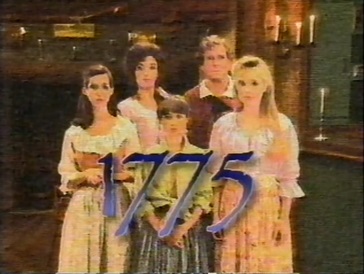
Retro Television Review: 1775 1.1 “The Pilot”


Welcome to Retro Television Reviews, a feature where we review some of our favorite and least favorite shows of the past!  On Thursdays, I will be reviewing 1775, which aired on CBS in 1992.  The entire show is currently streaming on YouTube!

This week, we take a trip into the past.  Welcome to 1775!

Episode 1.1 “Pilot”

(Dir by David Trainer, originally aired on September 5th, 1992)

The year is 1775 and the streets of Philadelphia are awash in rumors of war and revolution.  While some prepare for war and others continue to declare their loyalty to the British Empire, Jeremy (Ryan O’Neal) and Annabelle Proctor (Lesley-Anne Down) just try to run their inn and find suitable husbands for their three daughters.  The youngest daughter (Danielle Harris, of Halloween fame) wants a horse because all of her friends have a horse.  She also wants to run off with a patriot and is offended when the pro-British Governor Massengill (Jeffrey Tambor) stops by the inn.

The Proctors know that one way to marry off their daughters would be to have them attend a fancy ball.  Unfortunately, that would require paying money that they don’t have.  Jeremy may have to ask his smug brother-in-law for cash.  His brother-in-law’s name?  George Washington.  Who plays George Washington?  Somewhat inevitably, Adam West.

Now, I know Adam West playing a smug and superficial George Washington might sound like a lot of fun but West only shows up for one scene and it’s a short one at that.  And he really doesn’t get any fun lines or really any opportunity to do any of his trademark Westing.  It’s a bit of a wasted opportunity.

Actually, the entire show feels like a wasted opportunity.  Reportedly, 1775 was an attempt to do a Blackadder for America but the pilot lacks all of Blackadder’s lacerating wit.  Instead of poking fun at American history and traditions in the way that Blackadder did to the Brits, 1775 is just a typically lame family sitcom that happens to take place in 1775.  The youngest daughter wants a horse …. BECAUSE IT’S 1775!  If it was the modern era, she would want a car.  That’s the entire joke.

As for the show’s cast, Lesley-Anne Down delivers a few snarky put-downs with elan but Ryan O’Neal appears to be lost in the main role.  Have you seen that famous clip of Ryan O’Neal saying, “Oh man, oh God,” over and over again?  Well, that’s the level of his performance here.  O’Neal sleepwalks through the show, delivering his lines in the weary voice of someone who needs the paycheck but otherwise could hardly care less.  When he gets exasperated with his daughters, he sounds numbly homicidal.  It’s not a pleasant performance and it features none of the fierce intelligence that Rowan Atkinson brought to countless incarnations of Edmund Blackadder.

Not surprisingly, only one episode of the show aired before it was canceled.  The series didn’t even reach the start of the Second Continental Congress but that’s okay.  We all know how that went.

Fever Pitch (1985, directed by Richard Brooks)


It takes a great director to come up with a movie as bad as Fever Pitch and, in his day, Richard Brooks was a great director.  Among Brooks’s films as a director you’ll find titles like Blackboard Jungle, Cat on a Hot Tin Roof, Elmer Gantry, The Professionals, and In Cold Blood.  These were all films that took risks and broke new ground and which were willing to defy the conventions of the time.  Brooks was a director who told hard-boiled stories that dealt honestly with real-life issues.

Unfortunately, as often happens with great filmmakers, Brooks struggled to remain relevant as he got older.  Hollywood’s sensibility eventually caught up with Brooks’s sensibility and then moved past it.  While Brooks remained an interesting director, his final films often seemed to be the work of a grumpy old man who just wanted all those young people to stay off his lawn.

Fever Pitch, Brooks’s final film, stars Ryan O’Neal as Steve Taggart.  Taggart is a sports writer for The Los Angeles Herald Examiner.  He’s been writing a series of stories about a compulsive gambler named Mr. Green.  The stories are so popular that his editor (John Saxon) has no problem giving Taggart $10,000 so that Taggart can then give the money to Mr. Green so that Mr. Green can continue to gamble.  What anyone, especially the editor of a major newspaper, should be able to figure out is that Mr. Green is actually Steve Taggart.

Taggart takes the money to Las Vegas, where he hits the casinos while also researching the root causes of gambling.  On the one hand, Brooks includes a lot of scenes of Taggart listening to real people explain the history and the dangers of gambling, often in the most didactic ways possible.  (Hank Greenspun, the legendary publisher of The Las Vegas Sun, appears as himself and shows why he became a publisher and not an actor.)  On other other hand, MGM not only produced the film but allowed it to be filmed at the MGM Grand Resort & Casino in Las Vegas.  Fever Pitch is anti-gambling film that also doubles as a commercial for a casino.  It’s like an anti-smoking film that gives everyone in the audience a free pack of Camels.

Steve hooks up with an unbelievable wholesome prostitute played by Catherine Hicks.  He also has to deal with several shady characters, including a veteran gambler named Charlie (Giancarlo Giannini) ad a debt collector named The Hat (played by William Smith).  Taggart is obsessed with gambling but he doesn’t seem to be very good at it, as he keeps getting beat up and threatened.  Eventually, he goes to a Gamblers Anonymous meeting and he seems to be ready to admit that he has a problem and that it’s keeping him from being a good father to his daughter.  That might seem like the ideal place for the movie to end but instead, Taggart has to try his luck with just one last slot machine.

Fever Pitch is doomed from the minute Ryan O’Neal starts his narration.  Nothing about O’Neal suggests that he could be capable of writing a hard-hitting expose about the life of a compulsive gambler.  In this film, he doesn’t even come across like he would be capable of reading it. O’Neal is too passive of an actor to be a convincing gambler and his wooden performance clashes with Brooks’s attempts to create a hyperkinetic feel to the Vegas scenes.  While everyone in the film is lecturing him about the dangers of gambling, O’Neal sit there with same blank look on his face.

A critical and a commercial failure, Fever Pitch was Brooks’s final film.  He died seven years later, leaving behind a legacy of important movies that cannot be tarnished even by something like Fever Pitch.

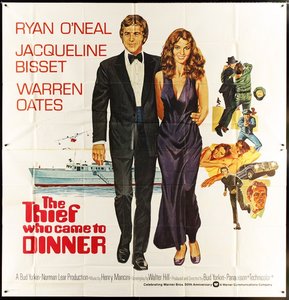
Film Review: The Thief Who Came To Dinner (1973, directed by Bud Yorkin)


0033bee5_mediumIn The Thief Who Came To Dinner, Ryan O’Neal plays Webster McGee, a Houston-based computer programmer.  After deciding that living in a capitalist society means that everyone steals from everyone else, Webster quits his boring job and decides to become a real thief.  Figuring that they can afford to lose a little wealth, Webster only targets the rich and powerful.  After he steals some incriminating documents from a crooked businessman (Charles Cioffi), Webster uses those documents to blackmail his way into high society.  Soon, Webster owns a mansion of his own and is living with a gorgeous heiress (Jacqueline Bisset, who played a lot of gorgeous heiresses back in the day).  Webster also has an insurance investigator after him.  Dave Reilly (Warren Oates) knows that Webster is a thief but he also can not prove it.  As Dave obsessively stalks him, Webster plots one final heist.

Until I saw it on TCM on Monday, I had never heard of The Thief Who Came To Dinner.  Directed in a breezy style by Bud Yorkin, The Thief Who Came To Dinner was an early script from Walter Hill.  Though the film is much more comedic than his best known work, it’s still easily recognizable as coming from Hill’s imagination.  The obsessive Dave and the coolly professional Webster are both prototypical Hill characters and their adversarial yet friendly rivalry would be duplicated in several subsequent Hill films.

The Thief Who Came To Dinner is an engaging movie that doesn’t add up to much.  The normally stiff Ryan O’Neal gives one of his better performances, though he struggles to hold his own whenever he has to act opposite the far more energetic Warren Oates.  Ned Beatty, Gregory Sierra, John Hillerman, Michael Murphy, and Austin Pendleton all appear in minor roles, making the film’s cast a veritable who’s who of 70s character actors.  And, of course, the film features Jacqueline Bisset at her loveliest.

The Thief Who Came To Dinner may not be well-known but it is an enjoyable and satisfying piece of 70s entertainment.

Lisa Watches An Oscar Nominee: Barry Lyndon (dir by Stanley Kubrick)


Barry_Lyndon_A

“It was in the reign of George III that the aforesaid personages lived and quarreled; good or bad, handsome or ugly, rich or poor, they are all equal now.”

— Barry Lyndon (1975)

As I may have mentioned yesterday on this site, Texas has finally caught up with the rest of this frozen country.  Starting on Sunday night, it has finally been cold and wintry down in my part of the world!  For two days straight, schools have been closed and the streets have been covered in ice.  And, even though the temperature got slightly above freezing today, I have been told that I can expect to wake up tomorrow morning to a snowy wonderland.

And I hope that’s the case because I would love to stay home on Wednesday!  Ever since the 31 Days of Oscar began, I have recorded so many movies off of TCM that I am running dangerously close to running out of space on the DVR.  The best thing about being snowed (or iced) in is that it gives me an opportunity to watch some of those films.

For instance, I spent this afternoon watching the 1975 best picture nominee Barry Lyndon.  And when I say that I spent an afternoon, I mean that literally.  Clocking in at a little over 3 hours, Barry Lyndon is a film that’s so long that it even provides an intermission so the you can stand up and stretch your legs.

Seriously, I was really thankful for that intermission.

Which not to say that Barry Lyndon is a bad film.  Far from it!  It’s actually one of the best films to be included in this year’s 31 Days of Oscars.  While I may have no first hand knowledge of what it was like to live in the 1700s, I can now say that I definitely have a clue on account of the fact that I’ve seen Barry Lyndon.

Directed by the great Stanley Kubrick and based on a novel by William Makepeace Thackery, Barry Lyndon tells the story of a penniless Irishman Redmond Barry (Ryan O’Neal) who, following a duel with a wealthy British captain, is forced to flee from his home.  After being robbed by a highwayman, Barry joins the British army but, upon being sent to fight in Germany, discovers that he has no love for combat.  As such, Barry deserts but is then captured by and forced to enlist in the Prussian Army.  Once the war ends, Barry is order to spy on a professional gambler who the Prussians suspect might, himself, be a spy.  Barry and the gambler soon become partners and travel around Europe together.  However, Barry has decided that he now wants to marry into wealth and he gets that chance when he meets the Countess of Lyndon (Marisa Berensen), whose husband is dying.

And that’s when the intermission kicks in.

http://www.youtube.com/watch?v=titZx8VA4DY

When we come back, Redmond Barry is now known as Barry Lyndon and appears to have everything that he’s ever wanted.  However, while Barry may have been naturally lucky when he was poor, the opposite is true once he’s rich.  Despite his new station in life, Barry is never truly accepted by his wife’s circle of friends.  Furthermore, his son, Bryan (David Morley) is injured while out riding a horse and Lady Lyndon has a nervous breakdown as a result.  Meanwhile, Barry’s stepson, Lord Bullington (Leon Vitali), hates him and spends most of his time plotting ways to get rid of his stepfather.

And, naturally enough, it all leads to one final duel in a barn, in which two men point guns while surrounded by the deafening sounds of hundreds of pigeons cooing.

I’m at something of a disadvantage when it comes to reviewing Barry Lyndon because I watched it on television and Barry Lyndon is one of those films that demands to be seen on a big screen.  For all of the dramatic moments and satirical asides (this film has a wonderfully snarky narrator), Barry Lyndon is ultimately most concerned with recreating the past as authentically as possible.  Watching this film, you really do feel as if you’ve traveled back to the 18th Century, where all of the rooms are lit by candle light and one’s station in life can be determined by the ornateness of his or her costume.

As I watched Barry Lyndon, I had to wonder — whatever happened to Ryan O’Neal?  I recently saw O’Neal in a film called The List and it was hard to believe that the terrible actor from that film was the same guy who starred in Barry Lyndon.  Kubrick may not have a reputation for being an actor’s director but Ryan O’Neal gives a great performance in Barry Lyndon.  (Compare O’Neal’s performance in the earlier Love Story to his performance here and you’ll see how good a job Kubrick did when it came to directing O’Neal.)  When we first meet Barry, he is an almost passive aggressive character, a cunning guy who has the patience necessary to wait for his opportunity to advance.  It’s only during the second half of the film that Barry becomes a truly sympathetic character, redeemed by both his love for his son and the fact that all of his enemies are even worse than him.  The strength of Ryan O’Neal’s performance can be found in the fact that Barry can be both amoral and sympathetic at the same time.

So, I’m glad that the streets were icy on Tuesday.  I’m thankful because it gave me a chance to watch Barry Lyndon.

And yes, I’m also very thankful for that intermission.

Shattered Politics #66: The List (dir by Sylvain Guy)


The List

“No one pays $15,000 for a back rub.” — Words of wisdom from The List (2000)

 Oh my God.

Listen, I have seen some truly terrible films before but very few were as bad as the 2000 thriller The List.  The List is not just bad.  Instead, it’s bad on a level that very few films manage to reach.  It’s almost as bad as April Rain and that’s pretty bad.

(It’s also currently available on Netflix, just in case anyone wants to take the risk.)

The film opens with a lingerie-clad woman (Madchen Amick) reading the U.S. Constitution to a fat, naked, middle-aged man.  We discover that he’s a judge when she calls him, “your honor.”

“I am no longer your honor,” the naked fat guy says, “I am your dishonor.  And, as for the founding fathers, fuck them.”

Uhmmm…okay.

Anyway, then the police come rushing into the room and arrest both the woman and the judge.  It turns out that the woman is Gabrielle Mitchell (Madchen Amick), a prostitute who is exclusively used by the rich and powerful.  She has a list of her clients, one of whom happens to be the governor of New York state.

Despite the best efforts of her over-the-top pimp Dom Roselli (Roc LaFortune), Gabrielle is convicted and sentenced to prison.  Hoping to get a few years taken off of her sentence, Gabrielle testifies at the judge’s trial.  She hands the list over to yet another judge, Andrew Miller (Ryan O’Neal).

Andrew, who is conservative and very religious, has recently been nominated to the state supreme court.  However, now that he has the list, he find himself being threatened by shadowy figures, one of whom tries to stuff a cow’s tongue down his throat.  Or something like that. I’m not really sure what was going on in that scene and dammit, I’m not going to waste any more of my life trying to figure it out.

Meanwhile, Gabrielle’s associates are also being murdered.  Written in blood near every body: Snitching Pigs Die!

So, if a bunch of community theater actors got together with a film school drop out and attempted to make a film out of a script written by a 16 year-old with authority issues, the end result would look a lot like The List.  When Andrew  holds a press conference, there are about 6 reporters present and only two of them get to ask questions.  When the bad guys all meet to discuss what should be done about Gabrielle, they appear to be sitting in a community college study room.  When a character is found dead, it’s obvious that some crew members got a little bit enthusiastic about splashing red paint all over the set.  The actors may trip over their lines and they may seem frequently confused by what their saying but, obviously, this was one of those films were second takes were considered to be too expensive.

Did I mention that Ben Gazzara is in this thing?  Because he so is!  I can’t being to imagine what path could have led Gazzara from co-starring in Anatomy of a Murder to appearing in something like The List but, let it be said that he actually gives a pretty good performance.  Or, at the very least, he does the best with what he’s been given.

Ryan O’Neal on the other hand…

O’Neal wanders through the film, watching the action through bloodshot eyes and defiantly refusing to show the slightest hint of emotion or interest.  It’s an interesting idea actually, casting an actor who appears to be perpetually hung over in the role of a straight-laced, moralistic judge.

Usually, I make excuses for films that were obviously filmed with next to no budget but seriously, The List could have been made for Avatar money and it would still suck.  I’m sad to say that it doesn’t even manage to raise to the level of being so bad that it’s good.

Instead, it’s just bad.

But, in case you’re into that, it is on Netflix.

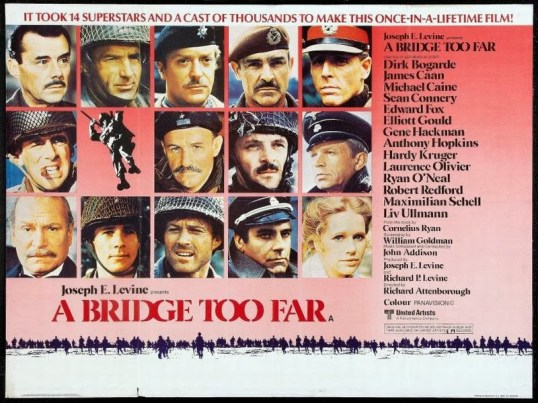
Review: A Bridge Too Far (dir. by Sir Richard Attenborough)


1977 a bridge too far

“Well, as you know, I always felt we tried to go a bridge too far” — Lt. Gen. Frederick Browning

With the recent passing of Sir Richard Attenborough I decided to bring up one of the films which first brought his name to my attention. I was quite the young lad when I first saw Attenborough’s epic war film A Bridge Too Far. I would say that it was one of my earlier memories of watching a film with my father who was a major fan of war films. One could say that I got my appreciation and love for the genre from him.

A Bridge Too Far was adapted from the Cornelius Ryan book of the same name which depicted from start to finish the disastrous World War II battle known as Operation Market Garden. The film states that the Allied landings at Normandy, France in the summer of 1944 had the German forces reeling and on the verge of collapse. With Eisenhower having to choose between competing plans to chase Hitler’s forces right into Berlin from his two best generals in George S. Patton and Bernard Montgomery, the film already lays down something that’s become synonymous with military disasters throughout history. Political expediency and pressure on Eisenhower led to an operation that was never attempted in military history and one which required every aspect of the operation to go according to plan for it to work. As the film would show this was not meant to be.

The film begins with the operation’s early days as Allied commanders rush to put Montgomery’s plan to drop 35,000 paratroopers behind German lines in occupied-Netherlands in order to capture and hold key bridges until Allied armored forces arrived to reinforce them. It’s a daring plan that the Attenborough films with a obvious confidence and enthusiasm, but also one that already showed some nagging doubts from field commanders who would be in the thick of the fighting if intelligence reports were inaccurate. One could almost say that Attenborough was making the film a sort of anti-war message which was a rarity when it came to Hollywood and and film industry depicting the events of World War II at the time.

While the film does explore that very anti-war theme throughout it’s really a by-product of how the battle itself unfolds and shown to the viewers that might give one such an idea. Yet, in the end A Bridge Too Far was a much more complicated film to just be labeled as an anti-war film. Yes, the battle itself was a disaster for the Allied forces of American, British and Polish soldiers involved, but despite the political bumbling and military arrogance of those who command from behind a desk, the film actually does a great job of showing that bond soldiers earn when confronted with the horrors of battle.

Attenborough and producer Joseph E. Levine pulls together an all-star cast for the film with names such as Sean Connery, Edward Fox, Robert Redford, Michael Caine and Laurence Olivier just to name a few. Films such as A Bridge Too Far rarely get made anymore in this day and age. The cast itself is part of the reason why the film still holds up to scrutiny decades after it’s release. While all-star casts such as this seemed to have been common place before the 1980’s it still looked like a daunting task for Attenborough to manage so many Hollywood stars and veteran British actors. Every character from Hopkin’s Col. Frost, Connery’s Gen. Urquhart and Redford’s Maj. Cook get to shine in their sections of the film as their individual stories about the battle all tie-in together to show just how complicated the events that they were filming truly turned out to be.

At times, one almost could feel overwhelmed by the amount of recognizable names and faces that come across the screen, yet Attenborough and producer Levine were able to juggle not just the logistics of the film’s screenplay, but the egos and reputation of the very stars who would become the backbone of the film.I think in a lesser filmmaker A Bridge Too Far could easily have turned into the very Operation Market Garden it was trying to depict.

It’s a film that never celebrates the concept of war itself, but actually shows that war remains a bloody and chaotic affair that relies not just on planning and execution but on the whims of lady luck. While Attenborough’s film never reached the sort of iconic status that another Cornelius Ryan adapted film has attained in The Longest Day, it does remain the more powerful of the two as it doesn’t just explore the historical event as a sort of academic exercise, but as an exploration of that old military adage of “No plan survives contact with the enemy”.

So, in the end I recommend that those looking to watch and experience the earlier directorial works of Sir Richard Attenborough should check out A Bridge Too Far. It remains to this day one of his more underappreciated films especially when compared to his later more acclaimed films like Gandhi, Chaplin and Shadowlands.

Lisa Marie Laughs and Cries Over Love Story (dir. Arthur Hiller)


They are so freaking pretty!

I’ve discovered something as I’ve pursued my mission to see every single film ever nominated for best picture.  Quite a few of the nominees (perhaps the majority of them) are no longer impressive because they’ve simply become dated by the passage of time.  We can still watch these films and understand (and believe) that they were probably quite groundbreaking and impressive when initially released.

And then there’s the films like the 1970 best picture nominee, Love Story.  These are the nominees that you quickly realize were never good.  These are the films that were nominated because they either dominated the box office or perhaps they just lucked out and were released in a bad year for cinema in general.  At least that’s what we tell ourselves.  In all honesty, the circumstances of how they came to be nominated are often enigmatic and shrouded in mystery.  I have yet to read a single critic — from either 1970 or the present day — who has had a single kind thing to say about Love Story and, after sitting through it last night, I can say that for once, me and the critical establishment are in agreement.

The plot of Love Story is pretty simple and I’m going to go ahead and include the entire story here because quite frankly, it’s impossible to spoil something this predictable.  Oliver (Ryan O’Neal) meets Jenny (Ali MacGraw).  Oliver is a rich jock who is attending Harvard.  Jenny is a poor music student.  Upon first meeting her, Oliver calls Jenny a “bitch.”  Jenny calls Oliver “a dumb jock.”  Oliver falls in love with Jenny.  Jenny calls Oliver “a dumb jock.”  Oliver and Jenny get married.  Oliver’s father (Ray Milland) disapproves.  Jenny’s father (John Marley) is just kind of confused.  Cut off from the family fortune, Oliver struggles to provide for Jenny.  (Apparently, the 70s were a tough time to be a graduate of Harvard Law School.)  Jenny and Oliver have a fight.  Oliver cries.  Jenny says, “Love means never having to say you’re sorry,” which seems to be an underhanded way of admitting that most guys aren’t ever going to say that anyways.  Oliver is happy.  Jenny comes down with a never-named terminal illness and dies.  The end.

I know that I’m supposed to watch a movie like Love Story and just shrug my shoulders and go, “Oh well, it’s not very good but I’m a girl so I’ll love it unconditionally.”  And God knows, I tried my best,  I tried so very hard to just shut down my mind and give control over to my heart.  Because, believe it or not, I’m just a dorky, asthmatic romantic.  I’m the type of girl who gets all giggly and excited when she gets flowers, despite all of my allergies.  I can remember every sunset I’ve ever watched.  The rare times we actually do have a winter down here in Texas, I’m all about the snowball fights that end with a long, passionate kiss.  I love Valentine’s Day and I remember anniversaries.  I still have every gift that I’ve ever been given, even the really cheap and ugly things that I wouldn’t be caught dead wearing in public.  Every trinket, every stuffed animal, every card, every piece of jewelery, every note, every article of lingerie, every movie ticket — if it’s an artifact of a past or current relationship, I have it all safely stored in a place of honor. 

Yes, I adore everything that Love Story was selling and yet, as I watched Love Story, I felt myself growing more and more cynical with each passing moment.  Fortunately, the movie only last 99 minutes because if it had gone on for a few 120, I probably would have ended up “an old maid…closing up the library!” like Donna Reed in It’s a Wonderful Life.  The problem with Love Story isn’t that it’s not romantic; it’s that it takes the standard clichés of romance and embraces them to such an extent that I didn’t feel as if I was being manipulated by the film as much as I felt like I was being brutally violated by it.

Seriously, the entire time I was watching, I felt like the film was screaming at me, “Look at how beautiful they are!  Look at that sunset!  Listen to that music!  Cry, damn you, cry!”  Never mind the fact that MacGraw and O’Neal — pretty as they are to look at — generate close to zero chemistry.  Never mind that  MacGraw responds to being terminally ill by laying in bed with her hair artfully spread on the pillow behind her while director Arthur Hiller practically bathes her in a warm, saintly glow.  Never mind that “Love means never having to say you’re sorry,” doesn’t make any freaking sense at all.  Trust me, if you love me and yet you still insist on acting like an asshole, you sure as Hell have to apologize to me. 

On the plus side, the film’s got one of those overdone, lush soundtracks; the type that can make you cry as long as you don’t pay attention to what’s happening on-screen.  (That said, Taylor Swift is nowhere to be found.)  Ryan O’Neal is surprisingly likable as Oliver but Ali MacGraw — oh my God, where do I begin?  Actually, I don’t think I will because there’s simply no way I can explain just how bad of a performance she gives here.  Instead, I’ll just point out that Love Story also features the film debut of Tommy Lee Jones.  He’s credited as Tom Lee Jones here and he plays Oliver’s roommate.  He’s an on-screen for about 12 seconds and he delivers exactly one line. 

Needless to say, he pretty much steals the entire film.