Film Review: Every Which Way But Loose (dir by James Fargo)


In 1978’s Every Which Way But Loose, Clint Eastwood plays Philo Beddoe.

Philo’s an ordinary guy with beautiful hair and a way with throwing punches.  He’s a truck driver.  He enjoys a cold beer.  He enjoys country music.  He makes some extra money by taking part in bare-knuckle brawls.  Everyone says that he could be the next Tank Murdock, a legendary fighter.  Philo is just a simple, blue collar guy who lives in a small house, next door to his best friend Orville (Geoffrey Lewis) and Orville’s profanity-loving mother (Ruth Gordon).  Philo also owns an orangutan named Clyde.  He saved Clyde from being sent to live in a “desert zoo.”

(Actually, now that I think about it, most blue collar guys don’t own monkeys but whatever.  Clyde’s cute and Eastwood’s Eastwood.)

When Philo meets a country singer named Lynn Halsey-Taylor (Sondra Locke), he is immediately smitten.  When Lynn disappears and leaves Philo a cryptic note, Philo decides to go looking for her.  Clyde, Orville, and Philo hit the road.  Along the way, Orville meets and picks up a woman named Echo (Beverly D’Angelo).  This is a road movie so, of course, Clyde, Orville, Philo, and Echo have their adventures on the way to Colorado.  They end running afoul both a corrupt cop and a gang of buffoonish bikers.  Philo enters a fight whenever they need money and one occasionally gets the feeling that Eastwood took this role to show off the fact that, for someone approaching 50, he still looked good without a shirt on.  And good for him!  Because, seriously, Clint does look good in this movie….

I have to admit that, for all of my attempts at sophistication, my roots are in the country and I’ve traveled down enough dirt roads that I find it hard to resist a good redneck story.  And really, there aren’t many films that as proudly and unashamedly redneck than Every Which Way But Loose.  It’s a film that has a laid back, take-it-as-it-comes vibe to it.  Philo may be looking for Lynn but he seems to be okay with taking a few detour along the way.  There’s no real sense of urgency to any part of the movie.  Instead, Every Which Way But Loose was made for people who like a cold beer at the end of the day and who find Ruth Gordon to be hilarious when she curses.  Myself, I don’t drink.  That’s one part of the country lifestyle that passed me over.  But I did enjoy seeing Ruth Gordon cuss out the Nazi biker gang.

Eastwood, Lewis, and D’Angelo have a likable chemistry and the monkey’s cute.  Unfortunately, Sondra Locke isn’t particularly well-cast in the role of Lynn.  (Considering that she was in a relationship with Eastwood, it’s amazing how little chemistry they have in this movie.)  As I watched the film, it occurred to me that it probably would have worked better if Locke and D’Angelo had switched roles.  Locke’s character is supposed to be a femme fatale type but she gives a boring performance and, as a result, the revelation that Philo has misjudged her doesn’t really carry any emotional weight.

That said, this film features some beautiful shots of the wilderness, a charming romance between Lewis and D’Angelo, and a shirtless Clint Eastwood beating folks up.  That’s more than enough to please this secret country girl.
Days of Paranoia: The Gauntlet (dir by Clint Eastwood)


In 1977’s The Gauntlet, Dirty Harry is sent….

Oh wait, sorry.  This is not a Dirty Harry movie.  It sure feels like a Dirty Harry movie but it’s not.  And really, the character that Clint Eastwood plays in this movie, Phoenix Detective Ben Shockley, is different from Dirty Harry Callahan.  Shockley is a cynical (and single) detective who does things his own way.  He’s got that in common with Callahan.  But Shockley is also an alcoholic and that’s something that Harry would never allow himself to become.  Harry may be unpredictable but he’s disciplined and he’s always in control.  The other big difference is that Shockley has a little more faith in his fellow cops than Harry does.  As a result, Shockley gets set-up in a trap that Harry would have seen coming from miles away.

Shockley is sent to Las Vegas to pick up a prostitute named Augustina and bring her back to Arizona.  Augustina — who goes by Gus — is played by Sondra Locke.  This was the second film that Eastwood and Locke made together.  As a result of preparing for today’s Eastwood marathon, I watched all of the Eastwood/Locke films.  The Gauntlet features Locke’s best performance opposite Eastwood.  (She was good in The Outlaw Josey Wales but her role was also fairly small and simple.)  As opposed to her later films, Locke actually has a good deal of romantic chemistry when Eastwood in this film and, even more importantly, she actually seems invested in the role.  She plays Gus as being a feisty asskicker.  It doesn’t matter that she’s in jail or that she’s handcuffed or that she’s been escorted to another state.  Gus isn’t going to let anyone tell her what to do.   It’s impossible not to root for both her and Shockley in this film.

Of course, it turns out that Shockley has been set up.  Phoenix Police Commissioner Blakelock (William Prince) and District Attorney John Feyderspiel (Michael Cavanaugh) both have their own reasons for not wanting Gus to make it to Phoenix and they’re both willing to sacrifice Shockley to get to her.  They assumed that Shockley, being an alcoholic, would be easy to defeat.  Did they not consider that, alcoholic or not, Ben Shockley is played by Clint Eastwood?  Every attempt that is made to stop him just makes Shockley all the more determined to get Gus to Phoenix.  The film becomes a particularly violent take on It Happened One Night, going as far as to have Gus and Shockley take over a bus on their way to Phoenix.

Ah, the bus.  The Gauntlet climaxes with a scene in which literally thousands of bullets are fired into a bus that Shockley and Gus are driving through Phoenix.  It’s an exciting sequence, one that’s so gloriously over-the-top that you can’t help but feel that Eastwood was poking fun at his own persona.  At the same time, the sequence also works as a commentary on the blind obedience necessary for an authoritarian to come to power.  The cops who have lined up to shoot at the bus open fire when they’re ordered to, without asking why a bus has to be riddled with bullets.  Eastwood manages to mix a healthy dose of paranoia with his satire.

Though the plot (much like the bus) is riddled with holes, The Gauntlet‘s an entertaining film.  Between Eastwood and Locke’s chemistry and the explosive action sequences, The Gauntlet is a film you can’t look away from.

Film Review: Thunderbolt and Lightfoot (dir by Michael Cimino)


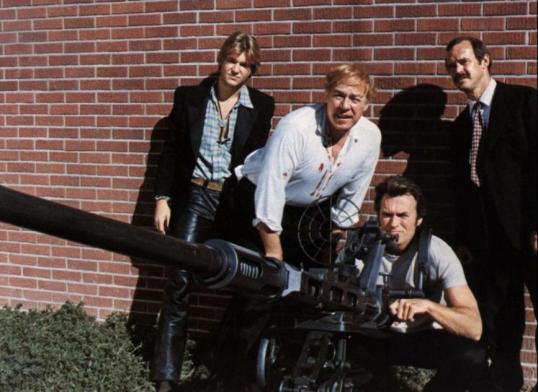
1974’s Thunderbolt and Lightfoot opens with two men, one young and one middle-aged, facing a moment of truth.

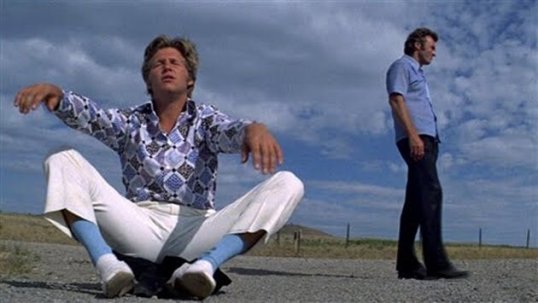
The younger of the two is Lightfoot (Jeff Bridges), a wild and hyperactive rich kid who is in his 20s and who steals a corvette right off of a used car lot.  The other man is simply known by his nickname, Thunderbolt (Clint Eastwood).  When we first see Thunderbolt, he’s giving a sermon in a small Montana church.  When a gun-wielding man steps into the church and promptly starts firing at Thunderbolt, he takes off running.  Pursued by his attacker, Thunderbolt runs through a field and just happens to jump onto Lightfoot’s speeding corvette.  Lightfoot runs over the Thunderbolt’s pursuer.  Thunderbolt slips into the car and Lightfoot drives on for a bit.  Lightfoot is excited and talkative.  Thunderbolt is more concerned with popping his shoulder back into its socket.  A stop at a gas station leads to the men stealing someone else’s car.

And so it goes for a good deal of the movie.  Thunderbolt and Lightfoot is a road movie, the majority of which is taken up with scenes of the two men just hanging out.  Thunderbolt and Lightfoot take an instant liking to each other.  When Lightfoot picks up a prostitute (Catherine Bach), he makes sure to ask that she bring along a friend for Thunderbolt.  When a criminal punches Lightfoot, Thunderbolt is quick to punch back.  “That’s for the kid,” Thunderbolt says.  That’s the type of friendship that they have.  Jeff Bridges is handsome and full of energy as Lightfoot and Clint Eastwood smiles more in this film than I think I’ve seen him smile in any other film.  For once, Eastwood is not playing a perpetually grumpy stranger or a supercop.  Instead, he’s just a blue collar guy who enjoys having a friend to travel with.

Eventually, Thunderbolt and Lightfoot meet up with two of Thunderbolt’s former associates.  Red (George Kennedy) is a brutal brawler who, it is suggested, served with Thunderbolt in the Korean War.  Goody (Geoffrey Lewis) is a gentle soul who takes orders from Red but still can’t bring himself to shoot anyone, no matter how much Red demands that he pull the trigger.  Red and Goody have always assumed that Thunderbolt stole the loot from a bank robbery that they pulled off.  Thunderbolt explains that he didn’t steal the money.  He just got arrested after hiding it.  Lightfoot suggests that maybe the four of them could pull off another bank heist….

Kennedy and Lewis are perfectly cast as the two criminals who end up working with Thunderbolt and Lightfoot.  In many ways, the relationship between Red and Goody mirrors the relationship between our lead characters.  The main difference is that Red is sadistic and quick to loose his temper, whereas Thunderbolt controls his emotions and tries not to hurt anyone while committing his crimes.  Lightfoot looks up to Thunderbolt and Goody looks up to Red.  Again, the difference is that Thunderbolt actually cares about Lightfoot, whereas Red is incapable of truly caring about anyone but himself.  Eastwood, Bridges, Kennedy, and Lewis make quite a team and it’s hard not to worry about all four of them, especially when the film takes an unexpectedly dramatic turn during its third act.

I really wasn’t expecting Thunderbolt and Lightfoot to make me cry but the final thirty minutes of the film brought tears to my eyes as what started out as a buddy comedy turned into a tragedy.  (I shouldn’t have been surprised.  I’ve seen enough 70s movies that I really should have known better than to have expected a happy ending.)  Thanks to the perceptive script by Michael Cimino (who would go on to make The Deer Hunter and Heaven’s Gate) and the performances of Eastwood and Bridges, the movie’s final moments carry quite a punch and they leave you wondering if Thunderbolt and Lightfoot’s road trip was worth the price that was ultimately paid.  The film works as not only a tribute to friendship but also as a fatalistic portrait of life on the backroads of America.

Thunderbolt and Lightfoot was the first Eastwood film to receive an Oscar nomination, with Jeff Bridges competing for Best Supporting Actor.  (He lost to Robert De Niro’s star turn in The Godfather, Part II.)  Eastwood, reportedly, felt that he deserved a nomination for his performance as Thunderbolt and, considering that that Oscar itself was won by Art Carney for his pleasant but hardly revelatory work in Harry and Tonto, Eastwood was correct.  Instead, Eastwood would have to wait for another 18 years before he finally received Academy recognition for starring in, producing, and directing Unforgiven.

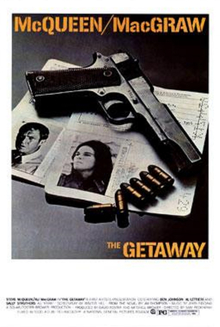
The Getaway (1972, directed by Sam Peckinpah)


Doc McCoy (Steve McQueen) is doing a ten-year sentence in a Texas state prison when he’s offered a chance at parole.  The only condition that Jack Benyon (Ben Johnson) gives Doc is that, once out of prison, Doc is going to have to plan and carry out a bank robbery with two other criminals, Frank (Bo Hopkins) and Rudy (Al Lettieri).  Desperate for his freedom and to be reunited with his wife, Carol (Ali MacGraw), Doc agrees.  On the outside, Doc carries out the robbery but it turns out that no one can be trusted.  With everyone double-crossing everyone else, Doc and Carol head for the border, pursued by the police, Rudy, and Benyon’s brother, Cully (Roy Jenson).

Based on a novel by Jim Thompson, The Getaway is a fast-paced and violent heist film.  It was on this film that Ali MacGraw and Steve McQueen first met and famously fell for each other.  Married to producer Robert Evans, Ali MacGraw left him for McQueen.  Their very real chemistry gives the film its forward momentum and it is so palpable that it doesn’t matter that the stunningly beautiful Ali MacGraw couldn’t really act.  Steve McQueen, on the other hand, is at his coolest in The Getaway.  McQueen was an actor who didn’t need much dialogue to say a lot and The Getaway features him at his tough and ruthless best.  Doc is not one of the good guys.  He’s a bad guy but not as bad as Rudy, Frank, Jack, and Cully.

As was typical of Peckinpah, The Getaway is full of small moments and details that make the movie’s world come to life.  While Doc and Carol flee across Texas, Rudy has a twisted loves story of his own with Fran (Sally Struthers, in a role that will surprise anyone who only knows her as Gloria Stivic).  Jack Dodson plays Fran’s kindly husband and gives a performance that reminds us of the human cost of crime.  Slim Pickens has a wonderful cameo as an old cowboy whose truck is hijakced by Jack and Carol.  Those who thought of Peckinpah as just being a director of violent thrillers often overlooked the moments of humanity that regularly emerged amongst all the bloodshed.

The Getaway was not given the critical acclaim it deserved when it was released but today, it’s regularly recognized as a career best for both Sam Peckinpah and Steve McQueen.

Scenes that Bradley loves – triggering human time bombs in TELEFON!


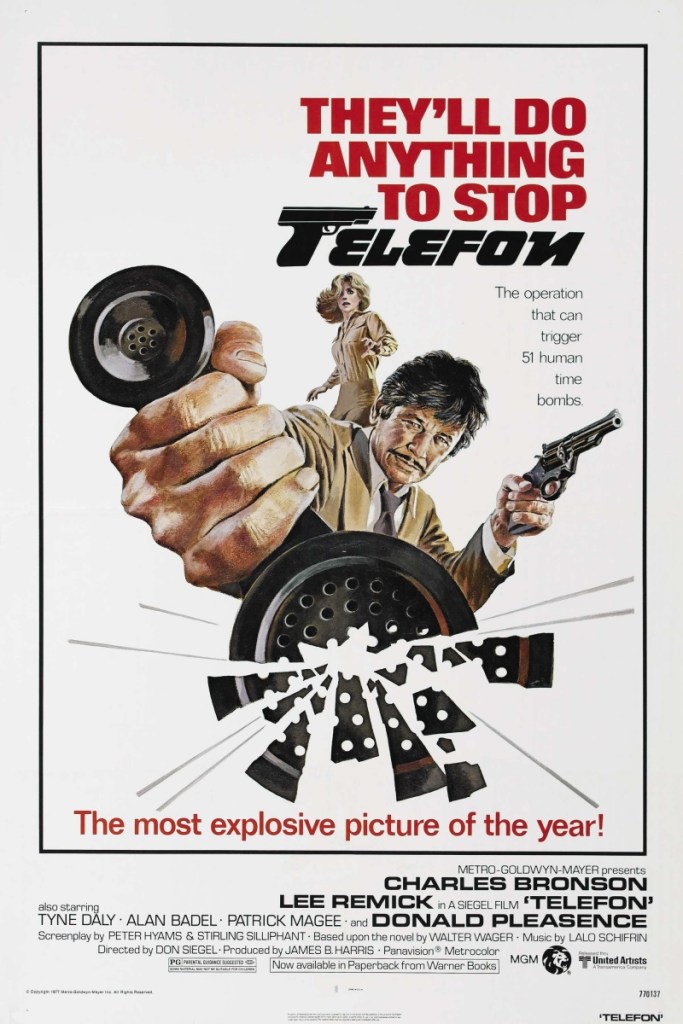
Well before THE NAKED GUN was triggering Reggie Jackson, director Don Siegel and Charles Bronson were triggering human time bombs in TELEFON (1977). Quentin Tarantino even borrowed from this film when he chose the Robert Frost poem for Stuntman Mike’s (Kurt Russell) lap dance from Arlene (Vanessa Furlito). It’s not as sexy, but it’s still a good time as Bronson tries to prevent World War III. Enjoy!

TELEFON – Charles Bronson plays a KGB agent in a movie that inspired The Naked Gun and Tarantino’s Death Proof!


When I was a kid, FOX-16 out of Little Rock, Arkansas would have “Charles Bronson weeks” where every night they’d show a different Bronson film.  I saw several of his films for the first time during those weeks and TELEFON was one of those movies.  I remember really enjoying it that first time I saw it, and I’ve always carried that positive feeling with me.  

The plot of TELEFON is pretty interesting.  In a nutshell, Charles Bronson is Russian KGB agent, Grigori Borsov, who’s been sent to the United States to stop radical Russian Nicolai Dalchimsky (Donald Pleasance), before he can set off more hypnotized human time bombs.  Lee Remick is a beautiful Russian agent (double agent?) who helps him with his mission.  

I personally think TELEFON is an underrated Charles Bronson film, and it seems like a movie that has almost been forgotten.  This is strange to me because it had quite the pedigree at the time of production.  Bronson was a huge star at the time, and the director was Don Siegel, the man behind such classics as DIRTY HARRY, ESCAPE FROM ALCATRAZ, and THE SHOOTIST.  The cast is exceptional as well, with Bronson being joined by the likes of Donald Pleasance, Lee Remick, Tyne Daly, Sheree North and Patrick Magee. The screenplay was co-written by Peter Hyams, who would go on to direct such excellent films as OUTLAND, THE STAR CHAMBER, and RUNNING SCARED.  My point of sharing all of this is that true professionals were at work in front of, and behind the camera, and they created a damn fine Cold War thriller.  I was glad that Shout Factory put out a nice blu ray of the film in January of 2024.  Hopefully film enthusiasts will begin discovering the film again.  

With that said, TELEFON isn’t a perfect film and I do have a few small complaints.  First, Charles Bronson doesn’t appear in the film until we’re already 21 minutes deep.  That’s a long time for me to have to wait for the man!  Second, Bronson and Remick don’t have a lot of sexual chemistry.  She’s beautiful and he oozes masculinity, but somehow it doesn’t really extend to a real connection between their characters.  That’s one of the reasons I like it when Bronson works with his wife Jill Ireland.  That chemistry is usually there between them.  Third, Donald Pleasance wears several wigs and looks kind of dorky at times.  Fourth, Sheree North wears a housecoat during her section of the film.  If you’ve seen her in BREAKOUT with Bronson from a couple of years earlier, you understand just what a missed opportunity that was.  Finally, Tyne Daly is so good in her small role, but she ultimately just kind of exits the film.  I’d have liked even more of her.  These are small complaints, with the exception of Bronson’s entrance & North’s wardrobe choice, that I don’t really hold against the movie.  

The last thing that I want to mention is that there are a couple interesting pop culture references to TELEFON in movies that came out later.  First, the writers of THE NAKED GUN borrowed the plot about hypnotized human time bombs in their own plot to assassinate the visiting Queen of England.  Certain scenes are taken directly from TELEFON.  I remember watching THE NAKED GUN in theaters in the late 80’s and wondering if I was the only person who realized this fact.  Second, in DEATH PROOF, Quentin Tarantino used the major plot device of quoting the Robert Frost poem “Stopping by Woods on a Snowy Evening” in order to trigger something. In TELEFON, it was human time bombs.  In DEATH PROOF, it was human lap dances.  God bless Quentin Tarantino!

Retro Television Review: The Glass House (dir by Tom Gries)


Welcome to Retro Television Reviews, a feature where we review some of our favorite and least favorite shows of the past!  On Sundays, I will be reviewing the made-for-television movies that used to be a primetime mainstay.  Today’s film is 1972’s The Glass House!  It  can be viewed on YouTube.

The Glass House starts with three men arriving at a location that will define the next few months of their lives.

Brian Courtland (Clu Gulager) is a veteran of the Vietnam War.  He spent part of his service working as a guard in the brig.  Now that he’s back in the United States and in need of a regular paycheck, he has gotten a job working as a prison guard.  Courtland is not naive about where he’s going to be working or who he is going to be working with.  But he is an idealist, one who tries to treat everyone fairly and who hopes that he will be able to do some sort of good in his new position.

Alan (Kristoffer Tabori) is a young man who has been arrested for selling marijuana.  He is quiet and just hoping to serve his time and then get on with his life.  His fellow prisoners have different plans for him.

Finally, Jonathan Paige (Alan Alda) is a liberal professor who, in a moment of rage, accidentally killed a man in a fight.  Convicted of manslaughter, Paige enters the prison in a daze and cannot stop flashing back to the one moment that changed his life forever.  Paige is assigned to work in the pharmacy, where he meets a prisoner-turned-activist named Lennox (Billy Dee Williams).  Paige struggles to retain his humanity despite the harsh conditions.

All three of the men find themselves having to deal with the attentions of Hugo Slocum (Vic Morrow), the predatory “king” of the prison.  Slocum expects Paige to help him run drugs though the the pharmacy.  Slocum preys on Alan and sends his gang to punish him when Alan refuses Slocum’s advances.  And Slocum expects that Courtland will just be another corrupt guard who agrees to look the other way when it comes to Slocum’s activities.  Courtland, however, turns out to have more integrity than anyone was expecting.

The Glass House opens with a title card, informing the viewer that the film was shot at an actual prison and that the majority of the people in the film were actual prisoners.  Not surprisingly, The Glass House does feel authentic in a way that a lot of other films about incarceration does not.  The prison is claustrophobic and dirty, with every crack in the wall reminding the prisoners and the viewer that no one cares about what happens there.  The extras have the blank look of men who understand that showing any emotion will be taken a sign of a weakness.  Made in 1972, at a time when America was still struggling to integrate, The Glass House takes place in an almost totally segregated world.  The black prisoners stick together.  The white prisoners stick together.  Everyone understands that’s the way that it will always be and, as we see by the end of the film, that’s the way the guards and the warden (Dean Jagger) prefer it because that means almost any incident can be written off as a being “a race riot.”

The real actors amongst the population do a good job of blending into the surroundings.  Alda, Williams, and Tabori all give good performance while Vic Morrow is truly menacing in the role of the vicious Slocum.  Slocum may not be particularly bright but, because he has no conscience, he is uniquely suited to thrive in a world with no morality.  The film’s best performance comes from Clu Gulager, who does a great job of portraying Courtland’s growing disgust with how the system works.

Though it’s over 50 years old, The Glass House is a still a powerful look at life on the fringes.  Society, for the most part, doesn’t really care much about what happens to the incarcerated.  This film makes a strong case that we probably should.  One is left with little doubt that, even if relatively harmless prisoners like Paige and Campbell survive being locked up with men like Slocum, they’ll still be incapable of returning to the “real world” afterwards.  The viewer, like Brian Courtland, is left to wonder how much corruption can be tolerated before enough is enough.

Demonoid (1981, directed by Alfredo Zacarias)


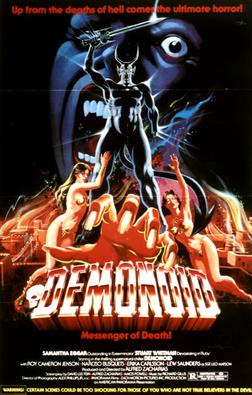
Demonoid has a great title and it had a good one sheet but don’t be fooled.  The sword-wielding devil is barely in the move and the women at his feet may have appeared on the cover of every heavy metal album in the 80s but they’re not in the movie.

Exploring a recently uncovered tomb in Mexico, Jennifer (Samantha Eggar) and Mark Baines (Roy Jenson) are intrigued by a number of bodies that are missing their left hand.  Their guide explains that, centuries ago, men, women, and children were sacrificed to the Devil by having their left hands cut off.  When Mark and Jennifer discover a casket with a severed hand, they decide to take it back to the hotel with them.  Of course, the hand is not dead.  It springs from its casket and possesses Mark.  This leads to Mark fleeing back to the United States, trying to find a way to get rid of his possessed hand.  Unfortunately, the hand has a mind of its own and, even after Mark ends up getting set on fire, the hand continues to live and possess one person after another.  Jennifer teams up with Father Cunningham (Stuart Whitman), trying to bring an end to the hand’s reign of terror and giving the audience a chance to wonder how these two actors went from being Oscar nominees to co-starring in Demonoid.

Demonoid is a strange film that starts out as a leisurely travelogue of Mexico and then suddenly turn into a cinematic Grand Guignol, with person after person trying to figure out how to chop off their left hand without doing permanent damage to themselves.  Because the hand is immortal, it has no problem trying to kill whoever it is currently attached to, which leads to not only several scenes of actors fighting with themselves but also several detached hands running across the screen.  A detached but moving hand is creepy the first time you see it but it becomes progressively less so the more time that you spend with it.  The plot is ridiculous enough to be initially intriguing but ultimately, Demonoid is a handsy bore.

Retro Television Reviews: A Tattered Web (dir by Paul Wendkos)


Welcome to Retro Television Reviews, a feature where we review some of our favorite and least favorite shows of the past!  On Sundays, I will be reviewing the made-for-television movies that used to be a primetime mainstay.  Today’s film is 1971’s A Tattered Web!  It  can be viewed on YouTube!

Sgt. Ed Stagg (Lloyd Bridges) is a good cop and an overprotective father.  Ever since his wife left him, Ed has been determined to make sure that his daughter, Tina (Sallie Shockley), has a good life.  So, as you can probably guess, Ed is not amused when he finds out that Tina’s husband, Steve (Frank Converse), has been cheating on her with Louise Campbell (Anne Helm).  Ed has never liked Steve and would love it if his daughter left him.  But, Ed still doesn’t want want Tina to have to go through the pain of knowing that her husband is seeing another woman.

Ed decides to drop by Louise’s apartment and talk to her himself.  Louise, however, is not willing to let some old stranger tell her how to live her life.  After all, she’s heard from Steve about what a terrible and judgmental father-in-law Ed is.  Ed gets frustrated and shoves Louise.  Louise stumbles back, hits her head, and …. uh-oh.  Louise is dead!  To be honest, it didn’t really look like she hit her head that hard.  In fact, I had to rewatch the scene to see if she actually hit her head at all.  But no matter.  Louise is dead and Ed’s responsible.

The next morning, when Ed and his partner, Joe (Murray Hamilton), are called in to investigate Louise’s homicide, Ed is approached by Louise’s neighbor (John Fiedler), who gives him a description of a  young man who he says he frequently saw going up to Louise’s apartment.  The description perfectly describes Steve.  The police sketch artist draws a picture that looks like just like Steve.  Joe thinks that Steve is responsible.  Not wanting his daughter to think that her husband’s a murderer, Ed decides to frame Willard Edson (Broderick Crawford), an alcoholic who frequently comes into the station and confesses to crimes so that he can have a place to sleep for the night.

Yes, it’s a tattered web indeed.  Ed is able to talk Edson into confessing to the crime but then Steve does his own detective work and realizes that Edson couldn’t be the murderer.  Ed tells Steve that he should just let the police arrest Edson because, otherwise, they’re going to come after Steve.  Steve, however, says that he would rather be arrested and be given a chance to prove his innocence than just stand by idly while an innocent man goes to jail.  Being a veteran cop, Ed wasn’t expecting everyone to be so damn honest!

A Tattered Web isn’t bad for a 70-minute made-for-TV movie.  The film’s main strength is the cast, with Lloyd Bridges, Murray Hamilton, and especially Broderick Crawford giving strong performances.  The scene where Ed talks Edson into confession is especially well-done, with Crawford giving a performance of growing desperation while Bridges himself appears to be on the verge of tears as Ed realizes what his life has become.  Like his sons Jeff and Beau, Lloyd Bridges is such a likable actor that it’s hard not to care about what happens to the characters that he’s playing, even when he’s playing a murderer.  A Tattered Web is an effective thriller that reminds viewers that guilt cannot be escaped.

Retro Television Reviews: Fantasy Island 3.2 “Goose For The Gander/Stuntman”


Welcome to Retro Television Reviews, a feature where we review some of our favorite and least favorite shows of the past!  On Tuesdays, I will be reviewing the original Fantasy Island, which ran on ABC from 1977 to 1986.  The entire show is currently streaming on Tubi!

This week, Tattoo is nice and Mr. Roarke is understandably suspicious.

Episode 3.2 “Goose For The Gander/Stuntman”

(Dir by Cliff Bole, originally aired on September 14th, 1979)

This episode opens with Tattoo being very nice and polite to Mr. Roarke and asking if there is anything that he can do to help Roarke as they head out to meet the plane.  It says a lot about how much Roarke hates his assistant that Roarke’s immediate reaction is to suspect that Tattoo has done something wrong and is trying to escape being punished as a result.  By the end of the episode, Roarke learns that Tattoo is freaking out because Tattoo saw a classified ad announcing that Roarke was looking for a new “assistant manager,” and Tattoo feared he was going to be fired.  Mr. Roarke has a good laugh over that.  Roarke enjoys anything that makes Tattoo’s life miserable.

As for the fantasies, this is another week where we get one silly fantasy and one serious fantasy.

The silly fantasy involves Marjorie Gibbs (Doris Roberts), who owns a truck stop in Arizona.  A new highway is being put in and all of Marjorie is going to have to relocate her diner.  Unfortunately, that is going to cost money that Marjorie does not have.  All of Marjorie’s customers tipped in and raised enough money to send Marjorie to Fantasy Island so that she can compete in a cooking contest and win a huge cash prize.

Can Marjorie win the contest?  It’s not going to be easy, as one of her competitors is a sneaky French chef (Vito Scotti) and the judge (Hans Conried) is one of those food snobs.  Fortunately, Marjorie strikes up a friendship with another diner owner, Joe Lange (Abe Vigoda).  Joe supports Marjorie and helps her to win, even after the French chef steals one of Marjorie’s recipes!  They also fall in love and save a goose from becoming a meal.  Awwwwww!  This was a silly but sweet fantasy.  Doris Roberts and Abe Vigoda made for a good comedic team.

As for the serious fantasy, it’s all about stunts.  Retired stuntman Peter Rawlings (Dale Robertson) comes to the island with his wife, Norma (Dana Wynter).  Norma thinks this is just a normal vacation but Peter actually wants to come to the island because his son, Bill (Grant Goodeve), is the stunt coordination for a film that is shooting there.  Bill has lived his whole life in his father’s shadow and Peter fears that Bill’s desire to pull off the biggest stunt of all time will lead to his death.  Peter also discovers that Bill’s insecurity has led to him becoming a tyrant on the set.  In fact, as soon as Peter shows up, Bill is fired and Peter is named the new stunt coordinator.  Can father and son set aside their differences and pull off a truly spectacular stunt?

Of course they can.  This is Fantasy Island.

This was one of those episodes that pretty much succeeded on the charm of the cast alone.  Neither one of the fantasies was particularly interesting.  We were told that Marjorie and Joe’s food was the best but, since we couldn’t taste it, we had no way of knowing for sure.  And the big stunt really didn’t look all that special.  But Doris Roberts, Dale Robertson, and Abe Vigoda all gave charming performances so, in the end, I was happy everything worked out.

Next week: Tattoo gets a fantasy!  Roarke better watch out!