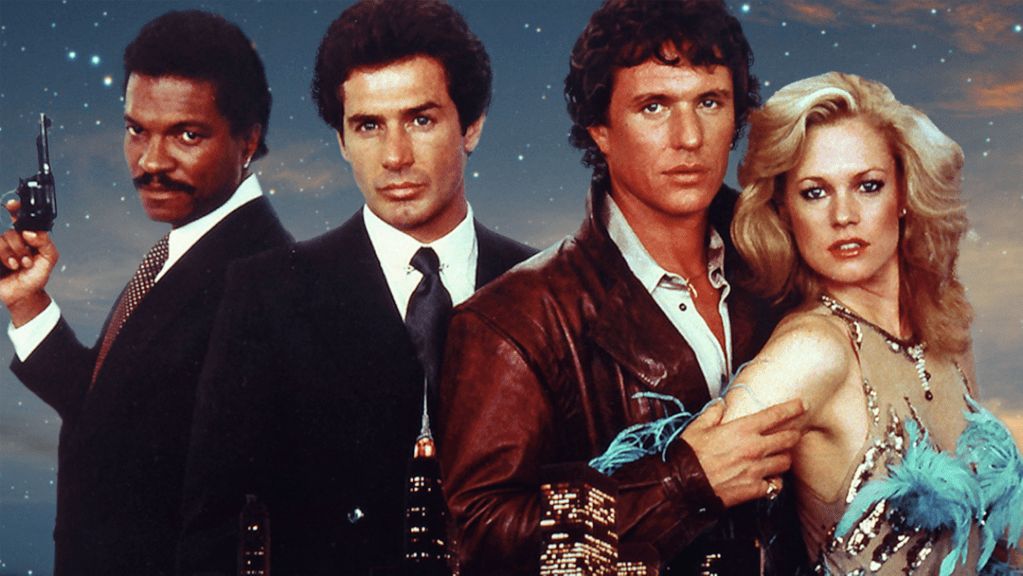
Every Monday night at 9:00 Central Time, my wife Sierra and I host a “Live Movie Tweet” event on X using the hashtag #MondayMuggers. We rotate movie picks each week, and our tastes are quite different. Tonight, Monday January 27th, we’re watching FEAR CITY starring Tom Berenger, Billy Dee Williams, Jack Scalia and Melanie Griffith.
So why did I pick FEAR CITY, you might ask?
I’m a huge fan of Tom Berenger. SOMEONE TO WATCH OVER ME (1987 with Mimi Rogers), SHOOT TO KILL (1988 with Sidney Poitier), MAJOR LEAGUE (1989 with Charlie Sheen), and LAST OF THE DOGMEN (1995 with Barbara Hershey) are some of my very favorite films. He’s an outstanding actor and screen presence. Tom Berenger is one of those actors who I always enjoy seeing on screen.
FEAR CITY is directed by Abel Ferrara. Abel Ferrara is one of those directors who makes movies about the very worst in society. His films MS. 45 (1981), KING OF NEW YORK (1990), and BAD LIEUTENANT (1992) are all movies that intrigued me greatly as I was trying to discover who I was growing up in the 80’s and early 90’s.
The sleaze is off the charts in FEAR CITY, with so many big-time stars, and set in New York City of the 1980’s. From everything I’ve read, this a time capsule of a place that no longer exists. If I ever make it to New York City, I’ll be greeted with a place that’s designed more like Disney World. I think it’s interesting to see the city as presented here!
I also think it will be interesting to see what it’s like to experience a movie like FEAR CITY as part of a group. I discovered this film as a teenager in the 80’s. I remember being a little embarrassed as I watched the film, especially with its large serving of nudity (from big stars) and graphic violence. I’ve watched films in groups with the most extreme graphic violence imaginable and no one batted an eye. I’m looking forward to seeing how this plays out.
So join us tonight to for #MondayMuggers and watch FEAR CITY! It’s on Amazon Prime.
Welcome to Retro Television Reviews, a feature where we review some of our favorite and least favorite shows of the past! On Tuesdays, I will be reviewing the original Fantasy Island, which ran on ABC from 1977 to 1984. Unfortunately, the show has been removed from most streaming sites. Fortunately, I’ve got nearly every episode on my DVR.
Yay! It’s finally time to return to the Island.
Episode 5.7 “The Perfect Husband/Volcano”
(Dir by Philip Leacock, originally aired on November 21st, 1981)
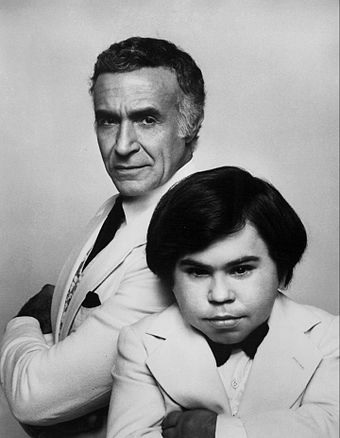
This week, it’s Tattoo’s turn to serve as Roarke’s sidekick while Julie is sent off to deal with two weddings and a tour for “the seniors.”
On the one hand, it’s incredibly awkward for Roarke to have two sidekicks and it’s pretty obvious that Julie was only hired to serve as insurance in case Herve Villechaize walked off the set.
On the other hand, it is kind of nice to be reminded of the fact that there’s a lot happening on Fantasy Island. Fantasy Island is not just a mystical nation that is ruled over by the enigmatic Mr. Roarke. It’s also a resort that hosts vacations and retirement homes. Apparently, you don’t have to have a fantasy in order to spend some time on Fantasy Island. Instead, you can just come to Fantasy Island for a nice tropical vacation. That’s kind of nice.
But, that said, the fantasies are why we’re here. We’ve got two good ones this week.
Dorothy Nicholson (Susan Sullivan) is a newspaper publisher who has been feeling unfulfilled ever since her husband was killed by a drunk driver. She want to find the perfect husband, a man without any flaws whatsoever. After giving her his customary “You may not like what you find,” warning, Roarke sends her to Paradise Cove. Operated by the sinister Anton Jagger (Rossano Brazzi), Paradise Cover is a resort where wealthy women are assigned the perfect companion. Dorothy’s perfect man is Gilbert (Lyle Waggoner). Gilbert is handsome, suave, charming, and attentive. Unfortunately, like all of the perfect men at Paradise Cove, he’s also a robot and a part of Jagger’s scheme to cheat women out of their money! Dorothy figures out the truth after Gilbert doesn’t even flinch after his hand catches on fire. Can she defeat Jagger’s plans and rescue the real Gilbert?
(Of course, she can. It’s Fantasy Island!)
Dr. Hal Workman (George Maharis) thinks that he’s figured out a way to detect when a volcano is going to erupt. He wants to go to Fantasy Island’s own active volcano to test out his methods. Roarke agrees, even though he worries that Dr. Workman only cares about science and not about people. (Honestly, who cares? A volcano detection system sounds like it would be a good thing, regardless of the motives of the man who created it.) Workman is led to the volcano by a disillusioned former priest named Lauria (Richard Romanus). However, Workman and Lauria are not the only people at the volcano. There’s also a shady tycoon, Joseph Butler (Norman Alden), and his girlfriend, Terri (Misty Rowe). You can probably guess what happens. Workman falls in love with Terri. Lauria finds his faith. And Butler presumably dies when the volcano erupts and a deluge of what appears to be very thin tomato sauce comes pouring down the mountain.
Both of these fantasies were cheerfully ridiculous, which made them a lot of fun. You may wonder why Roarke would send one of his guests to a resort that’s being run by a madman and that’s a legitimate question. But the important thing is that the viewer gets a montage of all of the robots malfunctioning at once. And you may wonder at the wisdom of allowing someone to go to an active volcano but the important thing is that we get a scene of George Maharis and Richard Romanus running away from the least realistic lava flow ever caught on film. Fantasy Island is a lot of fun when it goes over the top and embraces its beautiful absurdity and that’s exactly what this episode did.
The 1954 Best Picture nominee, Three Coins In The Fountain, tells the story of three American women living in Rome. They’re all employed by the same secretarial agency. Maria Williams (Maggie McNamara) is young and hoping that she’ll stay in Rome for at least a year and that she’ll meet her future husband. Anita Hutchins (Jean Peters) is not-so-young and is planning on returning to America so that she can meet her own future husband. Miss Frances (Dorothy McGuire) is middle-aged and has spent the last 15 years working for the man that she wishes could be her future husband.
If you’re getting the feeling that there’s not much to our leads beyond a desire to get married, you’re not wrong. However, Anita swears that it’s impossible to find a husband in Rome because the only Italians who are interested in “secretaries” are too poor to be good husbands which …. well, like I mentioned before, this film is from 1954. Just the fact that the film featured three single women living together in a foreign country was probably considered to be daring back in 1954.
The three women eventually end up at the Trevi Fountain, where Maria and Frances throw in their coins and make their wishes. Anita, however, does not toss in a coin because apparently, she’s not scared of offending God. No sooner have the three women visited the fountain than things begin to happen. Soon, all three of them are in love but each has to deal with a compliction.
Miss Frances may have finally convinced her employer, writer John Frederick Shadwell (Clifton Webb), to marry her but when he discovers that he’s terminally ill, he tries to call off the engagment.
Maria meets Prince Dino di Cessi (Louis Jourdan) but will the Prince still want to be with her after he discovers that she’s been lying about being interested in the same things that he’s interested in?
Anita falls for Giorgio (Rossano Brazzi) but he’s poor! Plus, he also works for the agency and apparently, there’s some sort of weird 1954 rule that forbids the American employees from fraternizing with the Italian employees. Is Anita willing to lose her job just so she can marry someone who doesn’t have any money?
That’s pretty much it. Other than John Shadwell wrestling with his own mortality, there’s really not a whole lot of drama to be found in Three Coins In The Fountain. This is a film about pleasant people doing pleasant things and having pleasant conversations. It’s a rather chaste romance, one of those films where you have no doubt that everyone involved will wait until marriage and that all of the women will quit their jobs and settle down as soon as the right ring gets put on their finger. In other words, this is very much a film of its time and watching it today can be bit of an odd experience. This is ultimately the type of film that works best as a travelogue. Rome looks beautiful. There’s a striking shot of the sunset reflected in the canals of Venice. The Trevi Fountain truly does look like it can grant wishes. (It’s amusing to compare the reverence that the American-made Three Coins In The Fountain shows towards The Trevi Fountain to the way that Rome-native Federico Fellini used the fountain in La Dolce Vita.) One gets the feeling that, even in 1954, people flocked to this film more to see Rome than to really worry about whether or not the Prince would eventually propose.
In fact, one of the main reasons why I watched this film tonight is because I spent one of the greatest summers of my life in Italy. I’ve been to Rome. I’ve thrown coins into the Trevi Fountain and I’ve made wishes. I loved Rome. I loved the people. I loved the culture. I loved the buildings. I loved the feeling of walking through history. I loved looking out at the horizon and feeling as if I was somehow in a living painting. (I actually went into a bit of daze when I was in Florence. Stendhal Syndrome is for real.) If you can’t find romance in Rome then you’re obviously not looking. For me, the main appeal of Three Coins In The Fountain was being able to watch it and say, “I’ve been there!” I imagine for audiences in 1954, the appeal was probably to be able to watch it and say, “I’m going to go there!”
How did this perfectly pleasant but otherwise unmemorable film end up as a best picture nominee? I imagine a lot of it had to do with the fact that the film was a box office success. It’s certainly not because it was a better film than either Rear Window or Sabrina, both of which were not nominated for Best Picture despite being nominated for Best Director. In the end, the 1954 Best Picture Oscar was won by On The Waterfront, a film that appears to be taking place in an entirely different universe than Three Coins In A Fountain.
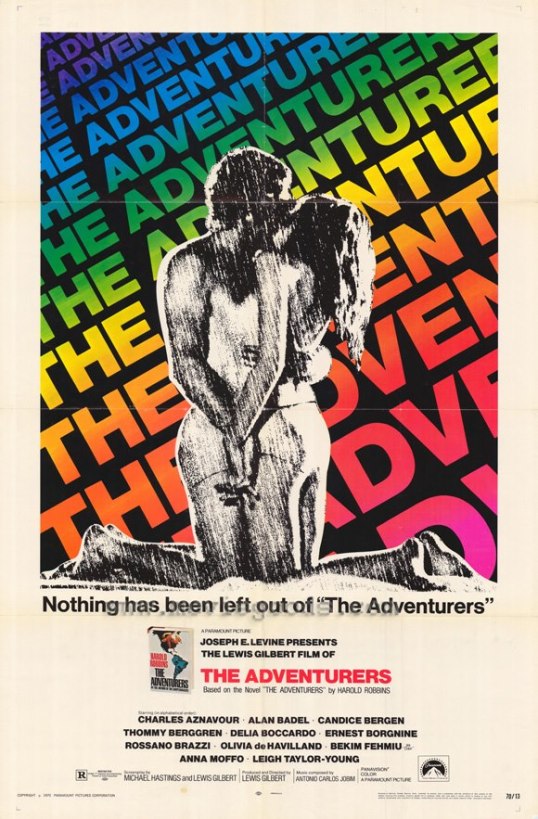
The 1970 film, The Adventurers, is a film that I’ve been wanting to watch for a while.
Based on a novel by Harold Robbins, The Adventurers was a massively expensive, three-hour film that was released to terrible reviews and even worse box office. In fact, it’s often cited as one of the worst films of all time, which is why I wanted to see it. Well, three weeks ago, I finally got my chance to watch it and here what I discovered:
Yes, The Adventurers is technically a terrible movie and Candice Bergen really does give a performance that will amaze you with its ineptitude. (In her big scene, she sits in a swing and, with a beatific look on her face, begs her lover to push her “Higher! Higher!”)
Yes, The Adventures is full of sex, intrigue, and melodrama. Director Lewis Gilbert, who did such a good job with Alfieand The Spy Who Loved Me, directs as if his paycheck is dependent upon using the zoom lens as much as possible and, like many films from the early 70s, this is the type of film where anyone who gets shot is guaranteed to fall over in slow motion, usually while going, “Arrrrrrrrrrrrgh….” A surprisingly large amount of people get shot in The Adventurers and that adds up to a lot of slow motion tumbles and back flips. Gilbert also includes a sex scene that ends with a shot of exploding fireworks, which actually kind of works. If nothing else, it shows that Gilbert knew exactly what type of movie he was making and he may have actually had a sense of humor about it. That’s what I choose to believe.
Despite the fact that The Adventurers is usually described as being a big-budget soap opera, a good deal of the film actually deals with Latin American politics. For all the fashion shows and the decadence and the scenes of Candice Bergen swinging, the majority of The Adventures takes place in the Latin American country of Cortoguay. If you’ve never heard of Cortoguay, that’s because it’s a fictional country. Two hours of this three-hour film are basically devoted to people arguing and fighting over who is going to rule Cortoguay but it’s kind of impossible to really get to emotionally involved over the conflict because it’s not a real place.
Ernest Borgnine plays a Cortoguayan named — and I’m being serious here — Fat Cat. Seriously, that’s his name. And really, how can you not appreciate a movie featuring Ernest Borgnine as Fat Cat?
Fat Cat is the guardian of Dax Xenos (Bekim Fehmiu). Dax’s father is a Cortoguayan diplomat but after he’s assassinated by the country’s dictator, Dax abandons his home country for America and Europe. While he’s abroad, Dax plays polo, races cars, and has sex with everyone from Olivia de Havilland to Candice Bergen. He also gets involved in the fashion industry, which means we get two totally 70s fashion shows, both of which are a lot of fun. He marries the world’s richest heiress (Bergen) but he’s not a very good husband and their relationship falls apart after a pregnant Bergen flies out of a swing and loses her baby.
Throughout it all, Fat Cat is there, keeping an eye on Dax and pulling him back to not only Cortoguay but also to his first love, Amparo (Leigh Taylor-Young), who just happens to be the daugther of Cortoguay’s dictator, Rojo (Alan Badel). In fact, when Fat Cat and Dax discover that an acquaintance is selling weapons to Rojo, they lock him inside of his own sex dungeon. That’s how you get revenge! And when Dax eventually does return to Cortoguay, Fat Cat is at his side and prepared to fight in the revolution. Incidentally, the revolution is led by El Lobo (Yorgo Voyagis), who we’re told is the son of El Condor.
The Adventurers is melodramatic, overheated, overlong, overdirected, and overacted and, not surprisingly, it’s eventually a lot of fun. I mean, the dialogue is just so bad and Lewis Gilbert’s direction is so over the top that you can’t help but suspect that the film was meant to be at least a little bit satirical. How else do you explain that casting of the not-at-all-Spanish Bekim Fehmiu as a Latin American playboy? Candice Bergen plays her role as if she’s given up any hope of making sense of her character or the script and the rest of the cast follows her lead. Ernest Borgnine once said that The Adventurers was the worst experience of his career. Take one look at Borgnine’s filmography and you’ll understand why that’s such a bold statement.
The Adventurers is three hours long but it’s rarely boring. Each hour feels like it’s from a totally different film. It starts out as Marxist agitprop before then becoming a glossy soap opera and then, once Fat Cat and Dax return home and get involved in the revolution, the film turns into “modern” spaghetti western. It’s a film that tries so hard and accomplishes so little that it becomes rather fascinating.
And, if nothing else, it reminds us that even Fat Cat can be a hero….
For the longest time, I thought that Two-Minute Warning was a movie about a gang of art thieves who attempt to pull off a heist by hiring a sniper to shoot at empty seats at the Super Bowl. As planned by a master criminal known as The Professor (Rossano Brazzi), the sniper will cause a riot and the police will be too busy trying to restore order to notice the robbery being committed at an art gallery that happens to be right next to the stadium.
I believed that because that was the version of Two-Minute Warning that would sometimes show up on television. Whenever I saw the movie, I always through it was a strange plan, one that had too many obvious flaws for any halfway competent criminal mastermind to ignore them. What if the sniper was captured before he got a chance to start shooting? What if a riot didn’t break out? The sniper spent the movie aiming at empty seats but, considering how many people were in the stadium, it was likely that he would accidentally shoot someone. Were the paintings really worth the risk of a murder charge?
Even stranger was that Two-Minute Warning was not only a heist film but it was also a 1970s disaster film. Spread out throughout the stadium were familiar character actors like Jack Klugman, John Cassevetes, David Janssen, Martin Balsam, Gena Rowlands, Walter Pidgeon, and Beau Bridges. It seemed strange that, once the shots were fired and Brazzi’s men broke into the gallery, all of those familiar faces vanished. When it comes to disaster movies, it is an ironclad rule that at least one B-list celebrity has to die. It seemed strange that Two-Minute Warning, with all those characters, would feature a sniper shooting at only empty seats. For that matter, why would there be empty seats at the Super Bowl?
That wasn’t the strangest thing about Two-Minute Warning, though. The strangest thing was that Charlton Heston was in the film, playing a police captain. In most of his scenes, he had dark hair. But, in the scenes in which he talked about the art gallery, Heston’s hair was suddenly light brown.
Recently, I watched Two-Minute Warning on DVD and I was shocked to discover that the movie on the DVD had very little in common with the movie that I had seen on TV. For instance, the television version started with the crooks discussing their plan to rob the gallery. The DVD version opened with the sniper shooting at a couple in the park. In the DVD version, there was no art heist. The sniper had no motive and no personality. He was just a random nut who opened fire on the Super Bowl. And, in the DVD version, he did not shoot at empty seats. Several of the characters who survived in the version that I saw on TV did not survive in the version that I saw on DVD.
What happened?
The theatrical version of Two-Minute Warning was exactly what I saw on the DVD. A nameless sniper opens fire and kills several people at the Super Bowl. In 1978, when NBC purchased the television broadcast rights for Two-Minute Warning, they worried that it was too violent and too disturbing. There was concern that, if the film was broadcast as it originally was, people would actually think there was a risk of some nut with a gun opening fire at a crowded event. (In 1978, that was apparently considered to be implausible.) So, 40 minutes of new footage was shot. Charlton Heston even returned to film three new scenes, which explains his changing hair color. The new version of Two-Minute Warning not only gave the sniper a motive (albeit one that did not make much sense) but it also took out all of the violent death scenes.
Having seen both versions of Two-Minute Warning, neither one is very good, though the theatrical version is at least more suspenseful than the television version. (It turns out that it was better to give the sniper no motive than to saddle him with a completely implausible one.) But, even in the theatrical version, the potential victims are too one-dimensional to really care about. Ultimately, the most interesting thing about Two-Minute Warning is that, at one time, an art heist was considered more plausible than a mass shooting.
Originally, it had been planned that the Omen franchise would be made up of six or seven films and that each movie would check in on another year in the life of Damien Thorn, a bit like an apocalyptic version of Boyhood. However, after Damien: Omen II failed to perform up to expectations, plans were changed.
Instead of continuing the story of Damien’s adolescence, the 1981 film Omen III: The Final Conflict jumps straight into Damien’s adulthood. Now 32 years old and played by a very young (and handsome) Sam Neill, Damien Thorn is now the CEO of Thorn Enterprises. With the help of his loyal assistant Harvey Dean (Don Gordon), Damien has become one of the most popular and powerful men on the planet. Thorn Enterprises, having followed Paul Buhler’s scheme from the second film, is now responsible for feeding a good deal of the world. Damien is seen as being a humanitarian and a future President. When the U.S. Ambassador to the United Kingdom reacts to spotting a black dog in the park by committing suicide, Damien is appointed to the position.
(Needless to say, everyone in London is happy to see Damien. Nobody says, “I just hope you don’t end up going crazy and dying a violent death, like everyone else in your family and immediate circle of acquaintances.” But they’re probably thinking it…)
Now in London (and also appointed to be head of the United Nations Youth Organization, which just goes to show that your crazy uncle is right and the United Nations is a conspiracy), Damien pursues a rather creepy romance with journalist Kate Reynolds (Lisa Harrow) and makes plans to prevent the Second Coming by killing every single baby born on the morning of March 24th. (But Harvey’s son was born on March 24th — wow, could this lead to some sort of conflict?)
Meanwhile, a group of priests (led by an embarrassed-looking Rossanno Brazzi) have recovered these damn daggers of Megiddo and are now all attempting to assassinate Damien. Unfortunately, none of them are very good at their job. (“You had one job, Father! One job!”)
Bleh.
The Final Conflict is not that good. It’s boring. The plot is full of holes. For instance — and yes, these are SPOILERS — why have we sat through two movies listening to characters insist that Damien has to be stabbed by all seven of the daggers when apparently, just one dagger will do the job? Why, after being told that Jesus is going to be reborn as a child, does he then appear as an adult at the end of the film? And finally, why does nobody ever seem to find it strange that everyone that Damien knows end up suffering a freak accident?
I will say that there are two good things about The Final Conflict.
First off, Sam Neill gives a good performance as Damien Thorn. He’s handsome, he’s charismatic, and he’s not afraid to be evil. But, unfortunately, Damien’s just not that interesting of a character anymore. In the first Omen, he was interesting because he was an evil five year old. In the second Omen, he was at least occasionally conflicted about his role. In the third Omen, Damien is just evil and evil without nuance is boring.
Secondly, there’s that sequence where Damien’s followers go after the babies born on March 24th. Oh my God, that was so disturbing and it was one of the few moments when The Final Conflict actually became horrific.
Otherwise, The Final Conflict is a thoroughly forgettable sequel to a memorable film.



 Through the Shattered Lens