Horror Film Review: X: The Man With X-Ray Eyes (dir by Roger Corman)


X: The Man With The X-Ray Eyes (1963, dir by Roger Corman, DP: Floyd Crosby)

Eyes.  They’re one of the most important parts of our body but they’re also frightening easy to damage. Unlike the heart or the liver or the brain, they don’t have a protective covering of skin and bone.  They sit exposed and  are easily injured.  They can be ripped out of one’s head, which is a scary thought.  As well, they tend to grow weaker over time.  I love my multi-colored eyes and I think they’re one of my best features but I still spend a lot of time wishing that they weren’t quite as vulnerable as they are.  I often say that I’m blind without my contacts or my glasses.  That’s not quite true, of course.  I can see enough to get by if I forget to put in my contacts but I still have to do a lot of squinting, enough so that most people can take one look at me and say, “You forgot to put in your contacts, didn’t you?”  In my case, my eyesight has definitely gotten even worse over the past few years.  I’ve been told that’s normal but it still freaks me out.  I worry about waking up one day and not being able to see anything at all.

Director Lucio Fulci, a diabetic who was slowly going blind during the final years of his life, was infamous for including scenes of eyes being either pierced or gouged out in his films.  The New York Ripper even featured one scene where an eye was slit in half with a razor blade.  (This occurred in a close-up, no less!)  In Joe D’Amato’s Beyond the Darkness, there’s a scene where a mad taxidermist replaces the eyes of his dead fiancée with glass and for me, that’s one of most disturbing elements of the film.  Horror directors understand the vulnerability of the eyes and the sadness when life is extinguished from those eyes.  Eyes are said to be the windows to soul and when those eyes are lifeless, it’s a reminder that a living soul is a fleeting thing.

Perhaps that’s why 1963’s X: The Man With The X-Ray Eyes is such an effective work of art.  Directed by Roger Corman, the film tells the story of Dr. James Xavier (Ray Milland), a doctor who has developed eye drops that, when taken, allow one to have x-ray vision.  Dr. Xavier claims that the eye drops will allow doctors to more easily diagnose their patients and certainly, he has a point there.  His friend, Dr. Sam Brant (Harold J. Stone), points out that the eyes are directly connected to the brain and that using experimental eye drops on them could potentially drive a person mad.  Dr. Xavier proves Dr. Brant’s point by losing his tempter and accidentally pushing him out of a window.

Ah, x-ray vision.  It all starts out fun.  Dr. Xavier is performing miracle surgeries and seeing what everyone looks like naked.  (The swinging jazz party scene is a classic example of how 60s B-movies teased audiences while never quite showing everything.) But once he’s forced to go on the run from the police, Xavier finds himself making a living as a carnival psychic while still trying to refine his eyedrops.  Xavier’s sleazy manager (Don Rickles) tries to turn Xavier into a faith healer but, with Xavier’s x-ray vision growing more erratic and more intense, Xavier ends up running off to Vegas with a former colleague, Dr. Diane Fairfax (Diana Van der Vils).

And again, it’s all fun and games as Xavier uses his powers to cheat at cards.  But then the megalomania kicks in and, after Xavier basically announces that he’s cheating, he finds himself being chased through the desert by a police helicopter and freaking out as more and more of the universe is revealed to him.  Much like a Lovecraftian protagonist who has been driven mad by the sight of the Great Old Ones, Xavier finds himself overwhelmed by the center of the universe.  At a tent revival, a preacher shouts, “If thine eye offends thee, pluck it out!”

The film’s final image is a shocking one and it stays with you.  (There were rumors that the film originally ended with Xavier shouting, “I can still see!” but Corman himself said that never happened.)  Even without that final image, this would be one of Corman’s best films, a surprisingly intelligent and rather sad story about a man who, in trying to see what is usually hidden, was driven mad by what he discovered.  Ray Milland was well-cast as Dr. Xavier and watching him go from being a somewhat stiff but good-hearted scientist to a raving madman at a revival is quite an experience, a testament to the vulnerability that all humans share.  In the name of science, Xavier goes from being a respected researcher to being chased through the desert by a helicopter.  The man who wanted to be able to see everything finds himself wishing to be forever blinded.  Sometimes, the film suggests, it’s best not to be able to see everything around us.  Sometime, the mysteries of the universe should remain mysteries and the rest of us should respect our own vulnerabilities.

Horror on the Lens: The Terror (dir by Roger Corman, Francis Ford Coppola, Jack Hill, Monte Hellman, Dennis Jakob, and Jack Nicholson)


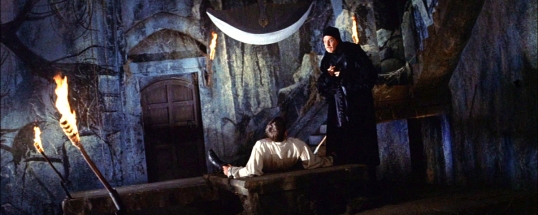
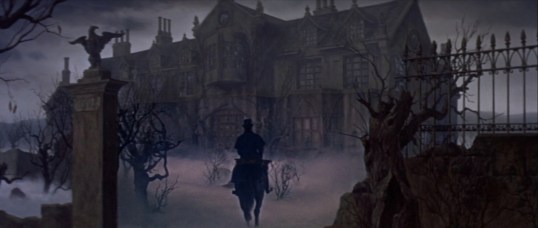
Have you ever woken up and thought to yourself, “I’d love to see a movie where a youngish Jack Nicholson played a French soldier who, while searching for a mysterious woman, comes across a castle that’s inhabited by both Dick Miller and Boris Karloff?”

Of course you have!  Who hasn’t?

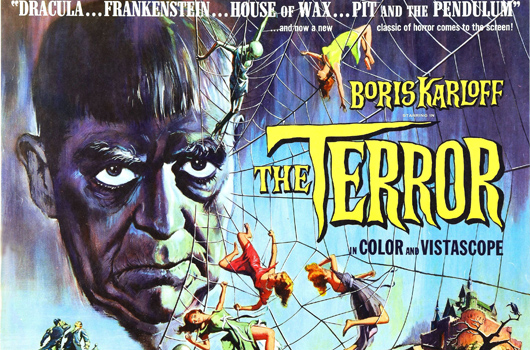
Well, fortunately, it’s YouTube to the rescue.  In Roger Corman’s 1963 film The Terror, Jack Nicholson is the least believable 19th century French soldier ever.  However, it’s still interesting to watch him before he became a cinematic icon.  (Judging from his performance here and in Cry Baby Killer, Jack was not a natural-born actor.)  Boris Karloff is, as usual, great and familiar Corman actor Dick Miller gets a much larger role than usual.  Pay attention to the actress playing the mysterious woman.  That’s Sandra Knight who, at the time of filming, was married to Jack Nicholson.

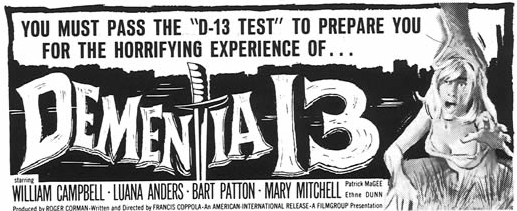
Reportedly, The Terror was one of those films that Corman made because he still had the sets from his much more acclaimed film version of The Raven.  The script was never finished, the story was made up as filming moved alone, and no less than five directors shot different parts of this 81 minute movie.  Among the directors: Roger Corman, Jack Hill, Monte Hellman, Francis Ford Coppola, and even Jack Nicholson himself!  Perhaps not surprisingly, the final film is a total mess but it does have some historical value.

(In typical Corman fashion, scenes from The Terror were later used in the 1968 film, Targets.)

Check out The Terror below!

4 Shots From 4 Films: Special Roger Corman Edition


4 (or more) Shots From 4 (or more) Films is just what it says it is, 4 (or more) shots from 4 (or more) of our favorite films. As opposed to the reviews and recaps that we usually post, 4 (or more) Shots From 4 (or more) Films lets the visuals do the talking.

Today, on the first day of Horrorthon, we remember the great film pioneer and director, Roger Corman!  It’s time for….

4 Shots From 4 Roger Corman Films

Not of this Earth (1957, dir by Roger Corman DP: John J. Mescall)

Pit and the Pendulum (1961, dir by Roger Corman, DP: Floyd Crosby)

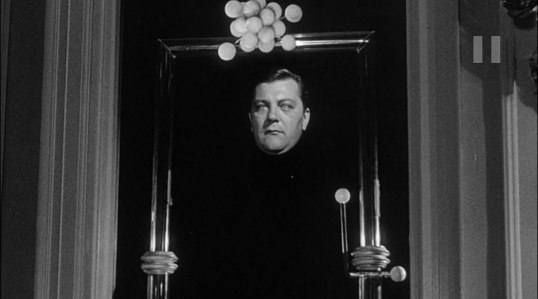
X: The Man With The X-Ray Eyes (1963, dir by Roger Corman, DP: Floyd Crosby)

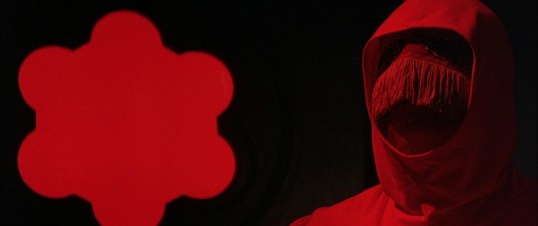
The Masque of the Red Death (1964, dir by Roger Corman, DP: Nicolas Roeg)

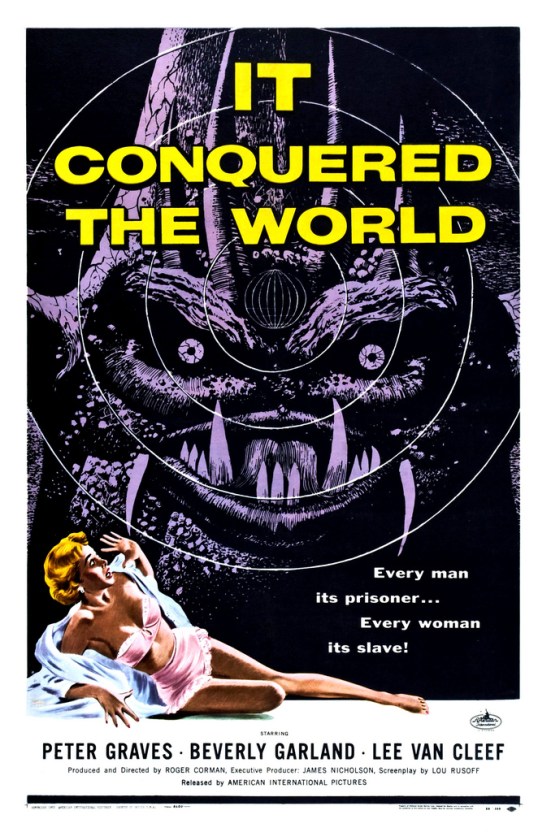
Horror Film Review: It Conquered The World (dir by Roger Corman)


“Man is a feeling creature, and because of it, the greatest in the universe….”

So says scientist Paul Nelson (Peter Graves) towards the end of 1956’s It Conquered The Universe.  Paul may be a scientist but he understands the importance of emotion and imagination and individuality.  He knows that it’ll take more than just cold logic to save humanity from destruction.

Unfortunately, Paul’s best friend, Tom Anderson (Lee Van Cleef), disagrees.  Tom worked at Los Alamos.  Tom helped to develop the atomic bomb.  Tom is convinced that humanity will destroy itself unless a greater power takes over.  Tom feels that he has discovered that greater power.  Tom has recently contacted a Venusian and invited it to come to Earth.  Upon arriving, the Venusian promptly disrupts all electrical power on Earth.  It sends out bat-like creatures that inject humans with a drug that takes control of their minds and turns them into a compliant slaves.  Paul tells Tom that robbing people of their free will is not going to save the Earth but Tom remains committed to the Venusian, even as it becomes obvious that the Venusian’s main concern is with its own survival.

It Conquered The World is very much a film of the 1950s.  Along with tapping into the era’s paranoia about nuclear war and UFOs, it also features Peter Graves delivering monologues about freedom and the inherent superiority of the human race.  When Paul confronts Tom, he not only accuses Tom of selling out the Earth but he also attacks Tom’s patriotism.  When Tom’s wife, Claire (Beverly Garland), confronts the alien and orders it to leave her plant along, she does it while wearing high heels and a tight sweater and holding a rifle.  The one female scientist (played by Karen Kadler) spends most of her screentime being menaced while wearing a white slip and there’s a platoon of bumbling but unbrainwashed soldiers hanging out in the woods.  If one looked up 1956 in the dictionary, there’s a very good chance this film would be the definition.

At the same time, the film’s story feels like a metaphor for modern times.  When the Venusian-controlled police turn authoritarian and start threatening to punish anyone who questions their orders, we’re reminded of the excesses of the COVID lockdowns.  When the editor of the town’s newspaper is shot by a policeman who says that words are no longer necessary in the new world, it’s hard not to think of all the writers, commentators, artists, and ordinary citizens who have run afoul the online cancellation brigade.  When Paul is reduced to riding a bicycle from place to place, it’s hard not to think of the environmental Luddites, with their hatred of anything that makes life more convenient.  When Tom rationalizes his activities by saying that humanity must be saved from itself, he’s expressing an opinion that is very popular among several people today.  Tom’s embrace of cold logic feels very familiar.  Of course, today, people don’t need a Venusian to order them to accept authoritarianism.  Instead, they’re more than happy to do on their own.

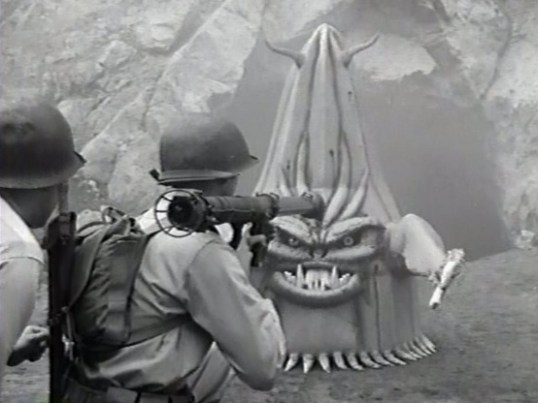
It Conquered The World was directed by Roger Corman.  It was his eighth film as a director and it remains one of his most entertaining.  As one might expect from a low-budget sci-fi film, It Conquered The World produces it’s share of laughs.  It’s hard not to smile at the sight of the extremely serious Peter Graves peddling his bicycle from location to location.  (It doesn’t help that Graves never takes off his suit or loosens his tie.)  And the Venusian simply has to be seen to be believed:

At the same time, It Conquered The World holds up well.  Lee Van Cleef and Beverly Garland both give performances that transcend the material, with Van Cleef especially doing a good job of paying a man struggling to rationalize his bad decisions.  It Conquered The World holds up today, as both a portrait of the 50s and 2024.

Horror on the Lens: The Little Shop of Horrors (dir by Roger Corman)


Hi!  Welcome to Horrorthon!  It’s a tradition around these parts that we offer up a classic (or not-so-classic) horror film for our readers to watch every day in October.  As we have just lost the great Roger Corman, it seems appropriate to start things off with one of his best films.

And so, without further ado….

Enter singing.

Little Shop…Little Shop of Horrors…Little Shop…Little Shop of Terrors…

For the 2024 Horrorthon’s first plunge into the world of public domain horror films, I’d like to present you with a true classic.  From 1960, it’s the original Little Shop of Horrors!

When I was 19 years old, I was in a community theater production of the musical Little Shop of Horrors.  Though I think I would have made the perfect Audrey, everybody always snickered whenever I sang so I ended up as a part of “the ensemble.”  Being in the ensemble basically meant that I spent a lot of time dancing and showing off lots of cleavage.  And you know what?  The girl who did play Audrey was screechy, off-key, and annoying and after every show, all the old people in the audience always came back stage and ignored her and went straight over to me.  So there.

Anyway, during rehearsals, our director thought it would be so funny if we all watched the original film.  Now, I’m sorry to say, much like just about everyone else in the cast, this was my first exposure to the original and I even had to be told that the masochistic dentist patient was being played by Jack Nicholson.  However, I’m also very proud to say that — out of that entire cast — I’m the only one who understood that the zero-budget film I was watching was actually better than the big spectacle we were attempting to perform on stage.  Certainly, I understood the film better than that screechy little thing that was playing Audrey.

The first Little Shop of Horrors certainly isn’t scary and there’s nobody singing about somewhere that’s green (I always tear up when I hear that song, by the way).  However, it is a very, very funny film with the just the right amount of a dark streak to make it perfect Halloween viewing.

So, if you have 72 minutes to kill, check out the original and the best Little Shop of Horrors

6 Trailers In Memory of Roger Corman


Today, for the first day of Horrorthon, we pay tribute to the legacy of the legendary Roger Corman with a special edition of Lisa Marie’s Favorite Grindhouse and Exploitation Film Trailers.

1. The Day The World Ended (1955)

Though Corman worked in almost every type of film genre imaginable, he’s probably best remembered for his science fiction and horror films.  This was one of the first of them.

2. Bucket of Blood (1959)

In Bucket of Blood, Roger Corman gave Dick Miller a starring role and also mixed comedy and horror in a way that influence many future horror directors.

3. Little Shop of Horrors (1960)

Roger Corman famously shot Little Shop of Horrors in just two days.  The end result was a mix of comedy and horror that continues to be influential to this day.  The musical is very good but I still prefer the cheerful low-budget aesthetic of the Corman original.

4. The Terror (1963)

Corman was famous for his ability to spot new talent.  His 1963 film The Terror starred a then unknown actor named Jack Nicholson.

5. The Masque of the Red Death (1964)

In the 60s, Corman was also well-known for his Edgar Allan Poe adaptations, the majority of which starred Vincent Price.  With these colorful and flamboyant films, Corman showed himself to be a pop artist at heart.

6. Frankenstein Unbound (1990)

In the 1970s, Corman retired from directing and instead focused on producing and distributing movies.  In 1990, he briefly came out of retirement and gave us his final directorial effort, Frankenstein Unbound.

The Fantastic Four (1994, directed by Oley Sassone)


It’s not that bad.

Produced by Roger Corman and made for a budget of only a million dollars, the very first film version of The Fantastic Four is best known for having never been released.  Stan Lee always claimed that the film was never meant to be released and that it was only made so that German producer Bernd Eichinger could hold onto the rights for the characters.  Eichinger has always said that he wanted to release the flm and it was Avi Arad, the future founder of Marvel Studios, who asked him not to because he felt a low-budget B-movie would damage the Marvel brand.  Arad has said that Eichinger is telling the truth and considering the reception that Albert Pyun’s Captain America received, I can understand why Arad was concerned.

Though the film was never officially released, bootleg copies are out there.  I’ve seen the movie a few times and I watched it again last night.  Watching it, I was reminded that The Fantastic Four is not as bad as people say.

It’s an origin story.  Reed Richards (Alex Hyde-White) flies into space with his girlfriend Sue (Rebecca Staab), her annoying kid brother Johnny (Jay Underwood), and Reed’s best friend Ben (Michael Bailey Smith).  Cosmic comet rays lead to them developing super powers.  Reed can stretch.  Johnny can burst into flame.  Sue can turn invisible.  Ben turns into a creature with orange, rocky skin.  On Earth, they battle both the evil Doctor Doom (Joseph Culp) and the Jeweler (Ian Trigger) for possession of a powerful diamond.

The low budget is obvious and the script isn’t great, with the Jeweler being a truly unimpressive villain.  (Unlike Doctor Doom, the Jeweler was created specifically for this movie.)  But the movie still has more genuine heart than the future big-budget Fantastic Four films. Alex Hyde-White plays Reed as being brilliant but self-absorbed.  Sue is a thankless role but Rebecca Staab does her best.  Jay Underwood is annoying as Johnny but Johnny was annoying in the comic books as well.  This version of The Fantastic Four is the only movie, so far, to capture and stay true to the spirit of the characters.

This is especially true when it comes Michael Bailey Smith’s performance as Ben Grimm.  More than either Jamie Bell or Michael Chiklis, Smith realistically portrays Ben’s bitterness over knowing that he will never be able to return to his former life.  Of all the film versions of the Fantastic Four, this is the only one that adequately captures both the look and the personality of The Thing.  He become a real person and not just an actor in a rubber suit.  This movie is also the only one, so far, to really do a decent job of portraying Dr. Doom’s megalomania.  It’s interesting that the film that Marvel didn’t want released is the one that stays true to the original comic book.

The Fantastic Four will be joining the MCU in 2025.  Ironically, considering that Marvel Comics started with the Fantastic Four, they’ll be among the last of the major characters to get an MCU film.  There’s hope that the new Fantastic Four will reverse the MCU’s declining fortunes.  I’ve been skeptical ever since I heard the Silver Surfer was going to be played by Julia Garner but hopefully, I’ll be wrong.  Galactus is one of the great Marvel villains and I hope the new Fantastic Four will do him justice.  When people are watching the massively hyped, big budget, CGI-heavy version of The Fantastic Four, I hope at least some will remember the low-budget version that could barely afford a single special effect and I hope they’ll remember that it wasn’t that bad.

12 Roger Corman Trailers


Roger Corman in The Godfather Part II

Today we pay tribute to the legacy of Roger Corman with a special edition of Lisa Marie’s Favorite Grindhouse and Exploitation Film Trailers.

  1. Five Guns West (1955)

This western was the first film that Roger Corman was credited with directing.

2. The Day The World Ended (1955)

Though Corman worked in almost every type of film genre imaginable, he’s probably best remembered for his science fiction and horror films.  This was one of the first of them.

3. Not of this Earth (1957)

Not of this Earth was not only one of Corman’s better sci-fi films but this also the first film in which Corman really took full advantage of character actor Dick Miller.  (Miller, a longtime friend of Corman’s, largely improvised his role as a hip vacuum cleaner salesman.)

4. Machine Gun Kelly (1958)

Along with westerns and sci-fi films, Corman also directed several gangster classics.  Machine Gun Kelly is remembered as one of his best.

5. Bucket of Blood (1959)

In Bucket of Blood, Roger Corman gave Dick Miller a starring role and also mixed comedy and horror in a way that influence many future horror directors.

6. Little Shop of Horrors (1960)

Roger Corman famously shot Little Shop of Horrors in just two days.  The end result was a mix of comedy and horror that continues to be influential to this day.  The musical is very good but I still prefer the cheerful low-budget aesthetic of the Corman original.

7. The Intruder (1962)

Corman was an exploitation filmmaker with a conscience.  At a time when other films were avoiding social issues, Corman dove right in with challenging films like The Intruder.

8. The Terror (1963)

Corman was famous for his ability to spot new talent.  His 1963 film The Terror starred a then unknown actor named Jack Nicholson.

9. The Masque of the Red Death (1964)

In the 60s, Corman was also well-known for his Edgar Allan Poe adaptations, the majority of which starred Vincent Price.  With these colorful and flamboyant films, Corman showed himself to be a pop artist at heart.

10. The St. Valentine’s Day Massacre (1967)

The St. Valentine’s Day Massacre featured Corman directing a film for a big studio.  The film recreated the gang war between Al Capone and George Moran while also finding room for Corman regulars like Jack Nicholson, Dick Miller, and Jonathan Haze.

11. The Trip (1967)

Roger Corman was always sympathetic to the counter-culture, which led to the remarkably nonjudgmental nature of The Trip, a film in which Peter Fonda drops acid under the guidance of Bruce Dern and Dennis Hopper.  Jack Nicholson wrote the script.

12. Frankenstein Unbound (1990)

In the 1970s, Corman retired from directing and instead focused on producing and distributing movies.  In 1990, he briefly came out of retirement and directed his final film, Frankenstein Unbound.

4 Shots From 4 Films: Special Roger Corman Edition


4 (or more) Shots From 4 (or more) Films is just what it says it is, 4 (or more) shots from 4 (or more) of our favorite films. As opposed to the reviews and recaps that we usually post, 4 (or more) Shots From 4 (or more) Films lets the visuals do the talking.

Today, we wish a happy 98th birthday to the legendary filmmaker, Roger Corman!  And that means that it’s time for….

4 Shots From 4 Roger Corman Films

Not Of This Earth (1957, dir by Roger Corman, DP; John J. Mescall)

X: The Man With The X-Ray Eyes (1963, dir by Roger Corman, DP: Floyd Crosby)

The Masque of the Red Death (1964, dir by Roger Corman, DP: Nicolas Roeg)

The Trip (1967, dir by Roger Corman, DP: Archie R. Dalzell)