4 (or more) Shots From 4 (or more) Films is just what it says it is, 4 (or more) shots from 4 (or more) of our favorite films. As opposed to the reviews and recaps that we usually post, 4 (or more) Shots From 4 (or more) Films lets the visuals do the talking.
Today would have been the 99th birthday of the legendary filmmaker, Roger Corman! And that means that it’s time for….
4 Shots From 4 Roger Corman Films
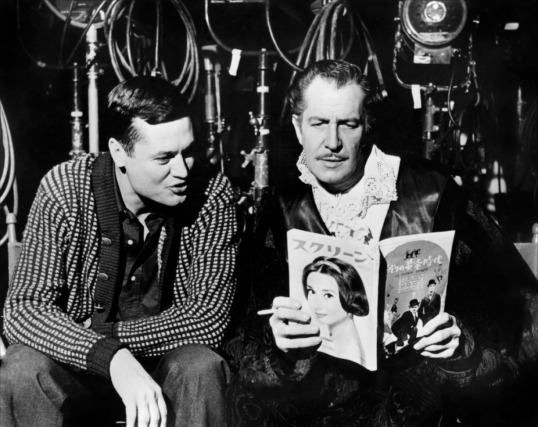
Not of this Earth (1957, dir by Roger Corman DP: John J. Mescall)
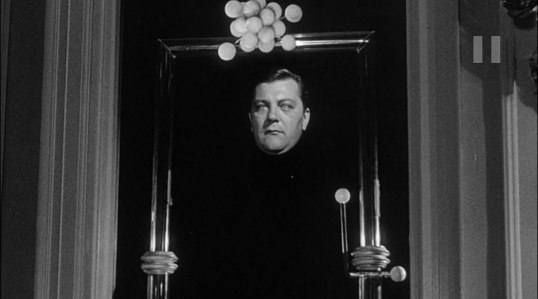
The Fall of the House of Usher (1960, dir by Roger Corman, DP: Floyd Crosby)
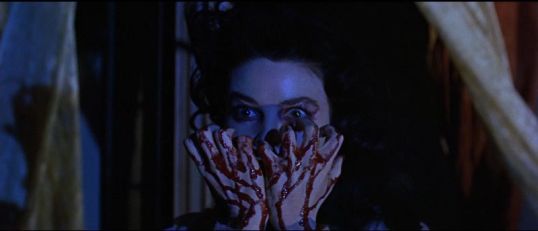
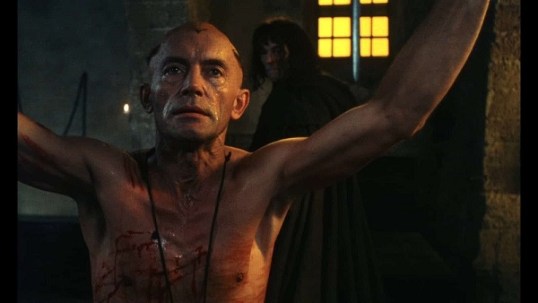
The Masque of the Red Death (1964, dir by Roger Corman, DP: Nicolas Roeg)
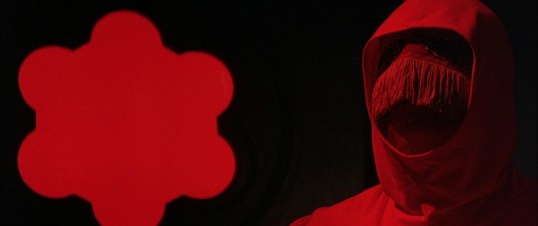
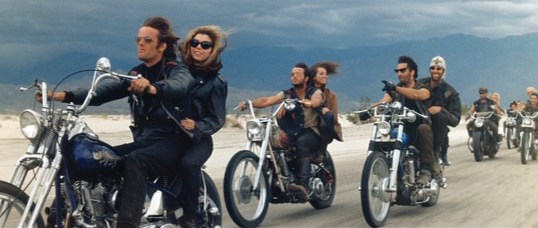
The Wild Angels (1966, dir by Roger Corman, DP: Richard Moore)
1984’s Swing Shift begins in 1941. Kay (Goldie Hawn) and Jack Walsh (Ed Harris) are a young married couple in California. At first glance, they seem to have the perfect life. Jack works all day and comes home and has a beer and tells his wife how much he loves her. Kay spends her day cleaning up around the house and when her husband comes home, she sits down next to him and tells him how much she loves him. Whenever their neighbor, Hazel (Christine Lahti), walks by their bungalow, Jack mutters that she’s a tramp. Hazel sings in a sleazy nightclub and dates a shady fellow named Biscuit (Fred Ward) and that’s just not what respectable people do!
When the Japanese bomb Pearl Harbor, Jack enlists in the Navy. Kay suggests that she could get a job while he’s gone but Jack is firm. He doesn’t want his wife working. However, after Jack leaves, Kay is motivated by both boredom and her patriotic duty to apply for a job in an armaments factory. With all of the men overseas fighting, their wives have been implored to do their part for the war effort.
Kay works the swing shift, along with Hazel and a trumpet player named Lucky (Kurt Russell). (Lucky sweetly declines to explain why he’s called Lucky.) Despite some early antagonism, Hazel and Kay becomes friends. Kay starts to come out of her shell, especially where Lucky is concerned. How will Jack react when he returns home?
The late director Jonathan Demme described directing Swing Shift as being one of the worst experiences of his career. Demme’s original cut of the film was an ensemble piece that was a drama with comedic moments. Star Goldie Hawn was reportedly not happy with Demme’s original cut and the film was essentially taken away from the director. Screenwriter Robert Towne was brought in to write some additional scenes. (Even before Towne was brought in, at least four writers had written a draft of the script and the screenplay itself was finally credited to a non-existent “Rob Morton.”) Some scenes were reshot. The film itself was reedited. The end result was a film that focused primarily on Kay and made her relationships with Hazel, Jack, and Lucky far less complex. Jonathan Demme walked away from the film, retaining his directorial credit but pointedly requesting that the film not be advertised as a “Jonathan Demme film.” Later in life, Demme declined to discuss either Swing Shift or the experience of working with Goldie Hawn.
Watching the studio cut of Swing Shift on Prime, I could understand many of Demme’s objections. It’s a film that’s full of good performances and some stylish visuals but it really doesn’t have much narrative momentum and, especially when it comes to Kay’s friendship with Hazel, it does feel like certain scenes are missing. Hazel is remarkably quick to forgive someone who she believes has spent years calling her a tramp. As well, there’s a lot of interesting characters in the background, many of whom are played by regular members of the Jonathan Demme stock company. (Charles Napier, Susan Peretz, Holly Hunter, Roger Corman, Lisa Peilkan, Sudie Bond, and Stephen Tobolowsky all have small roles.) Watching the film, one gets the feeling that they all probably had more to do in Demme’s original cut.
That said, I have to admit that I still enjoyed the studio cut of Swing Shift, flaws and all. A lot of that is due to the performances of Hawn and Russell. (Christine Lahti received a Supporting Actress Oscar nomination for her performance in this film. She’s okay, though I don’t really think she deserved a nomination over someone like Elizabeth Berridge in Amadeusor Tuesday Weld in Once Upon A Time In America.) Hawn does a wonderful job portraying Kay’s transformation from being a rather meek housewife to someone who can put a plane together without a moment’s hesitation. Hawn and Russell began their legendary romance on the set of Swing Shift and their chemistry is strong enough to carry the film over plenty of rough spots. At its best, Swing Shift inspired me to wonder what I would have done if I had been alive in the 1940s. Would I have ended up cutting my hair and working in a factory? Would I have waited at home from my ‘husband or sweetheart” (as the film refers to them) to come home? Or would I have run off with Lucky and followed him from town to town? Swing Shift is a good film that could have been great and, by many accounts, actually was great before it was recut. (Even with the reediting, enough of Demme’s trademark humanity comes through to make the scenes in the factory memorable.) In the end, Swing Shift isn’t perfect but I still enjoyed it.
4 (or more) Shots From 4 (or more) Films is just what it says it is, 4 (or more) shots from 4 (or more) of our favorite films. As opposed to the reviews and recaps that we usually post, 4 (or more) Shots From 4 (or more) Films lets the visuals do the talking.
216 years ago today, Edgar Allan Poe was born in Boston, Massachusetts. From his humble beginnings as the son of two struggling actors, Poe would go on to become one of the first great American writers. (It’s been said that, when Charles Dickens first traveled to the United States in 1842, he specifically wanted to meet Edgar Allan Poe. Unfortunately, it appears that popular story my not be true but it’s still a good story.) Poe was controversial in life and even his death generated more questions than answers but no one can deny his strength as a poet and as a prose writer. Both the detective and the horror genres owe a huge debt to Edgar Allan Poe.
Today, in honor of Edgar Allan Poe’s legacy, TSL presents 4 shots from 4 films that were inspired by the work of Edgar Allan Poe!
4 Shots From 4 Films
The Fall of the House of Usher (1960, dir by Roger Corman, DP: Floyd Crosby)
The Raven (1963, dir by Roger Corman, DP: Floyd Crosby)
The Masque of the Red Death (1964, dir by Roger Corman, DP: Nicolas Roeg)
The Pit and the Pendulum (1990, dir by Stuart Gordon, DP: Adolfo Bartoli)
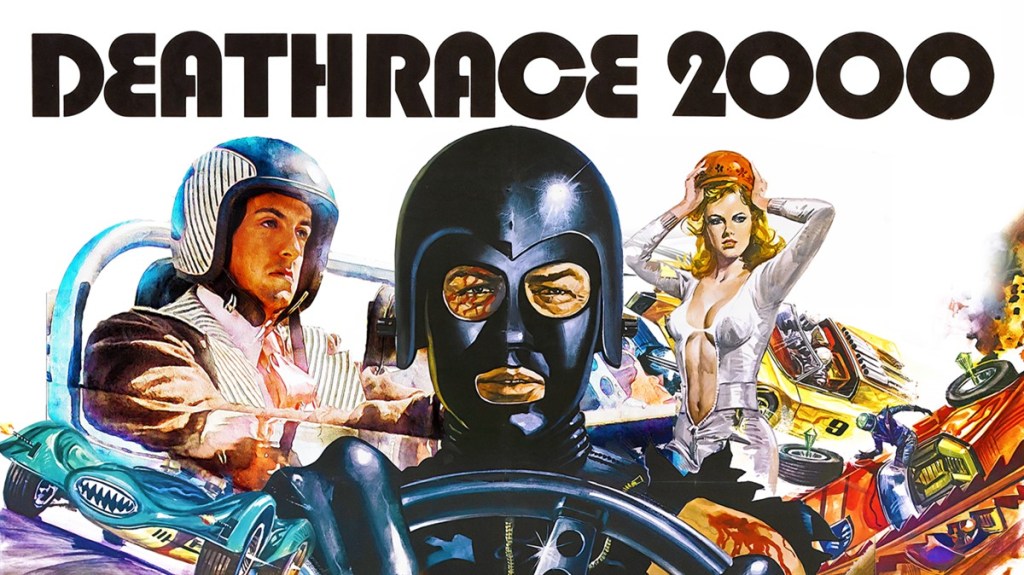
Every Monday night at 9:00 Central Time, my wife Sierra and I host a “Live Movie Tweet” event on X using the hashtag #MondayMuggers. We rotate movie picks each week, and our tastes are quite different. Tonight, Monday December 2nd, we’re watching DEATH RACE 2000 starring David Carradine, Sylvester Stallone, Simone Griffith, Mary Woronov, Roberta Collins, and Martin Kove.
So why did I pick DEATH RACE 2000, you might ask? It’s pretty simple. I think it will be a fun movie to watch with a group. Unlike most of my choices, which are movies I’ve seen many times, I’ve only seen DEATH RACE 2000 one time before and it’s been awhile. I’m looking forward to seeing it again myself. I like that it’s a B-movie from legendary producer Roger Corman. That’s usually a good thing. I like that it’s directed by Paul Bartel. Bartel’s EATING RAOUL was one of those movies that helped me appreciate black comedy when I was growing up. I really like the cast, especially David Carradine and Sylvester Stallone. And finally, I like that it’s 80 minutes long. In today’s world where every film feels the need to be between 2 and 3 hours, I’ve grown to really appreciate movies clocking in at 90 minutes or less!
It’s on Amazon Prime and Tubi. Join us if you’d like!
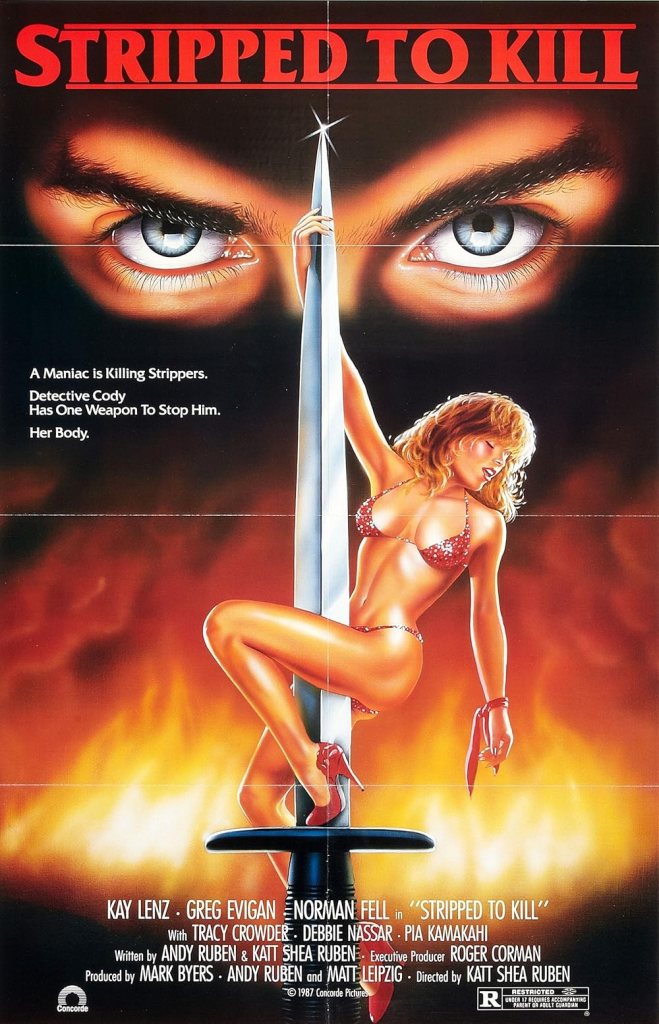
If you were a teenage boy in the 80’s, and you spent time at video stores, there’s no doubt in my mind that you noticed the VHS box for STRIPPED TO KILL. I certainly did! The box art promised violence and sexy women, and I was all in. I’m guessing that I watched the film when I was around 15 or 16 years old, and I hadn’t seen it since then. A few weeks back, we were recording an episode of our THIS WEEK IN CHARLES BRONSON PODCAST when actress Kay Lenz came up in reference to her part in DEATH WISH 4: THE CRACKDOWN. One of my buddies also mentioned her part in STRIPPED TO KILL. With that seed planted, I decided to give it another viewing and find out what sort of difference an additional 35 years would make in the viewing experience.
Not surprisingly, STRIPPED TO KILL opens with a beautiful young lady named Angel performing a striptease act to an extremely 80’s song called “Deny the Night.” I’ll give Larry Steicher his credit because he was singing the hell out of the song on the soundtrack. A little later, the stripper gets a phone call from someone she knows asking her to meet. When she shows up to meet this mystery person, they throw gasoline on her and burn her alive. Detective Cody Sheenan (Kay Lenz) and her partner Detective Heineman (Greg Evigan) are working undercover in the area and come across this assault and murder in the act, but the killer gets away. When the two cops find out that the victim was a stripper at the Rock Bottom Dance Club, they want the case. Through a series of events, including Cody winning an “Amateur Night” contest, she’s able to go undercover at the club where she gets to know the dancers. Detective Heineman hangs out as well in order to protect her, and I think, to get a look at her performances. Our two undercover cops immediately begin to learn the backgrounds of the ladies at the club, and they also investigate any suspicious characters they see hanging around. When another stripper is murdered, and with several suspects beginning to emerge, it’s a race against time to see if they can catch the killer before other strippers have to die!
I will say right off the bat that STRIPPED TO KILL delivers on the box art. There are multiple strippers killed, and by my count, there are 12 different striptease performances of various quality and duration throughout the course of the 88 minute film. And the cast is downright impressive for a low-budget B-movie like this. Kay Lenz is a fine actress with an impressive resume of TV and films, including productions like Clint Eastwood’s BREEZY, WHITE LINE FEVER with Jan-Michael Vincent, THE GREAT SCOUT & CATHOUSE THURSDAY with Lee Marvin, and FAST-WALKING with James Woods. As referenced in an earlier paragraph, she co-starred with Charles Bronson in DEATH WISH 4: THE CRACKDOWN the same year that she filmed STRIPPED TO KILL. Two classics in the same year is something every actor should hope for, and she doesn’t hold back in her performance here! Greg Evigan was in a show I liked very much when I was a kid called B.J. AND THE BEAR. I also remember him in that show MY TWO DADS when I was a teenager as well. He’s not a great actor, but he’s fine here. And then there’s Norman Fell, Mr. Roper himself, as the manager of the strip club. I have a soft spot for Norman because he played Charles Bronson’s boss in the 1973 film THE STONE KILLER, a film that also features John Ritter in a small role. Norman probably needed the paycheck, but he’s definitely a welcome presence in the film.
This is the directorial debut of actress Katt Shea. She co-wrote the script for STRIPPED TO KILL with her then husband Andy Ruben. She apparently got the idea for the film when she lost a bet with Andy and ended up actually going to a strip club. She was so impressed with some of the performances that she wanted to make a movie showing the ladies in that world. Katt Shea would later direct films like POISON IVY with Drew Barrymore and THE RAGE: CARRIE 2. And, of course, the biggest factor in getting the movie made, Katt Shea was able to convince the legendary Roger Corman to produce the film. STRIPPED TO KILL would turn into a financially successful film for Corman. It was particularly successful overseas and on the home video market. Nice investment, Mr. Corman!
Overall, STRIPPED TO KILL delivers exactly what it promises, and it does so in 1 hour and 28 minutes. That’s a pretty nice combination in my book. I think I felt the same way in 1989 as well!
That’s the question I asked myself as I watched 1964’s The Tomb of Ligeia. Loosely based on a short story by Edgar Allan Poe, The Tomb of Ligeia tells the story of Verden Fell (Vincent Price). Fell’s wife, Ligeia, has recently died but Fell worries that her spirit is still haunting and watching him. One gets the feeling that Fell hated his late wife but, at the same time, was obsessed with her. Fell has an eye condition which causes him to wear dark glasses on the rare occassions that he leaves his manor. He’s definitely a creepy guy but that doesn’t stop Rowena (Elizabeth Shepherd) from falling in love with him and leaving her fiancé, Christopher Gough (John Westbrook), to marry him. Unfortunately, Rowena is soon feeling the spirt of Ligeia as well, in the form of a black cat who keeps attacking Rowena.
Now, in all honesty, I doubt that Roger Corman specifically had an issue with cats. It’s possible the Edgar Allan Poe had an issue with cats, as he lived at a time when cats were rarely kept as pets and were instead just used to catch and kill mice and rats. (And, in fairness to the 19th century, that was a very important job in those days of bad hygiene and outhouses.) There’s no cats to be found in Poe’s short story about Ligeia but there was one very prominently featured in The Black Cat. As Ligeia was not exactly one of Poe’s most detailed stories, it’s probable that Corman and screenwriter Robert Towne just included the evil black cat because that story was one of Poe’s best-known.
That said, for me, it was difficult to watch an entire movie about people hating and attempting to destroy a cat. It’s certainly not the cat’s fault that it’s been possessed by the spirit of Ligeia. As I watched the film, it occurred to me that cats may not have been as popular in the 1960s as they are today. I mean, there was no internet when this film was made and, as a result, people weren’t constantly being bombarded by cute cat pictures. Instead, people probably just knew cats for their habit of hissing at people and scratching their owners. Today, we find that behavior to be cute. Perhaps back in 1964, people felt differently.
If I seem to be rambling on about the cat, that’s because there’s not really a lot to be said about The Tomb of Ligeia. It was the last of Corman’s Poe films and neither Corman nor Price seem to be particularly invested in the material. Price is actually rather miscast as Verden Fell. Fell is meant to be a mysterious aristocrat, in the spirit of Maxim de Winter from Rebecca. But Vincent Price is …. well, he’s Vincent Price. Vincent Price was a wonderful actor and personality but he wasn’t particularly enigmatic. From the first minute we see Price, we know that he’s being haunted by his dead wife because he’s Vincent Price and the same thing happened to him in several other films.
The Tomb of Ligeia is full of the ornate sets and beautiful costumes that were featured in all of Corman’s Poe films. And even a miscast Vincent Price is still fun to watch. But, when compared to the other films in the Poe Cycle, this one falls flat.
In 1964’s The Masque of the Red Death, Vincent Price stars as Prospero.
Prospero is a nobleman in medieval Italy, a decadent tyrant who rules his villages with an iron hand and who proudly and openly worships Satan. When an old woman in one of the villages dies of the plague, Prospero orders the village to be burned to the ground. He returns to his castle where, with his mistress (Hazel Court), he plans to throw a masquerade for the local nobility. His plan is for everyone to hide out in the castle until Death has passed. The problem, of course, is keeping Death from sneaking into the castle and claiming everyone within.
Prospero also abducts three villagers, Ludovico (Nigel Green), his daughter Francesca (Jane Asher), and Francesca’s boyfriend, Gino (David Weston). The three villagers find themselves in a decadent world, where Prospero and his attendants are motivated by their own greed and petty jealousies. Keeping Death from entering the castle would probably be a lot easier if the people in the castle would stop trying to kill each other. It’s an odd atmosphere within the castle. Everyone fears Death and yet, everyone seems to be doing all that they can do invite it in with them. Can anyone, even a worshipper of the Damned liked Prospero, truly escape Death?
The Masque of the Red Death is not only the best of Roger Corman’s Edgar Allan Poe adaptations but it’s also the best film that Corman ever directed. Working with cinematographer Nicolas Roeg (who was himself destined to have quite a career as a director of enigmatic films), Corman fills the screen with vivid colors and scenes of medieval decadence. Price gives one of his best performances, playing Prospero as someone who is in love with his own amoral nature but whose arrogance quickly gives way to fear when he starts to suspect the Death has somehow managed to enter the castle. The inhabitants of the castle are all memorably eccentric and, in many cases, evil. A man in an ape costume is burned to death and hardly anyone seems to notice or care. Prospero and his nobles think that they’re above death because of their wealth and their place in society but, of course, no one can escape Death.
David Weston and Jane Asher are both well-cast as the two lovers, though Asher is clearly more a product of the swinging sixties than medieval Italy. Patrick Magee and Skip Martin are both memorable as members of Prospero’s court, with Skip Martin giving an especially diabolical performance as a murderous court jester. In the end, though, this film truly belongs to Price, Corman, and Roeg. Roeg’s cinematography is dazzling, with the use of red foreshadowing his later film, Don’t Look Now. Corman’s direction puts the viewer right in the center of Prospero’s court. And Vincent Price gives one of his best performances as the self-amused but unashamedly evil Prospero. The Masque of the Red Death remains a classic of 60s pop art and the best of Corman’s many films.
In the 18th century, the inhabitants of Arkham, Massachusetts yank Joseph Curwen (Vincent Price) out of his mansion and tie him to a tree. They accuse Curwen of being a warlock who is in league with the devil and who has been bringing young women to his “palace,” and putting them in a trance. They burn Curwen alive but, before the flames are lit, they also give Curwen a chance to speak and curse both them and their descendants.
You really do have to wonder about the logic behind witch (and warlock) burnings. They seem counter-productive because they always give the accused just enough time to cast one final curse before being burned to a crisp. Indeed, you have to wonder why witches and warlock were allowed any final words to begin with. I mean, at some point, you would think everyone would notice that the final words were always a curse.
Anyway. 110 years later, Joseph Curwen’s descendant, Charles Dexter Ward (Vincent Price, again) rides into town with his wife, Anne (Debra Paget). He is stunned to see that Arkham has apparently fallen on hard times, with many of the town’s people being horribly disfigured. It’s explain to him that the disfigurements and the poverty are all a result of his ancestor’s curse. That’s going to make things a bit awkward, considering that Charles Dexter Ward has not only inherited the Palace but he’s also inherited a copy of Necronomicon and a legacy of messing with Cthulhu. The townspeople don’t want Ward around but he and Anne decide to spend the night in the Place regardless.
Of course, it doesn’t take long for Curwen’s spirit to possess Charles. Soon, Charles is trying to resurrect Curwen’s mistress, Hester (Cathie Merchant) and pursuing Curwen’s goals of breeding a race of super humans by forcing the women of the town to mate with the fearsome Yog-Sothoth. Charles also seeks vengeance on the descendants of those who burned Curwen at the stake, as if all of the poverty and the deformities aren’t punishment enough. Again, this is why you don’t give warlocks and witches a chance to get out one last curse before being executed.
Though The Haunted Palace is usually considered to be a part of Roger Corman’s Edgar Allan Poe cycle, the story itself is actually based on H.P. Lovecraft’s The Case of Charles Dexter Ward. (In Lovecraft’s novella, Ward seeks out his evil ancestor whereas, in the film, Ward is more or less an innocent victim.) The film’s title comes from a Poe poem, which is recited at both the beginning and the end of the film. But the film itself, with its references to the Cthulhu mythos and its hideous New England setting, is definitely a work of Lovecraftian horror.
Fortunately, it’s an effective work of Lovecraftian horror, one that captures the feeling of people unwisely trying to control a force of evil that they cannot begin to comprehend. Roger Corman keeps the action moving quickly and creates a gothic atmosphere of impending doom. Vincent Price, toning down his usual theatrics, is chillingly evil as Curwen and sympathetic as Charles. The film’s strongest performance, however, comes from Debra Paget, who desperately tries to free her husband from Curwen’s control. Any woman who has suddenly felt as if she can no longer recognize the man who she once loved will be able to relate to Paget’s performance.
The Haunted Palace is a strong entry in the films of Roger Corman and Vincent Price and one of the better adaptations of the work of H.P. Lovecraft.
I have to admit that I’ve never been a huge fan of anthology films. Anthology films are almost always a bit uneven. Some filmmakers are better suited to making short films than others and, as anyone who has ever sat through one can tell you, sitting through a boring short film is actually worse than having to watch a boring long film. Too often, anthology films are just a collection of boring short films. If you get lucky, there might be a good segment hidden amongst all of the bad segments. But even so, that often means sitting through 30 minutes of bad filmmaking for 15 minutes of something that’s moderately entertaining.
1962’s Tales of Terror is an anthology horror film. Directed by Roger Corman, the film is a part of his Poe cycle and features adaptations of three Poe short stories, Morella, The Black Cat, and The Facts In The Case of M. Valedemar. While it definitely suffers from the flaws that afflict many anthology films, Tales of Terror is saved a bit by the presence of Vincent Price. Price not only appears in all three of the films but he also provides the narration that links each film. As I mentioned when I reviewed The Premature Burial, one cannot underestimate the importance of Vincent Price and his unique style of acting when it comes to discussing Corman’s Poe adaptations. With his dramatic flourishes and his theatrical style of speaking, Price was the perfect star for these films. As an actor, he perfectly complimented Corman’s flamboyant and colorful direction. It also helps that Price himself seems to be truly enjoying himself in all of these films. His eccentricity brings the film’s to life.
As for the separate stories that make up Tales of Terror, things get off to a rather macabre start with Morella. Leonora (Maggie Pierce) returns home to visit her father (Vincent Price), who is now a drunken wreck who continues to blame Leonora for the death of her mother, Morella (Leona Gage). Morella died while giving birth to Leonora. Leonora is shocked to discover that her father is keeping her mother’s decomposing body in the mansion. Leonora, who is suffering from a terminal illness, tries to take care of her father. However, Morella’s spirit remains in the house, leading this story to a rather depressing and unsettling ending. This story was effectively done, playing out like a particularly morbid companion to The Fall Of The House of Usher.
The Black Cat is presented as a comedy, starring Peter Lorre as a man who becomes convinced that his wife is cheating on him with a snobby wine taster who is, of course, played by Vincent Price. This overlong segment did not work for me and I have to admit that a lot of that is because I love cats, black cats in particular. Beyond that, the humor is a bit too broad. Corman could do comedy, as he showed with Little Shop of Horrors, but he seems to be trying a bit too hard here.
Finally, the third segment is The Facts In The Case of M. Valdemar, in which Vincent Price plays the title character. The dying Valdemar employs a hypnotist (Basi Rathbone) to put him in a trance to help relieve his suffering. However, the hypnotist hopes to marry Valdemar’s wife (Debra Paget) and, after putting Valdemar into a trance, he leaves the dying man there. Valdemar, whose body starts to decay, cannot die. But, once he becomes angry enough, he can still rise from his bed to seek revenge even as his body putrefies. This segment was the best of the three, featuring Price’s best work in the film and also a wonderfully villainous turn from Basil Rathbone. The makeup effects that were used to capture Valdemar’s decay remain effectively frightening today.
Tales of Terror is two good stories and one mediocre one, which is better than the usual anthology film. Still, not surprisingly, the main reason watch is for the wonderful Vincent Price.
“You finally did it! You blew it up! …. Goddamn you to Hell!”
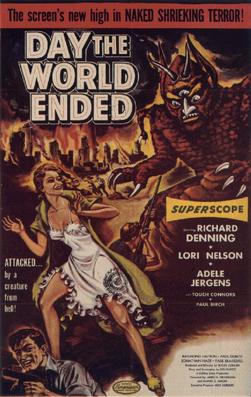
That’s right. Just as how the original Planet of the Apes showed us what the world would look like centuries after a nuclear war, 1957’s Day The World Ended shows us what things would be like in the weeks afterwards. And guess what? It wouldn’t be a lot of fun.
Day The World Ended starts with the bombs dropping and mushroom clouds forming in all of their fearsome glory. (Oppenheimer may have hated his greatest achievement but aesthetically, the atomic bomb is still an impressive invention.) Jim Maddison (Paul Birch) and his daughter, Louise (Lori Nelson), manage to survive by camping out in a steel bunker that Maddison built especially for the moment. As a former Navy commander, Maddison understood that the world was on the verge of nuclear war and he also understood that only those with discipline would survive. He’s filled with bomb shelter with supplies and he’s told Louise that only the two of them can use the shelter. Anyone else is out of luck.
Unfortunately, people keep showing up at the shelter and asking to come in. And while Maddison is prepared to leave them outside with the fallout and the mutants that have started to roam the desert, Louise just can’t stand the thought of leaving anyone to die. Reluctantly, Maddison starts to allow people to join him and his daughter. Some of them, like geologist Rick (Richard Denning), are a good addition to the group, Rick is actually an expert in uranium mining and a potential husband for Louise. (Louise has a fiancé but he’s missing. She keeps his picture by her bed. The picture, of course, is actually a photo of director Roger Corman.) Unfortunately, not everyone is as likable and well-intentioned as Rick. Lowlife hood Tony (Mike Connors) and his girlfriend, Ruby (Adele Jergens) show up and continue to act as if they’ve got the police after them even though the police were probably atomized with the rest of civilization. And finally, there’s a man (Jonathan Haze) who is transforming into a mutant and who develops a strange mental connection to Louise.
No one said the end of the world would be easy!
Day The World Ended was Corman’s fourth film as a director and it was also his first film in the horror genre. (It’s actually a mix of science fiction and horror but whatever.) The film was enough of a box office success that it inspired Corman to do more films in the genre. Seen today, it’s obviously an early directorial effort. It lacks the humor that distinguished Corman’s later films. In fact, the film is actually a little bit boring. Watching a film like this really drives home just how important Vincent Price and his energy were to Corman’s later films. This film doesn’t have an actor like Vincent Price or Boris Karloff or even Dick Miller, someone who could energize a film just through the power of their own eccentricities. Instead, Mike Connors, Paul Birch, and Richard Denning all give dull performances as the survivors. This is a historically important film because, without its box office success, Corman probably would have stuck with doing B-westerns and gangster films. Filmgoers should be happy that audiences in the 50s were drawn in by the film’s title and their own paranoia about nuclear war. It’s a film that one appreciates as a piece of history, even if it doesn’t quite stand up to the test of time.

 Through the Shattered Lens