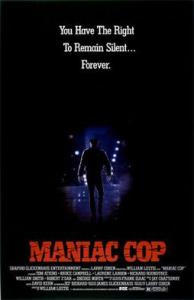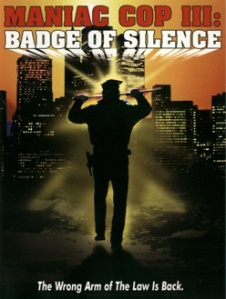
Maniac Cop III: Badge of Silence (1992, directed by William Lustig)


Despite finally getting his burial with honors at the end of Maniac Cop 2, Matt Cordell (Robert Z’Dar) returns for one last outing.  Raised from the dead by a voodoo houngan (Julius Harris), Cordell invades a hospital to seek vengeance for a comatose policewoman named Katie Sullivan (Gretchen Baker).  In a coma due to the wounds she received while thwarting a convenience store robbery, Katie is being framed by unscrupulous reporters and attorneys who claim that Katie was a bad cop who killed a clerk in cold blood.  Cordell sees Katie as being a fellow victim of anti-cop bias and he is not going to let anyone treat her with disrespect, which is something that two doctors (Robert Forster and Doug Savant) are unfortunate enough to discover.  Sean McKinney (Robert Davi) and Dr. Susan Lowery (Caitlin Dulany) try to figure out how to bring peace to the souls of both Cordell and Katie.

As opposed to the first two films, Maniac Cop III had a troubled production.  Lustig and screenwriter Larry Cohen wanted to set the film in a Harlem hospital and bring in an African-American detective to investigate Cordell’s activities.  The film’s Japanese producers insisted that Robert Davi return as the lead, even though the script’s lead character had little in common with the way Sean McKinney was portrayed in Maniac Cop 2.  Larry Cohen then refused to do any rewrites on the script unless he was paid more.  William Lustig filmed what he could and ended up with a 51-minute movie.  Extra scenes were directed by one of the film’s producers and the film was also padded out with outtakes from Maniac Cop 2.

The film is disjointed and there’s too much time devoted to Jackie Earle Haley playing a character who has much in common Leo Rossi’s serial killer from the second film.  (Haley’s performance is fine but the character feels superfluous).  But the movie’s hospital setting leads to some interesting kill scenes and Z’Dar and Davi both give good performances as two different types of maniac cops.  The supporting cast is full of good character actors like Haley, Forster, Savant, Julius Harris, Bobby Di Cicco, and Paul Gleason.  Despite the film’s flaws, Maniac Cop III is a solid ending for the trilogy.
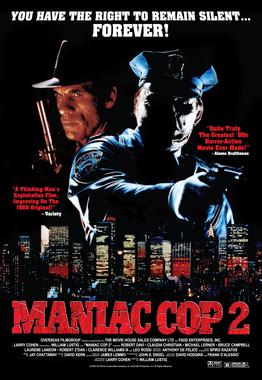
Maniac Cop 2 (1990, directed by William Lustig)


Maniac Cop 2 picks up where the first Maniac Cop ended.

The NYPD thinks that the undead maniac cop Matt Cordell (Robert Z’Dar) has been destroyed but he is actually still alive and killing civilians and cops in New York.  He has even teamed up with a serial killer named Steven Turkell (Leo Rossi, ranting and raving like a pro).  Jack Forrest (Bruce Campbell) and Theresa Malloy (Laurene Landon) both return from the first film but both of them are killed by Cordell before the movie is even halfway over.  Maniac Cop 2 is not playing around.

With Jack and Theresa gone, it falls to Detective Sean McKinney (Robert  Davi) and Officer Susan Riley (Claudia Christian) to discover what the rest of the audience already knows, that Cordell is seeking revenge against the system that abandoned him in prison.  The new police commissioner, Ed Doyle (Michael Lerner), is determined to cover up what happened but Cordell is even more determined to have his vengeance.  Working with Turkell, Cordell heads to the prison where he was unjustly incarcerated and murdered.

Maniac Cop 2 is a marked improvement on the first film.  Cordell is no longer a lumbering and slow monster.  He is now a ruthless, Terminator-style executioner who, in the film’s best-known scene, wipes out an entire police precinct in a matter of minutes.  Cordell is so ruthless that he won’t even stop when he’s on fire.  His partnership with Turkell adds a new twist to the Maniac Cop saga.  Turkell views Cordell as his partner-in-crime but Cordell is only interested in getting his revenge.  (Turkell was originally meant to be Frank Zito, the main character from Lustig’s Maniac.  When Maniac star Joe Spinell died before shooting began, the role was changed to Leo Rossi’s Steven Turkell.)

Stepping into the shoes of the main investigation, Robert Davi gives one of his best performances.  As opposed to the boring heroes of the first film (sorry, Bruce!), Davi’s Sean McKinney is just as obsessive and ruthless as Cordell.  Cordell sets fire and McKinney uses those fires to light his cigarettes.

William Lustig has described Maniac Cop 2 as being his best film and he’s probably right.  It is definitely the best of the Maniac Cop films and the only one to fully take advantage of its premise.

Maniac Cop (1988, directed by William Lustig)


In New York City, murders are being committed by a hulking man dressed in a policeman’s uniform.  The NYPD brass (led by William Smith and Richard Roundtree) want to cover up the fact that the murders are being committed by an apparent maniac cop but Lt. Frank McRae (Tom Atkins) leaks the news to the press.  With the citizens taking up arms against cops, the brass is eager to frame adulterous cop Jack Forrest (Bruce Campbell) for not only murdering his wife but also committing all of the murders.  Lt. McRae believes that Jack is innocent.

Why is the brass so eager to frame Jack?  Maybe it’s because they know that the Maniac Cop is actually Matt Cordell (Robert Z’Dar), a formerly good cop who was sent to Sing Sing on  trumped up brutality charges.  Cordell was killed in prison but he has now come back to life and is seeking revenge on the police force that he feels betrayed him.

Written by Larry Cohen and directed by William Lustig, Maniac Cop is the first of three Maniac Cop films.  While the other two Maniac Cop movies largely work and hold up well, the first Maniac Cop is undoubtedly the worst of the trilogy, with most of the kills occurring offscreen and the action moving very slowly.  The film is full of genre vets and Tom Atkins gives another one of this good tough guy performances.  Bruce Campbell disappointingly plays his role straight and Robert Z’Dar, as intimidating as he is, is actually underused in this film.

As with most films written by Cohen, Maniac Cop has an interesting political subtext.  It focuses on cop brutality and corruption with Cordell becoming a symbol of most people’s mixed feelings about the police.  But the Maniac Cop trilogy wouldn’t really come to life until the second film.  The first spends a lot of time setting Cordell up as a relentless avenger but there’s not much of pay-off.

The TSL Grindhouse: Killing American Style (dir by Amir Shervan)


Filmed in 1988 but apparently not released until 1990, Killing American Style is a low-budget variation on The Desperate Hours.

The film opens with a ruthless criminal named Tony Stone (Robert Z’Dar, of Maniac Cop fame) leading a daring robbery of an ice cream truck depot.  All of the ice cream trucks have come back for the day and, when Tony and the boys show up, the money is still being counted.  Tony quickly takes control of the situation, intimidating everyone with both his weaponry and his amazing jawline.

Unfortunately, for Tony, the robbery is not as successful as he thought.  Yes, he gets away with a lot of money but the police quickly track him down to his home, where he’s in the process of having sex with his stepmother.  Tony is arrested and, in record time, sentenced to a maximum security prison.  (Seriously, the arrest, conviction, and sentencing all seem to happen on the same day.)  Tony is put on a prison bus but then the bus itself stops to help out a stranded motorist.  The motorist turns out to be Tony’s brother, Jesse (Bret Johnston).  In the resulting shootout, all of the guards are killed but Jesse is wounded.  Tony and his associate, Lynch (John Lynch …. hey, I wonder if that’s just coincidence?), take Jesse to a nearby ranch house.

The house belongs to John Morgan (Harold Diamond), who is a long-haired kickboxing champion.  When Tony arrives, John is out of the house and beating up the dad of a kid who bulled Morgan’s son, Brandon.  John is not happy to come home and discover Tony holding his entire family hostage.  For that matter, Morgan’s son isn’t amused by it either.

Because they are being pursued by a grim and determined police detective (played by Jim Brown …. yes, the same Jim Brown who starred in countless blaxploitation films in the 70s), Tony and his men do not want to run the risk of leaving the house to retrieve the loot from the robbery themselves.  So, they send Morgan out to pick up the suitcase from Tony’s stepmother.  I guess they assume that Morgan will be able to move around inconspicuously despite the fact that Morgan is a 6’1 kick boxer with long hair.  I mean, there’s no way that Morgan is going to be able to move around without being noticed by the cops.

Of course, before Morgan can get the money, he also has to get a doctor for Jesse.  Dr. Fuji (Joselito Rescober) agrees to help, despite the fact that he never seems to be quite sure what’s actually going on with all the angry men who keep pointing guns at each other.  When Dr. Fuji mentions that he wants to kill Tony “Japanese style,” Morgan promises that he’s going to kill Tony “American style.”  It’s never really made clear what the difference is between the two styles, though the American version does seem to involve a bit more kickboxing.

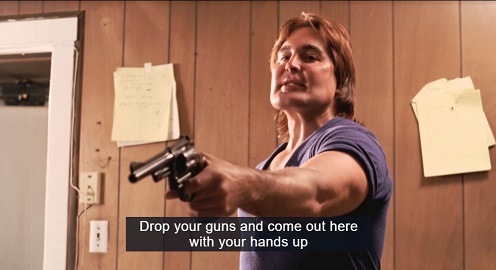
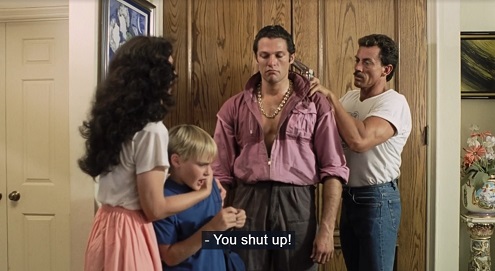
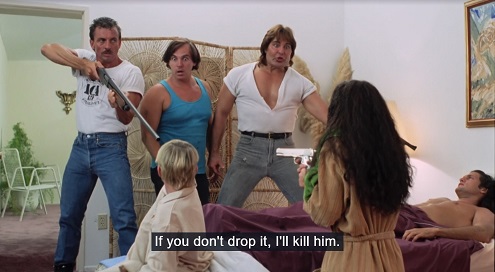
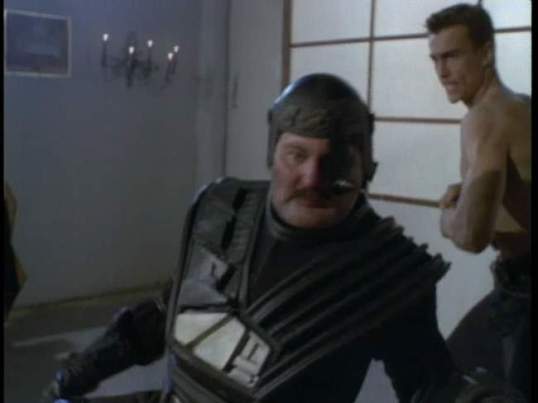
Anyway, this is an incredibly cheap and dumb movie but Robert Z’Dar seems like he’s having fun as Tony and …. well, to be honest, Robert Z’Dar is really the only reason to recommend this film.  He gives an enjoyably over-the-top performance, one that certainly contrasts with the more subdued performance of Harold Diamond.  (For his part, Diamond often seems to be struggling to stay awake.)  Hostage movies usually bore me to tears and this one had a lot of slow spots but it also had shots like the one below:

Eh.  Let’s call it even.

All Hail Jan-Michael Vincent: Red Line (1996, directed by John Sjogren)


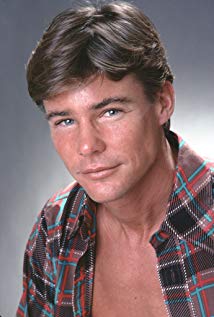
Jan-Michael Vincent, back in the day

When Jan-Michael Vincent died on February 10th, we lost a legend.

For obvious reasons, the life and career of Jan-Michael Vincent is often held up as a cautionary tale.  Vincent went from being a rising star in the 70s to being nearly unemployable in the 90s.  When you watch Vincent in one of his early film, like The Mechanic or Big Wednesday, you see an actor who had both the talent and the looks to be a major star.  He was such a natural and deceptively low-key performer that it is not a surprise that he was twice cast as Robert Mitchum’s son.  He could play everyone from a hippie to a cowboy to a surfer to an assassin.  Unfortunately, once the 80s rolled around, Vincent became better known for his struggles with drugs and alcohol than for his talent.  After a brief but profitable stint starring in Airwolf, Jan-Michael Vincent found himself appearing mostly in straight-to-video action films.  By the mid-90s, he was a mainstay on late night Cinemax.  Even though the films had gotten smaller and his famous good looks had been ravaged by years of hard living, Vincent was still capable of giving a good performance.

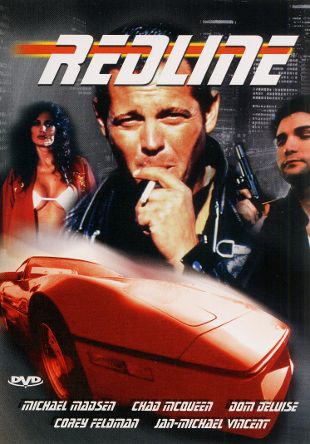
It is impossible to talk about the legend of Jan-Michael Vincent without talking about Red Line.  In this direct-to-video car chase film, Vincent was cast as a gangster named Keller.  When an auto mechanic named Jim (Chad “Son of Steve” McQueen) makes the mistake of taking one of Keller’s cars for a joyride, Keller blackmails Jim into stealing a corvette from a police impound lot.  Red Line was typical of the type of films that Vincent was usually offered in the 90s, an action-filled crime film with a handful of recognizable faces.
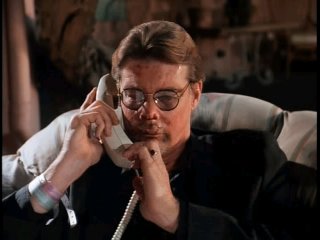
It was also a film that Vincent nearly didn’t live to make.  Two days before filming was to begin, Jan-Michael Vincent was nearly killed when he crashed his motorcycle.  Vincent suffered severe facial lacerations and he would later tell Howard Stern that his eye was nearly popped out of his head as a result of the accident.  Vincent was rushed to the hospital and put in intensive care.

However, Jan-Michael Vincent still had a movie to make.  So, what did he do?  Two days after his accident, he checked himself out of the hospital and, unexpectedly, showed up on set.  With his face noticeable bruised and swollen and with the stitches and sutures still visible, Vincent played the role of Keller.  If you watch carefully, you can even spot his hospital ID, still hanging around his wrist.  The script was hastily rewritten to explain Vincent’s injuries and, though he could barely speak or walk, he still delivered his lines and filmed his scenes.  And goddamn if Jan-Michael Vincent didn’t steal the entire movie.  Even after years of hard-living (not to mention just two days after nearly dying), Jan-Michael Vincent still had it.  Even though he had to whisper his lines and film most of his scenes sitting down, Vincent was still credibly threatening in the role of Keller. He even points out his own injuries, saying, “I’m sick of looking like Frankenstein!”

Jan-Michael Vincent in Red Line

The rest of the cast was made up of an eclectic collection of familiar faces.  Dom DeLuise played Chad McQueen’s boss.  Michael Madsen and Corey Feldman (!) both played rival gangsters while Roxanna Zal played the young woman who becomes McQueen’s partner in crime.  B-movie fans will want to keep an eye out for Julie Strain, Robert Z’Dar, and Chuck Zito.  None of them make as much of an impression as Vincent, though.

Red Line was meant to be an homage to the type of car chase films that Steve McQueen made famous.  Chad McQueen even gets to drive a replica of the car that his father drove in Bullitt.  Some of the chase scenes are exciting but Chad doesn’t have his father’s screen presence and the film never overcomes its low-budget.  Watching the movie is a lot like watching someone else play Grand Theft Auto.  Red Line is a forgettable movie but it will always be remembered as an important chapter in the legend of Jan-Michael Vincent.

Jan-Michael Vincnet, RIP

A Movie A Day #103: Mobsters (1991, directed by Michael Karbelnikoff)


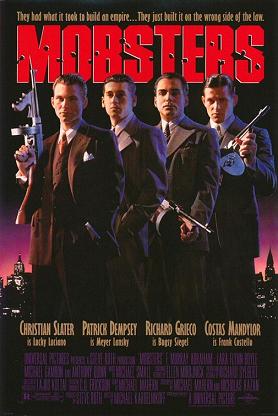
The place is New York City.  The time is the prohibition era.  The rackets are controlled by powerful but out of touch gangsters like Arnold Rothstein (F. Murray Abraham), Joe Masseria (Anthony Quinn), and Salvatore Faranzano (Michael Gambon).  However, four young gangsters — Lucky Luciano (Christian Slater), Meyer Lansky (Patrick Dempsey), Frank Costello (Costas Mandylor), and Bugsy Siegel (Richard Greico) — have an ambitious plan.  They want to form a commission that will bring together all of the Mafia families as a national force.  To do it, they will have to push aside and eliminate the old-fashioned mob bosses and take over the rackets themselves.  When Masseria and Faranzano go to war over who will be the new Boss of all Bosses, Luciano and Lansky seen their opportunity to strike.
I love a good gangster movie, which is one reason that I have never cared much for Mobsters. Mobsters was made in the wake of the success of Young Guns and, like that film, it attempted to breathe new life into an old genre by casting teen heartthrobs in the lead roles.  There was nothing inherently wrong with that because Luciano, Lansky, and Seigel were all still young men, in their 20s and early 30s, when they took over the Mafia.  (Costello was 39 but Mobsters presents him as being the same age as they other three.)  The problem was that none of the four main actors were in the least bit convincing as 1920s mobsters.  Christian Slater was the least convincing Sicilian since Alex Cord in The Brotherhood.  As for the supporting cast, actors like Chris Penn and F. Murray Abraham did the best that they could with the material but Anthony Quinn’s performance in Mobsters was the worst of his long and distinguished career.

Fans of Twin Peaks will note that Lara Flynn Boyle had a small role in Mobsters.  She played Luciano’s girlfriend.  Unfortunately, other than looking pretty and dying tragically, she was not given much to do in this disappointing gangster film.

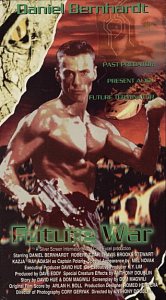
A Movie A Day #78: Future War (1997, directed by Anthony Doublin)


“Four days ago, a fire fell from the sky.”
So says Sister Ann (Travis Brooks Stewart), the former prostitute junkie turned nun who narrates Future War.  She says it at least three times.

But what was in that fire?

Was it The Runaway (Daniel Bernhardt), the Swiss kickboxer who was kidnapped by intergalactic slave traders shortly after the writing of the King James’s Bible and who, when he finally escapes, somehow finds himself in 20th Century Los Angeles?

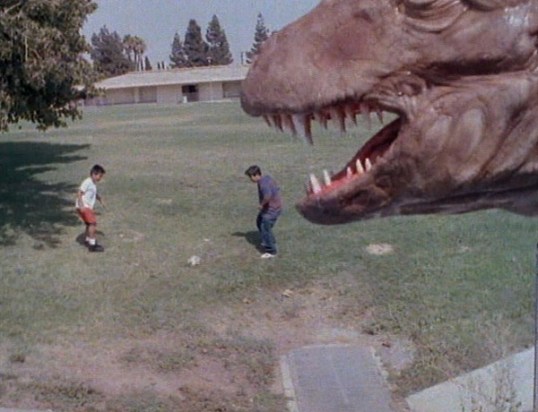
Was it the dinosaurs that were sent down to purse him?

Was it the Cyborg Master (played by Maniac Cop himself, Robert Z’Dar)?

Or was the fire from the sky any hope that Future War would feature consistent continuity and narrative logic crashing down to the Earth and burning up in the atmosphere?

Future War is one of the worst films ever made, which is the main reason to watch it.

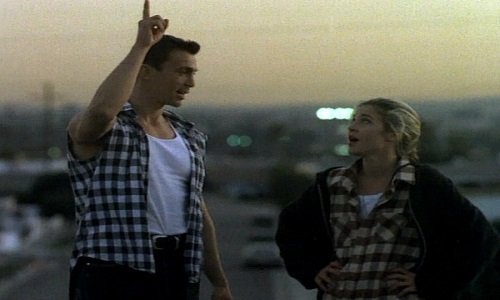
Watch as The Runaway points up at the sky and proves incapable of speaking until it is convenient for him to do so!

Thrill to countless fights that take place in warehouses that appear to be full of empty boxes!

Listen as multiple plot holes and inconsistencies are explained away by Sister Ann’s voice over!

Gasp at the sight of The Runaway and The Cyborg Master having a showdown in a church, John Woo-style!

Scream as dinosaur puppets are held really close to the camera in an effort to make them look bigger!

Laugh as the late Forrest J Ackerman makes a cameo, reading Famous Monsters of Filmland before getting eaten!

Wonder why The Runaway’s chest is bloody and injured in one shot but not the next!

Future War has it all!