Future serious actor Robert Vaughn made his film debut in 1958’s TeenageCaveman. Directed by Roger Corman, TeenageCaveman tells the story of a rebellious young man (that’s Robert Vaughn) who chooses to defy his father’s warnings and venture beyond the caves and into “the forbidden zone.” He’s told that monsters roam in the forbidden zone and indeed, at least one of them does. However, neither the Teenage Caveman nor his father are prepared for what lies at the heart of the forbidden zone.
(What will he find out there, Dr. Zaius?)
Robert Vaughn later said that, out of all the bad films that he made, this was the worst. Personally, I think he was being a bit too hard on the film. It’s not good but it is definitely fun. Along with watching all of the dinosaur stock footage, you get to wonder how a caveman — especially a teenage caveman! — could possibly have such perfect hair. Even more importantly, if you stick with it, this film has a twist ending that has to be seen to be believed.
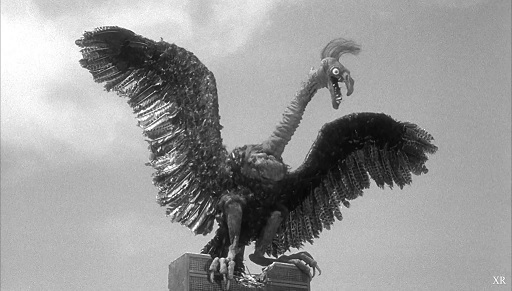
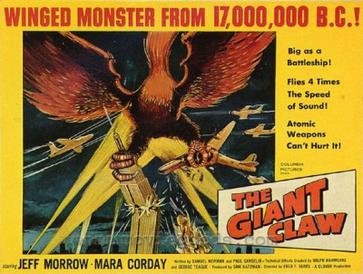
You know, a lot of people are a bit of dismissive of 1957’s The Giant Claw because they say that the monster — a big flying turkey from an anti-matter universe that has somehow slipped into our universe — is not convincing.
They make fun of the fact that, instead of hiring Ray Harryhausen like they were originally planning to do, the producers decided to save money by going for his non-union, Mexican equivalent.
They make fun of the scene in which a French-Canadian trapper announces that the Turkey Monster is actually a mythological beast that has the body of a woman, the head of a wolf, and the wings of a bat because the Turkey Monster certainly looks nothing like that.
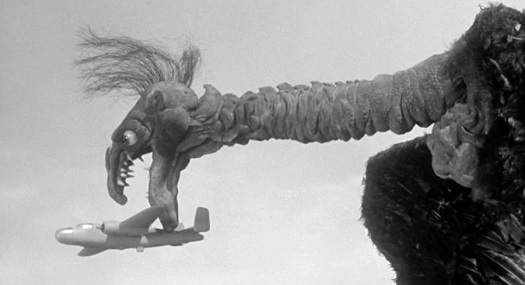
They laugh at the scene where the Turkey Monster chases an airplane, even though I think that would be pretty terrifying if I was actually on the airplane. I mean, the last time we were flying home from the UK, we hit a bit of turbulence and it traumatized me for days. I can only imagine how I would feel if I looked out the window and I saw a giant flying turkey chasing after the plane.
Critics will even make fun of how the turkey sounds, mocking it for its weird “caw caw” noises.
Well, alright. Let’s just admit it. The turkey isn’t the most menacing monster in the world and yes, it does sometimes sound a bit hoarse and it could definitely stand to put on a little weight but seriously, how can you not love this thing?
As for the film itself, it not only features one of the greatest monster of all time but it’s also a love story! Mitch MacAfee (Jeff Morrow) is a pilot who sees a UFO and who faces an attempt, by the government, to cover up what he’s seen. As happened to so many of the people who saw UFOs in the 50s, he’s accused of being either mistaken or an outright hoaxer. Meanwhile, Sally Caldwell (Mora Corday) is a mathematician who is originally skeptical of Mitch and his claims but who realizes that he was right when they’re attacked by the Turkey Monster. Their plane crashes in Canada, where they are rescued by a French-Canadian trapper named Pierre Brousssard (Lou Merrill). While the Turkey Monster is terrifying the world, Sally and Mitch are falling in love and since Jeff Morrow and Mara Corday are the most attractive people in the film, it only seems right. They’re a cute couple, who cares if the script makes any sense?
Anyway, back to the Turkey Monster. The Turkey Monster is protected by an anti-matter shield, which makes it impossible for it to be attacked by missiles and planes. A high-ranking general is left repeating, “Missiles and bombs,” after realizing that they’re all useless against the turkey.
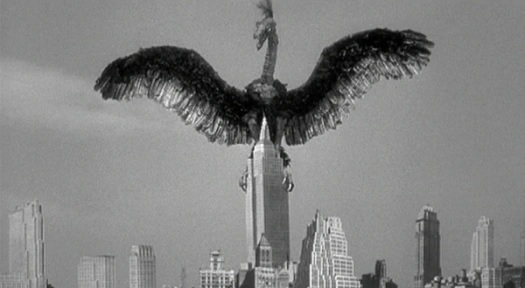
Eventually, the Turkey Monster makes its way to New York City and announces that it’s not going anywhere!
Well, you know what, Giant Turkey? If you can make it there, you can make it anywhere!
Sadly, the Turkey’s New York visit doesn’t end well and that’s a shame. Benjamin Franklin famously suggested that America’s official bird should have been the turkey as opposed to the eagle. Looking at the Giant Turkey sitting on the Empire State Building, how can you disagree?
Seriously, don’t listen to the critics. The Turkey Monster is one of the most entertaining monsters of all time and The Giant Claw is tons of fun!
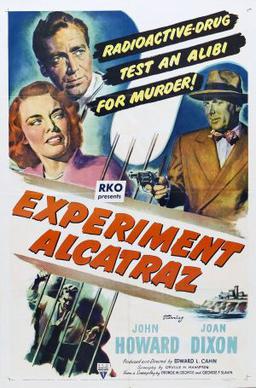
Dr. Ross Williams (John Howard) has a theory that injecting patients with a radioactive isotope can be used to treat a serious blood disease. However, he needs people on which to test his theory and, since it involves radiation, volunteers aren’t exactly lining up. Finally, five prisoners at Alcatraz agree to be used as test subjects in return for early parole. The prisoners are whisked off to a military where Williams and nurse Joan McKenna (Joan Dixon) oversee the experiment. Joan has her own reasons for hoping that Williams’s treatment is a success. Her own brother is currently dying of the disease.
Unfortunately, things go terribly wrong when one of the convicts, Barry Morgan (Robert Shayne), grabs a pair of scissors and stabs another prisoner to death. Morgan claims that he was driven mad by the treatment and, as a result, the experiments are canceled. Both Joan and Dr. Williams are convinced that Morgan had another reason for killing the prisoner. With Morgan and his cronies now free, Williams launches his own investigation into what happened.
Experiment Alcatraz starts out with an intriguing premise but then settles into being a typical B-crime film. Robert Shayne does a good job playing the viscous criminal but Morgan’s motives for committing the murder turn out to be fairly predictable and the story’s conclusion won’t take anyone by surprise. Howard and Dixon are competent leads but both are playing dull characters and too much of the film’s story depends on getting the audience to believe that a potentially revolutionary medical treatment would be tested in a thoroughly haphazard manner. Worst of all, despite the title, there’s very little Alcatraz to be found in Experiment Alcatraz. The prisoner leaves the prison early and never look back.
Experiment Alcatraz is one of the many films to be directed by the incredibly prolific and fast-working Edward L. Cahn. Between 1931 and 1962, Cahn is credited as having directed 127 movies. In 1961 alone, he directed 11 feature films! 1950 was actually a slow year for Cahn. Including Experiment Alcatraz, he only directed 5 films that year. As you can guess with that many movies, Cahn’s output was uneven. For every Experiment Alcatraz, there was an It! The Terror From Beyond Space. Despite a promising premise, Experiment Alcatraz is one of Cahn’s more forgettable films.
The 1957 film Footsteps in the Night opens in a small motel apartment in Los Angeles.
Jazz blares from a record player. Playing cards are spread across a table. A cigarette burns in an ashtray while a stack of poker chips sits undisturbed nearby. When the apartment’s resident, Henry Johnson (Douglas Dick) steps into the room, he nearly stumbles over the dead body that’s lying in the middle of the floor.
Henry looks down at the body. Is he shocked? Is he scared? Is he regretful? Is he guilty? It’s impossible to tell from his somewhat perturbed but mostly blank facial expression. He takes in the scene and then promptly turns out the lights.
The dead man is Henry’s neighbor, Fred Horner (Robert Shaye). When the police arrive, Detectives Andy Doyle (Bill Elliott) and Mike Duncan (Don Haggerty) immediately deduce that someone murdered Fred in the middle of a poker game. Since everyone says that Henry was not only a degenerate gambler but that he also frequently got into arguments with Fred, Henry becomes the number one suspect. Not helping Henry’s case is the fact that he’s disappeared and his girlfriend, Mary Raiken (Eleanore Train), won’t reveal where he’s hiding.
It seems like an open-and-shut case but Doyle has his doubts. The case against Henry is almost too perfect and Doyle wonders if maybe they’re overlooking something. As Doyle and Duncan continue to investigate, they discover that Fred Horner was an angry and misanthropic man. They also discover that there’s a salesman named Bradbury (James Flavin) who is staying at an adjacent hotel and who bears a strong resemblance to the dead man….
Clocking in at just 62 minutes, Footsteps in the Night is a fast-paced police procedural with elements of film noir tossed in for good measure. While I was doing some research for this review, I discovered that Footsteps in the Night was actually the fifth and final film in which Bill Elliott played Detective Andy Doyle. Before taking on the role of Doyle, Elliott appeared in several westerns and he plays Doyle much like an ideal frontier sheriff. He’s a no-nonsense lawman who solves cases with common sense and doesn’t have much time for wild speculation. Dan Haggerty backs him up as the equally no-nonsense Mike Duncan. As opposed to the modern tendency to celebrate cops who “break the rules,” Footsteps in the Night emphasizes the professional, by-the-book attitude of Doyle and Duncan. If you were ever murdered, Duncan and Doyle are the type of cops that you would want assigned to the case.
As for their number one suspect, Henry may claim to have just been an innocent bystander but his gambling addiction makes him less than trustworthy in the eyes of many cops. It’s only when Doyle and Duncan start to dig into the case that they discover just how cruelly Fred manipulated Henry’s addiction. In the best tradition of many murder mysteries, Footsteps in the Night not only leaves you wondering who the murderer may have been but also whether or not the victim may have gotten what he deserved.
Footsteps in the Night is a good police procedural. I look forward to watching and reviewing the other four films in which Bill Elliott played Detective Doyle as well.
Today’s horror on the lens is the surprisingly brutal 1956 B-movie, Indestructible Man!
I reviewed this movie back in 2013. It was definitely made on a low-budget and it features one of the most sexist endings in cinematic history and yet it’s also occasionally effective. The film’s biggest strength is that the Indestructible Man is played by Lon Chaney, Jr. Though Chaney was clearly dealing with his personal demons at the time this film was made, his surly manner and ravaged face make him very effective in the role of Charles “Butcher” Benson.
The aliens have arrived! They landed one night in the middle of a thunderstorm and now, they’re hiding underground in a sandpit. Only David McClean (Jimmy Hunt) was awake to witness their arrival. He was supposed to be asleep but who could sleep through all that thunder and lightning? (Not to mention the sound of the flying saucer!) Unfortunately, no one’s going to believe David because he’s only 12 years old!
That’s the premise at the heart of Invaders from Mars, a nicely surreal science fiction film from 1953.
In order to humor David, a few people do go to the sandpit to look for this supposed UFO. They include his scientist father (Leif Erickson) and a few local cops. They all return saying that they found nothing. They also all return in a really bad mood. David’s formerly loving and humorous father is suddenly distant and rather grumpy. And he no longer speaks like himself. Instead, he is now rigidly formal, like someone still getting used to speaking a new language. Maybe it has something to do with the strange mark on the back of his neck….
David goes into town and soon discovers that several townspeople are acting just like his father. It’s almost as if something is controlling them! Well, what else can David do but go to the local observatory and get the U.S. Army involved!?
Invaders from Mars may be disguised as a children’s film about a flying saucer but it actually deals with some very adult issues. What do you do when you know that you’re right but no one is willing to listen to you? Do you stubbornly cling to what you believe or do you just become a mindless and unquestioning zombie like everyone else? Do you remain independent or do you get the mark on your neck? Of course, it should also be pointed out that Invaders From Mars was made at a time when people were very much worried that America was being invaded from within by communists and subversives, all of whom would rob Americans of their individual freedoms just as surely as the aliens in David’s town. Invaders From Mars came out two years before Invasion of the Body Snatchers but they both deal with very similar issues.
What sets Invaders From Mars apart is that it’s told from a child’s point of view. It plays out like a nightmarish fairy tale. The film was directed by the famous production designer, William Cameron Menzies and he gives the entire film a nicely surreal look. The town is just a little bit too perfect while the inside of the spaceship is a maze of corridors, all overseen by a ranting head in a crystal ball.
The film’s ending was probably chilling to audiences in 1953. For modern audiences, it’s a bit of groan-inducing cliché. Still, the ending itself makes sense when viewed in the context of the entire film. (It’s literally the only ending that makes sense.) Still, ending aside, Invaders From Mars is a classic sci-fi film and one well worth watching this Halloween season.
Last week, along with my friends and fellow members of the Late Night Movie Gang, I watched the 1954 sci-fi film, Tobor The Great.
As you can probably tell by looking at the top of this review, Tobor came with a really great poster. It’s a poster that promises all sorts of sci-fi thrills and chills. It screams, “B-movie masterpiece!” You look at that poster and you think to yourself, This film is probably extremely silly but I absolutely have to watch it!
Of course, if you know anything about the B-movie aesthetic of the 50s and 60s, you won’t be shocked to learn that the poster has next to nothing to do with the actual film. True, there is a robot is featured in the film. The poster is honest about that. And Tobor actually looks just as good in the movie as he does on the poster. And there is a subplot about space travel but, at no point, do we see Tobor walking across the surface of Neptune or Jupiter or wherever it is that Tobor is supposed to be in this poster. Maybe he’s on one of the moons of Saturn. Who knows?
Also, at no point, does Tobor carry around a woman. In fact, Tobor is pretty much a film for kids. The main character, other than Tobor, is an 11 year-old boy named Gadge (Billy Chapin). I can only imagine how audiences reacted when they went into the film expecting to see the scene in the poster and instead, they were confronted with a movie about a little boy and his robot.
Tobor is one of those films that opens with several minutes of stock footage. Rockets take off. The stars shine in the sky. Scientists and engineers do stuff. It all looks pretty impressive but, of course, none of it was actually shot for this film. In fact, the use of all that stock footage mostly serves to highlight how cheap the rest of the movie looks.
As for the film’s plot, it has apparently been determined that it’s too dangerous to send humans into space. So, Professor Nordstrom (Taylor Holmes) and Dr. Harrison (Charles Drake) build a robot that is specifically designed to fly an interstellar craft. They name their creation Tobor, because that’s robot spelled backwards. (Tobor even points out that his name is robot spelled backwards.) In order to help Tobor explore the universe, they design him to be able to simulate human emotions. In fact, they’re so successful at it that Tobor ends up befriending Nordstrom’s grandson, the aforementioned Gadge.
The press and the military are all very impressed with Tobor. Unfortunately, it’s the 1950s and that means that the communists are impressed by Tobor as well! Can the scientists and their families keep Tobor from getting abducted by a bunch of Russian agents!? Let’s hope so because there’s a lot of space that needs to be explored….
Anyway, Tobor The Great is silly but kind of fun. It has its slow spots but it also has a really cool robot and it’s always fun to watch the commies get thwarted. It’s a real time capsule film, one that not only reflects the decade in which it was made but which also has a somewhat charming innocence to it. If nothing else, it’s nice to think that, in the days before CGI, the filmmakers actually had to make a Tobor of their own. Apparently, Tobor is currently in a private collection and I hope whoever has him is treating him well.
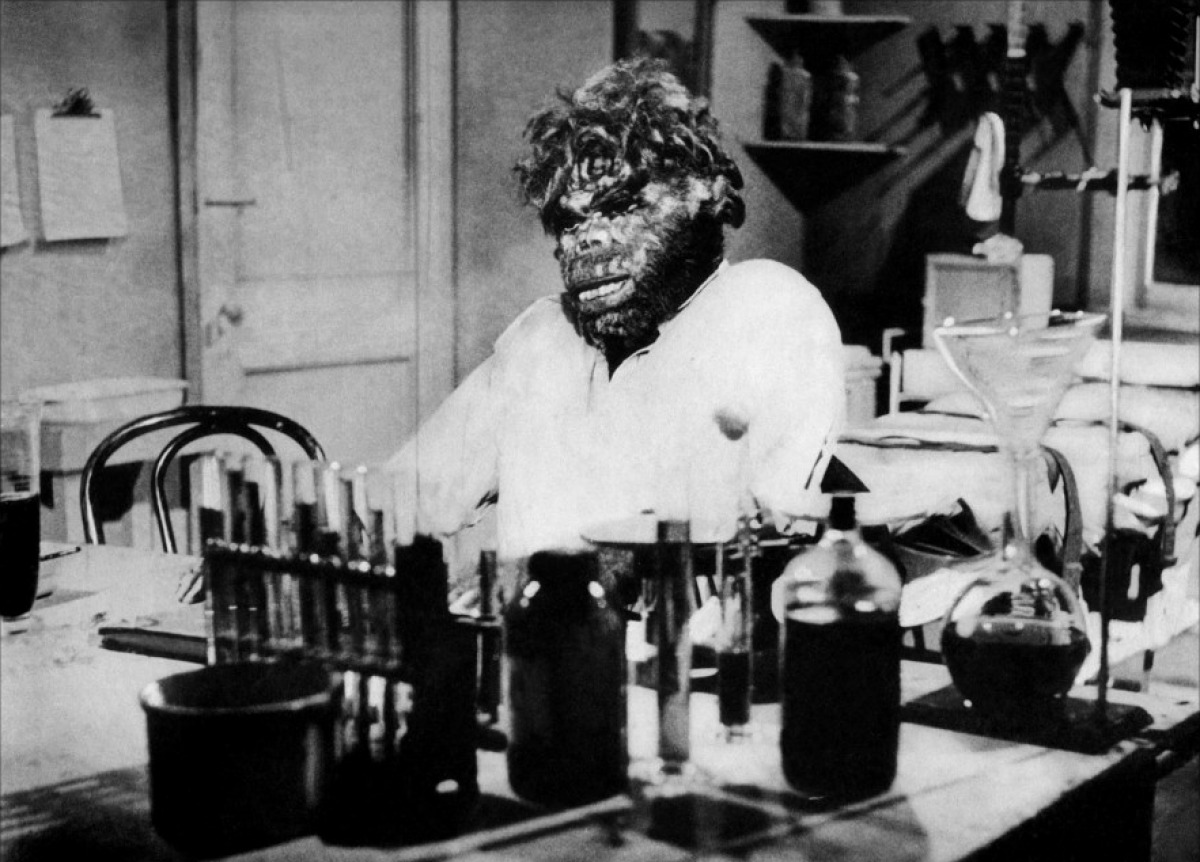
I’ve seen a lot of horror movies. All the Universal classics, Hammer horrors, big budget, low budget, no-budget, you name it. THE NEANDERTHAL MAN is without a doubt one of the worst I’ve ever laid eyes on. It’s not even so-bad-it’s-good. It’s just so-bad-it’s-bad.
This totally unlikeable turkey involves a mad scientist whose experiments in evolution lead him to create a serum that devolves species. After success with turning a cat into a saber-toothed tiger (via stock footage and some really bad fake tusks), Professor Groves injects himself with the stuff and becomes Neanderthal Man. The prof goes on a pretty tame killing spree before getting his inevitable comeuppance. In a part that begs for John Carradine (or better yet, Bela Lugosi!), we get Robert Shayne of TV’s THE ADVENTURES OF SUPERMAN fame. The erstwhile Inspector Henderson is all over the place, overacting in some spots, underacting in others. Whereas a…
The 39th film in the Fabulous Forties box set was 1947’s Smash-Up, the Story of a Woman. I have to say it was a little bit strange going from watching the hilarious and life-affirming My Man Godfrey to watching the very serious and rather depressing Smash-Up.
Smash-Up is pure, tear-jerking Hollywood melodrama. When the film starts, Angie Evans (Susan Hayward) is in a hospital, with her face totally covered in bandages. Just by looking at her, we already know that her story is not going to be a happy one.
Flash back time! Angie was a nightclub singer and a pretty good one at that. The audiences loved her and she loved performing but she loved one thing more. (See how overwrought my prose was there? That’s a reflection of Smash-Up’s style.) She loved Ken Conway (Lee Bowman, who may be related to me but probably isn’t). Ken was a singer himself, though he was nowhere near as successful as Angie. However, after Ken and Angie married, Angie put her career on hold while Ken went on to become a huge success.
Angie was already a drinker before she met Ken. Having a few drinks before going out on stage helped to calm her nerves. It helped her to relax and become the performer that the audiences loved. However, once Ken became a star and Angie found herself continually alone in their home, she started to drink because it was the only thing that made her happy. Whenever she started to regret giving up her career, she drank. When she was worried that Ken was having an affair with his secretary (Marsha Hunt), Angie drank. Ken’s best friend and songwriter, Steve (Eddie Albert), could see that Angie was losing control. However, Ken refused to accept that his wife had a drinking problem. Accepting that Angie was drinking to be happy would mean accepting that she wasn’t happy in the first place.
Trapped in the middle of all this was their daughter, Angel (Sharyn Payne). When Ken, finally admitting that his wife could not control her drinking, demanded custody of Angel, Angie was determined to get back her daughter.
But, even though she wanted to, Angie could not stop drinking. Or smoking. And the smoking, the drinking, and the kidnapping did not make for a particularly good combination.
According to Wikipedia, Smash-Up was a failure at the box office and I can actually see why. 1940s American cinema can basically be divided between the earnest, patriotic, and optimistic films that were released during World War II and the dark and pessimistic films that came out after the war ended and the world realized just how evil and dangerous human beings could be. Smash-Up is one of those dark films. It’s not a happy film, nor is it at all subtle. In fact, as much as I love a good melodrama, Smash-Up occasionally seems like a bit much. Absolutely every bad thing that could happen does happen and it’s typical of the approach of Hollywood in the 40s that, for all the trouble Angie suffers as a result of her drinking, the film still has to find an excuse to send her to hospital with her face in bandages. The film is often very empathetic in its treatment of Angie but, in the 1940s, mistakes still had to be punished.
Fortunately, Susan Hayward gives a great performance in the role of Angie, capturing the aching sadness that leads her to drink in the first place. She saves the entire film and, quite justifiably, she received a nomination for best actress for her performance here. She didn’t win but she still made Smash-Up worth seeing.
First released in 1956, Indestructible Man is a low-budget B-movie that, as a result of being in the public domain, has been released on DVD by several different companies and seems to be included in just about every other compilation box set released by the folks at Mill Creek. Perhaps because it stars Lon Chaney, Jr., it also seems to turn up on TCM fairly regularly. That’s how I first saw it.
Whenever anyone mentions the film Indestructible Man to me, I always think about … well, actually no one ever mentions Indestructible Man to me. But if they did, I would probably always remember one scene in particular. It comes towards the end of the film. Detective Dick Chasen (Max Showalter) has managed to solve the mystery of the Indestructible Man. He celebrates by going out with his new girlfriend, a burlesque dancer played by Marian Carr. Sitting there in the car, illuminated by the romantic glow of the moon, Detective Chasen informs her that he’s gotten her fired from her job because she’s going to be way too busy being his wife to have a career. “Even if I wanted to, I couldn’t say no!” his girlfriend responds.
Don’t believe me? Watch for yourself. From Indestructible Man, here’s one of the most sexist scenes in film history…
Up until that ending, Indestructible Man tells the story of Charles “Butcher” Benson (Lon Chaney, Jr). As you might guess from his nickname, Butcher isn’t a nice guy. In fact, he’s a career criminal who is sitting on death row in California. He’s been double-crossed by his criminal partners (who include both a lawyer and a guy named Squeamy, so you know they’re bad) and, from his prison cell, he swears that he will have his revenge.
And then he’s promptly executed.
However, his body is donated to science. Scientist Robert Shaye is investigating whether or not massive electrical shock can be utilized to cure cancer. When he and his assistant (Joe Flynn) shock the Butcher’s corpse, the Butcher comes back to life and starts to wander around the laboratory. Shaye attempts to give him a shot but the hypodermic needle snaps when pressed against the Butcher’s skin. The Butcher proceeds to strangle both the scientist and his assistant…
What’s going on? Well, fortunately, this film is narrated by Detective Dick Chasen (and yes, that is the character’s name and that’s all I’m going to say about it). Dick Chasen explains to us that 1) the electrical shock fried Butcher’s vocal chords and rendered him mute and that 2) the shock caused Butcher’s cells to multiply at such a rate that he is now …. INDESTRUCTIBLE!
Anyway, Butcher proceeds to spend the rest of the movie tracking down and murdering his former criminal associates. Even before you reach the most sexist ending in the history of American cinema, it’s all rather silly. It’s also rather slow. The film lasts 70 minutes and I would say that 20 of those minutes consist of pure padding.
However, as often happened with B-movies, the low budget occasionally works to the film’s advantage. The flat black-and-white and the stark sets may have been an unintentional consequence of economic reality but, at the same time, they give the film a much needed edge.
Much as the low budget accidentally worked to the film’s advantage, so to did the personal demons of Lon Chaney, Jr. contribute to making him into a surprisingly effective and disturbingly believable killer. Though he’s best remembered for playing the handsome and soulful Larry Talbot in the original Wolf Man, by the time Lon Chaney, Jr. made Indestructible Man, years of drinking, smoking, and self-destructive behavior had caught up with the former matinée idol. Chaney’s ravaged face, marked by deep lines and sporting a permanently grim expression, makes him perfect for this role. The highest praise that I can pay to Chaney’s performance is that you look at him and you truly believe that his character would be nicknamed Butcher.
As I stated at the start of this review, Indestructible Man is in the public domain and it’s fairly easy to track down. For that matter, you can always watch it below.
And just remember … you’re not supposed to say no to a detective…






 Through the Shattered Lens