4 Or More Shots From 4 Or More Films is just what it says it is, 4 shots from 4 of our favorite films. As opposed to the reviews and recaps that we usually post, 4 Shots From 4 Films lets the visuals do the talking!
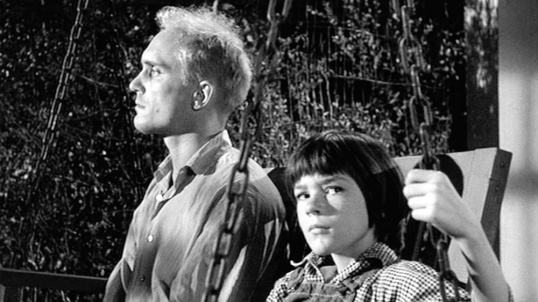
Today, we celebrate the 91st birthday of one of the finest American actors out there, Mr. Robert Duvall. Ever since he made his film debut in 1962’s To Kill A Mockingbird, Duvall has been a regular presence in American cinema. He’s an actor who has appeared in some of the best American films ever made (The Godfather, Network, Apocalypse Now, To Kill A Mockingbird, Tender Mercies, and others) and he’s played a wide variety of characters. He’s been everything from a lawyer to a cowboy to a network executive to a professional criminal to a cop and he’s never been less that convincing. He’s got a filmography about which anyone would be jealous. And, at an age when most actors have retired, Duvall is still working and taking the occasional part.
On a personal note, I have to say that, for someone who was born in California, raised in Maryland, and who started his career in New York, Robert Duvall is one of the few actors to have perfected both the Southern and the Southwestern accent. Whenever I see him playing a Texan, I always have to remind myself that he’s not actually from around here.
In honor of Robert Duvall’s birthday, here are….
6 Shots From 6 Robert Duvall Films
To Kill A Mockingbird (1962, dir by Robert Mulligan, DP: Russell Harlan)
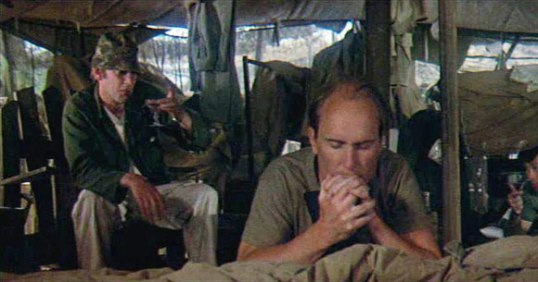
MASH (1970, dir by Robert Altman, DP: Harold E. Stine)
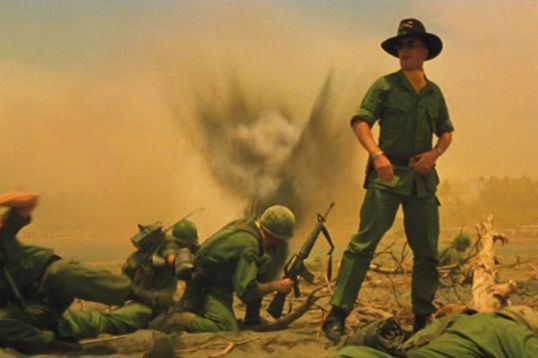
Apocalypse Now (1979, dir by Francis Ford Coppola, DP: Vittorio Storaro)
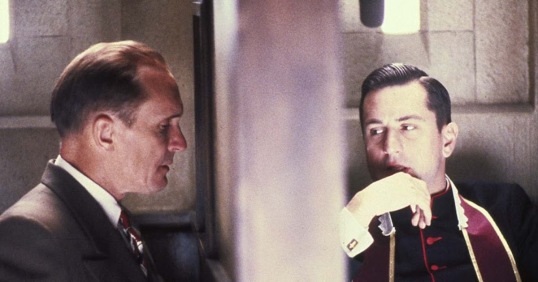
True Confessions (1981, dir by Ulu Grosbard, DP: Owen Roizman)
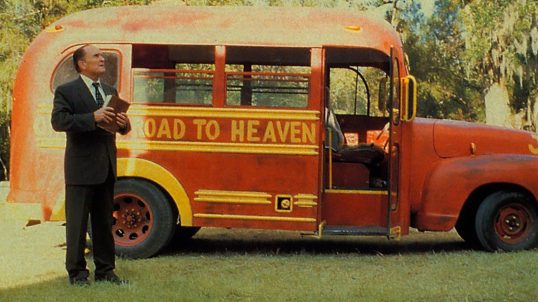
The Apostle (1997, dir by Robert Duvall, DP: Barry Markowitz)
The Judge (2014, dir by David Dobkin, DP: Janusz Kamiński)
After Mr. Markheim (Franchot Tone) murders a pawnbroker, he assures himself that he’s not going to do anything more than take some of the man’s possessions and then lead a good life. After all, he’s not really an evil man. He simply did what he did because he was so jealous of the pawnbroker. Why should the pawnbroker have so much while Markheim has so little?
Unfortunately, an otherworldly visitor pops up and suggests that there’s no way that Markheim can lead a good life after doing something so evil. So, why not go out and be evil for a little while more?
This episode originally aired on October 28th, 1952. Truman was still president but not for much longer.
Originally, I was going to finish up the first day of my back to school reviews by talking about A Clockwork Orange. I figured that, since the second film I reviewed was Andy Warhol’s Vinyl, it would just make sense that the fourth film would A Clockwork Orange.
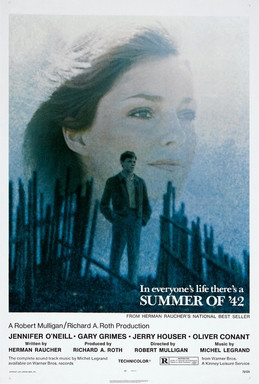
But, I don’t know. As I sat down and started to work on my fourth review, I realized that I’m not quite ready to write about A Clockwork Orange. Instead, I’d rather hold off on that until tomorrow. So, instead, I’m going to talk about Summer of ’42, another coming-of-age film that came out the same year.
That’s right — A Clockwork Orange and Summer of ’42 both came out in 1971 but — in content and sensibility — they might as well exist in different universes. In fact, the only thing that they have in common is that they both tend to show up on TCM fairly frequently and that they’ve both influenced countless other films.
Speaking of TCM, that’s where I first saw Summer of ’42. I have to admit that I’m writing this review from memory and that may not be the best way to review a film. I saw Summer of ’42 about four months ago and, at the time, I thought it was a well-done but predictable little movie. I even took notes for a future review but I didn’t get around to writing that review because … well, at the time, it just seemed like there wasn’t a lot to say about it. Summer of ’42 is a sweet film but almost everything about it is right on the surface. What you see is what you get. I’m not surprised to discover that it was the 6th highest grossing film of 1971. In a year that saw not only A Clockwork Orange but The Last Picture Show,The French Connection, Brother John, Billy Jack, Carnal Knowledge, Dirty Harry, Harold and Maude, Let’s Scare Jessica To Death, Klute, Straw Dogs, Pretty Maids All In A Row, and The Zodiac Killer, audiences were probably relieved to see a film that was neither violent, morally ambiguous, nor apocalyptic.
Instead, Summer of ’42 is a coming-of-age story that was specifically crafted to appeal to a world-weary audience’s nostalgia for the simple and carefree days of World War II. This is one of those films where an older narrator continually reassures us that we’re seeing the most defining moment of his youth and all of the pretty images are in soft focus. Hermie (Gary Grimes), Oscy (Jerry Houser), and Benjie (Oliver Conant) are three fifteen year-olds, all of whom are spending their summer on Nantucket Island. Benjie is obsessed with sex but he’s nerdy. Oscy is obsessed with sex but he’s a jerk. Hermie is obsessed with sex but he’s the narrator so we already know that he’s too sensitive to lose his virginity to any girl his own age.
Luckily, there’s a woman in her 20s who is living in a nearby beach house. Dorothy (Jennifer O’Neill) is beautiful but she’s married. However, her husband’s a soldier and it is 1942 so, pretty soon, he’s out of the picture. Hermie develops a mad crush on her and then, luckily for him, her husband dies and she spends a night teaching him the ways of love. The next morning, she vanishes but leaves Hermie a note, telling him that she will never forget him and that it’s up to him to decide what their night together meant.
(Hermie never gets around to telling us what their night together meant so I guess it’s up to us to decide. Personally, I just hope Hermie was careful who he told because, nowadays, a 23 year-old can get in a lot of legal trouble if she’s caught having sex with a 15 year-old. Maybe things were different in 1942…)
As I said before, my initial response was that Summer of ’42 was sweet but predictable. And that’s the way I still feel about it. It was well-acted, well-filmed, and Jennifer O’Neill was amazingly beautiful but there was still something about Summer of ’42 that kind of bothered me. We never really got to know who Dorothy was. Her entire character was defined by her one night with Hermie. Yes, I do understand that was kind of the point because the story was being told exclusively from Hermie’s point of view. But it still bothered me. Beyond being beautiful, tragic, and ultimately available, who was Dorothy?
But really, it wasn’t just something about the Summer of ’42 that was bothering me. Instead, it was something about the coming-of-age genre in general. I have lost track of how many nostalgic films and TV shows that I have seen that feature a narrator talking about the summer that he “became a man.” It’s amazing how many awkward teenage boys apparently lost their virginity to a beautiful older woman who promptly vanished afterwards. If, as has been recently suggested, I spent next summer in a rented beach house, am I going to be obligated to be the first lover of every 15 year-old, aspiring writer who happens to come wandering down the beach? That could be time consuming, depending on how popular the beach is.
I guess what I’m saying is that perhaps somebody needs to remake Summer of ’42 and tell it from Dorothy’s point of view.
So, I guess I should explain why I’m including the classic 1962 film (and best picture nominee), To Kill A Mockingbird, in this series of reviews of films about politicians. After all, while To Kill A Mockingbird dealt with the issue of racism in Alabama in a surprisingly honest manner, it doesn’t feature any elected officials. Nobody shows up playing Gov. Benjamin J. Miller or President Franklin Roosevelt. Instead, this film is about a wise lawyer named Atticus (Gregory Peck), an innocent man named Tom (Brock Peters), a girl named Scout (Mary Badham) and her older brother Jem (Philip Alford), and a mysterious recluse named Boo (Robert Duvall).
However, if you’ve read Harper Lee’s wonderful novel, then you know that Atticus is not just the smartest man in Maycomb, Alabama. He’s also a member of the Alabama state legislature and his political career is a fairly important subplot in the book, with him occasionally having to leave home so he can go down to Montgomery and help to write the budget. (Incidentally, Harper Lee’s father actually was a member of the Alabama House of Representatives.)
In the film, no mention of Atticus being a member of the state legislature is made but I still choose to believe that he was. Because, as played by Gregory Peck, Atticus Finch is exactly the type of man who you would want to think of as serving in government. He’s wise, compassionate, and firm. For much of To Kill A Mockingbird, he is literally the only sane adult in Maycomb. He’s the only attorney willing to defend Tom Robinson when Tom is accused of raping a white girl. When a mob shows up to lynch Tom, Atticus is the only adult willing to stand up to them. (Fortunately, Jem also runs up and shames the mob by reminding them that she goes to school with their children.) And, in court, it is Atticus who proves that Tom is innocent.
When Tom is still convicted, what makes it all the more devastating is that wise and compassionate Atticus doesn’t seem to be surprised as all. If even Atticus feels that there is no hope for a black man to get a fair trial from an all-white jury, the film seems to be saying, then there truly is no hope.
Of course, the film is not just about Atticus. It’s about Scout and Jem and their friend Dill (John Megna) and how the three of them grow up and learn the truth about their world. Watching them from behind the closed doors of his house is the mysterious and reclusive Boo Radley. When Boo shows up towards the end of the film, I always find tears in my mismatched eyes. Boo is played, in his film debut, by Robert Duvall. Duvall doesn’t say a word but he still makes an incredible impression as the shy and withdrawn Boo.
So, I may be cheating a lot by including To Kill A Mockingbird in this series of reviews. Oh well. Who am I to turn down a chance to rewatch it? To Kill A Mockingbird is just a great film.


 Through the Shattered Lens