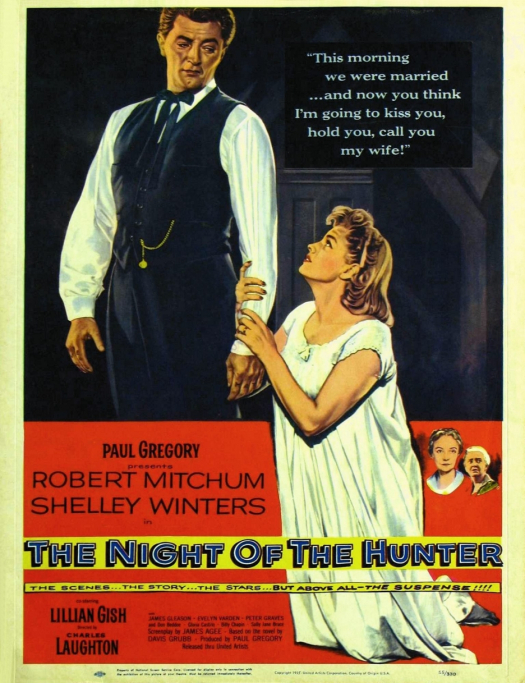
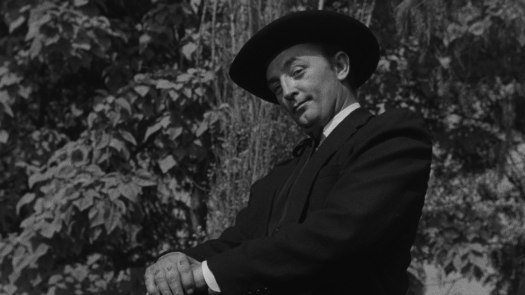
Regular readers know I’m a big fan of Big Bob Mitchum, having covered nine of his classic films. The self-effacing Mitchum always downplayed his talents in interviews, but his easy-going, naturalistic style and uncanny ear for dialect made him one of the screen’s most watchable stars. Whether a stoic film noir anti-hero, a rugged soldier fighting WWII, a romantic lead, or a malevolent villain, Mitchum always delivered the goods. Last night I watched THE NIGHT OF THE HUNTER for the first time, and his performance as the murderous ‘Reverend’ Harry Powell just zoomed to the top of my list of marvelous Mitchum performances.
Mitchum’s Powell is totally amoral and totally crazy, a sociopathic killer who talks to God about killing women, those “perfume smelling things, lacy things, things with curly hair” that The Lord hates, according to Harry. He’s sexually repressed to the point he must murder in the name of God to…
The Longest Day is a pain-staking and meticulous recreation of invasion of Normandy, much of it filmed on location. It was reportedly something of a dream project for the head of the 20th Century Fox, Darryl F. Zanuck. Zanuck set out to make both the ultimate tribute to the Allied forces and the greatest war movie ever. Based on a best seller, The Longest Day has five credited screenwriters and three credited directors. (Ken Annakin was credited with “British and French exteriors,” Andrew Marton did “American exteriors,” and the German scenes were credited to Bernhard Wicki. Oddly, Gerd Oswald was not credited for his work on the parachuting scenes, even though those were some of the strongest scenes in the film.) Even though he was not credited as either a screenwriter or a director, it is generally agreed that the film ultimately reflected the vision of Darryl F. Zanuck. Zanuck not only rewrote the script but he also directed a few scenes as well. The film had a budget of 7.75 million dollars, which was a huge amount in 1962. (Until Steven Spielberg’s Schindler’s List, The Longest Day was the most expensive black-and-white film ever made.) Not only did the film tell an epic story, but it also had an epic length. Clocking in at 3 hours, The Longest Day was also one of the longest movies to ever be nominated for best picture.
The Longest Day also had an epic cast. Zanuck assembled an all-star cast for his recreation of D-Day. If you’re like me and you love watching old movies on TCM, you’ll see a lot of familiar faces go rushing by during the course of The Longest Day. American generals were played by actors like Robert Mitchum, Robert Ryan, Henry Fonda, and John Wayne. Peter Lawford, then the brother-in-law of the President of the United States, had a memorable role as the Scottish Lord Lovat, who marched through D-Day to the sounds of bagpipes. When the Allied troops storm the beach, everyone from Roddy McDowall to Sal Mineo to Robert Wagner to singer Paul Anka can be seen dodging bullets. Sean Connery pops up, speaking in his Scottish accent and providing comic relief. When a group of paratroopers parachute into an occupied village, comedian Red Buttons ends up hanging from the steeple of a church. When Richard Beymer (who is currently playing Ben Horne on Twin Peaks) gets separated from his squad, he stumbles across Richard Burton. Among those representing the French are Arletty and Christian Marquand. (Ironically, after World War II, Arletty was convicted of collaborating with the Germans and spent 18 months under house arrest. Her crime was having a romantic relationship with a German soldier. It is said that, in response to the charges, Arletty said, “My heart is French but my ass is international.”) Meanwhile, among the Germans, one can find three future Bond villains: Gert Frobe, Curt Jurgens, and Walter Gotell.
It’s a big film and, to be honest, it’s too big. It’s hard to keep track of everyone and, even though the battle scenes are probably about an intense as one could get away with in 1962 (though it’s nowhere near as effective as the famous opening of Saving Private Ryan, I still felt bad when Jeffrey Hunter and Eddie Albert were gunned down), their effectiveness is compromised by the film’s all-star approach. Often times, the action threatens to come to a halt so that everyone can get their close-up. Unfortunately, most of those famous faces don’t really get much of a chance to make an impression. Even as the battle rages, you keep getting distracted by questions like, “Was that guy famous or was he just an extra?”
Among the big stars, most of them play to their personas. John Wayne, for instance, may have been cast as General Benjamin Vandervoort but there’s never any doubt that he’s playing John Wayne. When he tells his troops to “send them to Hell,” it’s not Vandervoort giving orders. It’s John Wayne representing America. Henry Fonda may be identified as being General Theodore Roosevelt II but, ultimately, you react to him because he’s Henry Fonda, a symbol of middle-American decency. Neither Wayne nor Fonda gives a bad performance but you never forget that you’re watching Fonda and Wayne.
Throughout this huge film, there are bits and pieces that work so well that you wish the film had just concentrated on them as opposed to trying to tell every single story that occurred during D-Day. I liked Robert Mitchum as a tough but caring general who, in the midst of battle, gives a speech that inspires his troops to keep fighting. The scenes of Peter Lawford marching with a bagpiper at his side were nicely surreal. Finally, there’s Richard Beymer, wandering around the French countryside and going through the entire day without firing his gun once. Beymer gets the best line of the film when he says, “I wonder if we won.” It’s such a modest line but it’s probably the most powerful line in the film. I wish The Longest Day had more scenes like that.
The Longest Day was nominated for best picture of 1962 but it lost to an even longer film, Lawrence of Arabia.
G’day, mates! Let’s take a trek through the wilds of 1920’s Australian outback with , Robert Mitchum Deborah Kerr, and a herd of bouncing sheep in THE SUNDOWNERS. Fred Zinnemann, generally associated with serious, tense dramas like HIGH NOON and FROM HERE TO ETERNITY, lends a lighter touch than usual to this sprawling, almost John Ford-esque tale of an itinerant sheep drover and his family, and the wife who longs to settle into a home of her own.
Mitchum plays Paddy Carmody, a stubborn Irishman who has to keep moving, unable and unwilling to be tied to one place. He’s a wanderer with a fondness for booze and gambling, and Big Bob is perfect for the part. Mitchum’s penchant for dialects make his Aussie accent more than believable, and his facial expressions, especially during the sheep-shearing contest, are priceless. Deborah Kerr is his equal as wife Ida, the tough Earth Mother who’s loyal to Paddy…
Robert Mitchum puts the pedal to the metal as a moonshine runner at odds with both the Feds and gangsters in THUNDER ROAD. This is Mitchum’s most personal picture, not only starring but producing, writing the story (and two songs!), and, rumor has it, doing much of the directing. His notorious independent streak comes through in his character Luke Doolin, a Korean War vet who believes in the right of individual ownership, whether on his land or in his car, and free market enterprise, without interference from outsiders or the government. That’s right, Luke Doolin is a true Libertarian hero!
He’s also the best damn driver in River Valley, Kentucky, as we see in the opening scene, speeding down the backroads, eluding police with the greatest of ease. The Doolins have been making moonshine for generations, with daddy Vernon running the still, baby brother Robin the family mechanic, and mama Sarah praying for…
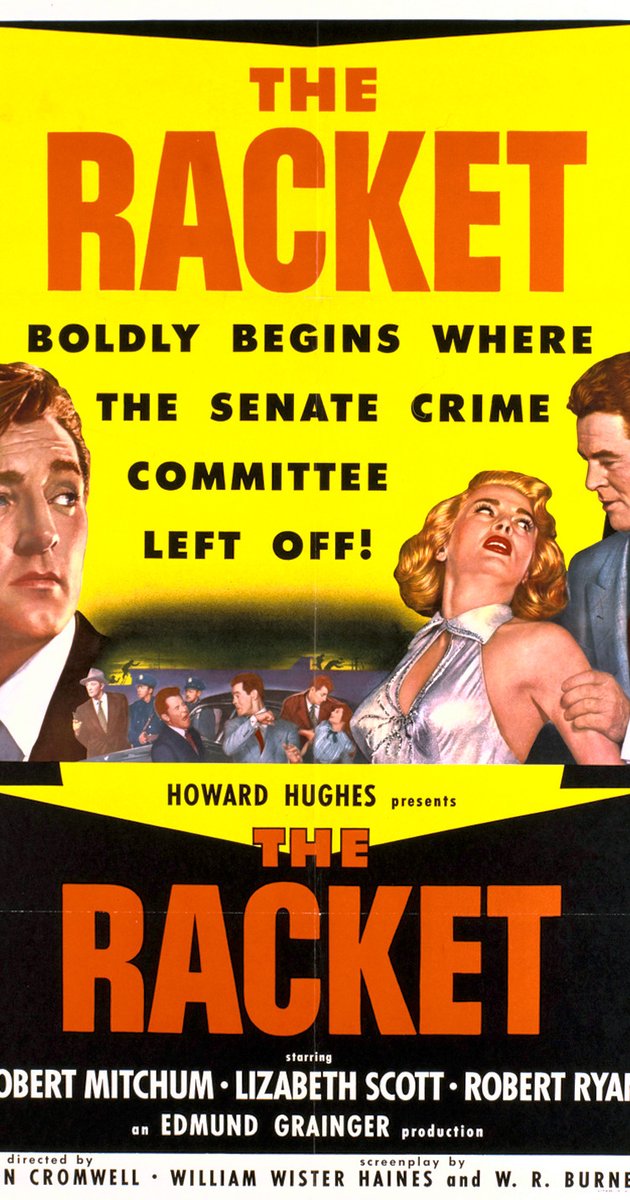
A solid film noir cast headed by Robert Mitchum , Robert Ryan , and Lizabeth Scott ; and a lineage that dates back to both a Broadway smash and an Oscar-nominated original can’t save THE RACKET from rising above minor status. Once again, tinkering behind the scenes by RKO honcho Howard Hughes, this time under pressure from Hollywood censorship czar Joseph I. Breen, scuttles a promising premise that coulda been a contender into an average movie.
City crime boss Nick Scanlon is an old-school hood whose violent ways don’t jibe with the modern-day syndicate. Capt. Thomas McQuigg, “an honest cop” who’s a no-nonsense guy, is determined to take him down. But the city’s rife with tainted politicians, making McQuigg’s job that much harder. Scanlon’s got a headstrong kid brother named Joe dating a “cheap canary” named Irene, and McQuigg plans on using him to get to Nick. Add a crooked DA, a…
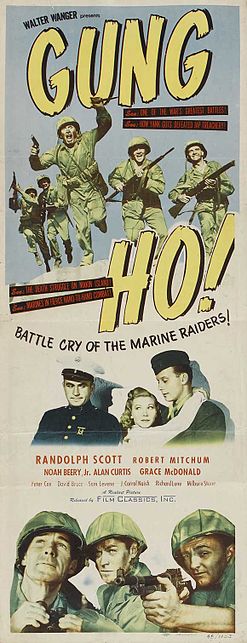
The 17th film in Mill Creek’s Fabulous Forties Box Set was the 1943 war film, Gung Ho!
Gung Ho!, which is filmed in a documentary style and features a narrator, opens with a series of job interviews. A tough lieutenant (J. Carrol Naish) is recruiting Marines to serves in a special unit, one which will only take on the most hazardous of assignments. The narrator reminds us that the interviews are taking place just a few weeks after the attack on Pearl Harbor and we listen as each interviewee is asked whether or not he is okay with killing members of the Japanese army.
Some of the interviewees hesitate and some don’t but ultimately, all of them are okay with killing. One (Rod Cameron) explains that he’s already a murderer, having killed someone back in Kentucky. Another says that he fought in the Spanish Civil War and that he sees his service as being a continuation of the fight against fascism. Another Marine (Alvan Curtis) says that he’s an ordained minister but he’s willing to do what has to be done. A Marine named Pig Iron shows up and, since he’s played by a young Robert Mitchum, we know that he’ll get things taken care of.
And then we get to the final interviewee. He doesn’t have a big role in the film but his one line makes a big impression. When asked why he doesn’t mind the idea of killing, he replies, “I just don’t like Japs.”
AGCK!
That’s a line that would definitely not make it into a modern version of Gung Ho! Or, if it did, it would be followed by the interviewee being admonished and then kicked out of the office. But Gung Ho! was made in 1943, at the height of World War II and in the shadow of Peal Harbor. As uncomfortable as it may make us today, “I just don’t like Japs,” was probably Gung Ho‘s big applause line when it was originally released.
And really, that’s the main value of a film like Gung Ho! It’s a well-made but predictable war film but ultimately, it’s most important as a time capsule. If you want to know the truth about an era’s culture, as opposed to what you may want the truth to be, look at the art. Read the books. Watch the movies. You may not always like what you find but you owe it to yourself to do so.
Anyway, as far the rest of Gung Ho!, it plays out exactly as you would expect. Under the eye of Lt. Commander Thornwald (Randolph Scott), the men train for combat. They visit Pearl Harbor and see the sunken remains of ships that are still smoking after being bombed. And finally, the men fight the Japanese on an island. Some survive. Many more of them die. And the fight continues.
Gung Ho! will probably be best appreciated by fans of war films, which admittedly I am not. That said, it is an interesting time capsule of 1943 America. Plus, it features Robert Mitchum! Admittedly, it’s a small role but he does get two great scenes and … well, he’s Robert Mitchum! How can you not enjoy watching Robert Mitchum?
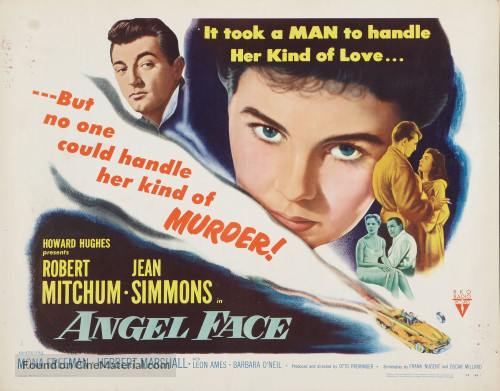
I saved ANGEL FACE for last in this week’s look at RKO/Robert Mitchum films because it’s been hailed as a near-classic by many film noir fans. It’s certainly different from HIS KIND OF WOMAN and MACAO; much darker in tone, and features an unsympathetic performance by Mitchum. It’s more in the noir tradition of bleak films like DETOUR and BORN TO KILL. But better than the other two? That depends on your point of view. Let’s take a look:
An ambulance screams its way to the Tremayne home in ritzy Beverly Hills. The wealthy Mrs. Catherine Tremayne has been subjected to a gas leak of unknown origin. One of the ambulance drivers, Frank Jessup, comes across beautiful Diane playing the piano. She bursts into hysterics, and Frank smacks her, receiving one in return. After she calms down, Frank and his partner Bill head home. Frank has a date with his girl Mary…
Even though 1951’s HIS KIND OF WOMAN lost money (mainly due to studio boss Howard Hughes’ meddling), Robert Mitchum and Jane Russell were reteamed the following year in MACAO. The film was actually sitting on the RKO shelf, having been completed in 1950. Once again, the autocratic Hughes wasn’t pleased with the original version, and fired credited director Josef von Sternberg, replacing him with Nicholas Ray. Mitchum himself even contributed to rewriting some scenes. The result is an entertaining noir that, while not quite as good as HIS KIND OF WOMAN, still manages to hold your interest.
On a boat from Hong Kong, drifter Nick Cochran (Mitchum) meets grifter Julie Benson (Russell), who lifts his wallet. The pair also meet Lawrence C. Trumble (William Bendix), a salesman specializing in “nylons, pearl buttons, coconut oil, and fertilizer”. The three are headed to Macao, “The Monte Carlo of the Orient” (actually the RKO backlot), for various reasons…
“People don’t go to the movies to see how miserable the world is; they go there to eat popcorn, be happy“- Wynton (Jim Backus) in HIS KIND OF WOMAN
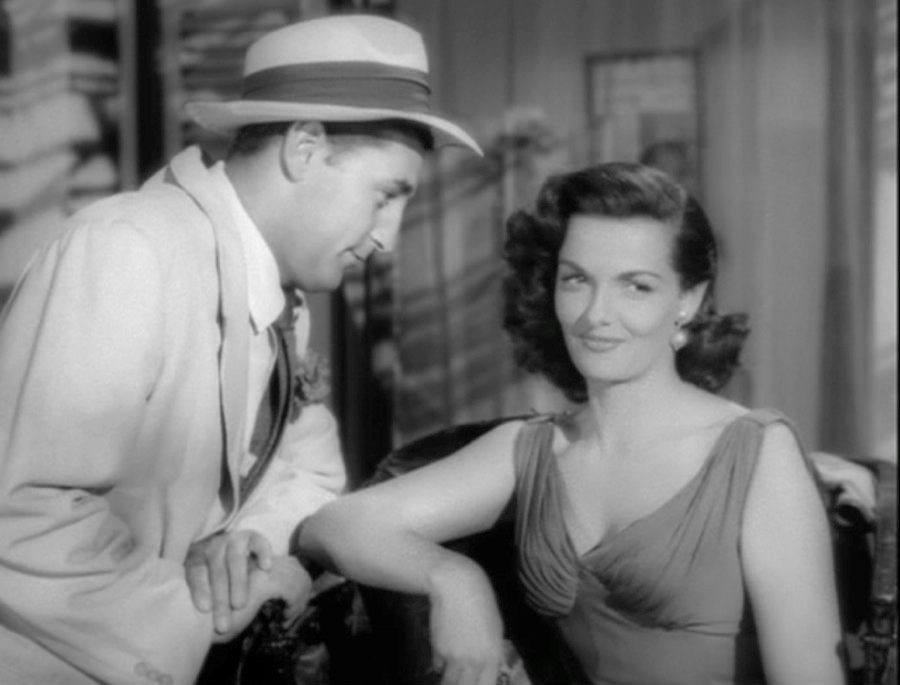
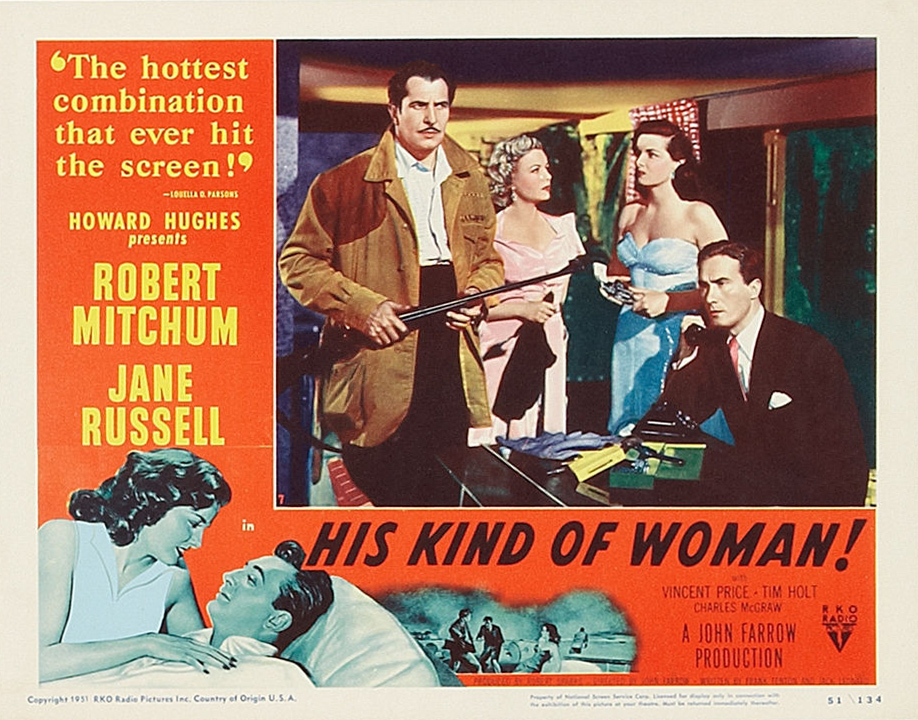
Right you are, Mr. Howell, err Backus. There’s an abundance of fun to be had in HIS KIND OF WOMAN, the quintessential RKO/Robert Mitchum movie. Big Bob costars with sexy Jane Russell in a convoluted tale that’s part film noir, part Monty Python, with an outstanding all-star cast led by Vincent Price serving up big slices of ham as a self-obsessed movie star. And the backstory behind HIS KIND OF WOMAN is as entertaining as the picture itself!
But we’ll go behind the scenes later. First, let’s look at the movie’s plot. We meet down on his luck gambler Dan Milner (Mitchum) in a bar…. drinking milk! Dan just got done doing a 30 day stretch in a Palm Springs jail…
Thanks to TCM’s 31 Days of Oscar, I now have several movies on my DVR that I need to watch over the upcoming month. Don’t get me wrong — I’m not complaining. I’m always happy to have any reason to discover (or perhaps even rediscover) a movie. And, being an Oscar junkie, I especially enjoy the opportunity to watch the movies that were nominated in the past and compare them to the movies that have been nominated more recently.
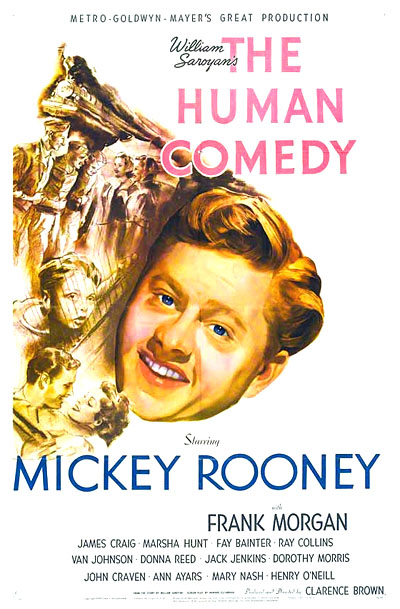
For instance, tonight, I watched The Human Comedy, a film from 1943. Along with being a considerable box office success, The Human Comedy won on Oscar (for Best Story) and was nominated for four others: picture, director (Clarence Brown), actor (Mickey Rooney), and black-and-white cinematography. The Human Comedy was quite a success in 1943 but I imagine that, if it were released today, it would probably be dismissed as being too sentimental. Watching The Human Comedy today is something of a strange experience because it is a film without a hint of cynicism. It deals with serious issues but it does so in such a positive and optimistic manner that, for those of us who are used to films like The Big Short and Spotlight, a bit of an attitude adjustment is necessary before watching.
And yet that doesn’t mean that The Human Comedy is a bad film. In fact, I quite enjoyed it. The Human Comedy is a time capsule, a chance to look into the past. It also features a great central performance, one that was quite rightfully nominated for an Oscar. As I watched Mickey Rooney in this film, I started to feel guilty for some of the comments I made when I reviewed Mickey in The Manipulator last October.
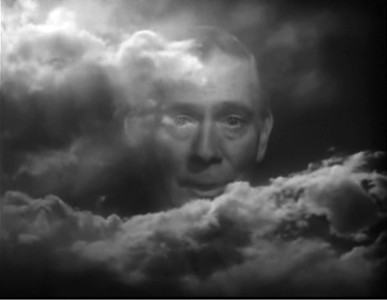
The Human Comedy opens with an overhead shot of the small town of Ithaca, California. The face of Mr. McCauley (Ray Collins, who you’ll recognize immediately as Boss Jim Gettys from Citizen Kane) suddenly appears in the clouds. Mr. McCauley explains that he’s dead and he’s been dead for quite some time. But he loves Ithaca so much that his spirit still hangs around the town and keeps an eye on his family. Somehow, the use of dead Mr. McCauley as the film’s narrator comes across as being both creepy and silly.
But no sooner has Mr. McCauley stopped extolling the virtues of small town life than we see his youngest song, 7 year-old Ulysseus (Jack Jenkins), standing beside a railroad track and watching a train as it rumbles by. Sitting on the cars are a combination of soldiers and hobos. Ulysseus waves at some of the soldiers but none of them wave back. Finally, one man waves back at Ulysseus and calls out, “Going home, I’m going home!” It’s a beautifully shot scene, one that verges on the surreal.
That opening pretty much epitomizes the experience of watching The Human Comedy. For every overly sentimental moment, there will be an effective one that will take you by surprise. The end result may be uneven but it’s still undeniably effective.
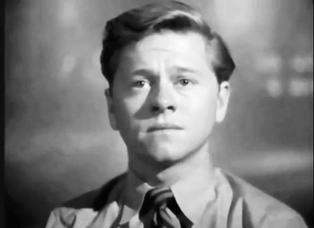
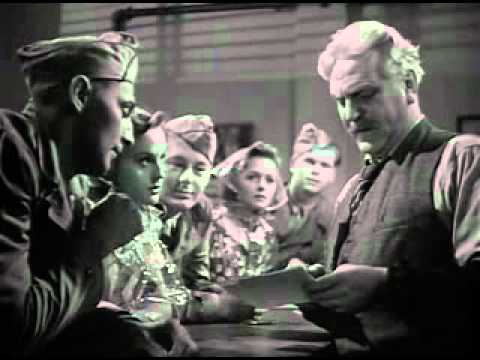
The majority of the film deals with Homer McCauley (Mickey Rooney). Homer may still be in high school but, with his older brother, Marcus (Van Johnson), serving overseas and his father dead, Homer is also the man of the house. Homer not only serves as a role model for Ulysseus but he’s also protector for his sister, Bess (Donna Reed). (At one point in the film, she gets hit on by three soldiers on leave. One of them is played by none other than Robert Mitchum.) In order to bring in extra money for the household, Homer gets a job delivering telegrams.
In between scenes of Homer in Ithaca, we get oddly dream-like scenes of Marcus and his army buddies hanging out. Marcus spends all of his time talking about how much he loves Ithaca and how he can’t wait for the war to be over so he can return home. One of his fellow soldiers says, “I almost feel like Ithaca is my hometown, too.” Marcus promises him that they’ll all visit Ithaca. As soon as the war is over…
With World War II raging, Homer’s job largely consists of delivering death notices (and the occasional singing telegram, as well). Telegraph operator Willie Grogan (Frank Morgan) deals with the burden of having to transcribe bad news by drinking. Homer, meanwhile, tries to do his job with compassion and dignity but one day, he has to deliver a telegram to his own house…
The Human Comedy is an episodic film, full of vignettes of life in Ithaca and Homer growing up. There’s quite a few subplots (along with a lot of speeches about how America is the best country in the world) but, for the most part, the film works best when it concentrates on Homer and Mickey Rooney’s surprisingly subdued lead performance. By today’s standards, it may seem a bit predictable and overly sentimental but it’s also so achingly sincere that you can’t help but appreciate it.
The Human Comedy was nominated for best picture but it lost to a somewhat more cynical film about life during World War II, Casablanca.





 Through the Shattered Lens