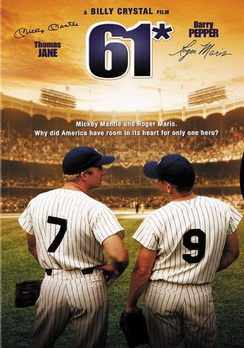
61* is about two baseball player and two friends who couldn’t seem to be more different.
Roger Maris (Barry Pepper) is an introverted family man who doesn’t like it when reporters show up at his house in search of a story or a quote. He’s a good ball player, one of the best, but he doesn’t want to be a celebrity. Mickey Mantle (Thomas Jane) is a larger-than-life personality, a beloved figure on the field and in the dugout. Mickey loves being famous and the fans love him. Both Maris and Mantle are members of the New York Yankees. Because Mantle is struggling with his drinking, he becomes Maris’s roommate when they’re on the road. In 1961, the two friends both go after Babe Ruth’s record of 60 home runs in a season. The press presents their season as a battle, a race to see who will be the first to hit the sixty-first home run of the season. Mantle and Maris, though, are just swinging the bat and making plays.
I really enjoyed 61*, which is a baseball film made by and for people who love baseball. I liked the contrast between the quiet Maris and the charismatic Mantle. Even though Maris is a hard worker and a good ballplayer, Mantle is the fan favorite and the one that people actually want to break the record. I appreciated that Maris and Mantle remained friends even when the press tried to turn them into rivals. That’s what teamwork is all about. Barry Pepper and Thomas Jane were great as Maris and Mantle and the movie showed how each man dealt with the stress of possibly breaking Babe Ruth’s record.
(Why is there an asterisk in the title? Babe Ruth set his record in a season that only had 154 games. The 1961 baseball season was 8 games longer. The asterisk was added as a reminder that Maris and Mantle had 8 more games than Ruth did to try to break the record. Baseball fans understand how important accurate statistics are to a player’s career and a team’s season.)
61* celebrates the way baseball used to be, a game played by athletes who had to depend on skill and teamwork instead of performance enhancing drugs. The movie opens with Maris’s family watching as Mark McGuire closes in on breaking the record. McGuire would only briefly hold the record. He would lose it, for 48 minutes, to Sammy Sosa and then, three years after winning it back, he would lose it a second time to Barry Bonds. Of course, Roger Maris won the record without using steroids so, as far as I’m concerned, it still belongs to him.
If you’re a baseball fan, 61* is a film that you have to see.
The Sundance Film Festival is currently underway in Utah. For the next few days, I’ll be taking a look at some of the films that have previously won awards at Sundance.
First released in 1990, Longtime Companion was one of the first mainstream feature films to deal with the early days of the AIDS epidemic.
The film follows a group of friends and lovers over the course of ten years. The film opens with a crowded and joyous 4th of July weekend at Fire Island. Willy (Campbell Scott) is a personal trainer who has just started a relationship with an entertainment lawyer who, due to his beard, is nicknamed Fuzzy (Stephen Caffrey). Willy’s best friend is the personable and popular John (Dermot Mulroney). David (Bruce Davison) and Sean (Mark Lamos) are the elder couple of the group. Sean writes for a soap opera and one of Fuzzy’s clients, Howard (Patrick Cassidy), has just landed a role on the show. He’ll be playing a gay character, even though everyone warns him that the role will lead to him getting typecast. The group’s straight friend is Lisa (Mary-Louise Parker), an antique dealer who lives next door to Howard and who is Fuzzy’s sister. The film takes it times showing us the friendships and the relationships between these characters, allowing us to get to know them all as individuals.
Even as the group celebrates the 4th, they are talking about an article in the New York Times about the rise of a “gay cancer.” Some members of the group are concerned but the majority simply shrug it off as another out-there rumor.
The movie moves quickly, from one year to another. John, the youngest of them, is the first member of the group to die, passing away alone in a hospital room while hooked up to a respirator. (The sound of the respirator is one of the most haunting parts of the film.) Sean soon becomes ill and starts to dramatically deteriorate. It falls to David to take care of Sean and to even ghostwrite his scripts for the soap opera. Howard’s acting career is sabotaged by rumors that he has AIDS while Willy and Fuzzy tentatively try to have a relationship at time when they’re not even sure how AIDS is transmitted. At one point, Willy visits a friend in the hospital and then furiously scrubs his skin in case he’s somehow been infected. When one member of the group passes, his lover is referred to as being his “longtime companion” in the obituary. Even while dealing with tragedy and feeling as if they’ve been shunned and abandoned to die by the rest of America, the characters are expected to hide the details of the lives and their grief.
It’s a poignant and low-key film, one that was originally made for PBS but then given a theatrical release after production was complete. Seen today, the film feels like a companion piece to Roger Spottiswoode’s And The Band Played On. If And The Band Played On dealt with the politics around AIDS and the early struggle to get people to even acknowledge that it existed, Longtime Companion is about the human cost of the epidemic. The film is wonderfully acted by the talented cast. Bruce Davison was nominated for an Oscar for his sensitive performance as David. If not for Joe Pesci’s performance in Goodfellas, it’s easy to imagine that Davison would have won. The scene where he encourages the comatose Sean to pass on will make you cry. Interestingly, when David gets sick himself, it happens off-screen as if the filmmakers knew there was no way the audience would have been able to emotionally handle watching David suffer any further.
Longtime Companion played at the 1990 Sundance Film Festival, where it won the Dramatic Audience Award.
Picture it…it’s 1992 or 1993 and I’m back at my local Hastings Entertainment superstore browsing through an entertainment magazine. Surprisingly, I came across a bit of entertainment news that a 71 year old Charles Bronson had accepted an offer of $5 million to reprise his Paul Kersey character for a fifth time. I couldn’t help but wonder what possible direction that they could take the series that would be interesting. I didn’t see anything else about the movie for the next year or so, and then it showed up some time in 1994 available for rent at that same Hastings Entertainment superstore. As far as I know, it never played in theaters in Arkansas, although it did play in some theaters in other parts of the country prior to going to home video. I immediately rented the film, somewhat apprehensive of what it would be….
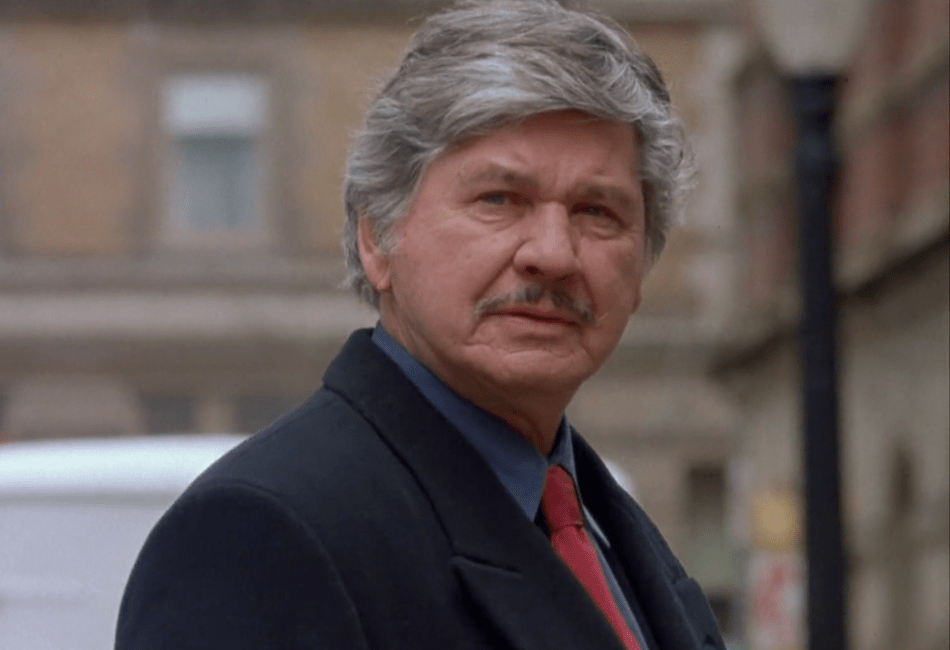
DEATH WISH V: THE FACE OF DEATH, begins with Paul Kersey (Charles Bronson) back in New York. We first see him, looking quite dapper I might add, walking down the street in the garment district. He’s on his way to see his latest girlfriend, fashion designer Olivia Regent (Lesley Anne-Down), whose fashion show is currently underway. You immediately feel sorry for Ms. Regent as you know her prospects for survival are somewhere between slim and none since Kersey’s her man. It doesn’t help matters when her ex-husband, awkwardly impotent mobster Tommy O’Shea (Michael Parks) shows up and starts physically abusing her and her employees. You see, O’Shea is trying to force his ex-wife to use her fashion business to help him launder money from his various criminal activities. Kersey tries to convince Olivia to go to District Attorney Brian Hoyle (Saul Rubinek) to try to put O’Shea away. Unfortunately, there’s corruption in the D.A.’s office in the form of Hector Vasquez (Miguel Sandoval), who passes the information back to O’Shea. From this point forward, Ms. Regent’s life is in serious jeopardy and we all know Kersey’s record of keeping his women alive isn’t that great. I won’t give the details away, but let’s just say that events conspire so that the cursed Kersey will have to resume his old vigilante ways in pursuit of a justice that can never be provided to him by the law.
I remember vividly my first ever viewing of DEATH WISH V back in 1994. I put the videotape in the VCR and watched several previews that looked crappy and didn’t give me a lot of hope for the movie. And then it started, and I have to admit I enjoyed it from the very beginning to the end. I guess my expectations were so low that it was a major relief when I realized that it was a reasonably well-made, audience satisfaction movie designed for people like me who simply enjoy seeing Bronson acting as an instrument of justice. I thought Bronson looked good for an action star over 70 years old. I really liked the movie’s sense of humor. Michael Parks overacted to the point of parody as O’Shea, and the character of Freddie Flakes (Robert Joy) was especially fun as a hitman with major dandruff problems. And there was something about Charles Bronson that was different in comparison to some of the earlier entries. Then I realized what it was, Bronson was having fun. He took out the bad guys with things like poisoned cannolis and exploding soccer balls, all with a twinkle in his eyes. In the 70’s, Bronson made several movies where his characters had that twinkle. It was nice to see it back. Bad things happened of course, but director Allan A. Goldstein kept a tone of black comedy that suited the movie and its aging star well.
Even in 1994, watching DEATH WISH V felt like the end, not just of the DEATH WISH series, but of Bronson’s time as a movie star. As his biggest fan, that made me kind of sad. He would only make 3 more TV movies after this, those being the FAMILY OF COPS TV movies. And while there are some who don’t like DEATH WISH V and seem to go out of their way to put it down, I’m exactly the opposite. To me, DEATH WISH V: THE FACE OF DEATH is a gift to Charles Bronson fans and an enjoyable end to his signature series!
It will always fascinate me that Stephen King, one of the most popular writers in the world and one of the legitimate masters of horror, also has one of the least inspiring accounts on twitter.
Seriously, he may be the most popular author in the world but he tweets like a retiree who has just discovered the internet. Go over to his twitter account and you won’t find memorable descriptions of small town hypocrisy. You won’t find scenes of shocking psychological insight. You won’t find moments of unexpected but laugh-out-loud dark humor. Instead, you’ll find a combination of dad jokes, boomer nostalgia, and an unseemly obsession with wishing death on any public figure who is to the right of Bernie Sanders. It’s odd because no one can deny that King’s a good storyteller. At his best, Stephen King is responsible for some of the best horror novels ever written. Everyone who is a horror fan owes him a debt of gratitude for the work that he’s done promoting the genre. At his worst, he’s your uncle who retweets the article without reading it first.
Of course, someone can be great at one thing an terrible at something else. I can dance but I certainly can’t sing. Stephen King can write a best seller but a good tweet is beyond him. That’s the dual nature of existence, I suppose. That’s certainly one of the themes at the heart of both Stephen King’s The Dark Half and the subsequent film adaptation from George Romero.
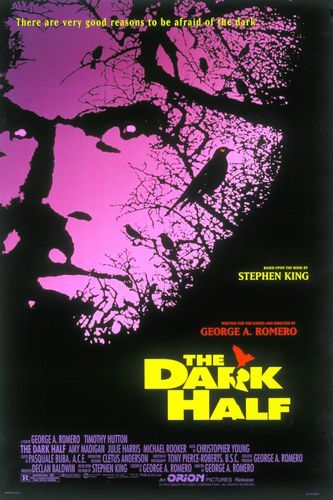
Filmed in 1990 but not released for three years due to the bankruptcy of the studio that produced it, The Dark Half tells the story of Thad Beaumont and George Stark (both played by Timothy Hutton). Thad is a professor who writes “serious” literature under his real name and violent, pulpy fiction under the name of George Stark. No one reads Thad’s books but they love George Stark and his stories about the master criminal and assassin, Alexis Machine. (Alexis Machine? George Stark may be a good writer but he sucks at coming up with names.) After a demented fan (played, with creepy intensity, by Robert Joy) attempts to blackmail him by threatening to reveal that he’s George Stark, Thad decides to go public on his own. His agent even arranges for a fake funeral so that Thad can bury George once and for all.
Soon, however, Thad’s associates are turning up dead. It seems as if everyone associated with the funeral is now being targeted. Sheriff Alan Pangborn (Michael Rooker) suspects that Thad is the murderer. However, the murderer is actually George Stark, who has come to life and is seeking revenge. Of course, George has more problems than just being buried. His body is decaying and he’s got a bunch of angry sparrows after him. The Sparrows Are Flying Again, we’re told over and over. Seeking to cure his affliction and to get those birds to leave him alone, Stark targets Thad’s wife (Amy Madigan) and their children.
The Dark Half has its moments, as I think we would expect of any film based on a Stephen King novel and directed by George Stark. Some of the deaths are memorably nasty. Hutton is believably neurotic as Thad and cartoonishly evil as Stark and, in both cases, it works well. Rooker may be an unconventional pick for the role but he does a good job as Pangborn and Amy Madigan brings some unexpected energy to the thankless role of being the threatened wife.
But, in the end, The Dark Half never really seems to live up to its potential. In the book, Thad was a recovering alcoholic and it was obvious that George Stark was a metaphor for Thad’s addiction. That element is largely abandoned in the movie and, as a result, George goes from being the literal representation of Thad’s demons to just being another overly loquacious movie serial killer. Despite having a few creepy scenes, the film itself is never as disturbing as it should be. For all the blood, the horror still feels a bit watered down. Take away the sparrows and this could just as easily be a straight-forward action film where the hero has to rescue his family from a smug kidnapper. Comparing this film to Romero’s Martinis all the proof you need that Romero was best-served by working outside the mainstream than by trying to be a part of it.
Add to that, I got sick of the sparrows. Yes, both the film and the book explain why the sparrows are important but “The Sparrows Are Flying Again” almost sounds like something you’d find in something written in a deliberate attempt to parody King’s style. It’s a phrase that’s intriguingly enigmatic the first time that you hear it, annoying the third time, and boring the fifth time.
The Dark Half was a bit of a disappointment but that’s okay. For King fans, there will always be Carrie. (I would probably watch The Shining but apparently, King still hasn’t forgiven Stanley Kubrick for improving on the novel.) And, for us Romero fans, we’ll always have Night of the Living Dead, Martin, Dawn of the Dead, and the original Crazies. And, for fans of George Stark, I’m sure someone else will pick up the story of Alexis Machine. It’s hard to keep a good character down.
To quote Geoffrey Chaucer, “All good things must come to an end.”
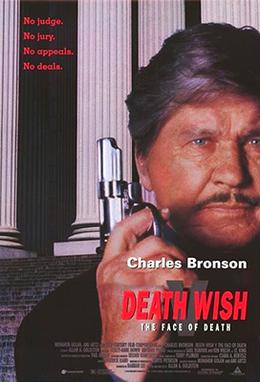
Death Wish V: The Face of Death marked the end of the original Death Wish franchise, concluding the violent saga of Paul Kersey 20 years after it began. It probably should have ended sooner.
After the box office failure of Death Wish IV and the subsequent bankruptcy of Cannon Films, future plans for the Death Wish franchise were put on hold. After the collapse of Cannon, Menahem Golan started a new production company, 21st Century Film Corporation. In 1993, needing a hit and seeing that the previous Death Wish films were still popular on video, Golan announced that Paul Kersey would finally return in Death Wish V: The Face of Death. Charles Bronson also returned, though he was now 72 years old and in poor health. Death Wish V would also mark the end of Bronson’s feature film career. He would make appearances in a few television movies before subsequently retiring from acting.
Death Wish V finds Paul in the witness protection program. His latest girlfriend, Olivia (Lesley-Anne Down), just happens to be the ex-wife of a psychotic mobster named Tommy O’Shea (Michael Parks). Throughout the entire franchise, the Death Wish films argued that crime is so out of control that no one was safe and that Paul had no choice but to pick up a gun and shoot muggers. But, judging from Death Wish V, Paul just seems to have incredibly bad luck. What are the odds that a mild-mannered architect would lose his wife, his maid, his daughter, his best friend from the war, his next two girlfriends, and then end up dating the ex-wife of New York City’s craziest gangster?
The district attorney’s office wants Olivia to testify against her ex-husband so Tommy gets his henchman, the dandruff-prone Freddie Flakes (Robert Joy), to kill her. Looks like it’s time for New York’s favorite vigilante to launch a one-man war against the Mafia!
The only problem is that New York’s favorite vigilante is too old to chase people down dark alleys and shoot them. He has to get creative, which means using everything from poisoned cannoli to a vat of acid to take out his targets. One gangster is killed by an exploding soccer ball!
With both Bronson and Lesley-Anne Down giving an indifferent performances, it is up to the supporting cast to keep the movie interesting. Appearing here after his bravura turn as Jean Renault in Twin Peaks but before Robert Rodriguez and Quentin Tarantino introduced him to a whole new generation of filmgoers, Michael Parks is flamboyantly evil as Tommy O’Shea and injects the movie with what little life that it has. Speaking of Twin Peaks alumni, Kenneth Welsh (who played Windom Earle in the last few episodes of season 2) plays this installment’s understanding police detective. Saul Rubinek plays the district attorney who is willing to look the other way when it comes to killing gangsters.
Dull and cheap-looking, Death Wish V was a box office bomb and it brought the original franchise to a definite end. Will the Eli Roth/Bruce Willis reboot of Death Wish also lead to a reboot of the franchise? Time will tell!
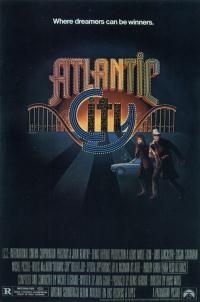
(With the Oscars scheduled to be awarded on March 4th, I have decided to review at least one Oscar-nominated film a day. These films could be nominees or they could be winners. They could be from this year’s Oscars or they could be a previous year’s nominee! We’ll see how things play out. Today, I take a look at the 1981 best picture nominee, Atlantic City!)
Welcome to Atlantic City, New Jersey!
It’s a city with a storied past and an uncertain future. It’s a place where old men on street corners can tell you stories about meeting Bugsy Siegel in the lobby of an old hotel that’s just been demolished. The decrepit remains of old Atlantic City co-exists next to half-completed luxury casinos and hotels. It’s a place where business deals are celebrated in the Frank Sinatra Suite and where a woman trying to make a very important phone call might find herself being serenaded by Robert Goulet.
It’s also the home of Lou (Burt Lancaster). From the minute we first see Lou, it’s obvious that he’s a man past his time. He walks up and down the worst streets of Atlantic City, dressed in a gray suit and trench coat. With his white mustache and his coolly professional manner, he looks like he belongs in an old movie and not hanging out in his shabby apartment or drinking in the local bar. When Lou was younger, he was acquainted with all of the big names: Siegel, Luciano, Costello, Lansky. Of course, he wasn’t ever much of a mobster. He used to run numbers. If pressed, he’ll tell some interesting stories but it’s not difficult to tell that he’s lying. (At one point, it’s mentioned that Lou’s Mafia nickname was Numbnut.) Now, Lou is an old man. Much like a condemned Atlantic City hotel, he’ll soon be due for demolition. He spends most of his time taking care of Grace (Kate Reid), the widow of a mobster. When he’s not responding to Grace’s demands, he watches his neighbor, Sally (Susan Sarandon).
Sally is originally from Canada. She came to America looking for a better life and ended up working as a waitress. Under the strict tutelage of Joseph (Michel Piccoli), Sally is learning how to be a blackjack dealer. Someday, she hopes that she’ll be able to move out of her apartment and into a communal house on the beach. Until then, she works hard every day and then returns to her apartment, little realizing that she’s being watched by Lou.
And then David shows up.
David (played by Canadian character actor Robert Joy) is Sally’s estranged husband. Sally knows that David can’t be trusted but she reluctantly allows him and his pregnant girlfriend (Hollis McLaren) to stay with her for a few days. David has stolen a large amount of cocaine from the Philadelphia mob. David wants to sell it but he quickly discovers that no one in Atlantic City is willing to deal with someone who they don’t know. Fortunately, for David, he runs into Lou. Lou, looking for a chance to be a real gangster and also wanting a chance to get closer to Sally, agrees to help David sell the cocaine. Unfortunately, for David, two hit men from Philadelphia have traced him to Atlantic City and are determined to not only get their cocaine back but to also kill David as well.
It may sound like the set up for a standard crime thriller but Atlantic City is actually a thoughtful meditation on getting older, falling in love, and dealing with the fact that things change. Lou is a relic of the past, looking for one last chance to make his mark before, like the older buildings on the boardwalk, he’s demolished and forgotten about. Sally and David are the dreamers, hoping to build a future in America.
Louis Malle directs at a leisurely pace. Those looking for a hyperkinetic gangster film will be disappointed. There’s only two acts of violence in Atlantic City and Malle presents both of them in a low-key, matter-of-fact fashion. Instead, Malle focuses on exploring the lives and dreams of the film’s characters and Burt Lancaster rewards that attention with an absolutely outstanding performance as a dignified man who knows his best days are behind him but who still refuses to give in to defeat. It’s one of Lancaster’s best performances and he was rewarded with an Oscar nomination for best actor.
Atlantic City was nominated for best picture but lost to Chariots of Fire.
 To quote Geoffrey Chaucer, “All good things must come to an end.”
 Through the Shattered Lens