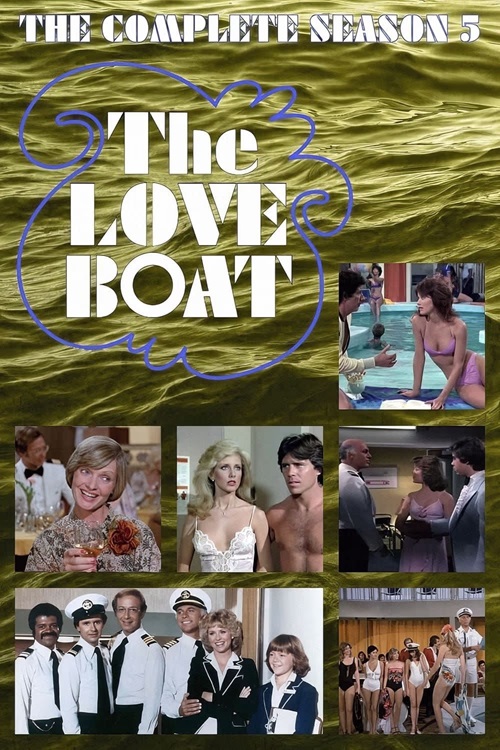
Retro Television Review: The Love Boat 5.13 “Doc Take the Fifth/Safety Last/A Business Affair”


Welcome to Retro Television Reviews, a feature where we review some of our favorite and least favorite shows of the past!  On Wednesdays, I will be reviewing the original Love Boat, which aired on ABC from 1977 to 1986!  The series can be streamed on Paramount Plus!
Love, exciting and new….

Episode 5.13 “Doc Take the Fifth/Safety Last/A Business Affair”

(Dir by Bruce Bilson, originally aired on Jan. 2nd, 1982)

Returning from his vacation, Doc boards the boat with a young Russian blonde woman named Tania (Irena Ferris).  Oh, the crew says, Doc has a new girlfriend.

No, Doc has a new wife!  Doc and Tania met after Doc saw her performing as a member of a communist symphony during his vacation.  They struck up a conversation and, according to Doc, it was love at first sight,  After a whirlwind courtship, Doc and Tania got married, mere hours before heading to the boat.  It’s going to be a working honeymoon for Doc and he can’t wait to consummate the marriage.  The crew can’t wait for him to do it either.  (Seriously, they are oddly obsessed with Doc Bricker’s sex life.)  This is Doc’s fifth marriage and it’s going to last!

Except …. Tania doesn’t seem to want to consummate the marriage.  In fact, once the boat sets sail, Tania seems to be avoiding Doc.  Doc wonders if maybe Tania is just shy but seriously — refusing to have sex with your new husband on a luxury cruise ship?  No one’s that shy!  Then Doc spies Tania kissing another passenger.

“Adam,” the captain says, “you don’t know Tania that well.”

Indeed, Adam does not.  Eventually, Tania tells Doc Bricker the truth.  She married Adam so she could stay in the country with the true love of her life, political dissident Mikhail (Kai Wulff).  Tania says that she really, really likes Doc but she is not in love with him.  Both Tania and Mikhail apologize to Doc and tell him that Tania will get the marriage annulled and return to Russia.

Personally, I think Doc would have been justified in tossing them both overboard.  Instead, Doc asks Captain Stubing to call a friend at the State Department and arrange for Tania to get permanent refugee status in the United States.  Awwww, that was nice of Doc!

This storyline was depressing but, as I’ve said before, I always appreciate it when The Love Boat allows Doc Bricker to be something other than just a lech.  Bernie Kopell was so likable in the role that it was always nice when he got to play Doc as being a nice guy as opposed to a manipulative sex addict.  Kopell did an especially good job in this episode, especially at the end where he appears to be on the verge of tears as he watches Tania and Mikhail leave the boat.

As for the other two stories, neither one was particularly interesting.  A safety inspector (Don Adams) is so obsessed with safety that he nearly misses a chance for romance with Alice (Britt Ekland).  Luckily, Isaac is there to set him straight.  A business executive (Robert Fuller) is upset that everyone thinks he’s sleeping with his Vice President (Judy Norton).  But then he falls in love with her and sleeps with her for real so I guess the rumors were true!

Those stories were boring but Doc’s story redeemed this week’s cruise.  Poor Doc!  Maybe the sixth time will be the charm.
Retro Television Review: Fantasy Island 5.22 “The Ghost’s Story/The Spoilers”


Welcome to Retro Television Reviews, a feature where we review some of our favorite and least favorite shows of the past!  On Tuesdays, I will be reviewing the original Fantasy Island, which ran on ABC from 1977 to 1984.  Unfortunately, the show has been removed from most streaming sites.  Fortunately, I’ve got nearly every episode on my DVR.

This week, season 5 comes to an end.

Episode 5.22 “The Ghost’s Story/The Spoilers”

(Dir by Don Chaffey, originally aired on May 8th, 1982)

The latest batch of guests are arriving and Julie is nowhere to be seen!  Perhaps that’s because, as Mr. Roarke explains to Tattoo, Julie is helping out a guest who has an invisibility fantasy.  Tattoo and Roarke watch as the guest walks by.  His body may be invisible but his pants are not.

This is the final episode of the fifth season and it’s also the final episode in which Wendy Schaal will be credited as a part of the cast.  I wasn’t a huge fan of the Julie character but it still seems like a bit of a shame that she didn’t get to do anything in the finale.  Then again, this episode doesn’t really feel like a finale.  I don’t know what was going on behind the scenes during the fifth season but it’s hard not to feel, with the way that Julie and Tattoo have randomly shown up in different stories, that the season’s episodes were not shown in the order in which they were filmed.  Maybe all the Julie episodes were filmed at one time, while Herve Villechazie was off doing something else.  Who knows?  It’s just been a strange season.

That’s all wonderful and interesting, Lisa …. But what about this week’s fantasies!? you may be asking.

They both feel a bit familiar.  That’s not always a bad thing, of course.  Fantasy Island is a comfort show and a part of the comfort is knowing that things are always going to play out in a certain way.  But, with this episode, both fantasies felt as if they had been done better in the past.

Harry (Bo Hopkins) is a bounty hunter who comes to the Island to track down fugitive Nick Tanner (Robert Fuller).  Nick has been accused of robbing a bank and is hiding out on a nearby island.  Harry goes to the island but he soon discovers that Nick is innocent and that the real bank robbers have also come to the island in search of Nick.  Luckily, there’s a widow named Juliet (Jo Ann Pflug) who is also living on the island.  Harry and Nick hide out at her place before they all team up to defeat the real bank robbers.  Nick and Juliet fall in love and Mr. Roarke performs one of his trademark wedding ceremonies.  Nick and Juliet then board the plane back to America and …. wait a minute, what about Harry?  It was his fantasy!  We don’t ever see Harry leave Fantasy Island.  Maybe he’s still living there.

(Personally, I think he married Julie and that’s why she was no longer working there once season six began.  I like that.  Consider it to be canon.)

The other fantasy is a haunted house story.  Amanda Parsons (Tanya Roberts) comes all the way from Baltimore to spend 24 hours in one of Fantasy Island’s many haunted houses.  Two other paranormal investigators attempt to do it before Amanda but they end up fleeing after two minutes.  I’m not sure why.  The manor looks creepy but it turns out that the ghost is a rather wimpy and not at all frightening guy named Timothy Black (Dack Rambo).  Cursed by his own father after Timothy refused to fight a duel with Captain Fitzhugh Ross (John McCook), Timothy has spent two hundred years haunting the old manor.  Amanda takes sympathy on him.  It turns out that Ross’s descendant is also on the Island.  Timothy challenges him to a duel, causing the latest Ross to run in fear.  Timothy and his ghost dad (John Myhers) realize it’s okay to be scared of getting shot.  Ghost Dad asks Roarke to bring Timothy back to life so that he can pursue his romance with Amanda.  Roarke does just that, despite the fact that, in many previous episodes, Roarke has specifically said that he cannot bring the dead back to life.

Usually, I enjoy Fantasy Island‘s haunted house fantasies but this one didn’t do much for me.  I think it’s because the ghost was just too wimpy.  There’s nothing more annoying than a whiny a dead guy,

And so ends this very odd season.  Next week, we being season 6!

The Gatling Gun (1971, directed by Robert Gordon)


In the post-civil war west, two Calvary troopers steal a Gatling Gun, the weapon that was invented to be such a powerful instrument of death that people would stop fighting wars just to avoid finding themselves in front of its barrel.  (It didn’t work out that way, of course.)  With the help of a pacifist reverend named Harper (John Carradine), they smuggle the gun into Apache territory.  Rev. Harper thinks that the gun is going to be destroyed and, thus, another instrument death will be eliminated. from the world  Instead, the greedy troopers are planning on selling the gun to Apache Chief Two Knife (Carlos Rivas).  Two Knife has promised a fortune’s worth of gold to anyone who can deliver to him the deadliest weapon in the west.

Before the gun can be exchanged, the reverend, his daughter, and the two deserters are intercepted by a group of Calvary troops led by Lt. Wayne Malcolm (Guy Stockwell).  One of the deserters is killed while the other, Pvt. Sneed (Robert Fuller) is captured.

However, Chief Two Knife still wants what he calls “the king gun.”  Malcolm and his troops find themselves pinned down by the Apaches.  Can Malcolm, with the help of a rancher (Phil Harris), a scout (Woody Strode), and a cook (Pat Buttram), keep both the gun and the all important firing pin from falling into the hands of Two Knife?

The Gatling Gun is a low-budget western that would probably be today forgotten except that it has fallen into the public domain and has been included in several DVD box sets.  It has the flat, generic look of a Western television show and Guy Stockwell’s stiff performance may be believable for a 19th century Calvary captain but it’s still doesn’t exactly make for compelling viewing.  The main problem is that the most exciting and interesting part of the story, the two deserters stealing the gun and tricking the Reverend into helping them, occurs off-screen and the movie instead begins with Malcolm capturing Sneed.

Western fans will mostly want to watch this one to see John Carradine and Woody Strode, two very different actors who were both favorites of John Ford’s and who appeared in several other, better westerns.  (Strode and Carradine had both previously appeared in The Man Who Shot Liberty Valance, to name just one example.)  Carradine is typically theatrical, delivering his lines like the old Shakespearean that he was.  Strode, as usual, is stoic but his imposing screen presence makes him the most memorable of the film’s heroes.  Also keep an eye out for Patrick “son of John” Wayne, playing the rancher’s son.

Though The Gatling Gun has the look of a film that was shot on a studio backlot in Hollywood, it was actually filmed, on location, in New Mexico.  The state’s then-governor, David Cargo, has a small role as Corporal Benton and is listed in the credits as “Honorable Governor David Cargo.”  A look at his imdb page reveals that David Cargo appeared in four films while he was governor.  All of them were filmed in New Mexico so I guess casting the governor was a requirement for filming in that state.  When Cargo left office in 1971, his movie career ended.

Incident at Phantom Hill (1966, directed by Earl Bellamy)


During the final weeks of the Civil War, a group of Confederates, led by Joe Barlow (Dan Duryea,) hijacked a shipment of Union gold and buried it near Phantom Hill, Texas. Now that the war is over and Barlow is in custody, he makes an offer. He’ll lead the government to the gold in return for a pardon. Needing the money, the government agrees to Barlow’s conditions. A group of Cavalrymen, led by Matt Martin (Robert Fuller), are ordered to accompany Barlow to Phantom Hill and retrieve the gold. Because the gold itself is buried near Comanche territory, the men will be traveling undercover. If Martin and his men are captured or killed, the U.S. government will disavow any knowledge of the them. Cue the Mission Impossible theme.

It’s an eventful journey to Phantom Hill. When a local sheriff recognizes Barlow as a wanted criminal, Martin has to convince him not to kill Barlow. The sheriff agrees, on the condition that Martin and his men escort a prostitute named Memphis (Jocelyn Lane) out of town. When a group of outlaws discover that Martin and Barlow are heading for the gold, they take off after them. Meanwhile, Barlow has a few plans of his own.

Incident at Phantom Hill is a fast-moving B-western, the type that will be appreciated by fans of the genre. There are a few good shootouts. Jocelyn Lane is beautiful as Memphis, Robert Fuller is firm at Matt Martin, and Dan Duryea is dangerous as Joe Barlow. The outlaws are unusually cruel and the scene where the kill a comic relief character was probably shocking for 1966. The most interesting thing about the movie is its portrayal of Union officers working with former Confederates and the struggle to determine where everyone fits in now that the Civil War is over. Barlow is not to be trusted by the relationship between Memphis and Matt suggests that the country can come back together as long as everyone has a common enemy that needs to be defeated.


Disaster on the Coastliner (1980, directed by Richard C. Sarafian)


A completely computerized passenger train is traveling across the country, with the Vice President’s wife as one of the passengers.  When Jim Waterman (Paul L. Smith), a man who blames the railroad for the death of his family, manages to hijack the train he plans to ram into a locomotive until his demands a met.  He wants railroad president Estes Hill (Raymond Burr) to take responsibility for the crash that killed his wife and children.  With Waterman determined to crash the two trains, it falls to dispatchers Al Mitchell (Lloyd Bridges) and Roy Snyder (E.G. Marshall) to try to figure out a way to stop the collision.  Helping them out on the train is a con artist named Stuart Peters (William Shatner!) who may be wanted by the police but who is still willing to do whatever it takes to save his fellow passengers.

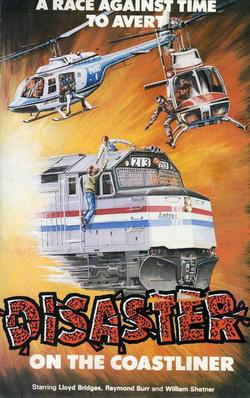
Disaster on the Coastliner is an above-average made-for-TV disaster movie.  Even though it was obviously made for a low-budget and that the majority of the money was probably spent on securing the B-list cast, there are enough shots of the train careening on the tracks to bring happiness to the hearts of most disaster movie fans.  The cast is full of the type of people who you would typically expect to find in a movie like this, people like Raymond Burr, Lloyd Bridges, and William Shatner.  Bridges, interestingly enough, gives the same performance here that he gave in Airplane! and when he starts ranting about how everything’s computerized, he sounds like he could be reciting dialogue from that film.  The only difference is that Airplane! was a comedy while Disaster On The Coastliner is meant to be a drama.  Raymond Burr also does a good job hamming it up as the president of the railroad.  He spends most of the movie sitting behind his desk and looking annoyed, which was pretty typical of Burr in the years after Perry Mason and Ironside. 

For a lot of people, the main appeal of this film will be seeing what William Shatner was doing in between Star Trek movies.  This is a typical early 80s Shatner performance, when he was still trying too hard to win that first Emmy but also when he had just starting to develop the self-awareness necessary to poke fun at his own image.  Shatner really digs into the role of a conman with a heart of gold.  He delivers his lines in his trademark overdramatic style but, in scenes like the one where he sheepishly discovers that a door that he’s been pounding on was unlocked all the time, Shatner actually seems to be in on the joke.  Shatner also did his own stunts in this film, including one where he had stand on top of a speeding train.  In his autobiography, Shatner wrote that he wasn’t even wearing a safety harness in the scene so give it up for Bill Shatner.  That took guts!

Fast-paced and agreeably unpretentious, Disaster On The Coastliner is an enjoyable runaway train movie.