Retro Television Reviews: The Love Boat 2.27 “Third Wheel/Grandmother’s Day/Second String Mom”


Welcome to Retro Television Reviews, a feature where we review some of our favorite and least favorite shows of the past!  On Wednesdays, I will be reviewing the original Love Boat, which aired on ABC from 1977 to 1986!  The series can be streamed on Paramount Plus!

This week, the second season of The Love Boat comes to a close.

Episode 2.27 “Third Wheel/Grandmother’s Day/Second String Mom”

(Dir by Gordon Farr, originally aired on May 12th, 1979)

 It’s time for a special Mother’s Day cruise!

Gopher is excited because his mother, Roz (Ethel Merman), and his father, Eliot (an unwell-looking Robert Cummings), will be on the ship.  As quickly becomes clear, Gopher takes after his mother.  Like her son, Roz is impulsive, loves show business, and has issues with recognizing boundaries.  As soon as she boards the boat, she and Gopher are singing songs and imitating the Marx brothers.  Eliot, on the other hand, is quiet and reserved.  Interesting enough, Eliot has quite a bit in common with Captain Stubing.  Seeing Eliot and Stubing interact, the viewer suddenly understands why Gopher is always looking for the Captain’s approval.  Gopher and Eliot have a distant relationship and Gopher now sees Stubing as being more of a father figure to him than his own father.  Awwwww, how sad!

What’s even more sad is that it is easy to see that Eliot would like to be closer to his son.  He just doesn’t know how to go about it and he knows that he can’t compete with Roz’s carefree personality.  When Gopher and Roz agree to perform a number at a special Mother’s Day variety show, Eliot becomes jealous.  He claims that he’s worried that Roz is somehow going to embarrass Gopher in front of his co-workers but it’s obvious that Eliot is the one who is embarrassed by his lack of a relationship with his son.  It all works out in the end, of course and Gopher becomes closer to both of his parents.

Meanwhile, Mac O’Brian (Barry Nelson, best-known for being the first actor to play James Bond and for playing Mr. Ullman in Kubrick’s The Shining) is looking forward to a life of retirement.  Except, his wife, Maggie (Nanette Fabray), keeps having dizzy spells.  Doc examines her and announces that, despite the fact that she’s nearly 60, Maggie’s pregnant!  Maggie worries about how tell her husband, who has made it clear that he feels that he’s earned a rest from worrying about children.  At first, Mac doesn’t take the news well but never fear.  Things work out in the end because it’s The Love Boat!

Finally, Mary Noble (Michele Tobin) and her sister, Judy Noble (Shelly Juttner), are on their cruise with their father (Ken Berry) and his new wife (Beth Howland).  At first, they go out of their way to be rude to their new stepmother but eventually, they realize how happy she makes their father and they come to accept her.  Once again, everyone gets a happy ending on The Love Boat.

Despite the fact that it featured Gopher’s parents and offered up some insight into what made one of the show’s main characters tick, this episode of The Love Boat was pretty forgettable.  The success or failure of a show like this all comes down to chemistry and none of the guest stars on this particular episode seemed to have any.  Robert Cummings, in particular, looked absolutely miserable throughout the entire cruise while Barry Nelson and Nanette Fabray seemed more like strangers having a random hook-up than a longtime married couple.  I did like the storyline about the stepparent but that’s just because I could relate to the two sisters because I know me and my sisters had a tendency to get a bit bratty whenever we felt anyone was trying to take our mom away from us.  But, in the end, even this storyline felt like something The Love Boat had done better in the past.

Sadly, the second season of The Love Boat came to end with not a bang but a whimper.  Next week, we start season 3!

Games People Play: Alfred Hitchcock’s DIAL M FOR MURDER (Warner Brothers 1954)


gary loggins's avatarcracked rear viewer

Alfred Hitchcock  wasn’t afraid to take chances. When the 3-D craze hit in the 1950’s, the innovative director jumped on the new technology to make DIAL M FOR MURDER, based on Frederick Knott’s hit play. The film is full of suspense, and contains many of The Master’s signature touches, but on the whole I consider it to be lesser Hitchcock… which is certainly better than most working in the genre, but still not up to par for Hitch.

Knott adapted his play for the screen, and keeps the tension mounting throughout. The story is set in London, and revolves around ex-tennis pro Tony Wendice, whose wife Margot is having an affair with American mystery writer Mark Halliday. Tony comes up with an elaborate plot to have her murdered by stealing a love letter Mark has written and blackmailing her, then setting up his old school acquaintance C.A. Swann, a man…

View original post 403 more words

Sweet Land of Liberty: Alfred Hitchcock’s SABOTEUR (Universal 1942)


gary loggins's avatarcracked rear viewer

The Master of Suspense puts the pedal to the metal once again in SABOTEUR, another “double chase” spy thriller that doesn’t get the attention some of Alfred Hitchcock’s other films do, but should. I’ve always enjoyed the performance of Robert Cummings as the “ordinary man caught in an extraordinary situation”; his naturally laid-back, easygoing charm makes him perfect playing Barry Kane, accused of sabotaging a wartime aircraft plant and killing his best friend in the process, who winds up on a cross-country chase alongside reluctant heroine Priscilla Lane . SABOTEUR is certainly an  important film in Hitchcock’s body of work for one important reason: it’s the director’s first film for Universal Pictures, a studio he’d have a long and profitable association with, and where he’d later create some of his finest movies.

SABOTEUR is in many respects a loose remake of Hitchcock’s THE 39 STEPS , transplanted to America and…

View original post 701 more words

Rockin’ in the Film World #3: BEACH PARTY (AIP 1963)


gary loggins's avatarcracked rear viewer

Beach Party (USA, 1963) - 01

Finally! The weather here in New England has begun to break, and we’re heading into summer. I even managed to get some beach time in today. TCM beat me to the punch when they aired BEACH PARTY as part of their month-long salute to American International Pictures, a blast from the past filled with sand, surf, teenage sex, and plenty of good ol’ rock’n’roll! BEACH PARTY spawned a series of films and a whole slew of imitators , but AIP did ’em first and best.

beach2

Teen idol Frankie Avalon and ex-Mouseketeer Annette Funicello starred in most of the AIP’s, using the same plot over and over. Frankie wants sex, but Annette wants to wait for marriage. They fight, and try to make each other jealous by dating someone new, but wind up together by film’s end. Simple, and rehashed using gimmicks like bodybuilding, drag racing, sky diving, and skiing to make things seem fresh…

View original post 579 more words

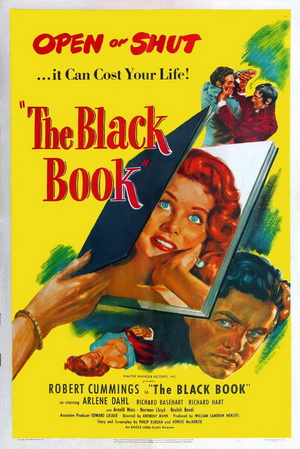
The Fabulous Forties #3: The Black Book (dir by Anthony Mann)


The_Black_Book_Poster

The third film in Mill Creek’s Fabulous Forties box set was 1949’s The Black Book, which was also released under the title Reign of Terror.

The Black Book takes place during the French Revolution.  It is, to quote Dickens, both the best of times and the worst of times.  Actually, mostly it’s just the worst of times.  The Black Book portrays revolutionary France as being a dark and shadowy country, one where the only things that hold the people together are paranoia and terror.  It’s a country where anyone can be executed at any moment and where power mad tyrants excuse their excesses by saying that they are only doing the people’s will.  Considering that the The Black Book was made in 1949, its vision of revolutionary France can easily been seen as a metaphor for Nazi Germany or Communist Russia.  Or perhaps even America at the start of the Red Scare.

(It’s probably not a coincidence that the Nazis also had a document known as the Black Book, one that listed everyone who was to be arrested and executed if Hitler succeeded in conquering Great Britain.)

Maximilien Robespierre (Richard Basehart, giving a disturbingly plausible performance that will make you think of more than a few contemporary political figures) is on the verge of having himself declared dictator of France.  Unfortunately, his little black book has disappeared.  Inside that black book is the name of everyone that he is planning to send to the guillotine.  If the book ever became public, then Robespierre would be the one losing his head.

Robespierre summons a notorious prosecutor named Duval (Robert Cummings) to Paris and gives him 24 hours to track down the book.  He gives Duval the authority to imprison and interrogate anyone in France.  He also informs Duval that, if the book is not found, Duval will be the next to lose his head.

However, what Robespierre does not know is that Duval is not Duval.  He is Charles D’Aubigny, a rebel against the Revolution.  Charles murdered Duval and took his place.  Now, Charles has to find the book without his own identity being discovered.  Not only do some of Robespierre’s allies suspect that Duval may not actually be Duval but some of Charles’s former allies also start to suspect that Charles may secretly be working for Robespierre, even as he claims that he’s trying to bring him down.  At times, even the viewer is unsure as to who is actually working for who.

Oh my God, this is such a good film!   In fact, it was so good that I was surprised that I hadn’t heard of it before watching it last night.  The chance to discover a hidden gem like The Black Book is the main reason why I continue to take chances on Mill Creek box sets.

The Black Book was definitely made on a very low-budget but director Anthony Mann (who is best known for directing several landmark westerns) uses that low-budget to his advantage.  There’s little spectacle to be found in this historical epic but then again, there was little spectacle to be found in the reign of terror.  This is a film that takes place in shadowy rooms and dark, almost claustrophobic streets.  It’s a historical film that looks and plays out like the most cynical of film noirs.  Despite the fact that all of these well-known French figures are being played by very American actors, the cast all does an excellent job of capturing the fear and desperation of people living under oppression.  The subtext of The Black Book was undoubtedly clear in 1949 and it’s just as clear today.  Fanaticism remains fanaticism, regardless of when it happened or what ideology is used to justify it.

There is a somewhat awkward moment towards the end of the film when a French army officer is asked for his name.

“Bonparte,” the officer replies, “Napoleon Bonaparte.”

“I’ll remember that name,” someone snarkily replies.

But, other than that one moment (which immediately made me think of Titanic‘s infamous “Something Picasso” line), The Black Book is an intelligent and effective thriller.  And because it’s in the public domain, you watch it below!


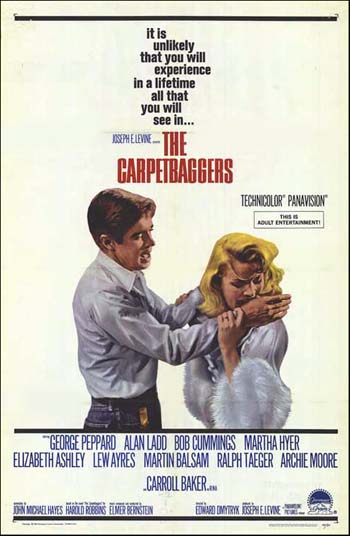
Embracing the Melodrama Part II #28: The Carpetbaggers (dir by Edward Dmytryk)


The_Carpetbaggers_1964_poster

The 1960s was apparently a bad time for talented old school Hollywood filmmakers getting sucked into making big budget, excessively lengthy films.  Joseph L. Mankiewicz spent most of his career making movies like All About Eve and then, in 1963, he ended up directing Cleopatra.  Elia Kazan went from A Face In The Crowd to The Arrangement.  John Huston went from Treasure of the Sierra Madre and The African Queen to directing not only The Bible but Reflections in a Golden Eye as well.

And then there’s Edward Dmytryk.  Dmytryk may not be as highly regarded by modern critics as Mankiewicz and Huston but he still directed some of the best film noirs of the 1940s.  His 1947 film Crossfire was nominated for best picture and probably should have won.  In 1952, he directed one of the first true crime procedural films, The Sniper.  His 1954 best picture nominee, The Caine Mutiny, featured one of Humphrey Bogart’s best and most unusual performances.

And yet, in 1964, he somehow found himself directing The Carpetbaggers.

The Carpetbaggers tells the story of Jonas Cord (George Peppard).  Jonas is the son of the fabulously wealthy Jonas Cord, Sr. (Leif Erickson).  At the start of the film, father and son do not get along.  Senior resents that Junior is more interested in piloting airplanes than in learning the family business.  Junior is angry that Senior has married Jonas’s ex-girlfriend, actress Rina Marlowe (Carroll Baker).  In fact, as far as Jonas, Jr. is concerned, Nevada Smith (Alan Ladd) is more of a father to him than his actual father.

Nevada Smith is Jonas, Sr.’s best friend and occasional business partner.  He’s a former cowboy who, we are told in a lengthy bit of exposition, is legendary for tracking down and killing the three men who killed his parents.  (As we listen to Jonas, Jr. tell the entire lengthy story, we find ourselves thinking, “Okay, so why not make a movie out of that story?”  Well, they did.  Two years after the release of The Carpetbaggers, Steve McQueen starred in Nevada Smith.)  Nevada’s also a film star whose career is in deep decline.

Speaking of deep decline, Jonas, Sr. ends up having a heart attack and dramatically dropping dead before he can get a chance to disinherit his son.  Jonas, Jr. inherits the Cord fortune and the Cord business and proceed to spend the next two and a half hours abusing everyone who gets close to him.  He even mistreats his loving and neurotic wife, Monica (Elizabeth Ashley, giving the only really memorable performance in the entire film).

Yes, there’s really no reason to have any sympathy at all for Jonas Cord, Jr. but the film insists that we should because he’s the main character and he’s played by the top-billed star.  We’re also told that he’s a brilliant aviation engineer and I guess we’re supposed to admire him for being good at what does.  We also discover that Jonas believes that his mother was insane and that she passed down her insanity to him.  He fears that he’ll pass the crazy gene to any of children that he might have so that’s why he pushes everyone away.  Just in case we don’t understand how big a deal this is to him, the camera zooms in for a closeup whenever Jonas is reminded of his mother.

(In the 60s, all mental instability was represented via zoom lens.)

However, Jonas isn’t just into airplanes!  He also buys a movie studio, specifically because Rina Marlowe is under contract.  Soon, Jonas is directing movies his way.  Jonas also finds himself falling in love with another actress (Martha Hyer) so, of course, he starts treating her badly in an effort to push her away.

What can be done to save the tortured soul of Jonas Cord?  Maybe he just need to get beaten up by Nevada Smith…

The Carpetbaggers was based on a novel by Harold Robbins.  The novel was apparently quite a scandal when it was originally published.  People read it and they wondered, “Who was based on who?”  Well, if you’ve ever seen The Aviator, it’s not that difficult to figure out.  Jonas Cord, eccentric movie mogul and obsessive pilot, was obviously meant to be Howard Hughes.  Rina Marlowe was meant to be Jean Harlow, a fact that can be guessed just by looking at the last names.  And I’m guessing that Nevada Smith was probably based on former President Warren G. Harding because … well, why not?

I suppose that, by the standards of 1964, the film version of The Carpetbaggers would have been considered risqué.  For a modern audience, the main appeal of something like The Carpetbaggers is to see what was once considered to be shocking.  The film is overlong, George Peppard doesn’t exactly figure out how to make Jonas into the compelling  rogue that he needs to be, the clothes and the sets are a lot more interesting than any of the dialogue (but not interesting enough to carry a nearly 3 hour movie), and the film’s pacing is so off that some scenes seem to go on forever while others are way too short.  But, as a cultural and historical artifact, The Carpetbaggers does hold some interest.

The Carpetbaggers was made at a time when Hollywood felt it was under attack from both television and European cinema.  With a film like The Carpetbaggers, the studios were saying, “See!?  Television will never be able to make a film this long and big!  And those Europeans aren’t the only ones who can make a movie about sex!”  Of course, as so often happened during this time, the studios failed to take into account that size and length don’t always equal quality (and ain’t that the truth?).  As for the sex — well, we hear a lot more than we actually see.  The Carpetbaggers is one of those films where everyone talks about sex, largely because showing sex wasn’t really an option.  (And it should be noted that most of the sex talk is delivered in the language of euphemism.)  As a result, The Carpetbaggers feels incredibly tame by today’s standards.  As a result, your main reaction to The Carpetbaggers will probably be to marvel at what was considered daring and shocking 50 years ago.

(And before we get too cocky and quick to dismiss those who came before us, let’s consider how our current films will look to movie audiences five decades from now…)

As far as biopics of Howard Hughes are concerned, The Carpetbaggers in no Aviator.  However, it is an occasionally interesting historical artifact.

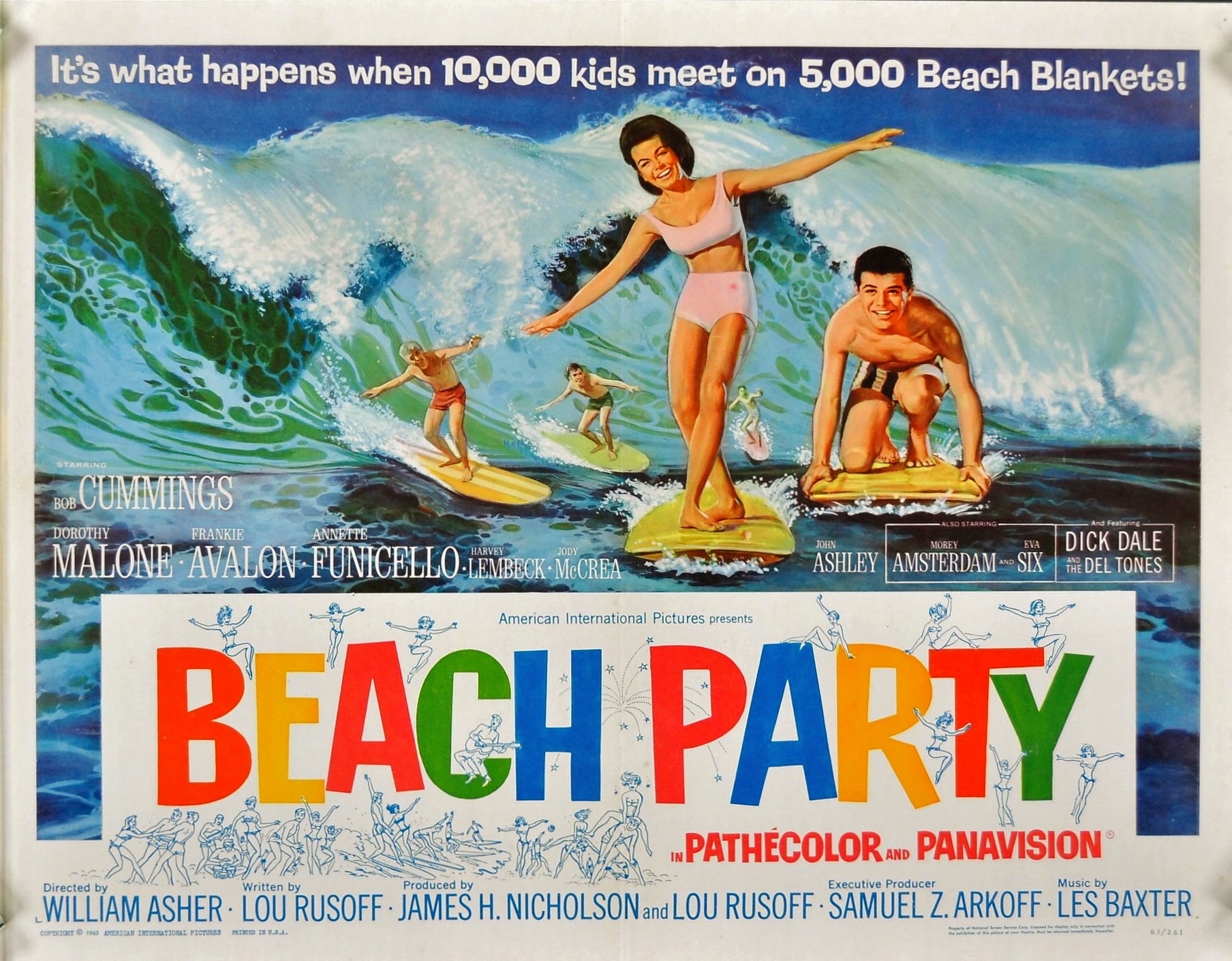
Life Is A Beach #1: Beach Party (dir by William Asher)


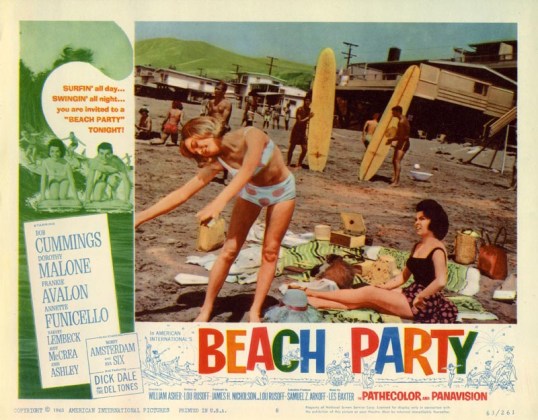
Beach-Party-Lobby-Card8

It seems a little bit strange that today was, for many people, the first day of Spring Break.

First off, it was cold and rainy today and, whenever I found myself glancing out a window and being confronted by the gray weather, it was very hard for me to imagine having any fun on a beach.

Secondly, for reasons that I never quite understood, the University of North Texas’s Spring Break was always a week after everyone else’s.  As a result, I’ve been conditioned to think of Spring Break as starting during the third week of March.

I always looked forward to Spring Break, despite the fact that we always got out a week late.  In fact, it was kind of nice to know that, when my friends and I got down to that year’s beach, the most obnoxious of the alcoholic frat boys would already be back in Oklahoma.  I’ve always loved the beach, which is odd because I’m scared of drowning.  Fortunately, you don’t have to swim to look good in a bikini.

Now, of course, I’m an adult and I don’t get a Spring Break.  But that doesn’t mean that I can’t relive the fun of it all by spending the next few days watching and reviewing beach movies!

For instance, earlier today, I discovered that the 1963 film Beach Party was available on Netflix.   I watched the first 40 minutes during my lunch and then, as the day progressed, I watched the rest of it in bits and pieces until finally, nearly 8 hours after starting the film, I finished it.  Needless to say, this is absolutely the worst way to watch a film like Beach Party.  Beach Party was designed to be a film to be enjoyed but not thought about.  It’s the cinematic equivalent of fast food.  Watching Beach Party in increments of 2 or 3 minutes at a time is a bit like buying a Wendy’s bacon cheeseburger and not eating it until the next day.

(Or so I assume.  I would never do that because, seriously, Wendy’s makes the best bacon cheeseburgers!)

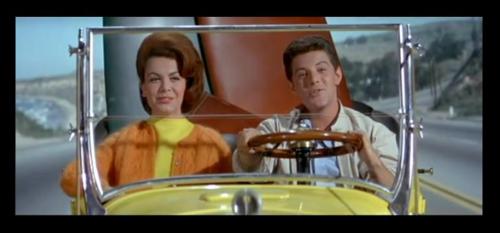
It feels kind of silly to try to describe the plot of something like Beach Party but here goes: Frankie (Frankie Avalon) and Delores (Annette Funicello) are two teenagers in love.  Or, at the very least, Delores is in love.  Frankie, however, has a hard time saying it.  Frankie and Delores are planning on spending the weekend at a beach house where, Frankie tells her, it will be just like they’re married.  Though it’s never explicitly stated (like many films from the early 60s, Beach Party is all about the euphemisms), Frankie is obviously expecting that he and Delores will finally be having sex in that beach house.  However, Delores had the same idea so she invited all of their friends to stay at the beach house as well, specifically to keep her from giving in during a moment of weakness.

Meanwhile, Prof. Robert Sutwell (Robert Cummings) is also hanging out on the beach.  He’s an anthropologist who has a rather prominent beard.  He’s studying the sex lives of teenagers.  Since they’re adults, Robert and his assistant Marianne (Dorothy Malone) are actually allowed to say the word “sex.”

Speaking of which, that’s one thing that nobody on the beach seems to be doing.  Robert is too obsessed with his work, Marianne is too frustrated with his lack of interest, Frankie is too busy surfing and singing, and Delores says she’s not interesting in “being a woman” until she’s married.  There’s constant flirting going on, of course but, for the most part, these teenagers make the spring breakers from From Justin To Kelly look wild.  (One can only guess what would happen if any of them ever ran into the spring breakers from Spring Breakers….)

That said, I do think that I did spot Frankie and his friends passing around a joint during one scene.  According to some comments at the imdb, it was probably meant to be a cigarette that Frankie was sharing with his friends Ken (John Ashley) and Deadhead (Jody McCrea) but it sure looked like a joint to me.  Plus, Frankie was listening to beatnik poetry at the time and we all know those crazy kids loved the poetry and loved the marijuana.

Oh!  And did I mention that there’s a motorcycle gang in this film?  Because there so totally is.  The Rat Pack is led by a guy named Erich Von Zipper (Harvey Lembeck) and they pretty much show up whenever the film starts to run out of ideas…

Now, it may sound like I’m being pretty critical of Beach Party but actually, I thought it was fun in a time capsule sort of way.  This is one of those films that is so obviously a product of the time in which it was made that watching it is a bit like getting to take a ride in a time machine.  Everything about this film — from the dialogue to the cultural attitudes to the clean-cut teenagers to the music to the bizarrely modest bikinis — practically screams 1963.  As a secret history nerd, I loved the part of Beach Party.

Add to that, Vincent Price has a cameo!  That’s always fun.

Anyway, Beach Party is currently available to be watched on Netflix and Hulu.  If you can’t get to the beach this year, you can always watch Frankie Avalon getting high in Beach Party.

http://www.youtube.com/watch?v=nkhGmZPJIHY

Embracing the Melodrama #9: Kings Row (dir by Sam Wood)


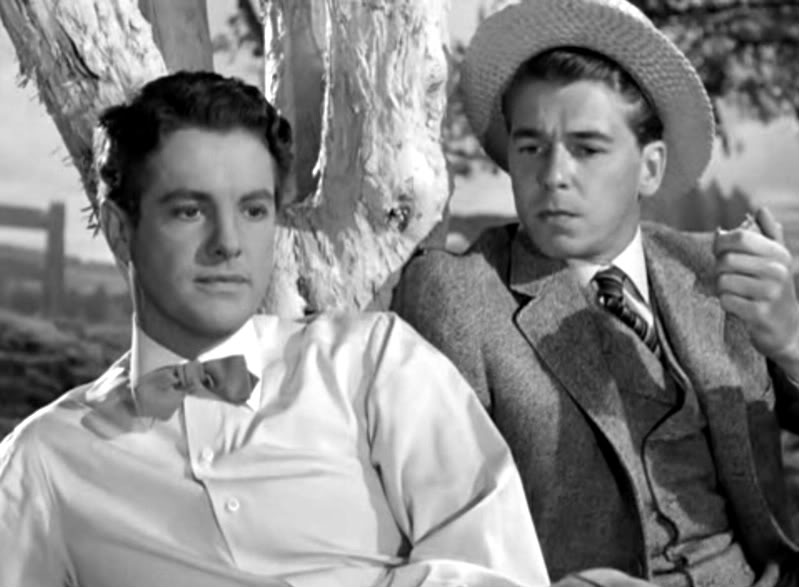
Kings Row“Where’s the rest of me!?” — Drake McHugh (Ronald Reagan), upon waking up to discover that his legs have been amputated, in Kings Row (1942)

It is with that line that the 1942 best picture nominee Kings Row earns its place in film history.  The formerly carefree and rich Drake had lost all of his money due to a crooked banker.  However, instead of feeling for himself, Drake got a job working for the railroad and finally started to show that he was capable of acting like a mature, responsible adult.  However, when Drake was injured in a boxcar accident, he had the misfortune to be taken to the sadistic Dr. Gordon (Charles Coburn).  Gordon felt that it was his duty to punish those who he considered to be wicked and that’s exactly how he felt about about Drake.  So, despite the fact that Drake had once been in love with Gordon’s daughter, Gordon proceeded to chop of Drake’s legs.

It’s just another day in Kings Row.

Of course, to an outsider, Kings Row looks like your typically calm and pleasant community.  But behind closed doors, this small town is full of sordid secrets.  Only those who have grown up in Kings Row understand the truth.  Only they can understand how Drake McHugh could end up losing his legs.

When they were both growing up at the turn of the century, Drake’s best friend was Parris Mitchell (Robert Cummings).  While Drake was pursuing Dr. Gordon’s daughter, and being loved from afar by Randy Monaghan (Ann Sheridan), Parris was studying to be a doctor under the tutelage of Kings Row’s other doctor, Dr. Alexander Tower (Claude Rains).  While Dr. Tower appeared to be a much nicer man than Dr. Gordon, he definitely had his eccentricities.  For instance, there was the wife who was reportedly confined somewhere in the house and never allowed to leave.  And then there was Dr. Tower’s daughter, Cassandra (Betty Field).  Dr. Tower was very protective of Cassandra, perhaps too protective.  How would Dr. Tower react when Parris, his best student, started to develop romantic feelings towards Cassandra?

Again, it’s just another day in Kings Row.

So, by now, it should be pretty obvious that Kings Row is one of those films that deals with big secrets in small towns.  That, of course, is a theme that was explored by films that were made long before Kings Row.  What made Kings Row unique is that it was perhaps the first film to actually portray that evil as specifically existing and thriving because of the repressive nature of a small town.  Whereas other films had featured outsiders bringing bad habits to an otherwise innocent and idyllic community (and be sure to watch Hitchcock’s Shadow of a Doubt if you want a perfect example of this), Kings Row suggested that the very nature of its setting is what led to all of the melodrama.  The film suggests that evil men like Dr. Gordon can specifically thrive in a town like Kings Row because his fellow townspeople aren’t willing to risk the placid surface of their existence by exposing him.  As such, Kings Row serves as a template for all of the sin-in-a-small-town films and TV shows that have followed.

Beyond the film’s historical importance, Kings Row holds us pretty well as entertainment.  As the film’s hero, Robert Cummings is a bit on the bland side but, fortunately, he’s surrounded by an excellent cast of character actors.  It’s a bit of a cliché to say that Claude Rains was perfectly cast because, seriously, when wasn’t Claude Rains perfectly cast?  But, in the role Dr. Tower, Claude Rains is perfectly cast.  Charles Coburn makes for a perfectly terrifying villain.  Ann Sheridan is likable and sympathetic as the woman who tries to help Drake recover after Dr. Gordon takes away his legs.  And finally, you’ve got future President Ronald Reagan in the role of Drake McHugh.  Reagan is usually dismissed a being a pretty boring actor (and I really haven’t seen enough of his films to say one way or the other) but he gave a great performance in Kings Row.

And that’s why, even beyond its historical significance, Kings Row is still a film that is more than worth watching.

KingsRowFRIENDS-1

44 Days of Paranoia #34: Saboteur (dir by Alfred Hitchcock)


For today’s entry in the 44 Days of Paranoia, we take a look at the 1942 Alfred Hitchcock film, Saboteur.

Saboteur opens at an aircraft factory in Glenda, California.  Co-workers Barry Kane (Robert Cummings) and Ken Mason (Virgil Summers) notice a stand-offish new guy named Frank Fry (Norman Lloyd, who appropriately looks something like a rodent).  When a fire breaks out at the factory, Fry hands Barry a fire extinguisher which Barry then hands off to Ken.  The extinguisher, however, is full of gasoline, both causing the fire to turn into an inferno and killing Ken.

When questioned by the FBI, Barry explains that Fry handed him the extinguisher, just to then be informed that no one named Fry worked at the plant and that no one saw Fry — or anyone else — hand Barry the extinguisher.  Realizing that Fry has framed him and also remembering the address on an envelope that Fry was carrying, Barry runs.  With the FBI and police pursuing him, Barry tries to track down the real saboteur.  Along the way, he discovers a friendly rancher (Otto Kruger) who is actually a Nazi agent and gets some help from a group of circus freaks, a blind man, and the blind man’s model daughter (Peggy Cummings).  He also discovers that the U.S. is crawling with Nazi double agents who hide behind a veil of respectability and are plotting to destroy historic landmarks across the country.  It all eventually leads to a genuinely exciting climax atop the Statue of Liberty.

Saboteur doesn’t get as much attention as some of the other films that Hitchcock directed in the 40s and perhaps that’s not surprising.  It’s not as technically audacious as Notorious nor is it as thought-provoking as Shadow of the Doubt or as flamboyant as Spellbound.  While Robert Cummings and Priscilla Lane make for perfectly likable leads, they certainly don’t generate the chemistry of Cary Grant and Ingrid Bergman.  When one looks at the masterpieces that Hitchcock directed in the 40s, it’s easy to dismiss Saboteur as being a well-made B-movie.

And yet, I love Saboteur.  The film is pure non-stop melodrama and, over 70 years since it was first made, it remains an exciting and entertaining film.  Despite the fact that some critics may not hold Saboteur in as high regard as some of Hitchcock’s other films, Saboteur is full of moments of the director’s trademark ambiguity and irony.  This is one of Hitchcock’s wrong man films, where innocent men are chased across a shadowy landscape by the forces of law and order who, in many ways, are portrayed as being just as menacing as the film’s nominal villains.  Meanwhile, the Nazi agents hide behind warm smiles and friendly words, their evil only apparent when it’s too late to stop them.  Despite his rather fearsome reputation, Hitchcock’s sympathies always lay with the powerless and the wrongly accused.

It’s those sympathies that make Saboteur into far more than just another B-movie.

Instead, it’s one of Hitchcock’s best.

Other Entries In The 44 Days of Paranoia 

  1. Clonus
  2. Executive Action
  3. Winter Kills
  4. Interview With The Assassin
  5. The Trial of Lee Harvey Oswald
  6. JFK
  7. Beyond The Doors
  8. Three Days of the Condor
  9. They Saved Hitler’s Brain
  10. The Intruder
  11. Police, Adjective
  12. Burn After Reading
  13. Quiz Show
  14. Flying Blind
  15. God Told Me To
  16. Wag the Dog
  17. Cheaters
  18. Scream and Scream Again
  19. Capricorn One
  20. Seven Days In May
  21. Broken City
  22. Suddenly
  23. Pickup on South Street
  24. The Informer
  25. Chinatown
  26. Compliance
  27. The Lives of Others
  28. The Departed
  29. A Face In The Crowd
  30. Nixon
  31. The Hunger Games: Catching Fire
  32. The Purge
  33. The Stepford Wives