Whatever else one may want to say about it, 1996’s Jingle All The Way is a cute film.
It’s necessary to point that out because Jingle All The Way has a terrible reputation and, if we’re going to be honest, it deserves a lot of the criticism that it has gotten over the years. In many ways, it epitomizes the way a Hollywood studio can take an interesting idea and then produce a film that seems to have no understanding of what made that idea so interesting in the first place. Arnold Schwarzenegger plays Howard Langston, an overworked mattress store manager who waits until Christmas Eve to try to buy his son a Turbo Man action figure. (In the film, they call it a “doll,” which is one of the film’s false moments.) The only problem is that the Turbo Man action figure is the most popular gift of the year and everyone is looking for one. What starts out at as a satire of commercialism ultimately becomes a celebration of the same thing as Howard ends up dressed up as Turbo Man and taking part in his town’s Christmas parade. The film becomes a comedy without any sharp edges.
That said, it’s a cute film. It’s not cute enough to really be good but it is cute enough that it won’t leave you filled with rage. Arnold Schwarzenegger is in True Lies mode here, playing a seemingly boring and suburban guy who is secretly a badass. (In True Lies, Schwarzenegger was secretly a spy who had killed man people, though all of them were bad. In Jingle All The Way, he’s just a parent who has waited too long to go Christmas shopping.) Schwarzenegger’s main strength as an action star — even beyond his physique — was that he always seemed to have a genuine sense of humor and he’s the best thing about Jingle All The Way. This film finds him acting opposite actual comedic actors like Jim Belushi and Phil Hartman and holding his own. (The film also features Sinbad as another dad trying to get the Turbo Man action figure but Sinbad comes across as being more of a stand-up comedian doing bits from his routine than an actual character.) The film’s set pieces grow increasingly bizarre and surreal as Howard searches for his Turbo Man and the film actually becomes less effective the stranger that it gets. A scene of Howard fighting a crowd in a toy store works far better than a later scene where Howard battles a bunch of men dressed as Santa Claus and his elves. (It doesn’t help that, after an intelligent and well-edited opening thirty minutes, the film seems to lose all concept of comedic timing.) But there’s a sincerity to Schwarzenegger’s performance that keeps you watching.
Of course, today, Jingle All The Way feels like a relic from a different age. All the kids want a Turbo Man and you’re so busy at work that the stores are closed by the time you get home? Fine. Hop on Amazon at three in the morning and order one. Christmas shopping is a lot easier nowadays.
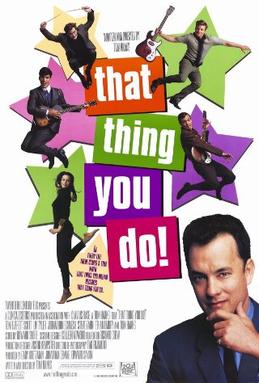
That Thing You Do! is the story of a one-hit wonder.
In 1964, an aspiring Jazz drummer named Guy (Tom Everett Scott) is a last minute addition to the a local band called the Oneders. (It’s meant to sound like Wonders but almost everyone mispronounces it as O-Needers.) The band’s egotistical leader, James (Jonathon Schaech) has written a slow ballad called That Thing You Do! but when Guy’s drumming causes the band to perform the song at a faster tempo, they end up with a local hit on their hands. That local hit becomes a national hit when The Oneders are signed by Play-Tone Records. First, Mr. White (Tom Hanks), their new manager, officially changes the name to The Wonders. Secondly, he makes sure that every teen in America is dancing to That Thing You Do! Third, he tells Guy to always wear sunglasses. Fourth, he tells James that he will record and perform what Play-Tone tells him to. Guitarist Lenny (Steven Zahn) and the unnamed Bass Player (Ethan Embry) are happy to be along for the ride but James chafes at his lack of artistic freedom. Guy, meanwhile, falls for James’s girlfriend (Liv Tyler, at her loveliest) and dreams of meeting his idol, jazzman Del Paxton (Bill Cobbs).
That Thing You Do! was Tom Hanks’s directorial debut and, with its careful recreation of a bygone era and its collection of authentic sounding early 60s rock on the soundtrack, it was obviously a labor of love. Considering the number of times that the song is played in the movie, it helps that it is a very good song. That Thing You Do! is a catchy tune, one that you can’t help but tap your feet to. At the same time, it also sounds like a one hit wonder. It’s good but not so great as to make you expect much else from The Wonders.
Not surprisingly, Tom Hanks gets great performances from the entire ensemble cast. Johnathon Schaech and Tom Everett Scott have never been better. Liv Tyler is lovely and vulnerable as James’s unappreciated girlfriend. Familiar faces like Peter Scolari, Kevin Pollak, Chris Isaak, and Clint Howard make welcome appearances. Hanks himself is surprisingly intimidating as Mr. White. When he says that the band will cover something the Play-Tone catalogue, it’s obvious that he’s not making a request.
The film is a tribute to being young and to loving music bit it’s also a study in the disillusionment of discovering that everything is ultimately a business. James is frequently an arrogant jerk and he treats his girlfriend terribly but it’s hard not to sympathize with him when he says that he wants to do more than just cover songs from the Play-Tone catalogue. To James and Guy, the Wonders are about self-expression and their love of music. To Mr. White, the Wonders are just another band that came up with one catchy tune and who probably aren’t ever going to be heard from again. That Thing You Do! pays tribute to all of the one-hit wonders out there, the bands who you forget about until you just happen to hear that one song on the radio or in a movie and suddenly, all the memories come flooding back.
In 2021, I finally saw the infamous film, The Bonfire of the Vanities.
I saw it when it premiered on TCM. Now, I have to say that there were quite a few TCM fans who were not happy about The Bonfire of the Vanities showing up on TCM, feeling that the film had no place on a station that was supposed to be devoted to classic films. While it’s true that TCM has shown “bad” films before, they were usually films that, at the very least, had a cult reputation. And it is also true that TCM has frequently shown films that originally failed with audiences or critics or both. However, those films had almost all been subsequently rediscovered by new audiences and often reevaluated by new critics. The Bonfire of the Vanities is not a cult film. It’s not a film about which one can claim that it’s “so bad that it’s good.” As for the film being reevaluated, I’ll just say that there is no one more willing than me to embrace a film that was rejected by mainstream critics. But, as I watched The Bonfire of the Vanities, I saw that everything negative that I had previously read about the film was true.
Released in 1990 and based on a novel by Tom Wolfe, Bonfire of the Vanities stars Tom Hanks as Sherman McCoy, a superficial Wall Street trader who has the perfect penthouse and a painfully thin, status-obsessed wife (Kim Cattrall). Sherman also has a greedy mistress named Maria (Melanie Griffith). It’s while driving with Maria that Sherman takes a wrong turn and ends up in the South Bronx. When Sherman gets out of the car to move a tire that’s in the middle of the street, two black teenagers approach him. Maria panics and, after Sherman jumps back in the car, she runs over one of the teens. Maria talks Sherman into not calling the police. The police, however, figure out that Sherman’s car was the one who ran over the teen. Sherman is arrested and finds himself being prosecuted by a power-hungry district attorney (F. Murray Abraham). The trial becomes the center of all of New York City’s racial and economic strife, with Sherman becoming “the great white defendant,” upon whom blame for all of New York’s problems can be placed. Bruce Willis plays an alcoholic journalist who was British in the novel. Morgan Freeman plays the judge, who was Jewish in the novel. As well, in the novel, the judge was very much a New York character, profanely keeping order in the court and spitting at a criminal who spit at him first. In the movie, the judge delivers a speech ordering everyone to “be decent to each other” like their mothers taught them to be.
Having read Wolfe’s very novel before watching the film, I knew that there was no way that the adaptation would be able to remain a 100% faithful to Wolfe’s lacerating satire. Because the main character of Wolfe’s book was New York City, he was free to make almost all of the human characters as unlikable as possible. In the book, Peter Fallow is a perpetually soused opportunist who doesn’t worry about who he hurts with his inflammatory articles. Sherman McCoy is a haughty and out-of-touch WASP who never loses his elitist attitude. In the film, Bruce Willis smirks in his wiseguy manner and mocks the other reporters for being so eager to destroy Sherman. Hanks, meanwhile, attempts to play Sherman as an everyman who just happens to live in a luxury penthouse and spend his days on Wall Street. Hanks is so miscast and so clueless as how to play a character like this that Sherman actually comes across as if he’s suffering from some sort of brain damage. He feels less like a stockbroker and more like Forrest Gump without the Southern accent. There’s a scene, written specifically for the film, in which Fallow and Sherman ride the subway together and it literally feels like a parody of one of those sentimental buddy films where a cynic ends up having to take a road trip with someone who has been left innocent and naïve as result of spending the first half of their life locked in basement or a bomb shelter. It’s one thing to present Sherman as being wealthy and uncomfortable among those who are poor. It’s another thing to leave us wondering how he’s ever been able to successfully cross a street in New York City without getting run over by an angry cab driver.
Because the film can’t duplicate Wolfe’s unique prose, it instead resorts to mixing cartoonish comedy and overwrought melodrama. It doesn’t add up too much. At one point, Sherman ends a dinner party by firing a rifle in his apartment but, after it happens, the incident is never mentioned again. I mean, surely someone else in the apartment would have called the cops about someone firing a rifle in the building. Someone in the press would undoubtedly want to write a story about Sherman McCoy, the center of the city’s trial of the century, firing a rifle in his own apartment. If the novel ended with Sherman resigned to the fact that his legal problems are never going to end, the film ends with Sherman getting revenge on everyone who has persecuted him and he does so with a smirk that does not at all feel earned. After two hours of being an idiot, Sherman suddenly outthinks everyone else. Why? Because the film needed the happy ending that the book refused to offer up.
Of course, the film’s biggest sin is that it’s just boring. It’s a dull film, full of good actors who don’t really seem to care about the dialogue that they are reciting. Director Brian De Palma tries to give the film a certain visual flair, resorting to his usual collection of odd camera angles and split screens, none of which feel at all necessary to the story. In the end, De Palma is not at all the right director for the material. Perhaps Sidney Lumet could have done something with it, though he would have still had to deal with the less than impressive script. De Palma’s over-the-top, set piece-obsessed sensibilities just add to the film’s cartoonish feel.
The film flopped at the box office. De Palma’s career never recovered. Tom Hanks’s career as a leading man was momentarily derailed. Bruce Willis would have to wait a few more years to establish himself as a serious actor. Even the normally magnanimous Morgan Freeman has openly talked about how much he hated being involved with The Bonfire of the Vanities. That said, the film lives on because De Palma allowed journalist Julie Salomon to hang out on the set and the book she wrote about the production, The Devil’s Candy, is a classic of Hollywood non-fiction. (TCM adapted the book into a podcast, which is how The Bonfire of the Vanities came to be featured on the station.) Thanks to Salomon’s book, The Bonfire of the Vanities has gone to become the epitome of a certain type of flop, the literary adaptation that is fatally compromised by executives who don’t read.
Asteroid City opens with black-and-white footage of Bryan Cranston, wearing a suit and speaking in the authoritative tones of someone who has made his living on television. Cranston informs us that we are about to see a televised production of a play by the famed but enigmatic playwright named Conrad Earp (Edward Norton).
The play, which is seen in stylized color, opens with Augie Steeback (Jason Schwartzman) driving his family through the desert. He is taking his son, Woodrow (Jake Ryan), to a Junior Stargazers convention that is being held at Asteroid City, a tiny town that is best-known for being the location of an impact crater. Along for the ride are Augie’s three daughters, who are all pretending to be witches. What Augie hasn’t told his children is that their mother has died, her cremated remains are in a Tupperware container, and that they will be moving in with their wealthy grandfather (Tom Hanks).
There’s not much to the town of Asteroid City. There’s a motel that’s managed by a man (Steve Carell) who sells land deeds out of a refurbished Coke machine. There’s a diner. There’s a group of helpful cowboys, led by the polite and helpful Montana (Rupert Friend). There’s a mechanic (Matt Dillon) who is called into duty when Augie’s car breaks down. The Junior Stargazer convention is the event of the year for Asteroid City. Young geniuses from all around the country have descended on the town and have brought their parents. One of them, Dinah (Grace Edwards), is the daughter of actress, Midge Campbell (Scarlett Johansson). When an alien (played, at one point in the film, by Jeff Goldblum) shows up and steals the town’s meteorite, General Gibson (Jeffrey Wright) declares a quarantine. Some people handle the lockdowns better than others. Augie takes pictures and thinks about his wife. Midge rehearses for her next role, one that is centered around her character dying. The genius children play a memory game that they realize will never end because they’re all geniuses. A teacher (Maya Hawke) tries to teach her students about the Milky Way, just to discover that the kids only want to talk about the alien. One of the fathers (Liev Schreiber) ends up with a useless plot of desert land and the death ray that his son recently invented.
Throughout it all, Bryan Cranston appears in black-and-white footage that gives us a look into what went on behind the scenes during the production of Asteroid City. The director (Adrien Brody) was a lech. The actor playing Augie struggled to understand what the play was about and who his character was meant to be while the actress (Margot Robie) hired to play his wife ended up in another play after her scenes were cut from Asteroid City. Only once does Bryan Cranston’s host appear in the color sections of Asteroid City, just to sheepishly admit that he’s not supposed to be there before ducking off camera.
Even if his name wasn’t in the opening credits, the viewer could probably easily guess that this is a Wes Anderson film. It features all of Anderson’s trademarks, all of the things that viewers will automatically love or hate depending on how they feel about Anderson’s quirky aesthetic. It’s a visually impressive, pop art-flavored, all-star comedy with an undercurrent of profound melancholy, one in which the fanciful strangeness of the alien’s “invasion” is compared and contrasted with the very real-life strangeness of how humans deal with life, loss, death, and uncertainty. Scenes of clever wordplay are mixed with scenes in which we see Augie still very much struggling to come to terms with the death of his wife and the actor Augie very much struggling to understand what is actually going on in his character’s head. As far as recent Anderson films go, Asteroid City is not quite as humanistic as Rushmore or Grand Budapest Hotel but, at the same time, it’s still more accessible than The French Dispatch.
If you’re not a fan of Anderson’s style, this film won’t convert you. That said, I am a fan of Anderson’s style and I absolutely loved Asteroid City. As with so many of Anderson’s films, the main focus is on how we try to deal with the uncertainties of life by trying to maintain an illusion of control over every aspect of our lives. Playwright Conrad Earp writes because that way he can have a world that follows his own rules. The actors follow a script that tells them how to react to everything that happens around them. In the play, the Junior Stargazers fall back on science while Augie’s father-in-law falls back on religion and Augie’s daughter convince themselves that spells will bring back or, at least, protect their mother. Even General Gibson falls back on his belief in the government and the military to deal with the sudden appearance by the alien. The alien is the unknowable and his arrival reminds everyone that life is unpredictable, regardless of how much you try to control your own story. Indeed, while the film takes place in the 50s and is full of comments about the Red Scare and atomic bomb testing, it’s hard not to see Asteroid City as being a commentary on the recent COVID lockdowns and the debate over whether people could ever go back to living the way that they did before the pandemic. Much as with the Coen Brothers’s similarly stylized A Serious Man, the ultimate message seems to be that the only way to deal with the unpredictability of life is to embrace it.
It’s also a very funny film, one that is full of small details that reward repeat viewing. If one focuses on the background characters, it quickly becomes apparent that there are actually several stories unfolding in the film and, much as with life, the viewer just has to be willing to look for them. (I particularly enjoyed the romance between The Teacher and Montana.) Jason Schwartzman is compelling as both Augie and the actor playing Augie and Scarlett Johansson plays both Midge and the actress playing Midge with the perfect amount of cool detachment. To the film’s credit, none of the character’s become caricatures. They remain individuals, regardless of how bizarre the film’s story may sometimes seem. Everyone gets a moment to reveal a little depth, from Jeffrey Wright’s sincere (if misplaced) faith in the lockdown policy to the moment when Tom Hanks’s previously unsympathetic father-in-law reveals that he’s as much in mourning as Augie. The all-star cast also includes Tilda Swinton, Liev Schrieber, Stephen Park, Willem DaFoe, Hong Chau, and Margot Robbie and all of them add to the film’s portrait of quirky but ultimately relatable humanity.
Again, with this film, it undoubtedly helps to already be familiar with and to like Wes Anderson’s way of doing things. If you’re not a fan of his film, this one probably won’t change your mind. That said, for those of us who do enjoy his style, this is Anderson at his best.
KIMI, the latest addition to Steven Soderbergh’s interesting but frustratingly inconsistent filmography, stars Zoe Kravitz as Angela Childs. Angela is an agoraphobic tech worker who is living in Seattle during the COVID pandemic. A sexual assault survivor, Angela spends her days and nights safely locked away in her apartment. She works from home. She always keeps her mask some place near. Occasionally, she’ll have a video session with her therapist. Her mom calls and scolds her for not going outside. She exchanges texts and occasionally more with Terry Hughes (Byron Bowers), an attorney who lives across the street.
And, she’s watched by Kevin (Devin Ratray). Kevin also lives across the street and, throughout the film, he’s occasionally seen watching her from his top floor apartment. It’s creepy but it’s not surprising. KIMI is a film in which everyone is being watched by someone else. Sometimes, they realize it and often they don’t. Welcome to the Surveillance State, where privacy is the ultimate illusion.
Angela works for the Amygdala Corporation. Under the leadership of CEO Bradley Hasling (Derek DelGuado), Amygdala has created KIMI, the virtual assistant that is superior to Alexa because all of KIMI’s errors are corrected not by a pre-programmed algorithm but instead by human workers who are constantly listening to KIMI’s data stream and correcting errors. Angela is one of those engineers. Usually, her job consists of programming KIMIs to play individual Taylor Swift songs as opposed to building Taylor Swift playlists. When one owner calls KIMI a peckerwood, Angela programs the KIMI to understand that peckerwood is an “insult; vulgar.” However, one data stream contains the sounds of what Angela believes to be a sexual assault and a subsequent murder.
Uniquely, for a film like this, Angela’s struggle is not to get people to believe that she heard what she heard. Instead, her struggle is to get the evidence to the people who need to hear it for themselves. Angela is terrified of leaving her apartment and, once she finally does, the outside world confirms all of her fears. KIMI is a film about paranoia, a portrait of a world where everyone can be tracked and no one — from Angela’s too-helpful boss (Rita Wilson) to the man who casually walks by with an umbrella — can be trusted.
As I’ve said in the past, Steven Soderbergh has always been hit and miss for me. It’s remarkable how many Soderbergh films that I love but it’s equally remarkable just how many Soderbergh films I absolutely loathe. At his best, he can be a clever stylist and, at his worst, he can be painfully pretentious. And yet, regardless of anything else, you do have to respect Soderbergh’s willingness to experiment with different genres and styles. Soderbergh never stops working, despite the fact that he announced his retirement years ago. Despite getting off to a slow start, KIMI is one of Soderbergh’s more entertaining thrillers, one that does a great job creating an atmosphere of paranoia and one that is also blessed with excellent performances from Zoe Kravitz and Rita Wilson, who makes good use of her limited screen time. KIMI is a well-made Hitchcockian thriller and, along with No Sudden Move, it’s a return to form for Soderbergh after the two terrible movies that he made with Meryl Streep, The Laundromat and Let Them All Talk. Yes, Soderbergh can be inconsistent but when he’s good …. he’s very, very good. (Sometimes, he’s even brilliant.) Narratively, KIMI may be a relatively simple film by Soderbergh standards but it’s undeniably effective.
Along with being a portrait of our paranoid age, KIMI is very much a pandemic thriller. Angela mentions that her relationship with Terry started during the lockdowns, a time when no one found it strange that someone would be unwilling to leave their apartment. When Angela does finally step out of her apartment, she is, of course, fully masked up and her paranoia about being followed severs as a metaphor for the paranoia that many people felt (and continue to feel) during the pandemic. KIMI is not the first pandemic thriller and it certainly won’t be the last. Still, what’s interesting to me that the pandemic subtext will probably be more noticeable to those who lived in states with mask mandates and aggressively regulated lockdowns than it will be for those of us who live in states that never had mandates and which, for lack of a better term, re-opened last year. Half the people viewing KIMI will nod in recognition as Angela grabs her mask before walking up to her front door and as she quickly dashes down the street, careful not get too close to anyone else. The other half will feel as if they’re watching some sort of dystopian science fiction film. It all depends on where you’ve lived for the past two years.
Though the Academy of Motion Picture Arts and Sciences claim that the Oscars honor the best of the year, we all know that there are always worthy films and performances that end up getting overlooked. Sometimes, it’s because the competition too fierce. Sometimes, it’s because the film itself was too controversial. Often, it’s just a case of a film’s quality not being fully recognized until years after its initial released. This series of reviews takes a look at the films and performances that should have been nominated but were,for whatever reason, overlooked. These are the Unnominated.
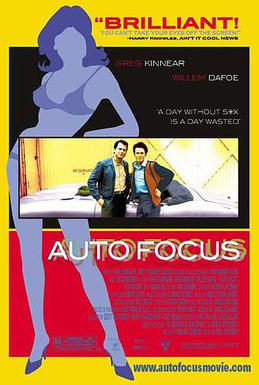
The 2002 film Auto Focus start out as almost breezy satire of the perfect all-American life and it ends with an act of shocking violence. It’s based on a real-life mystery, a murder that revealed a secret life.
When we first see Bob Crane (Greg Kinnear), he’s a disc jockey and a drummer living in the suburbs of Los Angeles in the mid-60s. He’s got what would appear to be the ideal life. He’s got a nice house. He and his wife (Rita Wilson) seem to be devoted to each other. His children are adorable. He goes to church. He tells corny Dad jokes. He’s got a quick smile and a friendly manner and it’s impossible not to like him. When he gets offered the lead in a sitcom, his happiness and enthusiasm feels so generous that it’s impossible not to be happy for him.
Of course, the show is a comedy that takes place in World War II POW camp, which doesn’t really sound like a surefire hit or really anything that should be put on the air. (“Funny Nazis?” Crane says in disbelief when he’s first told about the project.) Still, with Crane in the lead role, Hogan’s Heroes becomes a hit and, for a while, Bob Crane becomes a star and it seems like it couldn’t have happened to a more deserving guy.
The problem, of course, is that Crane seems like he’s too good to be true and we all know what they say about things like that. From the start, there are hints that Crane may be hiding another side of his personality. His wife, for instance, is not happy when she discovers his stash of pornographic magazines in their garage. (“They’re photography magazines!” Crane protests with a smile that’s a bit too quick.) Crane obviously enjoys the recognition that comes from being the star of a top-rated show. He starts hanging out at strip clubs, occasionally playing drums with the club’s band and watching the dancers with a leer that’s really not all that different from the smile that he flashes whenever he asks anyone if they want an autograph.
Crane also meets John Carpenter (Willem DaFoe), an electronics expert who introduces him to the then-expensive and exclusive world of home video. As opposed to the clean-cut and smoothly-spoken Crane, Carpenter is so awkward that it’s sometimes painful to watch him move or listen to him speak. He’s the epitome of the Hollywood hanger-on, the type who has deluded himself into thinking that his celebrity clients genuinely like him and enjoy his company. He and Crane become fast friends, though it’s always obvious that Crane considers himself to be better than Carpenter. However, Carpenter is the only person with whom Crane can share the details of his secret life.
The film covers several years, from the late 60s to the mid-70s. Crane goes from being so clean-cut that he neither drinks nor curses to being so addicted to sex that he can stop himself even when it starts to destroy his career and leads to him losing everything that he loves. Carpenter and Crane’s friendship becomes progressively more and more self-destructive until the film ends in violence and tragedy.
Auto Focus begins on a light and breezy note but, as Crane’s addiction grows, the film grows darker. By the time the movie enters the 70s, the camerawork becomes more jittery and the once soft-spoken Crane seems to be drowning in his own anxiety. He becomes the type who causally goes from talking to Carpenter about how he wants to direct the world’s greatest sex film to cheerfully announcing that Disney has decided to cast him in a film called SuperDad. Auto Focus‘s key scene comes towards the end, when Crane is a guest on a silly cooking show and shocks the audience by harassing a woman sitting in the front row. When the audience boos, Crane flashes his familiar smile and it becomes obvious just how much of Crane’s life has been spent hiding behind that smile. By the end of the film, not even Crane himself can keep track of whether or not he’s a wholesome comedy star or a self-destructive sex addict.
Both Greg Kinnear and Willem DaFoe gave Oscar-worthy performance in Auto Focus, performances that hold your interest even after their characters sink to some truly low depths. The film makes good use of Kinnear’s amiable screen presence and Kinnear convincingly creates a man who wishes that he could be the person that he’s fooled everyone into thinking that he is. By the time he’s reduced to begging his agent (well-played by Ron Leibman) to find him a game show so that he can finally stop doing dinner theater, it’s hard not to have a little sympathy for him, even if the majority of his problems are self-created. As Carpenter, DaFoe is convincingly creepy but, at times, he’s also so pathetic that, again, you can’t help but feel a little sorry for him. At his worst, Carpenter is the 70s equivalent of the twitter user who stans a celebrity by sending them adoring tweets and then picking fights with anyone who disagrees.
Unfortunately, the Academy nominated neither Kinnear for Best Actor nor DaFoe for Best Supporting Actor. The competition for Best Actor was fierce that year, with Nicolas Cage, Michael Caine, Daniel Day-Lewis, and Jack Nicholson all losing to Adrien Brody in The Pianist. While Kinnear deserved a nomination, it’s hard to say who I would drop from that line-up to make room for him. As for DaFoe, I would argue that he was more deserving of a supporting actor nomination than The Hours‘s Ed Harris or The Road To Perdition’s Paul Newman. Perhaps DaFoe was just too convincing as the type of clingy groupie that most members of the Academy probably dread having to deal with.
Nominated or not, Auto Focus is a disturbing and ultimately sad look at the darkness that often hides behind a perfect facade.
Tonight’s excursion into the world of televised horror is the 10th episode of the 3rd season of HBO’s Tales From The Crypt!
Steven Weber plays an alcoholic reporter who thinks that he has found the story of his career! Someone is preying on the homeless and our reporter is determined to find out who and why. (Not because he actually cares about the homeless, of course. He just needs a big story to save his career.) However, the reporter quickly discovers that 1) all charities are not charitable and 2) you should always be careful about biting off more than you can chew…
This well-acted episode was directed and written by Manny Coto and it originally aired on July 31st, 1991.
Originally, I was planning on using the 2001 thriller The Glass House as one of my guilty pleasure reviews. Because, seriously, this film truly is one of the guiltiest of all guilty pleasures. I mean, there’s so much that you can criticize about the movie but it’s so much fun that I always feel rather bad for doing so. However, after giving it some thought, I decided to use The Glass House as one of my Back to School reviews. Seeing as how I just totally trashed a Leelee Sobieski film called Here On Earth, it only seems fair to now recommend one of her films.
In The Glass House, Leelee plays Ruby Baker, a 16 year-old whose parents are killed in a car accident. Though their uncle (Chris Noth) wants to adopt them, the will states that Ruby and her nine year-old brother (Trevor Morgan) will instead be looked after by their parents’ best friends, Erin (Diane Lane) and Terry (Stellan Skarsgard).
Now, here’s the thing. This is going to blow your mind. Guess where Erin and Terry live? They live in a big mansion in Malibu and the entire house is made out of … GLASS! We have a title, right!? But wait, there’s more! Guess what Terry and Erin’s last name is? That’s right — GLASS! So, the house is not only literally a glass house but it’s also the Glass house as well! And beyond that, there’s that old saying that people who live in glass houses shouldn’t throw stones and … well, that really doesn’t apply to this film.
Anyway, I’m making such a big deal about the title because it pretty much tells you everything that you need to know about The Glass House. There is not a single subtle moment to be found in this entire film. And really, this is not a film that requires or rewards subtlety. We know that Terry Glass is up to no good from the minute we meet him, largely because he’s played by Stellan Skarsgard and when was the last time Stellan Skarsgard played a trustworthy character? Skarsgard pretty much gives the same performance here that he’s given in almost every thriller that he’s ever appeared in (including David Fincher’s rehash of The Girl With The Dragon Tattoo — which I’m still ticked off about, by the way) but it works wonderfully because there’s not a hint of pretension to The Glass House. It just wants to entertain and it does just that. There’s little that can match the entertainment value of watching Stellan Skarsgard go totally over the top.
Sure, the film has all sorts of flaws. Ruby’s intelligence changes from scene to scene, depending on what the film’s story needs her to do. (For that matter, the same thing can be said about every character in the film.) But the film’s a lot of fun and Leelee Sobieski gives one of the best and most sympathetic performances of her career. Ruby may be an inconsistent character but she’s so well-played that you like her anyway. In a film that often threatens to go just a little bit too crazy, Leelee gives a performance of both believable grief and believable inner strength. She keeps the film grounded just enough that you’ll continue to watch even when the narrative hits a rough patch. As well, Bruce Dern is hilariously sleazy as a possibly duplicitous attorney. The only thing more entertaining than watching Stellan Skarsgard go over the top is watching Bruce Dern do the same thing in the same film.
The Glass House is one of those films that seems to show up on cable constantly. And, 9 times out of 10, I’ll at least watch at least a little bit of it. It’s just a fun movie.



 Through the Shattered Lens