Lisa Marie Bowman had chosen her favorite scene from Dario Argento’s Suspiria as her latest “Scenes I Love” post and it’s quite the scene. I will match her choice with a horror scene which remains one of my favorite scenes in film history. It is also a scene from one of the best scifi-horror films ever made and, I would dare to even say, one of the best films ever created. The scene I speak of comes from Ridley Scott’s classic and iconic film Alien.
Anyone who has ever watched this classic scifi-horror will always gravitate towards talking about one particular scene. The scene is the first time the crew of the space tug Nostromo gets together to a meal as a group after the crisis which saw one of their own crew members attacked by an alien creature. This scene started off quite normal. Professionals enjoying food and good company. It’s through Ridley Scott’s direction and the exceptional performances of all involved which elevates the scene to one of the greatest. Through the scene’s depiction of normalcy we start to get a sense that something may not be right even before Kane begins to cough and have convulsions. For me it was a prolonged shot of crew member Ash during the banter around the table. His expression is all subdued smile then for just a split second we see him glance at Kane eating and being merry but he knows something is wrong and about to happen.
Even if people didn’t pick up that moment from Ash it still created a subconscious effect on the audience so that when Kane did begin to cough and convulse uncontrollably the audience was already on the razor’s edge. When the climactic event which punctuates this scene finally occurs the surprise on all the actors, especially that of actress Veronica Cartwright, has gone done as in film history as a classic. It helped that their reactions were quite genuine. Even knowing that the chestburster alien would pop out it was not being told that fake blood would squirt out that made their reaction of surprise and disgust so real. The extended version of this scene even had Cartwright slipping and falling as she screamed in horror at all the blood which had splashed on her.
One last thing which made this scene one I love and also one which I think makes it one of the greatest scenes in film history is that it was done in one take and that single take came out perfectly. This is a scene that has influenced many filmmakers since but its effect has never been fully replicated.
While I find my thoughts on how to continue my review on one of my favorite films of all-time I began to listen to it’s soundtrack for inspiration. So, while listening to the Vangelis composed score for Blade Runner I came across what has to be my favorite track from the many different editions of this film’s soundtrack. This track I picked to be my latest “Song of the Day”.
The track I chose is simply the “End Titles” which plays during the film’s end credits sequence. This version of the Vangelis ambient score comes directly from the Esper Edition of the soundtrack which was a bootleg edition that made the rounds in 2002. More specifically, this version of the “End Titles” track is a demo version of what would finally end up in the film.
Vangelis was one of my favorite film composers growing up and it’s saddening that he hasn’t done as much work in the last decade or so. But then his work on Ridley Scott’s Blade Runner was his best and it’s been difficult to top since. Everything about the “End Titles” track was able to convey each and every genre influence the film would mash together to make it into the masterpiece it has become. It’s ambient and electronic synthesizer melody has hints of film noir and, of course, the very science-fiction the film’s foundation has it’s origins in. This was a soundtrack that was one-of-a-kind and as much as others have tried to copy and emulate it they’ve never succeeded.
Luis Royo inaugurated the artist profile feature and he’s now followed up by Swiss surrealist painter and sculptor H.R. Giger.
Many who follow the heavy metal and the visual effects scenes know who H.R. Giger is. This artist who hails from Switzerland has been responsible for some of the most iconic images in science-fiction film history. Just looking at the samples of his work on this page one has to automatically notice how the designs look very similar to the alien creature in Ridley Scott’s sci-fi/horror classic Alien.
Scott had seen some of Giger’s art pieces from his Necronomicon IV art collection and instantly knew that this Swiss artist was the one to design his alien and the spacecraft it was to be discovered in. Giger’s alien and environment design were so masterful that he won an Oscar for Best Visual Effect in 1980 for his work in Alien. This accolade got him noticed to head the art design for a failed Dune film adaptation by Chilean filmmaker Alejandro Jodorowsky.
It was to great disappointment that when David Lynch finally worked on Dune only the basic designs Giger had created for the production was used. As one watches Lynch’s Dune bits and pieces of Giger’s signature biomechanical design does pop out. This is especially true when the film switched over to focus on scenes dealing with the Harkonnen and Giedie Prime.
Giger would go on to do some art and set designs for such films as Poltergeist II: The Other Side, Alien 3 and Species. Even now he has been tasked by Ridley Scott to work on his latest film, Prometheus, and come up with new creature designs.
H.R. Giger’s style is one of nightmarish and surreal landscapes and figures which some have described as Satanic, perverse and disturbing. He combines biological anatomy with the mechanical to create works of art that have become favorite of certain heavy metal subgenres like industrial metal and death metal. While most of his works were created using airbrushing techniques to create monochromatic pieces he has, of late, switched over to using pastels, markers and inks.
One wonders what sort images goes through such an artists’ mind to come up with some of the artwork Giger has become famous (and in some circles, infamous) for. Maybe the fact that Giger suffers from night terrors and this has led to heavily influencing the images he creates. In the end, H.R. Giger’s work defnitely falls under the old adage of “beauty lie in the eyes of the beholder”.
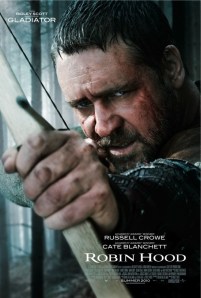
To make things clear, this movie is not really about Robin Hood. It’s about a common archer named Robin Longstride who fights in the Crusades, comes back to England, assumes another man’s identity, is adopted by a blind nobleman, ends fighting the French, and who discovers that his late father apparently wrote out the first draft of what will become the Magna Carta. Finally, at the end of the movie, Robin Longstride is declared an outlaw (or as Oscar Isaac, who plays King John, puts it, “AN OUTLAWWWWWWWWWW!) and it’s mentioned that he goes by the alias of “Robin of Hood.”
So, if you’re expecting a movie about Robin Hood or anything that is usually associated with Robin Hood — green tights, archery competitions, stealing from the rich and giving to the poor, that sort of thing — you’re pretty much out of luck.
On the face of it, this certainly isn’t an unwelcome idea. To be honest, I’ve always found whole idea of Robin Hood and his “merry men” to be a bit silly and rather dull. When it comes to English folklore, I’ve always preferred to read about King Arthur self-destructing. Add to that, it’s hard for me think about Robin Hood without thinking about the Dennis Moore episode of Monty Python’s Flying Circus.
(Remember Dennis Moore’s theme song — “Dennis Moore…Dennis Moore…He steals from the poor and gives to the rich…stupid bitch…”)
So, I really can’t complain about the way that the movie jettisons most of what one would traditionally expect from a film called Robin Hood. However, once the movie abandons tradition, it fails to come up with anything compelling to replace it with.
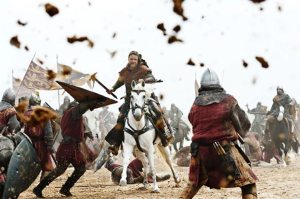
The movie opens with commoner Robin Longstride taking part in the Crusades. He’s a bitter, disillusioned archer who has grown weary of killing. So far so good. If nothing else, Ridley Scott has proven that he knows how to direct action and the early battle scenes are very well done. Robin is played by Russell Crowe and, even though he’s a bit too old for the role, Crowe has always been convincing playing men of action. Of course, this is largely because Crowe is himself a man of action but no matter. Crowe is believable in these scenes in ways that a more universally acclaimed actor like Leonardo DiCaprio never could be. It’s important that the movie convince on from the start that Robin is a master archer and both Scott and Crowe manage to do that. In fact, if the entire movie was just about an archer trying to survive of the chaos of the Crusades, it would have been a good deal better than Robin Hood.
(Speaking of archers, I’m actually quite a bit more skilled at with a bow than you probably think. Just three years ago, while visiting a city known as The Crossing, I used one shortbow and a quiver of 12 arrows to kills over 100 rats at Barana’s Shipyard. Of course, I should probably add that I was playing Dragonrealms at the time. I was a red-haired, Elven moon mage and my name was Cinzia, in honor of the Italian actress Cinzia Monreale. Sad to say, Cinzia was eventually killed by some sort of swamp monster but, while she lived, she was pretty good with a bow and arrow. But back to the movie…)
The movie starts to fall apart once Robin returns to England. In a set of circumstances that are way too tedious to go into now, Robin ends up assuming the identity of Sir Robert of Loxley and returning the crown of the dead King Richard the Lionhearted to London where it is promptly placed on the head of the new King John (Oscar Isaac).
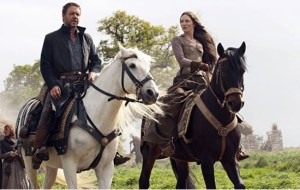
Robin then departs on a personal mission of his own. He goes up to Nottingham to return the dead Sir Robert’s sword to his father, the blind Sir Walter of Loxley (Max Von Sydow, going overboard). In Nottingham, Robin meets Robert’s widow, the maid Marian. Marian is played by Cate Blanchett who, for some odd reason, appears to be recreating his award-winning role as Katharine Hepburn in the aviator for most of her performance. Robin, to his credit, does not pretend to be “Sir Robert” when he first arrives in Nottingham. However, Walter promptly asks him to do so and in return, Walter will tell Robin all about Robin’s father. And so, again, Robin agrees to pretend to be Sir Robert.
Meanwhile, Robin has been accompanied by three friends. One of them — Little John — is played by the same guy who played Martin Keamy on Lost. These three friends — along with Friar Tuck who assures us that he’s “not a churchy-type friar” — will eventually become Robin Hood’s band of merry men though not in this movie. In this movie, they’re just four red herrings that have little to do.
King John, it would seem, is something of a neurotic tyrant so he is easily manipulated by his good friend Sir Godfrey (Mark Strong) into allowing Godfrey and his private army to roam the English countryside and “collect taxes.” What John doesn’t realize, of course, is that Godfrey is actually half-French and all of Godfrey’s soldiers actually are French. How this escape John’s attention is hard to determine as all of Godfrey’s soldiers either speak French or English with a heavy French accent.
(Actually, Sir Godfrey reminded me of another life I experimented with in Dragonrealms, a Gor’Tog Barbarian named Ironcrotch. The less said about Ironcrotch, the better.)
Anyway, Godfrey’s real mission is to be so tyrannical while collecting taxes that the English people will rise up against their king and the whole country will plunge into civil war. While this is going on, the French will then invade England and easily conquer it. As long as it took me to type all of that up and for you to read, it feels even longer when you’re sitting in a theater watching it.
On paper, at least, Ridley Scott would look like the perfect director for this movie but, other than the early battle scenes, his direction here is often rather uninspired. He seems to be bored with the movie and, for that matter, so does Russell Crowe. Crowe gives a surprisingly dull performance. You believe him as a soldier but you never believe him as a leader and that’s unfortunate because, for this movie to work, you have to believe Crowe as a man so charismatic that he could become a beloved criminal. When you consider just how talented Crowe has proven himself to be over the years, his performance here becomes even more distressing and, finally, somewhat infuriating. Once could accept a less-than-brilliant performance from someone like Jason Stathan. But this is Russell-freaking-Crowe, for the love of God!
In fact, the only actor who really seems to truly invested in his role is Oscar Isaac and he’s actually the best thing in the entire film. For over a month, I’ve been mocking the way he’s seen shouting “OUTLAWWWWW!” in the trailer for Robin Hood. Divorced from the rest of his performance, it just seems like a ludicrously over-the-top moment. However, when seen in the context of the character that he creates over the course of the film, it makes perfect sense that King John would randomly shout such things. Isaac makes plays the monarch as a spoiled brat, a hedonist given to cowardice, insecurity, and histrionics. Wisely, he never plays John as evil and, in some scenes, he almost manages to make this historically reviled man into an almost sympathetic figure, While the rest of the movie merely goes through all of the expected paces, Isaac always manages to bring something unexpected to every scene he is in. If there is any redemption to be found in Robin Hood, it is in his performance.
I should also add that, as critical as I’ve been of Robin Hood, I still enjoyed listening to all the anti-taxation, anti-government rhetoric. I only wish the movie had gone even further with the whole idea of Robin Hood as a 12th century libertarian.
In the end, what can you really say about a movie like Robin Hood? It is what it is. It’s a summer movie that’s obviously designed to serve as the launching pad for a bigger film franchise. To criticize it is to almost invite some stranger to accuse you of being a spoilsport. Summer movies are meant to be big and loud and borderline obnoxious. They’re meant to be a collection of trailer-ready scenes that can entice you into paying way too much to sit through them. Summer movies are made to make money and ultimately, the only judgment that carries any weight is the verdict of the box office.
Interestingly enough, the theater where I saw Robin Hood was deserted except for me and my friend. A lot of this, of course, is due to us attending a matinée showing but still, even a matinée will usually manage to bring in a handful of retirees who want to spend their twilight years complaining about how difficult is to hear movies nowadays. But no, on this day, it was just me and my friend.
(This worked out nicely, to be honest, because it allowed me and him to…uhmm…well, yeah, anyway. Back to the review…)
To me, that nearly deserted theater pretty much sums up Robin Hood. It’s the movie that everyone wants to see but that nobody’s going to want to watch twice. It’s the type of movie that you forget even while you’re watching it. Considering all of the talent that was involved in the making of this movie, I think the viewer is justified in expecting something just a little more.


 Through the Shattered Lens