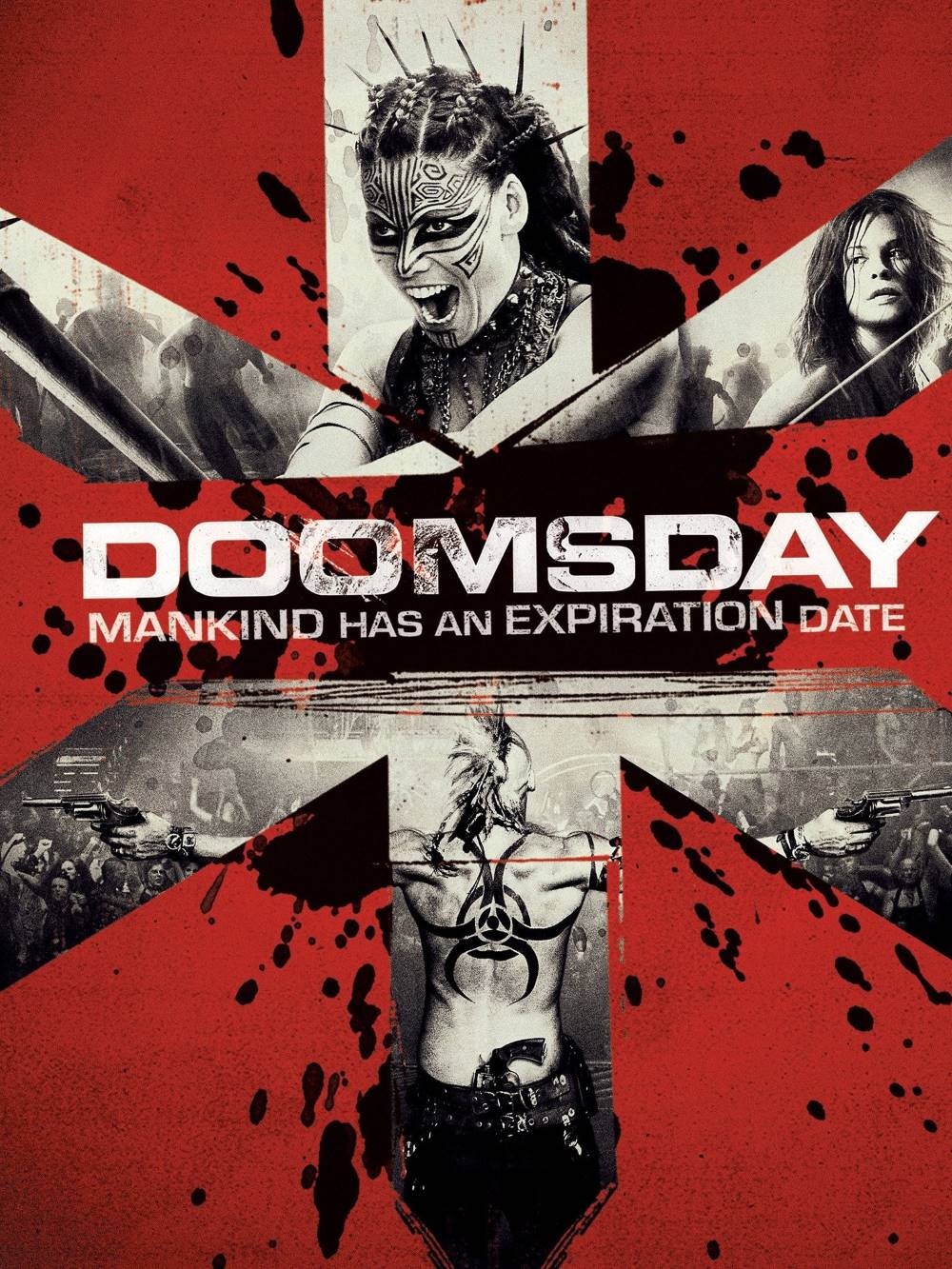
Review: Doomsday (dir. by Neil Marshall)


“Same shit, different era.” — Eden Sinclair

Doomsday tries to be a wild post-apocalyptic romp but ends up as such a profound disappointment, especially coming from Neil Marshall, whose previous two films, Dog Soldiers and The Descent, were much better entries in the horror genre where his attempts to inject new ideas landed the mark with precision and style. Here, Marshall shifts gears into a sprawling, uneven action-horror hybrid that feels like a highlight reel of better movies, bloated and unfocused where his earlier works thrived on tight scripting and fresh twists. While there are flashes of fun in the chaos, the film’s glaring flaws in plotting, tone, and originality outweigh any guilty-pleasure moments, leaving it as more of a curiosity than a recommendation.

The story kicks off with a decent hook: a deadly Reaper virus wipes out much of Scotland, prompting the government to seal it off behind a massive wall and leave the population to fend for itself. Years later, the virus resurfaces in London, and intel suggests survivors—and possibly a cure—lurk inside the quarantine zone. Major Eden Sinclair (Rhona Mitra) leads a ragtag military squad across the wall to hunt down a rogue scientist. It’s a setup that echoes classics like Escape from New York, but Doomsday quickly abandons any tension for a parade of borrowed set pieces that rarely gel, a far cry from the inventive werewolf siege of Dog Soldiers or the claustrophobic crawler terror in The Descent.

Once inside, the movie lurches from one aesthetic to the next without much logic or buildup. First comes a punk-anarchist wasteland with cannibals hosting gladiatorial freak shows amid flames and mohawks, then a sudden pivot to medieval knights in castles complete with jousts and sieges. These shifts feel arbitrary, like Marshall couldn’t decide on a vibe and just threw them all in—a scattershot approach that lacks the confident genre-blending of his prior successes. The worldbuilding is shallow—how did feudalism sprout up so neatly amid the apocalypse?—and the transitions are jarring, undermining any sense of immersion or stakes.

Rhona Mitra holds the center as Sinclair, a one-eyed badass who dispatches foes with grim efficiency, but even she can’t overcome the script’s limitations. Her character is a walking archetype: tough, quippy, and competent, with zero emotional depth or growth. The supporting players, including Malcolm McDowell as a scenery-chewing lord and Bob Hoskins as a gruff boss, are wasted on one-note roles. They’re recognizable enough to highlight how little the film does with its cast, turning potential strengths into reminders of squandered talent.

Visually, Doomsday has some grit thanks to practical effects and location shooting, especially in the grimy urban ruins and over-the-top chases that nod to Mad Max. The gore is plentiful and messy, which might appeal to splatter fans. But the action often devolves into incoherent shaky-cam slogs, and the pacing drags in spots despite the constant escalation. Worse, the film’s self-indulgent excess tips into silliness that undercuts its own grim premise, making it hard to buy the horror of the virus or the desperation of survival.

Tonally, Doomsday is all over the map, swinging from bleak quarantine dread to campy medieval farce without warning. This inconsistency is its biggest sin—serious moments clash with cartoon violence, and the humor lands flat or feels forced. Influences from 28 Days LaterThe Road Warrior, and even Excalibur are blatant, but Marshall doesn’t elevate them; he just remixes them into something louder yet less impactful. The result feels like fan fiction for genre nerds rather than a fresh take, missing the spark that made his earlier horrors stand out.

Thematically, there are glimmers of commentary on government abandonment, class divides, and viral panic, but they’re buried under the bombast and never explored. Instead of probing the ethics of walling off a nation, the film prioritizes spectacle, leaving those ideas as window dressing. It’s a missed opportunity that makes the whole endeavor feel hollow, especially when real-world parallels to pandemics could have added bite.

Doomsday struggles to stand on its own amid a crowded genre field, weighed down by narrative sloppiness and tonal whiplash that overshadow its few strengths. The positives—like visceral kills and Mitra’s presence—fail to overcome the disjointed plotting and lack of fresh ideas. Ultimately, it feels like a missed chance for something more cohesive, leaving little reason to revisit beyond a one-off curiosity.

In the end, Doomsday is a swing-and-a-miss for Neil Marshall, ambitious in scope but sloppy in execution, a letdown after the highs of Dog Soldiers and The Descent. The negatives dominate: uneven pacing, logical gaps, borrowed aesthetics without innovation, and a tone that alienates more than it entertains. If you’re in the mood for undemanding B-movie chaos on a slow night, it might scratch a minor itch. Otherwise, skip it for the films it rips off—they deliver the thrills without the frustration. At around 105 minutes, it’s not a huge time sink, but better options abound in the post-apoc genre.

Playing Catch-Up: Autumn in New York, Griffin & Phoenix, Harry & Son, The Life of David Gale


So, this year I am making a sincere effort to review every film that I see.  I know I say that every year but this time, I really mean it.

So, in an effort to catch up, here are four quick reviews of some of the movies that I watched over the past few weeks!

  • Autumn in New York
  • Released: 2000
  • Directed by Joan Chen
  • Starring Richard Gere, Winona Ryder, Anthony LaPaglia, Elaine Stritch, Vera Farmiga, Sherry Stringfield, Jill Hennessy, J.K. Simmons, Sam Trammell, Mary Beth Hurt

Richard Gere is Will, a fabulously wealthy New Yorker, who has had many girlfriends but who has never been able to find the one.  He owns a restaurant and appears on the cover of New York Magazine.  He loves food because, according to him, “Food is the only beautiful thing that truly nourishes.”

Winona Ryder is Charlotte, a hat designer who is always happy and cheerful and full of life.  She’s the type who dresses up like Emily Dickinson for Christmas and recites poetry to children, though you get the feeling that, if they ever somehow met in real life, Emily would probably get annoyed with Charlotte fairly quickly.  Actually, Charlotte might soon get to meet  Emily because she has one of those rare diseases that kills you in a year while still allowing you to look healthy and beautiful.

One night, Will and Charlotte meet and, together, they solve crimes!

No, actually, they fall in love.  This is one of those films where a young woman teaches an old man how to live again but then promptly dies so it’s not like he actually has to make a huge commitment or anything.  The film does, at least, acknowledge that Will is a lot older than Charlotte but it still doesn’t make it any less weird that Charlotte would want to spend her last year on Earth dealing with a self-centered, emotionally remote man who is old enough to be her father.  (To be honest, when it was revealed that Charlotte was the daughter of a woman who Will had previously dated, I was briefly worried that Autumn in New York was going to take an even stranger turn….)

On the positive side, the films features some pretty shots of New York and there is actually a pretty nice subplot, in which Will tries to connect with the daughter (Vera Farmiga) that he never knew he had.  Maybe if Farmiga and Ryder had switched roles, Autumn in New York would have worked out better.

  • Griffin & Phoenix
  • Released: 2006
  • Directed by Ed Stone
  • Starring Dermot Mulroney, Amanda Peet, Blair Brown, and Sarah Paulson

His name is Henry Griffin (Dermot Mulroney).

Her name is Sarah Phoenix (Amanda Peet).

Because they both have highly symbolic last names, we know that they’re meant to be together.

They both have cancer.  They’ve both been given a year to live.  Of course, they don’t realize that when they first meet and fall in love.  In fact, when Phoenix comes across several books that Griffin has purchased about dealing with being terminally ill, she assumes that Griffin bought them to try to fool her into falling in love with him.  Once they realize that they only have a year to be together, Griffin and Phoenix set out to make every moment count…

It’s a sweet-natured and unabashedly sentimental movie but, unfortunately, Dermot Mulroney and Amanda Peet have little romantic chemistry and the film is never quite as successful at inspiring tears as it should be.  When Mulroney finally allows himself to get mad and deals with his anger by vandalizing a bunch of cars, it’s not a cathartic moment.  Instead, you just find yourself wondering how Mulroney could so easily get away with destroying a stranger’s windshield in broad daylight.

  • Harry & Son
  • Released: 1986
  • Directed by Paul Newman
  • Starring Paul Newman, Robby Benson, Ellen Barkin, Wilford Brimley, Judith Ivey, Ossie Davis, Morgan Freeman, Katherine Borowitz, Maury Chaykin, Joanne Woodward

Morgan Freeman makes an early film appearance in Harry & Son, though his role is a tiny one.  He plays a factory foreman named Siemanowski who, in quick order, gets angry with and then fires a new employee named Howard Keach (Robby Benson).  Howard is the son in Harry & Son and he’s such an annoying character that you’re happy when Freeman shows up and starts yelling at the little twit.  As I said, Freeman’s role is a small one.  Freeman’s only on screen for a few minutes.  But, in that time, he calls Howard an idiot and it’s hard not to feel that he has a point.

Of course, the problem is that we’re not supposed to view Howard as being an idiot.  Instead, we’re supposed to be on Howard’s side.  Howard has ambitions to be the next Ernest Hemingway.  However, his blue-collar father, Harry (Paul Newman, who also directed), demands that Howard get a job.  Maybe, like us, he realizes how silly Howard looks whenever he gets hunched over his typewriter.  (Robby Benson tries to pull off these “deep thought” facial expressions that simply have to be seen to be believed.)  There’s actually two problems with Howard.  First off, we never believe that he could possibly come up with anything worth reading.  Secondly, it’s impossible to believe that Paul Newman could ever be the father of such an annoying little creep.

Harry, of course, has problems of his own.  He’s just lost his construction job.  He’s having to deal with the fact that he’s getting older.  Fortunately, his son introduces him to a nymphomaniac (Judith Ivey).  Eventually, it all ends with moments of triumph and tragedy, as these things often do.

As always, Newman is believable as a blue-collar guy who believes in hard work and cold beer.  The film actually gets off to a good start, with Newman using a wrecking ball to take down an old building.  But then Robby Benson shows up, hunched over that typewriter, and the film just becomes unbearable.  At least Morgan Freeman’s around to yell at the annoying little jerk.

  • The Life of David Gale
  • Released: 2003
  • Directed by Alan Parker
  • Starring Kevin Spacey, Kate Winslet, Laura Linney, Gabriel Mann, Rhona Mitra, Leon Rippy, Matt Craven, Jim Beaver, Melissa McCarthy

For the record, while I won’t shed any tears whenever Dzhokahr Tsarnaev is finally executed, I’m against the death penalty.  I think that once we accept the idea that the state has the right to execute people, it becomes a lot easier to accept the idea that the state has the right to do a lot of other things.  Plus, there’s always the danger of innocent people being sent to die.  The Life of David Gale also claims to be against the death penalty but it’s so obnoxious and self-righteous that I doubt it changed anyone’s mind.

David Gale (Kevin Spacey) used to the head of the philosophy department at the University of Texas.  He used to be a nationally renowned activist against the death penalty.  But then he was arrested for and convicted of the murder of another activist, Constance Harraway (Laura Linney) and now David Gale is sitting on death row himself.  With his execution approaching, journalist Bitsey Bloom (Kate Winslet) is convinced that Gale was framed and she finds herself racing against time to prevent Texas from executing an innocent man…

There’s a lot of things wrong with The Life of David Gale.  First off, it was made during the Bush administration, so the whole film is basically just a hate letter to the state of Texas.  Never have I heard so many inauthentic accents in one film.  Secondly, only in a truly bad movie, can someone have a name like Bitsey Bloom.  Third, the whole film ends with this big twist that makes absolutely no sense and which nearly inspired me to throw a shoe at the TV.

Of course, the main problem with the film is that we’re asked to sympathize with a character played by Kevin Spacey.  Even before Kevin Spacey was revealed to be a sleazy perv, he was never a particularly sympathetic or really even that versatile of an actor.  (Both American Beauty and House of Cards tried to disguise this fact by surrounding him with cartoonish caricatures.)  Spacey’s so snarky and condescending as Gale that, even if he is innocent of murder, it’s hard not to feel that maybe David Gale should be executed for crimes against likability.

The Things You Find On Netflix: The Loft (dir by Erik Van Looy)


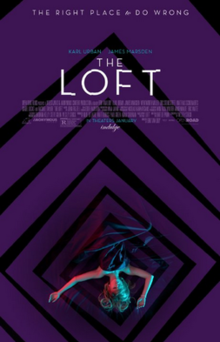
The_Loft_film_poster

The Loft‘s journey to Neftlix was a long one.

A remake of a Belgian film, The Loft was originally filmed in 2011 and was meant to come out in that year.  It was due to be released by Joel Silver’s Dark Castle Entertainment and Warner Bros.  However, when Silver had a falling out with Warner Bros and moved his operations over to Universal, he took The Loft with him.  And it turned out that Universal was in no hurry to distribute The Loft.  After sitting on the film for three years, Universal announced that they would release it in August of 2014 but, at the last minute, they changed their mind and instead released the horror film As Above, So Below in the spot that was originally set aside for The Loft.  Dark Castle then dropped the film, leaving The Loft in limbo until Open Road Pictures picked up the distribution rights and gave it a limited release in January of 2015.  The critics hated it, audiences were indifferent, and The Loft quickly vanished from theaters.  It’s now available on Netflix.

And, having watched the film, I can understand why the studios weren’t exactly enthused about it.  It’s not the type of film that works on the big screen.  The characters are too unlikable.  The plot is an unstable combination of silliness and melodrama.  The big twists are more likely to inspire groans than cheers.  It’s just not the type of film that you want to spend too much money on.

And yet, it’s the perfect film for Netflix.  What may seem over-the-top and annoying when viewed in a public theater becomes a lot more entertaining when viewed in the privacy on your own home.  The Loft is a film that works best if you don’t spend too much time thinking about how little sense it all makes.  It’s the perfect film to watch while you’re doing something else.

And if that sounds like faint praise, it’s not.  I thoroughly enjoyed The Loft without once mistaking it for being a “good” film.  Instead, it’s an over-the-top melodrama, with all that entails.  It’s ludicrous, it’s silly, and — when taken on its own terms — it’s also a lot of fun.

The film is about five friends and the loft to which they all have a key.  All five of the friends are married and all five of them have secrets.  Vincent (Karl Urban) is the unofficial leader of this group of friends, an architect who is also a compulsive cheater.  Luke (Wentworth Miller) is a nervous guy who appears to worship Vincent.  Marty (Eric Stonestreet) is an alcoholic who always manages to say the wrong thing.  Chris (James Marsden) is a psychiatrist who often seems to feel that he’s morally superior to his other friends.  And Phillip (Mattias Schoenarts) is Chris’s half-brother, a mentally unstable and violent guy who snorts cocaine and may have incestuous feelings towards his younger sister.

The five men use the loft to cheat on their wives.  The men are all confident that only they know about the existence of the loft and that they are the only ones who have a key.  So, naturally enough, they are all a little shocked when a woman turns up dead in the loft.  As the men gather in the loft, they debate who killed her and we get numerous flashbacks to how this all came to be.

Of course, it all leads to many secrets being revealed.  This is one of those films that simply cannot stop with one plot twist.  Instead, every twist leads to another twist until eventually, it becomes nearly impossible to keep up with who knows what.  In fact, the film features so many twists that it all quickly gets a bit silly.  But, at the same time, it’s also undeniably entertaining.  Strangely enough, the fact that it doesn’t make much sense only add to the film’s melodramatic charm.

As for the five men — well, none of them are particularly likable but at least they’re all interesting to watch.  Wentworth Miller is properly strange, Matthias Schoenarts is properly sleazy, and Eric Stonestreet is properly pathetic.  James Marsden often seems wasted in mainstream films (like Straw Dogs and The Butler) but he’s actually very charming when he appears in B-movies like this one and Walk of Shame.  And finally, you’ve got Karl Urban, doing great work and turning Vincent into the epitome of every middle-aged guy who has ever tried to flirt with me while I was waiting at a red light.

The Loft may not have got much respect when it was released into theaters but it’s entertaining enough for Netflix.

http://www.youtube.com/watch?v=GdVMCx3J6jo