Icarus File No. 24: Express to Terror (dir by Dan Curtis)


The year was 1979 and Fred Silverman, the president of NBC, had an idea.

How about a television series in which each week’s episode would depict a different group of passengers going on a trip?  The passengers would all be dealing with their own stories, some of which would be dramatic and some of which would be humorous.  With any luck, some of them might even fall in love over the course of their journey!

To keep the audience interested, the show would also feature a cast of regular characters, the crew.  Edward Andrews would play the captain, a sensible and by-the-book type.  Robert Alda played Doc, the doctor who was also a bon vivant.  Patrick Collins was the goofy purser.  Nita Talbot played Rose, the perky director of entertainment.  Michael DeLano was the bartender who always had the best advice for the passengers….

Does this sound familiar?

If you think that it sounds like Fred Silverman just ripped off The Love Boat …. well, you’re wrong.  The Love Boat took place on a boat.  Supertrain took place on a train.

At the time that Supertrain went into production, it was the most expensive television production of all time.  Before the pilot film was even shot, NBC had spent ten million dollars on the Supertrain sets.  Not only was a fake train built but two models were also constructed for the shots of the train moving through the countryside.  At the time, the assumption was that the costs would be easily covered by the money that NBC stood to make from broadcasting the 1980 Summer Olympics.  Unfortunately, Jimmy Carter decided that the U.S. would be boycotting the Olympics as a way to protest Russia’s invasion of Afghanistan.  The only thing that kept NBC from going bankrupt was that the BBC was apparently run by someone even more incompetent than Fred Silverman.  The BBC paid $25,oo per episode for the rights to air Supertrain in the UK.  Supertrain proved to be such a disaster that the BBC never actually aired the episodes that they had purchased.

1979’s Express to Terror was the pilot to Supertrain.  (It was later released in some territories as a stand-alone film.)  Directed by horror impresario Dan Curtis (who was also brought in to produce the series), Express to Terror opens with an apparently drunk Keenan Wynn playing the role of railway baron Winfield Root.   Winfield loudly announces to a group of nervous investors that he has created ” an atom-powered steam turbine machine capable of crossing this country in 36 hours!”  A few months later, Supertrain sets off from New York to Los Angeles.

The main thing that one notices about the train is that it’s incredibly tacky.  For all the money that Winfield Root (not to mention NBC) poured into the thing, it looks awful.  The cabins are bland and also seem to be constantly shaking as the train rumbles over its tracks.  Whereas The Love Boat featured glorious shots of passengers enjoying themselves on an open-air deck, Express to Terror features a lot of shots of passengers trying to squeeze their way through narrow and crowded hallways.  There’s a disco car, which sounds like fun but actually looks like a prom being held in a locker room.  There’s a swimming pool but you can’t really lay out by it because it’s on a train.  Winfield is among the passengers and he continually refers to the train as being “Supertrain” in conversation, which just sounds dumb.  “The next person who stops Supertrain,” he announces “will be walking to L.A!”

The main drama features Steve Lawrence as Mike Post, a Hollywood agent with a gambling problem who thinks that someone on the train is trying to kill him.  Actually, the assassin is after a different Mike Post (Don Stroud) but that Mike Post is a criminal who, after entering the witness protection program, changed his name to Jack Fisk.  The criminal Post is hoping that the agent Post will be killed by mistake.  The criminal Mike Post has a girlfriend named Cindy (Char Fontane) who falls in love with the agent Mike Post.  Fred Williamson appears as a football player-turned-assassin.  George Hamilton plays a Hollywood executive.  Don Meredith is the alcoholic best friend of the agent Mike Post.  Stella Stevens is on the train as a diva.  So is Vicki Lawrence, playing a naive innocent.

Express to Terror tries to mix comedy and drama but it doesn’t really work because the “Good” Mike Post doesn’t really seem to be worth all the trouble.  Steve Lawrence gives a mind-numbingly bad performance in the role and, as a result, “Good” Mike Post really isn’t any more sympathetic than “Bad” Mike Post.  The main problem is that “Good” Mike Post comes across as being a coward and there’s only so much time that you can watch a coward act cowardly before you lose sympathy for him.  Being scared is one thing.  Being so dumb that accidentally gets your fingerprints on a knife that’s just been used to kill a man is another thing.

As for the members of the crew — the captain, the doctor, the bartender, and such, they take a back seat to the drama of the two Mike Posts.  It’s a bit odd because no one on the train — not even Winfield Root — seems to be that upset by the fact that one of their passengers is murdered while the train is going through a tunnel.  You would think that everyone would be worried about the future of Supertrain at that point.  A murder is not good for publicity but Winfield Root is oddly unconcerned about it.  I swear, light rail people are almost as heartless as bicyclists!

Of course, the worst thing about Express to Terror is that it promises terror but it doesn’t deliver.  When I see a the word “terror” in a film directed by Dan Curtis, I expect a little terror!  Other than Steve Lawrence’s overacting, there really wasn’t anything particularly terrifying about Express to Terror.

As for Supertrain, it ran for nine episodes and was promptly canceled.  Fred Silverman left NBC and spent the rest of his career as an independent producer.  Supertrain’s tracks got too close to the sun and they nearly took down a network.

Previous Icarus Files:

  1. Cloud Atlas
  2. Maximum Overdrive
  3. Glass
  4. Captive State
  5. Mother!
  6. The Man Who Killed Don Quixote
  7. Last Days
  8. Plan 9 From Outer Space
  9. The Last Movie
  10. 88
  11. The Bonfire of the Vanities
  12. Birdemic
  13. Birdemic 2: The Resurrection 
  14. Last Exit To Brooklyn
  15. Glen or Glenda
  16. The Assassination of Trotsky
  17. Che!
  18. Brewster McCloud
  19. American Traitor: The Trial of Axis Sally
  20. Tough Guys Don’t Dance
  21. Reach Me
  22. Revolution
  23. The Last Tycoon

The Unnominated #20: The Ninth Configuration (dir by William Peter Blatty)


Though the Academy of Motion Picture Arts and Sciences claim that the Oscars honor the best of the year, we all know that there are always worthy films and performances that end up getting overlooked.  Sometimes, it’s because the competition too fierce.  Sometimes, it’s because the film itself was too controversial.  Often, it’s just a case of a film’s quality not being fully recognized until years after its initial released.  This series of reviews takes a look at the films and performances that should have been nominated but were, for whatever reason, overlooked.  These are the Unnominated.

Some films defy easy description and that’s certainly the case with 1980’s The Ninth Configuration.

The film opens with a shot of a castle sitting atop of a fog-shrouded mountain.  A voice over tells us that, in the early 70s, the castle was used by the U.S. government to house military personnel who were suffering from mental illness.  Inside the castle, the patients appear to be left to their own devices.  Lt. Reno (Jason Miller) is trying to teach dog how to perform Shakespeare.  Astronaut Billy Cutshaw (Scott Wilson) is haunted by the thought of being alone in space and refuses to reveal why he, at the last minute, refused to go to the moon.  The men are watched over by weary and somewhat sinister-look guards, who are played by actors like Joe Spinell and Neville Brand.

Colonel Kane (Stacy Keach) shows up as the new commandant of the the castle.  From the first minute that we see Kane, we get the feeling that there might be something off about him.  Though he says that his main concern is to help the patients, the man himself seems to be holding back secrets of his own.  With the help of Colonel Fell (Ed Flanders, giving an excellent performance), Kane gets to know the patients and the guards.  (Despite the objections of the guards, Kane says that his office must always be unlocked and open to anyone who want to see him.)  He takes a special interest in Cutsaw and the two frequently debate the existence of God.  The formerly religious Cutshaw believes the universe is empty and that leaving Earth means being alone.  Kane disagrees and promises that, should he die, he will send proof of the afterlife.  At night, though, Kane is haunted by dreams of a soldier who went on a murderous rampage in Vietnam.

The film start out as a broad comedy, with Keach’s smoldering intensity being matched with things like Jason Miller trying to get the dogs to perform Hamlet.  As things progress, the film becomes a seriously and thoughtful meditation on belief and faith, with characters like Kane, Billy, and Colonel Fell revealing themselves to be quite different from who the viewer originally assumed them to be.  By the time Kane and Cutshaw meet a group of villainous bikers (including Richard Lynch), the film becomes a horror film as we learn what one character is truly capable of doing.  The film then ends with a simple and emotional scene, one that is so well-done that it’ll bring tears to the eyes of those who are willing to stick with the entire movie.

Considering all of the tonal shifts, it’s not surprising that the Hollywood studios didn’t know what to make of The Ninth Configuration.  The film was written and directed by William Peter Blatty, the man who wrote the novel and the script for The Exorcist.  (The Ninth Configuration was itself based on a novel that Blatty wrote before The Exorcist.)  By most reports, the studio execs to whom Blatty pitched the project were hoping for another work of shocking horror.  Instead, what they got was an enigmatic meditation on belief and redemption.  The Ninth Configuration had the same themes as The Exorcist but it dealt with them far differently.  (Because he wrote genre fiction, it’s often overlooked that Blatty was one of the best Catholic writers of his time.)  In the end, Blatty ended up funding and producing the film himself.  That allowed him complete creative control and it also allowed him to make a truly unique and thought-provoking film.

The Ninth Configuration was probably too weird for the Academy.  Though it received some Golden Globe nomination, The Ninth Configuration was ignored by the Oscars.  Admittedly, 1980 was a strong year and it’s hard to really look at the films that were nominated for Best Picture and say, “That one should be dropped.”  Still, one can very much argue that both Blatty’s script and the atmospheric cinematography were unfairly snubbed.  As well, it’s a shame that there was no room for either Stacy Keach or Scott Wilson amongst the acting nominee.  Keach, to date, has never received an Oscar nomination.  Scott Wilson died in 2018, beloved from film lovers but never nominated by the Academy.  Both of them give career-best performances in The Ninth Configuration and it’s a shame that there apparently wasn’t any room to honor either one of them.

The Ninth Configuration is not a film for everyone but, if you have the patience, it’s an unforgettable viewing experience.

Previous Entries In The Unnominated:

  1. Auto Focus 
  2. Star 80
  3. Monty Python and The Holy Grail
  4. Johnny Got His Gun
  5. Saint Jack
  6. Office Space
  7. Play Misty For Me
  8. The Long Riders
  9. Mean Streets
  10. The Long Goodbye
  11. The General
  12. Tombstone
  13. Heat
  14. Kansas City Bomber
  15. Touch of Evil
  16. The Mortal Storm
  17. Honky Tonk Man
  18. Two-Lane Blacktop
  19. The Terminator

Horror On TV: The Curse of Degrassi (dir by Stefan Brogren)


Can you believe it?  The first day of Horrorthon is nearly over!  I’ve got tears in my mismatched eyes.

You may remember, from previous horrorthons, that I like to end each day in October by sharing a classic example of televised horror.  Much as with the the horror movies that I share at the start of each day, it should be remembered that I’m a bit at the whim of YouTube here.  If YouTube decides to yank down a video after I share it on this site, there’s nothing that I can do about it.  That’s why I encourage everyone to watch these now!  Don’t wait until 2035.  Who knows if YouTube will even still be a thing in 2035?

Let’s start things off with The Curse of Degrassi!

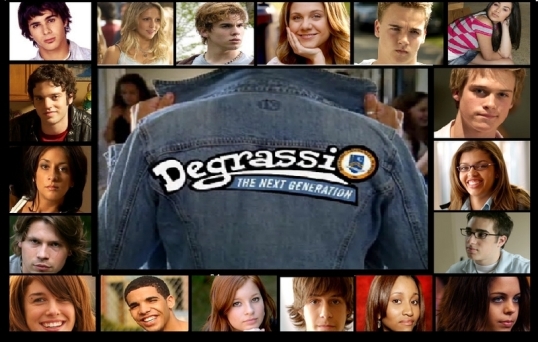
This is a special episode of my favorite TV show of all, Degrassi: The Next Generation!  Originally airing on October 28th, 2008, The Curse of Degrassi features Degrassi’s then-main mean girl, Holy J Sinclair (Charlotte Arnold), getting possessed by the vengeful spirit of deceased school shooter, Rick Murray (Ephraim Ellis).  Chaos follows!  Fortunately, Spinner (Shane Kippel) is around to save the day.  As any true Degrassi fan can tell you, only Spinner has a chance against the forces of the undead.

Enjoy The Curse of Degrassi.  As we say around these parts, “It goes there, eh?”

October Hacks: He Knows You’re Alone (dir by Armand Mastroianni)


198o’s He Knows You’re Alone opens with a young couple making out in a car.  (The guy, who is named Don, is played by Russell Todd, the devastatingly handsome actor who played the first victim in Friday the 13th Part II.)  A report comes over the radio.  There’s a killer on the loose.  The girl is concerned.  The guy is cocky.  It’s hard not to notice that both of them look a little bit too old to be playing high school students.  Suddenly the killer attacks and….

We sitting in a movie theater, watching as two friends, Ruthie (Robin Lamont) and Marie (Robin Tilgham), watch the film.  Marie covers her eyes while Ruthie announces, excitedly, that the couple is going to die.  Marie, uncomfortable with the onscreen violence, goes to the washroom.  She splashes water on her face.  She catches her breath.  When she returns to the theater, Ruthie is excited because the girl on screen is about get slashed by her stalker.  Marie hides her eyes.  Just as the girl onscreen screams, the man sitting behind Marie drives a knife into the back of her neck, killing her.

It’s a brilliantly edited sequence, one that comments on how audiences love depictions of violence while fearing it in real life.  It’s also a genuinely scary sequence, especially if you’re someone who frequently goes to the movies.  (Would the sequence have the same impact on someone who has grown up almost exclusively in the streaming age?  Probably not.)  It’s a sequence that shows a hint of a self-awareness that was lacking in many 80s slasher films.  It’s also so good that the rest of the film struggles to live up to it.

The killer in He Knows You’re Alone is Ray Carlton (played with wild-eyed intensity by Tom Rolfing), a serial killer who preys on women who are engage to be married.  While Detective Len Gamble (Lewis Arlt) tries to track down Ray and get revenge for the murder of his fiancée, Ray stalks Amy Jenson (Caitlin O’Heaney) and her bridesmaids, Nancy (Elizabeth Kemp) and Joyce (Patsy Pease).  (Why Ray focuses on the bridesmaids before going after Amy is never really explained.)

We also meet a few red herrings, all of whom would probably be suspects if the film hadn’t already shown us that Ray is the murderer.  Joyce is having an affair with a married professor named Carl (James Rebhorn).  While we don’t really get to know Amy’s fiancé, we do spend a good deal of time with her ex-boyfriend, hyperactive morgue attendant Marvin (Don Scardino).  We also meet Nancy’s date for the weekend, a psych major named Elliott (Tom Hanks).  This was Hanks’s film debut and, even though he doesn’t get much screentime, he’s  so instantly likable that it’s easy to understand why he became a star.

As I mentioned earlier, the rest of He Knows You’re Alone struggles to live up to its opening moments.  That doesn’t meant that He Knows You’re Alone is a bad movie.  Though there are a few scenes that comes across as being filler, it’s still an effective slasher film.  The fact that the killer is just some anonymous loser as opposed to a Freddy Krueger-style quip machine makes him all the more frightening.  Ray Carlton is a killer who you can actually imagine siting behind you, preparing to strike.  The film also makes good use of its chilly Long Island locations.  There’s a grittiness to the film that leaves the viewer feeling as if the world itself is decaying along with Ray’s victims.

And then there’s Tom Hanks, a ray of cheerfulness amidst the drabness of the Mid-Atlantic hellhole that is New York.  At one point, his psych student talks about how scary stories and movies can help people deal with the horrors of the real world, another hint that this film was more self-aware than the usual slasher flick.  Originally, Hanks’s character was meant to be one of Ray’s victims but director Amand Mastroianni (who later went on to direct several episodes of Friday the 13th: The Series) said that Hanks proved to be so likable in the role that no one could stand the thought of killing him off.

He Knows You’re Alone is an effective little slasher flick.  Watch it with the lights on.  You never know who might be behind you.


Amityville Horror Review: Amityville Toolbox (dir by Dustin Ferguson)


To be absolutely honest with you, I’m starting to think that the Amityville films aren’t exactly being honest about the whole “based on a true story” thing.

I mean, on the one hand, it is true that, in the early 70s, a teenage heroin addict named Ronald DeFeo murdered his family in their home in Amityville, New York.  Perhaps realizing that there was no way anyone was going to buy his original claim that the Mafia killed his entire family but somehow left him alive, Ronald DeFeo eventually claimed that he had been possessed by a demon.  Some people believed that story because some people will believe anything that involves demon possession.

It’s also true that a family called the Lutzes moved into the Amityville murder house and then moved out a few weeks later and claimed that they had been haunted by the same demons that drove Ronald DeFeo to kill.  It was a stupid story but it played into the 70s’s obsession with the apocalypse and demonic possession.  It was the decade of The Exorcist and The Omen.  A non-fiction novel was published and it became a best-seller.  In 1979, a movie was made and it became a hit.   And, in the years since, there have been over 50 films with the words “Amityville” in the title.  Some of those films have been actual Amityville films and some of them have just been generic low-budget horror flicks that just borrowed the term.  What they all have in common is the claim that the Ronald DeFeo was possessed by Satan and that the Lutzes weren’t lying about the house being haunted.  Of course, if there really is an Amityville Demon, it’s probably seriously pissed off by now,  These films do not make him look good.

The current popular gimmick is the idea that even things that used to be in the Amityville house have been filled with demonic energy that they still carry with them, even outside of the house.  2016’s Amityville Toolbox features Mark (played by Mark Popejoy) receiving a toy monkey for his 50th birthday.  No sooner has he unwrapped the monkey then he’s acting moody, drinking alcohol after years of sobriety, and then chopping wood with an axe.  His family, who have gathered at his country home for the weekend, watch him and wonder if anything’s wrong with Dad.  Well, he’s wandering around with an axe and now he’s loading a shotgun so what do you think?

Directed by Dustin Ferguson, Amityville Toolbox is a low-budget film that features dialogue that feels like it’s been improvised.  Up until Mark finally listens to the vengeful ghost of his father (Colby Coash) and finally starts doing the full DeFeo to his family, the pace is almost torturously slow.  That said, the film actually has a few fairly good shots.  A tracking shot down the foggy road leading to Mark’s home is a hundred times more creepy than it has any right to be.  Colby Coash is properly intimidating as the evil spirit and Mark Popejoy does a credible-enough job as the disturbed father who handles his midlife crisis in the worst way possible. Mark snaps and it’s actually a bit disturbing.   The rest of the cast is struggles with their underdeveloped characters but some of the visuals are primitively effective.

That said, I think Mark was more to blame for his actions than the Amityville house or the toy monkey.  Sometimes, even murderers need to take responsibility for their choices.

Previous TSL Amityville Reviews:

  1. The Amityville Horror (1979)
  2. Amityville II: The Possession (1981)
  3. The Amityville Cure (1990)
  4. The Amityville Haunting (2011)
  5. Amityville Death House (2015)
  6. Amityville: The Awakening (2017)
  7. The Amityville Murders (2018)
  8. Amityville Cop (2021)
  9. Amityville Emanuelle (2023)

The TSL Horror Grindhouse: The Last House On The Left (dir by Wes Craven)


The year is 1972 and the news is grim.  The fighting continues in Vietnam.  The protests continue at home.  Crime is rising.  The economy is struggling.  Groups like the Weathermen and the SLA are talking about taking the revolution to the streets.  In New York, the notorious murderers Krug Stillo (David Hess) and Fred “Weasel” Podowksi (Fred Lincoln) have broken out of prison and are one the run.  They are believed to be traveling with Krug’s drug-addicted son, Junior (Marc Sheffler), and a woman named Sadie (Jeramie Rain), who is said to be feral and bloodthirsty.

However, Mari Collingwood (Sandra Cassel) doesn’t care about any of that.  She’s just turned seventeen and she can’t wait to go to her first concert with her best friend, Phyllis (Lucy Grantham).  Mari is naive, optimistic, and comes from from a comfortably middle-class family.  Phyllis is a bit more worldly and tougher.  As she explains it, her family works in “iron and steel.”  “My mother irons, my father steals.”

While Mari’s parents (Richard Towers and Eleanor Shaw, though they were credited as Gaylord St. James and Cynthia Carr) bake a cake and prepare for Mari’s birthday party, Mari heads into the city with Phyllis.  Before they go to the concert, they want to buy some weed.  When they see Junior Stillo hanging out on a street corner, they assume he must be a dealer and they approach him.  Junior takes them to an apartment, where they are grabbed by Weasel and Krug.

1972’s The Last House On The Left was advertised with the classic (and much-repeated line), “To avoid fainting, keep repeating, ‘It’s only a movie …. it’s only a movie…. it’s only a movie….”  That advice is easy to remember during the first part of the film because, up until Mari and Phyllis approach Junior, the movie is fairly cartoonish, with Richard Towers giving an incredibly bad performance as Mari’s father.  This film was Wes Craven’s debut as both a director and a writer.  By his own admission, Craven had no idea what teenage girls would talk about and, as such, he just wrote a lot of dialogue in which Mari talked about her breasts and Mari’s mother complaining that young women no longer wore bras.  (On the commentary that he recorded for the film’s DVD release, Craven succinctly explained, “I guess I was obsessed with breasts.”)  This part of the film plays out like a weird counter-culture comedy.  Even when we first meet Krug, he’s using his cigar to pop a little kid’s balloon.

The Last House On The Left (1972, dir by Wes Craven, DP: Victor Hurwitz)

The tone of the film jarringly shifts the minute that Mari and Phyllis step into that apartment.  That’s largely due to the performances of David Hess and Fred Lincoln, who are both so convincing in their roles that it can be difficult to watch them.  In real life, Fred Lincoln was a stuntman (he’s in The French Connection) and an adult film actor.  David Hess, meanwhile, was a songwriter who was looking to break into acting.  (Hess’s songs — some of which are beautifully sad and some of which are disturbingly jaunty — are heard throughout the movie.)  Hess, in particular, is so frightening as Krug that he spent the rest of his career typecast as sociopathic murderers.  The middle part of the film alternates between disturbingly realistic scenes of Mari and Phyllis being tortured and humiliated and cartoonish scenes involving two incompetent cops (one whom is played by Martin Kove) and Mari’s parents.  Phyllis is murdered and dismembered in a graveyard and the gore effects remains disturbingly realistic even when seen today.  Mari, after being raped by Krug, recites a prayer, and then wades into a nearby lake.  Krug shoots her three times.  Afterwards, Krug, Weasel, and Sadie try to wash the blood off of themselves, the expression on their faces indicating that even they understand that they’ve gone too far.

Eventually, Krug, Weasel, Sadie, and Junior stop off at a nearby house, claiming to be salespeople who just had a little car trouble.  What they don’t realize is that the people who are generously welcoming them to spend the night are also the parents of Mari Collingwood….

Basing his script on Ingmar Bergman’s The Virgin Spring, Wes Craven has often said that The Last House On The Left was meant to be a commentary on the Vietnam War and the way that other films had glamourized violence.  That may or may not be true.  (Craven has also said that, at the time, he was so desperate to direct a movie that he would have filmed almost anything.)  What is true is that the violence in Last House On The Left is not easy to watch.  Once it starts, it’s relentless and, at no point, is the audience given an escape.  David Hess is so committed to playing a sadist that he never takes a moment to wink at the audience and say, “Hey, we’re just playacting here!”  Craven shot the film in a guerilla style and the shaky camera, the natural light, and the grainy images leave you feeling as if you’re watching some sicko’s home movies.  At the end of the movie, when Mari’s parents take the same joy in attacking her killers as Krug took in attacking their daughter, it’s hard not to feel that Mari has been forgotten.  Everyone has been consumed by the violence that has erupted around them.  Even though Richard Towers’s nearly blows the ending with a few hammy line readings, the film still leaves you exhausted.

The Last House on the Left (1972, dir. by Wes Craven, DP: Victor Hurwitz)

Not surprisingly, The Last House On The Left was attacked by most reviewers when it was originally released.  The movie played the drive-in and grindhouse circuit for three years, with producer Sean Cunningham often taking out advertisements in local newspapers that read: “You will hate the people who perpetrate these outrages—and you should! But if a movie—and it is only a movie—can arouse you to such extreme emotion then the film director has succeeded … The movie makes a plea for an end to all the senseless violence and inhuman cruelty that has become so much a part of the times in which we live.”  The film’s advertisements also contained a warning that no one under 30 should see the movie.  Needless to say, The Last House On The Left was a huge hit, especially with viewers under 30.

(One of the great ironies of film criticism is that one of the few critics to defend Last House On The Left was Roger Ebert.  Ebert, who would later be one of the slasher genre’s biggest attackers, gave Last House On The Left a very complimentary review and praised it for its political subtext.)

Seen today, The Last House On The Left still packs a punch.  It’s a shocking and shamelessly sordid film, one that shows hints of the talent that would make Wes Craven one of the most important directors to work in the horror genre.  It’s flawed, it’s exploitive, it’s thoroughly unpleasant, and yet it’s also a film that sticks with you.  It’s powerful almost despite itself.  It’s not a movie that I would necessarily chose to watch on a regular basis but, at the same time, I can recognize it as being a historically important film.  For better or worse, much of modern American horror owes a debt to Wes Craven’s Last House On The Left.  Even today, when one is regularly bombarded with horrific images, Last House On The Left still has the power to shock.

Retro Television Review: The Love Boat 6.20 “The Zinging Valentine/The Very Temporary Secretary/Final Score”


Welcome to Retro Television Reviews, a feature where we review some of our favorite and least favorite shows of the past!  On Wednesdays, I will be reviewing the original Love Boat, which aired on ABC from 1977 to 1986!  The series can be streamed on Paramount Plus!

Set a course for adventure, your mind on a new romance!

Episode 6.20 “The Zinging Valentine/The Very Temporary Secretary/Final Score”

(Dir by Richard Kinon, originally aired on February 12th, 1983)

It’s a Valentine’s Day cruise!

A football player (John Amos) tries to romance an intellectual college professor (Jayne Kennedy) who doesn’t care about sports.  The professor is impressed when the player reveals that he’s written a book.  But she’s shocked when she reads it and discovers how much time the player spent scoring off-the-field.

The head of a temp agency (Don Adams) comes on the boat to inform a magazine editor (Fannie Flagg) that he hasn’t been able to find a secretary for her.  But, when he meets her, Adams pretends to be the secretary, even though he doesn’t know how to take dictation or type.

Don Most is a cocky jerk who is informed by a singing telegram girl (Suzie Scott) that his girlfriend is dumping him.  Most gets upset.  Scott goes to look for him so she can apologize but — uh oh!  The ship sets sail!  Scott is stuck on the boat but, believe it or not!, she and Don Most eventually end up falling in love.

This was a sweet, uncomplicated, and likably lightweight episode.  At its best, The Love Boat was the epitome of television comfort food.  It’s a show that you watch because you know exactly what’s going to happen and you also know that everyone is going to get a happy ending.  This episode features likable guest stars (and yes, I’m including Don Adams, who was a lot more likable here than he was on Check It Out) and all the romance that you could hope for.  Personally, I loved that the ship was decorated for Valentine’s Day.  All of those hearts?  They totally made me want to take a cruise next February.  (Hint, hint….)

This episode also featured scenes in which all of the guest stars interacted with each other and discussed their problems.  I don’t think I’ve ever seen that on The Love Boat before.  Usually, the guest stars only interact with the people in their stories.  Instead, for this episode, we got scenes of Jayne Kennedy telling Fannie Flagg about how much she liked her magazine.  Suzie Scott told Kennedy and Flagg about how tough it was having to delivers singing messages for people.  Seeing Don Most, John Amos, and Don Adams sitting in the Pirate’s Cove and discussing their problems while Isaac watched was surprisingly entertaining.  In this episode, the boat felt truly alive and active.  It seemed like a genuinely fun cruise and a reminder that the Love Boat offers something for everyone.

This was a likable episode.  I enjoyed it.  Listen, just because I love horror movies, that doesn’t mean I can’t love my weekly cruise on the Love Boat!

Horror Book Review: Driver’s Dead by Peter Lerangis


Poor Kirsten!

In the 1994 novel Driver’s Dead, teenage Kirsten is not only currently living in a house that she thinks might be haunted by the ghost of the son of the previous owners but she’s also somehow gotten a reputation for being a bad driver!  (Ironically enough, the son of the previous owners was also killed in a car crash …. or was he?)

When it come to having one’s driving unfairly criticized, I could relate to Kirsten.  I can still remember the pain of those days when I was “learning” how to drive.  Learning is in quotes because, quite frankly, I already knew how to drive.  I had seen enough TV shows and gone on enough road trips with my family to know which pedal to push and how to turn the steering wheel.  And yet, every driving instructor that I had to deal with insisted on being like totally critical of me.  One of the first times that I drove on the road, I got yelled at by the instructor because I didn’t look both ways before making a lane change.

“I looked in the rearview mirror!” I snapped.

Apparently, that was not the right answer because she kept yelling at me until I finally said, “How am I supposed to concentrate on driving with you talking all the time!?”

That also did not go over well.  That particular instructor refused to ride with me anymore.  I went home in tears so my mother went up to the school and yelled at all of the instructors for being rude to me.  The next time I drove, it was with the owner of the school, who was much nicer to me.  The owner of the school asked me if I had a lazy eye.  “Not anymore,” I replied.

Anyway, you get my point.  I somehow managed to get my license despite having to deal with some pretty clueless driving instructors.

Anyway, back to Driver’s Dead.  Kirsten decides to deal with her driving struggles by getting some help from Rob.  Rob shows her how to drive but it turns out that his father is a big-time racist and Rob is kind of a jerk as well.  When Rob tries to grope her, Kirsten tells him to get lost.  (Yay!)  Then Rob turns up dead.  Uh-oh.

Who murdered Rob and how is it connected to the blood that keeps seeping out from underneath the closet in Kirsten’s bedroom?  And what to make of Mr. Busk, the alcoholic driver’s teacher who has apparently never gotten over his experiences in Vietnam?

Driver’s Dead is a YA book from the mid-90s so it’s definitely a bit dated.  Check out the reference to floppy disks and running DOS on a computer!  Check out Kirsten’s crush on Jason Priestly!  But I still found it to be entertaining because Kirsten was a likable character and the plot neatly mixed the supernatural with a standard YA mystery story.

Plus, who can’t relate to being a better driver than most people realize?  Ghosts and murder aside, I shared Kirsten’s struggle.


October True Crime: In Cold Blood (dir by Richard Brooks)


In 1959, the Clutter Family was murdered in Holcomb, Kansas.

Herbert Clutter was a farmer and was considered to be prosperous by the standards of small-town Holcomb.  Neither he nor his wife nor his teenage son and daughter were known to have any enemies.  The brutality of their deaths took not just the town but the entire state by surprise.  People like the Clutters were not supposed to be brutally murdered.  They certainly weren’t supposed to be brutally murdered in a tight-knit community like Holcomb or in a state like Kansas.

The Clutters

The author Truman Capote traveled to Holcomb with his friend Harper Lee, looking to write a story about how the heartland was dealing with such a brutal crime.  Six weeks after the murders, while Capote and Lee were still conducting their interviews, two small-time criminals named Dick Hickock and Perry Smith were arrested for the crime.  Capote’s proposed article about Holcomb instead became the basis for his best-known book, In Cold Blood.  Capote followed the case from the initial investigation to the eventual execution of both Hickok and Smith.  He examined the backgrounds of the two criminals, especially Perry Smith’s.  (Indeed, there were some who felt that Capote saw something of himself in the mentally-fragile Smith.)  In Cold Blood was Capote’s most successful book and it also launched the entire “true crime” genre.  It also may have been Capote’s downfall as Capote reportedly spent the rest of his life haunted by the feeling that he would never top the book and that he had potentially exploited Perry Smith while writing it.  In Cold Blood may be critical of the death penalty but, if Smith and Hickok hadn’t gone to the gallows, Capote would never have had an ending for the book.

(The writing of In Cold Blood and Capote’s subsequent struggles are dramatized in the excellent Capote.)

When it was published in 1965, In Cold Blood shot up the best seller lists.  A film version was an inevitability.  Otto Preminger —  who had already made films out of Anatomy of a Murder, Exodus, Advice and Consent, and The Cardinal — was eager to turn the book into a film and one can imagine him churning out some epic version with his usual all-star cast.  (Sal Mineo as Perry Smith?  Peter Lawford as Dick Hickok?  With Preminger, anything was possible.)  However, Capote sold the rights to Richard Brooks, an independent-minded director who was also an old friend.  Brooks decided to duplicate Capote’s “non-fiction novel” approach by actually shooting his film in Holcomb and having several residents of the town play themselves.  He also rejected Columbia’s suggestion that Smith and Hickok should be played by Paul Newman and Steve McQueen.  Instead, he cast former child actor Robert Blake as Perry Smith and an up-and-coming character actor named Scott Wilson as Dick Hickok.  The only “star” who appeared in the film was television actor John Forsythe, who played the Kansas detective who was placed in charge of the investigation.

The story plays out in deliberately harsh black-and-white.  (Legendary cinematographer Conrad Hall made his debut with this film.)  The opening contrasts scenes of Smith and Hickok, both recently released from prison, meeting up in Kansas with scenes of the Clutter family innocently going about their day.  Perry Smith is neurotic and quick to anger, a wannabe tough guy who wears a leather jacket and whose greasy hair makes him look less like a cunning criminal and more like an understudy in a regional production of West Side Story.  Dick Hickok is friendly and slick, a compulsive shoplifter who claims that his smile can get him out of anything.  In jail, Hickok heard a story that suggested that Mr. Clutter kept a lot of money hidden away in a safe on his farm.  Hickok’s plan is to tie up and rob a family of strangers, with the assumption being that, by the time the Clutters get loose and call the police, he and Smith will already be far out of town.  Neither he nor Smith seem like natural-born murderers.  Smith seems to be too sensitive.  Hickok seems like the epitome of someone who brags but doesn’t follow through.  And yet, the morning after the robbery, four of the Clutters are discovered murdered in their own home.

The film delves quite a bit into Perry Smith’s background.  Throughout the film, he has flashbacks to his abusive father and his promiscuous mother.  When Alvin Dewey (played by John Forsythe) investigates Smith’s family, the recurring theme is that Perry never really had much of a chance to become anything more than a criminal.  We learn less about Dick Hickok’s background, beyond the fact that he was a popular high school jock who turned mean after a car accident.  And yet, despite the fact that the film is clearly more interested in Perry Smith than Dick Hickok, it’s Scott Wilson who dominates the film.  It’s not that Robert Blake gives a bad performance.  It’s just that Perry is such a neurotic mess and Blake gives a performance that is so method-y that occasionally, you’re reminded that you’re just watching a movie.  Scott Wilson, on the other hand, gives a very natural performance as Dick Hickok.  There’s nothing particularly showy about his performance and that makes Hickok all the more disturbing as a criminal and a potential murderer.  If you’ve spent any time in the country, you’ve met someone like Dick Hickok.  He’s the friendly guy who always knows that right thing to say but there’s something just a little bit off about him.  He’s likable without being trustworthy.

A few years ago, when I saw that In Cold Blood was going to be airing on TCM, I told my aunt that I was going to watch the film.  She replied that I shouldn’t.  She saw the film when it was originally released and she described it as being incredibly disturbing.  Despite her warning, I watched the film and I have to admit that she was right.  Even though it’s nearly 60 years old and not particularly explicit when compared to the true crime films of today, In Cold Blood is still a disturbing viewing experience.  Towards the end of the film, we finally see the murders in flashback and the image of Smith and Hickok emerging from the darkness of the farmhouse will haunt you.  There’s not a lot of blood.  The camera often cuts away whenever the actual murders occur (we hear more gunshots than we see) but the Clutters themselves are sympathetic and innocent victims and their deaths definitely hurt.  Indeed, considering that the film falls on the more liberal side of the question of root causes, In Cold Blood deserves a lot of credit for not shying away from the brutality of the crimes.  After spending 90 minutes emphasizing Perry Smith’s terrible childhood, it was important to remind the audiences of what he and Dick Hickok actually did.

The murder scene is so nightmarish that it actually makes it a bit difficult to buy into the film’s anti-death penalty argument.  The film may end with Smith remorseful and a reporter (Paul Stewart) talking about how revenge is never the answer but the film’s liberal talking points feel hollow after witnessing the murder of four innocent people.  (Ironically, it turned out there was no safe so those four people died so Smith and Hickok could steal about forty dollars.)  A few years ago, I probably would have been very moved by the film’s anti-death penalty message.  While I’m still opposed to the death penalty because I think there’s too much of a risk of a wrongly convicted person being executed, I’m long past having much personal sympathy for the Perry Smiths of the world.

Overall, In Cold Blood remains a powerful and disturbing movie. It was a film that was nominated for several Oscars, though it missed out on Best Picture due to 20th Century Fox’s huge campaign for Dr. Dolittle.  Neither Blake nor Wilson were nominated, which is evidence that they were perhaps too convincing as Smith and Hickok for the Academy’s taste.  While Robert Blake would go on to have the more storied career, Scott Wilson was a dependable character actor up until his death in 2018.  A whole new generation of fans knew him not as Dick Hickok but instead as The Walking Dead‘s beloved Herschel Greene.

One final note: Both the book and the film present the murders as being an aberration, something that neither Smith nor Hickok originally planned.  In 2013, new evidence was released that revealed the Smith and Hickok were the number one suspects in the murder of Christine and Cliff Walker and their two children, a crime that occurred in Florida shortly after they fled Kansas.  The two of them were questioned at the time and given a polygraph test, which they both passed.  The bodies of Smith and Hickok were exhumed for DNA testing,  The tests came back inconclusive.

Horror Film Review: The Grapes of Death (dir by Jean Rollin)


1978’s The Grapes of Death is a zombie film that moves at a relentless place, combining effective body horror with an ominous atmosphere that leaves you feeling as if anyone could be the next victim of the zombie horde.

At a vineyard, a worker complains about the new pesticides that are being used and is told, by his smug manager, not to worry so much.  Later, when that worker stumbles aboard a train, his face is pulsing with hideous ulcers.  He kills one woman and chases another, Elizabeth (Marie-Georges Pascal), off the train.  Elizabeth, who is just trying to visit her boyfriend in a nearby village, makes her way across the French countryside, meeting men and women who have been infected by something and who are now going mad.  They may not technically be the undead but, with their nonstop pursuit and their obsession with killing everyone that they come across, they are definitely zombies.

The Grapes of Death is also one of the most French films ever made.  In this film, the zombies are not the creation of a voodoo curse or outer space radiation or even there no longer being room in Hell.  (In fact, it becomes fairly obvious that The Grapes of Death takes place in a world in which there is no Heaven or Hell.)  Instead, this film features people who are transformed into zombies because they drank contaminated wine at an annual festival.  When Elizabeth does eventually meet two men who have not been turned into zombies, they are both revealed to be beer drinkers.  One could actually argue that, despite the film’s grim atmosphere and all of the violence committed and the blood shed and the philosophical discussions that occur, The Grapes of Death is ultimately a satire of French culture.  Only in France could a bad crop of wine lead to the zombie apocalypse.

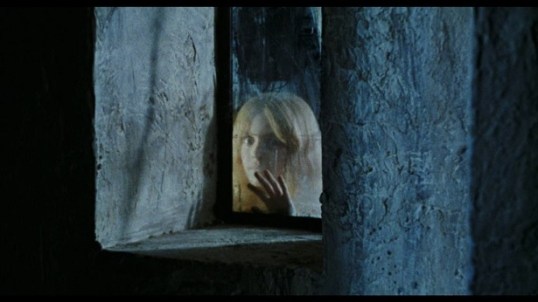
The Grapes of Death was one of the more commercially successful films to be directed by the great Jean Rollin.  Rollin is best-known for his surreal and dream-like vampire films.  In an interview, he stated that The Grapes of Death was his attempt to make a commercial horror film and that, when he was writing the script, he closely studied the structure of Night of the Living Dead.  While the film does have its similarities to Romero’s classic zombie film, The Grapes of Death is still definitely the work of Jean Rollin.  The lingering shots of the fog-shrouded French countryside and the ancient French villages, with blood staining the cobblestone streets, could have come from any of Rollin’s vampire films.  The film also uses the same serial structure that Rollin used in many of his film, with Elizabeth going from one adventure to another and almost always managing to narrowly escape danger.  Elizabeth goes from fleeing the infected man on the train to finding herself a near prisoner in an isolated house to protecting a blind girl (Mirella Rancelot) for her crazed boyfriend to being menaced by the mysterious Blonde Woman (played by frequent Rollin collaborator Brigitte Lahaie).  There’s a new cliffhanger every fifteen minutes or so.

(Rollin said that he originally envisioned contaminated tobacco as being the cause of the zombie outbreak but he ultimately went with wine instead.  Not everyone smokes but, in France, just about everyone drinks wine.)

First released as Les raisins de la mort, The Grapes of Death has been described as being “France’s first zombie film.”  I don’t know if it was the first but it’s certainly one of the best, a relentless chase through the French countryside that ends on a proper note of downbeat horror.  This film made me happy that I’m not a wine drinker.

(Be sure to read Arleigh’s thoughts here!)